General Chemistry: Atoms First, 2e (McMurry and Fay)
Chapter 1 The Structure and Stability of Atoms
1.1 Multiple Choice Questions
1) What is the chemical symbol for tin?
A) Sb
B) Sn
C) Ta
D) Ti
2) What is the chemical symbol for manganese?
A) Hg
B) Mg
C) Mn
D) Na
3) What is the chemical symbol for platinum?
A) P
B) Pa
C) Pt
D) Pu
4) Which element has the chemical symbol, P?
A) lead
B) phosphorus
C) platinum
D) potassium
5) Which element has the chemical symbol, Au?
A) aluminum
B) argon
C) gold
D) silver
6) Mendeleev arranged the elements according to
A) atomic number and atomic weight.
B) atomic weight and chemical reactivity.
C) electron configuration and atomic weight.
D) physical state and relative abundance.
7) Which is not true?
A) Mendeleev ended each row in his periodic table with an inert gas.
B) Mendeleev left gaps in his periodic table for undiscovered elements.
C) Mendeleev ordered the elements in his periodic table by atomic weight.
D) Mendeleev’s periodic table predated the concept of electron configuration.
8) The horizontal rows of the periodic table are called
A) groups.
B) periods.
C) triads.
D) elements.
9) The vertical columns of the periodic table are called
A) groups.
B) periods.
C) triads.
D) elements.
10) Lithium belongs to the ________ group of the periodic table.
A) alkali metal
B) alkaline earth metal
C) halogen
D) noble gas
11) Bromine belongs to the ________ group of the periodic table.
A) alkali metal
B) alkaline earth metal
C) halogen
D) noble gas
12) Argon belongs to the ________ group of the periodic table.
A) alkali metal
B) alkaline earth
C) halogen
D) noble gas
13) Calcium belongs to the ________ group of the periodic table.
A) alkali metal
B) alkaline earth
C) halogen
D) noble gas
14) Most elements in the periodic table are
A) metals.
B) non-metals.
C) noble gases.
D) semi-metals.
15) Elements in a periodic group have similar
A) chemical properties.
B) densities.
C) masses.
D) physical properties.
16) Which of the following elements has chemical properties similar to oxygen?
A) fluorine
B) hydrogen
C) nitrogen
D) sulfur
17) Which horizontal row of the periodic table contains the most elements?
A) row 4
B) row 5
C) row 6
D) They all contain the same number of elements.
18) Which of the following statements does not describe a physical property of chlorine?
A) Chlorine combines with sodium to form table salt.
B) The color of chlorine gas is green.
C) The density of chlorine gas at standard temperature and pressure is 3.17 g/L.
D) The freezing point of chlorine is -101°C.
19) Which of the following statements does not describe a chemical property of oxygen?
A) Iron will rust in the presence of oxygen.
B) Oxygen combines with carbon to form carbon dioxide gas.
C) The pressure is caused by collision of oxygen molecules with the sides of a container.
D) When coal is burned in oxygen, the process is called combustion.
20) Which of the following underlined items is not an intensive property?
A) A chemical reaction requires 3.00 g of oxygen.
B) Solid copper hydroxide is blue colored.
C) The density of helium at 25°C is 1.64 × 10⁻⁴ g/cm3.
D) The melting point of aluminum metal is 933 K.
21) Which of the following underlined items is not an extensive property?
A) the color of a cobalt compound
B) the diameter of a soap bubble
C) the mass of a diamond
D) the volume of a glucose solution
22) Which group 1A element is not a metal?
A) H
B) Li
C) Fr
D) none of these
23) Which group 5A element is most metallic?
A) N
B) P
C) Sb
D) Bi
24) Which of the following elements is a liquid at room temperature?
A) chlorine
B) helium
C) mercury
D) sodium
25) Which group of elements reacts violently with water?
A) halogens
B) noble gases
C) alkali metals
D) alkaline earth metals
26) Which of the following elements is not a solid at room temperature?
A) Ag
B) Al
C) Br
D) Fe
27) Which of the following elements is classified as a semimetal?
A) calcium
B) germanium
C) fluorine
D) uranium
28) Which of the following elements is a good conductor of heat and electricity?
A) carbon
B) chlorine
C) neon
D) zinc
29) Which one of the following elements is a poor conductor of heat and electricity?
A) copper
B) fluorine
C) iron
D) lead
30) Gaseous elements characterized by low reactivity are found in group ________ of the
periodic table.
A) 5A
B) 6A
C) 7A
D) 8A
31) All of the following elements are nonmetals except
A) antimony.
B) carbon.
C) hydrogen.
D) oxygen.
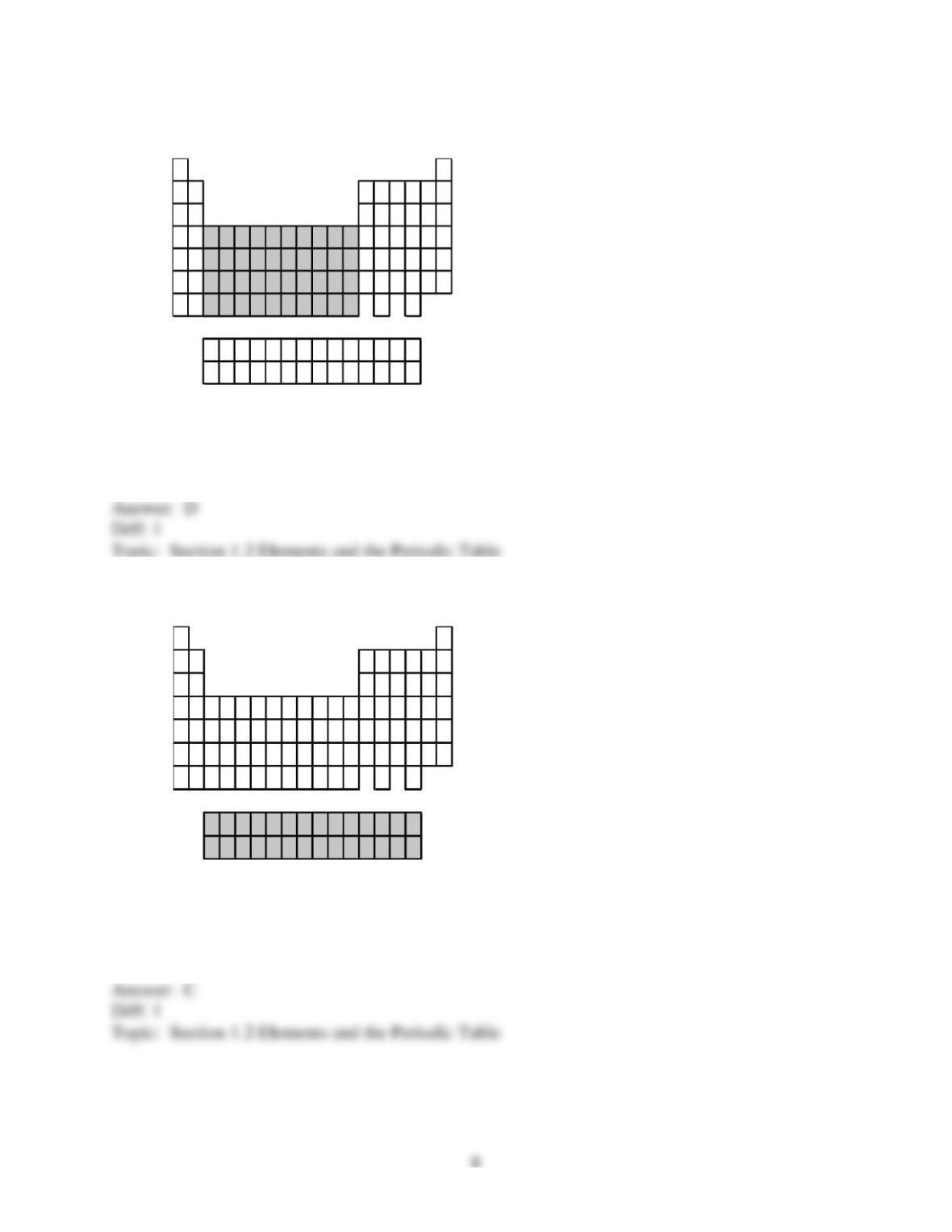
32) What group of elements does the shaded area in the following periodic table indicate?
A) alkali metals
B) alkaline earth metals
C) inner transition metals
D) transition metals
33) 1What group of elements does the shaded area in the following periodic table indicate?
A) alkali metals
B) alkaline earth metals
C) inner transition metals
D) transition metals
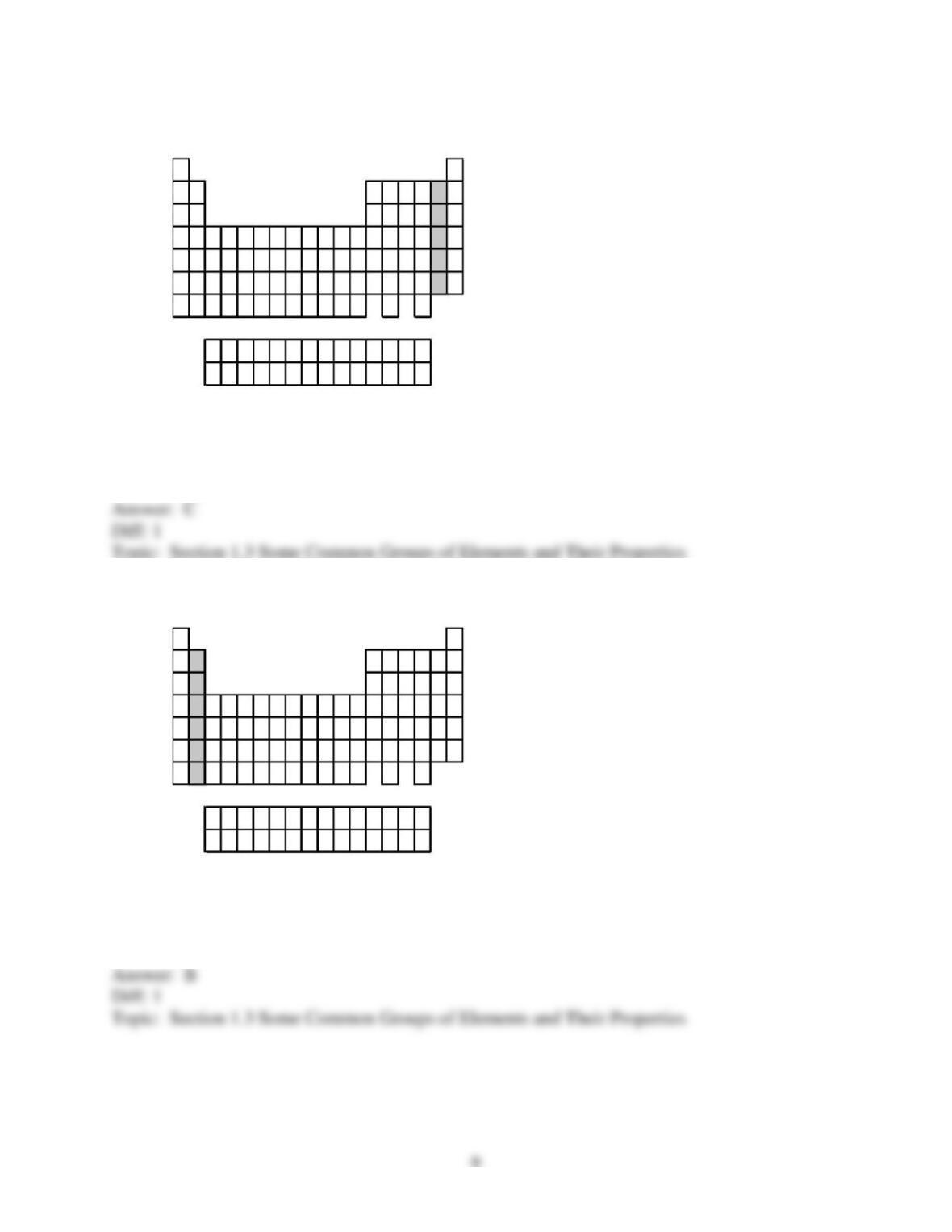
34) What group of elements does the shaded area in the following periodic table indicate?
A) alkali metals
B) alkaline earth metals
C) halogens
D) noble gases
35) What group of elements does the shaded area in the following periodic table indicate?
A) alkali metals
B) alkaline earth metals
C) halogens
D) noble gases
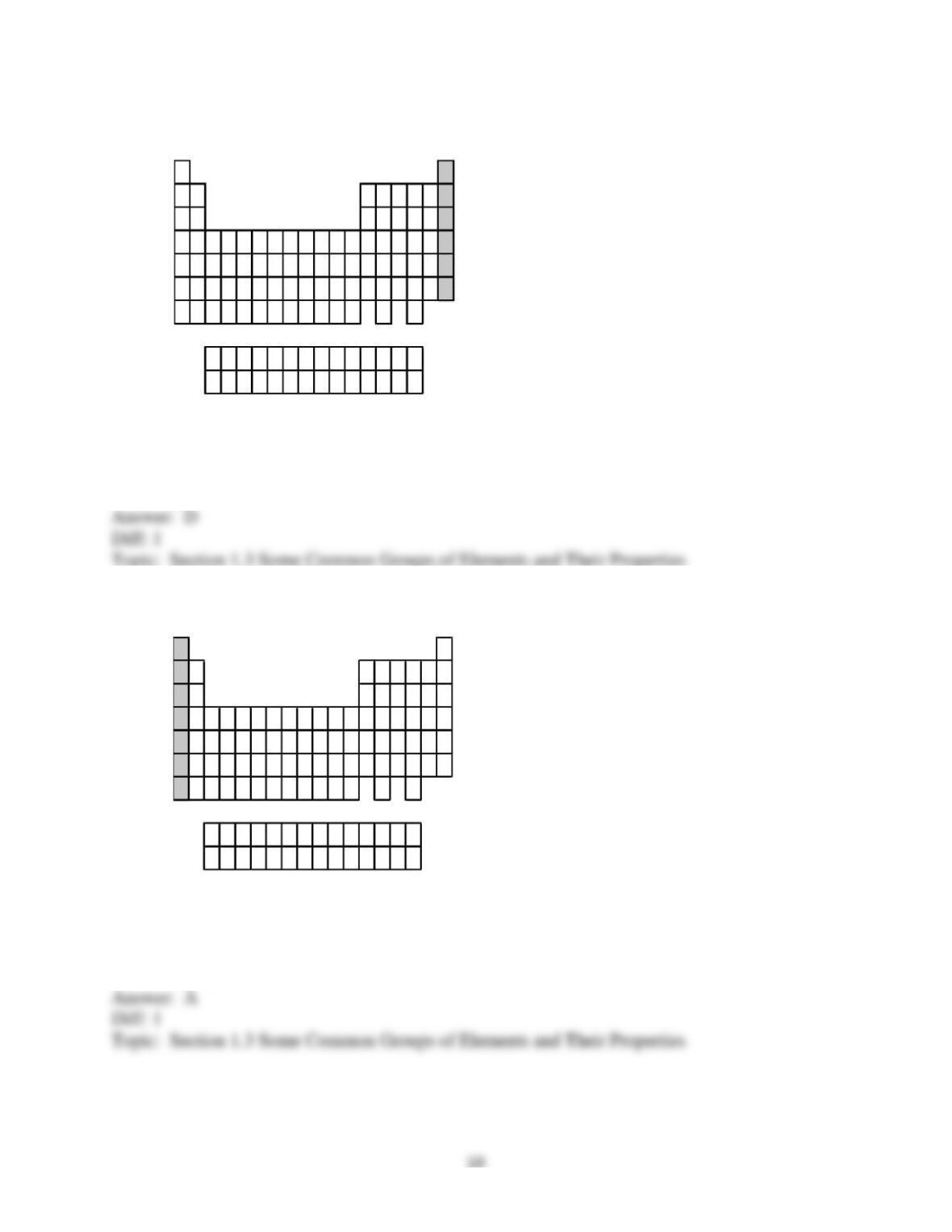
36) What group of elements does the shaded area in the following periodic table indicate?
A) alkali metals
B) alkaline earth metals
C) halogens
D) noble gases
37) What group of elements does the shaded area in the following periodic table indicate?
A) alkali metals
B) alkaline earth metals
C) halogens
D) noble gases
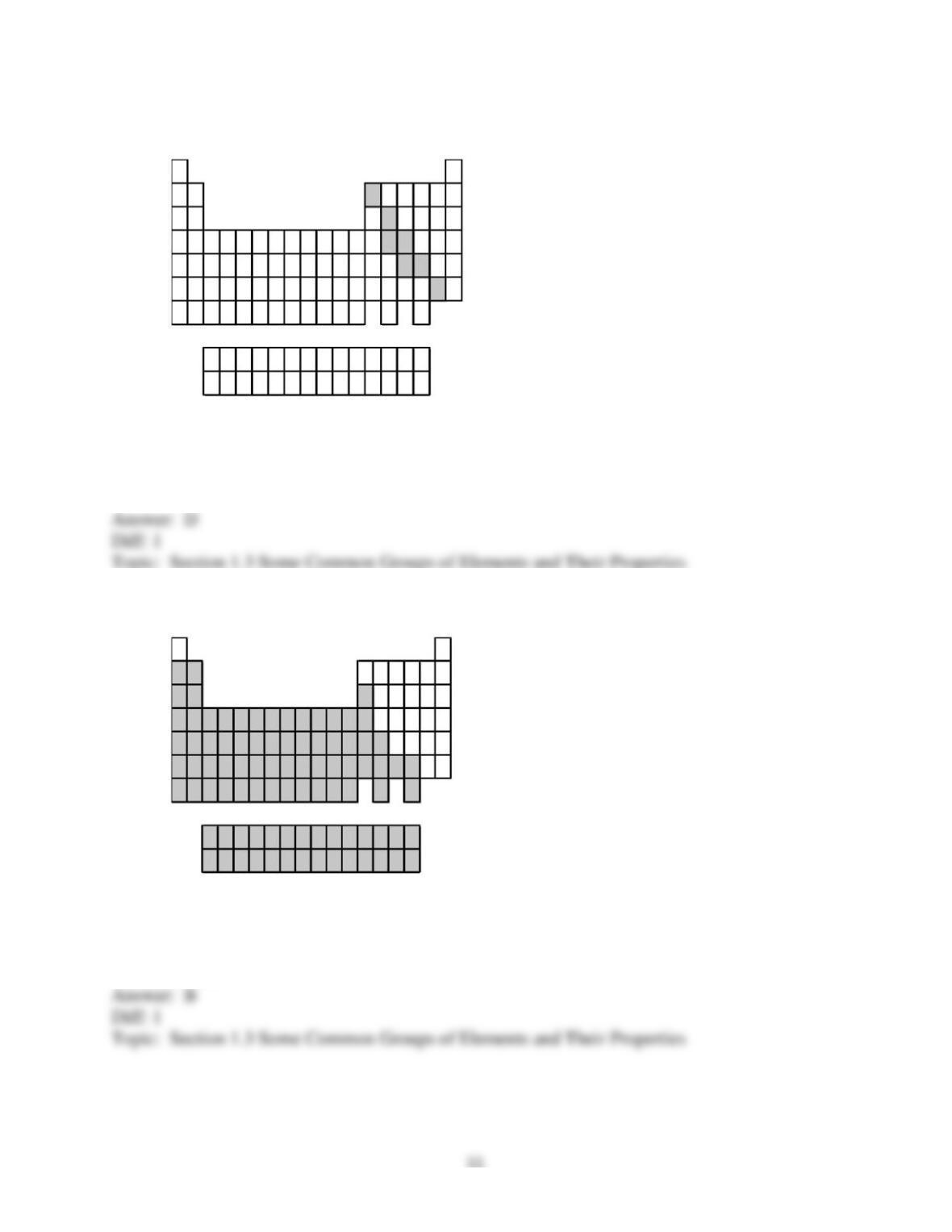
38) What group of elements does the shaded area in the following periodic table indicate?
A) gases
B) metals
C) nonmetals
D) semimetals
39) What group of elements does the shaded area in the following periodic table indicate?
A) gases
B) metals
C) nonmetals
D) semimetals
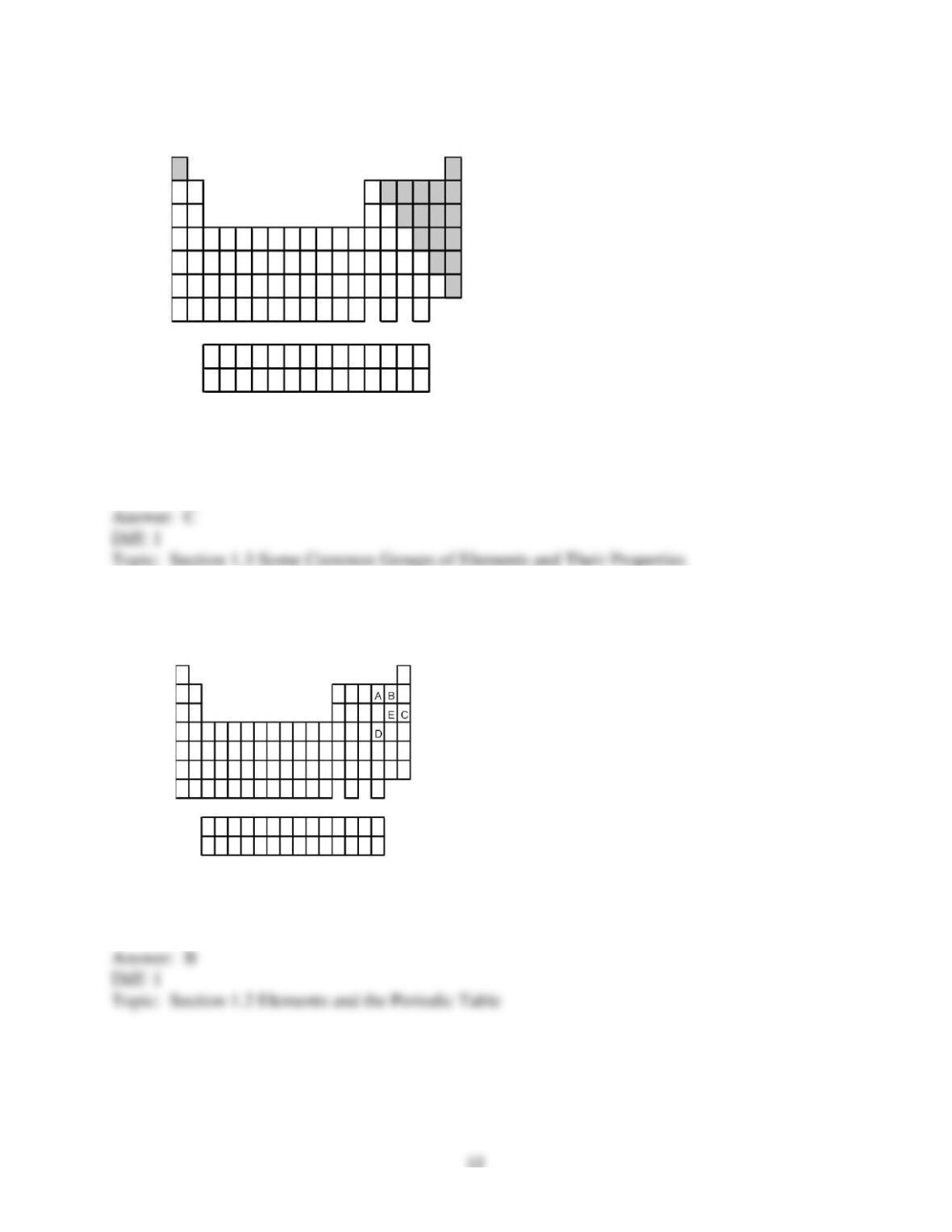
40) What group of elements does the shaded area in the following periodic table indicate?
A) gases
B) metals
C) nonmetals
D) semimetals
41) Which element is most chemically similar to the element indicated by the letter E in the
following periodic table?
A) A
B) B
C) C
D) D
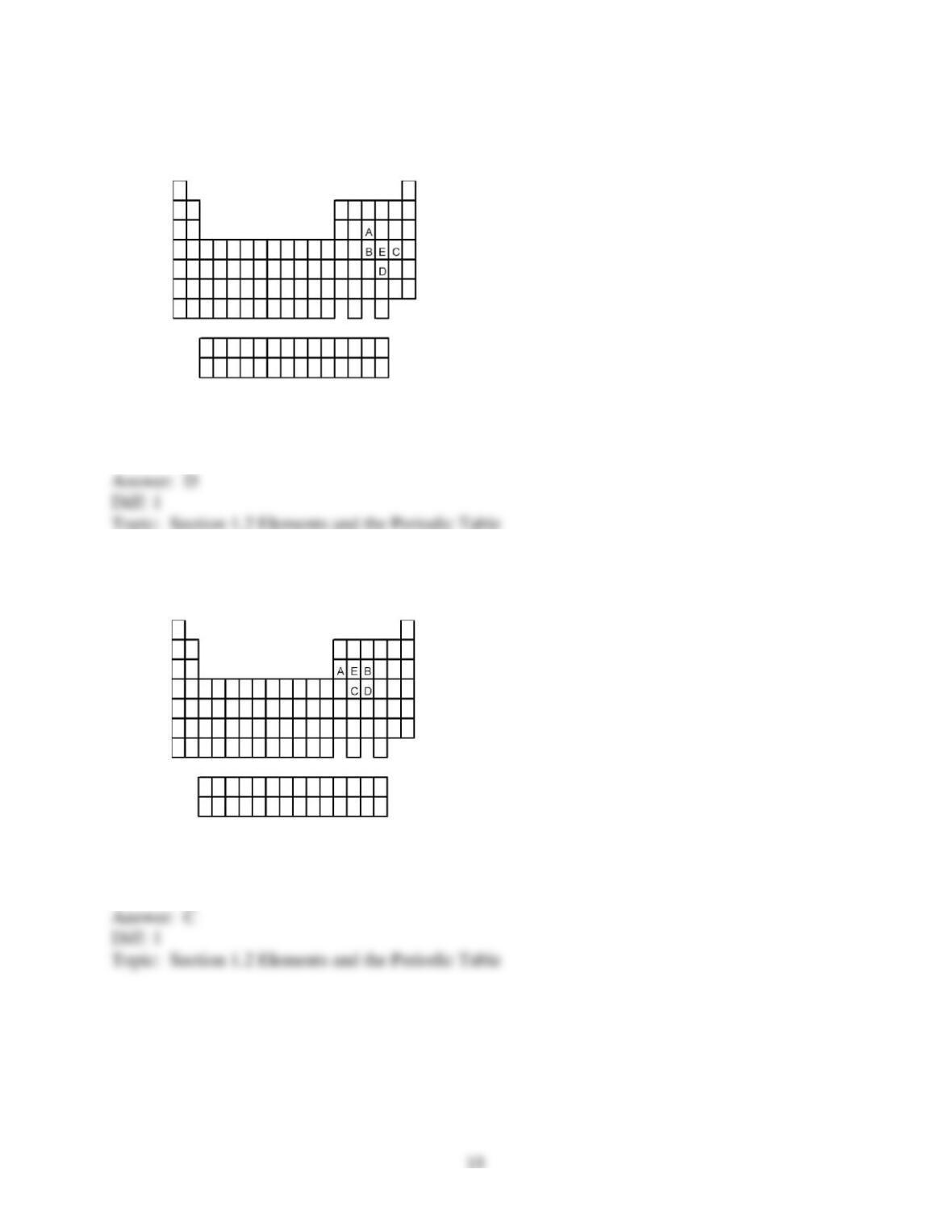
42) Which element is most chemically similar to the element indicated by the letter E in the
following periodic table?
A) A
B) B
C) C
D) D
43) Which element is most chemically similar to the element indicated by the letter E in the
following periodic table?
A) A
B) B
C) C
D) D
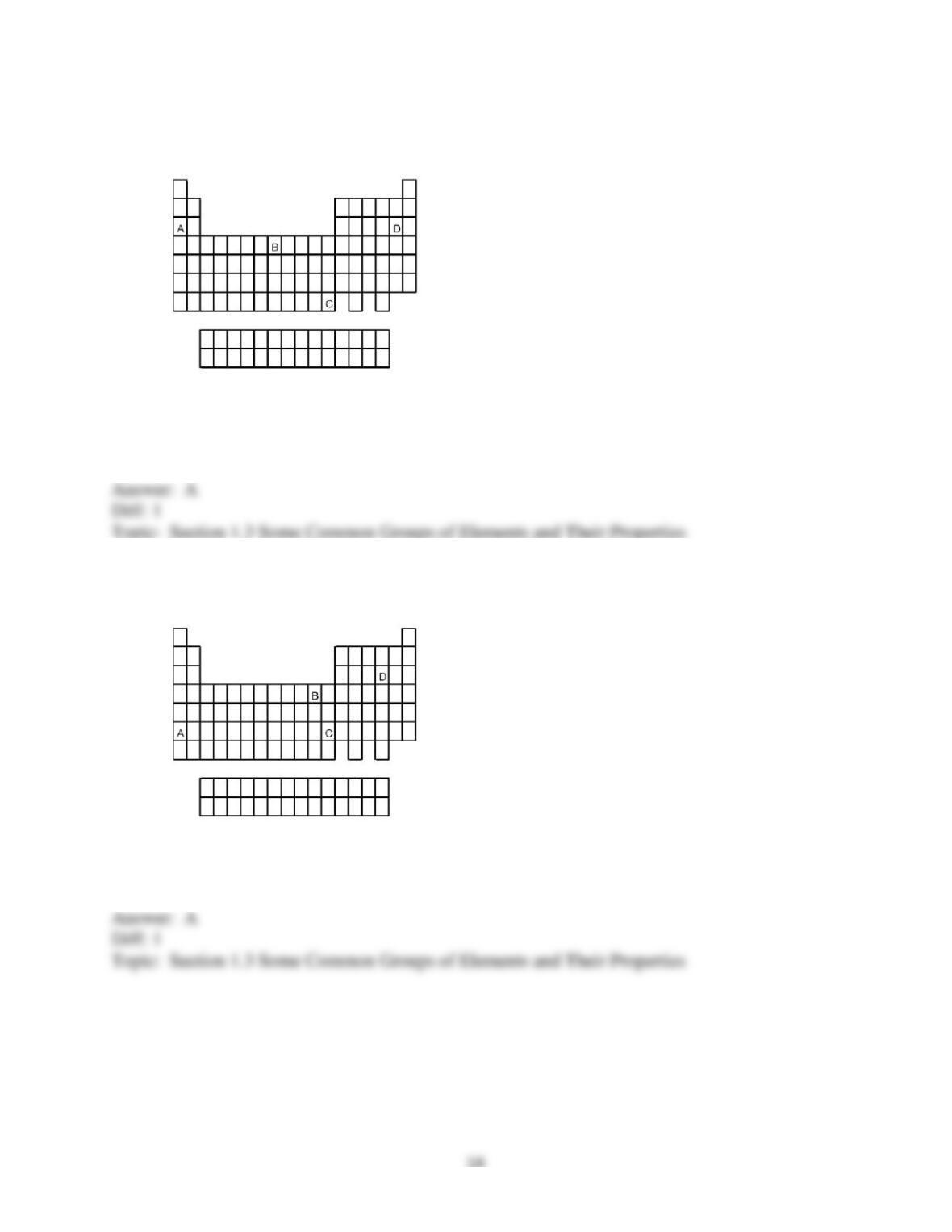
44) Which element indicated by letter in the following periodic table reacts rapidly with water to
form an alkaline solution?
A) A
B) B
C) C
D) D
45) Which element indicated by letter in the following periodic table reacts rapidly with water to
form an alkaline solution?
A) A
B) B
C) C
D) D
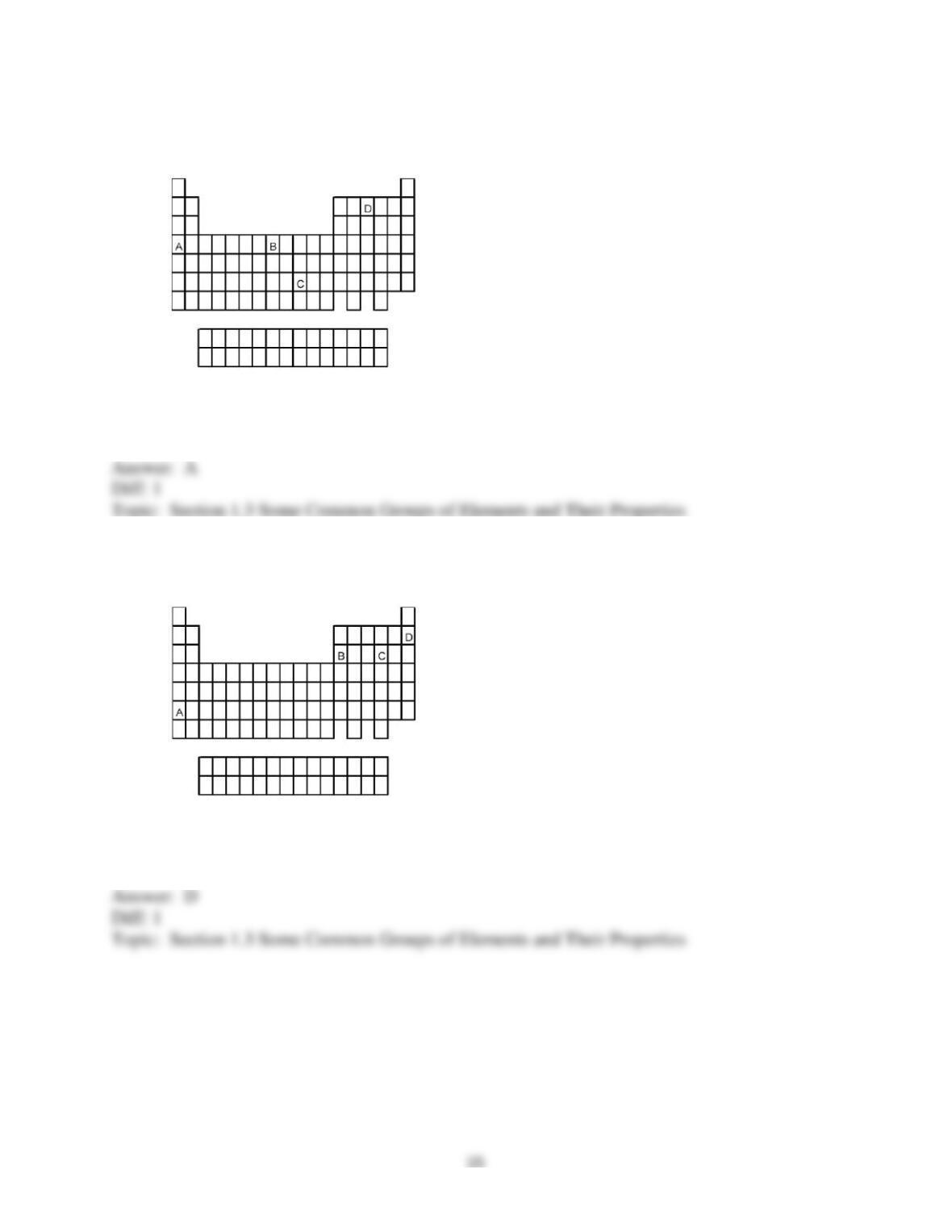
46) Which element indicated by letter in the following periodic table reacts rapidly with water to
form an alkaline solution?
A) A
B) B
C) C
D) D
47) Which element indicated by letter in the following periodic table is a gas at room
temperature?
A) A
B) B
C) C
D) D
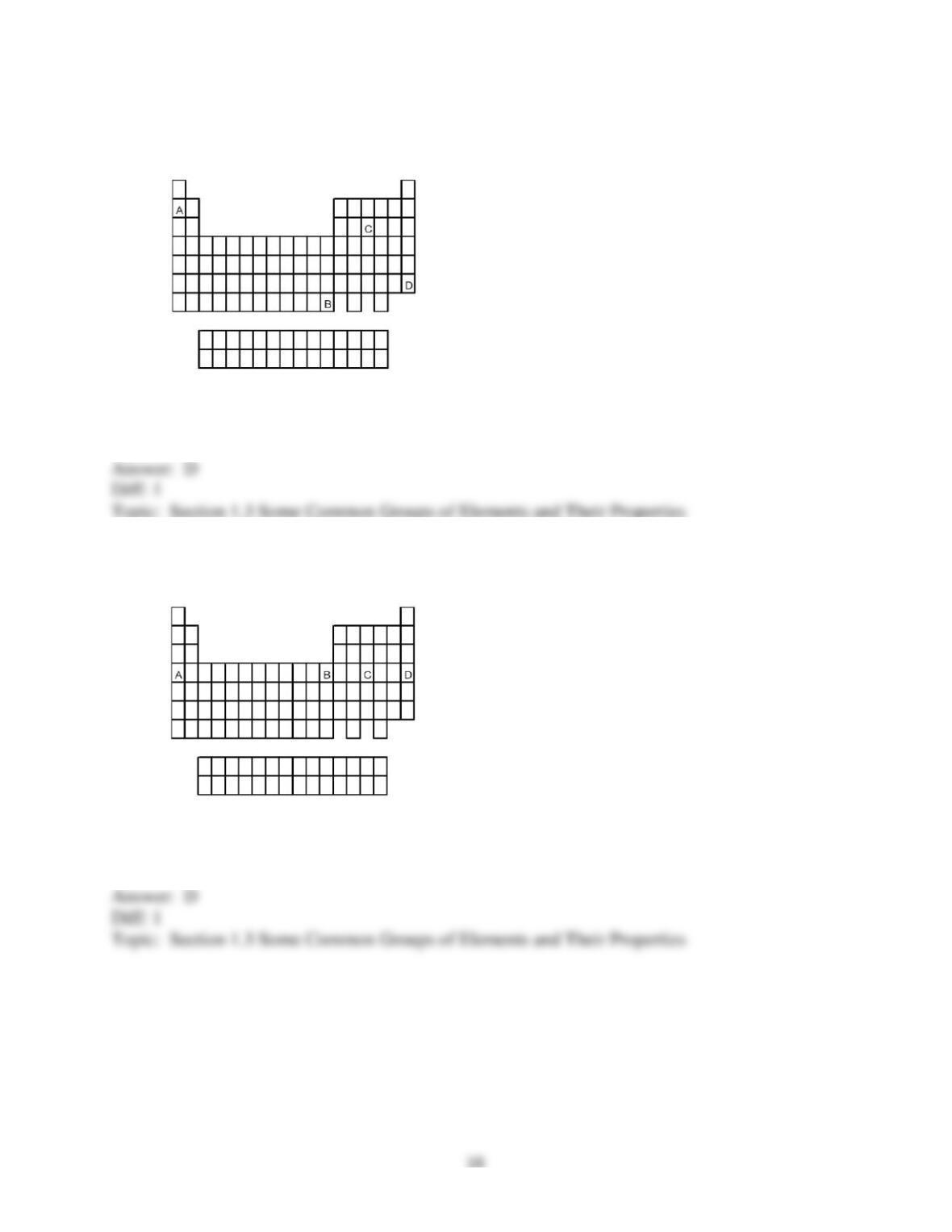
48) Which element indicated by letter in the following periodic table is a gas at room
temperature?
A) A
B) B
C) C
D) D
49) Which element indicated by letter in the following periodic table is a gas at room
temperature?
A) A
B) B
C) C
D) D
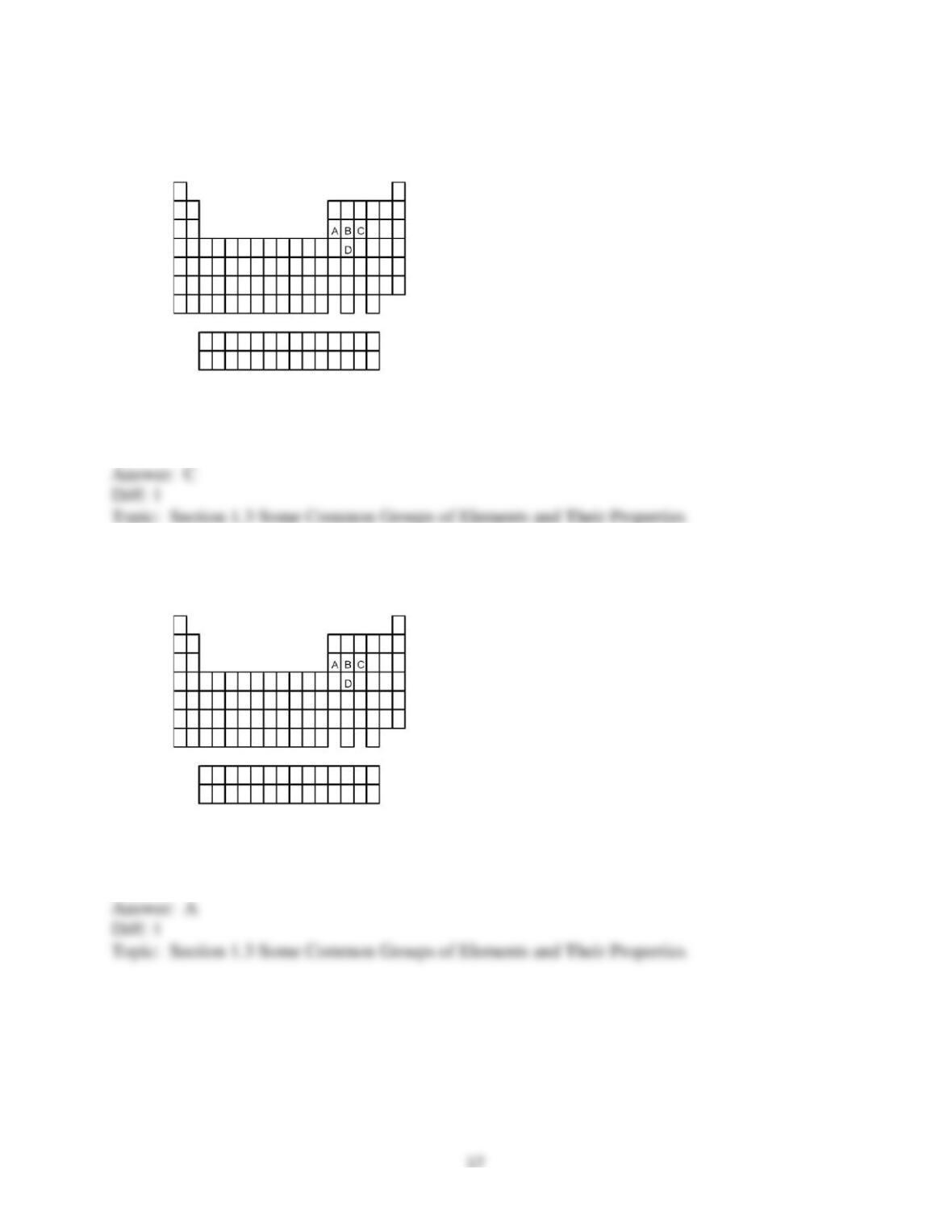
50) Which element indicated by letter in the following periodic table is the poorest conductor of
electricity and heat?
A) A
B) B
C) C
D) D
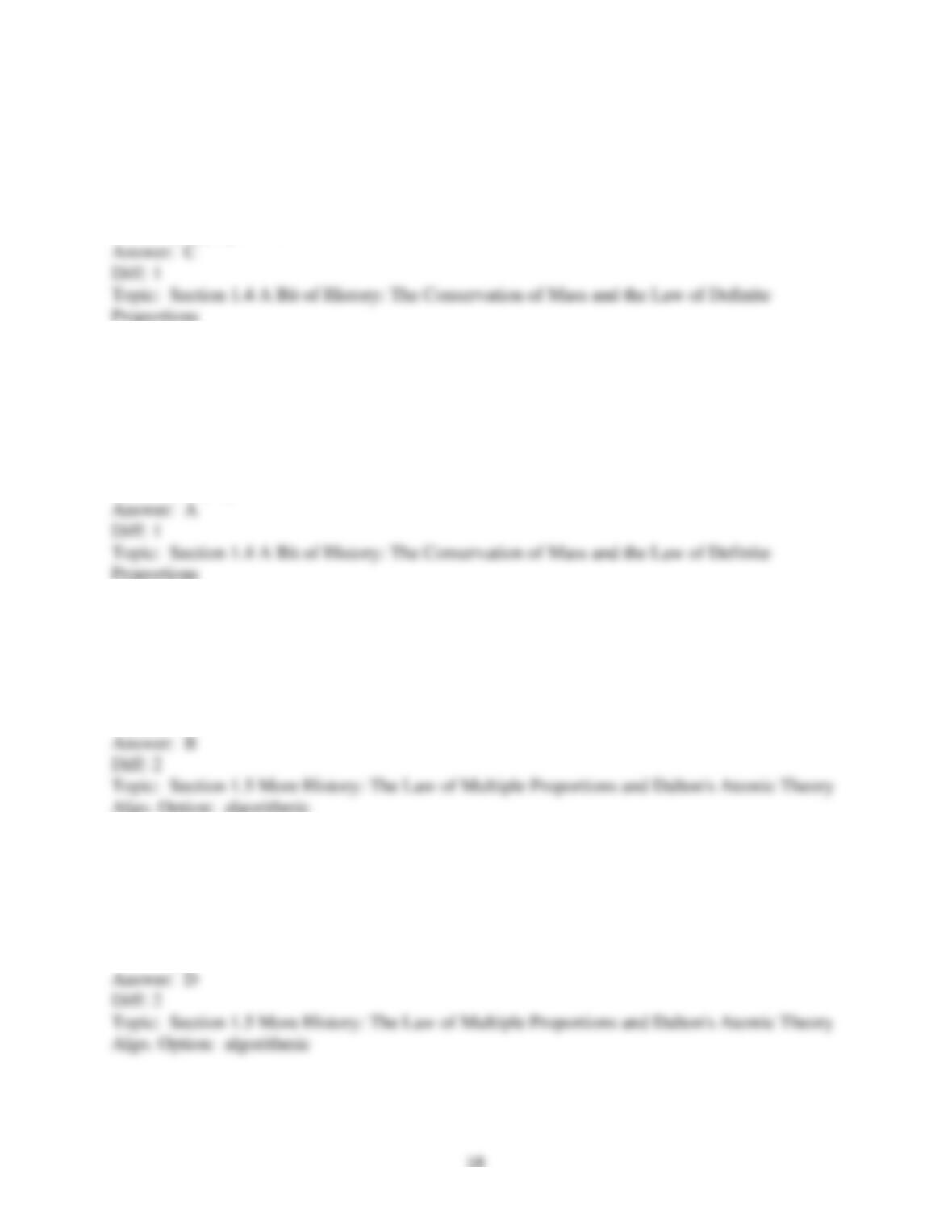
51) Which element indicated by letter in the following periodic table is the best conductor of
electricity and heat?
A) A
B) B
C) C
D) D
52) The observation that 15.0 g of hydrogen reacts with 120.0 g of oxygen to form 135.0 g of
water is evidence for the law of
A) definite proportions.
B) energy conservation.
C) mass conservation.
D) multiple proportions.
53) The observation that 4.0 g of hydrogen reacts with 32.0 g of oxygen to form a product with
O:H mass ratio = 8:1, and 6.0 g of hydrogen reacts with 48.0 g of oxygen to form the same
product with O/H mass ratio = 8:1 is evidence for the law of
A) definite proportions.
B) energy conservation.
C) mass conservation.
D) multiple proportions.
54) A sample of pure lithium carbonate contains 18.8% lithium by mass. What is the % lithium
by mass in a sample of pure lithium carbonate that has twice the mass of the first sample?
A) 9.40%
B) 18.8%
C) 37.6%
D) 75.2%
55) A sample of pure calcium fluoride with a mass of 15.0 g contains 7.70 g of calcium. How
much calcium is contained in 45.0 g of calcium fluoride?
A) 2.56 g
B) 7.70 g
C) 15.0 g
D) 23.1 g
56) The observation that hydrogen and oxygen can react to form two compounds with different
chemical and physical properties, one having an O:H mass ratio = 8:1 and the other having an
O:H mass ratio = 16:1 is consistent with the law of
A) definite proportions.
B) energy conservation.
C) mass conservation.
D) multiple proportions.
57) Which of the following statements is not a postulate of Dalton’s atomic theory?
A) Each element is characterized by the mass of its atoms.
B) Atoms are composed of protons, neutrons, and electrons.
C) Chemical reactions only rearrange atomic combinations.
D) Elements are composed of atoms.
58) Which of the following is a part of Dalton’s atomic theory?
A) Atoms are rearranged but not changed during a chemical reaction.
B) Atoms break down during radioactive decay.
C) Atoms contain protons, neutrons, and electrons.
D) Isotopes of the same element have different masses.
59) Which of the following is not explained by Dalton’s atomic theory?
A) conservation of mass during a chemical reaction
B) the existence of more than one isotope of an element
C) the law of definite proportions
D) the law of multiple proportions
60) Elements A and Q form two compounds, AQ and A2Q3. The mass ratio (mass Q)/(mass A)
for AQ is 0.574. What is the mass ratio (mass Q)/(mass A) for A2Q3?
A) 0.383
B) 0.861
C) 1.16
D) 2.61
61) Elements A and Q form two compounds, AQ and A2Q. Which of the following must be
true?
A) (mass Q)/(mass A) is one for AQ, and 1/2 for A2Q.
B) (mass Q)/(mass A) for AQ must equal (mass Q)/(mass A) for A2Q.
C) (mass Q)/(mass A) for AQ must be 2 times (mass Q)/(mass A) for A2Q.
D) (mass Q)/(mass A) for AQ must be 1/2 (mass Q)/(mass A) for A2Q.
62) Elements A and Q form two compounds. The ratio (mass Q)/(mass A) for compound one is
0.271 and ratio (mass Q)/(mass A) for compound two is 0.362. If compound one has the
chemical formula AQ, what is the chemical formula for compound two?
A) A3Q4
B) A2Q3
C) AQ2
D) AQ3
63) The existence of electrons in atoms of all elements was demonstrated by
A) Millikan’s oil drop experiment.
B) Rutherford’s gold foil experiment.
C) Thomson’s cathode ray tube experiment.
D) None of the above.