
Introduction to Financial Accounting, 10e (Horngren)
Chapter 1 Accounting: The Language of Business
Learning Objective 1.1 Questions
1.1-1) The primary purpose of financial accounting is to
A) supply information for external users’ decision making.
B) provide data for internal users’ decision making.
C) create data for income taxes.
D) report the audit.
E) organize the data for management.
1.1-2) Footnotes are
A) included in the audit report.
B) an integral part of financial statement information.
C) an appendix to the letter from corporate management.
D) at the bottom of the report of the independent auditors.
E) explanatory information in the statement of management‘s responsibility for preparation of financial
statements.
1.1-3) The new accountant at Shiley Industries is asked to prepare the financial statements for the month
of February. Which financial statement will he NOT prepare?
A) Balance sheet
B) Income statement
C) Statement of earnings and taxation
D) Statement of cash flows
E) Statement of stockholders’ equity
1.1-4) Which of the following would be classified as external users of financial statements?
A) Creditors of the organization and the Internal Revenue Service
B) Stockholders and the CFO of the organization
C) Management of the organization and the audit firm
D) Management of the organization and SEC
E) Stockholders and middle managers of the organization

1.1-5) Which of the following individuals are most interested in management accounting information for
TMV Corporation?
A) Bankers who loan money to TMV Corporation
B) The IRS, who TMV Corporation pays taxes to
C) Stockholders who buy stock in TMV Corporation
D) Management who work for TMV Corporation
E) Suppliers who sell goods to TMV Corporation
1.1-6) Accounting does not provide information that is useful in making decisions that have economic
consequences.
1.1-7) Because officials in federal, state, and local governments are not in the business of making a profit,
they do not need an understanding of accounting.
1.1-8) Financial accounting serves external decision makers, such as stockholders, suppliers, banks, and
government agencies.
1.1-9) Management accounting serves internal decision makers, such as top executives and department
heads.
1.1-10) Managerial accounting serves external users while financial accounting serves internal users.
1.1-11) The annual report is a document prepared by the board of directors and distributed to current and
potential investors.
1.1-12) Describe the differences between financial accounting and management accounting.
Learning Objective 1.2 Questions
1.2-1) A liability that results from a purchase of goods or services on open account is referred to as a(n)
A) accounts receivable.
B) notes payable.
C) accounts payable.
D) notes receivable.
E) capital stock.
1.2-2) Which of the following statements is true?
A) Owners’ equities are economic sacrifices after deducting liabilities.
B) Assets are expected to benefit no one.
C) Liabilities are future cash inflows.
D) Assets are always the sum of liabilities and owners’ equities.
E) Owners’ equities have priority over liabilities for assets.
1.2-3) The accounting equation can be stated as which of the following?
A) Assets – liabilities = owners’ equity
B) Assets + liabilities = owners’ equity
C) Liabilities + assets = owners’ equity
D) Owners’ equity + assets = liabilities
E) Liabilities – owners’ equity = assets

1.2-4) Which of the following describes a liability?
A) Future economic benefit
B) Economic obligations to creditors
C) Paid–in capital
D) Investment by owners
E) Present value of customer future payments
1.2-5) Notes Payable are classified as
A) equity.
B) assets.
C) owner investments.
D) liabilities.
E) expenses.
1.2-6) Income taxes owed to the federal government would be classified as a(n)
A) liability on the balance sheet.
B) asset on the balance sheet.
C) liability on the statement of cash flows.
D) equity on the balance sheet.
E) They would not appear on a financial statement.
1.2-7) An example of stockholders’ equity is
A) accounts payable.
B) accounts receivable.
C) capital stock.
D) marketable securities.
E) cash and cash equivalents.
1.2-8) Which of the following equations represents the balance sheet equation?
A) Net income = revenues – expenses
B) Assets = liabilities + revenues – expenses
C) Assets + owners‘ equity = liabilities
D) Assets + liabilities = owners’ equity
E) Assets = liabilities + owners’ equity
1.2-9) Statement of financial position is another name for the balance sheet.
1.2-10) Assets and owners’ equity are presented on the right side of the balance sheet.
1.2-11) The balance sheet equation is assets = liabilities – owner’s equity.
1.2-12) Liabilities are economic obligations of the organization to outsiders, or claims against its assets by
outsiders.
1.2-13) Accountants use the terms notes payable or notes receivable to describe the existence of
promissory notes.
1.2-14) Examples of assets include cash, inventory, and capital stock issued to investors.
1.2-15) Inventory is goods held by a company for the purpose of sale to customers, and is considered a
liability on the balance sheet.
1.2-16) A balance sheet is dated for a period of time, such as “for the year ended December 31, 20X2.”
1.2-17) Owners’ equity is the residual interest in the organization’s assets after deducting liabilities.
1.2-18) Long–term debt $ 190
Cash (1)
Total stockholders‘ equity (2)
Total liabilities (3)
Accounts receivable 450
Common stock 75
Inventory 375
Accounts payable 575
Property, plant, and equipment 525
Additional stockholders’ equity 650
Other assets 200
Other liabilities (4)
Total assets 2,000
Using the balance sheet equation as a starting point, determine the missing amounts: (1), (2), (3), and (4)
above.
1.2-19) What is the purpose of a balance sheet?
Learning Objective 1.3 Questions
1.3-1) An entity
A) is a separate economic unit.
B) allows a section of an organization to be a separate economic unit.
C) helps accountants relate events to a defined area of accounting.
D) All of the above
E) None of the above

1.3-2) If liabilities increase by $8,000 during a given period and stockholders’ equity decreases by $4,000
during the same period, assets must have
A) increased by $12,000.
B) increased by $4,000.
C) decreased by $4,000.
D) decreased by $12,000.
E) This cannot be determined with the given information.
1.3-3) A transaction
A) can be made by any stockholder.
B) maintains the equality of the balance sheet equation.
C) affects the cash position of an entity.
D) will always change values on the income statement.
1.3-4) Wyatt Products owned land originally costing $19,000. A real estate agent appraised the land and
stated that it is now worth $22,000. Wyatt Products should
A) increase the land account by $3,000 and increase the capital stock account by $3,000.
B) increase the land account by $3,000 and increase the cash account by $3,000.
C) increase the land account by $3,000 and increase the paid–in capital in excess of par account by $3,000.
D) There is no effect from this transaction on the accounts of Wyatt Products.
E) increase the land account and the unearned revenue account.
1.3-5) Which of the following statements is false?
A) If you increase an asset account, you may increase a liability account.
B) If you increase an asset account, you may decrease an asset account.
C) If you decrease an asset account, you may increase an owners’ equity account.
D) If you decrease an asset account, you may decrease owners’ equity account.
1.3-6) Scullin, Inc., acquired land costing $25,000. Beta, Inc., paid $10,000 in cash and issued a short–term
note for the balance. The effect of this transaction on Scullin, Inc., would be to
A) increase the land account by $25,000, decrease the cash account by $10,000, and decrease the balance in
the notes payable account by $15,000.
B) increase the land account by $25,000, decrease the cash account by $10,000, and decrease the balance in
the notes receivable account by $15,000.
C) increase the land account by $25,000, decrease the cash account by $10,000, and increase the balance in
the notes receivable account by $15,000.
D) increase the land account by $10,000 and decrease the cash account by $10,000.
E) increase the land account by $25,000, decrease the cash account by $10,000, and increase the balance in
the notes payable account by $15,000.
1.3-7) Assets amount to $20,000 at the beginning of the period and $25,000 at the end of the period.
Liabilities amount to $12,000 at the beginning of the period and $10,000 at the end of the period. What is
the amount of the change and the direction of the change in owners‘ equity for the period?
A) Increase of $2,000
B) Decrease of $2,000
C) Increase of $5,000
D) Decrease of $7,000
E) Increase of $7,000
1.3-8) Yanke Manufacturing sold unused land at cost, which was $11,000. The buyer paid $8,000 in cash,
with the balance to be paid on a note due in 6 months. The effect on Yanke Manufacturing is to
A) decrease the land account by $11,000, increase the cash account by $8,000, and increase the balance in
the notes payable account by $3,000.
B) decrease the land account by $11,000, increase the cash account by $8,000, and increase the balance in
the notes receivable account by $3,000.
C) decrease the land account by $11,000, increase the cash account by $8,000, and decrease the balance in
the notes receivable by $3,000.
D) decrease the land account by $8,000 and increase the cash account by $8,000.
E) decrease the land account by $11,000, increase the cash account by $8,000, and decrease the balance in
the notes payable account by $3,000.

1.3-9) Harrington, Inc., acquired equipment for $19,000. Harrington, Inc., paid $6,000 in cash, with the
balance due on a note. The effect of this transaction on Harrington, Inc., would be to
A) increase the equipment account by $19,000, decrease the cash account by $6,000 and increase the notes
payable account by $13,000.
B) increase the equipment account by $19,000, decrease the cash account by $6,000, and decrease the notes
receivable by $13,000.
C) increase the equipment account by $6,000, and decrease the cash account by $6,000.
D) increase the equipment account by $6,000, decrease the cash account by $6,000, and increase the notes
payable account by $13,000.
E) increase the equipment account by $19,000, and increase the notes payable account by $6,000.
1.3-10) Chiller Catering purchased a $14,000 van for use in the business. The company made a $5,000 cash
down payment, and signed a note for the balance. The effect of this transaction on Chiller Catering would
be to
A) increase the van account by $14,000, decrease the cash account by $5,000, and decrease the notes
receivable account by $9,000.
B) increase the van account by $14,000, decrease the cash account by $5,000, and decrease the notes
payable account by $9,000.
C) increase the van account by $5,000 and decrease the cash account by $5,000.
D) increase the van account by $14,000, decrease the cash account by $5,000, and increase the notes
payable account by $9,000.
E) decrease the van account by $5,000 and increase the cash account by $5,000.
1.3-11) Tanner, Inc., acquired some office equipment, including a desk costing $900. The owner of the
business next door said that he had been searching for a desk just like that one, so Tanner, Inc., sold the
desk to its business neighbor at cost, receiving $400 in cash, with the remainder to be paid in 30 days. The
effect of this transaction on Tanner, Inc., would be to
A) increase the cash account by $400, increase the capital account by $500, and decrease the equipment
account by $900.
B) increase the cash account by $400, increase the accounts payable account by $500, and decrease the
equipment account by $900.
C) increase the cash account by $400, decrease the accounts payable account by $500, and decrease the
equipment account by $900.
D) increase the cash account by $400, increase the accounts receivable account by $500, and decrease the
equipment account by $900.
E) increase the cash account by $400, decrease the accounts receivable account by $500, and decrease the
equipment account by $900.

1.3-12) Patrik’s Party Supplies acquired 60 tables from a manufacturer at a cost of $100 per table and
purchased the tables on account. The effect of this transaction on Patrik’s Party Supplies would be to
A) increase inventory by $6,000 and increase capital by $6,000.
B) increase inventory by $6,000 and decrease capital by $6,000.
C) increase inventory by $6,000 and decrease cash by $6,000.
D) increase inventory by $6,000 and increase accounts payable by $6,000.
E) increase inventory by $6,000 and decrease accounts payable by $6,000.
1.3-13) Kindra Novelties acquired equipment costing $3,000 on account. The effect of this transaction on
Kindra Novelties would be to
A) increase equipment by $3,000 and decrease capital by $3,000.
B) increase equipment by $3,000 and increase capital by $3,000.
C) increase equipment by $3,000 and increase accounts payable by $3,000.
D) increase equipment by $3,000 and decrease accounts payable by $3,000.
E) No transaction is recorded since no cash has been paid.
1.3-14) Green Technologies is a sole proprietorship owned by Rebecca Day. Rebecca acquired $4,000
worth of equipment for use in her store. She will pay for the equipment in 30 days. The effect of this
transaction on Green Technologies would be to
A) increase the equipment account by $4,000 and increase the accounts payable account by $4,000.
B) increase the equipment account by $4,000 and decrease the accounts payable account by $4,000.
C) increase the equipment account by $4,000 and increase the capital account by $4,000.
D) This would not change any account because the equipment has not been paid for.
E) This would not change any account because this transaction does not affect Professional Printing.
1.3-15) Jared Office Supplies has 2,500 folders in inventory that cost $1.00 each. The company’s supplier
announced that, effective immediately, all future folders will cost $1.10 each. Jared Office Supplies should
A) increase the inventory account by $250 and increase the capital account by $250.
B) increase the inventory account by $250 and decrease the capital account by $250.
C) increase the inventory account by $250 and increase the accounts payable account by $250.
D) increase the inventory account by $250 and decrease the accounts payable account by $250.
E) There is no effect from the price change on the accounts of Jared Office Supplies.

1.3-16) Suds for Pooches acquired office equipment valued at $4,000 and office supplies valued at $600 by
paying cash of $1,300 with the balance on account. The effect of this transaction on Suds for Pooches
would be to
A) increase the cash account by $1,300, increase the accounts payable account by $3,300, and increase the
office equipment account by $4,600.
B) increase the office equipment account by $4,600, decrease the cash account by $1,300, and decrease the
accounts payable account by $3,300.
C) decrease the cash account by $1,300, increase the accounts payable account by $3,300, increase the
office equipment account by $4,000, and increase the office supplies by $600.
D) increase the cash account by $1,300, increase the capital account by $3,300, decrease the equipment
account by $4,000, and increase the office supplies account by $600.
E) increase the office supplies account by $600, decrease the office equipment account by $4,000, increase
the accounts payable account by $4,000, and decrease the cash account by $600.
1.3-17) White Pet Store acquired $3,500 worth of merchandise inventory on account. Upon inspection, the
company discovered that $600 worth of the merchandise inventory was defective. White Pet Store
returned the defective merchandise inventory and received full credit. The effect of this transaction on
White Pet Store would be to
A) decrease the merchandise inventory account by $600 and increase the accounts payable account by
$600.
B) decrease the merchandise inventory account by $600 and decrease the accounts payable account by
$600.
C) decrease the merchandise inventory account by $600 and increase the accounts receivable account by
$600.
D) decrease the merchandise inventory account by $600 and decrease the accounts receivable account by
$600.
E) Because the merchandise inventory was never used, BPE would not record the return of the
merchandise inventory.
1.3-18) Stockholders’ equity at the beginning and end of the period amounts to $16,000 and $19,000,
respectively. Assets at the beginning and end of the period amount to $26,000 and $21,000, respectively.
Liabilities at the beginning of the period were $11,000. Liabilities at the end of the period amount to
A) $8,000.
B) $6,000.
C) $2,000.
D) $5,000.
E) $3,000.
1.3-19) What effect does the purchase of store equipment for cash have on the balance sheet equation?
A) Assets increase and liabilities decreases
B) Assets increase and liabilities increases
C) Assets decrease and liabilities decrease
D) Assets decrease and liabilities increase
E) There is no effect on the accounting equation.
1.3-20) What accounts are affected by an initial investment of cash by an owner into his business?
A) Cash and Owner payable
B) Cash and Paid in capital in excess of par
C) Owner payable and Owners’ equity
D) Cash and Owners’ equity
E) Cash and Paid in capital in excess of par
1.3-21) An owner’s investment into a business will increase assets and decrease liabilities.
1.3-22) An account is a summary record of the changes in a particular asset, liability, or owners’ equity.
1.3-23) A transaction affects the financial position of an entity and can be reliably recorded in terms of
money.
1.3-24) A transaction does not require counterbalancing entries so that the total assets are equal to the
total liabilities plus owner’s equity.
1.3-25) A loan from a financial institution will increase assets and increase liabilities.
1.3-26) The purchase of inventory on credit will increase liabilities and equity.
1.3-27) Buying or selling on credit creates an accounts payable or receivable.
1.3-28) A creditor is one to whom money is owed.
1.3-29) A payment to a creditor will decrease assets and increase liabilities.
1.3-30) If assets increase $50,000 during a period and liabilities decrease $20,000, then owners’ equity must
have decreased $30,000.
1
2
3
4
5
6
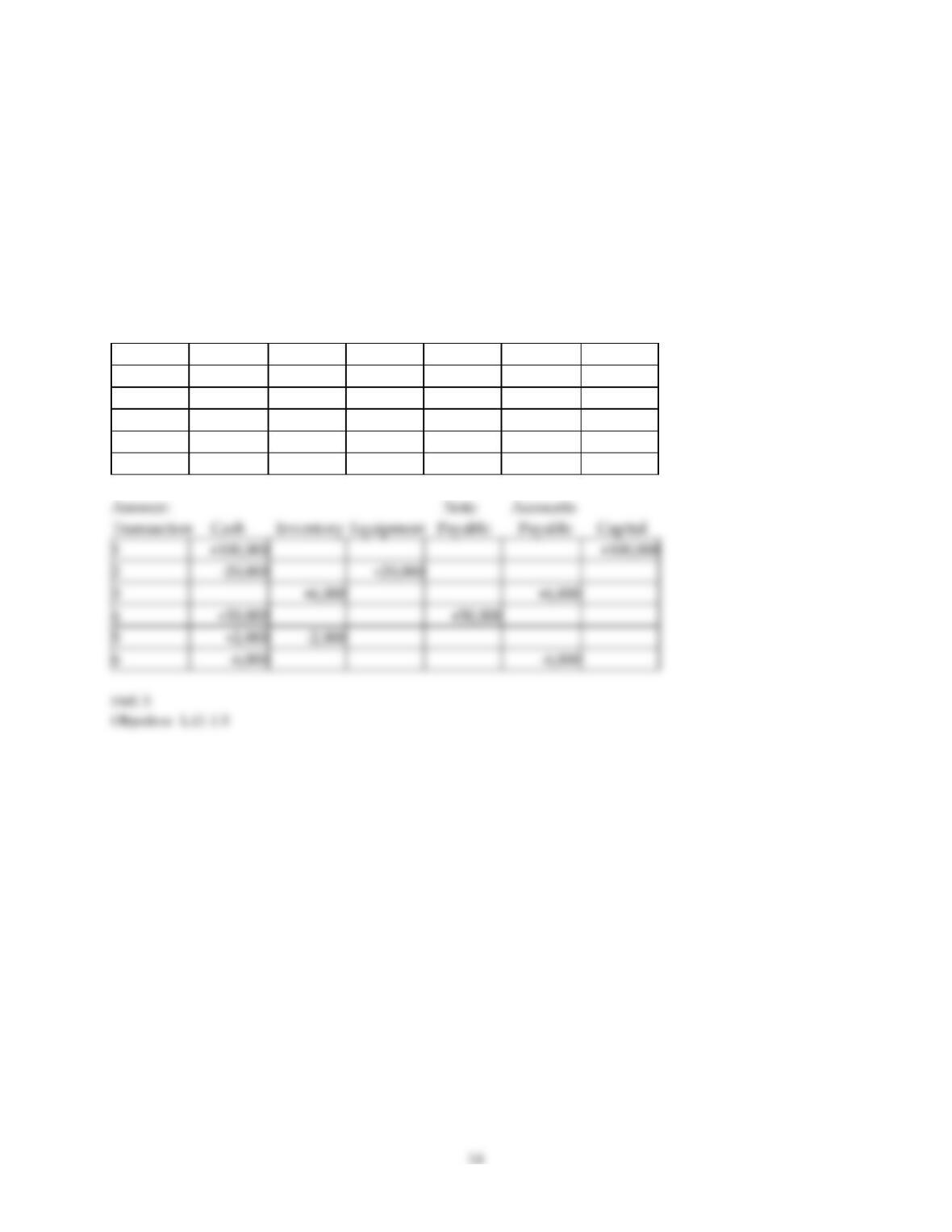
1.3-31) Analyze the following transactions in the balance sheet equation using the following worksheet.
1. Initial investment of $100,000 by the owner
2. Acquire equipment for $20,000 cash
3. Acquire inventory for $6,000 on credit
4. Obtain of loan of $50,000 from the bank
5. Sale of inventory to customer for $2,000 cash
6. Payment to creditors for full amount of inventory purchase
Note Accounts
Transaction Cash Inventory Equipment Payable Payable Capital
1
2
3
4
5
6
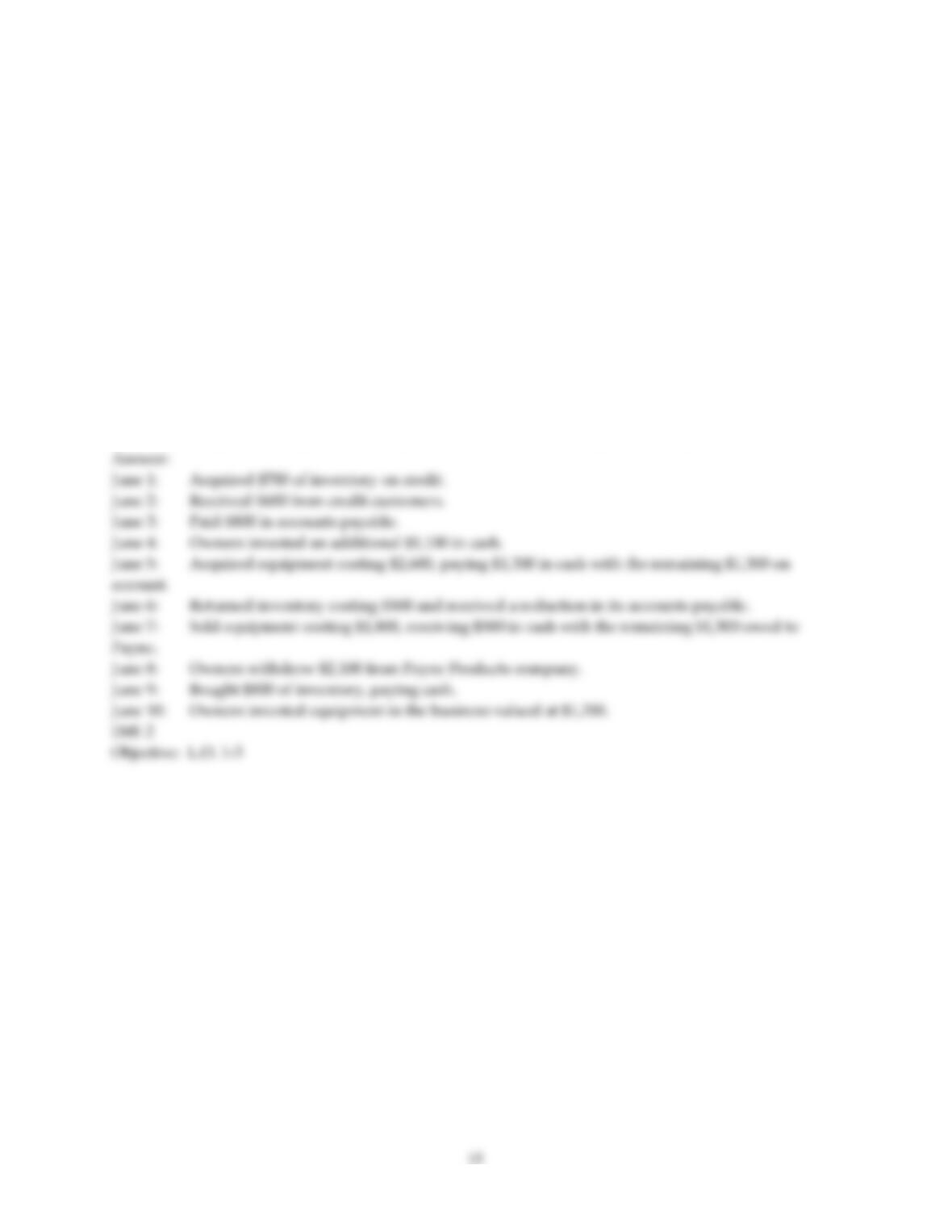
1.3-32) Given below are the daily balances in the accounts of Payne Products. Assuming only one
transaction occurred each day, explain the nature of each transaction from June 1 to June 10.
Accounts Accounts Owners’
Cash Receivable Inventory Equipment Payable Equity
Bal. $6,000 $3,000 $8,000 $7,000 $4,000 $20,000
June 1 6,000 3,000 8,700 7,000 4,700 20,000
June 2 6,600 2,400 8,700 7,000 4,700 20,000
June 3 5,800 2,400 8,700 7,000 3,900 20,000
June 4 6,900 2,400 8,700 7,000 3,900 21,100
June 5 5,600 2,400 8,700 9,600 5,200 21,100
June 6 5,600 2,400 8,200 9,600 4,700 21,100
June 7 6,100 3,700 8,200 7,800 4,700 21,100
June 8 4,000 3,700 8,200 7,800 4,700 19,000
June 9 3,200 3,700 9,000 7,800 4,700 19,000
June 10 3,200 3,700 9,000 9,500 4,700 20,700
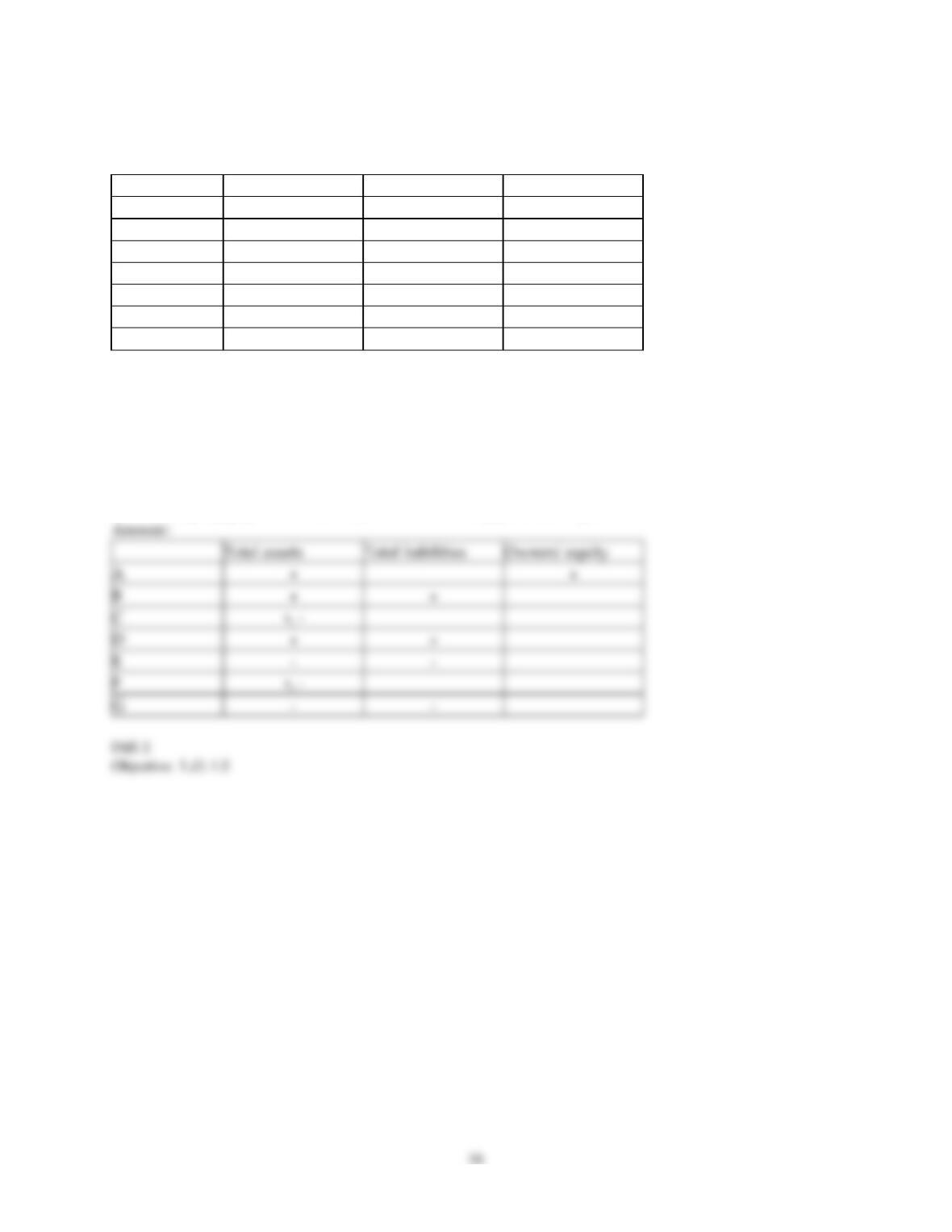
Total assets
Total liabilities
Owners’ equity
A
B
C
D
E
F
G
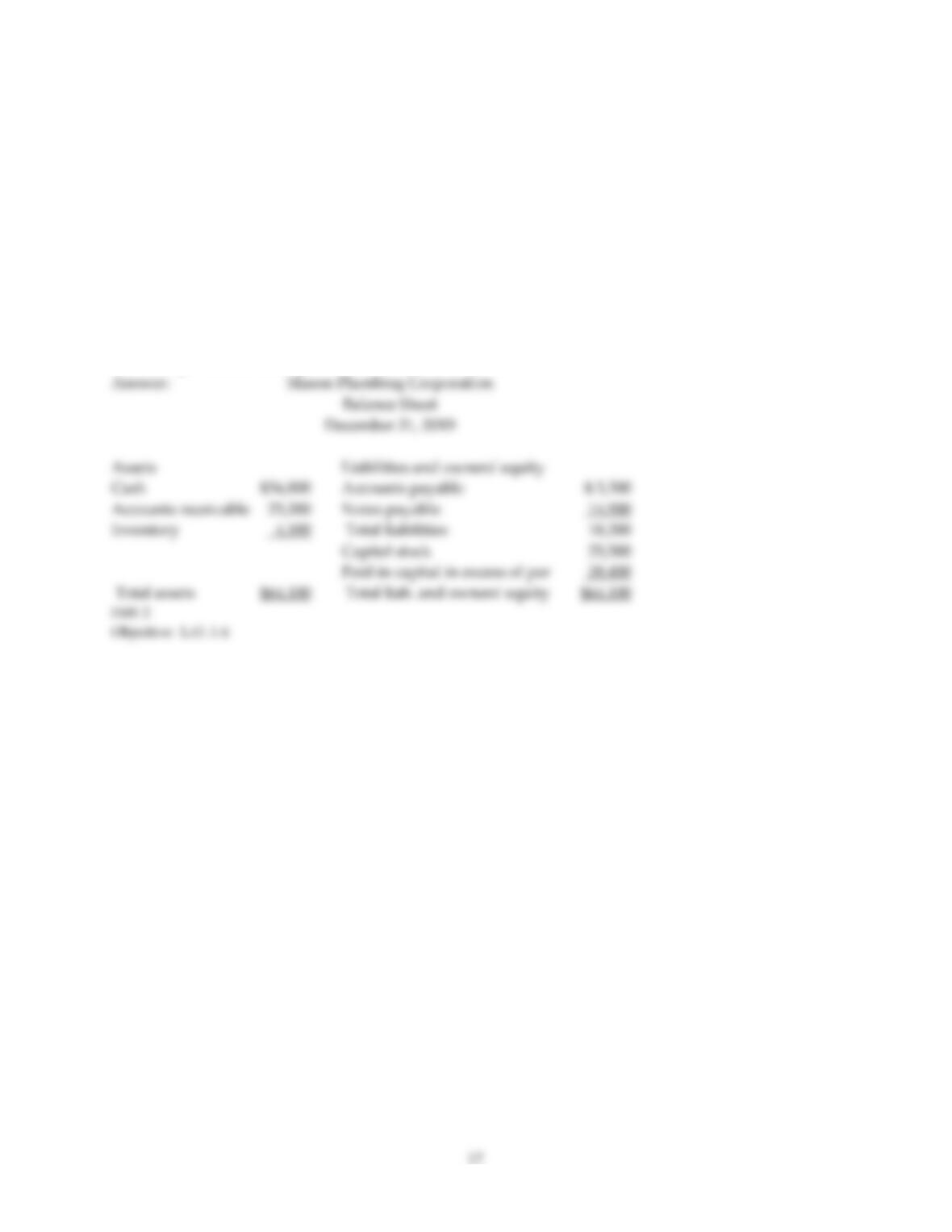
1.3-33) Use the following balance sheet equation format to show the effect of the following transactions.
Write the signs (+, -) for increases and decreases in components of the equation for each transaction.
Total assets
Total liabilities
Owners’ equity
A
B
C
D
E
F
G
A. The owner invests cash in the company.
B. The company borrows money from a bank, issuing a promissory note payable.
C. The company acquires equipment by paying cash for the total amount.
D. The company acquires inventory from the manufacturer on credit.
E. The company returns part of the inventory purchased in part D.
F. The company sells equipment acquired in part C to a competitor on open account at cost.
G. The company pays the amount due on the inventory purchase in part D.
Learning Objective 1.4 Questions
1.4-1) Following is an alphabetical list of the assets, liabilities, and stock owners’ equity accounts of Mason
Plumbing Corporation. Prepare a balance sheet dated December 31, 20X9.
Accounts payable $ 3,300
Accounts receivable 25,200
Capital stock 25,500
Cash 34,800
Inventory 4,100
Notes payable 14,900
Paid–in capital in excess of par 20,400