Syllabus for a course
using Writing for the Mass Media
The following syllabus is based on the one the author used while teaching at the University of
Alabama. You are free to use any part of it that can be adapted to your course.
Mass Communication 102
Introduction to Media Writing
Overview
This course introduces students to writing in a professional environment and to the forms of
writing for the mass media. These forms include news stories for print and broadcast, advertising
copy for print and broadcast, and other types of writing for public relations.
Texts
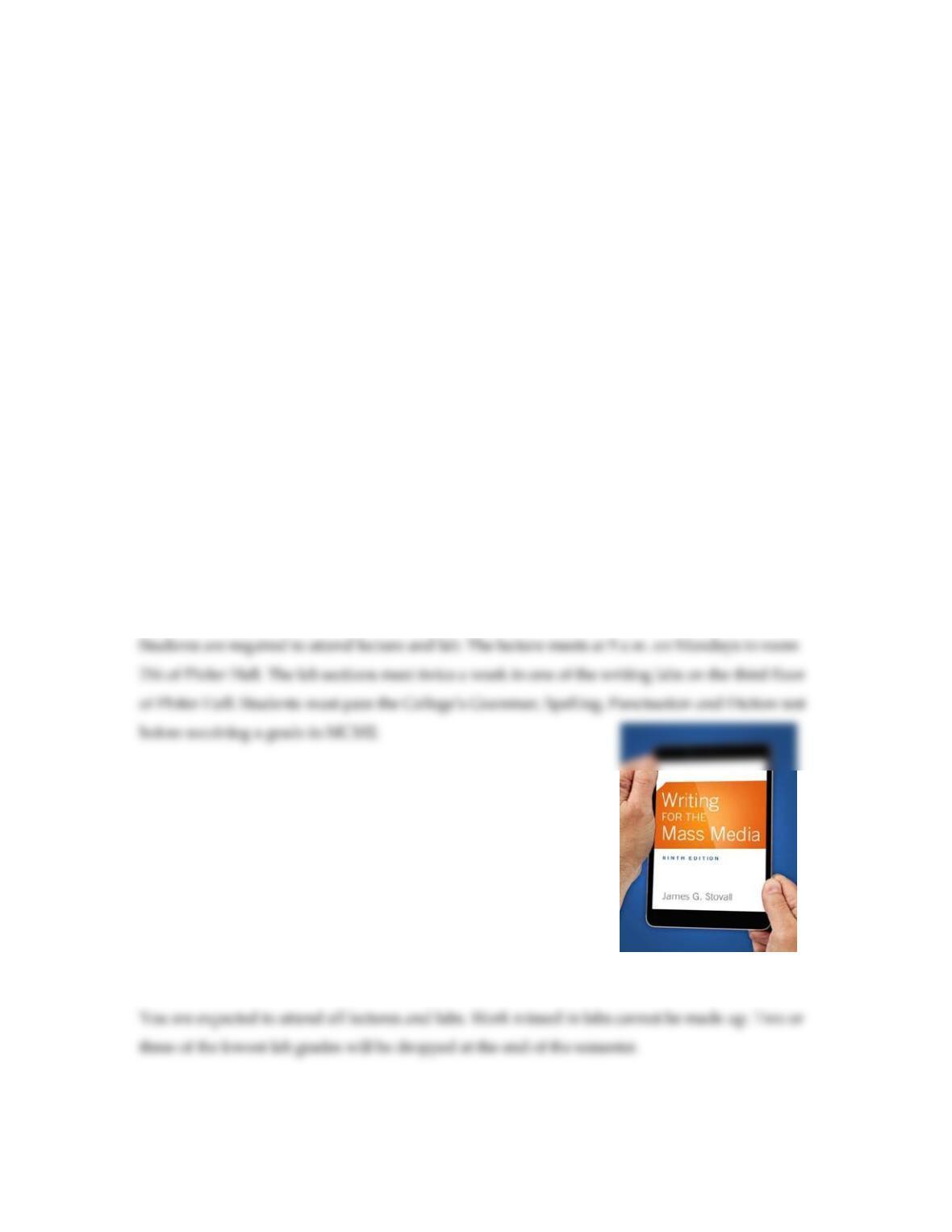
Two books are required for this course. They are Writing for the
Mass Media by James Glen Stovall; and the Associated Press Stylebook
and Libel Manual. You should also bring a dictionary to your lab.
Attendance
Grading
Academic honesty
All students attending the University of Alabama are expected to be honorable and observe
standards of conduct appropriate to a community of scholars. The university expects for its
students a higher standard of conduct than the minimum required to avoid discipline. All acts of
dishonesty in any academic work constitute academic misconduct. This includes, but is not
necessarily limited to, the following:
• Cheating — using or attempting to use unauthorized materials, information, or study aids in
any academic exercise.
Course schedule
Week 1 Introduction to the course
Topics: Basic principles of good writing
Expectations of the MC 102 student
Writing assignments: ch. 1 exercises
AP style, grammar quizzes
AP style, grammar quizzes
Week 4 News and newswriting
Topics: Writing with unity
Inverted pyramid
Writing assignments: ch. 5, supp. exercises
AP style, grammar quizzes
Week 7 Writing for the Web
Topics: Writing styles and techniques
Content and format
Writing assignments: additional Web writing
AP style, grammar quizzes
Week 9 Writing for broadcast I
Topics: Characteristics of broadcast news
Criticisms of broadcast writing
Dramatic unity
Writing assignments: ch. 6 exercises
AP style, word precision quizzes
Week 12 Writing advertising copy II
Topics: Key facts
Advertising appeals
Writing assignments: ch. 7 exercises, print
AP style, word precision quizzes
Week 14 Writing for public relations II
Topics: Writing letters and e-mail
Writing memoranda
Writing assignments: ch. 8 exercises
AP style, word precision quizzes
Lesson plans
for an Introduction to Media Writing course
using Writing for the Mass Media as the main textbook
Note: The “supplement” referred to in these lesson plans is no longer available. Much of the
material in the supplement can be found at JPROF.com (http://www.jprof.com)
Week 1
Lecture — Syllabus. Rules of good writing. What makes good writing and good writers.
give a real grade on this one.
Assignment: Write “incident” exercise, again being careful to have them use the principles of
good writing we discussed in class.
Lab 2 Current events quiz.
Introduce them to the computer tutorials by going through the tutorial sampler with them. Then
should be prepared to discuss this in class. Pick several of the best and discuss in class for next
time, 45 minutes maximum.
Thought
Writing is thinking, but it’s not free thought — stream of consciousness. It’s organized thinking.
Week 2
Lecture — The importance of grammar, punctuation and spelling
Lab 1 Current events quiz.
Give them some time (10-15 minutes) to go over grammar tutorials.
Lecture: Review grammar/punctuation terms in the text. We will begin grammar quizzes next
week. Also review spelling words in Appendix C of Stovall text.
Lab 2 Current events quiz.
Lecture: Go over common grammar problems, particularly pronoun-antecedent agreement; use
of its, it’s; sentence fragments and run-on sentences. Review common rules for using commas.
Assignment: From Stovall book combine 2-8 and 2-9 for one graded assignment.
In addition:
o Given them additional grammar exercises from exercises in chapter 2 of the text.
Week 3
Lecture — Writing in the media environment
Lab 1 Current events quiz
Grammar terms quiz
Give them some time to go through some of the AP style tutorials (10-15 minutes at least).
Lecture: Cover AP tip sheets in Chapter 3 of the text. These are some of the most common style
Lab 2 Current events quiz.
AP style quiz
Students need to get used to using the stylebook as a reference, not just a source of rules. Play
stylebook trivial pursuit. Divide them into two or three teams and let them look up questions that
do not involve style rules.
The importance of writing efficiently should be emphasized.
Week 4
Lecture — News and newswriting; news values; standard conventions of newswriting
Lab 1 Current events quiz
Grammar terms quiz
Lecture: Discuss news values because that’s not something I’ll hit heavily on in the Monday
lecture. Bring newspaper to class and discuss news values in stories contained therein. Discuss
Lab 2 Current events quiz.
Do another AP style trivial pursuit game.
Lecture: Use the previous day’s exercise to talk about leads and about newswriting in general.
Also talk about where a story can go after a lead. Nothing is automatic about newswriting. The
Week 5
Lecture — Writing in the media environment I, in which we discuss the concepts of accuracy,
information, the writing process, etc.
Lab 1 Current events quiz
Lecture: Talk about the inverted pyramid structure. In the story about the soccer team, see if you
Lab 2 Current events quiz.
Lecture: Use previous assignments to show them examples of wordiness problems and how they
can be fixed.
Assignment: Rewrite the previous assignment as necessary. This time the writing assignment will
be graded.
Week 6 — Writing for the Web I
Lab 1 — Current events quiz
Grammar terms quiz
Lecture: Review major points from the lecture as necessary.
Assignment: Exercise 1 from chapter 6.
• Write a concise summary of the story. This is a summary, not the lead paragraph. It should be
no more than 25 words and two sentences long. A summary has two purposes: to give enough
information so that the reader will know what the story is about and to help persuade readers to
read the story. The summary should display the following characteristics:
• It should be accurate (as well as complete, efficient and precise).
Lab 2 — Current events quiz
Lecture: Review major points from the lecture as necessary.
Assignment: Exercise 2 from chapter 6.
A good “who we are” statement is direct, efficient and factual, not self-indulgent. It gives the
Week 7—Writing for the Web II
Lab 1 — Current events quiz
Grammar terms quiz
Lecture: Review major points from the lecture as necessary.
Assignment: Exercise 3 from chapter 6. Write the copy for a splash (opening) page for a website.
This assignment will include an opening statement and descriptions of five section pages for the
Lab 2 — The assignment will be the same as that of lab 1 for week 6 — an inverted pyramid news
story with headline and summary. You should grade this and have it ready for the first lab next
week.
Week 8, Midterm
Lab 1
News quiz- 5 items
Discuss problems related with previous assignments.
Give students more practice in writing full news stories.
Through all of this writing, students should be learning AP style and putting it into practice.
Lab 2
More news writing practice
ALTERNATIVE—Feature writing
Important concepts from Chapter 5:
• Emphasize material on feature writing.
Week 9
Lab 1
News quiz- 5 items
Important concepts from Chapter 7:
• Emphasize material on selection of news.
• Watch out for the student who will say that we have already studied the criteria of news. You
will want to punch home the idea of timeliness as the second part of every story. For instance:
Lab 2
News quiz – 5 items
Return the assignment and comment. Did the student recognize news criteria?
Discuss style and broadcast, pages 236-240; go over the elements of newscast and agenda.
Week 10
Labs 1 and 2
Continue broadcast writing practice with exercises in the book. If possible, show a videotape of a
newscast and get students to listen closely to how the news items are written. Pay attention to
lead-ins.
Week 11
Lab 1
News quizzes are eliminated for the remainder of the term, however there may be spot quizzes
that will test our students’ basic ability to stay informed.
Important concepts from Chapter 10:
• To tell the truth.
• To write interesting exciting and persuasive advertisements without resorting to semantically
null words such as goodness.
Re-emphasize the material on appeals. From this our challenge is to get the student to accurately
Lab 2
Work on the following concepts: the audience, emphasizing demographics and psychographics;
the product; and the advertising situation.
Select one of the advertising exercises to do in class. Make sure the copy fits in with the appeal
that is being made.
Week 12
Lab 1, Radio
Important concepts from Chapter 9 related to radio.
The theater of the mind. No other medium works as well as radio when it enlists the
individual’s imagination. Our challenge this week is to get the student to understand how and
Make the connection to the basic forms of a print advertisement.
The headline and the illustration
They are used to gain attention and promise a benefit. Can the student use sound and music to
show a benefit? Develop in groups advertisements for the following problem page 192 car repair
shop.
Use narrator and sound only.
Use dialog to tell a story.
Divide into groups. Have them develop dialog for two people only. They must include dialog
Lab 2, Television
Important concepts from Chapter 7 related to television.
• Adding vision. Writing for television demands additional skills, not new skills. How do we
write visual directions?
This week, we must get the student to visualize the final product. What do we, the writers, want
to appear on the screen? How do we write these instructions?
First: Understand that this medium allows us to see a product demonstrated. What is different?
What is the same? From print we have an emphasis on illustration. — artistic, relevant. From
radio we have an understanding of sound effects, music and dialog. Now we must add sight to
this well-formed foundation.
Week 13
Lab 1
Important concepts from Chapter 11.
How do we enable our students to understand that public relations writing is not a one-way
street? Students must be aware of the need to communicate outside information to the
organization as well as dispense information to the public about the company.
Traditionally the path to a career in PR has focused on the journalist. Hammer home that the PR
person writes. Everyday and often each day there be writing to do. The reason for writing is the
Know thy audience!
Work on understanding of news journalism. All of what we learned about news writing applies
here!
Assignment write a news release. Assign one of the releases in exercise 11-1.
Lab 2
More on writing news releases
Emphasize again the same values and techniques as in writing news stories
Week 14
Lab 1
Discuss section on letters.
Lab 2
Speeches and statements; discuss text material.
Week 15
Students should read and discuss Chapter 10 in the text on mass media writing and the law. Use
this week for review and return to parts of the course in which students may need additional
practice.