CHAPTER 1
Early Childhood Education and Developmentally Appropriate Practice
AUTHENTIC ASSESSMENTS
1. After studying the history of early childhood education and other material from the chapter, write a rough
draft of your personal philosophy of early childhood education for your portfolio. Be ready to revise it in
following chapters.
2. Describe your own feelings regarding early childhood education. When do you believe children should
begin to receive formalized instruction? What kind of program do you prefer at this point? What kinds of
3. Visit a public school that has an after school program for children who would otherwise have no place to
5. Do further in-depth research and study of the social problems that young children encounter. You may
wish to select one of these problems and do a critical issues reporting on it.
6. Following your review of how children learn suggested in the text chapter, formulate a personal theory of
learning for early childhood education. Describe, in one to two pages, how you believe three- to eight-
year-old children learn. Add this to your portfolio along with your philosophy statement.
7. Do a scale drawing of a room arrangement for an early childhood classroom.
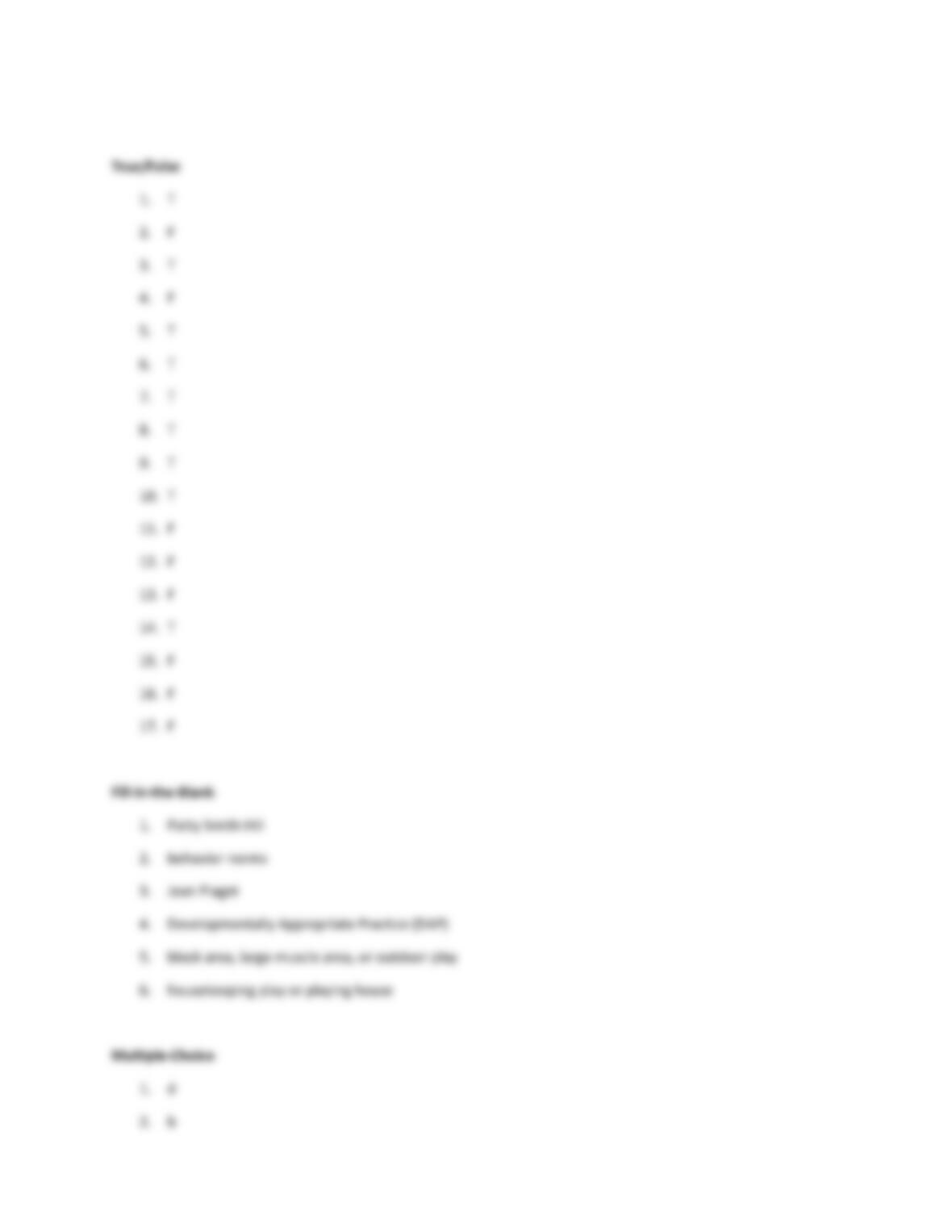
SUGGESTED TEST QUESTIONS
1. During the 17th and 18th centuries, children were not looked upon as being important and
valuable.
2. Pestalozzi emphasized the importance of individual differences.
3. Friedrich Froebel originated the first kindergarten in Germany.
4. In America, Margaret McMillan started the first nursery school.
5. The Montessori method emphasizes sensory training with young children.
6. How a child feels about himself/herself is reflected in his/her behavior.
7. There is a trend to teach skills and concepts earlier and earlier in educational and child care
settings.
8. The best kinds of learning for young children include real experiences, active learning, and
curious exploration of their environment.
9. Both teacher-initiated and child-initiated play are important.
10. One of the greatest benefits of free play or self-directed, self-discovery play, is that it allows
children the opportunity of making choices for themselves, and of having some control over their
learning and activity.
11. At least once a week children should have a block of time for spontaneous, free play.
Fill–in-the-Blank Questions
1. The American pioneer of kindergarten education was _______________.
2. Arnold Gesell, an American, is particularly known for establishing .
3. The theorist who has had the most impact in research on the growth of intelligence in young
children and developmentally appropriate practice is .
4. When teachers approach children from where they are and with an understanding of their
individual needs, we call this .
5. Name an area in the early childhood classroom that gives children the opportunity to develop
strength, coordination, balance, and exercise.

6. The most preferred theme for free dramatic play is .
Multiple-Choice Questions
1. The early philosopher who suggested that children pass through developmental stages was:
a. Locke.
b. Pestalozzi.
c. Dewey.
d. Rousseau.
2. One of the most long-term, significant happenings of the 1970’s was the
a. establishment of Head Start.
b. Education for All Handicapped Children Act.
c. establishment of the Children’s Defense Fund.
d. release of the report, A Nation at Risk.
3. Your textbook authors propose some of the main processes by which young children learn and
gain knowledge and skills are:
I. real experiences.
II. cooperative learning.
III. modeling.
IV. questioning and inquiry.
V. clarifying misconceptions and extending beyond the concept.
a. All of the above b. I, II, III, V
c. I, II, IV d. I, III, IV, V
Essay Question
1. What are some characteristics of effective, high-quality early childhood teachers?
2. What are the values of early childhood play experiences?
3. What are some values of physical games and activities?
4. What are some of the general guidelines for arranging an early childhood classroom?
5. What are some of the criteria you need to keep in mind when selecting toys and materials
for early childhood classrooms?
6. Describe characteristics of quality early childhood programs.
Chapter 1