
Revenues 400,000 400,000 400,000
–Cost of Goods Sold –180,000 –180,000 –180,000
–Depreciation –100,000 –100,000 –100,000
=EBIT 120,000 120,000 120,000
–Taxes (35%) –42,000 –42,000 –42,000
=Unlevered net income 78,000 78,000 78,000
+Depreciation 100,000 100,000 100,000
–Additions to Net Working Capital –20,000 –20,000 –20,000
–Capital Expenditures –300,000
=Free Cash Flow 158,000 158,000 158,000
76) Visby Rides, a livery car company, is considering buying some new luxury cars. After extensive research,
they come up with the above estimates of free cash flow from this project. The depreciation schedule shown
is for three–year, straight–line depreciation. By how much would the net present value (NPV) of this project
be increased, if the cars were depreciated by the MACRS schedule shown below given that the cost of capital
is 10%?
Year 0 Year 1 Year 2 Year 3
MACRS
Depreciation Rate 33.33% 44.45% 14.81% 7.41%
A) $8,342
B) $9,083
C) $25,912
D) $10,112
77) Which of the following best explains why is it sensible for a firm to use an accelerated depreciation schedule
such as MACRS rather than straight–line depreciation?
A) The firm will receive greater benefits to its cash flow earlier in the depreciation timeline and thus
increase net present value (NPV).
B) The firm can decide over how many years an item may be depreciated, thus allowing it full control of
its depreciation expenses.
C) The firm will have substantially fewer depreciation expenses later in the depreciation timeline.
D) The firm will substantially decrease its depreciation tax shield across all of the depreciation timeline.
78) Year 0 Year 1 Year 2 Year 3
MACRS
Depreciation Rate 33.33% 44.45% 14.81% 7.41%
A machine is purchased for $500,000 and is used through the end of Year 2. The machine will be
depreciated using the 3–Year MACRS schedule. At the end of Year 2, the machine is sold for $75,000.
What is the after–tax cash flow from the sale of the machine at the end of Year 2 if the firm’s marginal tax rate
is 40%?
A) $15,180
B) $37,950

C) $37,050
D) $59,820
79) Year 0 Year 1 Year 2 Year 3
MACRS
Depreciation Rate 33.33% 44.45% 14.81% 7.41%
A firm is considering the purchase of a new machine for $300,000. The firm is unsure if it should use the
3–Year MACRS schedule or straightline depcreciation over three years. What is the difference in the book
value after three years if the firm uses MACRS instead of straightline depreciation?
A) $66,660
B) $14,820
C) $7,410
D) $0
SHORT ANSWER. Write the word or phrase that best completes each statement or answers the question.
80) What are the most difficult parts of capital budgeting?
81) What is the most important function of sensitivity analysis?
82) What do you understand by break–even analysis?
TRUE/FALSE. Write ‘T’ if the statement is true and ‘F’ if the statement is false.
83) The most difficult part of the capital budgeting process is accurately estimating cash flows and cost of
capital.
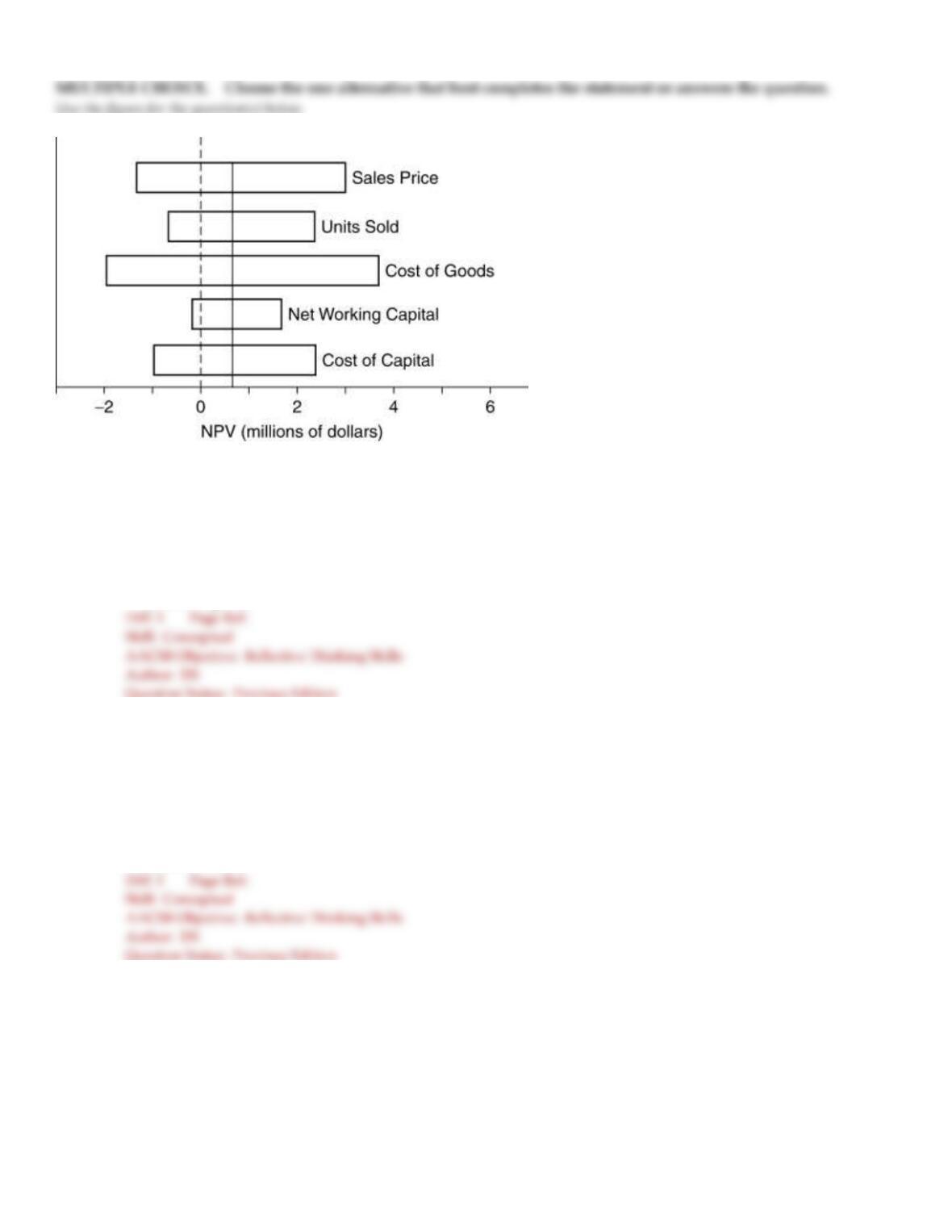
84) A consumer good company is developing a new brand of organic toothpaste. Above is the sensitivity
analysis for this product. The assumptions regarding which parameter should be scrutinized most carefully
in the estimation process?
A) units sold
B) cost of capital
C) sales price
D) cost of goods
85) A consumer good company is developing a new brand of organic toothpaste. Above is the sensitivity
analysis for this product. If the best–case assumptions for Net Working Capital are met, what will the net
present value (NPV) of this project be?
A) $2 million
B) $3 million
C) $1.7 million
D) $0.65 million
86) A company planning to market a new model of motor scooter analyzes the effect of changes in the selling
price of the motor scooter, the number of units that will be sold, the cost of making the motor scooter, the
effect on Net Working Capital, and the cost of capital for the project. They predict that the break–even point
for sales price for the motor scooter is $2480. What does this mean?
A) If the motor scooter is sold for $2480, then the net present value (NPV) for the product will be zero.
B) The predicted selling price of the motor scooter is $2480.
C) The maximum that the motor scooter can sell for and still make the project have a positive net present
value (NPV) is $2480.
D) If the motor scooter is sold for $2480, then the project will make a profit.
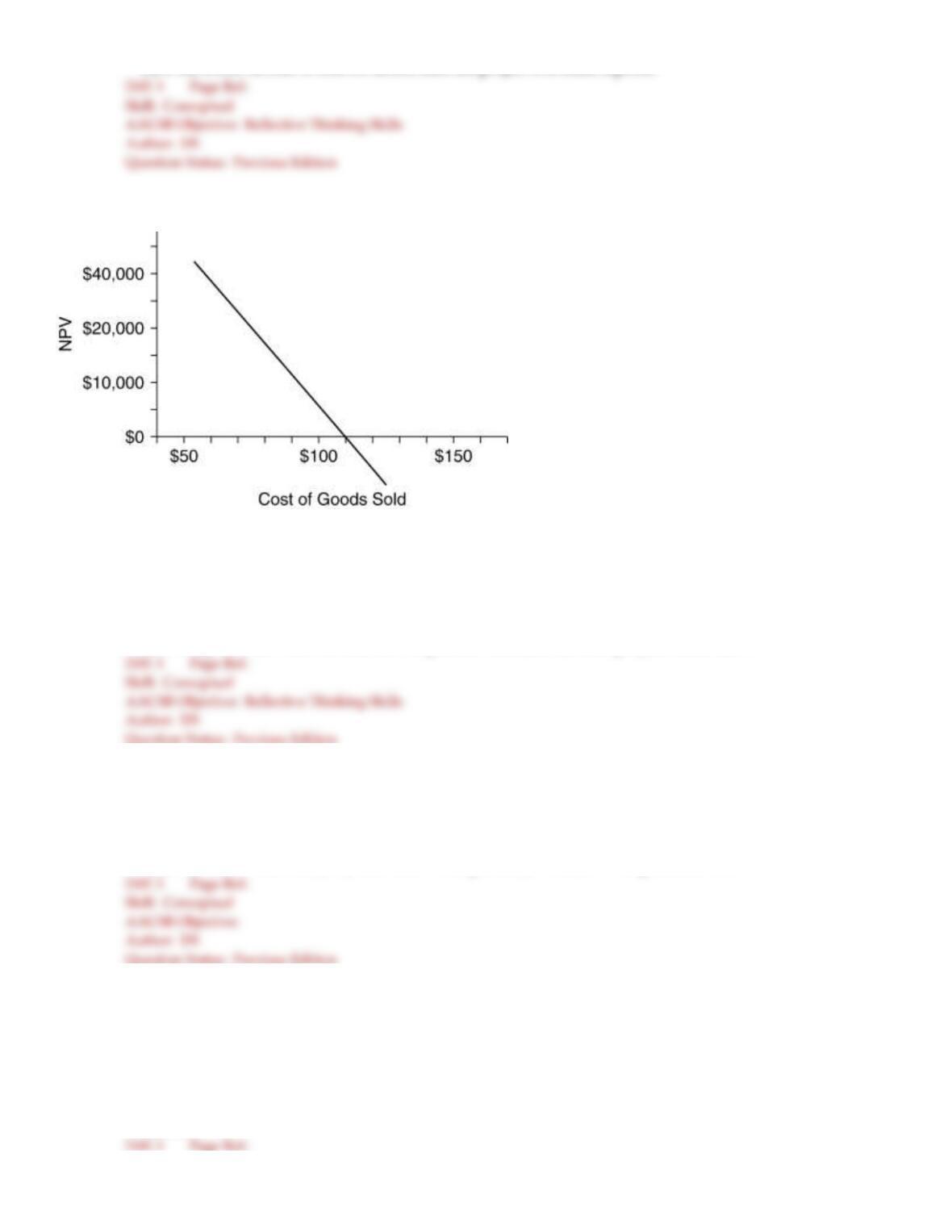
Use the figure for the question(s) below.
87) The graph above shows the break–even analysis for the cost of making a certain good. Based on this chart,
which of the following is true?
A) The project should not be undertaken if the predicted cost of goods sold is less than $110.
B) The net present value (NPV) of the project increases with increased cost of goods sold.
C) The net present value (NPV) of the project will be positive if the cost of good sold is greater than $110.
D) If the good costs $110 to make, the net present value (NPV) of the project will be zero.
88) The EBIT break even point can be calculated using which of the following formulas?
A) (Units Sold × Sale Price) + (Units Sold × Cost per unit) + SG&A — Depreciation = 0
B) (Units Sold × Sale Price) — (Units Sold × Cost per unit) — SG&A — Depreciation = 0
C) (Units Sold × Sale Price) — (Units Sold × Cost per unit) + SG&A + Depreciation = 0
D) (Units Sold × Sale Price) + (Units Sold × Cost per unit) — SG&A — Depreciation = 0
89) A maker of computer games expects to sell 500,000 games at a price of $49 per game. These units cost $12 to
produce. Selling, general, and administrative expenses are $1.2 million and depreciation is $280,000. What is
the EBIT break–even point for the number of games sold in this case?
A) $30,204
B) $30,192
C) $24,865
D) $40,000

90) A maker of kitchenware is planning on selling a new chef–quality kitchen knife. The manufacturer expects to
sell 1.6 million knives at a price of $120 each. These knives cost $80 each to produce. Selling, general, and
administrative expenses are $500,000. The machinery required to produce the knives cost $1.4 million,
depreciated by straight–line depreciation over five years. The maker determines that the EBIT break–even
point for units sold and sale price is less than these estimates and that the EBIT break–even point for costs per
unit, SG&A, and depreciation are greater than these estimates, so decides to go ahead with manufacturing
the knife. Was this the correct decision?
A) No, since the cost per unit should be greater than the EBIT–break even point for cost of goods if the
project is to have a positive EBIT.
B) Yes, since a positive EBIT ensures that the project will have a positive net present value (NPV).
C) Yes, since if the estimates for each parameter are correct , the EBIT will be positive.
D) It cannot be determined whether the decision was correct, since other factors contributing to the
project’s net present value (NPV), such as the upfront investment, have not been included in the
analysis.
91) The manufacturer of a brand of kitchen knives is investigating the likely effects that an increase in the cost of
the raw materials required to make these knives will have on thecost of manufacturing the knives, the selling
price of the knives, the number of knives that will then be sold, and the project’s net present value (NPV).
Which of the following best describes what type of analysis the manager is performing?
A) sensitivity analysis
B) EBIT–break even analysis
C) scenario analysis
D) break–even analysis
Use the table for the question(s) below.
Year 0 Years 1 to 10
Revenues 3.50
–Manufacturing Expenses –0.5
–Marketing Expenses –0.25
–Depreciation –0.8
=EBIT 1.95
–Taxes (40%) –0.78
=Unlevered net income 1.17
+Depreciation +0.8
–Additions to Net Working Capital –0.2
–Capital Expenditures –8.00
=Free Cash Flow 1.77

92) Panjandrum Industries, a manufacturer of industrial piping, is evaluating whether it should expand into the
sale of plastic fittings for home garden sprinkler systems. It has made the above estimates of free cash flows
resulting from such a decision. There are concerns of the sensitivity of this project to changes in the cost of
capital. For what cost of capital does this project break–even?
A) 12%
B) 16%
C) 18%
D) 14%
93) Panjandrum Industries, a manufacturer of industrial piping, is evaluating whether it should expand into the
sale of plastic fittings for home garden sprinkler systems. It has made the above estimates of free cash flows
resulting from such a decision (all quantities in millions of dollars). There are some concerns that estimates of
manufacturing expenses may be low, due to the rising cost of raw materials. What is the break–even point for
manufacturing expenses, if all other estimates are correct and the cost of capital is 10%?
A) $0.78 million
B) $0.97 million
C) $0.88 million
D) $1.22 million
94) Panjandrum Industries, a manufacturer of industrial piping, is evaluating whether it should expand into the
sale of plastic fittings for home garden sprinkler systems. It has made the above estimates of free cash flows
resulting from such a decision (all quantities in millions of dollars). It is thought that if marketing expenses
are increased by 40%, then revenues will rise. By how much will revenues have to rise for the net present
value (NPV) of the project to increase?
A) at least 2.0%
B) at least 3.2%
C) at least 2.9%
D) at least 3.8%
Use the table for the question(s) below.
Year 0 Year 1 Year 2 Year 3
Revenues 400,000 400,000 400,000
–Cost of Goods Sold –180,000 –180,000 –180,000
–Depreciation –100,000 –100,000 –100,000
=EBIT 120,000 120,000 120,000
–Taxes (35%) –42,000 –42,000 –42,000
=Unlevered net income 78,000 78,000 78,000
+Depreciation 100,000 100,000 100,000

–Additions to Net Working Capital –20,000 –20,000 –20,000
–Capital Expenditures –300,000
=Free Cash Flow 158,000 158,000 158,000
95) Visby Rides, a livery car company, is considering buying some new luxury cars. After extensive research,
they come up with the above estimates of free cash flow from this project. By how much could the discount
rate rise before the net present value (NPV) of this project is zero, given that it is currently 10%?
A) by 17%
B) by 22%
C) by 27%%
D) by 25%
96) Visby Rides, a livery car company, is considering buying some new luxury cars. After extensive research,
they come up with the above estimates of free cash flow from this project. Visby learns that a competitor is
thinking of offering similar services, thus reducing Visby’s sales. By how much could sales fall before the net
present value (NPV) was zero, given that the cost of capital is 10%, and that cost of goods sold is 45% of
revenues?
A) by 26%
B) by 24%
C) by 18%
D) by 12%
97) Which of the following statements is FALSE?
A) The break–even level of an input is the level for which the investment has an internal rate of return
(IRR) of zero.
B) The most difficult part of capital budgeting is deciding how to estimate the cash flows and the cost of
capital.
C) Sensitivity analysis reveals which aspects of the project are most critical when we are actually
managing the project.
D) When evaluating a capital budgeting project, financial managers should make the decision that
maximizes net present value (NPV).

98) Which of the following statements is FALSE?
A) Sensitivity analysis allows us to explore the effects of errors in our estimated inputs in our net present
value (NPV) analysis for the project.
B) Estimates of the cash flows and cost of capital are often subject to significant uncertainty.
C) To compute the net present value (NPV) for a project, you need to estimate the incremental cash flows
and choose a discount rate.
D) When we are certain regarding the input to a capital budgeting decision, it is often useful to determine
the break–even level of that input.
99) Which of the following statements is FALSE?
A) Scenario analysis breaks the net present value (NPV) calculation into its component assumptions and
shows how the net present value (NPV) varies as each one of the underlying assumptions changes.
B) We can use scenario analysis to evaluate alternative pricing strategies for our project.
C) Scenario analysis considers the effect on net present value (NPV) of changing multiple project
parameters.
D) The difference between the internal rate of return (IRR) of a project and the cost of capital tells you how
much error in the cost of capital it would take to change the investment decision.
100) The difference between scenario analysis and sensitivity analysis is:
A) Only scenario analysis breaks the net present value (NPV) calculation into its component assumptions.
B) Only sensitivity analysis allows us to change our estimated inputs of our net present value (NPV)
analysis.
C) Scenario analysis is based upon the internal rate of return (IRR) and sensitivity analysis is based upon
net present value (NPV).
D) Scenario analysis considers the effect on net present value (NPV) of changing multiple project
parameters.
101) An exploration of the effect of changing multiple project parameters on net present value (NPV) is called
A) accounting break–even analysis.
B) internal rate of return (IRR) analysis.
C) sensitivity analysis.
D) scenario analysis.

102) An analysis that breaks the net present value (NPV) calculation into its component assumptions and shows
how the net present value (NPV) varies as one of the underlying assumptions changes is called
A) accounting break–even analysis.
B) sensitivity analysis.
C) internal rate of return (IRR) analysis.
D) scenario analysis.
103) Which of the following will cause the EBIT Break–Even for sales to increase?
A) A decrease in the sales price.
B) A decrease in the number of units sold.
C) A decrease in selling, general, and administrative expenses.
D) A decrease in depreciation expense.
SHORT ANSWER. Write the word or phrase that best completes each statement or answers the question.
104) What is the major difference between scenario analysis and sensitivity analysis?
TRUE/FALSE. Write ‘T’ if the statement is true and ‘F’ if the statement is false.
105) A real option is the obligation to take a particular business action.
MULTIPLE CHOICE. Choose the one alternative that best completes the statement or answers the question.
106) Jim owns a farm that he wants to sell. He learns that a highway will be built near the farm in the future,
giving access to the farmland from a nearby city and thus making the land attractive to housing developers.
Expecting the net present value (NPV) of the sale to be greater after the highway is built, he decides not to
sell at this time. What real option is Jim taking?
A) option to abandon
B) option to delay
C) option to expand
D) option to switch

107) After research into where to place a new restaurant, Burger Billies, a small fast–food chain, plans to open a
new store near a small college. The anticipated customer base is students attending the college. They learn
that a major fast food chain will be opening a franchise within the college, which leads the owners of Burger
Billies to revise their estimate of sales to one below the break–even point. Which of the following is most
likely the best real option for Burger Billies to take with regard to the proposed restaurant site?
A) option to expand
B) option to abandon
C) option to delay
D) option to switch
108) A manufacturer of peripheral devices for PCs decides to try and capture some of the PC gaming market by
creating gaming versions of its traditional peripheral devices. It decides to start with a gaming version of its
standard keyboard, increasing the number of macro keys, adding a small LCD screen to display game data,
and giving the user the ability to backlight keys in different colors. If this device is a success, the
manufacturer plans to release gaming versions of its trackballs and other peripherals. What option is the
manufacturer gaining by the release of the new keyboard?
A) option to delay
B) option to switch
C) option to abandon
D) option to expand
109) Which of the following statements regarding real options is NOT correct?
A) Real options build greater flexibility into a project and thus increase its net present value (NPV).
B) Real options give owners the right, but not the obligation, to exercise these opportunities at a later date.
C) Real options should only be exercised when they increase the NPV of a project.
D) Real options enhance the forecast of a project’s expected future cash flows by incorporating, at the start
of the project, the effect of decisions that will be made at a later date.
SHORT ANSWER. Write the word or phrase that best completes each statement or answers the question.
110) Why does the option to abandon a project have value?
TRUE/FALSE. Write ‘T’ if the statement is true and ‘F’ if the statement is false.
111) A capital budget lists the potential projects a company may undertake in future years.

112) Capital budgeting decisions use the Net Present Value rule so that those decisions maximize net present
value (NPV).
MULTIPLE CHOICE. Choose the one alternative that best completes the statement or answers the question.
113) How does the capital budgeting process begin?
A) by analyzing alternate projects
B) by forecasting the future consequences for the firm of each potential project
C) by evaluating the net present value (NPV) of each project’s cash flows
D) by compiling a list of potential projects
114) What is the ultimate goal of the capital budgeting process?
A) to determine the effect of the decision to accept or reject a project on the firm’s cash flows
B) to list the projects and investments that a company plans to undertake in the future
C) to forecast the consequences of a list of future projects to the firm
D) to determine how the consequences of making a particular decision affects the firm’s revenues and
costs
115) Which of the following best defines incremental earnings?
A) the amount by which a firm’s earnings are expected to change as the result of an investment decision
B) the net present value (NPV) of earnings that a firm is expected to receive as the result of an investment
decision
C) the earnings arising from all projects that a company plans to undertake in a fixed timespan
D) cash flows arising from a particular investment decision
116) Which of the following best describes why the predicted incremental earnings arising from a given decision
are not sufficient in and of themselves to determine whether that decision is worthwhile?
A) They do not tell how the decision affects the firm’s reported profits from an accounting perspective.
B) These earnings are not actual cash flows.
C) They do not show how the firm’s earnings are expected to change as the result of a particular decision.
D) They are not easily predicted from historical financial statements of a firm and its competitors.

SHORT ANSWER. Write the word or phrase that best completes each statement or answers the question.
117) What is the correct tax rate that should be used for capital budgeting decisions?
118) How do we handle interest expense when making a capital budgeting decision?
TRUE/FALSE. Write ‘T’ if the statement is true and ‘F’ if the statement is false.
119) When evaluating the effectiveness of an improved manufacturing process we should evaluate the total sales
and costs generated by this process.
120) Interest and other financing–related expenses are excluded when determining a project’s unlevered net
income.
MULTIPLE CHOICE. Choose the one alternative that best completes the statement or answers the question.
121) Cameron Industries is purchasing a new chemical vapor depositor in order to make silicon chips. It will cost
$6 million to buy the machine and $10,000 to have it delivered and installed. Building a clean room in the
plant for the machine will cost an additional $3 million. The machine is expected to have a working life of six
years. Which of these activities will be reported as an operating expense?
A) the delivery and install cost and the cost of the depositor
B) the cost of the depositor only
C) the redesign of the plant only
D) the delivery and install cost only

122) Cameron Industries is purchasing a new chemical vapor depositor in order to make silicon chips. It will cost
$6 million to buy the machine and $10,000 to have it delivered and installed. Building a clean room in the
plant for the machine will cost an additional $3 million. The machine is expected to have a working life of six
years. If straight–line depreciation is used, what are the yearly depreciation expenses in this case?
A) $1,500,000
B) $1,501,667
C) $1,000,000
D) $1,001,667
123) An oil company is buying a semi–submersible oil rig for $20 million. Additionally, it will cost $1.5 million to
move the oil rig to the oil–field and to prepare it for operations. If it is depreciated over five years using
straight–line depreciation, what are the yearly depreciation expenses in this case?
A) $4.0 million
B) $5.0 million
C) $3.8 million
D) $4.3 million
124) Which of the following is usually NOT a factor that must be considered when estimating the revenues and
costs arising from a new product?
A) the fluctuations in the cost of capital over the period in question
B) the sales of a new product will typically accelerate, plateau, and ultimately decline over time
C) competition tends to reduce profit margins over time in most industries
D) the prices of technology products generally fall over time
125) Vernon–Nelson Chemicals is planning to release a new brand of insecticide, Bee–Safe, that will kill many
insect pests but not harm useful pollinators. Buying new equipment to manufacture the product will cost $20
million, and there will be an additional $2 million cost to reconfigure existing plant. The equipment is
expected to have a lifetime of eight years and will be depreciated by the straight–line method over its lifetime.
The firm expects that they should be able to sell 1,500,000 gallons per year at a price of $52 per gallon. It will
take $38 per gallon to manufacture and support the product. If Vernon–Nelson’s marginal tax rate is 40%,
what are the incremental earnings in year 3 of this project?
A) $10.5 million
B) $11.1 million
C) $18.5 million
D) $12.6 million

126) CathFoods will release a new range of candies which contain anti–oxidants. New equipment to manufacture
the candy will cost $2 million, which will be depreciated by straight–line depreciation over five years. In
addition, there will be $5 million spent on promoting the new candy line. It is expected that the range of
candies will bring in revenues of $4 million per year for five years with production and support costs of $1.5
million per year. If CathFood’s marginal tax rate is 35%, what are the incremental earnings in the second year
of this project?
A) $1.365 million
B) $1.753 million
C) $2.100 million
D) $1.500 million
127) A small manufacturer that makes clothespins and other household products buys new injection molding
equipment for a cost of $500,000. This will allow the manufacturer to make more clothespins in the same
amount of time with an estimated increase in sales of 15%. If the manufacturer currently makes 75 tons of
clothespins per year, which sell at $18,000 per ton, what will be the increase in revenue next year from the
new equipment?
A) $202,500
B) $20,700
C) $857,000
D) $80,500
128) Which of the following factors that a manager should bear in mind when estimating a project’s revenues and
costs is NOT correct?
A) Sales of a product will typically accelerate, stabilize, and then decline as the product becomes outdated
or faces increased competition.
B) Prices and costs tend to rise with the general level of inflation in the economy.
C) A new product typically has its highest sales immediately after release as customers are attracted by the
novelty of the product.
D) The prices of technology products tend to fall over time as newer, superior technologies emerge and
production costs decline.

129) A brewer is launching a new product; brewed ginger ale with a low alcohol content. The brewer plans to
spend $4 million promoting this product this year, which is expected to expand its sales of this product to
$10 million this year and $8 million next year. They do expect there will be loss of sales of $1 million this year
and next year in their other products as customers switch to drinking the new ginger ale. The gross profit
margin for the new ginger ale is 40%, the gross profit margin of all of the brewer’s other products is 30%, and
the brewer’s marginal corporate tax rate is 35%. What are incremental earnings arising from the promotional
campaign this year?
A) $1.95 million
B) $4.68 million
C) $4.290 million
D) $5.28 million
130) A stationery company plans to launch a new type of indelible ink pen. Advertising for the new product will
be heavy and will cost the company $10 million, although the company expects general revenues of $280
million next year from sources other than sales of the new pen. If the company has a corporate tax–rate of
40% on its pretax income, what effect will the advertising for the new pen have on its taxes?
A) Reduce taxes by $4 million
B) Increase taxes by $4 million
C) Increase taxes by $10 million
D) It will have no effect on taxes.
131) Which of the following statements is FALSE?
A) The opportunity cost of using a resource is the value it could have provided in its best alternative use.
B) The marginal corporate tax rate is the tax rate the firm will pay on an incremental dollar of pretax
income.
C) We begin the capital budgeting process by determining the incremental earnings of a project.
D) Investments in plant, property, and equipment are directly listed as expense when calculating earnings.
132) Which of the following statements is FALSE?
A) Only include as incremental expenses in your capital budgeting analysis the additional overhead
expenses that arise because of the decision to take on the project.
B) Many projects use a resource that the company already owns.
C) As a practical matter, to derive the forecasted cash flows of a project, financial managers often begin by
forecasting earnings.
D) When evaluating a capital budgeting decision, we generally include interest expense.
133) Which of the following costs would you consider when making a capital budgeting decision?
A) sunk cost
B) interest expense
C) fixed overhead cost
D) opportunity cost
134) A decrease in the sales of a current project because of the launching of a new project is
A) cannibalization.
B) an overhead expense.
C) a sunk cost.
D) irrelevant to the investment decision.
Use the information for the question(s) below.
Ford Motor Company is considering launching a new line of hybrid diesel–electric SUVs. The heavy advertising
expenses associated with the new SUV launch would generate operating losses of $35 million next year. Without the
new SUV, Ford expects to earn pretax income of $80 million from operations next year. Ford pays a 30% tax rate on its
pretax income.
135) The amount that Ford Motor Company owes in taxes next year without the launch of the new SUV is closest
to:
A) $24.0 million
B) $13.5 million
C) $31.5 million
D) $56.0 million
136) The amount that Ford Motor Company owes in taxes next year with the launch of the new SUV is closest to:
A) $24.0 million
B) $31.5 million
C) $13.5 million
D) $56.0 million
Use the information for the question(s) below.

Food For Less (FFL), a grocery store, is considering offering one–hour photo developing in their store. The firm expects
that sales from the new one–hour machine will be $150,000 per year. FFL currently offers overnight film processing with
annual sales of $100,000. While many of the one–hour photo sales will be to new customers, FFL estimates that 60% of
their current overnight photo customers will switch and use the one–hour service.
137) The level of incremental sales associated with introducing the new one hour photo service is closest to:
A) $150,000
B) $90,000
C) $120,000
D) $60,000
Use the information for the question(s) below.
The Sisyphean Corporation is considering investing in a new cane manufacturing machine that has an estimated life of
three years. The cost of the machine is $30,000 and the machine will be depreciated straight line over its three–year life to
a residual value of $0.
The cane manufacturing machine will result in sales of 2000 canes in year 1. Sales are estimated to grow by 10% per year
each year through year 3. The price per cane that Sisyphean will charge its customers is $18 each and is to remain
constant. The canes have a cost per unit to manufacture of $9 each.
Installation of the machine and the resulting increase in manufacturing capacity will require an increase in various net
working capital accounts. It is estimated that the Sisyphean Corporation needs to hold 2% of its annual sales in cash, 4%
of its annual sales in accounts receivable, 9% of its annual sales in inventory, and 5% of its annual sales in accounts
payable. The firm is in the 35% tax bracket and has a cost of capital of 10%.
138) The depreciation tax shield for the Sisyphean Corporation’s project in the first year is closest to:
A) $2800
B) $3500
C) $5200
D) $8000
139) Which of the following would you NOT consider when making a capital budgeting decision?
A) The opportunity to lease out a warehouse instead of using it to house a new production line.
B) The additional taxes a firm would have to pay in the next year.
C) The change in direct labor expense due to the purchase of a new machine.
D) The cost of a marketing study completed last year.

140) Which of the following is an example of cannibalization?
A) A toothpaste manufacturer adds a new line of toothpaste (that contains baking soda) to its product line.
B) A grocery store begins selling T–shirts featuring the local university’s mascot.
C) A convenience store begins selling pre–paid cell phones.
D) A basketball manufacturer adds basketball hoops to its product line.
SHORT ANSWER. Write the word or phrase that best completes each statement or answers the question.
141) How are the taxes paid under MACRS different from that paid under straight–line depreciation?
142) If available, should MACRS be preferred to straight–line depreciation?
TRUE/FALSE. Write ‘T’ if the statement is true and ‘F’ if the statement is false.
143) To evaluate a capital budgeting decision, it is sufficient to determine its consequences for the firm’s earnings.
144) The cash flow effect from a change in Net Working Capital is always equal in size and opposite in sign to the
changes in Net Working Capital.
MULTIPLE CHOICE. Choose the one alternative that best completes the statement or answers the question.
145) Which of the following adjustments should NOT be made when computing free cash flow from incremental
earnings?
A) subtracting depreciation expenses from taxable earnings
B) subtracting increases in Net Working Capital
C) adding depreciation
D) subtracting all non–cash expenses

146) Cameron Industries is purchasing a new chemical vapor depositor in order to make silicon chips. It will cost
$6 million to buy the machine and $10,000 to have it delivered and installed. Building a clean room in the
plant for the machine will cost an additional $3 million. The machine is expected to raise gross profits by $4
million per year, starting at the end of the first year, with associated costs of $1 million for each of those years.
The machine is expected to have a working life of six years and will be depreciated over those six years. The
marginal tax rate is 40%. What are the incremental free cash flows associated with the new machine in year
2?
A) $1,001,667
B) $1,298,917
C) $3,247,834
D) $2,200,667
147) Which of the following formulas will correctly calculate Net Working Capital?
A) Cash + Inventory – Receivables + Payables
B) Cash + Inventory + Receivables – Payables
C) Cash – Inventory + Receivables + Payables
D) Cash + Inventory + Receivables + Payables
148) Cameron Industries is purchasing a new chemical vapor depositor in order to make silicon chips. It will cost
$6 million to buy the machine and $10,000 to have it delivered and installed. Building a clean room in the
plant for the machine will cost an additional $3 million. The machine is expected to raise gross profits by $4
million per year, starting at the end of the first year, with associated costs of $1 million for each of those years.
The machine is expected to have a working life of six years and will be depreciated over those six years. The
marginal tax rate is 40%. What are the incremental free cash flows associated with the new machine in year
1?
A) –$6,010,000
B) –$3,709,417
C) –$6,000,000
D) $1,001,667
149) CathFoods will release a new range of candies which contain antioxidants. New equipment to manufacture
the candy will cost $2 million, which will be depreciated by straight–line depreciation over five years. In
addition, there will be $5 million spent on promoting the new candy line. It is expected that the range of
candies will bring in revenues of $4 million per year for five years with production and support costs of $1.5
million per year. If CathFood’s marginal tax rate is 35%, what are the incremental free cash flows in the
second year of this project?
A) $1.765 million
B) $2.415 million
C) $2.015 million

D) $2.500 million
Use the table for the question(s) below.
Balance Sheet
Assets Liabilities
Current Assets Current Liabilities
Cash 50 Accounts payable 42
Accounts receivable 22 Total current liabilities 42
Inventories 17
Total current assets 89
Long–Term Assets Long–Term Liabilities
Net property, plant,
and equipment 121 Long–term debt 128
Total long–term assets 121 Total long–term liabilities 128
Total Assets 210 Total Liabilities 170
Stockholders’ Equity 40
Total Liabilities and 210
Stockholders’ Equity
150) The balance sheet for a small firm is shown above. All amounts are in thousands of dollars. What is this
firm’s Net Working Capital?
A) $30,000
B) $47,000
C) $89,000
D) $40,000
151) A firm reports that in a certain year it had a net income of $4.5 million, depreciation expenses of $2.8 million,
capital expenditures of $2.3 million, and Net Working Capital decreased by $1.5 million. What is the firm’s
free cash flow for that year?
A) $6.5 million
B) $8.1 million
C) $2.4 million
D) $11.1 million