152) A company buys tracking software for its warehouse which, along with the computer system and ancillaries
to run it, will cost $1.8 million. This purchase will be deducted over five years. It is expected that the
software will reduce inventory by $10.5 million at the end of the first year after it is installed, though there
will be an annual cost of $120,000 per year to run the system. If the company’s marginal tax rate is 40%, how
will the purchase of this item change the company’s free cash flows in the first year?
A) $10,278,000
B) $10,422,000
C) $10,566,000
D) $10,020,000
153) Year 0 Year 1 Year 2 Year 3
Revenues 800,000 800,000 800,000
Costs of Goods Sold –320,000 –320,000 –320,000
Gross Profit 480,000 480,000 480,000
Selling, General and Admin –105,000 –105,000 –105,000
Depreciation –200,000 –200,000 –200,000
EBIT 175,000 175,000 175,000
Income tax (35%) –61,250 –61,250 –61,250
Incremental Earnings 113,750 113,750 113,750
Capital Purchases –600,000
Changes to NWC –12,000 –12,000 –12,000
Cromwell Industries is considering a new project which will have costs, revenues, etc. as shown by the data
above. If the cost of capital is 8.5%, what is the net present value (NPV) of this project?
A) $300,691
B) $231,973
C) –$278,832
D) –$153,046
154) Year 0 Year 1 Year 2 Year 3 Year 4
Revenues 120,000 400,000 400,000 300,00
Costs of Goods Sold –60,000 –200,000 –200,000 –150,000
Gross Profit 60,000 200,000 200,000 150,000
Selling, General and Admin –6,000 –6,000 –6,000 –6,000
Depreciation –70,000 –70,000 –70,000 –70,000
EBIT –16,000 124,000 124,000 74,000
Income tax (35%) 5,600 –43,400 –43,400 –25,900
Incremental Earnings –10,400 80,600 80,600 48,100
Capital Purchases –280,000
Changes to NWC –5,000 –5,000 –5,000 –5,000
A garage is installing a new “bubble–wash” car wash. It will promote the car wash as a fun activity for the
family, and it is expected that the novelty of this approach will boost sales in the medium term. If the cost of
capital is 10%, what is the net present value (NPV) of this project?
A) –$145,283
B) $76,607
C) $108,306
D) –$214,525
155) Your firm is considering building a new office complex. Your firm already owns land suitable for the new
complex. The current book value of the land is $100,000; however, a commercial real estate agent has
informed you that an outside buyer is interested in purchasing this land would be willing to pay $650,000 for
it. When calculating the net present value (NPV) of your new office complex, ignoring taxes, the
appropriate incremental cash flow for the use of this land is:
A) $0
B) $100,000
C) $750,000
D) $650,000
156) You are considering adding a microbrewery onto one of your firm’s existing restaurants. This will entail an
increase in inventory of $8000, an increase in accounts payables of $2500, and an increase in property, plant,
and equipment of $40,000. All other accounts will remain unchanged. The change in net working capital
resulting from the addition of the microbrewery is:
A) $10,500
B) $45,500
C) $6,500
D) $5,500
157) You are considering adding a microbrewery onto one of your firm’s existing restaurants. This will entail an
investment of $40,000 in new equipment. This equipment will be depreciated straight line over five years.
If your firm’s marginal corporate tax rate is 35%, then what is the value of the microbrewery’s depreciation
tax shield in the first year of operation?
A) $2800
B) $5200
C) $26,000
D) $14,000
158) The Sisyphean Company is considering a new project that will have an annual depreciation expense of $2.5
million. If Sisyphean’s marginal corporate tax rate is 40% and its average corporate tax rate is 30%, then
what is the value of the depreciation tax shield on the company’s new project?
A) $1,500,000
B) $1,000,000
C) $1,750,000
Use the information for the question(s) below.
The Sisyphean Corporation is considering investing in a new cane manufacturing machine that has an estimated life of
three years. The cost of the machine is $30,000 and the machine will be depreciated straight line over its three–year life to
a residual value of $0.
The cane manufacturing machine will result in sales of 2000 canes in year 1. Sales are estimated to grow by 10% per year
each year through year 3. The price per cane that Sisyphean will charge its customers is $18 each and is to remain
constant. The canes have a cost per unit to manufacture of $9 each.
Installation of the machine and the resulting increase in manufacturing capacity will require an increase in various net
working capital accounts. It is estimated that the Sisyphean Corporation needs to hold 2% of its annual sales in cash, 4%
of its annual sales in accounts receivable, 9% of its annual sales in inventory, and 5% of its annual sales in accounts
payable. The firm is in the 35% tax bracket and has a cost of capital of 10%.
159) The required net working capital in the first year for the Sisyphean Corporation’s project is closest to:
A) $2880
B) $3960
C) $5400
D) $3600

160) The required net working capital in the second year for the Sisyphean Corporation’s project is closest to:
A) $3190
B) $4360
C) $5940
D) $3960
161) The change in net working capital from year 1 to year 2 is closest to:
A) an increase of $360
B) an increase of $396
C) a decrease of $360
D) a decrease of $396
162) Bubba Ho–Tep Company reported net income of $300 million for the most recent fiscal year. The firm had
depreciation expenses of $125 million and capital expenditures of $150 million. Although it had no interest
expense, the firm did have an increase in net working capital of $20 million. What is Bubba Ho–Tep’s free
cash flow?
A) $5 million
B) $150 million
C) $170 million
D) $255 million
Use the information for the question(s) below.
Temporary Housing Services Incorporated (THSI) is considering a project that involves setting up a temporary housing
facility in an area recently damaged by a hurricane. THSI will lease space in this facility to various agencies and groups
providing relief services to the area. THSI estimates that this project will initially cost $5 million to set up and will
generate $20 million in revenues during its first and only year in operation (paid in one year). Operating expenses are
expected to total $12 million during this year and depreciation expense will be another $3 million. THSI will require no
working capital for this investment. THSI’s marginal tax rate is 35%.
163) Ignoring the original investment of $5 million, what is THSI’s free cash flow for the first and only year of
operation?
A) $8.0 million
B) $6.25 million
C) $3.75 million
D) $5.0 million
164) Assume that THSI’s cost of capital for this project is 15%. The net present value (NPV) of this temporary
housing project is closest to:
A) –$435,000
B) $435,000
C) –$650,000
D) $1,960,000
Use the information for the question(s) below.
Shepard Industries is evaluating a proposal to expand its current distribution facilities. Management has projected the
project will produce the following cash flows for the first two years (in millions).
Year
1
2
Revenues
1200
1400
Operating expense
450
525
Depreciation
240
280
Increase in working capital
60
70
Capital expenditures
300
350
Marginal corporate tax rate
30%
30%
165) The depreciation tax shield for Shepard Industries project in year 1 is closest to:
A) $84
B) $96
C) $168
D) $72
166) The depreciation tax shield for Shepard Industries project in year 2 is closest to:
A) $84
B) $72
C) $96
D) $196
incremental cash flow projects:
Year
0
1
2
3
Sales (Revenues)
100,000
100,000
100,000
– Cost of Goods Sold (50% of Sales)
50,000
50,000
50,000
– Depreciation
30,000
30,000
30,000
= EBIT
20,000
20,000
20,000
– Taxes (35%)
7000
7000
7000
= unlevered net income
13,000
13,000
13,000
+ Depreciation
30,000
30,000
30,000
+ changes to working capital
–5000
–5000
10,000
– capital expenditures
–90,000
167) The free cash flow for the first year of Epiphany’s project is closest to:
A) $45,000
B) $25,000
C) $38,000
D) $43,000
168) The free cash flow for the last year of Epiphany’s project is closest to:
A) $43,000
B) $38,000
C) $35,000
D) $53,000
169) The net present value (NPV) for Epiphany’s Project is closest to:
A) $20,400
B) $39,000
C) $4825
D) $11,946
170) Luther Industries has outstanding tax loss carryforwards of $70 million from losses over the past four years.
If Luther earns $15 million per year in pretax income from now on, in how many years will Luther first pay
taxes?
A) 5 years
B) 4 years
C) 7 years
D) 2 years
171) A firm is considering changing their credit terms. It is estimated that this change would result in sales
increasing by $1,000,000. This in turn would cause inventory to increase by $150,000, accounts receivable to
increase by $100,000, and accounts payable to increase by $75,000. What is the firm’s expected change in net
working capital?
A) $250,000
B) $325,000
C) $1,175,000
D) $175,000
172) A firm is considering investing in a new machine that will cost $600,000 and will be depreciated straight–line
over five years. If the firm‘s marginal tax rate is 39%, what is the annual depreciation tax shield of
purchasing the machine?
A) $234,000
B) $46,800
C) $120,000
D) $$07,692
173) A firm is considering a new project that will generate cash revenue of $1,000,000 and cash expenses of
$700,000 per year for five years. The equipment necessary for the project will cost $200,000 and will be
depreciated straight line over four years. What is the expected free cash flow in the second year of the project
if the firm’s marginal tax rate is 35%?
A) $162,500
B) $195,000
C) $212,500
D) $245,000
SHORT ANSWER. Write the word or phrase that best completes each statement or answers the question.
174) If a business owner is using the extra space at home for his business, does it imply a zero opportunity cost for
the space?

175) What are project externalities?
176) What are sunk costs?
TRUE/FALSE. Write ‘T’ if the statement is true and ‘F’ if the statement is false.
177) Firms should use the most accelerated depreciation scheme allowable.
178) An announcement by the government that they will decrease corporate marginal tax rates in the future
MULTIPLE CHOICE. Choose the one alternative that best completes the statement or answers the question.
179) A company spends $20 million researching whether it is possible to create a durable plastic from the process
waste from feedstock preparation. How should the $20 million best be considered?
180) Joe pre–orders a non–refundable movie ticket. He then reads a number of reviews of the movie in question
that make him realize that he will not enjoy it. He goes to see it anyway, rationalizing that otherwise his
money will have been wasted. Is Joe succumbing to the Sunk Cost Fallacy, and why?
A) No, because going to see the movie means that the product of his initial investment was realized as
originally planned.
B) No, because the cost of the movie was not recoverable and would have been lost whatever action he
took.
C) No, because he incurred no further costs by going to see the movie.
D) Yes, since he invested a valuable asset, his time, in a project based on its previous costs.

181) An insurance office owns a large building downtown. The sixth floor of this building currently houses its
entire Human Resources Department. After carrying out a survey to see whether the sixth floor could be
rented and for what price, the company must decide whether to split the Human Resources Department
between currently unoccupied spaces on several floors and rent out the entire sixth floor or to leave things as
they currently are. Which of the following should NOT be considered when deciding whether to rent out the
sixth floor?
A) the amount obtained by renting the sixth floor
B) cost involved with a loss of efficiency resulting from the Human Resources Department being split
between several spaces
C) the cost of the research into the feasibility of renting the sixth floor
D) the cost of refurbishing the new space to be occupied by the Human Resources Department
182) Year 0 Year 1 Year 2 Year 3
MACRS
Depreciation Rate 33.33% 44.45% 14.81% 7.41%
A fast–food company invests $2.4 million to buy machines for making slurpies. These can be depreciated
using the MACRS schedule shown above. If the cost of capital is 10%, what is the increase in the net present
value (NPV) of the product gained by using MACRS depreciation over straight–line depreciation for three
years?
A) $207,702
B) $66,782
C) $78,084
D) $34,452
183) Year 0 Year 1 Year 2 Year 3 Year 4 Year 5 Year 6 Year 7
MACRS
Depreciation Rate 14.29% 24.49% 17.49% 12.49% 8.93% 8.92% 8.93% 4.46%
A textile company invests $12 million in an open–end spinning machine. This was depreciated using the
seven–year MACRS schedule shown above. If the company sold it immediately after the end of year 3 for $7
million, what would be the after–tax cash flow from the sale of this asset, given a tax rate of 40%?
A) $1,300,480
B) $5,699,520
C) $2,076,880
D) $1,950,720
184) Year 0 Year 1 Year 2 Year 3 Year 4 Year 5
MACRS
Depreciation Rate 20.00% 32.00% 19.20% 11.52% 11.52% 5.76%
A bakery invests $30,000 in a light delivery truck. This was depreciated using the five–year MACRS schedule
shown above. If the company sold it immediately after the end of year 2 for $22,000, what would be the
after–tax cash flow from the sale of this asset, given a tax rate of 40%?
A) $8,640
B) $8,544
C) $5,184
D) $16,656
185) Year 0 Year 1 Year 2 Year 3 Year 4 Year 5 Year 6 Year 7
MACRS
Depreciation Rate 14.29% 24.49% 17.49% 12.49% 8.93% 8.92% 8.93% 4.46%
Massive Amusements, an owner of theme parks, invests $60 million to build a roller coaster. This can be
depreciated using the MACRS schedule shown above. How much less is the depreciation tax shield for year
4 under MACRS depreciation than under 7–year, straight–line depreciation,if the tax rate is 40%?
A) $2,143,200
B) $1,077,429
C) $1,285,371
D) $6,428,229
Use the table for the question(s) below.
Year 0 Year 1 Year 2 Year 3
Revenues 400,000 400,000 400,000
–Cost of Goods Sold –180,000 –180,000 –180,000
–Depreciation –100,000 –100,000 –100,000
=EBIT 120,000 120,000 120,000
–Taxes (35%) –42,000 –42,000 –42,000
=Unlevered net income 78,000 78,000 78,000
+Depreciation 100,000 100,000 100,000
–Additions to Net Working Capital –20,000 –20,000 –20,000
–Capital Expenditures –300,000
=Free Cash Flow 158,000 158,000 158,000
186) Visby Rides, a livery car company, is considering buying some new luxury cars. After extensive research,

Year 0 Year 1 Year 2 Year 3
MACRS
Depreciation Rate 33.33% 44.45% 14.81% 7.41%
A) $25,912
B) $8,342
C) $10,112
D) $9,083
187) Which of the following best explains why is it sensible for a firm to use an accelerated depreciation schedule
such as MACRS rather than straight–line depreciation?
A) The firm can decide over how many years an item may be depreciated, thus allowing it full control of
its depreciation expenses.
B) The firm will receive greater benefits to its cash flow earlier in the depreciation timeline and thus
increase net present value (NPV).
C) The firm will have substantially fewer depreciation expenses later in the depreciation timeline.
D) The firm will substantially decrease its depreciation tax shield across all of the depreciation timeline.
188) Year 0 Year 1 Year 2 Year 3
MACRS
Depreciation Rate 33.33% 44.45% 14.81% 7.41%
A machine is purchased for $500,000 and is used through the end of Year 2. The machine will be
depreciated using the 3–Year MACRS schedule. At the end of Year 2, the machine is sold for $75,000.
What is the after–tax cash flow from the sale of the machine at the end of Year 2 if the firm’s marginal tax rate
is 40%?
A) $59,820
B) $37,950
C) $37,050
D) $15,180
189) Year 0 Year 1 Year 2 Year 3
MACRS
Depreciation Rate 33.33% 44.45% 14.81% 7.41%
A firm is considering the purchase of a new machine for $300,000. The firm is unsure if it should use the
3–Year MACRS schedule or straightline depcreciation over three years. What is the difference in the book
value after three years if the firm uses MACRS instead of straightline depreciation?
A) $7,410
B) $14,820
C) $66,660
SHORT ANSWER. Write the word or phrase that best completes each statement or answers the question.
190) What are the most difficult parts of capital budgeting?
191) What is the most important function of sensitivity analysis?
TRUE/FALSE. Write ‘T’ if the statement is true and ‘F’ if the statement is false.
193) The most difficult part of the capital budgeting process is accurately estimating cash flows and cost of
capital.
MULTIPLE CHOICE. Choose the one alternative that best completes the statement or answers the question.
Use the figure for the question(s) below.
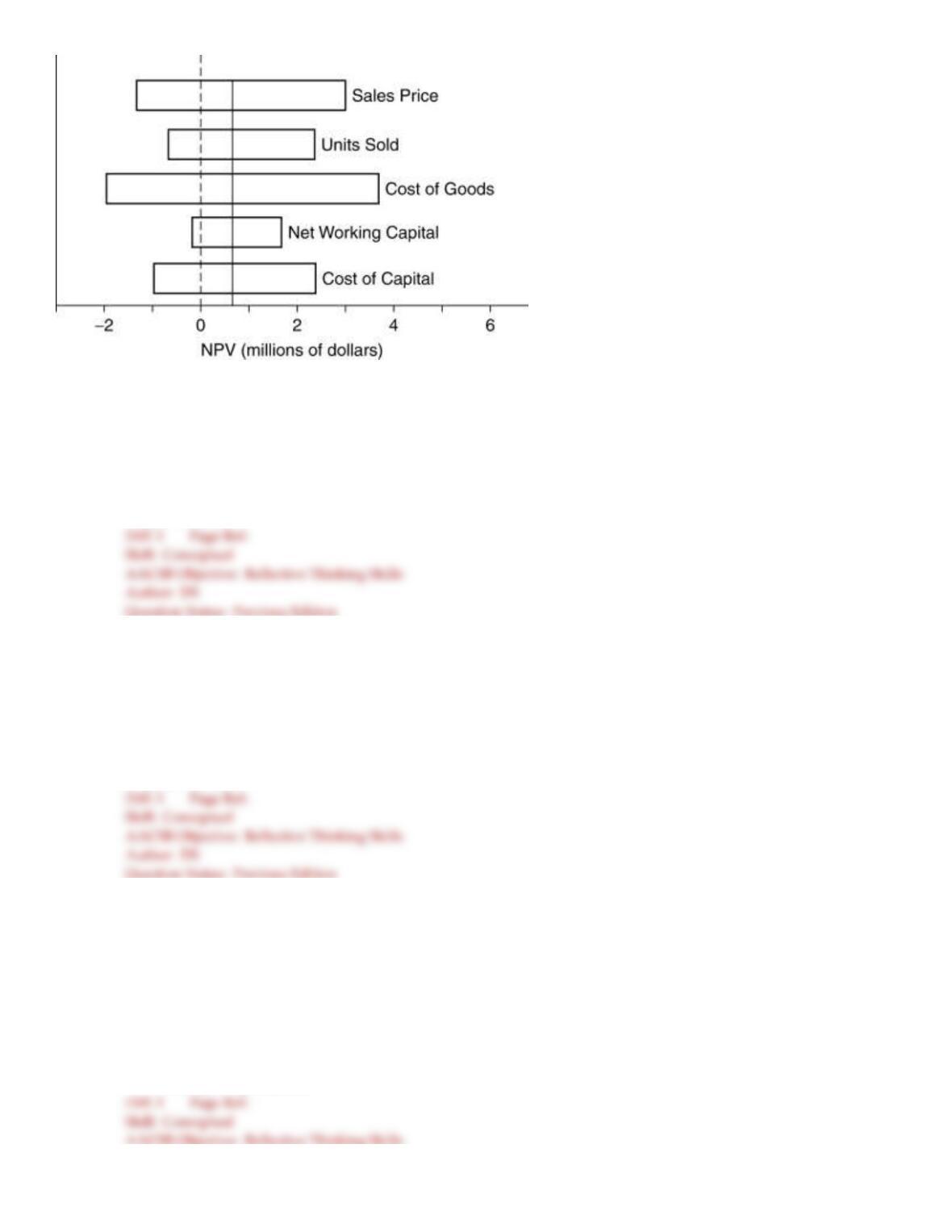
194) A consumer good company is developing a new brand of organic toothpaste. Above is the sensitivity
analysis for this product. The assumptions regarding which parameter should be scrutinized most carefully
in the estimation process?
A) cost of capital
B) sales price
C) cost of goods
D) units sold
195) A consumer good company is developing a new brand of organic toothpaste. Above is the sensitivity
analysis for this product. If the best–case assumptions for Net Working Capital are met, what will the net
present value (NPV) of this project be?
A) $3 million
B) $1.7 million
C) $0.65 million
D) $2 million
196) A company planning to market a new model of motor scooter analyzes the effect of changes in the selling
price of the motor scooter, the number of units that will be sold, the cost of making the motor scooter, the
effect on Net Working Capital, and the cost of capital for the project. They predict that the break–even point
for sales price for the motor scooter is $2480. What does this mean?
A) The predicted selling price of the motor scooter is $2480.
B) If the motor scooter is sold for $2480, then the project will make a profit.
C) If the motor scooter is sold for $2480, then the net present value (NPV) for the product will be zero.
D) The maximum that the motor scooter can sell for and still make the project have a positive net present
value (NPV) is $2480.