Author: DS
Question Status: Previous Edition
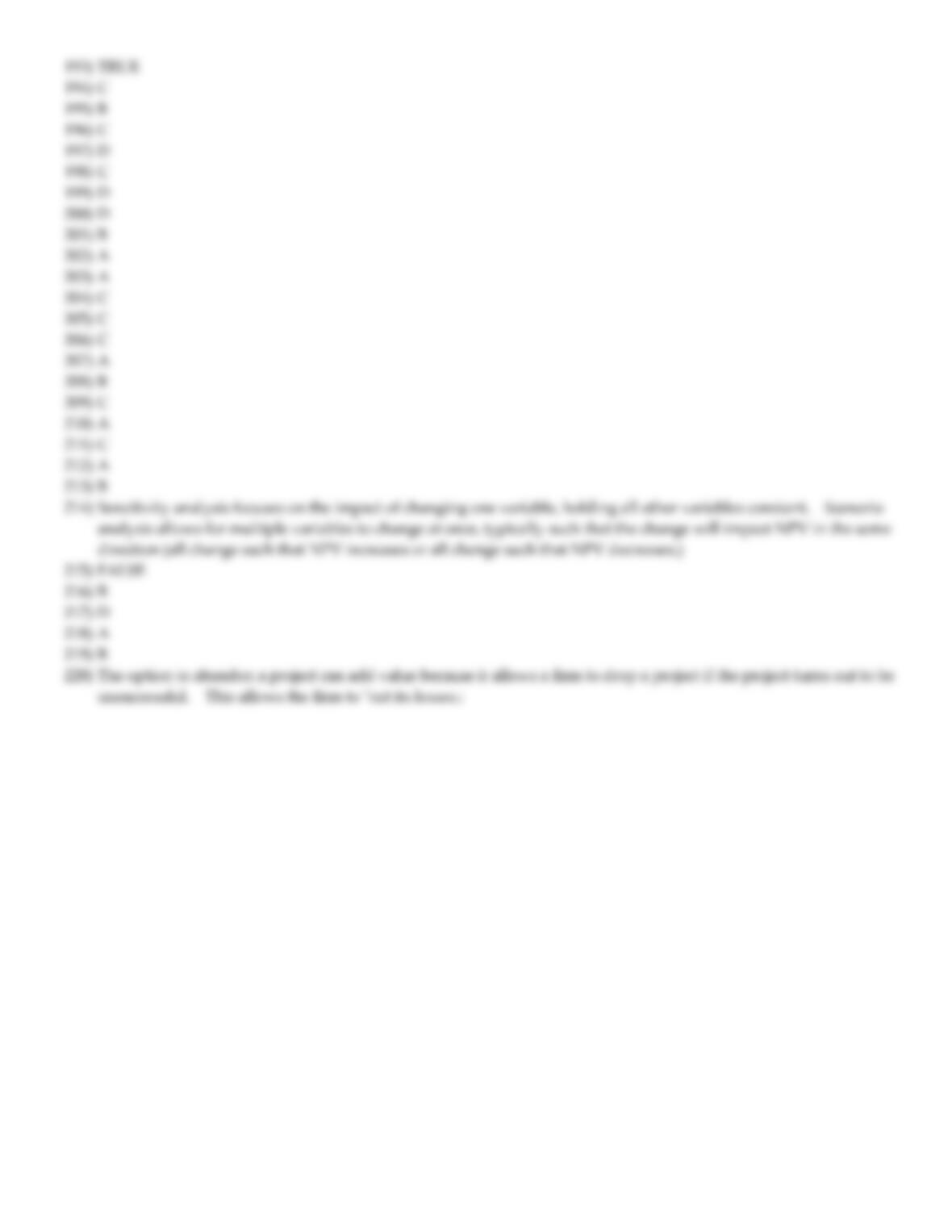
Use the figure for the question(s) below.
197) The graph above shows the break–even analysis for the cost of making a certain good. Based on this chart,
which of the following is true?
A) The net present value (NPV) of the project increases with increased cost of goods sold.
B) The net present value (NPV) of the project will be positive if the cost of good sold is greater than $110.
C) The project should not be undertaken if the predicted cost of goods sold is less than $110.
D) If the good costs $110 to make, the net present value (NPV) of the project will be zero.
198) The EBIT break even point can be calculated using which of the following formulas?
A) (Units Sold × Sale Price) + (Units Sold × Cost per unit) + SG&A — Depreciation = 0
B) (Units Sold × Sale Price) + (Units Sold × Cost per unit) — SG&A — Depreciation = 0
C) (Units Sold × Sale Price) — (Units Sold × Cost per unit) — SG&A — Depreciation = 0
D) (Units Sold × Sale Price) — (Units Sold × Cost per unit) + SG&A + Depreciation = 0
199) A maker of computer games expects to sell 500,000 games at a price of $49 per game. These units cost $12 to
produce. Selling, general, and administrative expenses are $1.2 million and depreciation is $280,000. What is
the EBIT break–even point for the number of games sold in this case?
A) $30,192
B) $30,204
C) $24,865
D) $40,000

200) A maker of kitchenware is planning on selling a new chef–quality kitchen knife. The manufacturer expects to
sell 1.6 million knives at a price of $120 each. These knives cost $80 each to produce. Selling, general, and
administrative expenses are $500,000. The machinery required to produce the knives cost $1.4 million,
depreciated by straight–line depreciation over five years. The maker determines that the EBIT break–even
point for units sold and sale price is less than these estimates and that the EBIT break–even point for costs per
unit, SG&A, and depreciation are greater than these estimates, so decides to go ahead with manufacturing
the knife. Was this the correct decision?
A) Yes, since if the estimates for each parameter are correct , the EBIT will be positive.
B) Yes, since a positive EBIT ensures that the project will have a positive net present value (NPV).
C) No, since the cost per unit should be greater than the EBIT–break even point for cost of goods if the
project is to have a positive EBIT.
D) It cannot be determined whether the decision was correct, since other factors contributing to the
project’s net present value (NPV), such as the upfront investment, have not been included in the
analysis.
201) The manufacturer of a brand of kitchen knives is investigating the likely effects that an increase in the cost of
the raw materials required to make these knives will have on thecost of manufacturing the knives, the selling
price of the knives, the number of knives that will then be sold, and the project’s net present value (NPV).
Which of the following best describes what type of analysis the manager is performing?
A) break–even analysis
B) scenario analysis
C) sensitivity analysis
D) EBIT–break even analysis
Use the table for the question(s) below.
Year 0 Years 1 to 10
Revenues 3.50
–Manufacturing Expenses –0.5
–Marketing Expenses –0.25
–Depreciation –0.8
=EBIT 1.95
–Taxes (40%) –0.78
=Unlevered net income 1.17
+Depreciation +0.8
–Additions to Net Working Capital –0.2
–Capital Expenditures –8.00
=Free Cash Flow 1.77
202) Panjandrum Industries, a manufacturer of industrial piping, is evaluating whether it should expand into the
sale of plastic fittings for home garden sprinkler systems. It has made the above estimates of free cash flows
resulting from such a decision. There are concerns of the sensitivity of this project to changes in the cost of
capital. For what cost of capital does this project break–even?
A) 18%
B) 16%
C) 12%
D) 14%
203) Panjandrum Industries, a manufacturer of industrial piping, is evaluating whether it should expand into the
sale of plastic fittings for home garden sprinkler systems. It has made the above estimates of free cash flows
resulting from such a decision (all quantities in millions of dollars). There are some concerns that estimates of
manufacturing expenses may be low, due to the rising cost of raw materials. What is the break–even point for
manufacturing expenses, if all other estimates are correct and the cost of capital is 10%?
A) $0.78 million
B) $1.22 million
C) $0.97 million
D) $0.88 million
204) Panjandrum Industries, a manufacturer of industrial piping, is evaluating whether it should expand into the
sale of plastic fittings for home garden sprinkler systems. It has made the above estimates of free cash flows
resulting from such a decision (all quantities in millions of dollars). It is thought that if marketing expenses
are increased by 40%, then revenues will rise. By how much will revenues have to rise for the net present
value (NPV) of the project to increase?
A) at least 3.2%
B) at least 3.8%
C) at least 2.9%
D) at least 2.0%
Use the table for the question(s) below.
Year 0 Year 1 Year 2 Year 3
Revenues 400,000 400,000 400,000
–Cost of Goods Sold –180,000 –180,000 –180,000
–Depreciation –100,000 –100,000 –100,000
=EBIT 120,000 120,000 120,000
–Taxes (35%) –42,000 –42,000 –42,000
=Unlevered net income 78,000 78,000 78,000
+Depreciation 100,000 100,000 100,000
–Additions to Net Working Capital –20,000 –20,000 –20,000
–Capital Expenditures –300,000
=Free Cash Flow 158,000 158,000 158,000
205) Visby Rides, a livery car company, is considering buying some new luxury cars. After extensive research,
they come up with the above estimates of free cash flow from this project. By how much could the discount
rate rise before the net present value (NPV) of this project is zero, given that it is currently 10%?
A) by 25%
B) by 27%%
C) by 17%
D) by 22%
206) Visby Rides, a livery car company, is considering buying some new luxury cars. After extensive research,
they come up with the above estimates of free cash flow from this project. Visby learns that a competitor is
thinking of offering similar services, thus reducing Visby’s sales. By how much could sales fall before the net
present value (NPV) was zero, given that the cost of capital is 10%, and that cost of goods sold is 45% of
revenues?
A) by 18%
B) by 12%
C) by 26%
D) by 24%
207) Which of the following statements is FALSE?
A) The break–even level of an input is the level for which the investment has an internal rate of return
(IRR) of zero.
B) Sensitivity analysis reveals which aspects of the project are most critical when we are actually
managing the project.
C) The most difficult part of capital budgeting is deciding how to estimate the cash flows and the cost of
capital.
D) When evaluating a capital budgeting project, financial managers should make the decision that
maximizes net present value (NPV).
208) Which of the following statements is FALSE?
A) Estimates of the cash flows and cost of capital are often subject to significant uncertainty.
B) When we are certain regarding the input to a capital budgeting decision, it is often useful to determine
the break–even level of that input.
C) To compute the net present value (NPV) for a project, you need to estimate the incremental cash flows
and choose a discount rate.
D) Sensitivity analysis allows us to explore the effects of errors in our estimated inputs in our net present
value (NPV) analysis for the project.
209) Which of the following statements is FALSE?
A) Scenario analysis considers the effect on net present value (NPV) of changing multiple project
parameters.
B) The difference between the internal rate of return (IRR) of a project and the cost of capital tells you how
much error in the cost of capital it would take to change the investment decision.
C) Scenario analysis breaks the net present value (NPV) calculation into its component assumptions and
shows how the net present value (NPV) varies as each one of the underlying assumptions changes.
D) We can use scenario analysis to evaluate alternative pricing strategies for our project.
210) The difference between scenario analysis and sensitivity analysis is:
A) Scenario analysis considers the effect on net present value (NPV) of changing multiple project
parameters.
B) Only scenario analysis breaks the net present value (NPV) calculation into its component assumptions.
C) Only sensitivity analysis allows us to change our estimated inputs of our net present value (NPV)
analysis.
D) Scenario analysis is based upon the internal rate of return (IRR) and sensitivity analysis is based upon
net present value (NPV).
211) An exploration of the effect of changing multiple project parameters on net present value (NPV) is called
A) internal rate of return (IRR) analysis.
B) accounting break–even analysis.
C) scenario analysis.
D) sensitivity analysis.
212) An analysis that breaks the net present value (NPV) calculation into its component assumptions and shows
how the net present value (NPV) varies as one of the underlying assumptions changes is called
A) sensitivity analysis.
B) accounting break–even analysis.
C) scenario analysis.
D) internal rate of return (IRR) analysis.
213) Which of the following will cause the EBIT Break–Even for sales to increase?

A) A decrease in the number of units sold.
B) A decrease in the sales price.
C) A decrease in selling, general, and administrative expenses.
D) A decrease in depreciation expense.
SHORT ANSWER. Write the word or phrase that best completes each statement or answers the question.
214) What is the major difference between scenario analysis and sensitivity analysis?
TRUE/FALSE. Write ‘T’ if the statement is true and ‘F’ if the statement is false.
215) A real option is the obligation to take a particular business action.
MULTIPLE CHOICE. Choose the one alternative that best completes the statement or answers the question.
216) Jim owns a farm that he wants to sell. He learns that a highway will be built near the farm in the future,
giving access to the farmland from a nearby city and thus making the land attractive to housing developers.
Expecting the net present value (NPV) of the sale to be greater after the highway is built, he decides not to
sell at this time. What real option is Jim taking?
A) option to switch
B) option to delay
C) option to abandon
D) option to expand
217) After research into where to place a new restaurant, Burger Billies, a small fast–food chain, plans to open a
new store near a small college. The anticipated customer base is students attending the college. They learn
that a major fast food chain will be opening a franchise within the college, which leads the owners of Burger
Billies to revise their estimate of sales to one below the break–even point. Which of the following is most
likely the best real option for Burger Billies to take with regard to the proposed restaurant site?
A) option to delay
B) option to switch
C) option to expand
D) option to abandon
218) A manufacturer of peripheral devices for PCs decides to try and capture some of the PC gaming market by
creating gaming versions of its traditional peripheral devices. It decides to start with a gaming version of its
standard keyboard, increasing the number of macro keys, adding a small LCD screen to display game data,
and giving the user the ability to backlight keys in different colors. If this device is a success, the
manufacturer plans to release gaming versions of its trackballs and other peripherals. What option is the
manufacturer gaining by the release of the new keyboard?
A) option to expand
B) option to switch
C) option to abandon
D) option to delay
219) Which of the following statements regarding real options is NOT correct?
A) Real options give owners the right, but not the obligation, to exercise these opportunities at a later date.
B) Real options enhance the forecast of a project’s expected future cash flows by incorporating, at the start
of the project, the effect of decisions that will be made at a later date.
C) Real options build greater flexibility into a project and thus increase its net present value (NPV).
D) Real options should only be exercised when they increase the NPV of a project.
SHORT ANSWER. Write the word or phrase that best completes each statement or answers the question.
220) Why does the option to abandon a project have value?