Environment: Science Behind the Stories, 2e Cdn. Ed. (Withgott)
Chapter 9 Conservation of Species and Habitats
9.1 Graph and Figure Interpretation Questions
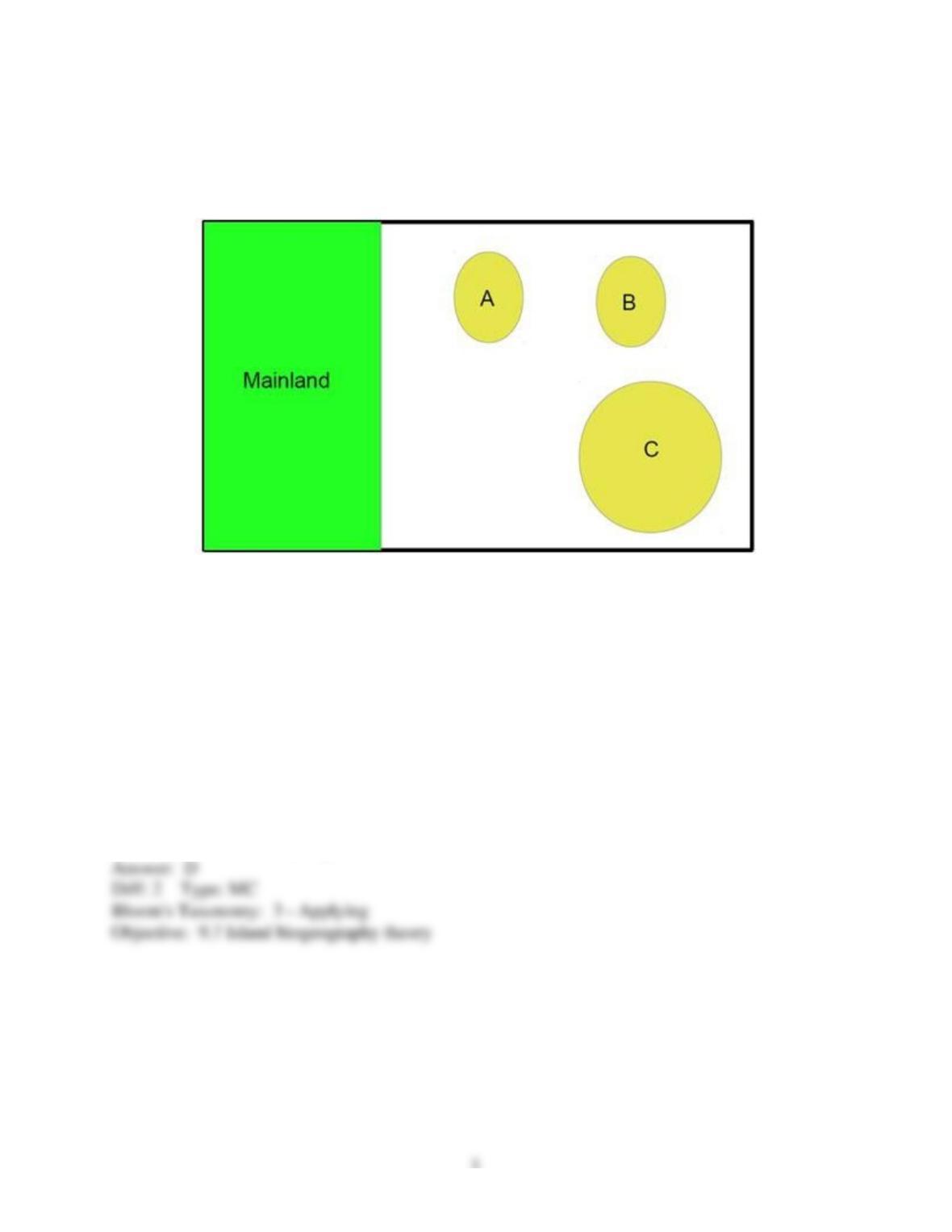
Figure 9.1
There are three islands in Figure 9.1: A, B,and C. A and B are shown off the coast of the
mainland; A is closest to the mainland; B is the same size as A but farther away. C is larger than
both A and B but it is the same distance from the shore as B.
Use Figure 9.1 to answer the following questions.
1) Refer to Figure 9.1. Which statement is TRUE with respect to the distance effect?
A) B will have more species because it is farther away.
B) C will have more species because it is farther away.
C) The islands will all have the same number of species because distance is not a factor.
D) A will have more species because it is closest to the mainland.
E) B and C will have more species than A.
2) Refer to Figure 9.1. It is TRUE that because of size, the rate of ________.
A) immigration is highest on A
B) extinction is highest on C
C) emigration is highest on A
D) immigration is highest on C
E) extinction is lowest on A
3) Refer to Figure 9.1. Which of the following statements is TRUE?
A) The extinction rate is highest on C.
B) The immigration rate is highest on A.
C) The extinction rate is highest on A.
D) There is greater emigration on C.
E) There is greater emigration on A.
3
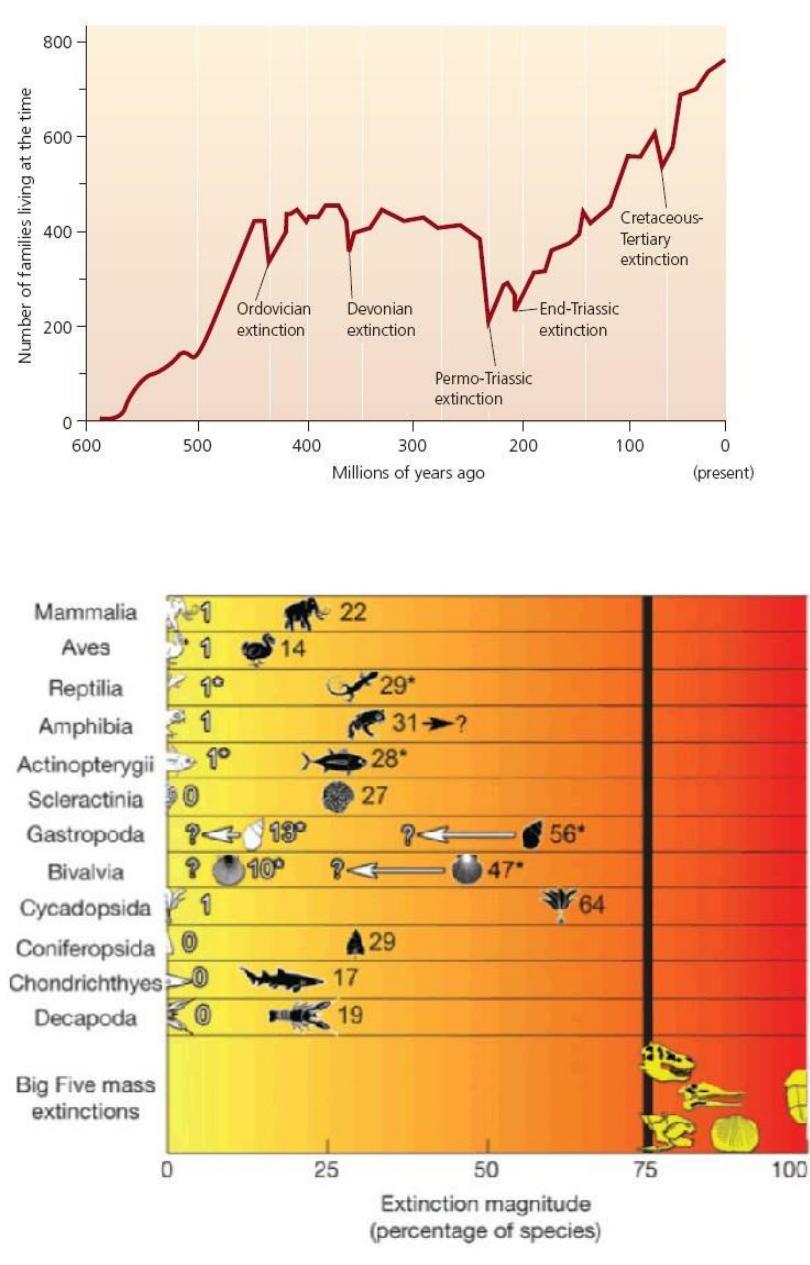
Figure 9.2 a) Source: Data from Raup, D. M., and J. J. Sepkoski (1982), Mass extinctions in the
marine fossil record. Science 215: 1501-1503.
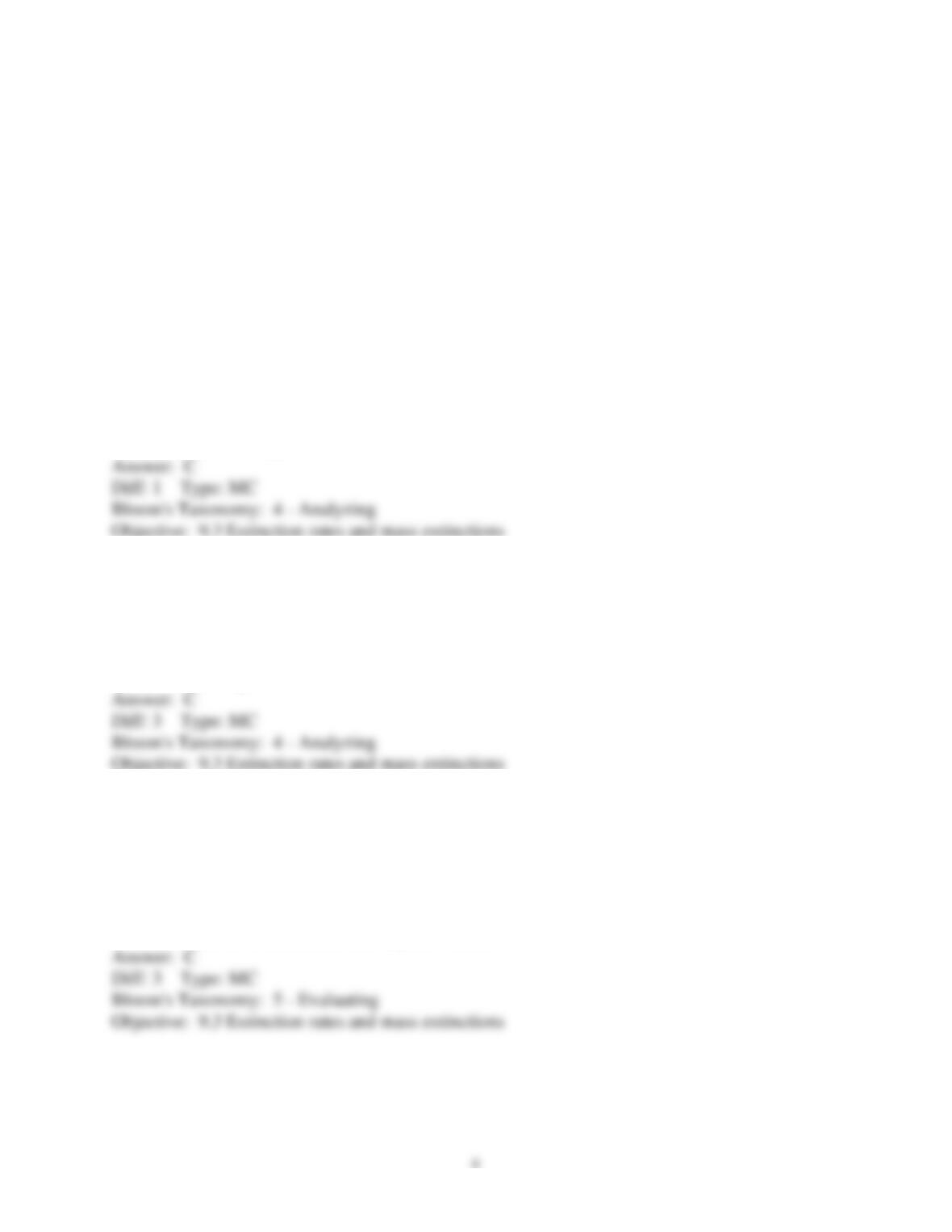
Figure 9.2 b) Percentages of each group that have become extinct or endangered during the past
500 years (left side) compared to the species-loss marking “Big Five” mass extinctions (bottom
right). The white icons show species that are Extinct or Extinct in the Wild. The black icons add
groups that are Threatened. The arrows indicate cases where the assessments may be either
inflated or underestimated.
Source: From Barnosky et al. (2001), Has the Earth’s sixth mass extinction already arrived?
Nature, 471: 51.
Use Figure 9.2 a) and 9.2 b) to answer the following questions.
4) Refer to Figure 9.2. a). Which of the five major extinctions was the largest?
A) Ordovician
B) Devonian
C) Permo-Triasic
D) End-Triasic
E) Cretaceous-Tertiary
5) Refer to Fig. 9.2.a). This graph suggests that the mass extinctions ________.
A) occur at roughly the same speed as the recovery
B) are slower than the recovery
C) are faster than the recovery
D) became less pronounced with time
E) have no clear pattern
6) Refer to Fig. 9.2.a). According to this figure, at the family level, the extinction rate was
________.
A) the lowest in the Permo-Triasic extinction
B) the highest in the Permo-Triasic extinction
C) roughly similar in all five major extinctions
D) the highest in the Cretacious-Tertiary extinction
E) the lowest in the Cretacious-Tertiary extinction
7) Refer to Figure 9.2. a) and Figure 9.2 b). Looking at these two figures together ,we can
conclude that the anthropogenic extinction during the last 500 years has ________ magnitude
________ rate compared to the “Big Five” mass extinctions of the past.
A) higher; and a higher
B) higher; but a lower
C) lower; but a higher
D) lower; and a lower
E) lower; and a similar
9.2 Matching Questions
Match the following.
A) genetic eccentricity
B) Canada Environmental Protection Agency
C) extinction
D) genetic diversity
E) extirpated
F) biophilia
G) hotspot
H) speciation
I) Wise-use advocates
J) Parks Canada
K) Canada Wildlife Service
L) community
M) endemic
N) UNESCO
O) umbrella species
P) extirpation
Q) major species
R) alleles
1) The loss of species from the planet
2) Differences in DNA composition among individuals within a given species
3) A population differentiating, over time into a new species
4) Protected animals, such as tigers, that need large amounts of land
5) The connections that human beings subconsciously seek with the rest of life
6) An area that supports an especially great diversity of endemic species
7) Species occurring in only one area
8) Manages national wildlife refuges that serve as wildlife havens; encourages hunting, fishing,
wildlife observation, photography, and environmental education
9) Manages world heritage sites, which include sites of cultural and natural importance
10) Promotes the transfer of federal lands to provincial, municipal, or private hands so that it can
be used for motorized recreation as well as extracting minerals, timber, and fossil fuels
Diff: 2 Type: MA
Bloom’s Taxonomy: 2 – Understanding
Objective: 9.9 Parks and reserves
9.3 Short Answer Questions
1) Polar bears are appearing more frequently in human settlements in the Canadian Arctic.
Explain the two very different interpretations of this fact and how they are used to argue for a)
increase and b) decrease in the number of permits for polar bears hunting.
2) What is the definition of biodiversity?
3) What is inbreeding, and why is it a problem?
4) What is habitat fragmentation and why is it a serious threat to bird species?
5) What is the main cause of the sixth mass extinction event, and why is it of particular concern?
6) Species diversity increases through the process of ________ and decreases through the
process of ________.
7) Most extinctions preceding the appearance of humans have occurred one by one, at a rate that
paleontologists refer to as the ________.
8) All of the valuable processes that intact ecosystems provide for us free of charge are known as
________.
9) Briefly explain wildlife corridors.
10) The extinction of a particular population from a given area (but not the entire species
globally) is called ________.
11) How can clearing plots within a forest affect the biodiversity of this forest?
12) When you want to protect enormous, beautiful, and unusual natural features such as the
spectacular mountains in Banff, Alberta, you are likely motivated by ________.
13) Explain how the physical appearance of polar bears distinguishes their species from other
bears and how it makes them well adapted to their specific habitat.
9.4 Multiple-Choice Questions
1) According to E. O. Wilson, biodiversity occurs on all levels EXCEPT ________.
A) genetic variants of a single species
B) individual species
C) communities of organisms
D) ecosystems
E) net biomass
2) A population of birds is found on a remote island. Which of the following information is most
important in deciding if the birds all belong to a single species or two separate species?
A) They share many physical characteristics.
B) They can breed with one another.
C) The males all sing very similar songs.
D) The offspring of some matings are sterile.
E) All the birds appear to eat the same range of food.
3) Which scientists classify species by using an organism’s physical appearance and genetic
makeup?
A) ecologists
B) taxonomists
C) geneticists
D) environmentalists
E) agronomists
4) The greatest diversity (numbers of different species) of organisms can be found in ________.
A) flowering plants
B) fish
C) insects
D) birds
E) mammals
5) The extinction of a particular population from a given area (but not the entire species globally)
is called ________.
A) extinction
B) extirpation
C) emigration
D) evolution
E) adaptation
6) The IUCN’s Red List is a(n) ________.
A) updated list of species facing unusually high risk of extinction
B) list of unidentified species
C) list of ecologically damaged ecosystems
D) identification list of known species
E) scorecard of international failures at conservation
7) Changes in habitat have tremendous effects on the local organisms that depend on them.
These effects are generally ________.
A) negative; organisms are already adapted to the habitats in which they occur and any change is
likely to render the habitat less suitable
B) positive; organisms are already adapted to the habitats in which they occur and any change is
likely to render the habitat more suitable
C) positive; the changes increase the habitat that is available for species to colonize
D) negative; the changes usually cause rapid extinction of most species
E) neutral; the variations within each species allow them to adapt very quickly
8) A species of lizard has gone extinct. This could have occurred because of any of the following
reasons EXCEPT ________.
A) inbreeding
B) habitat destruction by humans
C) introduction of a species that competed for food resources
D) increased genetic diversity within the species
E) climate change
9) In general, successful introduced species experience ________.
A) increased environmental resistance
B) decreased environmental resistance
C) increases in limiting factors
D) increased competition from other organisms
E) decreased biotic potential
10) Bullfrog tadpoles are often sold as fish bait, even in areas where they do not occur naturally.
When people buy 10 of them and don’t use them all, they often dump the remainder into the lake
or river. This is an example of ________.
A) habitat destruction
B) overharvesting of species from the wild
C) introduced species
D) inbreeding
E) extirpation
11) Biodiversity enhances food security because it ________.
A) provides genetic stability
B) reduces the number of pollinators
C) can protect some crops through genetic resources against losses caused by disease
D) decreases the number of predators
E) increases the number of available pathogens
12) Which of the following can change local species diversity but NOT global diversity?
A) immigration and extirpation
B) speciation and extinction
C) speciation and immigration
D) emigration and extinction
E) extirpation and extinction
13) Which of the following can change global species diversity?
A) immigration and extirpation
B) speciation and extinction
C) speciation and immigration
D) emigration and extinction
E) extirpation and extinction
14) Which of the following are facing the highest rates of extinction?
A) K-strategists in general, especially through overexploitation
B) r-strategists in general
C) insects in general
D) birds in general
E) plants in general
15) Removal of which of the following species will always result in the greatest changes in an
ecological system?
A) a competitive species
B) a carnivore species
C) a keystone species
D) a producer species
E) a decomposer species
16) The species most often vulnerable to human impact is the ________.
A) top predator
B) keystone species
C) decomposer
D) producer
E) competitive species
17) The field of conservation biology ________.
A) was developed in response to government intervention
B) was initially viewed as too measurement oriented, looking at details and not at the big picture
C) attempts to integrate an understanding of evolution, ecology, and extinction
D) tries to conserve every species, everywhere
E) tries to increase speciation events in order to increase biodiversity