Chapter 9 – Non-current assets and depreciation
TRUE/FALSE
1. The future benefits of a non-current asset are difficult to determine, due to the uncertainty of
measuring the unexpired benefit.
2. Depreciation spreads the original cost of a non-current asset over its useful life, but it cannot be
considered a precise measure as it is based on forecasts of future outcomes.
3. A major difference between current and non-current assets is that the future benefits of current
assets will expire in a short period of time, whereas the future benefits of all non-current assets will
decline over a longer period.
4. An expenditure is material if its omission or misstatement could influence economic decisions of
users.
5. Ongoing repairs to a machine used in the production process are considered part of the cost of the
machine.
6. The cost of a non-current asset consists of the purchase consideration, plus all incidental costs
incurred in getting the asset into a location and ready for use, and all costs that enhance the future
economic benefits of the asset beyond those initially expected at acquisition.
7. Residual value can be defined as the estimated disposal (sale) value of an asset when it is no longer
useful to the entity.
8. When technology is changing rapidly, depreciation of an asset will help maintain an entity’s
operating capacity.
9. Depreciation refers to the systematic allocation of the depreciable amount of a depreciable asset
over its useful life.
10. The expensing of an item that should have been capitalised as an asset will understate profits.
11. The reducing-balance method is an alternative method to the units-of-output method, and may be a
better reflection of the actual usage of most assets, such as plant and equipment.
12. If two entities use different methods of depreciation, then users need to make adjustments for this
when comparing the financial statements of the entities.
13. A machine was purchased for $30,000 with a life expectancy of five years and a zero residual
value. Under the straight-line method, the depreciation expense would be calculated at 20% per
annum of the cost.
14. Because goodwill is unidentifiable, it cannot be recognised as an asset.
15. Whether an asset should be reported as current or non-current, depends on whether the asset is in
the form of cash or will be realised or consumed within the ensuing operating cycle of the entity.
16. From the Hicksian economic viewpoint, profit is the amount which an individual can consume
over a period and still be as well off at the end of the period as he/she was at the beginning of the
period.
17. Depreciation expense has the effect of reducing profit, equity and assets.
18. The accumulated depreciation account, unlike the allowance for doubtful debts, is not a contra
account.
19. Depreciation is concerned with allocation not valuation.
20. The fundamental difference between identifiable and unidentifiable intangible assets is whether the
assets are separable from the business.
MULTIPLE CHOICE
1. Which of the following would not explain the difference between current and non-current assets?
A.
The future benefit of current assets will generally be used up within the entity’s operating
cycle.
B.
An expenditure is classified as a non-current asset if it is considered to be material.
C.
An asset is classified as non-current if it is intended to be used within the business for a
considerable period of time.
D.
The nature and intention of the business can help determine whether an expenditure should
be classified as a non-current asset.
2. The expensing of an office fan in the year purchased may be justified on the basis of:
A.
full disclosure.
B.
matching.
C.
consistency.
D.
materiality.
3. The cost of a non-current asset includes:
A.
all reasonable and necessary costs.
B.
production costs only.
C.
manufacturing costs only.
D.
marketing and selling costs only.
4. An expenditure that extends the life of an asset or enhances its value is a(n):
A.
capital expenditure, recorded as an asset.
B.
operating expenditure, recorded as an expense.
C.
investing expenditure, recorded as an expense.
D.
financing expenditure, recorded in shareholders’ equity.
5. Chan bought a second-hand car for $12,500. The original cost of the car was $18,000. He made
several modifications to the car to make it go faster. These modifications cost him $3000. What
will be the cost of the car when he decides to sell it (ignoring any depreciation charges)?
A.
$21,000
B.
$15,500
C.
$12,500
D.
$18,000
6. Jamboree Ltd has acquired land for tree farming. The cost of the land was $230,000 and an additional
amount of $45,000 was spent on land improvements. The land improvement cost should be:
A.
included in the cost of the land.
B.
subject to depreciation.
C.
deducted from the cost of the land.
D.
charged as an expense in the year of acquisition.
7. The following costs were incurred in the purchase of new office equipment.
Cash price
$22,000
Sales tax
3300
Insurance during transit
200
Installation
500
What amount should be recorded as the cost of the office equipment?
A.
$22,000
B.
$25,300
C.
$25,500
D.
$26,000
8. Which of the following is incorrect? Depreciation is calculated:
A.
on a systematic allocation basis.
B.
over the asset’s estimated useful life.
C.
to prevent losses.
D.
on a depreciable asset.
9. Which of the following assets is not depreciated?
A.
Buildings
B.
Motor vehicles
C.
Land
D.
Equipment
10. Which of the following is the main reason for depreciating non-current assets?
A.
To show consumption of economic benefits.
B.
To enable a business to continue production.
C.
To lessen the losses suffered by businesses.
D.
To set aside funds for the replacement of assets.
11. The expired cost of a depreciable asset is referred to as:
A.
residual value.
B.
carrying value.
C.
accumulated depreciation.
D.
depreciable cost.
12. Where an entity exists in a rapidly changing environment, depreciation of a non-current asset will:
A.
show the consumption of economic benefits during a given period.
B.
ensure operating capacity is maintained.
C.
provide sufficient funds to replace the asset.
D.
be inappropriate.
13. The cost of fixed assets recognised as being consumed during a fiscal period is:
A.
plant expense.
B.
depreciation expense.
C.
interest expense.
D.
cost of goods sold.
14. When a company reports depreciation expense on the statement of comprehensive income:
A.
it is based on allocations of cost rather than on the current value of the asset.
B.
the firm is reporting that asset’s decline in current value during the period.
C.
the shortest possible estimated useful life and lowest possible estimated residual value are
usually chosen.
D.
the company is ignoring the going-concern concept.
15. The using-up process or utilisation of intangible assets is referred to as:
A.
depreciation.
B.
depletion.
C.
dilution.
D.
amortisation.
16. How is accumulated depreciation reported in the financial statements?
On the Under the category of
A.
balance sheet assets
B.
balance sheet liabilities
C.
statement of comp income revenues
D.
statement of comp income expenses
17. If a firm’s depreciation expense doubles in a period which of the following will increase as a result
of this event?
Net profit Cash flow
A.
Yes Yes
B.
Yes No
C.
No Yes
D.
No No
18. Accumulated depreciation, as used in accounting, represents:
A.
funds (or cash) set aside to replace the asset being depreciated.
B.
earnings retained in the business that will be used to purchase another plant asset when the
present asset becomes fully depreciated.
C.
an expense that is shown in the statement of comprehensive income.
D.
the portion of the cost of a plant asset written off as an expense since the asset was
acquired.
19. If a firm’s depreciation expense is cut by 25% in a period which of the following will decrease as a
result of this event?
Net profit Cash flow
A.
Yes Yes
B.
Yes No
C.
No Yes
D.
No No
20. A business ended the year with a cash balance of $40,000. During the year, the following
transactions took place:
Cash purchase of a new computer
$5000
Depreciation expense
1500
Accumulated depreciation
1500
Assuming no other transactions took place, the cash at the beginning of the year was:
A.
$45,000.
B.
$48,000.
C.
$46,500.
D.
$35,000.
21. Depreciation affects profit in which of the following ways?
A.
Decreases profit, because it decreases a non-current asset.
B.
Increases profit, because it is an acquisition of a non-current asset.
C.
Profit decreases, because depreciation is an expense item.
D.
Profit increases, because depreciation is an expense item.
22. The expensing of a depreciable item when it should have been capitalised will result in:
A.
understated net profit for the current period.
B.
understated net profit for the succeeding period.
C.
overstated depreciation expense for the succeeding period.
D.
overstated total assets at end of current period.
23. Depreciation and amortisation:
A.
reduce net profit and cash flow from operating activities.
B.
reduce net profit but increase cash flow from operating activities.
C.
reduce net profit but have no direct effect on cash flow from operating activities.
D.
have no direct effect on net profit or cash flow from operating activities.
24. The carrying value of plant assets is:
A.
the cost of the assets less accumulated depreciation.
B.
an indicator of the market value of the assets.
C.
cost less residual value.
D.
not reported in the financial statements.
25. A building was purchased for $100,000 and used for four years of its estimated 10-year life. It has
no residual value and the straight-line method is used. The carrying value of the building after the
four years’ usage would be reported on the balance sheet at:
A.
$20,000.
B.
$40,000.
C.
$60,000.
D.
$80,000.
26. Consider the following information and answer the question(s) below.
Estimated
Residual
Depreciation
Machine
Date
Cost
life
value
method
1
30 Sept 20X5
$8500
12 years
$ 0
Reducing-balance
(Assume rate = 0.105)
What is the total accumulated depreciation at 30 June 20X7 for machine 1?
A.
$1786
B.
$1492
C.
$682
D.
$1827
27. Mendips Ltd net profit would be understated if in the first year, the residual value were excluded
when determining the depreciation expense using:
Straight-line Reducing balance
A.
Yes No
B.
Yes Yes
C.
No No
D.
No Yes
28. On 1 July 20X7, Gumi Company purchased equipment at a cost of $22,000. The equipment has an
estimated residual value of $3000 and is being depreciated over an estimated useful life of eight
years under the reducing-balance method of depreciation, at a rate equal to one-and-a-half times
the straight-line depreciation rate. For the six months ended 31 December 20X7, Gumi Company
recorded one-half year’s depreciation. What should the depreciation expense be (rounded to the
nearest dollar) on the equipment for the year ended 31 December 20X8? What is the written-down
book value at 31 December 20X8?
A.
Depreciation expense $2063, written-down book value $19,937.
B.
Depreciation expense $3158, written-down book value $18,842.
C.
Depreciation expense $3738, written-down book value $16,199.
D.
Depreciation expense $5791, written-down book value $14,146.
29. Flamingo Corporation purchased a machine for $300,000 on 1 January 20X7. The estimated life is
10 years. What is the book value on the 31 December 20X9 balance sheet, assuming that straight–
line depreciation is used and the estimated residual value is zero?
A.
$300,000
B.
$210,000
C.
$120,000
D.
$60,000
30. On 1 January 20X7, the local Red Cross affiliate acquired new blood-processing equipment
costing $400,000. The equipment has an estimated useful life of 10 years and an estimated residual
value of $50,000. After making all necessary calculations and entries on 31 December 20X8, what
are the accumulated depreciation to date and carrying value of the equipment? (Assume that the
straight-line method is used.)
Accumulated depreciation Carrying value as of
as of 31 December 20X8 31 December 20X8
A.
$70,000 $330,000
B.
$70,000 $280,000
C.
$35,000 $330,000
D.
$80,000 $320,000
31. Which of the following statements is true of the straight-line and/or reducing-balance methods
(using the theoretical rate) of depreciation?
A.
The two methods yield different amounts of total depreciation expense over the useful life
of the asset.
B.
The two methods yield the same amount of total depreciation expense over the useful life
of the asset.
C.
The straight-line method is applied to assets that wear and tear faster in the earlier years.
D.
The reducing-balance method is applied to assets that generate more revenue in later
years.
32. Compared to straight-line depreciation, reducing-balance depreciation:
A.
results in lower net profit in earlier years and higher net profit in later years.
B.
is used more often on the statement of comprehensive income than is the straight-line
method.
C.
leads to higher book values for depreciable assets than does the straight-line method.
D.
allocates larger portions of cost to later periods than to earlier ones.
33. When a plant asset is sold, the gain or loss on disposal is computed as the difference between:
A.
fair market value and accumulated depreciation.
B.
selling price and accumulated depreciation.
C.
fair market value and selling price.
D.
selling price and carrying value.
34. Slow Trucking owned a truck that cost $30,000 when it was purchased on 1 January 20X7. It had
accumulated depreciation of $18,000 at 31 December 20X8. Slow originally estimated that the
truck would have a residual value after using it for four years of $3000. It sold the truck for
$22,500 cash on 1 January 20X9. The amount of gain (loss) on the sale of the truck was:
A.
$4500 gain.
B.
$19,500 gain.
C.
$1500 loss.
D.
$10,500 gain.
35. An example of an intangible asset classification on a balance sheet is:
A.
rights held for a radio licence to the Himalayas.
B.
shares in BHP Limited.
C.
improvements to electric cables.
D.
interest on debentures due to be paid in 2010.
36. Which of the following is not an identifiable intangible asset?
A.
A patent
B.
Copyright
C.
Goodwill
D.
A brand name
37. A pair of identifiable and unidentifiable assets is:
A.
patents and copyrights.
B.
brand names and goodwill.
C.
copyright and franchises.
D.
research and development and patents.
38. Which of the following would not be included in property, plant and equipment?
A.
Equipment
B.
Buildings
C.
Goodwill
D.
Land
39. The excess of the cost of acquisition of a company over the fair value of its net identifiable assets
is known as:
A.
surplus.
B.
amortisation.
C.
goodwill.
D.
abatement.
40. Which of the following is not an intangible asset?
A.
Goodwill
B.
Patent
C.
Copyright
D.
Land
41. Sonya’s Fabrics purchased display equipment two years ago on 1 January for $10,000. Its expected
useful life was five years, and its residual value $1000. To record the depreciation for the current
year just ended, what would be the accounting entry, using the straight-line method?
A.
Increase both Depreciation Expense and Accumulated Depreciation by $2000.
B.
Increase Depreciation Expense and decrease Equipment, both by $1000.
C.
Increase Depreciation Expense and increase Accumulated Depreciation by $1800.
D.
Decrease both Depreciation Expense and Accumulated Depreciation by $1000.
42. An asset has a cost of $80,000, estimated residual value of $20,000 and estimated useful life of
five years. What is the amount of the depreciation expense for the first year, assuming the
reducing-balance method is used and the annual rate is 30%?
A.
$12,000
B.
$16,000
C.
$18,000
D.
$24,000
43. A computer system, which cost $9000 with a carrying value of $2000, is sold for $1700. Which of
the following adjustments is correct?
A.
Accumulated depreciation is decreased by $2000.
B.
The asset (computer) is decreased by $2000.
C.
A loss on sale of $300 is recognised.
D.
Accumulated depreciation is reduced by $7300.
44. The useful life of an asset for accounting purposes refers to:
A.
the period of time over which an asset is considered to be of use to an entity.
B.
the expected life of the asset based on engineering estimates.
C.
the maximum physical life of the asset.
D.
the shortest of the physical and economic lives of the asset.
45. Goodwill:
A.
is the collective name for the unidentifiable assets of an entity.
B.
may not be recognised as an asset.
C.
is the collective name for identifiable assets.
D.
includes trademarks and brand names.
46. Which of the following assets cannot be included as unidentifiable intangibles?
A.
Customer relations
B.
Size of the market controlled
C.
Copyright ownership
D.
Superior management skills
PROBLEM
1. Grey Egret Ltd purchased an item of equipment at a total cost of $85,000 on 1 October 20X7. The
equipment was expected to have residual value of $20,000 at the end of its five-year useful life to
the firm. The company’s financial year ends on 30 June.
(a)
Calculate the annual depreciation expense for the year ended 30 June 20X8 and
20X9, assuming that the equipment was depreciated using the straight-line
method.
(b)
Calculate the annual depreciation expense for the year ended 30 June 20X8 and
20X9, assuming that the equipment was depreciated using the reducing balance
method, at a rate of 26% per annum.
(c)
Show how the item of equipment would appear in the balance sheet of Grey
Egret Ltd at 30 June 20X9 assuming the straight-line method is used.
(a)
Year ended 30 June 20X8: $85,000 – 20,000 / 5 = $13,000 per annum.
Pro-rata $13,000 x 0.75 = $9750. Year ended 30 June 20X9: $13,000.
(b)
Year ended 30 June 20X8: $85,000 x 0.26 x 0.75 = $16,575.
Year ended 30 June 20X9: $85,000 – 16,575 x 0.26 = $17,790.
(c)
Balance sheet extract as at 30 June 20X9
Accumulated depreciation
(22,750)
$62,250.
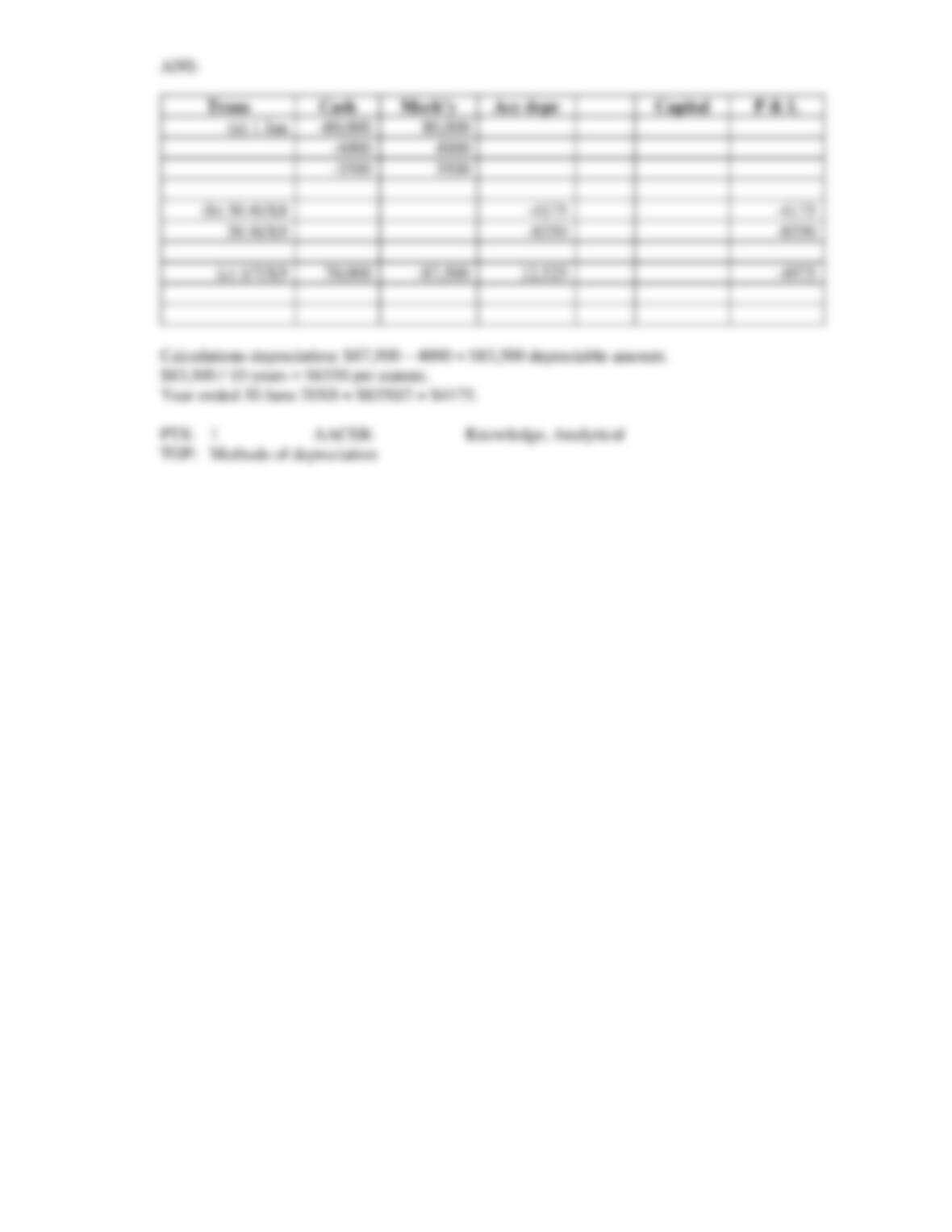
2. On 1 January 20X7 Pacioli Traders purchased machinery for use in the business. The purchase
price of the machinery was $80,000 cash. The business paid an additional $4000 cash to have the
machinery freighted from Sydney to Perth. A further $3500 cash was paid to install the machinery.
The machine was expected to have a useful life of 10 years and a residual value of $4000. The
financial year of the business ends on 30 June. The entity depreciates all machinery using the
straight-line method.
The machinery was sold on 1 July 20X9 for $70,000 cash.
(a)
Record the transactions dealing with the purchase of the asset at 1 January 20X7
on the worksheet provided.
(b)
Record the depreciation of the machinery at 30 June 20X8 and 30 June 20X9 on
the worksheet provided.
(c)
Record the sale of the machinery at 1 July 20X9 on the worksheet provided.
CASE
1. Albifrons Chat Ltd purchased an expensive new item of machinery for use in its manufacturing
process. The machine was manufactured on the site of the vendor. Albifrons assumed
responsibility for the cost of removing the new machine and restoring the site on which the plant
was originally built by the vendor. The obligation was a term of the original agreement for
acquiring the asset from the vendor. While it was clear to the company that the net invoice price
before GST and the cost of freighting the machine from Melbourne to the company’s
manufacturing plant in Sydney were to be capitalised as part of the cost of the asset, there was
some uncertainty surrounding the treatment of the items listed in (i) to (vi) below. All items of
expenditure were considered to be material in amount.
Discuss whether you consider the items should be capitalised or otherwise using the guidance
provided on the matter in paragraph 16 of AASB 116 Property, Plant and Equipment, as the basis
of your analysis. The paragraph appears as an exhibit below item (vi).
(i)
Government sales tax (GST) on the machine.
(ii)
Wages paid to employees for time spent in (i) removing the machine that the
newly acquired item replaced, and (ii) subsequently preparing the site for the
installation of the new machine.
(iii)
The cost of removing the new machine and restoring the sight. The task was
outsourced by Albifrons to a Melbourne based firm.
(iv)
Estimated fees for the removal of the new machine and the restoration process to
be conducted by a third party on behalf of Albifrons.
(v)
Costs of testing whether the machinery was functioning properly subsequent to
installation at the company’s Sydney plant. The samples produced during the
testing process were subsequently sold. The cost of selling the samples amounted
to 10% of the revenue obtained.
(vi)
Costs of marketing the new line of inventory that will be produced with the
machine.
Exhibit
AASB 116 Property, plant and equipment
Elements of Cost
The cost of an item of property, plant and equipment comprises:
(a)
its purchase price, including import duties and non-refundable purchase taxes,
after deducting trade discounts and rebates.
(b)
any costs directly attributable to bringing the asset to the location and condition
necessary for it to be capable of operating in the manner intended by
management; and
(c)
the initial estimate of the costs of dismantling and removing the item and
restoring the site on which it is located, the obligation for which an entity incurs
either when the item is acquired or as a consequence of having used the item
during a particular period for purposes other than to produce inventories during
that period.
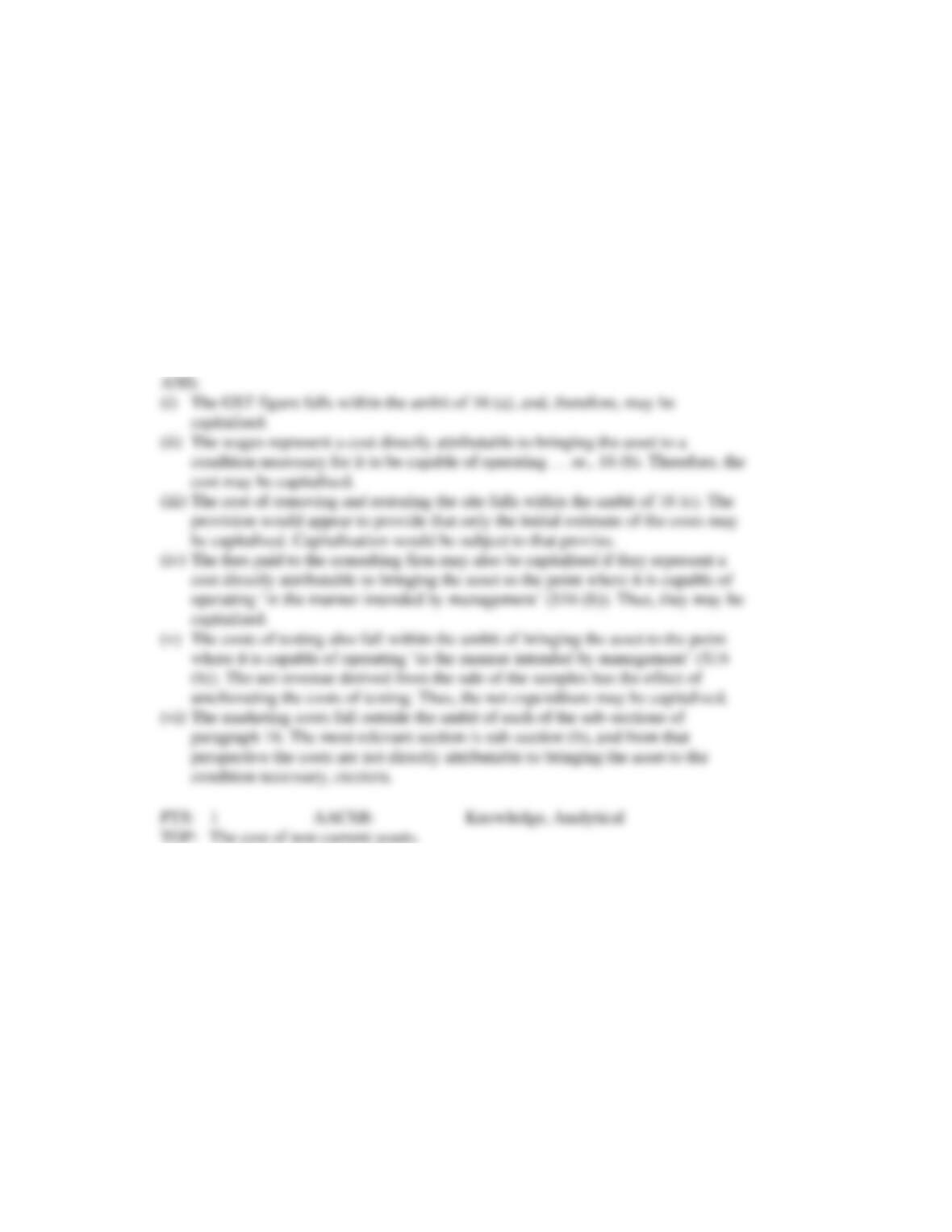
The GST figure falls within the ambit of 16 (a), and, therefore, may be
capitalised.
(ii)
The wages represent a cost directly attributable to bringing the asset to a
condition necessary for it to be capable of operating … re., 16 (b). Therefore, the
cost may be capitalised.
(iii)
The cost of removing and restoring the site falls within the ambit of 16 (c). The
provision would appear to provide that only the initial estimate of the costs may
be capitalised. Capitalisation would be subject to that proviso.
(iv)
The fees paid to the consulting firm may also be capitalised if they represent a
cost directly attributable to bringing the asset to the point where it is capable of
capitalised.
ameliorating the costs of testing. Thus, the net expenditure may be capitalised.
(vi)
The marketing costs fall outside the ambit of each of the sub-sections of
paragraph 16. The most relevant section is sub-section (b), and from that
perspective the costs are not directly attributable to bringing the asset to the
condition necessary, etcetera.