73) You are trying to decide between three mutually exclusive investment opportunities. The most
appropriate tool for identifying the correct decision is:
A) internal rate of return (IRR).
B) net present value (NPV).
C) profitability index.
D) incremental internal rate of return (IRR).
Use the table for the question(s) below.
Consider the following two projects:
Project
Year 0
Cash Flow
Year 1
Cash Flow
Year 2
Cash Flow
Year 3
Cash Flow
Year 4
Cash Flow
Discount
Rate
A
–100
40
50
60
N/A
0.15
B
–73
30
30
30
30
0.15
74) Assume that projects A and B are mutually exclusive. The correct investment decision and the best
rationale for that decision is to
A) invest in project B, since NPVB > NPVA.
B) invest in project A, since NPVA > 0.
C) invest in project A, since NPVB < NPVA.
D) invest in project B, since IRRB > IRRA.
Use the table for the question(s) below.
Consider the following two projects:
Project
Year 0
C/F
Year 1
C/F
Year 2
C/F
Year 3
C/F
Year 4
C/F
Year 5
C/F
Year 6
C/F
Year 7
C/F
Discount
Rate
Alpha
–79
20
25
30
35
40
N/A
N/A
15%
Beta
–80
25
25
25
25
25
25
25
16%
75) Assume that projects Alpha and Beta are mutually exclusive. The correct investment decision and the
best rationale for that decision is to
A) invest in project Beta, since NPVBeta > 0.
B) invest in project Beta, since IRRB > IRRA.
C)
invest in project Beta, since NPVBeta > NPVAlpha > 0.
D) invest in project Alpha, since NPVBeta < NPVAlpha.

SHORT ANSWER. Write the word or phrase that best completes each statement or answers the question.
76) How do you apply the Net Present Value rule when multiple projects are available and you have the
added constraint of accepting only one project?
77) What can you comment about the shape of the net present value (NPV) profile of a multiple IRR project?
78) Is there a unique way for calculating the MIRR to resolve the multiple IRR situation?
79) What are some potential problems in using internal rate of return (IRR) for mutually exclusive projects?
80) What is a safe method to use when confronted with mutually exclusive projects?
TRUE/FALSE. Write ‘T’ if the statement is true and ‘F’ if the statement is false.
81)
You can evaluate alternative projects with different lives by calculating and comparing their equivalent
annual annuity.
82) When using equivalent annual annuities to compare the costs of projects with different lives, you should
not consider any changes in the expected replacement cost of equipment.
MULTIPLE CHOICE. Choose the one alternative that best completes the statement or answers the question.
83) When comparing two projects with different lives, why do you compute an annuity with an equivalent
present value (PV) to the net present value (NPV)?
A) to ensure that cash flows from the project with a longer life that occur after the project with the
shorter life has ended are considered

B) to reduce the danger that changes in the estimate of the discount rate will lead to choosing the
project with a shorter timeframe
C) so that the projects can be compared on their cost or value created per year
D) so that you can see which project has the greatest net present value (NPV)
84) A janitorial services firm is considering two brands of industrial vacuum cleaners to equip their staff.
Option A will cost $1500, will require servicing of $200 per year, and last five years. Option B will cost
$1000, require servicing of $100 per year, and last three years. If the cost of capital is 8%, which is the
better option, given that the firm has an ongoing requirement for vacuum cleaners?
A) Option B, since it has a lower equivalent annual annuity.
B) Option A, since it has a greater equivalent annual annuity.
C) Option A, since it has a lower equivalent annual annuity.
D) Option B, since it has a greater equivalent annual annuity.
85) A garage is comparing the cost of buying two different car hoists. Hoist A will cost $20,000, will require
servicing of $1000 every two years, and last ten years. Hoist B will cost $15,000, require servicing of $800
per year, and last eight years. If the cost of capital is 7%, which is the better option, given that the firm
has an ongoing requirement for a hoist?
A) Hoist B, since it has a greater present value (PV).
B) Hoist B, since it has a greater equivalent annual annuity.
C) Hoist A, since it has a greater equivalent annual annuity.
D) Hoist A, since it has a greater present value (PV).
86) A security company offers to provide CCTV coverage for a parking garage for ten years for an initial
payment of $50,000 and additional payments of $20,000 per year. What is the equivalent annual annuity
of this deal, given a cost of capital of 6%?
87) An company buys a color printer that will cost $18,000 to buy, and last 5 years. It is assumed that it will
require servicing costing $500 each year. What is the equivalent annual annuity of this deal, given a cost
of capital of 12%?
A) –$3983
B) –$5493
C) –$4957
D) –$4002

88) A lawn maintenance company compares two ride–on mowers the Excelsior, which has an expected
working–life of six years, and the Grassassinator, which has a working life of four years. After examining
the equivalent annual annuities of each mower, the company decides to purchase the Excelsior. Which of
the following, if true, would be most likely to make them change that decision?
A) The prices of equivalent mowers are expected to grow in the future as lawnmower manufacturers
consolidate.
B) The mower is only expected to be needed for three years.
C) The number of customers requiring lawn–mowing services is expected to sharply increase in the
near future.
D) Fuel prices are expected to rise and raise the annual running costs of all mowers.
89) Jenkins Security has learned that a rival has offered to supply a parking garage with security for ten
years for $50,000 up front and a further $20,000 per year. If Jenkins Security offers to provide security for
eight years for an upfront cost of $70,000 and a separate yearly payment, what is the maximum that this
yearly payment can be so that Jenkins’ offer matches the equivalent annual annuity of their rival’s offer?
(Assume a cost of capital of 6%.)
A) $15,521
B) $13,458
C) $13,095
D) $13,995
90) A consultancy calculates that it can supply crude oil assaying services to a small oil producer for $120,000
per year for five years. There are some upfront costs the consultancy will require the oil producer to
absorb. What is the maximum that these upfront costs could be, if the equivalent annual annuity to the
oil company is to be under $150,000, given that the cost of capital is 10%?
A) $128,698
B) $113,724
C) $30,000
D) $150,000
TRUE/FALSE. Write ‘T’ if the statement is true and ‘F’ if the statement is false.
91) When different projects put different demands on a limited resource, then net present value (NPV) is
always the best way to choose the best project.

92) The profitability index can break down completely when dealing with multiple resource restraints.
MULTIPLE CHOICE. Choose the one alternative that best completes the statement or answers the question.
93) Initial Investment Cash flow
Project A $5 million $2 million per year for four years
Project B $3 million $1 million per year for five years
Project C $2 million $1 million per year for four years
Project D $3 million $1.5 million per year for three years
An investor has a budget of $5 million. He can invest in the projects shown above. If the cost of capital is
6%, what investment or investments should he make?
A) Project A
B) Project B
C) Project B and Project C
D) Project C and Project D
94) Initial Investment Cash flow
Project A $7 million $4 million per year for three years
Project B $6 million $3 million per year for three years
Project C $5 million $2 million per year for six years
Project D $4 million $1.5 million per year for eight years
An investor has a budget of $10 million. He can invest in the projects shown above. If the cost of capital is
6%, what investment or investments should he make?
A) Project A
B) Project B
C) Project B and Project D
D) Project C and Project D
95) 0 1 2 3
Investment B: –$1 million $500,000 $400,000 $300,000
The timeline of an investment is shown above. If the cost of capital is 5%, what is the profitability index
of this investment?
A) 0.098
B) 0.105
C) 0.368
D) 0.256

96) The owner of a number of gas stations is considering installing coffee machines in his gas stations. It will
cost $280,000 to install the coffee machines, and they are expected to boost cash flows by $120,000 per
year for their five–year working life. What must the cost of capital be if this investment has a profitability
index of 1?
A) 4.69%
B) 2.34%
C) 1.06%
D) 5.28%
97) Book NPV Number of writers needed
Prep for the College Entry Test $800,000 24
Prep for the Dental School Entry Test $250,000 8
Prep for the Grad School Entry Test $450,000 12
Prep for the Law School Entry Test $320,000 9
Prep for the Medical School Entry Test $400,000 10
A company that creates education products is planning to create a suite of books to help customers
prepare for high–stakes tests for entry into college and grad school. They have 33 in–house writers to
create these books. Due to the expertise needed in creating this content it will not be possible to hire
temporary writers within the planned time–frame. Which projects should be undertaken?
A) Prep for the Grad School Entry Test, Prep for the Law School Entry Test, and Prep for the Medical School
Entry Test
B) Prep for the Dental School Entry Test, Prep for the Grad School Entry Test, and Prep for the Medical School
Entry Test
C) Prep for the College Entry Test and Prep for the Law School Entry Test
D) Prep for the College Entry Test and Prep for the Grad School Entry Test
98) Outstanding Job Hours to Print Job Penalty for not completing job in 24 hours
Job A 6 –$120
Job B 9 –$200
Job C 12 –$360
Job D 16 –$400
Job E 2 –$50
A print shop has contracted to print a number of jobs within 24 hours. Any jobs not completely printed
within this time will result in a penalty, as shown in the table above. However too many jobs have been
accepted, and not all can be printed. Which jobs should be printed in the next 24 hours?
A) Job C, Job B, and Job E
B) Job D, Job A, and Job E
C) Job C and Job B
D) Job D and Job A

99) Department Yearly Profit Space Required (square feet)
Pet $600,000 6000
Fabrics $1,000,000 7000
Book $320,000 4000
Luggage $360,000 3000
Hardware $900,000 6000
Watches $300,000 2000
Shoe Repair $30,000 1000
A small department store in a mall has the opportunity to rent an additional 20,000 square feet of space
for five years. It can divide up this space between the above new departments. Each department will
require a different amount of space, and each department is expected to make a yearly profit as shown,
for each of the next five years. The discount rate is 10%. Based on this information, what departments
should be added?
A) Pet, Fabrics, Hardware, and Shoe Repair
B) Pet, Fabrics, Luggage, Hardware, and Shoe Repair
C) Pets, Fabrics, Books, and Luggage
D) Fabrics, Luggage, Hardware, Watches, and Shoe Repair
100) Project Capital Investment Cash Flows from Investment
I $7 million $1.2 million per year in perpetuity
II $12 million $1.5 million per year in perpetuity
III $16 million $2.2 million per year in perpetuity
IV $10 million $1.4 million per year in perpetuity
A company has four projects it wishes to undertake. Which of these investments should be the lowest
priority, given a discount rate of 5%?
A) Project I
B) Project II
C) Project III
D) Project IV
101) You are opening up a brand new retail strip mall. You presently have more potential retail outlets
wanting to locate in your mall than you have space available. What is the most appropriate tool to use
if you are trying to determine the optimal allocation of your retail space?
A) payback period
B) internal rate of return (IRR)
C) net present value (NPV)
D) profitability index

Consider a project with the following cash flows:
Year
Cash Flow
0
–10,000
1
4000
2
4000
3
4000
4
4000
102) Assume the appropriate discount rate for this project is 15%. The profitability index for this project is
closest to:
A) 0.60
B) 0.15
C) 0.22
D) 0.14
Use the table for the question(s) below.
Consider the following two projects:
Project
Year 0
Cash Flow
Year 1
Cash Flow
Year 2
Cash Flow
Year 3
Cash Flow
Year 4
Cash Flow
Discount
Rate
A
–100
40
50
60
N/A
0.15
B
–73
30
30
30
30
0.15
103) The profitability index for project A is closest to:
A) 21.65
B) 0.12
C) 12.04
D) 0.17
104) The profitability index for project B is closest to:
A) 0.12
B) 12.64
C) 23.34
D) 0.17
Use the table for the question(s) below.
Consider the following list of projects:
Project
Investment
NPV

A
135,000
6,000
B
200,000
30,000
C
125,000
20,000
D
150,000
2,000
E
175,000
10,000
F
75,000
10,000
G
80,000
9,000
H
200,000
20,000
I
50,000
4,000
105) Assuming that your capital is constrained, which investment tool should you use to determine the
correct investment decisions?
A) net present value (NPV)
B) incremental IRR
C) internal rate of return (IRR)
D) profitability Index
106) Assuming that your capital is constrained, which project should you invest in first?
A) Project C
B) Project F
C) Project B
D) Project G
107) Assuming that your capital is constrained, what is the fifth project that you should invest in?
A) Project H
B) Project I
C) Project A
D) Project B
108) Assuming that your capital is constrained, which project should you invest in last?
A) Project C
B) Project A
C) Project D
D) Project I

109) Assuming that your capital is constrained, so that you only have $600,000 available to invest in projects,
which project should you invest in and in what order?
A) CBFH
B) CBGF
C) CBFG
D) BCFG
110) Assume that your capital is constrained, so that you only have $600,000 available to invest in projects. If
you invest in the optimal combination of projects given your capital constraint, then the total net present
value (NPV) for all the projects you invest in will be closest to:
A) $69,000
B) $65,000
C) $80,000
D) $111,000
111) Assume that your capital is constrained, so that you only have $500,000 available to invest in projects. If
you invest in the optimal combination of projects given your capital constraint, then the total net present
value (NPV) for all the projects you invest in will be closest to:
A) $111,000
B) $80,000
C) $69,000
D) $58.000
ESSAY. Write your answer in the space provided or on a separate sheet of paper.
Use the information for the question(s) below.
Your firm is preparing to open a new retail strip mall and you have multiple businesses that would like lease space in
it. Each business will pay a fixed amount of rent each month plus a percentage of the gross sales generated each
month. The cash flows from each of the businesses has approximately the same amount of risk. The business
names, square footage requirements, and monthly expected cash flows for each of the businesses that would like to
lease space in your strip mall are provided below:
Business Name
Square Feet
Required
Expected Monthly
Cash Flow
Videos Now
4,000
70,000
Gords Gym
3,500
52,500
Pizza Warehouse
2,500
52,500
Super Clips
1,500
25,500
30 1/2 Flavors
1,500
28,500
S–Mart
12,000
180,000
WalVerde Drugs
6,000
147,000
Multigular Wireless
1,000
22,250

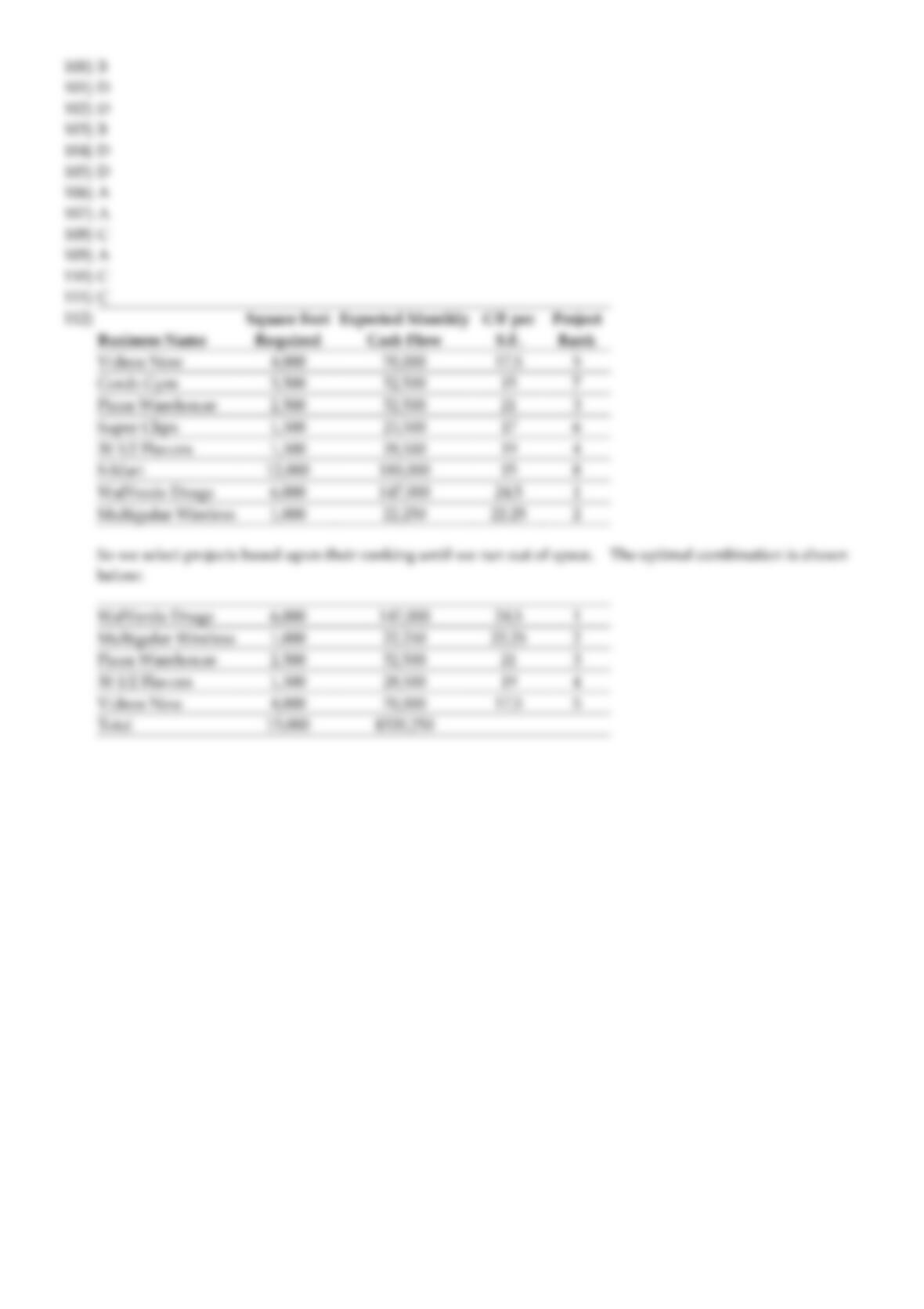
112) If your new strip mall will have 15,000 square feet of retail space available to be leased, to which
businesses should you lease and why?
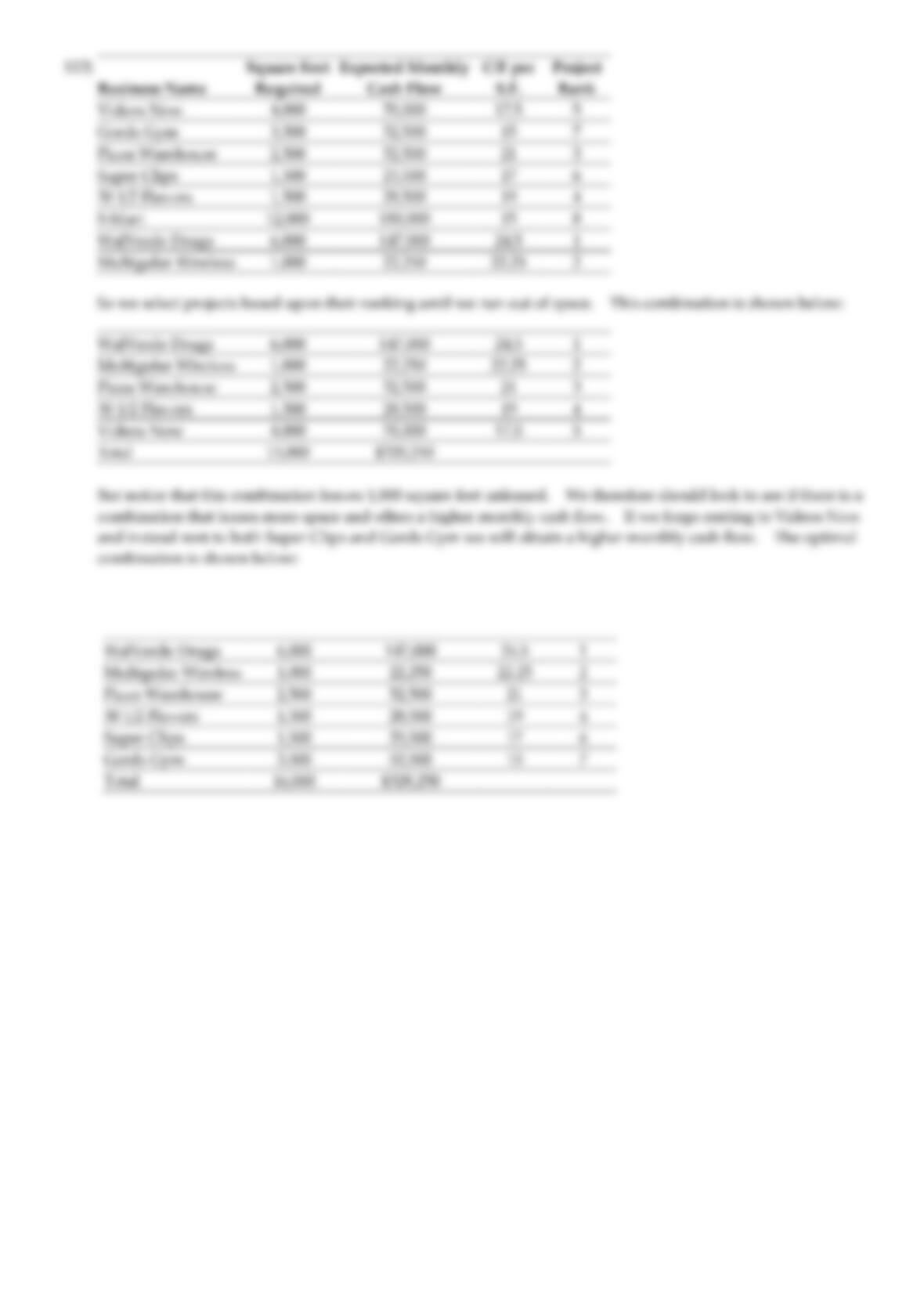
113) If your new strip mall will have 16,000 square feet of retail space available to be leased, to which
businesses should you lease and why?
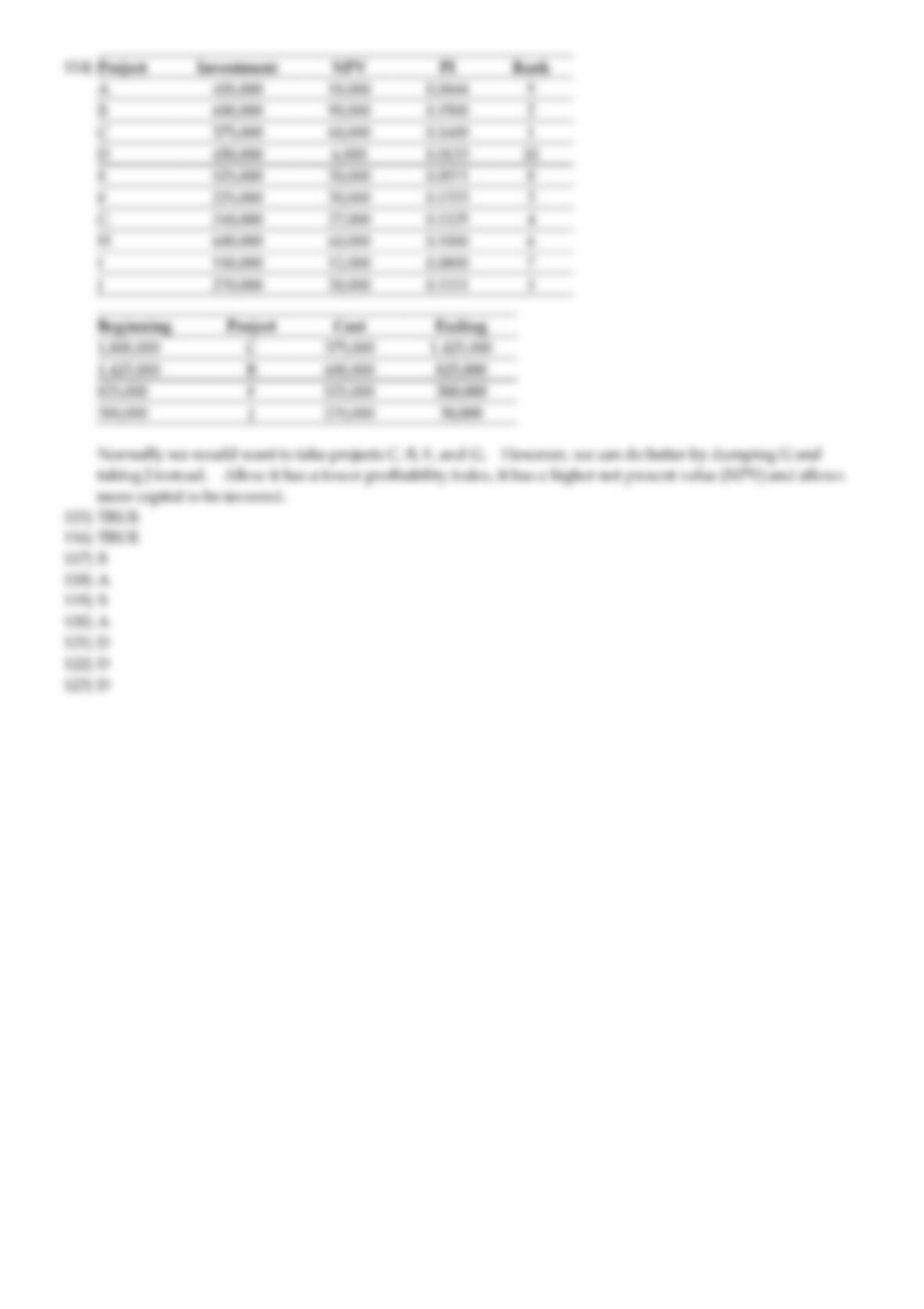
114) Consider the following list of projects:
Project
Investment
NPV
A
405,000
18,000
B
600,000
90,000
C
375,000
60,000
D
450,000
6,000
E
525,000
30,000
F
225,000
30,000
G
240,000
27,000
H
600,000
60,000
I
150,000
12,000
J
270,000
30,000
You are given a budget of only $1,800,000 to invest in projects. Which projects will you select, in what
order will you select them, and why?
TRUE/FALSE. Write ‘T’ if the statement is true and ‘F’ if the statement is false.
115) Net present value (NPV) is usefully supplemented by internal rate of return (IRR), since IRR gives a good
indication of the sensitivity of any decision made to changes in the discount rate.
116) When an alternative decision rule disagrees with the net present value (NPV), the NPV should be
followed.
MULTIPLE CHOICE. Choose the one alternative that best completes the statement or answers the question.
117) Which of the following best describes the Net Present Value rule?

A) When choosing among any list of investment opportunities where resources are limited, always
choose those projects with the highest net present value (NPV).
B) Take any investment opportunity where the net present value (NPV) is not negative; turn down
any opportunity when it is negative.
C) If the difference between the present cost of an investment and the present value (PV) of its benefits
after a fixed number of years is positive the investment should be taken, otherwise it should be
rejected.
D) Take any investment opportunity where the net present value (NPV) exceeds the opportunity cost
of capital; turn down any opportunity where the cost of capital exceeds the net present value (NPV)
118) Which of the following is a disadvantage of the Net Present Value rule?
A) Relies on accurate estimate of the discount rate
B) Ignores cash flows after the cutoff point
C) Can be misleading if inflows come before outflows
D) Not necessarily consistent with maximizing shareholder wealth
119) Which of the following decision rules is best defined as the amount of time it takes to pay back the initial
investment?
A) profitability index
B) payback period
C) net present value (NPV)
D) internal rate of return (IRR)
120) Which of the following decision rules might best be used as a supplement to net present value (NPV) by
a firm that favors liquidity?
A) payback period
B) MIRR
C) equivalent annual annuity
D) profitability index
121) Which of the following is NOT a limitation of the payback period rule?
A) It does not account for changes in the discount rate.
B) It does not account for the time value of money.
C) It ignores cash flows after payback.
D) It is difficult to calculate.

122) Which of the following is true regarding the profitability index?
A) It does not use the net present value (NPV) to assess benefits.
B) It is very simple to compute.
C) It is unreliable when used for choosing between different projects.
D) Attention must be taken when using it to make sure that all of the constrained resource is utilized.
123) A firm is considering several mutually exclusive investment opportunities. The best way to choose
between them is which of the following?
A) profitability index
B) internal rate of return (IRR)
C) payback period
D) net present value (NPV)