CHAPTER 8
LONG-TERM ASSETS
SUMMARY OF QUESTION TYPES BY LEARNING OBJECTIVE
AND LEVEL OF DIFFICULTY
Item
LO
LOD
Item
LO
LOD
Item
LO
LOD
Item
LO
LOD
Item
LO
LOD
True-False Statements
1.
1
M
4.
2
E
7.
4
E
10.
7
E
13.
10
E
2.
2
M
5.
3
E
8.
6
M
11.
9
E
3.
2
H
6.
3
M
9.
6
E
12.
9
E
Multiple Choice Questions
14.
1
E
26.
3
E
38.
4
M
50.
4
H
62.
7
E
15.
1
E
27.
3
E
39.
4
E
51.
4
M
63.
7
E
16.
2
M
28.
3
E
40.
4
E
52.
4
H
64.
7
M
17.
2
M
29.
4
E
41.
4
H
53.
4
M
65.
9
E
18.
2
E
30.
4
M
42.
4
E
54.
5
E
66.
9
M
19.
2
M
31.
4
E
43.
4
H
55.
5
E
67.
9
H
20.
2
H
32.
4
E
44.
4
M
56.
5
M
68.
9
H
21.
2
E
33.
4
E
45.
4
M
57.
5
H
69.
9,10
H
22.
2
M
34.
4
E
46.
4
M
58.
5
H
70.
9,10
H
23.
2
M
35.
4
E
47.
4
M
59.
6
E
71.
10
M
24.
2
M
36.
4
E
48.
4
M
60.
7
M
25.
2
M
37.
4
E
49.
4
M
61.
7
H
Exercises
72.
2
M
74.
4
M
76.
4,7
M
73.
2,4
M
75.
4,5
M
77.
4,7
M
Matching
78.
2,9,10
H
79.
4,8
M
Short-Answer Essay
80.
2
M
81.
8
M
82.
10
M
Essay
83.
2
M
84.
4
M
85.
4,9
E
Note: E = Easy M = Medium H = Hard
8 – 2 Test Bank for Understanding Financial Accounting, Canadian Edition
SUMMARY OF LEARNING OBJECTIVES BY QUESTION TYPE
Item
Type
Item
Type
Item
Type
Item
Type
Item
Type
Item
Type
Item
Type
Learning Objective 1
1.
TF
14.
MC
15.
MC
Learning Objective 2
2.
TF
16.
MC
19.
MC
22.
MC
25.
MC
78.
Ma
3.
TF
17.
MC
20.
MC
23.
MC
72.
Ex
80.
SAE
4.
TF
18.
MC
21.
MC
24.
MC
73.
Ex
83.
Es
Learning Objective 3
5.
TF
6.
TF
26.
MC
27.
MC
28.
MC
Learning Objective 4
7.
TF
33.
MC
38.
MC
43.
MC
48.
MC
53.
MC
77.
Ex
29.
MC
34.
MC
39.
MC
44.
MC
49.
MC
73.
Ex
79.
Ma
30.
MC
35.
MC
40.
MC
45.
MC
50.
MC
74.
Ex
84.
Es
31.
MC
36.
MC
41.
MC
46.
MC
51.
MC
75.
Ex
85.
Es
32.
MC
37.
MC
42.
MC
47.
MC
52.
MC
76.
Ex
Learning Objective 5
54.
MC
55.
MC
56.
MC
57.
MC
58.
MC
75.
Ex
Learning Objective 6
8.
TF
9.
TF
59.
MC
Learning Objective 7
10.
TF
61.
MC
63.
MC
76.
Ex
60.
MC
62.
MC
64.
MC
77.
Ex
Learning Objective 8
79.
Ma
81.
SAE
Learning Objective 9
11.
TF
65.
MC
67.
MC
69.
MC
78.
Ma
12.
TF
66.
MC
68.
MC
70.
MC
85.
Es
Learning Objective 10
13.
TF
69.
MC
70.
MC
71.
MC
78.
Ma
82.
SAE
Note: TF = True-False Ex = Exercise SAE = Short-Answer Essay
MC = Multiple Choice Ma = Matching Es = Essay
Long-Term Assets 8 – 3
CHAPTER LEARNING OBJECTIVES
1. Identify and distinguish between the various types of long-term assets.
2. Describe the valuation methods for property, plant, and equipment, including
identifying costs that are usually capitalized.
3. Explain why property, plant, and equipment assets are depreciated.
4. Identify the factors that influence the choice of depreciation method and
implement the most common methods of depreciation.
8 – 4 Test Bank for Understanding Financial Accounting, Canadian Edition
5. Describe and implement changes in depreciation estimates and methods.
6. Explain what it means if property, plant, and equipment assets are impaired.
7. Account for the disposal of property, plant, and equipment.
8. Explain the effect of depreciation on income taxes.
Long-Term Assets 8 – 5
9. Explain the accounting treatment for intangible assets, including amortization.
10. Explain the accounting treatment for goodwill, including impairment.
11. Assess the average age of property, plant, and equipment; calculate the fixed
assets turnover ratio; and assess the results.

8 – 6 Test Bank for Understanding Financial Accounting, Canadian Edition
TRUE-FALSE STATEMENTS
1. The cash inflows generated from a long-term asset will be received over several
future periods.
2. Under ASPE, property, plant, and equipment must be recognized using the
revaluation model.
3. The total accumulated depreciation on a long-term asset is also known as the asset’s
amortized cost.
4. In a basket purchase, the total purchase price is divided equally among the assets
acquired.
5. Depreciation expense is a measure of an asset‘s increase in value due to wear and
tear.
6. Depreciation is a cost allocation method and has nothing to do with determining an
asset’s market value.
7. Residual value directly enters into the calculation of depreciation expense under all
depreciation methods.
8. If a company determines that due to damage, the recoverable cost of its asset is
reduced, it increases accumulated depreciation.
9. An impairment loss should be recognized if the net recoverable amount of the asset
exceeds the carrying value.
10. Upon the disposal of an asset, if the carrying value is NOT equal to the proceeds, a
gain or loss must be recognized.
11. Basic research costs that occur prior to any decision to develop a product or process
are usually capitalized.
12. All patents have useful and economic lives of 20 years.
13. Internally generated goodwill may be capitalized annually.
Long-Term Assets 8 – 7
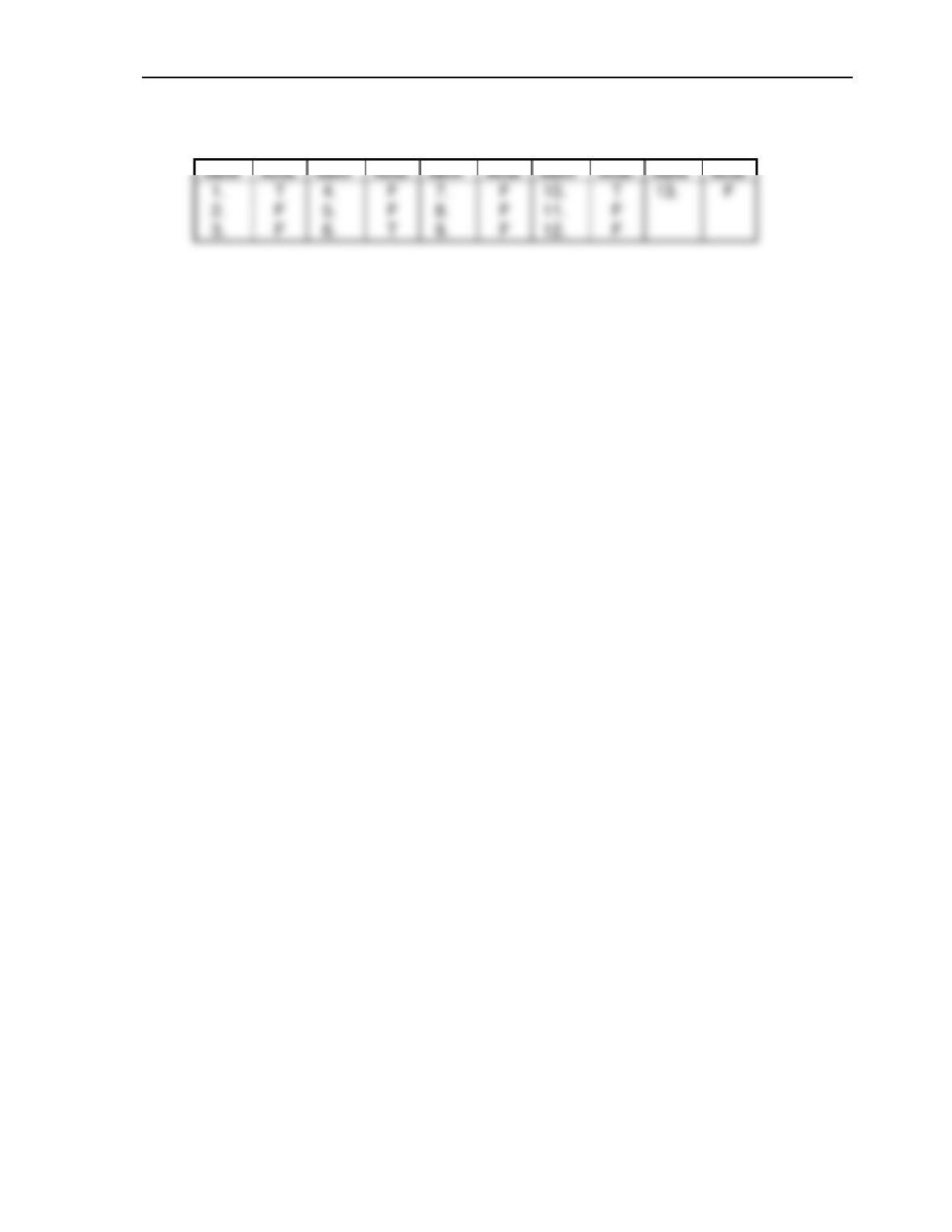
ANSWERS TO TRUE-FALSE STATEMENTS

8 – 8 Test Bank for Understanding Financial Accounting, Canadian Edition
MULTIPLE CHOICE QUESTIONS
14. Which of the following is NOT a tangible capital asset?
a) buildings
b) land
c) copyrights
d) equipment
15. Which of the following would NOT be classified as property, plant, and equipment?
a) buildings in current use
b) land purchased for resale
c) machinery
d) tools used in production
16. Which of the following would NOT be capitalized as part of a purchased asset’s
cost?
a) non-refundable taxes
b) installation cost
c) shipping costs
d) insurance costs
17. In 2017 as part of a property purchase, Melrose Ltd. incurred and paid 2016 property
taxes. These costs should be
a) recognized as an impairment loss.
b) recognized on the Statement of Income as an expense.
c) recognized as a capital cost.
d) not be taken into consideration, these costs are irrelevant.
18. Ukela Corp. purchased a piece of equipment on May 15 for $27,000. It cost $400 to
ship the equipment to the company’s facilities and another $1,000 to install the
equipment. After the equipment was installed the company had to pay an additional
$1,500 for increased insurance. The capitalized cost of the equipment was
a) $29,900.
b) $29,500.
c) $28,400.
d) $27,400.
19. A plot of land was purchased for $120,000 which had $10,000 of past due property
taxes on it. Non-refundable taxes on the purchase were $1,400 and the title search cost
$500. The capitalized cost of the land was
a) $120,000.
b) $121,900.
c) $130,000.
d) $131,900.

Long-Term Assets 8 – 9
20. A machine was built for $125,500 during July; the cost included $750 in interest
expense. The company had to pay $4,000 for shipping and another $2,000 for insuring
the parts. Following ASPE, the capitalized cost of the equipment was
a) $124,750.
b) $125,500.
c) $131,500.
d) $132,250.
21. Assets acquired in a basket purchase are to be allocated a portion of the total price
based on their respective
a) fair market values.
b) book values.
c) present values.
d) assessed values.
22. Mertle Holdings Co. purchased 12 acres of land with an office building and
warehouse on it for $2,000,000. The assets were appraised at: land $1,000,000, building
$600,000, and warehouse $900,000. The assets were carried on the seller’s books at:
land $800,000, building $500,000, and warehouse $700,000. At what cost should the
purchasing company record each of the assets?
Land Building Warehouse
a) $1,000,000 $600,000 $900,000
b) $800,000 $480,000 $720,000
c) $800,000 $500,000 $700,000
d) $1,000,000 $500,000 $500,000
23. Which of the following statements is true with respect to capitalizing asset costs?
a) All additional costs related to acquiring an asset should be expensed.
b) Land cannot be depreciated so it should just be expensed when acquired.
c) When costs are capitalized, the company gets the tax deduction immediately.
d) Some small expenses related to the purchase of an asset can be expensed for
simplicity.
24. When capitalizing the cost of a purchased asset, all of the following cost should be
included in capitalization except for
a) the full purchase price plus any discounts.
b) set up costs.
c) legal costs.
d) shipping costs.
25. When deciding whether to expense or capitalize the costs incurred after acquiring a
capital asset, which one of the following is NOT relevant to the decision?
a) Will these costs extend useful life?
b) Will these costs reduce asset operating costs?
c) Will these costs improve output?

8 – 10 Test Bank for Understanding Financial Accounting, Canadian Edition
d) Will these costs be incurred for more than one year?
26. The unexpensed portion of an depreciable asset is called
a) accumulated depreciation.
b) net realizable value.
c) estimated residual value.
d) net present value.
27. The ultimate sales value of a long-term asset is referred to as its
a) residual value.
b) value in use.
c) net book value.
d) historical value.
28. The depreciable cost of an asset is defined as the
a) original cost less residual value.
b) original cost less depreciation.
c) original cost less accumulated depreciation.
d) original cost.
29. According to accounting standards, the method of depreciation chosen should
a) measure the change in an asset’s value.
b) be systematic and rational.
c) allocate the most of the asset‘s cost to the early periods benefiting from its use.
d) recognize the reduced usefulness of an asset.
30. The depreciation method that most closely resembles what is allowable for tax
purposes under CRA is
a) the straight line method.
b) units of activity method.
c) the declining balance method.
d) depletion method.
31. Assets that produce their greatest benefits to a firm early in their useful life should be
depreciated using the
a) straight-line method.
b) declining-balance method.
c) compound interest method.
d) units-of-activity method.
32. The most commonly used method of depreciation is
a) straight-line.
b) capital cost allowance.
c) declining-balance.

Long-Term Assets 8 – 11
d) units-of-activity.
33. The residual value is NOT directly used for the calculation of depreciation expense
under which method?
a) units of activity method
b) straight line method
c) interest capitalization method
d) declining balance method
34. To apply the units–of-activity method, all of the following information is needed
EXCEPT the
a) original cost.
b) estimated residual value.
c) estimated useful life.
d) estimated usage.
35. A company is depreciating a $1,000,000 building using a straight-line rate of 5%.
The building has an estimated residual value of $200,000. What would the amount of
depreciation be in the first year using the straight-line method and the double-declining-
balance method?
Straight-line Double-declining-balance
a) $40,000 $80,000
b) $40,000 $100,000
c) $50,000 $80,000
d) $50,000 $100,000
36. Which of the following depreciation methods calculates annual depreciation expense
based on an asset’s cost minus its residual value?
a) deferred depreciation
b) straight-line
c) capital cost allowance
d) declining-balance
37. If an asset generates revenues evenly over its useful life, which depreciation method
should be used?
a) capital cost allowance
b) declining-balance
c) units-of-activity
d) straight-line
38. If management wanted to show an increasing income over the life of an asset which
method of depreciation should they choose?
a) capital cost allowance
b) declining-balance
c) units-of-activity

8 – 12 Test Bank for Understanding Financial Accounting, Canadian Edition
d) straight-line
39. Which of the following amortization methods ignore residual value in the calculation
of the annual depreciation expense?
a) double-declining-balance and capital cost allowance
b) straight-line and double-declining-balance
c) straight-line and capital cost allowance
d) present value and straight-line
40. The correct entry to record the annual depreciation expense for a long-term asset is
a) Dr. Accumulated depreciation
b) Dr. Depreciation expense, Cr. Accumulated depreciation
c) Dr. Accumulated depreciation, Cr. Long Term asset
d) Dr. Depreciation expense, Cr. Long Term asset
41. The maximum capital cost allowance (CCA) that may be deducted for new assets is
a) the same as the depreciation calculated for the year.
b) restricted by the residual value.
c) restricted to 50% of the normal amount.
d) is the annual amount prorated based on when the asset was purchased during the
year.
42. The Canada Revenue Agency allows corporations to deduct the following when
calculating taxable income
a) declining-balance amortization.
b) straight-line amortization.
c) capital cost allowance.
d) one-half of the cost of the asset in the year of acquisition.
Use the following information for questions 43–44.
Jeremiah Co. purchased a machine on January 1, 2017 for $22,500. The machine had
an estimated useful life of 10 years and an estimated residual value of $2,500. The
company uses double-declining-balance depreciation.
43. What will be the depreciation expense for 2017?
a) $4,500
b) $3,500
c) $2,250
d) $2,000
44. If Jeremiah Co. used the straight-line method of depreciation, what would the
carrying value of the machine be at the end of 2017?
a) $20,500
b) $20,250

Long-Term Assets 8 – 13
c) $18,250
d) $18,000
Use the following information for questions 45-46.
Picton Farms purchased some equipment on January 1, 2017 for $12,600. The
equipment has an estimated useful life of 10 years and an estimated residual value of
$1,200. The company uses double-declining-balance depreciation.
45. Depreciation expense for 2017 would be
a) $1,140.
b) $1,260.
c) $2,280.
d) $2,520.
46. The net book value on January 1, 2018 would be
a) $10,080.
b) $10,320.
c) $11,340.
d) $11,460.
Use the following information for questions 47-49.
On January 1, 2017, Bronson Co. purchased some equipment that initially cost $52,800.
Additional costs included freight costs $300, non-refundable taxes $6,400, and
installation $500. Estimated residual value is $2,000. The company uses a straight-line
rate of 10%.
47. Depreciation expense for 2017 was
a) $6,130.
b) $5,900.
c) $5,800.
d) $5,930.
48. Accumulated depreciation at the end of 2019 would be
a) $17,400.
b) $17,700.
c) $17,790.
d) $18,390.
49. What would the depreciation expense be for 2017 if Bronson Co. used the double-
declining-balance method?
a) $12,200
b) $12,000
c) $11,600
d) $ 6,000

8 – 14 Test Bank for Understanding Financial Accounting, Canadian Edition
50. A building currently has a net book value of $650,000 after three years of straight-
line depreciation totalling $150,000. The estimated residual value is $50,000. What was
the building’s original cost?
a) $900,000
b) $850,000
c) $800,000
d) $750,000
51. A depreciable asset with a cost of $42,500 has a residual value of $2,500 and a
useful life of 8 years. Total estimated units of output are 80,000 and in year 1; 5,200
units were produced. Under the straight-line method and the units-of-activity method the
depreciation expense for the first year would be
Straight-line Units-of-activity
a) $5,000.00 $2,600.00
b) $5,000.00 $2,762.50
c) $5,312.50 $2,600.00
d) $5,312.50 $2,762.50
52. An asset being depreciated with the straight-line method has a residual value of
$10,000 and accumulated depreciation expense of $30,000 in its second year. What
was the original cost of the asset if its useful life was 5 years?
a) $160,000
b) $140,000
c) $ 85,000
d) $75,000
53. Caricature’s Inc. bought new computers on January 1 for $18,000 to improve the
quality of their animation. The computers have a useful life of 8 years but Caricature’s
Inc. thinks that continuing technology developments will likely mean they will replace the
computers after 4 years, at which time they will be worth $2,000. If they use straight-line
depreciation, the depreciation expense for the first year will be
a) $2,000.
b) $2,250.
c) $4,000.
d) $4,500.
54. Changes in the estimates for residual value or useful life result in changes in the
depreciation expense calculation. These changes are handled
a) retroactively.
b) as cumulative changes.
c) prospectively.
d) as prior period adjustments.
55. The depreciation expense of an asset can change for all of the following reasons

Long-Term Assets 8 – 15
EXCEPT
a) change in the estimated useful life.
b) change in the asset’s expected residual value.
c) increases due to additions to the asset for major repairs and improvements.
d) increase in the asset due to regular repairs and maintenance.
56. An asset that cost $16,200 with a residual value of $1,200 and a useful life of 5 years
was depreciated for two years using the straight-line method. In the third year, the useful
life was determined to be 2 years longer than initially expected. Depreciation in the third
year would be
a) $3,000.
b) $2,143.
c) $2,040.
d) $1,800.
57. Proctor Paper Products purchased a machine on January 1, 2017 at a cost of
$380,000 with an estimated residual value of $30,000 at the end of its estimated useful
life of 8 years. On January 1, 2013 Proctor Paper estimates that the machine only has a
remaining life of 5 years and a residual value of $20,000. Proctor Paper uses straight-
line depreciation. Depreciation expense for 2019 would be
a) $48,500.
b) $54,500.
c) $57,000.
d) $72,000.
58. Water Company purchased a bottling machine on October 1, 2015 for $250,000. The
estimated useful life is 25 years and they are using straight-line depreciation. During
2017, they spent $46,000 on the machine to double its capacity and $5,000 on routine
cleaning. What should the depreciation expense be at September 30, 2017? The
company’s year end is September 30.
a) $10,000
b) $30,000
c) $12,200
d) $12,000
59. Bayside Ltd. owns a piece of land it had purchased in 2016 for $400,000. When they
started to develop the land in 2017, they discovered that there were environmental
problems with the land. It is now estimated to be worth only $150,000. Which of the
following is the correct way to account for this?
a) No accounting is necessary because the land is recorded at its historical cost, not its
market value.
b) The land account should be written down to $150,000 and a loss recognized.
c) The land should be written off completely because now the company cannot use it for
the purpose they intended to.
d) The land should be depreciated at a new rate to reflect the decline in its value.

8 – 16 Test Bank for Understanding Financial Accounting, Canadian Edition
60. An asset with an original cost of $75,000, a residual value of $7,500, and a useful life
of 5 years is given away without any consideration at the end of year five. The entry to
record this is
a) Dr. Accumulated depreciation, Dr. Loss on disposal, Cr. Long-Term asset
b) Dr. Accumulated depreciation, Cr. Gain on disposal, Cr. Long-Term asset
c) Dr. Long-Term asset, Cr. Accumulated depreciation
d) Dr. Accumulated depreciation, Cr. Long-Term Asset
61. Jeremiah Co. purchased a machine on January 1, 2017 for $22,500. The machine
had an estimated useful life of 10 years and an estimated residual value of $2,500. The
company uses double-declining-balance depreciation. Assuming Jeremiah Co. uses
straight-line depreciation, what would be the book value of the machine on December
31, 2021?
a) $ 0
b) $2,000
c) $2,250
d) $2,500
62. On July 1, 2017 a truck was sold for $10,000. The company originally paid $28,000
on June 30, 2010 and has recorded accumulated depreciation on it to date of $15,000.
The entry to record the sale would include a
a) credit to accumulated depreciation for $15,000.
b) debit to trucks for $28,000.
c) credit to gain on sale of truck for $3,000.
d) debit to loss on sale of truck for $3,000.
63. Upon the disposal of an asset, if the proceeds are greater than the carrying value of
the asset the company must
a) recognize a loss.
b) recognize a gain.
c) adjust the accumulated depreciation account so the carrying value equals the
proceeds.
d) adjust the carrying value to market value.
64. Losses on the cash sale of capital assets
a) are the excess of the cash proceeds over the carrying value of the asset.
b) are the excess of the cash proceeds over the market value of the asset.
c) are the excess of the carrying value of the asset over the cash proceeds.
d) are the excess of the carrying value of the asset over the market value.
65. Long-term capital assets with a(n) ___ may not be depreciable.
a) finite life
b) indefinite life
c) residual value
d) undefined value

Long-Term Assets 8 – 17
66. Which of the following methods of amortization is a company most likely to use for
financial statement purposes if it purchases a patent?
a) capital cost allowance
b) double-declining-balance
c) units-of-activity
d) straight-line
67. Which of the following statements is true with respect to intangible assets with
indefinite lives?
a) They should be amortized over a period of 40 years.
b) They should be expensed to income in the year they are acquired.
c) They should be evaluated each year to determine if there has been any impairment in
their value.
d) They are never amortized or written down but remain on the company’s balance sheet
at their original cost forever.
68. Electronics R Us spent $25,000 on research and development to create a new
product. The product was successfully developed and launched into the market. How
should the research and development costs be treated?
a) The full $25,000 should be capitalized.
b) The research portion of the $25,000 should be capitalized.
c) The research portion of the $25,000 should be expensed.
d) The full $25,000 should be expensed.
69. Harmax Limited spent $5,000 registering an internally developed patent and then
another $20,000 defending and enforcing the patent in its first year. How should the
patent be reflected in the financial statements?
a) the full $25,000 expensed in the year
b) $5,000 capitalized as Patent asset and the $20,000 expensed
c) $20,000 capitalized as Patent asset and the $5,000 expensed
d) the full $25,000 capitalized in the year
70. Which of the following is an example of an intangible with an indefinite life?
a) a copyright on a song
b) a patent on a new technology
c) the development costs of a new drug
d) the goodwill value assigned to the excess purchase price when purchasing a
company
71. Which of the following intangibles would be capitalized?
a) research
b) advertising
c) goodwill acquired in a purchase
d) internally developed patent
8 – 18 Test Bank for Understanding Financial Accounting, Canadian Edition
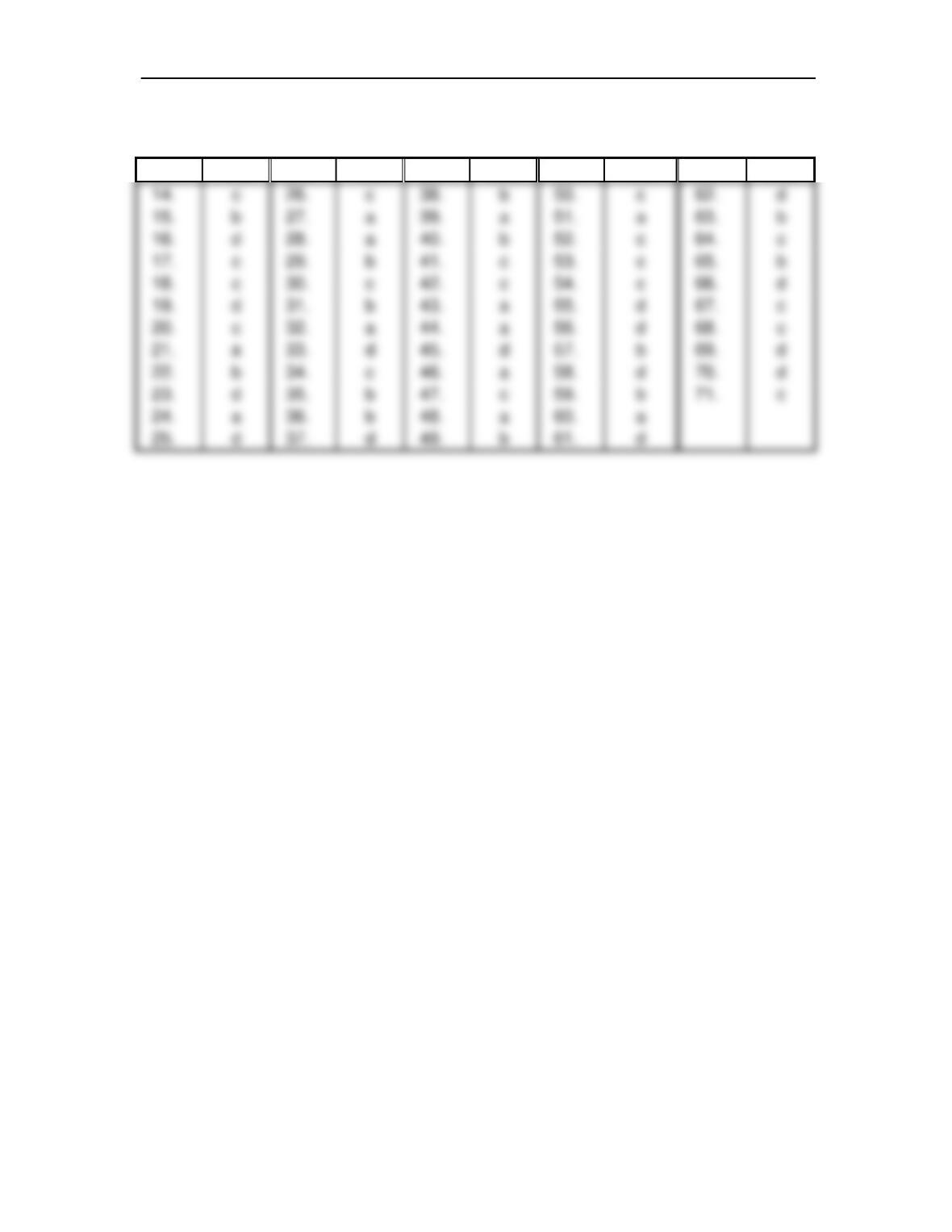
ANSWERS TO MULTIPLE CHOICE QUESTIONS
Item
Ans.
Item
Ans.
Item
Ans.
Item
Ans.
Item
Ans.
Long-Term Assets 8 – 19
EXERCISES
72. Approach Consulting made the following cash expenditures during its first year in
operations:
1. Cost of real estate purchased as a plant site
(land and building) $ 130,000
2. Accrued property taxes paid at the time of the
purchase of the real estate 3,000
3. Cost of demolishing building to make land
suitable for construction of a new building 9,000
4. Architect’s fees on building plans 12,000
5. Excavation costs for new building 27,000
6. Cost of filling and grading the land 2,500
9. Full payment to building contractor 750,000
10. Cost of parking lots and driveways 32,000
11. Property taxes paid for the current year on the land 5,000
Instructions
Record the above transactions and determine the cost of the land, land improvements,
and building that will appear on Approach’s year-end balance sheet.
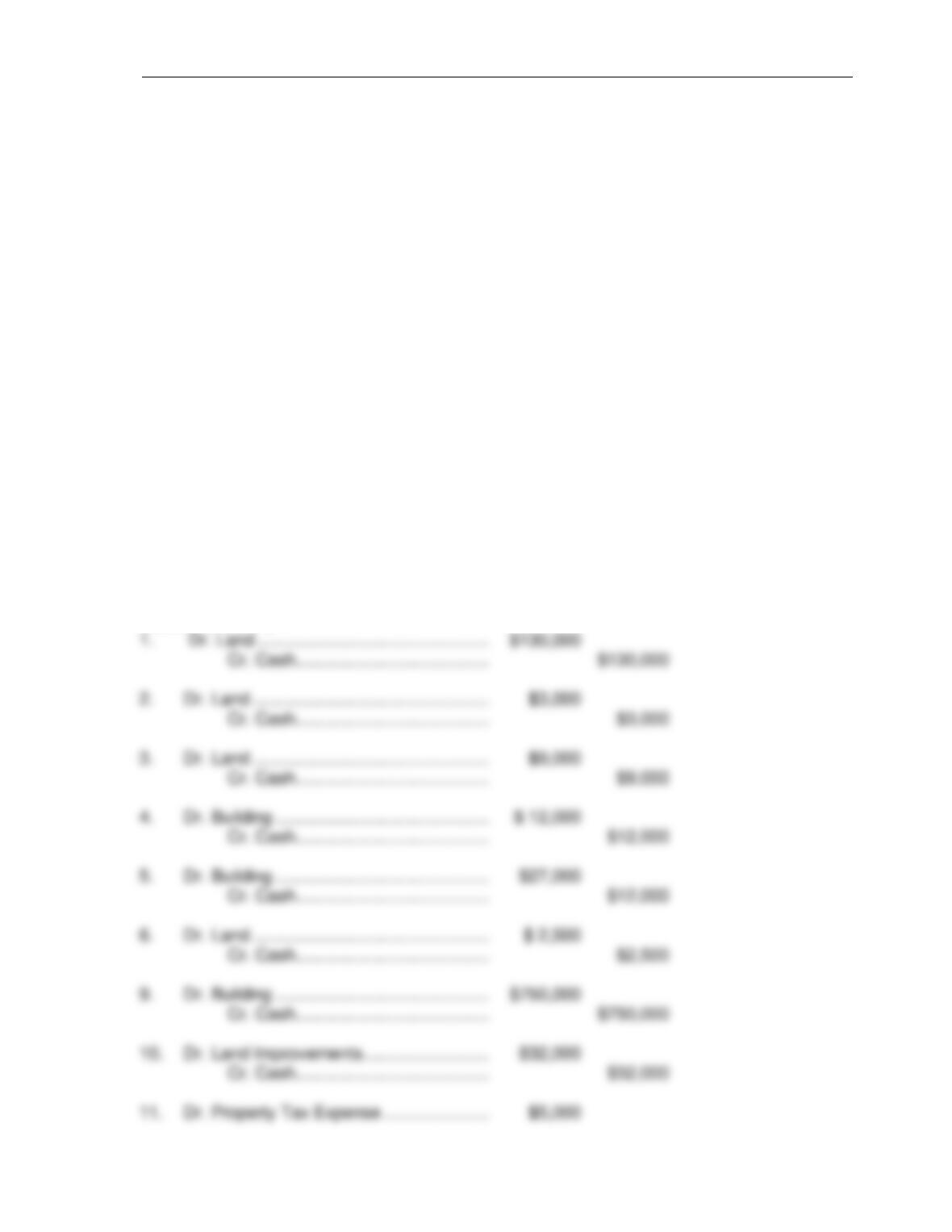
Solution (15 min.)
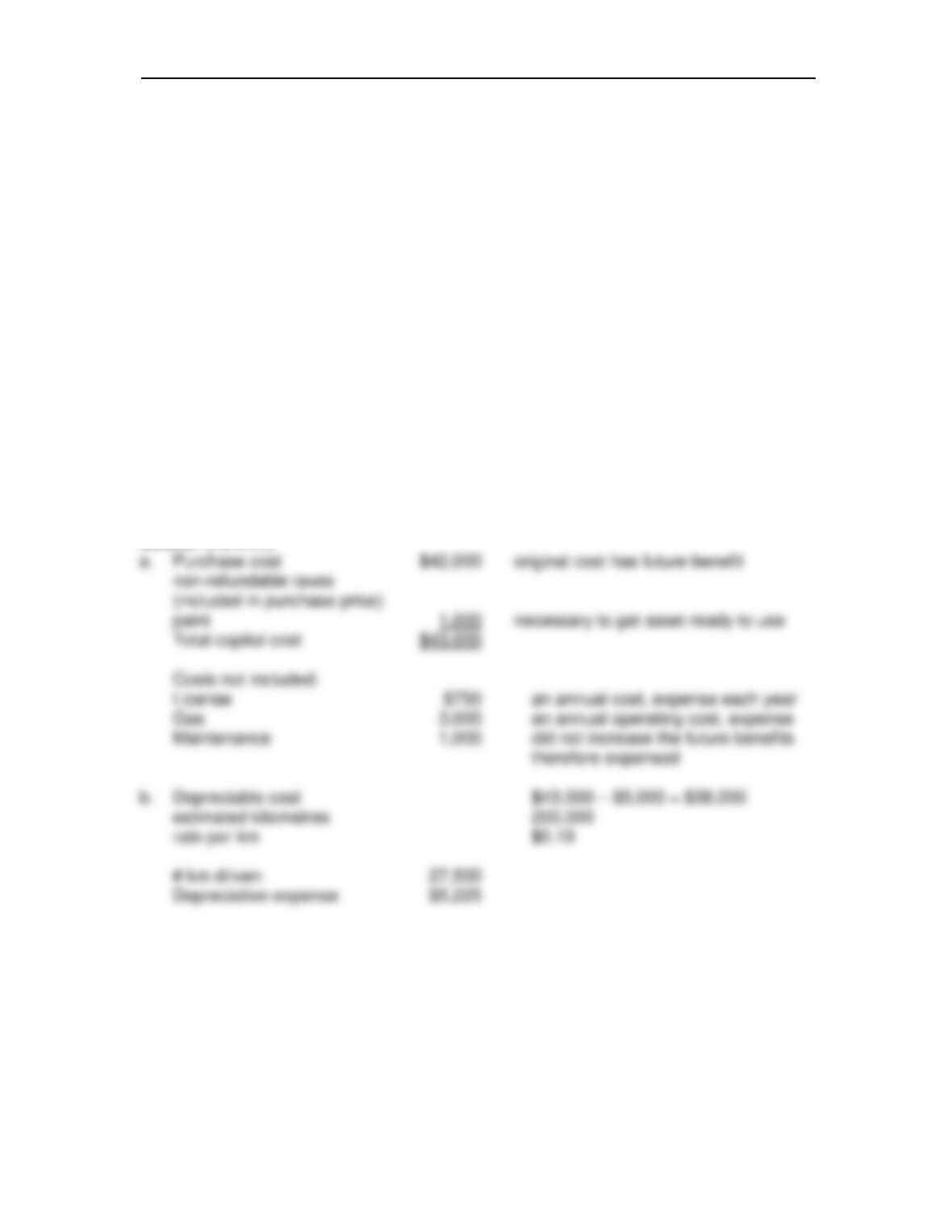
8 – 20 Test Bank for Understanding Financial Accounting, Canadian Edition
Cr. Cash …………………………………. $5,000
The account balances on the balance sheet at the end of the period are as follows:
Land $144,500
Land Improvement $32,000
Building $789,000
73. Mesa’s Mexican Food Inc. has decided to add a delivery service to its business. In
2017 the company purchased a car to use to deliver customer orders. The purchase
price of the car was $42,000, including non-refundable taxes of $5,800. The car was
painted with the store logo for $1,000 and an additional $750 was spent on the annual
license fee. During the year they spent $3,000 on gas and $1,000 on maintenance costs.
They expect to drive the car 200,000 kilometres and have a residual value of $5,000. In
2017, they drove 27,500 km.
Instructions
a. Calculate the cost of the asset to Mesa’s. Provide brief support for all items included
in the cost and the reason any costs are not included.
b. Record the depreciation expense for 2017 using the units-of-activity method.
Solution (10 min.)
74. On April 1, 2017 Robin’s Rigging Co. purchased a piece of equipment which cost
$68,900, has a $4,900 residual value, and an 8-year useful life. The company has a
fiscal year end of March 31.
Instructions
Calculate the depreciation expense for year one under
a) Straight-line
b) Capital cost allowance (rate 20%)
c) Double-declining-balance
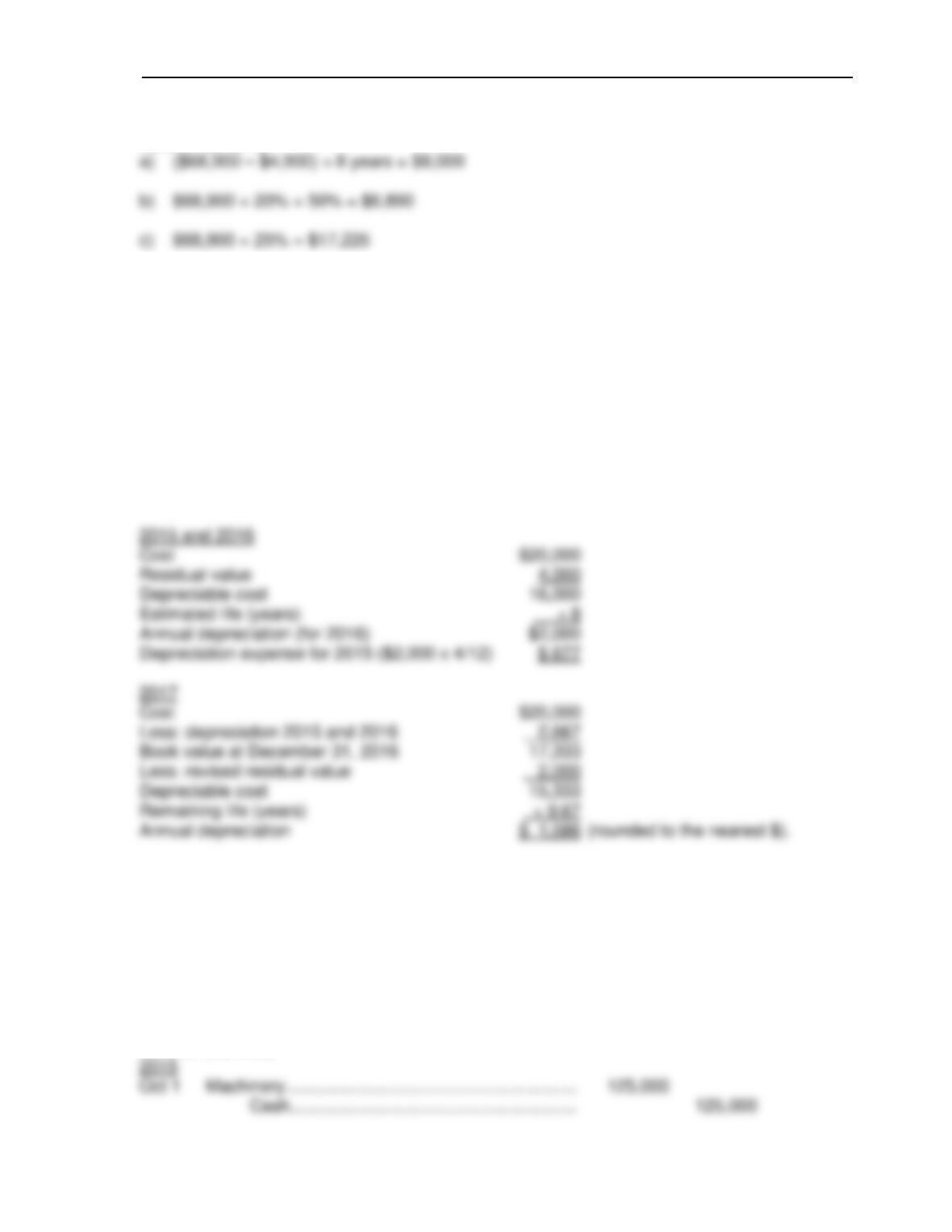
Long-Term Assets 8 – 21
Solution (5 min.)
75. Fabio’s Furniture purchased a laser-guided mitre saw on September 1, 2015 at a
cost of $20,000. Depreciation for 2015 and 2016 was based on an estimated 8-year
useful life and $4,000 estimated residual value. In 2017, Fabio revised its estimates and
now believes the laser mitre saw will have a total service life of an additional three years
but the residual value will be only $2,000. Fabio uses the straight-line method to
depreciate all assets. Fabio’s Furniture has a December 31 year end.
Instructions
Calculate depreciation expense for 2015, 2016, and 2017.
Solution (10 min.)
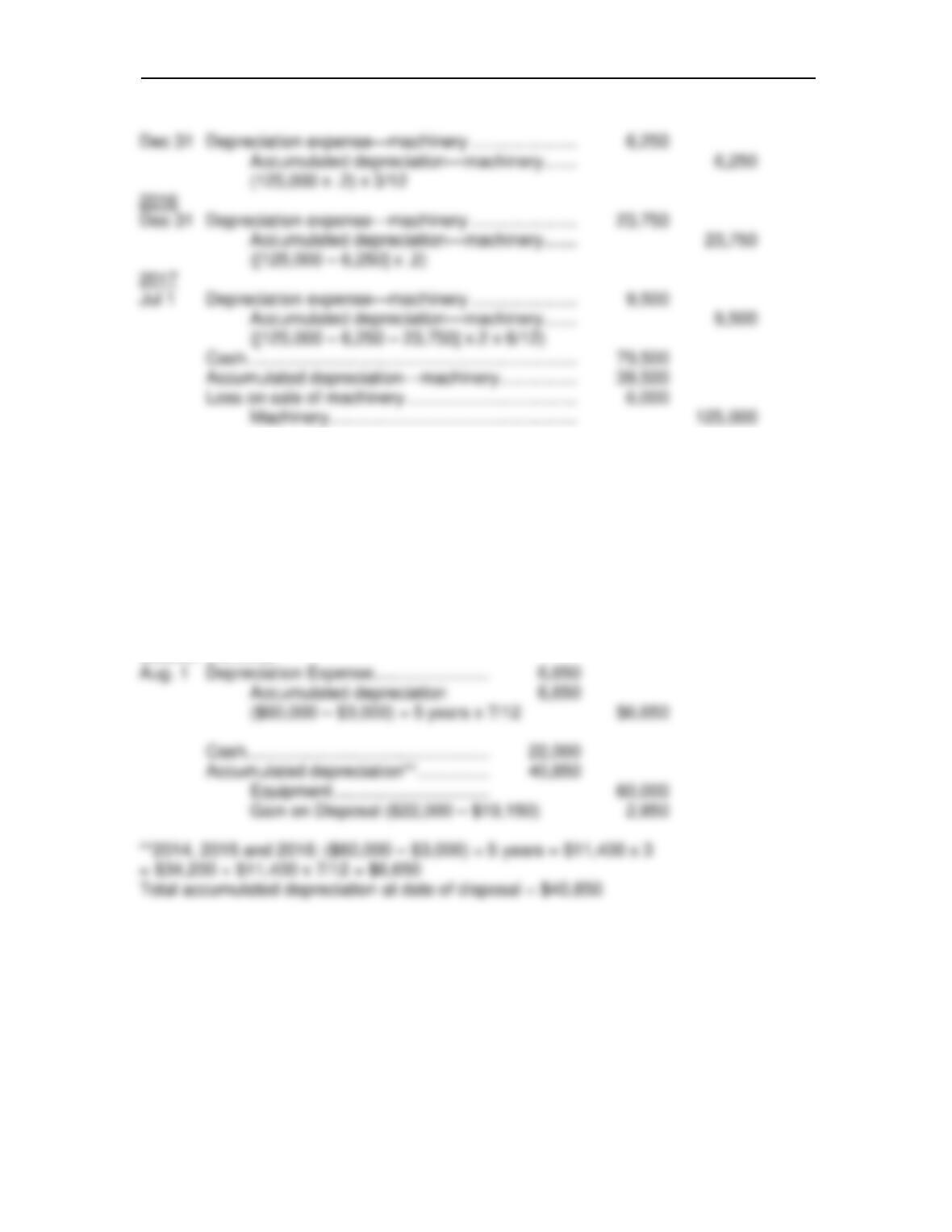
76. Lucky Lure Co. purchased a machine on October 1, 2015 for $125,000. It has a
$15,000 residual value and a 10-year useful life. On July 1, 2017 the machine sold for
$79,500. The company uses the double-declining-balance method of depreciation. The
company fiscal year end is December 31.
Instructions
Prepare the journal entries for 2015 through 2017.
Solution (12 min.)
8 – 22 Test Bank for Understanding Financial Accounting, Canadian Edition
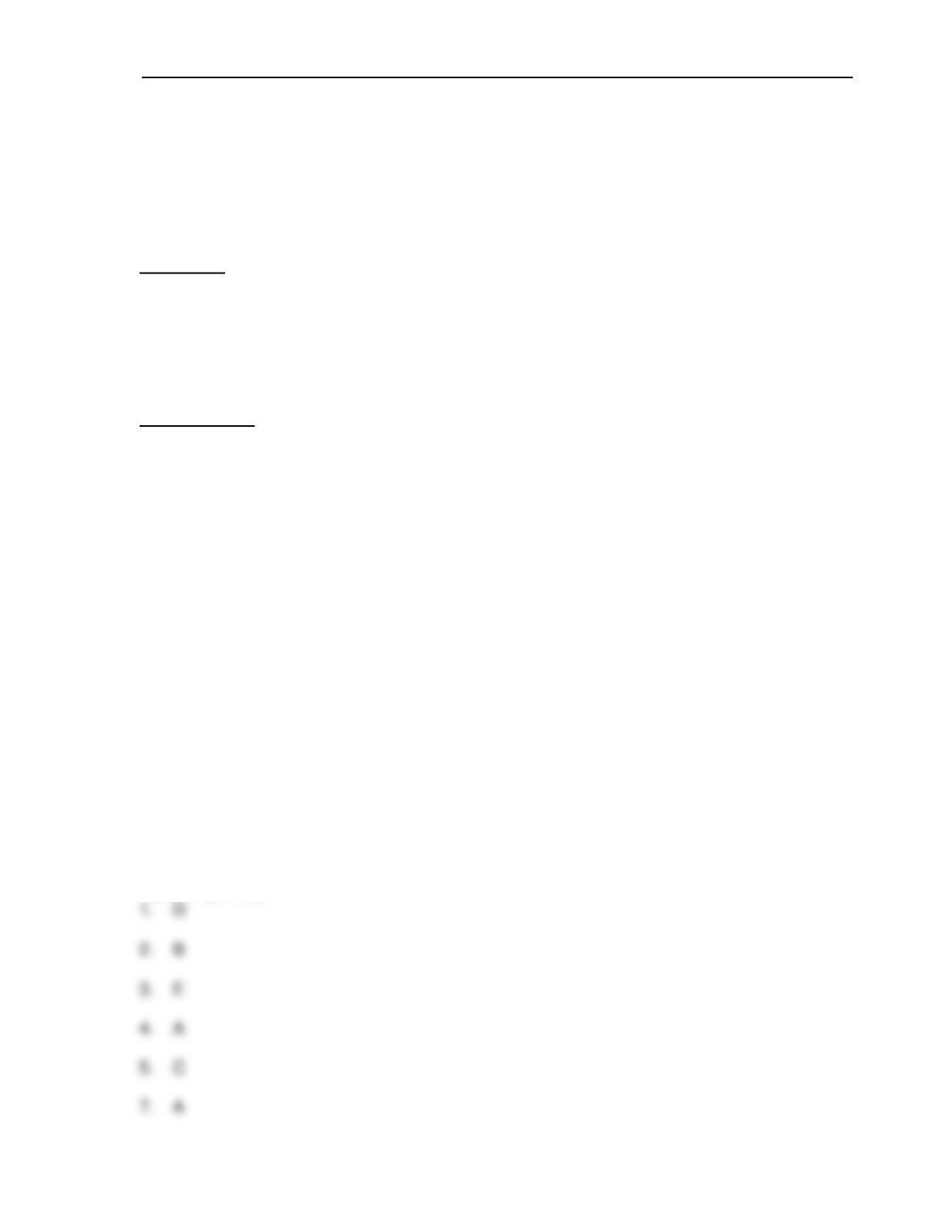
77. Disick Limited sold a piece of equipment August 1, 2017 for proceeds of $22,000.
The equipment had an original value of $60,000 and was purchased on January 1, 2014.
It was estimated to have a residual value of $3,000 and 5-year useful life. Disick uses
the straight line method. Disick has a December 31 year end.
Instructions
Journalize all entries required to update depreciation and record the sale of the asset in
2017.
Solution (10 min.)
Long-Term Assets 8 – 23
MATCHING
78. Listed below are various methods of allocating the cost of certain long-term assets
over their useful lives, followed by a series of descriptive statements. Match the methods
to the statements by placing the appropriate letter in the space provided.
METHODS
A. Capitalized and depreciated
B. Capitalized and depleted
C. Evaluated for impairment
D. Expensed
E. None of these
STATEMENTS
____ 1. research costs incurred internally
____ 2. cost of timber
____ 3. five-acre parcel of land where a firm’s headquarters is located
____ 4. purchased tools
____ 5. goodwill
____ 7. development costs for a new product
____ 8. purchased patent
____ 9. basket purchase of vehicles and equipment
____ 10. advertising costs
____ 11. intangible assets with indefinite live
____ 13. development costs that do not assist in creating a new product
Solution (3 min.)
8 – 24 Test Bank for Understanding Financial Accounting, Canadian Edition
79. Listed below are various depreciation methods followed by a series of descriptive
statements. Match the depreciation method to the statements by placing the appropriate
letter in the space provided. In some cases, more than one method is appropriate.
DEPRECIATION METHODS
A. Straight-line
B. Units-of-activity
C. Double-declining-balance
D. Capital cost allowance
E. None of these
STATEMENTS
____ 1. results in the measurement of the asset at its fair market value
____ 2. sometimes used for financial reporting by small businesses
____ 3. the simplest method to apply
____ 4. produces decreasing amounts of depreciation each year
____ 5. appropriate when related assets generate revenue evenly over their useful
lives
____ 6. required for Canadian tax purposes
____ 7. provides the largest annual depreciation expense for financial reporting in
the related asset‘s first year
____ 8. residual value is not used in annual depreciation expense calculation
____ 9. annual depreciation is calculated using a per-unit cost
Solution (4 min.)
Long-Term Assets 8 – 25
8 – 26 Test Bank for Understanding Financial Accounting, Canadian Edition
SHORT-ANSWER ESSAY QUESTIONS
80. St Jacques Company bought a piece of land with a building on it for a total of
$4,400,000. They hired two companies to estimate the fair values of the land and
building. The first estimate was: Land $1,200,000, Building $3,600,000. The second
appraisal was: Land $1,000,000 and Building $4,000,000.
Instructions
a) If management’s objectives are to minimize the amount of income tax they pay,
which of the two appraisals should they use to allocate the purchase price? Support
your answer.
b) Based on your answer in part a calculate the amount to be allocated to the Land
and the Building account.
c) Under what circumstances might management use the other appraisal value?
Solution (10 min.)
81. You are advising a client who has just gone into business, in selecting accounting
policies. The client wants to use capital cost allowance (CCA) for her financial
statements. Discuss the pros and cons of her choice.
Solution (8 min.)
82. A friend has come to you with the following question, “What is this goodwill account
Long-Term Assets 8 – 27
that I see on the balance sheet of a company that I own stock in?”
Instructions
Write a reply to your friend. Include in your explanation three factors that contribute to
goodwill, under what circumstances goodwill is recorded, and how it is accounted for.
Solution (8 min.)
8 – 28 Test Bank for Understanding Financial Accounting, Canadian Edition
ESSAY QUESTIONS
83. Bertin Baseball Advertising is relocating its operations. In doing so it purchases a
new plant, land, and printing equipment for $1,500,000. The fair value of these assets
had they been purchased separately is as follows: Equipment $800,000, Plant $500,000,
and Land $750,000. Explain how these assets should be reflected on the books and
why? What values should be assigned to these assets?
Solution (10 min.)
84. Depreciation is the allocation of an asset’s cost over its useful life. As a result,
depreciation affects each of the financial statements. Explain how depreciation affects
the statement of income, statement of financial position, and cash flow statement.
Solution (8 min.)
85. Capital assets can be classified as tangible or intangible assets and generally benefit
a number of accounting periods. Identify the different processes used to allocate the cost
of each of those types of long-term assets over the periods that they benefit. Match each
process with the type of asset it relates to and explain how the process is implemented.
Solution (10 min.)
Long-Term Assets 8 – 29
8 – 30 Test Bank for Understanding Financial Accounting, Canadian Edition
LEGAL NOTICE