Environment: Science Behind the Stories, 2e Cdn. Ed. (Withgott)
Chapter 8 Agriculture, Food, and Biotechnology
8.1 Graph and Figure Interpretation Questions
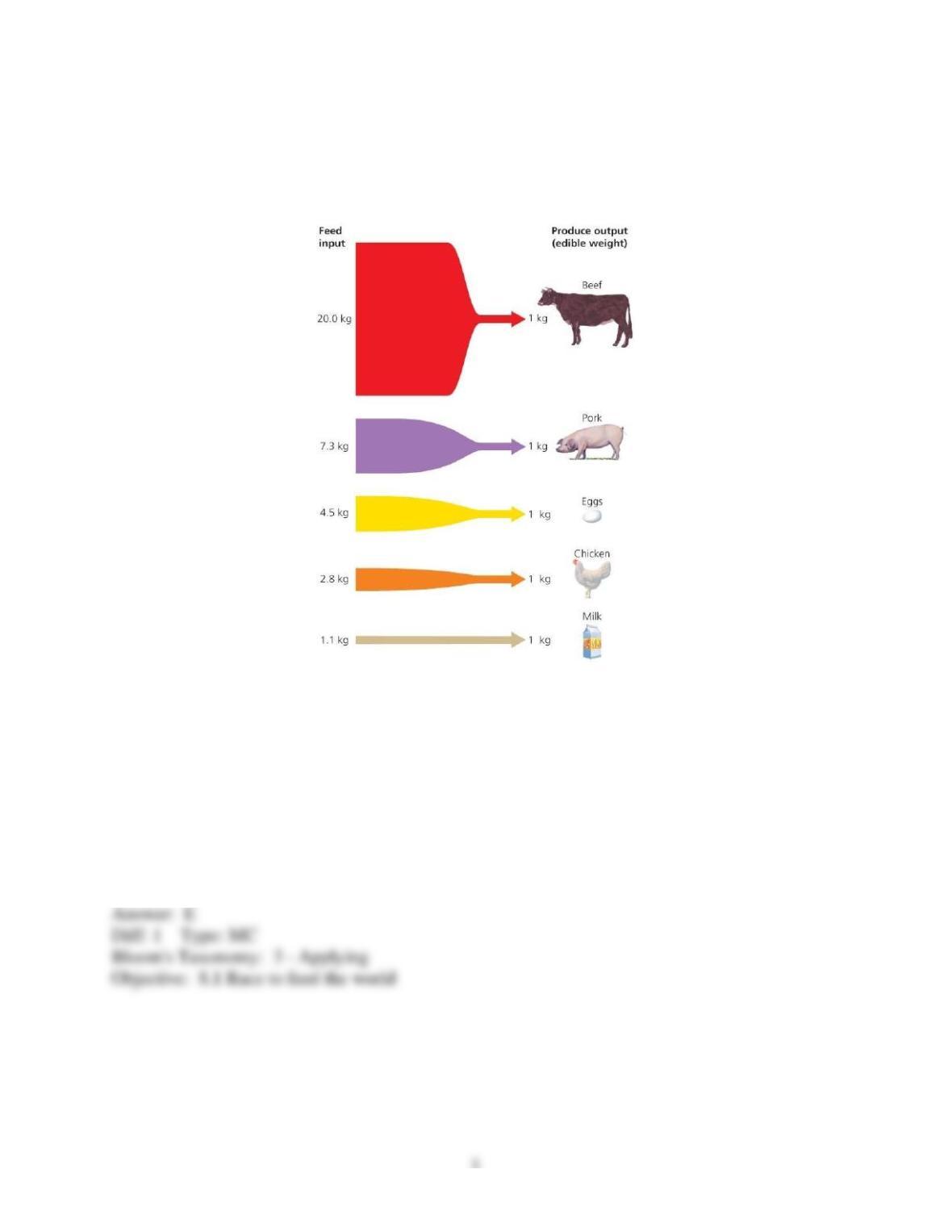
Figure 8.1
Use Figure 8.1 to answer the following questions.
1) Refer to Figure 8.1. The figure demonstrates that it requires roughly ________% more feed
input to produce 1 kg of eggs, compared to 1 kg of milk.
A) 30
B) 40
C) 50
D) 100
E) 400
2) Refer to Figure 8.1. The comparison shown in the figure is environmentally significant
because ________.
A) grain is a nonrenewable resource
B) we cannot survive without eating the foods pictured
C) the same grain used to feed chickens and cows could be fed to many humans instead
D) cows are a keystone species
E) production of beef and pork is resource-intensive
3) Refer to Figure 8.1. Cows require a high quantity of feed because they ________.
A) are genetically modified organisms
B) can feed more people than pigs
C) are raised on feedlots
D) take time to grow and have a low energy conversion efficiency
E) are the best source of high-quality protein
8.2 Matching Questions
Match the following.
A) earthworms
B) Pseudomonas syringae
C) Escherichia coli
D) Cactoblastis cactorum
E) bees
F) Pfiesteria
G) Bacillus thuringiensis
H) mites
I) aphids
J) wasps
1) Major pollinators of many flowering non-grain crop plants
2) Can protect crops from pest-related damage; are present in some bacteria and in some GMOs
3) Introduced to the Caribbean Islands, and now is eating through rare native Opuntia (prickly
pear) cacti in Florida and spreading to other states
4) Biological control introduced for control of pest caterpillars
5) A microbe that poisons fish; linked to poor waste containment practices at some feedlots
6) Source of generic plasmids for genetically modified organisms
Diff: 3 Type: MA
Bloom’s Taxonomy: 1 – Remembering
Objective: 8.5 Science of genetically modified food
4
8.3 Short Answer Questions
1) How did we increase food production during the 1960s?
2) Describe the use of biological control for battling pests.
3) What is the basic concept of sustainable agriculture?
4) What was the concern associated with the genetic stock of maize in Mexico, and why was it
controversial?
5) Briefly describe the advantages and disadvantages of monocultures.
6) List and define the three types of pesticides.
7) In 2002, the Zambian government refused a U.S. shipment of genetically modified (GM) corn.
Briefly explain how the Zambian government arrived at its decision.
8) Briefly discuss some disadvantages to aquaculture.
9) Why is resistance to pesticides likely over time when they are used in agriculture?
10) What are the encouraging aspects of Cuba’s agricultural practices?
11) ________ is any process whereby scientists directly manipulate an organism’s genetic
material in the lab, by adding, deleting, or changing segments of its DNA.
12) ________ is agriculture that does NOT deplete soils faster than they form.
13) Biological approaches such as composting and biocontrol are termed ________.
14) Why is industrialized agriculture necessary in industrialized countries?
15) The practice of planting vast areas with a single type of crop is known as ________.
16) What are the two main categories of agricultural lands that provide our food, and what is
produced on them?
1) Feedlots do NOT ________.
A) contribute to soil degradation
B) emit strong odours
C) meet the increasing demand for meat
D) cause outbreaks that kill fish
E) promote the antibiotic resistance in bacteria
2) In Queensland, Australia, cactus moths ________.
A) effectively cleared non-native prickly pear cactus from rangeland
B) are an invasive species
C) are raised as a food source for native Aborigines
D) are examples of species that have developed resistance to pesticides
E) are a keystone species
3) Recombinant DNA ________.
A) describes pollination of one plant by another of the same species
B) describes pollination of one plant by another of a different species to create new hybrids
C) describes the merging of DNA from unrelated organisms to create new hybrids
D) is assembled in the lab from mononucleotides
E) was part of the Green Revolution of the 1960s
4) What is true about GM crops?
A) Europe leads the world in land area dedicated to GM crops.
B) The United States has almost half of the world’s land area dedicated to GM crops.
C) Canada leads the world in land area dedicated to GM crops.
D) They are unanimously opposed by environmentalists.
E) They are unanimously favoured by environmentalists.
5) Raising ________ requires the most land and water.
A) beef cattle
B) dairy cattle
C) chickens
D) pigs
E) goats
6) Researchers in Canada, the United States, and Switzerland have demonstrated that organic
farming ________.
A) is only sustainable with government support
B) presently has no market in Canada
C) increased topsoil depth and activity of earthworms
D) increased the incidence of invasive species
E) requires bees
7) Golden rice ________.
A) is an invasive species
B) is a GM variety that contains vitamin A
C) is a wild variety of rice from China
D) is resistant to herbicides
E) is resistant to most insects
8) Bt crops ________.
A) have not yet been approved by the CFIA
B) include strawberries that are resistant to frost damage
C) include corn and potatoes
D) have terminator seeds
E) are widely grown in Europe
9) Which of the following requires the least land to produce 1 kg of protein?
A) eggs
B) milk
C) chicken
D) pork
E) beef
10) Oaxaca, Mexico ________.
A) is a world centre of biodiversity for maize
B) has more poverty than any other place in the world
C) is known for successful organic farming
D) is where the Green Revolution was launched
E) is where the gene revolution was launched
11) Which of the following is true?
A) World hunger has increased significantly since 1970.
B) Aquaculture has decreased significantly since 1985.
C) World grain production has increased significantly since 1985.
D) Paul Ehrlich predicted catastrophic failure of agricultural systems.
E) The main reason why people are undernourished is because they are not educated about
proper nutrition.
12) Green Revolution techniques ________.
A) focus on organic farming
B) have contributed to an increased diversity of foods in the human diet
C) have increased crop yields but may not be sustainable
D) focus on preserving biodiversity
E) focus on sustainability
13) ________% of the food we consume comes from ________ crop species.
A) 90; 15
B) 90; 100
C) 50; 20
D) 50; 50
E) 10; 100
14) Of the following, ________ increased fastest (in %) between 1961 and 2000.
A) area used for agriculture
B) food production
C) nitrogen fertilizer use
D) world population
E) food production per capita
15) Which of the following best describes integrated pest management (IPM)?
A) biocontrol measures, crop rotation, habitat diversification
B) major reliance on synthetic pesticides
C) subsidies for pesticide use
D) continuous monoculture cropping and harvesting
E) transgenic crops
16) A monoculture ________.
A) decreases the use of synthetic fertilizers or pesticides
B) is more resistant to pests than a polyculture
C) is more resistant to pests than an aquaculture
D) preserves crop diversity by making the crops grown in monocultures less likely to become
extinct
E) is frequent in industrialized agriculture
17) Plants with showy flowers typically ________.
A) are eaten by animals
B) are pollinated by animals
C) are genetically modified by animals
D) are killed by animals
E) decrease biodiversity in an area
18) Recombinant DNA technology ________.
A) preserves the original combinations of genes
B) contributes to pollution
C) presently is not approved by the FDA
D) creates transgenic organisms
E) is no different than selective breeding
19) The European Union nations ________.
A) have converted all farms to organic agriculture
B) along with Canada, Brazil, and Argentina have developed and planted many GM crops
C) have refused to allow synthetic pesticides to be used on non-exported crops
D) produce so little food that they have to import most meats and vegetables
E) do not support the growth of GM crops
20) Aquaculture ________.
A) can bring economic benefits and food security to many developing regions
B) has no real environmental disadvantages
C) frequently results in unintended catch of non-target species
D) uses more fossil fuels than traditional commercial fishing
E) produces less fish per unit area compared to ocean water harvesting
21) Organic farming succeeds because it ________.
A) provides cheaper food because of savings on not buying fertilizers and pesticides
B) usually produces higher crop yields
C) requires less work
D) alleviates many problems of conventional agriculture
E) practically eliminates pest infestations
22) In conventional (non-organic) agriculture, it takes ________ kg of pesticides and fertilizers
to grow cotton required to manufacture one T-shirt.
A) 0.1
B) 0.5
C) 0.01
D) 0.05
E) 1
23) Seed banks are important for ________.
A) cash deposits for developing countries
B) protecting monoculture productivity
C) protecting genetic diversity
D) loans to developing countries
E) providing farmers with the current year’s GM crops
24) It is more energetically efficient for us to eat more ________.
A) plant-based foods
B) herbivorous animals such as cattle and chicken
C) carnivorous animals such as fish and alligator
D) GM foods
E) foods grown using IPM methods
25) When governments support IPM, it is usually because ________.
A) pesticides are expensive, cause pollution, and decrease yields in the long term
B) their people are dying of starvation
C) they want to encourage transition to genetically modified crops.
D) they are in a recession and IPM costs less than pesticides
E) they are lobbied by large agricultural companies
26) In order for livestock to be considered organic ________.
A) hormones and antibiotics are permitted, but not vaccines
B) animals must be fed 100% organic agricultural feed
C) animals cannot be transferred from regular treatment to organic standards
D) no vitamins and mineral supplements can be used
E) animals must be reared under natural conditions in intact ecosystems
27) During most of our species’ 100 000-year existence, and until about 10 000 years ago, we
depended on ________.
A) crops
B) hunting
C) cattle
D) crops and cattle
E) hunting and gathering