Chapter 8 – Inventories and work in progress
TRUE/FALSE
1. The just-in-time technique aims to minimise the costs of holding inventory.
2. The costs of holding inventory will vary depending on the type of business; generally, however,
holding excessive amounts of inventory will increase storage costs but decrease debt to finance the
inventory held.
3. Holding excessive inventory undermines the liquidity and profitability of an entity.
4. Goods, other property and services: (a) held for sale in the ordinary course of business; (b) in the
process of production for such sale; or (c) to be used up in the production of goods, other property
or services for sale, including consumable stores and supplies, are all various types of inventory.
5. Consumable goods for use within the production process are not classified as inventory under
current assets in the balance sheet.
6. Products and services that are at an intermediate stage of completion form part of the work in
progress.
7. Goods that have been through the complete production or assembly cycle and are ready for resale
to the customer are finished goods.
8. The time spent by a barrister briefing a client prior to a court hearing would constitute ‘work in
progress’ for the law firm.
9. The cost of an item is important in considering whether it should be classified as inventory or not.
10. Items purchased for incorporation into the manufacture or assembly of goods are referred to as raw
materials, but they do not constitute inventory until the manufacturing or production process is
complete.
11. The nature of the business will determine if the purchase of 500 litres of paint constitutes inventory
or not.
12. It is most likely that a manufacturing firm will have inventory that constitutes raw materials, work
in progress and finished goods.
13. The perpetual method of valuing inventory is more effective in detecting inventory theft than the
periodic system.
14. The method of accounting for inventory where an accurate record of purchases is kept and an
annual inventory count is conducted to establish the cost of goods sold during a period is the
periodic method.
15. Cost of goods sold can be determined by adding purchases to closing inventory and deducting
opening inventory.
16. After calculating that the closing inventory balance was $27,000, a physical stocktake revealed that
inventory was actually $17,000. This means that cost of goods sold must be $10,000.
17. When calculating cost of goods sold, an error was made which understated closing inventory. The
effect will be to understate profit for the period.
18. When calculating cost of goods sold, an error was made which overstated closing inventory. The
effect will be to overstate profit for the period.
19. When calculating cost of goods sold, an error was made which overstated opening inventory. The
effect will be to understate profit for the period.
20. When calculating cost of goods sold, an error was made which understated opening inventory. The
effect will be to overstate profit for the period.
21. Under AASB 102, where the purchase price (cost) of an item of inventory is $248 and the net
realisable value is $256, inventory should be adjusted to reflect the net realisable value.
22. The absorption costing method determines the cost of inventories and includes a share of both
variable and fixed costs, the latter being allocated on the basis of normal operating capacity.
23. If AASB 102 determines that the cost of inventory consists of the cost of purchase, the cost of
conversion and other costs, then this eliminates the use of the variable-cost method of valuing
inventories for external reporting.
24. Technological changes are likely to cause a downward movement in inventory values, whereas
changes in taste are more likely to cause an upward movement in inventory values.
25. Different valuation rules affect inventory values and therefore cost of sales and profits.
26. LIFO is a method of inventory valuation based on the assumption that the last goods bought are the
first sold. Closing inventory is therefore assumed to consist of the cost of the earliest units
purchased.
27. FIFO is a method of inventory valuation based on the artificial assumption that the first goods
bought are the first sold. Closing inventory is therefore assumed to be that purchased most
recently.
28. The inventory turnover ratio is: cost of goods sold/average inventory.
29. The net realisable value of inventory represents selling price less the costs involved in completing
and selling the inventory.
30. ABC Ltd purchased an item inventory at a cost of $27,000. The item was damaged during storage.
The company could sell the item in its damaged state for $23,000, and in doing so incur selling
costs of $1000. The net realisable value of the item of inventory is $23,000.
MULTIPLE CHOICE
1. If an item of inventory is counted twice in the annual stocktake, then:
A.
current profit will be understated.
B.
beginning inventory for the next period will be understated.
C.
current cost of goods available for sale will be understated.
D.
current cost of goods sold is understated.
2. Why is the method of valuing inventory important?
A.
Inventory valuation is based on the actual flow of goods.
B.
Inventories always account for over 50% of the total assets and therefore have a considerable
impact on a company’s financial position.
C.
Companies desire to use the inventory valuation method that minimises the cost of goods
sold expense.
D.
The inventory valuation method chosen determines the value on the balance sheet and the
cost of goods sold expense in the statement of comprehensive income.
3. Which of the following is not an aspect of efficient inventory management?
A.
Holding too few items of inventory risks losing profitable sales.
B.
Holding excessive amounts of inventory requires large storage space and adds to the cost
of the business.
C.
The costs of holding inventory will vary depending on the type of business.
D.
Holding large amounts of inventory can reduce debt as there will be no requirement to
finance it.
4. Efficient inventory management is least likely to be assessed by:
A.
determining the amount of wastage of inventory.
B.
evaluating the inventory turnover ratio.
C.
calculating the number of times during a period that inventory has been turned over.
D.
looking at the revenue generated from inventory sales.
5. Inventories do not include goods and services:
A.
held for sale.
B.
used up in production.
C.
sold to customers.
D.
consumed in production.
6. Inventory should normally be classified on the balance sheet as:
A.
a current asset.
B.
shareholders’ equity.
C.
property, plant, and equipment.
D.
an intangible asset.
7. You would expect to see the account Work–in-Progress Inventory reported on the balance sheet of
a:
Manufacturing firm Merchandising firm
A.
Yes No
B.
No No
C.
Yes Yes
D.
No Yes
8. The cost of inventory becomes an expense in the period when:
A.
the inventory is purchased.
B.
the inventory is sold.
C.
payment is received for inventory sold.
D.
the purchaser obtains ownership of the inventory.
9. When goods sold are automatically recorded into an inventory recording system, this inventory
system is known as the:
A.
periodic method.
B.
cost of goods sold method.
C.
closing and opening stock method.
D.
perpetual method.
10. The practice of recording inventory and conducting a physical inventory count at the end of the
accounting period, which highlights spoilage and theft, is called:
A.
the periodic inventory system.
B.
the average cost inventory system.
C.
the perpetual inventory system.
D.
merchandising inventory.
11. Hilton owns a store that operates on a periodic inventory method. He starts the year with $12,000
of goods, makes purchases of $40,000 and finishes the year with $8000 of inventory. What is the
cost of the goods sold?
A.
$36,000
B.
$40,000
C.
$44,000
D.
$52,000.
12. Which of the following is not included in the calculation of the cost of goods sold?
A.
Closing inventory
B.
Purchases
C.
Freight out costs
D.
Beginning inventory
13. The cost of goods sold is calculated as:
A.
opening inventory plus purchases plus theft less closing inventory.
B.
opening inventory plus purchases less closing inventory.
C.
opening inventory less purchases plus theft less closing inventory.
D.
sales less net profit.
14. When calculating cost of goods sold, an error was made which understated closing inventory.
What effect will this have on assets and on profits?
A.
Assets will be understated and profit for the period will be understated.
B.
Assets will be overstated and profit for the period will be overstated.
C.
Assets will be understated and profit for the period will be overstated.
D.
Assets will be overstated and profit for the period will be understated.
15. Gross profit is best described as:
A.
shown in the profit statement of a service enterprise.
B.
sales revenue less cost of goods sold.
C.
sales revenue less cost of goods sold and other expenses.
D.
cost of goods sold less expenses.
16. Different inventory valuation methods do not affect:
A.
profit.
B.
cost of sales.
C.
liabilities.
D.
assets.
17. The net realisable value of inventory is:
A.
the cost of goods sold.
B.
the purchase cost of inventory.
C.
the selling price less any costs of sale.
D.
the selling price less cost of completion and any costs of sale.
18. The cost of a block of wood is $28 but the net realisable value is $24. Under the valuation rule in
accounting standards, the block of wood is recognised at:
A.
$24 or $28.
B.
$24.
C.
$28.
D.
$32
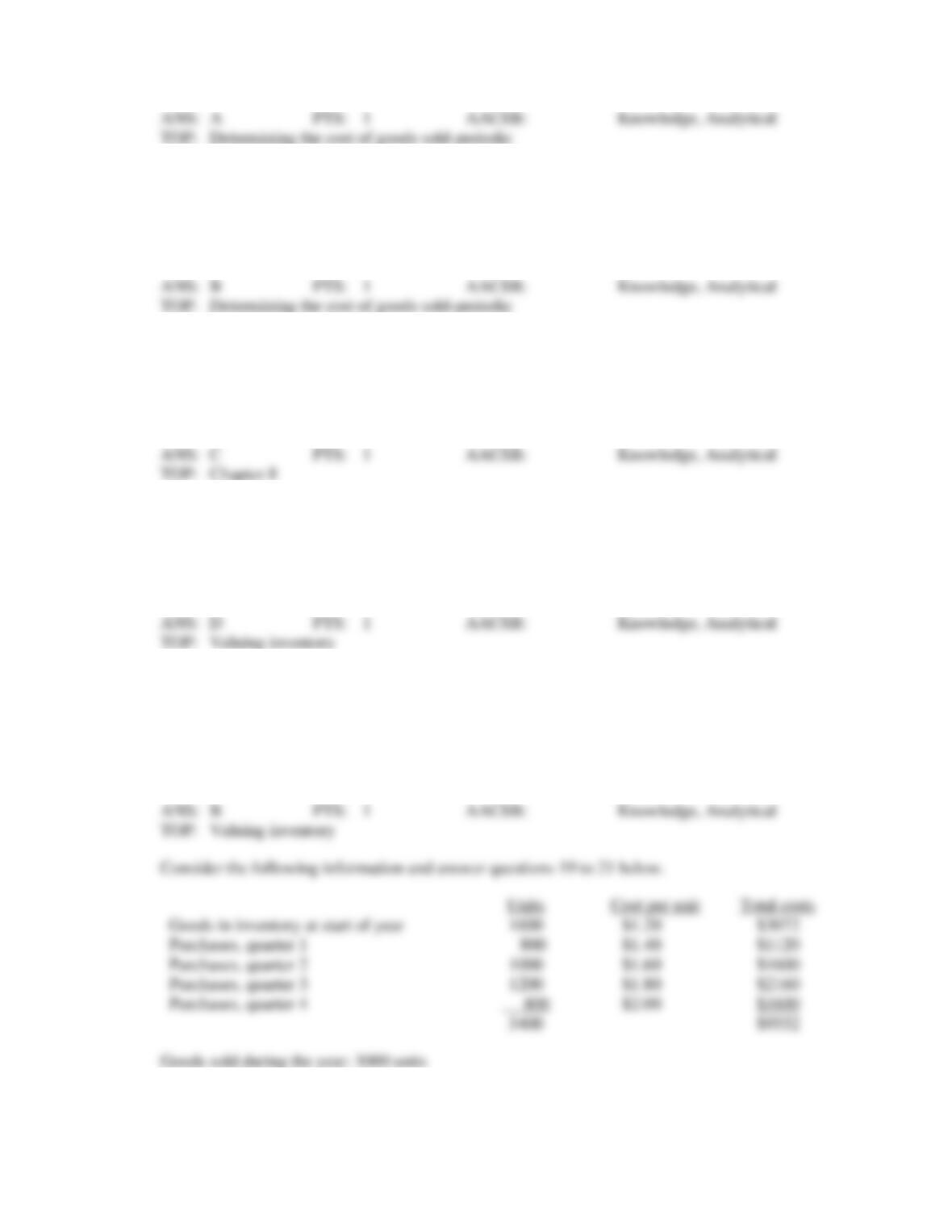
19. Using the last-in, first-out periodic method, the value of closing inventory is:
A.
$4400.
B.
$4192.
C.
$1840.
D.
$3460.
20. Using the first-in, first-out periodic method, the value of closing inventory is:
A.
$4192.
B.
$3450.
C.
$2510.
D.
$4400.
21. Using the weighted-average-cost method, the value of closing inventory is:
A.
$4400
B.
$4192
C.
$4245
D.
$5040
22. Which of the following methods results in the higher value for cost of goods sold in times of rising
inventory prices?
A.
First-in, first-out
B.
Weighted average cost
C.
Last-in, first-out
D.
None of the above
23. First-in, first-out is the same as:
A.
weighted average cost.
B.
last-in, last-out.
C.
last-in, first-out.
D.
first-in, last-out.
24. Assuming that there are inflationary trends in the economy, the inventory amount shown in the
balance sheet, if based on LIFO, would normally be:
A.
lower than the FIFO value.
B.
equal to current market value.
C.
higher than the FIFO value.
D.
higher than current market value.
25. Which inventory measurement method would have the most recent costs in cost of goods sold?
A.
First-in, first-out (FIFO)
B.
Last-in, first-out (LIFO)
C.
Weighted average
D.
Work-in-progress
26. The inventory valuation method that results in the recognition of the oldest inventory costs on the
balance sheet and statement of comprehensive income, respectively, is:
BS Position SOCI Performance
A.
FIFO LIFO
B.
FIFO FIFO
C.
LIFO LIFO
D.
LIFO FIFO
27. When the price of inventory is decreasing, which of the following is true regarding the three best–
known inventory valuation methods?
A.
The LIFO method will yield the smallest amount for cost of goods sold.
B.
The weighted-average method will yield the largest amount for closing inventory.
C.
The FIFO method will yield the highest amount for closing inventory.
D.
Both LIFO and FIFO will yield a smaller tax obligation than weighted-average.
28. The So-Big Company sells hot-dogs. Inventory information for a recent week is shown below:
Units
Unit Cost
Total Cost
Beginning inventory
2
$ 6
$12
Purchase
4
8
32
Purchase
6
10
60
If five units were sold during the week, what is the cost of goods sold if the LIFO periodic method
is used?
A.
$68
B.
$54
C.
$50
D.
$36
29. The So-Big Company sells hot-dogs. Inventory information for a recent week is shown below in
chronological order:
Units
Unit Cost
Total Cost
Beginning inventory
2
$ 6
$12
Purchase
Sales
4
3
8
32
Purchase
Sales
6
2
10
60
What is the cost of goods sold if the LIFO perpetual method is used?

A.
$68
B.
$54
C.
$50
D.
$36
30. Schultz-Stein Company has the following inventory information for a recent year:
Beginning inventory
$500
(10 units with an average cost of $50 each)
January purchase
10 units @ $48 each
July purchase
30 units @ $52 each
October purchase
20 units @ $48 each
Ending inventory
25 units
The cost of ending inventory, using the weighted-average periodic method, is:
A.
$1250.
B.
$1240.
C.
$1237.50.
D.
$1220.
31. An advocate of the LIFO inventory method would maintain that:
A.
current costs are matched with current selling prices.
B.
the lowest possible costs are always shown in the ending inventory.
C.
the oldest inventory is relieved of its cost before the newer purchases.
D.
the highest possible costs are always shown in the ending inventory.
32. Davenport Merchandising Company uses the FIFO periodic method of cost assignment. The
following data are available:
Date
Units
Unit Cost
Total Cost
Beginning inventory
1 Jan
400
$24
$9600
Purchase
13 Mar
800
28
22,400
Purchase
20 Jun
1200
32
38,400
Ending inventory
31 Dec
200
The value of the ending inventory will be:
A.
$2400.
B.
$4800.
C.
$5866.
D.
$6400.

33. Gamma Bomber Parts uses the FIFO periodic costing method. The following data are available:
Units
Unit Cost
Total Cost
Beginning inventory
20
$4000
$80,000
Purchase
20
4800
96,000
Purchase
16
3600
57,600
Sales during the year
25
The cost of goods sold should be:
A.
$104,000.
B.
$100,800.
C.
$129,600.
D.
$132,800.
34. J. Q. Adams Co. had beginning inventory of 50 units with a total cost of $1000. During the period,
J. Q. Adams first purchased 20 units for $800 and then 30 units for $1800. The company uses the
LIFO periodic method of costing inventory. If a physical count of ending inventory showed 45
units, at what amount would they be valued on the balance sheet?
A.
$1620
B.
$900
C.
$2400
D.
$3600
35. Which of the following is false concerning the lower-of-cost-or-net realisable value rule when it is
applied to the valuation of inventory?
A.
Inventory must be written up (increased) if the net realisable value of ending inventory is
greater than the cost of ending inventory as estimated using the LIFO method.
B.
Inventory must be written down (decreased) if the net realisable value of ending inventory
is less than the cost of ending inventory as estimated using the average cost method.
C.
Inventory must be written down (decreased) if the current market cost of ending inventory
is less than the cost of ending inventory as estimated using the FIFO method.
D.
Writedowns (decreases) are more common in times of rising prices when FIFO is used.
36. The balances for the opening and closing inventory of XYZ Ltd for the financial year were
$40,000 and $50,000 respectively. Sales for the year totalled $3 million, and cost of goods sold
was $600,000. The ratio for inventory turnover for the year was approximately:
A.
66.67:1
B.
13.33:1
C.
1.25:1
D.
5:1
37. The balances for the opening and closing inventory of ABC Ltd for the financial year were
$40,000 and $50,000 respectively. Sales for the year totalled $2.5 million. Purchases of inventory
for the year totalled $700,000. What was the gross profit figure for the year?
A.
$690,000
B.
$1,800,000
C.
$1,810,000
D.
$2,500,000
38. Which of the following items of expenditure would not be included under the variable cost method
of measuring inventory:
A.
direct materials.
B.
fixed manufacturing overheads.
C.
direct labour.
D.
variable manufacturing overheads.
SHORT ANSWER
1. Distinguish between the periodic and perpetual methods of recording inventories.
2. Describe the difference between absorption costing and variable costing. Support your answer with
reference to the following costs:
•
managing director’s salary.
•
machine operator’s wages.
•
cost of raw materials.
•
factory supervisor’s salary.
3. Describe the LCM rule as it applies to the valuation of closing inventory, and name three different
methods of calculating the cost of inventory.
4. How would the composition of the inventory reported in the balance sheet of a retail organisation,
such as Woolworths, be similar to that of a manufacturing entity, and in what way(s) would it
differ?
PROBLEM
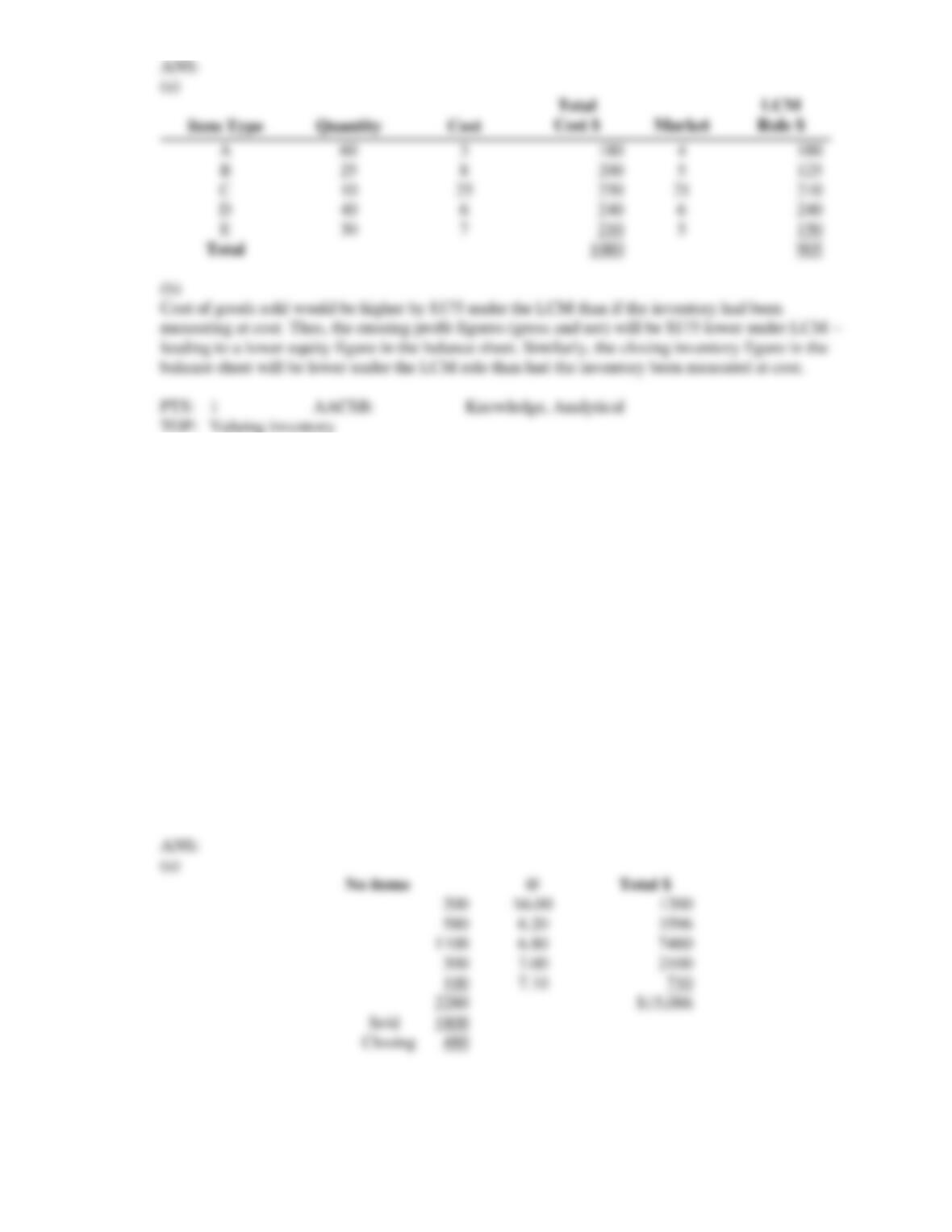
1. The inventory of Lusitania Ltd contains the following items at 30 June 20X7.
Total
Cost $
Market
Item Type
Quantity
Cost
A
60
3
180
4
B
25
8
200
5
C
10
25
250
21
D
40
6
240
6
E
30
7
210
5
(a)
Determine the ending inventory value at 30 June 20X7, applying the lower cost and
market rule to the individual items.
(b)
What would the application of the LCM rule rather than cost have on the financial
statements of the company?
2. During the year ended 30 June 20X7 Excelsior Soccer sold 1800 soccer balls at $12.50 each. The
entity uses the periodic method of recording inventory. Beginning inventory on 1 July 20X6
amounted to 200 balls at a cost of $1200. Purchases during the year were made in the following
order: 580 units @ $6.20
100 units @ $6.80
300 units @ $7.00
100 units @ $7.10
(a)
Calculate the 30 June 20X7 closing inventory figure using the following assumptions
regarding the flow of costs (round to the nearest $):
•
FIFO, periodic method.
•
LIFO, periodic method.
•
Weighted average, periodic method.
(b)
Prepare partial statements of comprehensive income for each method to the gross profit
stage.