
Chapter 8: Investment Decision Rules
TRUE/FALSE. Write ‘T’ if the statement is true and ‘F’ if the statement is false.
1) Preference for cash today versus cash in the future in part determines net present value (NPV).
2) Net present value (NPV) is the difference between the present value (PV) of the benefits and the present
value (PV) of the costs of a project or investment.
MULTIPLE CHOICE. Choose the one alternative that best completes the statement or answers the question.
3) Most corporations measure the value of a project in terms of which of the following?
A) discount value
B) present value (PV)
C) future value (FV)
D) discount factor
4) What is the present value (PV) of an investment?
A) the difference between the cost of the investment and the benefit of the investment in dollars today
B) the amount by which the cash flow of an investment exceeds or falls short of the cash flow
generated by the same amount of money invested at market rate
C) the amount that an investment would yield if the benefit were realized today
D) the amount you need to invest at the current interest rate to re–create the cash flow from the
investment
5) Tanner is choosing between two investment options. He can invest $500 now and get (guaranteed)
$550 in one year, or invest $500 now and get (guaranteed) $531.40 back later today. The risk–free rate is
3.5%. Which investment should Tanner prefer?
A) $550 in one year, since it is $50 more than he invested rather than $31.40 more than he invested.
B) $531.40 later today, since $1 today is worth more than $1 in one year.
C) Neither – both investments have a negative NPV.
D) Tanner should be indifferent between the two investments, since both are equivalent to the same
amount of cash today.
6) A firm has an opportunity to invest $100,000 today that will yield $115,000 in one year. If interest rates
are 6%, what is the net present value (NPV) of this investment?
A) $14,151
B) $9000
C) $8491
D) $15,000
7) A car dealership offers a car for $14,000, with up to one year to pay for the car. If the interest rate is 7%,
what is the net present value (NPV) of this offer to buyers who elect not to pay for the car for one year?
A) $14,000
B) $916
C) $13,084
D) $1896
8) Martin is offered an investment where for $5000 today, he will receive $5250 in one year. He decides to
borrow $5000 from the bank to make this investment. What is the maximum interest rate the bank needs
to offer on the loan if Martin is at least to break even on this investment?
A) 3.2%
B) 4.8%
C) 5.6%
D) 5.0%
9) A security firm is offered $80,000 in one year for providing CCTV coverage of a property. The cost of
providing this coverage to the security firm is $74,000, payable now, and the interest rate is 8.5%. Should
the firm take the contract?
A) Yes, since net present value (NPV) is negative.
B) It does not matter whether the contract is taken or not, since NPV = 0.
C) No, since net present value (NPV) is negative.
D) Yes, since net present value (NPV) is positive.
10) A farmer sows a certain crop. It costs $250,000 to buy the seed, prepare the ground, and sow the crop. In
one year’s time it will cost $110,000 to harvest the crop. If the crop will be worth $380,000, and the interest
rate is 8%, what is the net present value (NPV) of this investment?
A) –$220
B) –$21,000
C) $0
D) $23,100

11) A delivery service is buying 600 tires for its fleet of vehicles. One supplier offers to supply the tires for
$85 per tire, payable in one year. Another supplier will supply the tires for $20,000 down today, then $50
per tire, payable in one year. What is the difference in PV between the first and the second offer,
assuming interest rates are 8.5%?
A) $276
B) $1000
C) –$1000
D) $645
12) Peter has a business opportunity that requires him to invest $10,000 today, and receive $12,000 in one
year. He can either use $10,000 that he already has for this investment or borrow the money from his
bank at an interest rate of 10%. However, the $10,000 he has right now is needed for urgent repairs to his
home, repairs that will cost at least $15,000 if he delays them for a year. What is the best alternative for
Peter out of the following choices?
A) Yes, since the net present value (NPV) of the investment, should he take it, is greater than the net
present value (NPV) of the home repairs if he delays them for one year.
B) Yes, since the net present value (NPV) of the investment is greater than zero he can invest the
$10,000 in the business opportunity, and then next year use this money plus the benefit from this
money to make the necessary home repairs.
C) No, since the net present value (NPV) of the investment, should he take it, is less than the net
present value (NPV) of the home repairs if he delays them for one year.
D) Yes, since he can borrow the $10,000 from a bank, repair his home, invest $10,000 in the business
opportunity, which, since it has a NPV > 0 will mean he will still come out ahead after repaying the
loan.
SHORT ANSWER. Write the word or phrase that best completes each statement or answers the question.
13) What is the Net Present Value rule?
14) Should personal preferences for cash today versus cash tomorrow play a role in the net present value
(NPV) decision–making process?
TRUE/FALSE. Write ‘T’ if the statement is true and ‘F’ if the statement is false.
15) The Net Present Value rule implies that we should compare a project’s net present value (NPV) to zero.

MULTIPLE CHOICE. Choose the one alternative that best completes the statement or answers the question.
16) An auto–parts company is deciding whether to sponsor a racing team for a cost of $1 million. The
sponsorship would last for three years and is expected to increase cash flows by $580,000 per year. If the
discount rate is 7.5%, what will be the change in the value of the company if it chooses to go ahead with
the sponsorship?
A) $740,000
B) $863,000
C) $508,305
D) $808,786
17) An orcharder spends $100,000 to plant pomegranate bushes. It will take four years for the bushes to
provide a usable crop. He estimates that every year for 20 years after that he will receive a crop worth
$10,000 per year. If the discount rate is 8%, what is the net present value (NPV) of this investment?
A) –$27,834
B) $108
C) –$12,897
D) $3,268
18) The owners of a chain of fast–food restaurants spend $28 million installing donut makers in all their
restaurants. This is expected to increase cash flows by $10 million per year for the next five years. If the
discount rate is 6.5%, were the owners correct in making the decision to install donut makers?
A) Yes, as it has a net present value (NPV) of $13.56 million.
B) No, as it has a net present value (NPV) of–1.68 million.
C) No, as it has a net present value (NPV) of –$2.25 million.
D) Yes, as it has a net present value (NPV) of $8.74 million.
Use the information for the question(s) below.
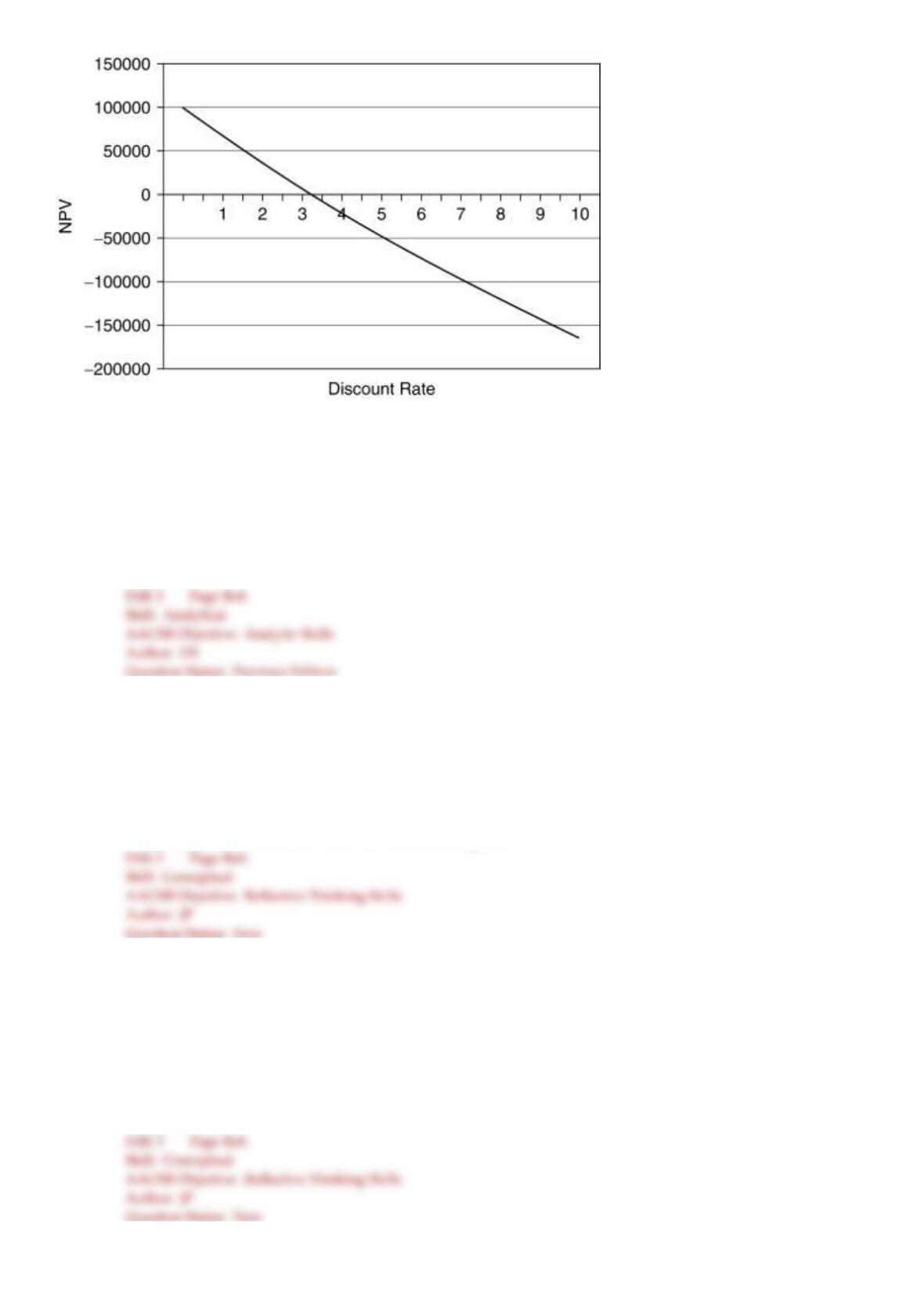
19) The owner of a hair salon spends $1,000,000 to renovate its premises, estimating that this will increase
her cash flow by $220,000 per year. She constructs the above graph, which shows the net present value
(NPV) as a function of the discount rate. At what discount rate does her decision to renovate become
untenable?
A) 3.3%
B) 4.8%
C) 4.0%
D) 3.0%
20) The owner of a hair salon spends $1,000,000 to renovate its premises, estimating that this will increase
her cash flow by $220,000 per year. She constructs the above graph, which shows the net present value
(NPV) as a function of the discount rate. If her discount rate is 6%, should she accept the project?
A) Yes, because the NPV is positive at that rate.
B) No, because the NPV is positive at that rate.
C) No, because the NPV is negative at that rate.
D) Cannot be determined from the information given.
21) The owner of a hair salon spends $1,000,000 to renovate its premises, estimating that this will increase
her cash flow by $220,000 per year. She constructs the above graph, which shows the net present value
(NPV) as a function of the discount rate. At what dollar value should the NPV profile cross the vertical
axis?
A) The vertical axis crossing point cannot be calculated since the cash inflows are a perpetuity.
B) $780,000
C) Cannot be determined because inadequate information is given.
D) $1,000,000
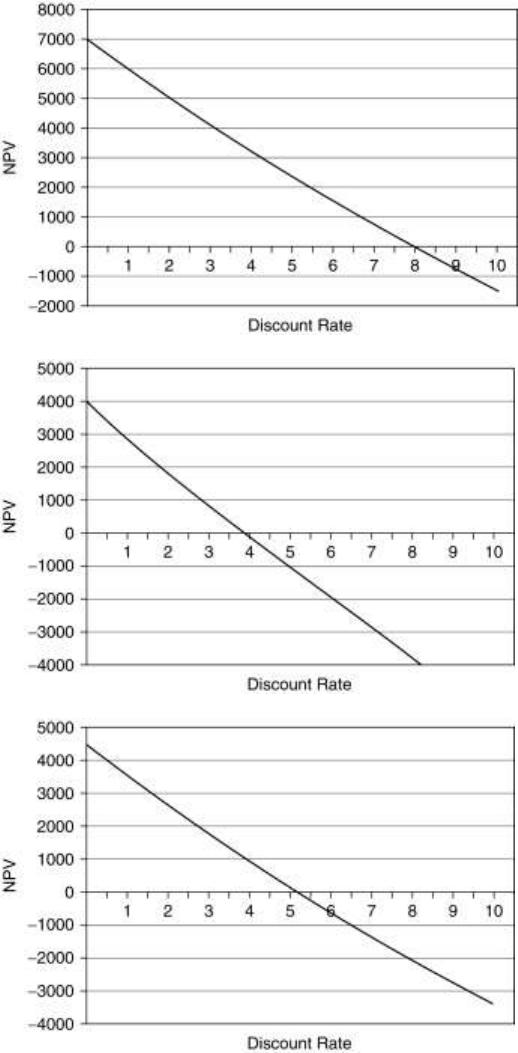
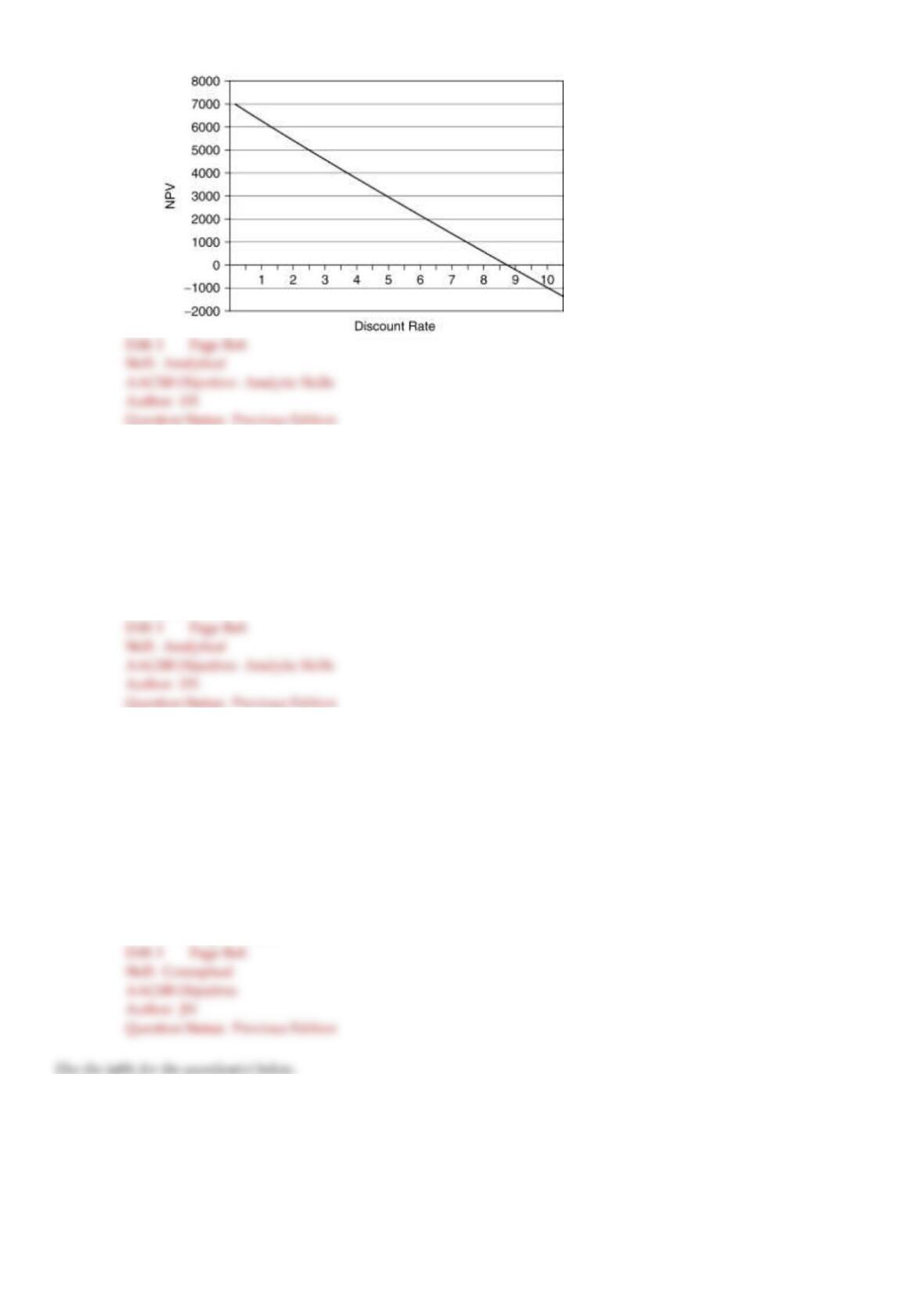
22) A bakery is deciding whether to buy an extra van to help deliver its products. The van will cost $28,000,
but is expected to increase profits by $6500 per year over the five years of its working life. Which of the
following is the correct net present value (NPV) profile for this purchase?
A)
B)
C)
D)
23) A manufacturer of video games develops a new game over two years. This costs $850,000 per year with
one payment made immediately and the other at the end of two years. When the game is released, it is
expected to make $1.2 million per year for three years after that. What is the net present value (NPV) of
this decision if the cost of capital is 9%?
A) $991,220
B) $1,841,093
C) $1,071,432
D) $1,564,559
24) Which of the following statements is FALSE?
A) If you are unsure of your cost of capital estimate, it is important to determine how sensitive your
analysis is to errors in this estimate.
B) If the cost of capital estimate is more than the internal rate of return (IRR), the net present value
(NPV) will be positive.
C) The internal rate of return (IRR) can provide information on how sensitive your analysis is to errors
in the estimate of your cost of capital.
D) In general, the difference between the cost of capital and the internal rate of return (IRR) is the
maximum amount of estimation error in the cost of capital estimate that can exist without altering
the original decision.

Consider a project with the following cash flows:
Year
Cash Flow
0
–10,000
1
4000
2
4000
3
4000
4
4000
25) If the appropriate discount rate for this project is 15%, then the net present value (NPV) is closest to:
A) $867
B) $6000
C) $1420
D) –$867
26) Given the cash flows in the table above, the point at which the NPV profile crosses the vertical axis is:
A) $6000
B) 22.0%
C) –$867
D) 15.0%
Use the table for the question(s) below.
Consider the following two projects:
Project
Year 0
Cash Flow
Year 1
Cash Flow
Year 2
Cash Flow
Year 3
Cash Flow
Year 4
Cash Flow
Discount
Rate
A
–100
40
50
60
N/A
0.15
B
–73
30
30
30
30
0.15
27) The net present value (NPV) of project A is closest to:
A) 12.6
B) 42.9
C) 15.0
D) 12.0
28) The net present value (NPV) of project B is closest to:
A) 12.0
B) 15.0
C) 12.6
D) 23.3

Use the information for the question(s) below.
The Sisyphean Company is planning on investing in a new project. This will involve the purchase of some
new machinery costing $450,000. The Sisyphean Company expects cash inflows from this project as
detailed below:
Year 1
Year 2
Year 3
Year 4
$200,000
$225,000
$275,000
$200,000
The appropriate discount rate for this project is 16%.
29) The net present value (NPV) for this project is closest to:
A) $123,420
B) $176,270
C) $179,590
D) $450,000
Use the table for the question(s) below.
Consider the following two projects:
Project
Year 0
C/F
Year 1
C/F
Year 2
C/F
Year 3
C/F
Year 4
C/F
Year 5
C/F
Year 6
C/F
Year 7
C/F
Discount
Rate
Alpha
–79
20
25
30
35
40
N/A
N/A
15%
Beta
–80
25
25
25
25
25
25
25
16%
30) The net present value (NPV) for project alpha is closest to:
A) $16.92
B) $20.96
C) $24.01
D) $14.41
31) The net present value (NPV) for project beta is closest to:
A) $14.41
B) $24.01
C) $20.96
D) $16.92
SHORT ANSWER. Write the word or phrase that best completes each statement or answers the question.
32) How can you calculate the y–intercept of a net present value (NPV) profile without using TVM concepts?
33) What is the general shape of the net present value (NPV) profile?
34) Under what situation can the net present value (NPV) profile be upward sloping?
TRUE/FALSE. Write ‘T’ if the statement is true and ‘F’ if the statement is false.
35) The payback rule is based on the idea that an opportunity that pays back its initial investment quickly is
a worthwhile opportunity.
MULTIPLE CHOICE. Choose the one alternative that best completes the statement or answers the question.
36) Which of the following situations can lead to IRR giving a different decision than NPV?
A) Differences in project scale
B) Multiple IRRs
C) Delayed investment
D) All of the above can lead to IRR giving a different decision than NPV
37) According to Graham and Harvey’s 2001 survey (Figure 8.2 in the text), the most popular decision rules
for capital budgeting used by CFOs are:
A) IRR, NPV, Payback period
B) Profitability index, NPV, IRR
C) MIRR, IRR, Payback period
D) NPV, IRR, MIRR

TRUE/FALSE. Write ‘T’ if the statement is true and ‘F’ if the statement is false.
38) The internal rate of return (IRR) rule will agree with the Net Present Value rule even when positive cash
flows precede negative cash flows.
MULTIPLE CHOICE. Choose the one alternative that best completes the statement or answers the question.
39) Which of the following is NOT a limitation of the payback rule?
A) It is difficult to calculate.
B) It does not consider cash flows occurring after the payback period.
C) It does not consider the time value of money.
D) Lacks a decision criterion that is economically based.
40) A convenience store owner is contemplating putting a large neon sign over his store. It would cost
$50,000, but is expected to bring an additional $24,000 of profit to the store every year for five years.
Would this project be worthwhile if evaluated using a payback period of two years or less and if the cost
of capital is 10%?
A) No, since the value of the cash flows over the first two years are less than the initial investment.
B) Yes, since the cash flows after two years are greater than the initial investment.
C) Yes, since it will pay back its initial investment in two years.
D) Yes, since the value of the cash flows into the store, in present dollars, are greater than the initial
investment.
Use the information for the question(s) below.
Project A
Project B
Time 0
–10,000
–10,000
Time 1
5,000
4,000
Time 2
4,000
3,000
Time 3
3,000
10,000
41) If WiseGuy Inc. uses payback period rule to choose projects, which of the projects (Project A or Project B)
will rank highest?
A) Project A
B) Project B
C) Project A and Project B have the same ranking.
D) Cannot calculate a payback period without a discount rate.
42) If WiseGuy Inc. uses IRR rule to choose projects, which of the projects (Project A or Project B) will rank
highest?

A) Project B
B) Project A
C) Project A and Project B have the same ranking.
D) Cannot calculate a payback period without a discount rate.
43) A florist is buying a number of motorcycles to expand its delivery service. These will cost $87,000, but are
expected to increase profits by $3000 per month over the next four years. What is the payback period in
this case?
A) 29 months
B) 12 months
C) 24 months
D) 18 months
44) Investment A:
Year: 0 1 2 3 4 5
Cash flow: –$14,000 $6,000 $6,000 $6,000 $6,000 $6,000
Investment B:
Year: 0 1 2 3 4 5
Cash flow: –$15,000 $7,000 $7,000 $7,000 $7,000 $7,000
Investment C:
Year: 0 1 2 3 4 5
Cash flow: –$18,000 $12,000 $4,000 $4,000 $4,000 $4,000
The cash flows for three projects are shown above. The cost of capital is 7.5%. If an investor decided to
take projects with a payback period two years or less, which of these projects would he take?
A) Investment A
B) Investment B
C) Investment C
D) none of these investments
45) A lottery winner can take $6 million now or be paid $600,000 at the end of each of the next 16 years. The
winner calculates the internal rate of return (IRR) of taking the money at the end of each year and,
estimating that the discount rate across this period will be 6%, decides to take the money at the end of
each year. Was her decision correct?
A) Yes, because it agrees with both the Net Present Value rule and the payback rule.
B) Yes, because it agrees with the Net Present Value rule.
C) No, because it disagrees with the Net Present Value rule.
D) Yes, because it agrees with the payback rule.
46) Mary is in contract negotiations with a publishing house for her new novel. She has two options. She
may be paid $100,000 up front, and receive royalties that are expected to total $26,000 at the end of each
of the next five years. Alternatively, she can receive $200,000 up front and no royalties. Which of the
following investment rules would indicate that she should take the former deal, given a discount rate of
8%?
Rule I: The Net Present Value rule
Rule II: The Payback Rule with a payback period of two years
Rule III: The internal rate of return (IRR) Rule
A) Rule III only
B) Rule I and II
C) Rule II and III
D) Rule I only
47) A local government awards a landscaping company a contract worth $1.2 million per year for five years
for maintaining public parks. The landscaping company will need to buy some new machinery before
they can take on the contract. If the cost of capital is 7%, what is the most that this equipment could cost
if the contract is to be worthwhile for the landscaping company?
A) $4.55 million
B) $4.61 million
C) $5.26 million
D) $4.92 million
48) A mining company plans to mine a beach for rutile. To do so will cost $10 million up front and then
produce cash flows of $3 million per year for five years. At the end of the sixth year the company will
incur shut–down and clean–up costs of $2 million. If the cost of capital is 11%, then what is the MIRR for
this project?
A) 10.92%
B) 12.5%
C) 8.52%
D) 11.03%
49) An investor is considering a project that will generate $800,000 per year for four years. In addition to
upfront costs, at the completion of the project at the end of the fifth year there will be shut–down costs of
$500,000. If the cost of capital is 5%, based on the MIRR, at what upfront costs does this project cease to
be worthwhile?
A) $2.32 million
B) $2.84 million
C) $2.58 million
D) $2.44 million

50) Which of the following is NOT a valid method of modifying cash flows to produce a MIRR?
A) Discount all of the negative cash flows to time 0 and leave the positive cash flows alone.
B) Turn multiple negative cash flows into a single negative cash flow by summing all negative cash
flows over the project’s lifetime.
C) Discount all of the negative cash flows to the present and compound all of the positive cash flows to
the end of the project.
D) Leave the initial cash flow alone and compound all of the remaining cash flows to the final period
of the project.
51) Which of the following statements is FALSE?
A) A net present value (NPV) will always exist for an investment opportunity.
B) The payback investment rule is based on the notion that an opportunity that pays back its initial
investments quickly is a good idea.
C) An internal rate of return (IRR) will always exist for an investment opportunity.
D) In general, there can be as many internal rates of return (IRRs) as the number of times the project’s
cash flows change sign over time.
52) Which of the following statements is FALSE?
A) The payback rule is reliable because it considers the time value of money and depends on the cost
of capital.
B) The payback rule is useful in cases where the cost of making an incorrect decision might not be
large enough to justify the time required for calculating the net present value (NPV).
C) For most investment opportunities expenses occur initially and cash is received later.
D) Fifty percent of firms surveyed reported using the payback rule for making decisions.
Use the table for the question(s) below.
Consider a project with the following cash flows:
Year
Cash Flow
0
–10,000
1
4000
2
4000
3
4000
4
4000
53) Assume the appropriate discount rate for this project is 15%. The payback period for this project is
closest to:

A) 2
B) 2.5
C) 4
D) 3
Use the table for the question(s) below.
Consider the following two projects:
Project
Year 0
Cash Flow
Year 1
Cash Flow
Year 2
Cash Flow
Year 3
Cash Flow
Year 4
Cash Flow
Discount
Rate
A
–100
40
50
60
N/A
0.15
B
–73
30
30
30
30
0.15
54) The payback period for project A is closest to:
A) 2.5 years
B) 2.4 years
C) 2.0 years
D) 2.2 years
55) The payback period for project B is closest to:
A) 2.2 years
B) 2.0 years
C) 2.4 years
D) 2.5 years
Use the information for the question(s) below.
The Sisyphean Company is planning on investing in a new project. This will involve the purchase of some
new machinery costing $450,000. The Sisyphean Company expects cash inflows from this project as
detailed below:
Year 1
Year 2
Year 3
Year 4
$200,000
$225,000
$275,000
$200,000
The appropriate discount rate for this project is 16%.
56) The internal rate of return (IRR) for this project is closest to:

SHORT ANSWER. Write the word or phrase that best completes each statement or answers the question.
57) What is the decision criteria while using the payback rule?
58) What is the decision criteria using the Net Present Value rule?
59) What is the decision criteria using internal rate of return (IRR) rule?
TRUE/FALSE. Write ‘T’ if the statement is true and ‘F’ if the statement is false.
60) When different investment rules give conflicting answers, then decisions should be based on the Net
Present Value rule, as it is the most reliable and accurate decision rule.
61) Internal rate of return (IRR) can reliably be used to choose between mutually exclusive projects.
62) When comparing mutually exclusive projects which have different scales, you must know the dollar
impact of each investment rather than percentage returns.

MULTIPLE CHOICE. Choose the one alternative that best completes the statement or answers the question.
63) The cash flows for four projects are shown below, along with the cost of capital for these projects. If these
projects are mutually exclusive, which one should be taken?
A) Year: 0 1 2 3 4 5
Cash flow: –$20,000 $6000 $6000 $6000 $6000 $6000
Cost of Capital: 8%
B) Year: 0 1 2 3 4 5
Cash flow: –$15,000 $4000 $4000 $4000 $4000 $4000
Cost of Capital: 7%
C) Year: 0 1 2 3 4 5
Cash flow: –$–18,000 $5000 $5000 $5000 $5000 $5000
Cost of Capital: 7.5%
D) Year: 0 1 2 3 4 5
Cash flow: –$12,000 $4000 $4000 $4000 $4000 $4000
Cost of Capital: 5%
Use the information for the question(s) below.
Project A
Project B
Time 0
–10,000
–10,000
Time 1
5,000
4,000
Time 2
4,000
3,000
Time 3
3,000
10,000
64) If WiseGuy Inc is choosing one of the above mutually exclusive projects (Project A or Project B), given a
discount rate of 8%, which should the company choose?
A) Project B
B) Project A
C) Neither project – both have negative NPV.
D) Both projects – both have positive NPV.
65) The cash flows for four projects are shown below, along with the cost of capital for these projects. If these
projects are mutually exclusive, which one should be taken?
A) Year: 0 1 2 3 4 5
Cash flow: –$5000 $2000 $2000 $2000 $2000 $2000
Cost of Capital: 6%
B) Year: 0 1 2 3 4 5
Cash flow: –$6000 $2500 $2500 $2500 $2500 2,500
Cost of Capital: 7%
C) Year: 0 1 2 3 4 5
Cash flow: –$7000 $3000 $3000 $3000 $3000 $3000
Cost of Capital: 8%
D) Year: 0 1 2 3 4 5
Cash flow: –$8000 $3200 $3200 $3200 $3200 $3200
Cost of Capital: 9%

66) An investor has the opportunity to invest in four new retail stores. The amount that can be invested in
each store, along with the expected cash flow at the end of the first year, the growth rate of the concern,
and the cost of capital is shown for each case. It is assumed each investment will operate in perpetuity
after the initial investment. Which investment should the investor choose?
A) Initial investment: $100,000; Cash flow in year 1: $12,000; Growth Rate: 1.25%; Cost of Capital: 9.0%
B) Initial investment: $90,000; Cash flow in year 1: $10,000; Growth Rate: 1.50%; Cost of Capital: 9.0%
C) Initial investment: $80,000; Cash flow in year 1: $8000; Growth Rate: 1.75%; Cost of Capital:8.0%
D) Initial investment: $60,000; Cash flow in year 1: $6000; Growth Rate: 2.50%; Cost of Capital: 7.5%
67) The following show four mutually exclusive investments. Which is the best investment?
A) Initial investment: $1.1 million; Cash flow in year 1: $160,000; Annual Growth Rate: 2%; Cost of
Capital: 9.0%
B) Initial investment: $1.2 million; Cash flow in year 1: $150,000; Annual Growth Rate: 2%; Cost of
Capital:7.0%
C) Initial investment: $1.3 million; Cash flow in year 1: $160,000; Annual Growth Rate: 1%; Cost of
Capital: 6%
D) Initial investment: $1.4 million; Cash flow in year 1: $150,000; Annual Growth Rate: 2%; Cost of
Capital: 8%
68) The cash flows for four investments have been identified as follows:
Investment A B C D
Cash Flow Today
in thousands of dollars –8.0 –12.2 –6.0 –2.2
Cash Flow in One Year
in thousands of dollars 9.4 14.3 7.05 2.59
Based on the above information, and with an interest rate of 6%, which is the best investment?
A) Investment A
B) Investment B
C) Investment C
D) Investment D
69) Two mutually exclusive investment opportunities require an initial investment of $5 million. Investment
A then generates $1.5 million per year in perpetuity, while investment B pays $1 million in the first year,
with cash flows increasing by 3% per year after that. At what cost of capital would an investor regard
both opportunities as being equivalent?
A) 3%
B) 10%
C) 9%
D) 6%
70) A company has identified the following investments as looking promising. Each requires an initial
investment of $1.2 million. Which is the best investment?
A) a perpetuity that generates a cash flow at the end of year 1 of $100,000, has a growth rate of 1.25%,
and a cost of capital of 10%
B) a perpetuity that generates a cash flow at the end of year 1 of $800,000, has a growth rate of 2.25%,
and a cost of capital of 12%
C) an investment that generates a cash flow of $400,000 at the end of each of the next five years, when
the cost of capital is 6%
D) an investment that generates a cash flow of $200,000 at the end of each of the next ten years, when
the cost of capital is 6%
71) Time: 0 1 2 3
Investment A: –$1 million $300,000 $400,000 $500,000
Investment B: –$1 million $500,000 $400,000 $300,000
An investor is considering the two investments shown above. Her cost of capital is 9%. Which of the
following statements about these investments is true?
A) The investor should take investment B since it has a greater internal rate of return (IRR).
B) The investor should take investment B since it has a greater net present value (NPV).
C) The investor should take investment A since it has a greater internal rate of return (IRR).
D) The investor should take investment A since it has a greater net present value (NPV).
72) An investor is considering the two investments shown above. Which of the following statements about
these investments is true?
A) The investor should take investment A since it has a greater net present value (NPV).
B) The investor should take investment B since it has a greater net present value (NPV).
C) The investor should take investment A since it has a greater internal rate of return (IRR).
D) Neither investment should be taken since they both have a negative net present value (NPV).