Chapter 7: Attitudes and Attitude Change
TRUE/FALSE
1. Attitudes motivate people to behave in relatively consistent ways.
2. According to the ABC approach to attitudes, the statement, “I really like my smartphone,” is an
example of the behavior component of attitude.
3. Buying a product because it delivers a specific benefit is an example of the value-expressive function
of attitudes.
4. The knowledge function of attitudes allows consumers to simplify decision-making processes.
5. The utilitarian function of attitudes works as a defense mechanism for consumers.
6. The ego-defensive function of attitudes enables a consumer to protect him- or herself from information
that may be threatening.
7. In the high-involvement hierarchy, beliefs and feelings about products are formed first following
which, the consumer decides whether or not to buy the product.
8. Impulse purchases are never motivated by feelings.
9. The behavioral influence hierarchy suggests that some behaviors occur without either beliefs or affect
being strongly formed beforehand.
10. The attitude-toward-the-object (ATO) model combines information about a number of beliefs and
evaluations pertaining to an object’s attributes.
11. In the attitude-toward-the-object (ATO) model, the belief ratings (b) do not vary across the brands
under consideration, while the evaluation ratings do.
12. The ATO approach is known as a non-compensatory model.
13. Attitude-behavior consistency refers to the extent to which a strong relationship exists between
attitudes and actual behavior.
14. The behavioral intentions model is sometimes referred to as the ATO model.
15. The behavioral intentions model adds the subjective norm component that assesses the consumer’s
perceptions of what other people think they should do.
16. The behavioral intentions model explicitly focuses on the consumer’s attitude toward the object rather
than the attitude toward the behavior of buying.
17. As the length of time between attitude measurement and overt behavior grows, the predictive ability of
attitudinal models strengthens.
18. Attitude-behavior models tend to perform very well in impulse-buying situations.
19. The theory of planned action expands upon the behavioral intentions model by including a subjective
norm component.
20. Attitude auditing refers to the extent to which a company actively monitors its customers’ attitudes
over time.
21. Persuasion refers to specific attempts to change attitudes.
22. According to the ATO model of persuasion, changing beliefs would involve improving the belief
rating for an attribute that is evaluated positively.
23. According to the behavioral influence approach to persuasion, behavior change can occur only if
beliefs and attitudes are changed first.
24. According to the changing schema-based affect theory, if the affect found in a schema can be changed,
then the attitude toward a brand will change as well.
25. The elaboration likelihood model (ELM) illustrates how consumers compare incoming information to
their existing attitudes about a particular object or issue.
26. According to the elaboration likelihood model, if the central route to persuasion is activated, the
consumer develops a number of cognitive responses regarding the incoming message that may either
support or contradict the information.
27. Contradicting thoughts are known as negative arguments.
28. Attitude change tends to be relatively enduring when it occurs in the central route.
29. According to the elaboration likelihood model (ELM), if a consumer is highly involved with a
message, the peripheral route to persuasion will be followed.
30. According to the elaboration likelihood model of persuasion, nonproduct related information such as
music or the imagery presented along with the message, are examples of central cues.
31. According to the elaboration likelihood model of persuasion, if the consumer is influenced more by
peripheral cues than central cues, any resulting belief or attitude change will likely be enduring.
32. The balance theory is based on the consistency principle.
33. The balance theory approach was introduced by psychoanalyst Sigmund Freud.
34. In balance theory, unit relations are the relations between the observer (consumer) and the other
elements in the system.
35. The basic premise of balance theory is that consumers are motivated to maintain perceived consistency
in the relations found in the triad (composed of observer, person, and object).
36. According to the balance theory, consistency in the triad (composed of observer, person, and object) is
maintained when the multiplication of the signs in the sentiment and unit relations results in a negative
value.
37. Initial judgment theory proposes that consumers compare incoming information to their existing
attitudes about a particular object or issue and that attitude change depends upon how consistent the
information is with the initial attitude.
38. According to social judgment theory, for a message to fall within a consumer’s latitude of acceptance,
the information presented must be perceived as coming from a credible source.
39. According to social judgment theory, a message that is perceived as being far away from, or opposed
to, the original attitude position will fall within the latitude of rejection.
40. Source effects is a term used to describe how the appeal of a message and its construction affect
persuasion.
41. Noise, in the basic communication model, represents all the stimuli in the environment that assist the
communication process.
42. In interactive communications, the information flow represents a “one–way street” in which consumers
passively receive messages from marketers.
43. Highly explicit sexual content in advertisements effectively directs consumers’ attention to the product
advertised.
44. High levels of humor in advertisements can limit a consumer’s ability to process information regarding
the product being advertised.
45. Advertisements that allow consumers to arrive at their own conclusions tend to be more persuasive
when the audience has a high level of involvement with the product.
46. A primacy effect is said to occur when material presented toward the end of the advertisement has the
most impact.
47. To gain the attention of audiences with lower levels of involvement, advertisers must implement the
primacy effect in their messages.
48. The credibility of sources impacts the certainty with which consumer attitudes are held, with lower
levels of credibility leading to higher levels of certainty.
49. Trustworthy sources can be persuasive even if they’re not experts, and expert sources can be
persuasive even if they’re perceived as being untrustworthy.
50. Source likeability affects persuasion more for consumers with high need for cognition than for those
with a low degree of this trait.
MULTIPLE CHOICE
1. _____ are relatively enduring overall evaluations of objects, products, services, issues, or people.
a.
Beliefs
b.
Attitudes
c.
Prejudices
d.
Intentions
e.
Support arguments
2. Sean recently bought an expensive tablet from Sigma Inc. He is very happy and satisfied with the
tablet’s performance and has even started promoting it on social networks. He feels strongly about
Sigma’s products and plans to make more purchases from the company in the future. The way Sean
feels about Sigma Inc. and its products represents his _____.
a.
prejudice
b.
trustworthiness
c.
changing beliefs
d.
attitude
e.
latitude of rejection
3. According to the _____, attitudes possess three components: affect, behavior, and cognitions.
a.
ABC approach to attitudes
b.
abstract approach to attitudes
c.
functional approach to attitudes
d.
utilitarian approach to attitudes
e.
relational approach to attitudes
4. The statement, “I always buy Honda automobiles”, is an example of the _____ component of attitude.
a.
affect
b.
cognition
c.
behavior
d.
trustworthiness
e.
abstract
5. The statement, “Volvo vehicles are the safest automobiles,” is an example of the _____ component of
attitude.
a.
abstract
b.
affect
c.
behavior
d.
cognitive
e.
relational
6. The statement, “I really like my new tablet computer,” best reflects the _____ component of attitude.
a.
cognitive
b.
affect
c.
behavior
d.
abstract
e.
relational
7. The _____ function of attitudes is based on the concept of reward and punishment.
a.
utilitarian
b.
ego-defensive
c.
knowledge
d.
value-expressive
e.
cognitive
8. Roger is an ardent supporter of the Chelsea Football Club. He always wears the team’s apparel for
Premier League matches in order to fit in and connect with other fans of the famous soccer club. This
is an example of the _____ function of attitudes.
a.
knowledge
b.
utilitarian
c.
ego-defensive
d.
bilateral
e.
value-expressive
9. Which of the following refers to a function of attitudes that allows consumers to simplify their
decision-making processes?
a.
Utilitarian function
b.
Ego-defensive function
c.
Knowledge function
d.
Bilateral function
e.
Value-expressive function
10. Karen Bates has owned several Honda automobiles throughout her life. So, when she decided to
purchase a new car for her daughter, her brand loyalty made the decision easy. Consequently, she
gifted her daughter the latest Honda car. According to the functional theory of attitudes, this scenario
relates to the _____ function of attitude.
a.
reinforcement
b.
utilitarian
c.
bilateral
d.
ego-defensive
e.
knowledge
11. The value-expressive function of attitudes:
a.
allows consumers to simplify their decision-making processes.
b.
enables a consumer to express his or her core values, self-concept, and beliefs to others.
c.
works as a defense mechanism for consumers to avoid facts or defend themselves from
their own low self–concept.
d.
compensates for a general feeling of being out-of-shape, thereby protecting the ego and
self-image.
e.
provides a negative expression of the type of person a consumer perceives himself or
herself to be and the values that they hold.
12. Ryan Moore has a “Free Tibet” bumper sticker on his car because he feels strongly about the Tibetan
Independence movement and supports the cause. Which of the following refers to a function of
attitudes represented in this instance?
a.
Utilitarian function
b.
Reinforcement function
c.
Knowledge function
d.
Value-expressive function
e.
Ego-defensive function
13. According to the functional theory of attitudes, the _____ function of consumer attitudes enables a
consumer to protect him- or herself from information that may be threatening.
a.
utilitarian function
b.
value-expressive function
c.
ego-defensive function
d.
hedonic function
e.
cognitive function
14. Nathan is a chain smoker who habitually discounts the negative consequences of smoking. This is an
example of the _____ function of attitudes.
a.
ego-defensive
b.
cognitive
c.
utilitarian
d.
value-expressive
e.
knowledge
15. The ego-defensive function of consumer attitudes:
a.
is based on the concept of reward and punishment.
b.
makes a consumer vulnerable to information that may be threatening.
c.
enables a consumer to express his or her core values, self-concept, and beliefs to others.
d.
allows consumers to simplify decision-making processes.
e.
works as a protection mechanism.
16. Which of the following refers to an approach that suggests that the three components of attitudes may
be formed in a sequential pattern?
a.
Sequential approach
b.
Hierarchy of effects approach
c.
Spiral model approach
d.
Waterfall model approach
e.
Incremental build model approach
17. Ken Rogers wants to purchase a new computer for his daughter. In order to make this purchase, he
carefully collects information about the latest models in the market, their features, and prices. He plans
to make the actual purchase only after extensively researching and evaluating the various models
available in the market. According to the hierarchy of effects approach to attitudes, which of the
following best describes Ken’s actions?
a.
Behavioral influence
b.
High involvement
c.
Low involvement
d.
Hedonic
e.
Experiential
18. Which of the following best explains impulse purchases?
a.
High-involvement hierarchy
b.
Low-involvement hierarchy
c.
Experiential perspective
d.
Behavioral influence
e.
Reinforcement perspective
19. Which of the following instances refers to experiential hierarchy?
a.
Aaron wants to purchase a new car for his family. Since he wouldn’t be the only one
driving it, he involves his family in the purchase decision. They discuss different brands,
product features, maintenance issues, mileage, and so on. Finally, they decide on one
particular model and Aaron places an order for that car.
b.
Eva is spending her weekend in New York City with her friends. They decide to explore
the city and window-shop at some exclusive designer outlets. Even though Eva had no
intentions to shop, she sees a beautiful designer bag on sale and instantly buys it as she
finds it extremely hard to resist.
c.
Kylie has been asked by her mother to go buy groceries for the week. Kylie visits the
supermarket and picks up the same items that her mother normally purchases.
d.
Jack is the owner of a cafe in Texas. His cafe has the ambience of the Wild West with
pictures of horses and cowboys on the walls. The waiters are also dressed in cowboy
outfits. Jack feels that people love hanging out in his cafe as they enjoy the unique
ambience and service.
e.
Brian is the owner of an Italian restaurant in Ohio. His restaurant plays soft, soothing
music in the background as he feels that such music makes people feel relaxed and order
more drinks.
20. Justin wants to buy a new smartphone. He did a lot of research over the Internet and identified four
attributes that he would rate his smartphone options on. He considered low price, sensitivity to touch,
low weight, and compatibility with apps, as the attributes. He used a ten-point scale to rate how he
thought each of his options would perform or how likely was it that the phones had those attributes.
Next, he used a -3 to +3 scale to rate how he felt about these attributes. Finally, he opted for one
particular model based on the highest overall attitude score. Which model did Justin implement?
a.
The balance model
b.
The elaboration likelihood model
c.
The behavioral intention model
d.
The changing schema-based affect model
e.
The attitude-toward-the-object model
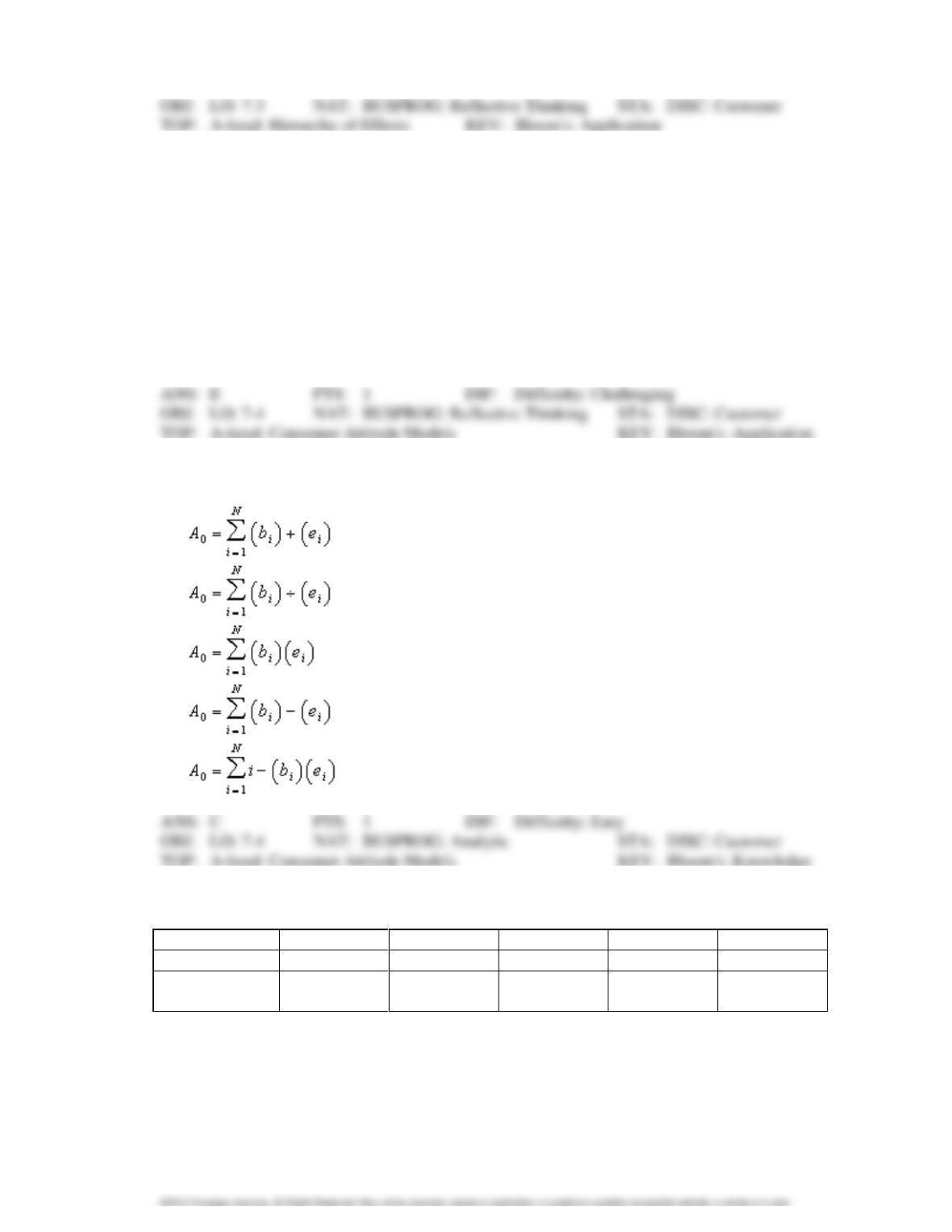
21. Which of the following is the formula for predicting attitudes using the attitude-toward-the-object
model?
a.
b.
c.
d.
e.
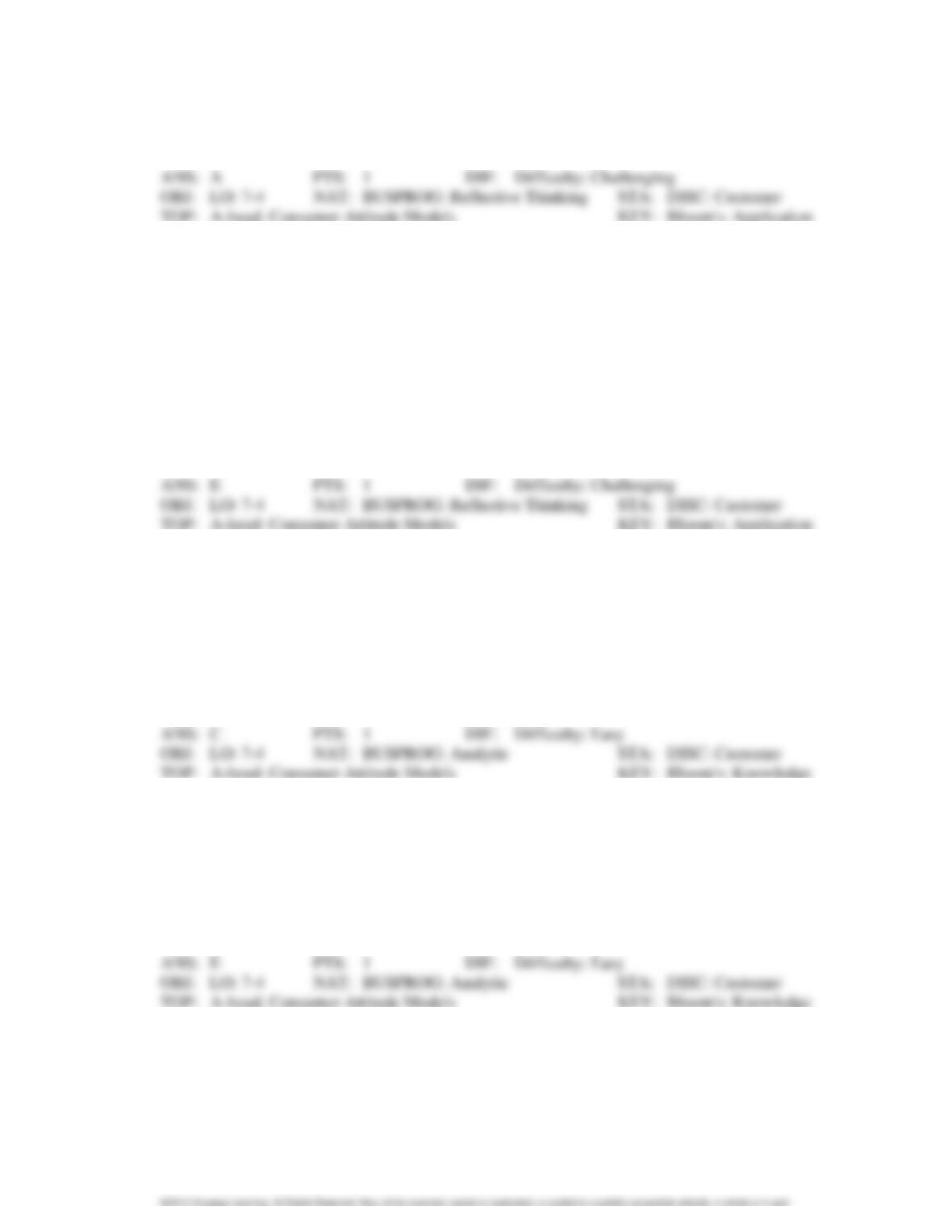
22. Michelle wants to buy a new laptop. She wants it to be light weight and have a larger battery backup.
She chooses five models on the Internet. The belief ratings for each of the models are as follows:
Model A
Model B
Model C
Model D
Model E
Light Weight
8
9
2
10
4
Large Battery
Backup
7
6
3
5
10
She gives these criteria evaluative ratings of 3 and 2 respectively. Using the attitude-toward-the-object
model, which of the following models would Michelle purchase based on the highest overall attitude
score for the model?
a.
Model D
b.
Model A
c.
Model C
d.
Model E
e.
Model B
23. William is planning a vacation to Europe. He looks for travel packages that provide accommodation
and travel facilities. He finds two packages that provide these criteria. He gives package 1 belief
ratings of 8 and 7 respectively, and package 2 belief ratings of 9 and 5 respectively. Next, he gives
these criteria evaluative ratings of 3 and 2 respectively. Finally, he calculates the overall attitude using
the attitude-toward-object model and chooses package 1 over package 2 based on the score. Which of
the following is the overall attitude score of package 1?
a.
37
b.
75
c.
15
d.
14
e.
38
24. The ATO approach is known as the _____, which indicates that attitudes are formed holistically across
a number of attributes, with poor ratings on one attribute being compensated for by higher ratings on
another attribute.
a.
holistic model
b.
single-attribute model
c.
compensatory model
d.
hierarchical model
e.
subjective model
25. The _____, sometimes referred to as the theory of reasoned action, explicitly focuses on the
consumer’s attitude toward the behavior of buying rather than the attitude toward the object.
a.
ATO model
b.
hierarchical model
c.
balance theory model
d.
elaboration likelihood model
e.
behavioral intentions model
26. Caroline wants to do her Bachelors in Medicine but is confused about which schools to apply to. She
considers her family and friends’ advice regarding the best schools to study medicine. They convince
her that she must apply at the top-ranked medical schools. But she believes that her parents, both
doctors, want her to study in the same school they had studied in, so she considers it as well. In
addition to this, she also wishes to study in the same medical school as her best friend. In this scenario,
Caroline’s focus is on what other people think she should do in addition to her own attitude toward
specific schools. Which of the following refers to a consumer attitude model that is best applicable in
this instance?
a.
Attitude-toward-the-object model
b.
Changing schema-based affect
c.
Social judgment model
d.
Behavioral intentions model
e.
Elaboration likelihood model
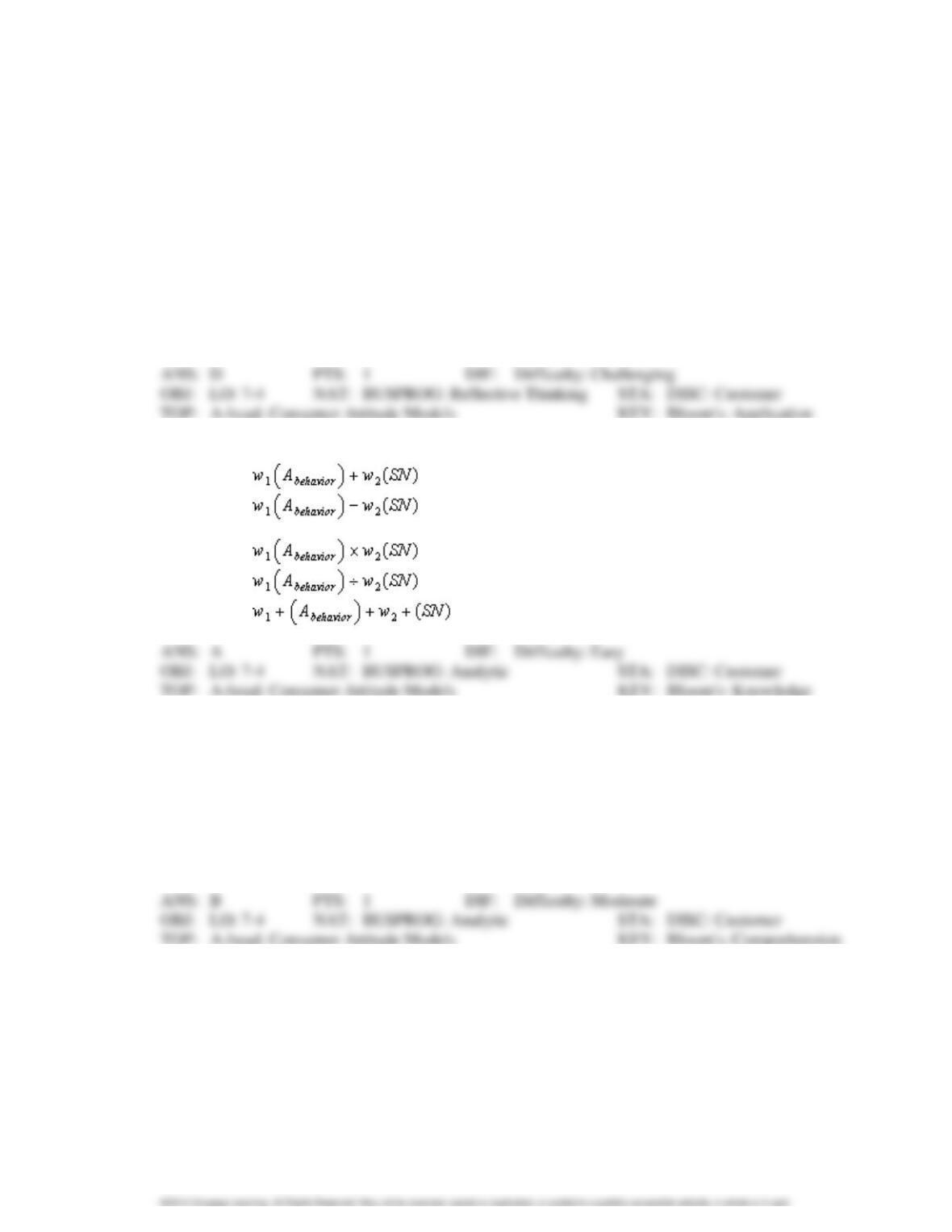
27. Which of the following is the formula for the behavioral intentions model?
a.
=
b.
=
c.
=
d.
=
e.
=
28. Which of the following is true about the attitude-behavior relationship?
a.
As the length of time between attitude measurement and overt behavior grows, the
predictive ability of attitudinal models increases.
b.
The specificity with which attitudes are measured has an impact on accuracy.
c.
When consumers feel rushed, decision making is stalled.
d.
Strong environmental pressures have no effect on consumers while they perform intended
behaviors.
e.
Attitude-behavior models tend to perform very well in impulse-buying situations.
29. Which of the following expands upon the behavioral intentions model by including a perceived control
component that assesses the difficulty involved in performing the behavior and the extent to which the
consumer perceives that he or she is in control of the product selection?
a.
Theory of planned action
b.
Theory of self-efficacy
c.
Balance theory
d.
Elaboration likelihood theory