Elements of Ecology, 9e (Smith)
Chapter 7 Animal Adaptations to the Environment
7.1 Short Answer Questions
1) An organism that obtains its energy and most nutrients from consuming plants or animals is
called a(n) ________.
2) The predictable change in morphological and physiological features as a function of body size
is referred to as ________.
3) Smaller bodies have a larger surface area relative to their ________ than do larger objects of
the same size.
4) Animals that feed exclusively on the tissues of other animals are called ________.
5) Herbivores are unable to digest ________ and thus rely on the help of specialized bacteria and
protozoa living in their digestive tracts.
6) Some herbivorous mammals have four-chambered stomachs in which fermentation occurs in
the first chamber, known as the ________.
7) Herbivores are unable to synthesize about half of the 20 ________ that are required to make
proteins.
8) Herbivores typically prefer plants with the highest concentrations of ________, an element
that is probably detected by taste and odor.
9) ________ is the maintenance by an animal of a relatively constant internal environment in a
varying external environment.
10) ________ is required in aerobic respiration, a cellular process that releases energy through
the breakdown of organic compounds.
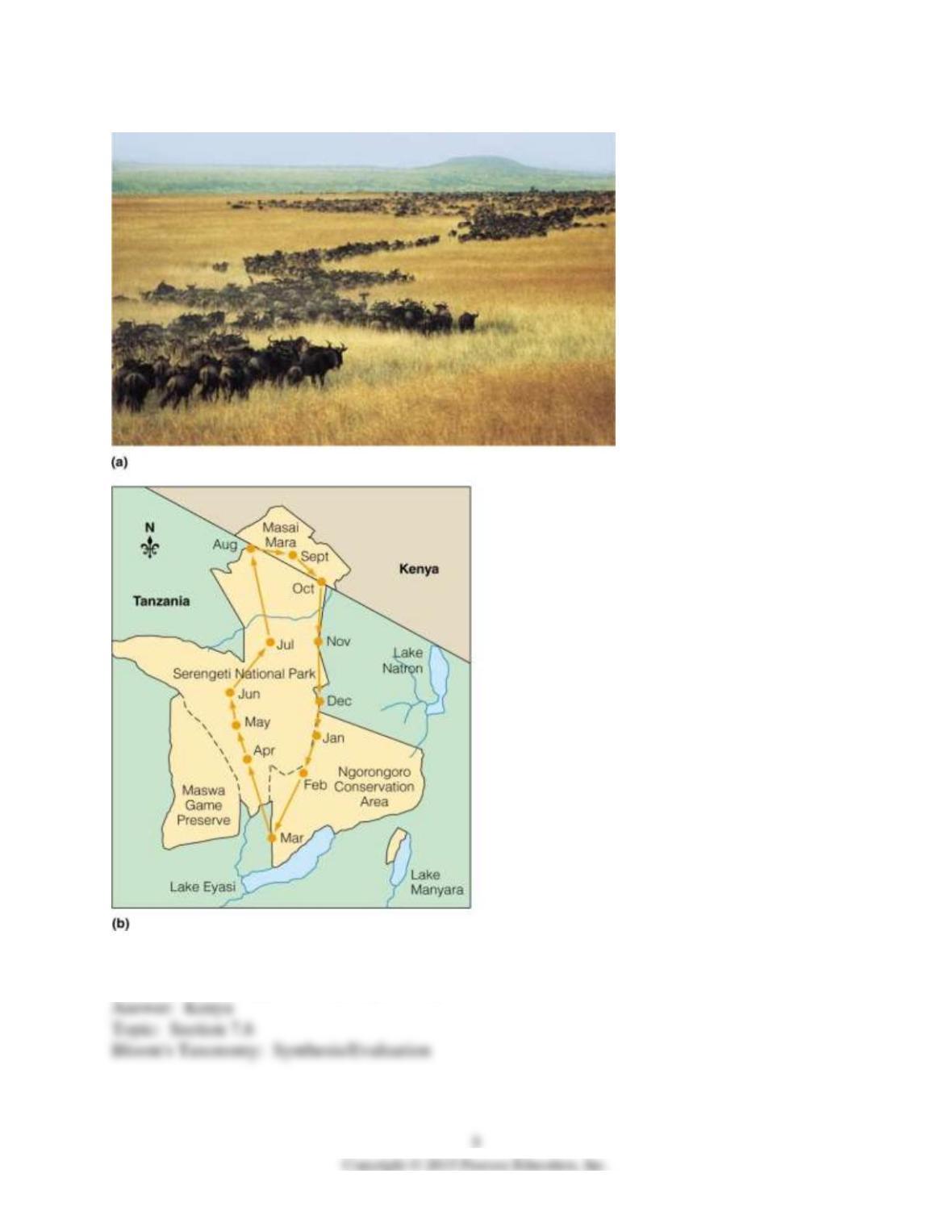
11)
Using the figure, the country of ________ may possibly lose migrating ungulate populations if
global climate change shifted precipitation patterns.
12) Birds and reptiles have a ________, which is a common receptacle for the digestive, urinary,
and reproductive tracts that reabsorbs water back into the body.
13) Many insects undergo ________, a stage of arrested development in their life cycle from
which they emerge when conditions improve.
14) Aquatic organisms that have a lower salt concentration in their bodies than the surrounding
water are considered ________.
15) Thermal ________ is the ability of an organism to transmit heat.
16) Animals that generate internal heat metabolically are called ________.
17) Animals that generate body heat metabolically at some times and from the environment at
other times are referred to as ________.
18) The ________ zone is a range of environmental temperatures within which homeothermic
metabolic rates are minimal.
19) When insulation fails, many animals resort to ________, which is a form of involuntary
muscular activity that increases heat production.
20) The smaller a homeotherm, the ________ the loss of heat to the surrounding environment.
21) The process of temporarily dropping body temperature to the temperature of the environment
for part of the day is called daily ________.
22) ________ is a long, seasonal torpor characterized by a cessation of activity.
23) Some sharks and tunas possess a ________, a blood circulation system that allows them to
keep internal temperatures higher than external temperatures.
24) To conserve heat in a cold environment and to cool vital parts of the body under heat stress,
some animals have a ________ heat exchange system.
25) In marine mammals, lipids are typically deposited as a layer of fat just below the skin,
referred to as ________.
7.2 Multiple-Choice Questions
1) The surface area of a cube increases how in relation to its length (l)?
A) l
B) l2
C) l3
D) 6l2
2) In comparison with a blue whale, a shrew has
A) a larger surface area relative to volume.
B) the same surface area relative to volume.
C) a slightly smaller surface area relative to volume.
D) a much smaller surface area relative to volume.
3) Long-distance transport of oxygen to the cells of animals is facilitated by the
A) brain.
B) heart.
C) stomach.
D) mouth.
4) Which of the following would have the most surface area assuming the same volume?
A) a golf ball
B) a perfect sphere
C) a cube
D) a tube
5) Animals that feed on both plant and animal tissues are referred to as
A) herbivores.
B) carnivores.
C) omnivores.
D) detritivores.
6) In some species of herbivorous mammals, hindgut fermentation occurs in the
A) rumen.
B) reticulum.
C) colon.
D) caecum.
7) The ingestion of fecal material for further extraction of nutrients is referred to as
A) nectarivory.
B) coprophagy.
C) folivory.
D) autophagy.
8)
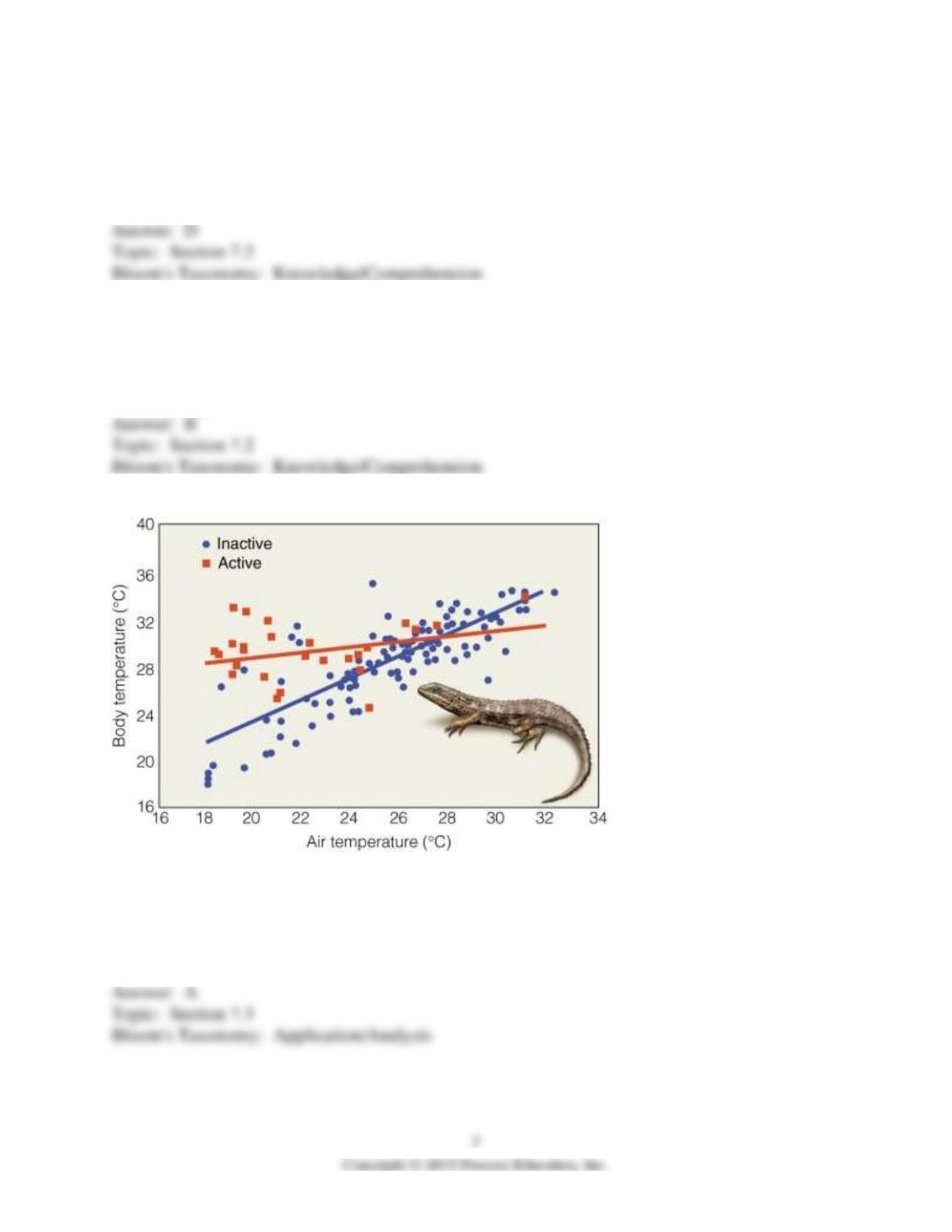
In this figure, the slope of the lines for active lizards and inactive ones suggests that
A) active lizards are regulating their temperature in some way.
B) inactive lizards are regulating their temperature in some way.
C) there is no difference in trends between the two types.
D) active lizards retain their cool across a wider variety of temperatures.
9) Which of the following is an example of a conformer?
A) lizard
B) rodent
C) starfish
D) bird
10) Which of the following is the concept associated with an animal shivering in a cold
environment to stay warm?
A) homeostasis
B) conformer
C) counter current heat exchange
D) torpor
11) Which of the following animals does not use lungs to acquire oxygen?
A) whale
B) frog
C) bird
D) butterfly
12) Many species of insects undergo a state of arrested development in their life cycle to avoid
desiccation or cold, referred to as
A) torpor.
B) hibernation.
C) diapause.
D) metamorphosis.
13) Which of the following is a major problem for animals that live in hyperosmotic
environments?
A) preventing heat loss
B) access to mineral nutrients
C) preventing water loss
D) obtaining enough oxygen
14) A marine fish is ________ and tends to ________ water to/from the environment.
A) hyperosmotic; gain
B) hyperosmostic; lose
C) hypoosmotic; gain
D) hypoosmotic; lose
15) A saltwater fish tends to be ________ to its surrounding aquatic environment.
A) endothermic
B) isoosmotic
C) hyperosmotic
D) hypoosmotic
16) Which of the following is done by toads to avoid hot, dry periods of the year?
A) hibernation
B) torpor
C) diapause
D) estivation
17) An animal has a very thin layer of insulation between its body core and surface causing it to
have a very high ________.
A) body temperature
B) salt content
C) level of fat
D) thermal conductivity
18) The regulation of body temperature exclusively from the external environment is referred to
as
A) endothermy.
B) ectothermy.
C) homeothermy.
D) heterothermy.
19) Maintaining a relatively constant body temperature independent of external temperature is
referred to as
A) heterothermy.
B) ectothermy.
C) poikilothermy.
D) homeothermy.
20) What happens to a lizard’s metabolic rate when the temperature increases 10°C?
A) The metabolic rate stays constant.
B) The metabolic rate approximately doubles.
C) The metabolic rate approximately triples.
D) The metabolic rate approximately quadruples.
21) Water flows over gills in the opposite direction of blood flow in a process known as
A) inhalation.
B) respiration.
C) diffusion.
D) countercurrent exchange.
22) Which of the following factors does not influence animal heat exchange?
A) oxygen diffusion rate
B) conductivity of fat
C) movement of blood to the body’s surface
D) fat thickness
23) Many species of small mammals, especially those that hibernate, increase heat production by
A) growing denser fur during winter.
B) burning highly vascular brown fat.
C) panting.
D) sweating.
24) The respiration rate of homeotherms is proportional to
A) air pressure.
B) body temperature.
C) body size.
D) environmental temperature.
25) The basal metabolic rate per unit of body mass is highest in a
A) large endotherm.
B) small endotherm.
C) large ectotherm.
D) small ectotherm.
26) An advantage of homeothermy is
A) that it requires a low caloric intake.
B) that it maximizes allocation of energy to growth.
C) that it allows the organism to remain active in a wide range of external temperatures.
D) that it allows the organism to tolerate wide fluctuations in body temperature.
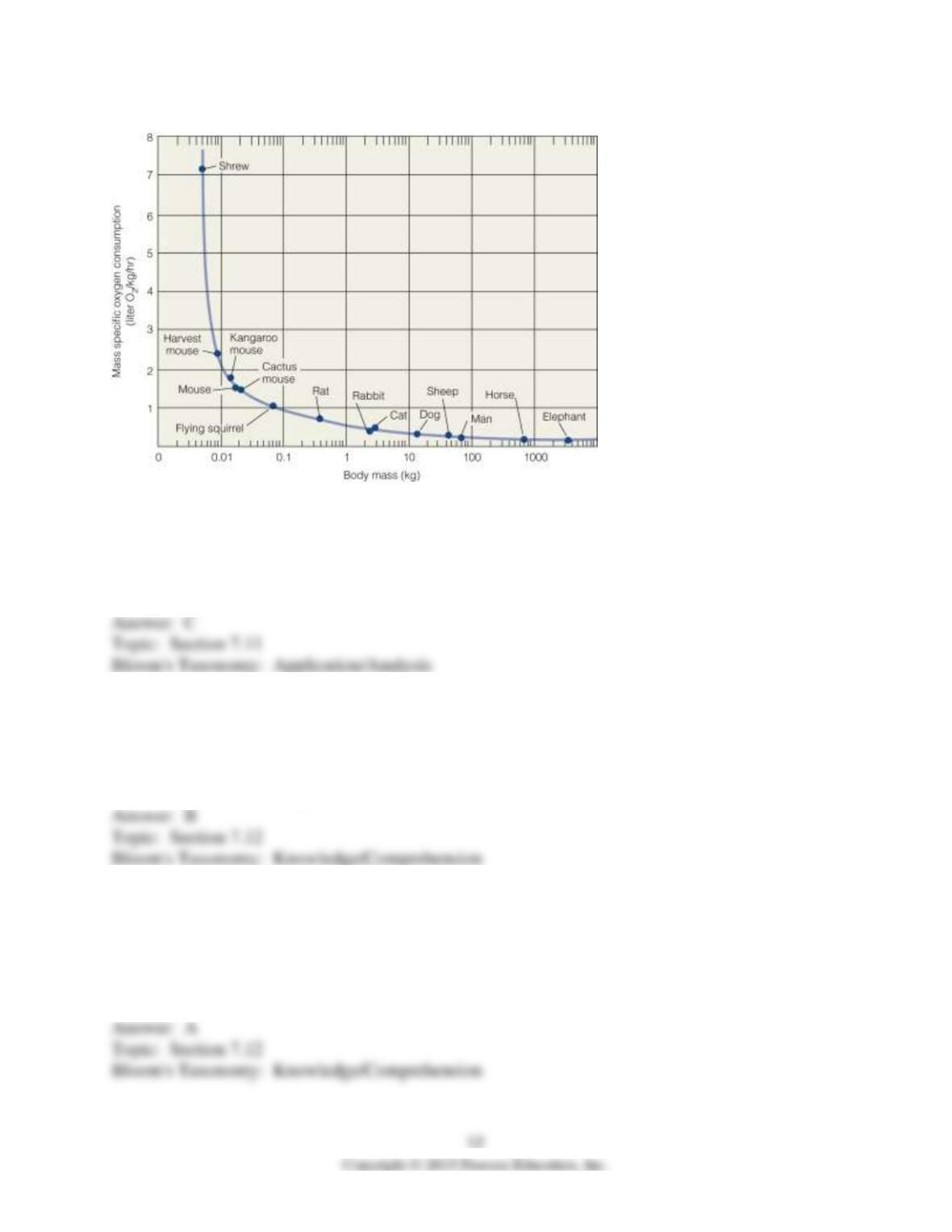
27)
Which of the following animals has the highest mass specific oxygen consumption?
A) elephant
B) sheep
C) mouse
D) man
28) Immediately prior to flight in cool temperatures, some insects
A) must consume hundreds of calories.
B) increase heat production by shivering flight muscles of the thorax.
C) seek shade.
D) increase anaerobic respiration.
29) The seasonal cessation of activities accompanied by a reduction in metabolism in response to
cold temperatures during winter is called
A) hibernation.
B) torpor.
C) heterothermy.
D) diapause.
30) All of the following characterize a hibernating homeotherm, except
A) low blood pH.
B) high CO2 level in blood.
C) increased heart rate.
D) decrease in body temperature.
31) In which of the following is countercurrent heat exchange not known to occur?
A) porpoise fluke
B) beaver tail
C) bird legs
D) primate hands
32) Several amphibian species survive the winter using antifreeze chemicals by the process of
A) supercooling.
B) countercurrent heat exchange.
C) torpor.
D) rete.
33) Some species of animals in cold environments lower the freezing point of water in their
tissues by increasing solutes in their body fluids, especially
A) glucose.
B) glycerol.
C) salt.
D) sucrose.
34) According to Bergmann’s rule, as global temperature increases,
A) body size will increase.
B) body size will decrease.
C) territory size will increase.
D) territory size will decrease.
35) In cases where global temperature increase results in increased resource availability,
A) population sizes are shrinking.
B) average body sizes are decreasing.
C) average body sizes are increasing.
D) average limb lengths are decreasing.
7.3 True/False Questions
1) As the surface area of a body increases, its volume increases at the same rate.
2) A detritivore feeds primarily on dead plant or animal matter.
3) Ruminants are herbivorous reptiles, such as tortoises and iguanas, which regurgitate food to
further break it down into smaller pieces.
4) Coprophagy is common among animals that feed on detritus.
5) All species of fish are carnivorous.
6) Homeostatic systems work within minimum and maximum values by using positive feedback
to regulate activity above and below a set point.
7) A living organism must maintain each internal condition (e.g., body temperature) to a fixed set
point.
8) Some amphibians can take in oxygen through their skin.
9) Air flow through bird lungs is a continuous circuit, flowing in one direction only.
10) Freshwater aquatic organisms are faced with the problem of preventing excessive uptake or
retention of water.
11) Terrestrial animals are usually subject to more radical changes in their thermal environment
than aquatic animals.
12) The regulation of body temperature by internal metabolism is called ectothermy.
13) Birds are homeothermic animals.
14) Some aquatic poikilotherms (e.g., sharks) are able to maintain a higher internal body
temperature than the surrounding water.
15) Endotherms can sustain a higher level of physical activity for longer periods of time than
ectotherms.
16) Only animals with sweat glands can take advantage of evaporative cooling.
17) The smallest animals are ectotherms.
18) An ectotherm requires more calories per gram of body mass than an endotherm of similar
size.
19) Daily torpor is more likely to be used by large mammals than small mammals to conserve
energy when inactive.
20) Flying insects have a high metabolic rate when flying and can produce as much heat as
endotherms.
7.4 Essay Questions
1) With the use of a graph, explain the relationship between the surface area and volume of a
body as it increases in size. How have some animals adapted to the constraints imposed by
cellular respiration and delivery of oxygen?
2) Discuss and describe several different strategies that herbivores use to extract nutrients from a
cellulose-rich diet.
3) Define homeostasis and explain the importance of negative feedback to the maintenance of
homeostatic plateaus in animals.
4) Compare and contrast the mechanisms used by animals for the uptake of oxygen from the
terrestrial and aquatic environments.
5) Define ectothermy, endothermy, poikilothermy, homeothermy, and heterothermy, and give
examples of organisms that use each strategy.
6) Use an example to explain how poikilotherms change behavior and exploit microclimates to
regulate body temperature.
7) Discuss several strategies used by animals to maintain body temperatures within the
thermoneutral zone during extreme cold and extreme heat.
8) Discuss the trade-offs between ectothermy and endothermy. Under what conditions is each
one beneficial and why?
9) Discuss the physiological changes that occur in organisms when they go into daily or seasonal
torpor.
10) Explain the countercurrent heat exchange mechanism. How does this mechanism serve
opposite purposes for animals in cold and hot environments?