83) Ralph buys a software business from Waldo in Columbus, Ohio. As part of the deal, Waldo
signs a covenant not to compete by opening another software business anywhere in Ohio for the
rest of his life. Such a covenant would be enforceable.
84) A business buyer can be held liable in product liability lawsuits for unsafe products that
cause damage or injuries to customers even though they were made prior to the business
purchase.
85) Potential buyers should examine income statements, balance sheets, and income tax returns
for the past three to five years.
86) Many business owners show low profits in their businesses intentionally to lower their tax
obligations.
87) Because so many business owners take money from their companies’ sales without reporting
it as income, a business buyer should expect to pay for undocumented, “phantom” profits when
buying an existing business.
88) The practice of taking money from sales without reporting it as income is called sliding.
89) Some buyers may assume that if profits are adequate, there will be sufficient cash to pay all
of the bills and fund an attractive salary for themselves, but that is not necessarily the case.
90) Skimming is the act of taking money from sales without reporting it as income and it is an
illegal and unethical practice.
91) A nondisclosure document is an agreement between a business buyer and a seller that
requires the buyer to maintain strict confidentiality of all records, documents, and information he
receives during the parties’ negotiations.
92) A letter of intent is a nonbinding document stating that a business buyer and a seller have
reached a sufficient “meeting of the minds” to justify the time and the expense of negotiating a
final agreement.
93) If the owner of an existing business refuses to disclose the company’s financial records, an
entrepreneur who is considering buying it should walk away from the deal.
94) Goodwill is the difference between an established successful business and one that has yet to
prove itself.
95) Goodwill is an intangible asset that the business buyer cannot depreciate or amortize for tax
purposes.
96) When an entrepreneur purchases an existing business, he or she essentially is purchasing its
future profit potential.
97) The balance sheet technique is one of the most commonly used methods of evaluating an
existing business, although it oversimplifies the valuation process because it values a company
only on the basis of its net worth.
98) Most small businesses have market values that exceed their book value.
99) The most meaningful method of determining the value of an existing business’s inventory is
its book value.
100) Business evaluation based on balance sheet methods offers one key advantage: it considers
the future earning potential of the business.
101) The adjusted balance sheet method of valuing a business changes the book value of net
worth to reflect its actual market value.
102) Neither the balance sheet method nor the adjusted balance sheet method of valuing a
business considers the future earning power of the business.
103) FIFO, LIFO, and average costing are three frequently used techniques, but the most
common methods use the cost of last purchase and the replacement value of the inventory.
104) A method of valuing a business that recognizes that a buyer is purchasing the future income
(earning) potential is the earnings approach.
105) Assessing the opportunity cost associated with the decision is not a valuable consideration
when deciding to purchase a business.
106) The rate of return used to value a business is composed of the basic, risk-free return, an
inflation premium, and the risk allowance for investing in the particular business.
107) Under the capitalized earnings approach to business valuation, firms with higher risk factors
are more valuable than those with lower risk factors.
108) The discounted future earnings approach to valuing an existing business involves estimating
the company’s net income for several years into the future and then discounting those future
earnings back to their present value.
109) Under the capitalized earnings approach to business valuation, firms with lower risk factors
are more valuable than those with higher risk factors.
110) Under the capitalized earnings approach to valuing an existing business, most normal-risk
businesses use a rate-of-return factor ranging from 20 to 25 percent.
111) According to the discounted future earnings technique, a dollar earned in the future is worth
more than a dollar earned today.
112) The reliability of the discounted future earnings approach to valuing a business depends on
making accurate forecasts of future earnings and on choosing a realistic present value rate.
113) The best method for determining a business’s worth is the discounted future earnings
approach.
114) A business buyer should build his or her own pro forma income statement from an existing
firm’s accounting records and compare it to the same statement provided by the owner.
115) A disadvantage of the market approach to valuing a business is the difficulty of finding
similar companies for comparison.
116) Next to picking the right buyer, planning the structure of a business sale is one of the most
important decisions a seller can make.
117) Owners who do not want to sell a business outright, but want to stay around for a while or
surrender control gradually can use a restructuring strategy.
118) Although selling the business outright is the cleanest exit path for an entrepreneur, it may
have negative tax consequences, and it often excludes the option of “staying on” and exiting
gradually.
119) An earn-out is an exit strategy in which an entrepreneur can increase his or her payout by
actively participating in the business to make sure the company hits specific performance targets.
120) A family limited partnership allows entrepreneurs to transfer their business to their children,
however, the entrepreneur will forfeit all control over the business from that point forward.
121) To use an ESOP successfully, a company should have pre-tax profits of at least $100,000
and a payroll exceeding $500,000 a year.
122) Briefly describe the advantages and the disadvantages of buying an existing business.
123) Briefly discuss the seven steps in acquiring a business.
124) Your friend Susan is considering purchasing an existing business. How would you explain
to her what due diligence is, why it is important, and the critical areas of it?
125) Explain the steps in the acquisition process.
126) What is “goodwill”? Give an example of goodwill. Is it possible to inherit “ill will” from an
existing business?
127) Is there a “best method” for determining the value of a business? Why? How should a
prospective buyer go about establishing the value of a business?
128) Briefly summarize the mechanics of each of the methods for valuing an existing business:
balance sheet technique, adjusted balance sheet technique, excess earnings method, capitalized
earnings method, discounted future earnings method, and the market approach.
129) Explain the strategies business owners can use to exit their businesses. Cite a specific
advantage of each.
130) Explain what the buyer and the seller of a business are each looking for in the negotiation
process.
131) Identify five questions that influence the negotiation process between a business buyer and
a seller.

33
Mini-Case 7-1: What’s It Worth?
Lauren Holcombe has wanted to open her own clothing store since she was in high school. Her
career interest and dynamic personality enabled her to get a part-time job at a small women’s
clothing shop in her hometown after school. When Lauren enrolled in the state university to
major in retail management, she got a part-time job in the ladies’ clothing section of a prestigious
department store in the city. Lauren’s supervisor was impressed with her business acumen and
her congenial personality. “Lauren is one of the best workers we’ve ever had in this department.
She’s very bright, quite attractive, and very outgoing. Lauren is eager to learn anything she can
about the business; she’s always asking questions!”
During Lauren’s senior year in college, her Aunt Bessie died and left her an inheritance totaling
nearly $300,000. “I’ll miss dear old Aunt Bessie, but have I got plans for my inheritance! Now,
I’ll be able to run my own clothing store just like I’ve always dreamed.” Lauren immediately
began planning to launch her business venture, but progress was slow. During a trip to her
hometown over the Christmas break, Lauren discovered that a well-established ladies’ clothing
shop was up for sale. The shop was well known and quite successful, but the owner, Kathleen
Todd, was quitting to retire in Tahiti. Lauren contacted Ms. Todd to discuss the sale of the
business.
Ms. Todd hired a company to conduct an independent appraisal of the business, which concluded
that tangible assets were $230,000 and assumable liabilities were $18,000. The appraisal
estimated net profit for the next year to be $73,000 before deducting any managerial salaries.
Lauren expects to draw $20,000 in salary since she believes this is the salary she could expect
when working for someone else. Lauren estimates that a reasonable rate of return on an
investment of similar risk is 25 percent. Ms. Todd has set a value of $85,000 for intangibles such
as goodwill, and is asking $297,000 for the business.
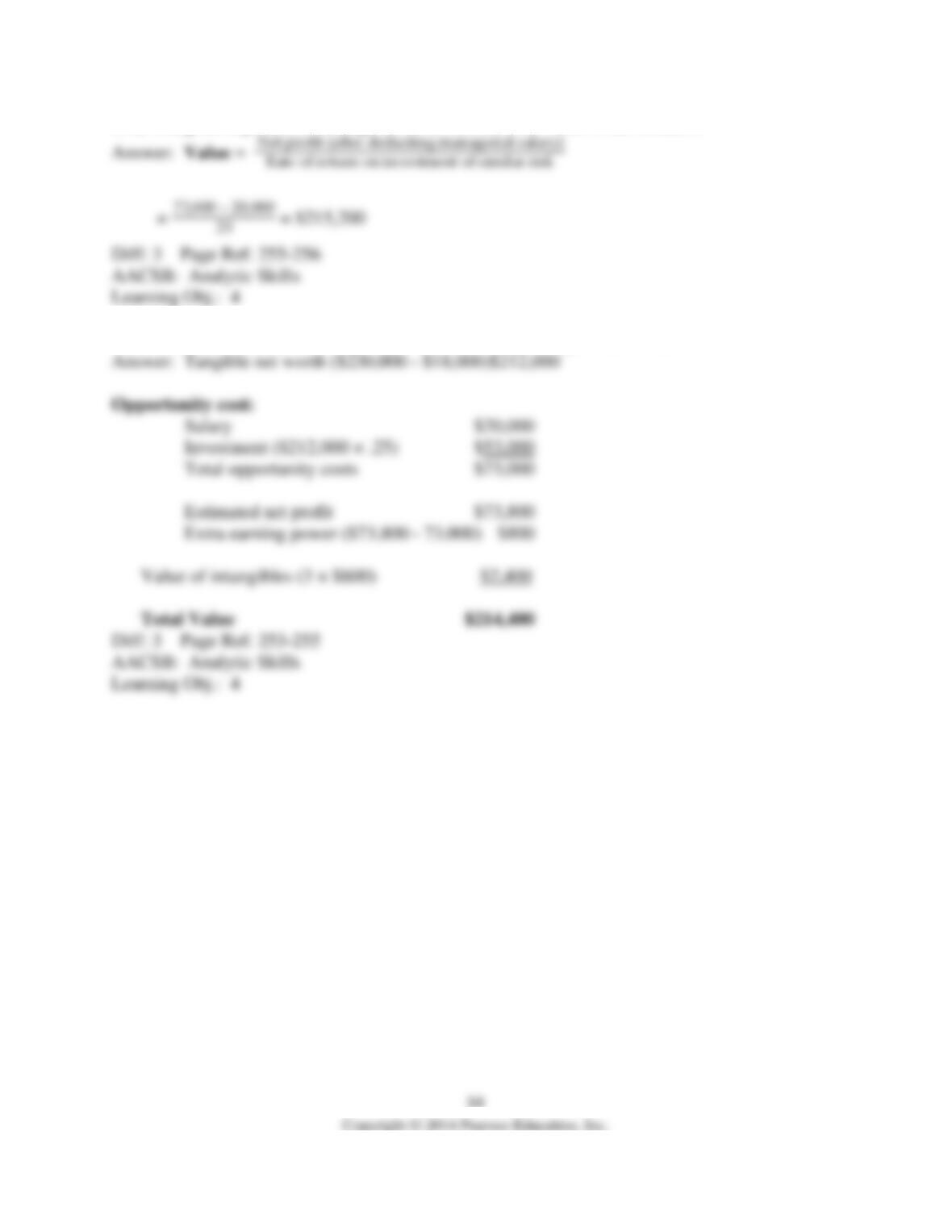
132) Using the capitalized earnings method, calculate the value of the business.
133) Based on the excess earnings approach, what do you expect the business to be worth?
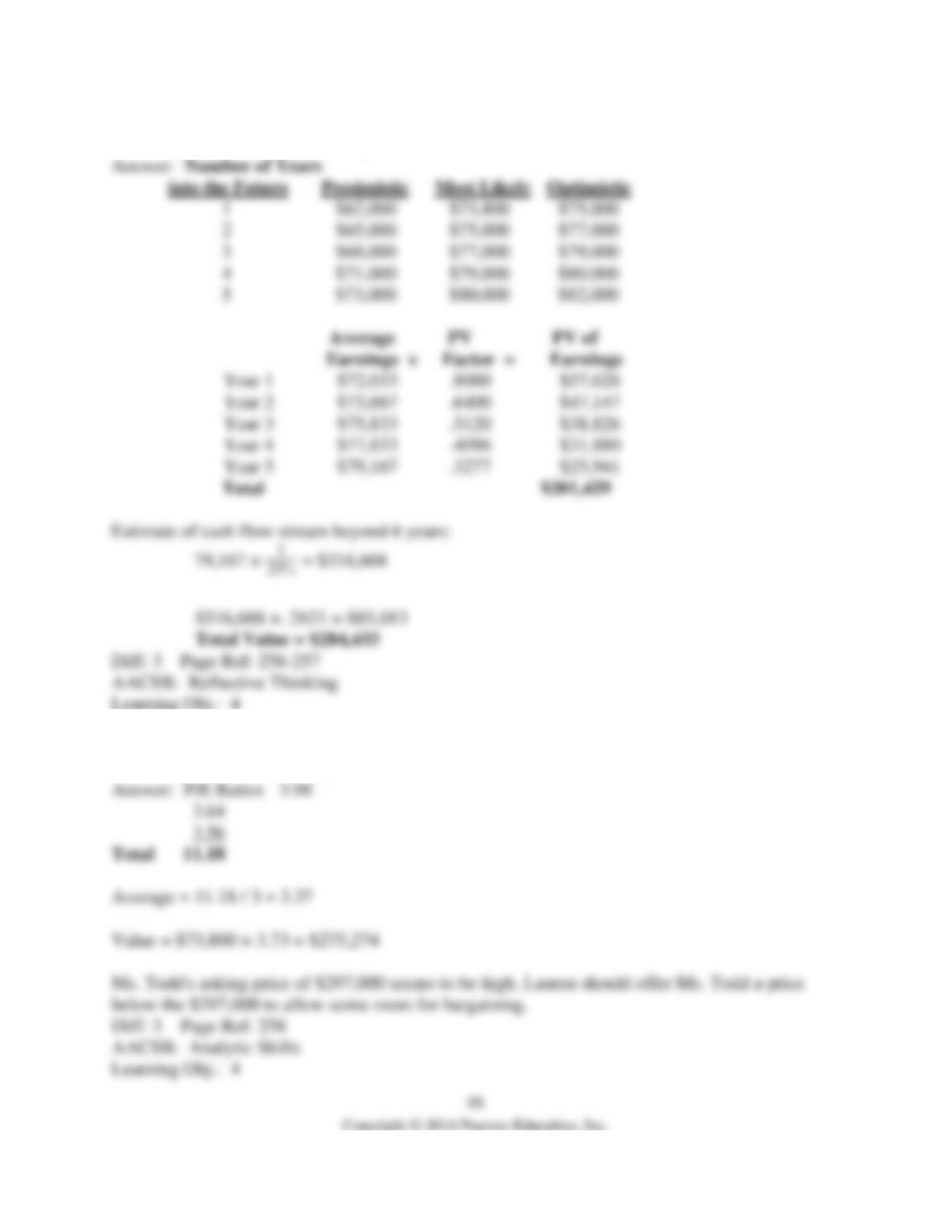
134) Given the following earnings estimates, compute the value of the business using the
discounted future earnings technique.
135) Is Ms. Todd’s asking price reasonable? How much should Lauren offer Ms. Todd at the
beginning of the negotiation process?
Mini-Case 7-2: Building Supply
You have recently decided to purchase a local building supply store. The business has passed the
initial screening test and you are ready to begin discussing prices with the present owner. An
independent appraisal has calculated the tangible net worth of the business to be $175,000. You
determine the rate of return on an investment of similar risk to be 25 percent. You plan to draw a
salary of $19,000. Your CPA estimates the net profit of the business (before your salary is
deducted) to be $75,000. The present owner has selected a goodwill value of $65,000, and is
asking $240,000 for the business.
136) Based on the balance sheet method, what do you calculate the business to be worth?
137) Based on the capitalized earnings method, what do you calculate the business to be worth?
138) Based on the excess earnings approach, what do you calculate the business to be worth?
139) You have found two similar businesses whose stock is publicly traded on the OTC market.
Their price-earnings ratios are 3.19 and 2.91. Using these two firms as a benchmark, what do you
estimate the business to be worth using the market approach?
140) Given the following earnings estimates, compute the value of the business.
141) How much would you offer the present owner at the beginning of the negotiation process?