Environment: Science Behind the Stories, 2e Cdn. Ed. (Withgott)
Chapter 7 Soil Resources
7.1 Graph and Figure Interpretation Questions
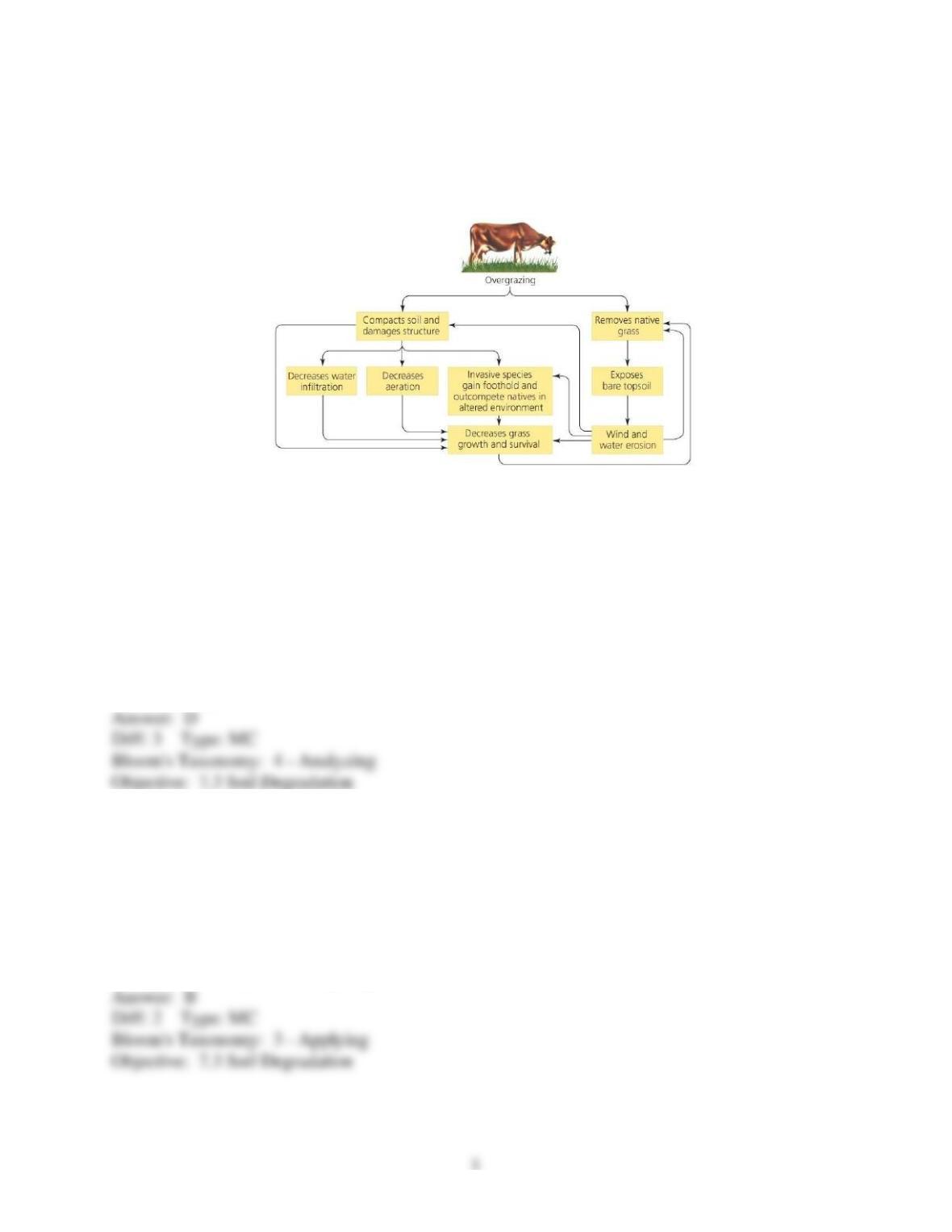
Figure 7.1
Use Figure 7.1 to answer the following questions.
1) Refer to Figure 7.1. Prairie dogs living in the pastures burrow numerous holes. This activity
most likely ________.
A) compresses topsoil, therefore increasing losses on account of erosion
B) makes worse the effects of overgrazing by cattle
C) improves the soil by limiting aeration and water infiltration
D) counters some effects of overgrazing by cattle
E) neither improves nor worsens the condition of the soil
2) Refer to Figure 7.1. The arrows showing the removal of native grass, the exposure of bare
topsoil, and wind and water erosion then point to ________, leading back to the removal of
native grasses.
A) a negative feedback loop
B) a positive feedback loop
C) a self-sustaining circuit
D) an ecological spiral
E) a systematically decreasing loop

3) Refer to Figure 7.1. Based on this figure, you would NOT expect that in the overgrazed areas
________.
A) the cellular respiration in roots increases
B) the invasive grass species do better
C) the frequency of dust storms increases
D) the water table lowers
E) the streams become more prone to flash floods

7.2 Matching Questions
Match the following.
A) ion exchange
B) O horizon
C) humus
D) A horizon
E) profile
F) soil
G) horizon
H) rangeland
I) parent material
J) intercropping
K) irrigation
L) shelterbelts
1) Lands used for grazing livestock
2) Alternating bands of different types of vegetation planted across a slope
3) The geological material from which soils in a particular area are formed
4) The name for an individual layer of soil
5) The layer below the O horizon in an idealized profile
6) Plants obtain many nutrients through this
Diff: 2 Type: MA
Bloom’s Taxonomy: 2 – Understanding
Objective: 7.2 Biogeochemical Cycling in Soil

7.3 Short Answer Questions
1) No-till farming reduces ________.
2) How does climate explain the poor soils in the Amazon rainforests?
3) Explain waterlogging and how it affects plants.
4) What are the three types of weathering and how do they differ?
5) What is the basis for soil textural determinations? What are the specific components that
determine soil texture?

6) ________ and ________ are the two most common soil problems associated with irrigation.
7) Climate change may change the patterns of precipitation. In an area with reduced
precipitation, crops grown in which type of soil (clay-, silt- ,or sand-dominated) will be most
vulnerable to drought and why?
8) Soils that are NOT inverted by ploughing are said to be ________ farming systems.
9) Salinization is an irrigation problem widespread in countries with a ________ climate,
because ________.
10) The artificial provision of water to support agriculture is known as ________.
11) What are the advantages of biochar?

12) How are overgrazing and invasive plants linked?
13) How could the climatograph describing the biome found in the Amazon explain the high or
low fertility of the soils there?
7.4 Multiple-Choice Questions
1) Humus is ________.
A) the artificial fertilizer applied to monocultures
B) composed of organic compounds and is necessary for fertile soils and for holding soil
moisture
C) a layer sometimes found in a soil horizon that is created by eluviation; it causes serious
problems in agricultural fields in climates with high humidity
D) caused by agricultural runoff into waterways or into the water table
E) one of the primary causes of desertification if it is present in excess

2) Currently, the main reason for the loss of productive cropland is ________.
A) conversion of agricultural land to forest by replanting
B) erosion, over-irrigation, and other factors
C) climate change increasing temperature, limiting precipitation, and other factors
D) subsidization and other factors
E) abandonment, feralization, and other factors
3) Which factors are involved in soil formation?
A) nitrogen-fixing bacteria, grazing by herbivores
B) erosion, level terrain, absence of rooted vegetation
C) weathering of parent material, freezing/thawing, growth of tree roots
D) tropical climate, acid precipitation, frequent wildfires
E) seasonal changes in the tides
4) Which is NOT true about biochar?
A) Its production does not emit carbon dioxide.
B) It can be used for a long-term carbon sequestration.
C) It can be produced by natural processes.
D) It can be produced by pyrolysis.
E) It can help improve soil fertility.
5) As a result of acid rains, the soil may supply plants with cations of ________.
A) aluminium
B) calcium
C) potassium
D) ammonium
E) magnesium

6) The nineteenth-century peasant immigrants to Canada looking for the most fertile soil to settle
and grow crops would have looked for soil characterized by an abundance of ________.
A) clay particles and humus
B) clay and silt particles
C) clay and sand particles
D) silt particles and humus
E) sand particles and humus
7) A soil deficient humus would ________.
A) not be very productive
B) be vulnerable to droughts
C) have stable neutral pH
D) have a large amount of vegetative detritus at the surface
E) have unusually high levels of biological activity
8) The breakdown of large rocks into smaller pieces is ________.
A) mineralization
B) affected by rainfall, freezing and thawing
C) unaffected by winds
D) a major cause of topsoil erosion
E) primarily caused by topsoil erosion
9) Leaching ________.
A) can help plant growth only if done properly
B) is caused by movement of water upward through soil from the water table
C) adds nutrients to soil naturally
D) is increased in low pH conditions
E) is a common agricultural practice to improve soil

9
10) The O horizon is ________.
A) composed primarily of bedrock
B) composed of equal amounts of bedrock and organic material
C) primarily loam
D) usually more sand than silt or clay
E) primarily composed of organic materials
11) The zone beneath the A horizon, where leaching has deposited materials, is called the
________.
A) O horizon
B) B horizon
C) C horizon
D) E horizon
E) Leaching removes, rather than deposits, materials.
12) Oxidation of minerals, warm and wet conditions, reactions of water with parent material: all
are components of ________.
A) chemical weathering of soils
B) erosion
C) leaching
D) physical/mechanical weathering of soils
E) humus formation
13) Farmer John bought a field in which soils have lots of sand particles. This suggest that this
soil will have ________.
A) high permeability
B) high capacity to hold water
C) high fertility
D) high cation exchange capactiy
E) low interconnectedness
14) Acidity of precipitation is likely to influence ________.

A) cation retention
B) nitrogen fixation
C) soil compaction
D) the number of soil horizons
E) soil clumpiness
15) The loss of more than 10% productivity in arid areas because of erosion, soil compaction,
forest removal, and an array of other factors is called ________.
A) climatization
B) global change
C) desertification
D) salinization
E) waterlogging
16) The Canadian agency charged with slowing soil degradation is the ________.
A) Soil Aggregation Service
B) Agricultural Standards Agency
C) Conservation Integration Service
D) Soil Conservation Council
E) There is no Canadian agency charged with soil degradation, only volunteer firms funded by
farmers.
17) Shelterbelts are to ________ as terraces are to ________.
A) wind erosion; water erosion
B) water erosion; wind erosion
C) leaching; desertification
D) stratification; salinization
E) salinization; stratification

11
18) The frequent negative side effect of irrigation in arid climates on the quality of soil is
________.
A) salinization
B) nutrient leaching
C) wind erosion
D) water erosion
E) evaporation
19) A farmer has a nitrogen-depleted field. To address this shortage, he plants beans to take
advantage of ________.
A) denitrification
B) nitrification
C) nitrogen fixation
D) nitrogen defixation
E) the Haber-Bosch reaction
20) Microorganisms that convert ammonium into nitrites are ________, while microorganisms
converting molecular nitrogen into ammonium are ________.
A) heterotrophs; chemoautotrophs
B) photoautotrophs; heterotrophs
C) chemoautotrophs; heterotrophs
D) heterotrophs; photoautotrophs
E) chemoautotrophs; photoautotrophs
21) The consequences of overfertilization can include ________.
A) very large fruits and vegetables
B) eutrophication in nearby waters
C) large crop yields per acre
D) crops spreading rapidly into nearby areas
E) very fertile soils in future years
22) The Soil Conservation Council encourages farmers to ________.

A) grow native crops such as corn and beans
B) stop cultivating highly erodible cropland
C) grow cattle feed instead of commercial crops
D) stop growing mustard plants
E) grow soybeans
23) What organisms can fix nitrogen gas?
A) symbiotic and free-living bacteria
B) symbiotic bacteria
C) free-living bacteria
D) symbiotic and free-living bacteria, and symbiotic algae
E) free-living bacteria and symbiotic algae
24) When soil becomes waterlogged for an extended time, it tends to ________.
A) increase its contribution to climate change by emitting methane, which is a more potent
greenhouse gas than carbon dioxide (CO2)
B) increase its contribution to climate change by emitting CO2, which is a more potent
greenhouse gas than methane
C) decrease its contribution to climate change by emitting methane, which is a less potent
greenhouse gas than CO2
D) decrease its contribution to climate change by emitting CO2, which is a less potent
greenhouse gas than methane
E) maintain its previous contribution to climate change, because any change in methane emission
would be compensated by the change in CO2 emission having the opposite effect

7.5 True/False Questions
1) Many permafrost soils in the Arctic are peat soils.
2) Soil particle surfaces that are positively charged hold on to the biologically important cations
such as magnesium and potassium ions.
3) Soil profiles in all ecosystems contain O, A, E, B, C, D, E, and R horizons.
4) Acid precipitation may damage the fertility of soil by leaching away aluminium cations.
5) Inorganic fertilizers can cause environmental damage even if used only in the amounts
necessary to supply sufficient nitrogen for a crop.
6) Tropical rain forest has the most fertile soil of all major terrestrial biomes.

7.6 Essay Questions
1) Define the term soil profile. What are the influences on the development of a soil profile, and
how do profiles differ?
2) Describe the Prairie Dust Bowl in Canada and the lesson learned.
3) Discuss the practices used by farmers to protect their soils.

4) Discuss how specific land-use management strategies, such as management of rangelands and
forests, can result in degradation of soils.
5) Differentiate between splash, sheet, rill, and gully erosion. Of these four types, list all that can
be prevented, or at least limited, by contour farming.
6) Discuss the factors that affect the severity of soil loss to water erosion.

7) Discuss the factors that affect the severity of soil loss to wind erosion.
8) Explain the no-till method and discuss its pros and cons.

9) Two farmers, John in Alberta and Ibrahim in Egypt, do not get enough rain, so both irrigate
their fields with a great deal of water. However, their crops do not grow as well as expected.
What is the most likely irrigation problem in each case, and what could each farmer have done
to prevent the problem?
7.7 Scenario-Based Questions
Read the following scenario and answer the questions below.
Large stretches of mountains on the Pacific Coast of British Columbia are covered with ancient
mist-enshrouded old-growth forest, growing in the valleys and on the slopes of coastal
mountains. When the moisture-laden ocean air is pushed up a mountain, the air cools, and can
no longer hold its moisture, which then precipitates as rains and mist, creating a rare biome,
temperate rainforest. Most of Canada’s old growth temperate rainforest was opened by the
government to logging and has been already logged. The logging method of choice has been
clear-cutting, in which all trees are removed from an area. The logging companies claim that the
forest will regrow. Environmentalists point out that the new forest will not be the same as the one
that had been cut: because the old-growth forest grew to its current state over many hundreds of
years. Furthermore, the clear-cutting may do irreversible damage to the soil, so there won’t be
enough good soil left to nurture the majestic cedars, sky-high Douglas firs, hemlocks, and other
trees of the old-growth temperate rainforest.
1) The soil in the clear-cut areas of the forest described in this scenario is prone to degradation
because of ________.
A) strong winds, mainly
B) heavy rains, mainly
C) heavy rains and steep mountain slopes (of equal importance)
D) strong winds and heavy rains (of equal importance)
E) strong winds and steep mountain slopes (of equal importance)

2) Which of the following would NOT increase the degradation of soil after a clear-cut?
A) more rain
B) steeper slopes
C) longer slopes
D) leaving forest undergrowth
E) logging roads down the mountain
3) If the clear-cut slopes were converted into agricultural land, which agricultural erosion-
prevention techniques would be LEAST effective in this ecosystem?
A) contour farming
B) shelterbelts
C) terracing
D) reduced tillage
E) agroforestry
4) A logging company operating in the area was told by the provincial forest department to build
its logging roads perpendicular to the slope of the mountains. Such a practice would resemble
what erosion prevention strategy used in agriculture?
A) shelterbelts
B) contour farming
C) intercropping
D) reduced tillage
E) agroforestry
5) Clear-cutting on these mountain slopes increases which of the terms in the Universal Soil Loss
Equation?
A) erosivity factor R
B) vegetative cover and management factor C
C) slope length and steepness factor LS
D) erosion control practices factor P
E) None of the above because clear-cutting is no longer allowed in British Columbia.

19
6) Soils in this forest are vulnerable to ________.
A) salinization from the evaporated salt blown over from the ocean
B) loss of the topsoil
C) desertification
D) denitrification
E) waterlogging
7
.
3
S
o
i
l
D
e
g
r
a
d
a
t
i