Chapter 7 – Debtors, creditors, accruals and prepayments
TRUE/FALSE
1. A debtor arises when a business sells goods or services to a third party on credit terms.
2. The absence of bad debts is an indicator that the credit policy may be too strict, and can result in
the loss of profits.
3. A prepayment is an asset when it has future economic benefits that are controlled by the business.
4. A prepayment is recorded on the balance sheet as a current asset, but the proportion of the payment
that relates to benefits unexpired at the end of the period is recorded as an expense.
5. The future benefit of a prepayment will be in a form other than cash.
6. Payments in advance are commonly called prepayments.
7. When a prepayment is made and it is known that the future benefit will expire in the same period,
then the worksheet must always record the transaction as an asset first and then make an adjusting
entry at the end of the period to record an expense.
8. A credit sale of a business where the revenue is not collected due to the debtor not paying is a bad
debt.
9. The direct write-off method can mean that assets may be overstated in one year and understated the
next.
10. A contra debtor’s account is the allowance for doubtful debts, which shows the estimated total of
future bad debts.
11. Allowance for Doubtful Debts is a contra account to debtors.
12. Bad debts have the effect of reducing assets and reducing profits, which results in a reduction of
equity.
13. Management prepares and examines an aged debtor list, which analyses each debt in order to reach
a decision on the probability of receipt of payment.
14. The direct write-off method for accounting for bad debts is preferred over the allowance for
doubtful debts method, as the latter creates a negative or contra asset which is not considered a
‘real’ account under accrual accounting.
15. Under the allowance for doubtful debts method, the net amount of assets will not change when
recording a transaction that determines that a specific debtor will not pay.
16. The failure to allow for uncollectable accounts will cause the owners’ equity to be overstated.
17. Trade credit is the finance provided by suppliers from selling goods on credit.
18. If an accrual for interest has been recorded in the previous period and the payment is made in the
current period, then an adjustment decreasing liabilities (accruals) will need to be made in the
current period.
19. Debtors and prepayments are classified as current assets at the reporting date because they will be
realised or consumed within the next operating cycle.
20. The key to the effective management of debtors relies on maximising the benefits from selling
goods on credit, not minimising the losses from bad debts.
21. Working capital is the residual of current assets after deducting current liabilities.
22. Accounting for bad debts under the direct write-off method involves a reduction of debtors and a
reduction in owners’ equity.
23. The key difference between creditors and accruals as two separate types of liabilities centres on
whether the amounts involved are certain or otherwise.
MULTIPLE CHOICE
1. Which of the following bases of accounting measurement recognises revenues when resources are
created as part of an organisation’s operating activities?
A.
Cash
B.
Financing
C.
Investing
D.
Accrual
2. Under accrual-basis accounting, sales made on credit are usually reported as:
A.
liabilities.
B.
revenue.
C.
cash from operating activities.
D.
a contra account to sales revenue.
3. Which of the following statements is incorrect?
A.
A debtor arises when a business sells goods or services to a third party on credit terms.
B.
The absence of bad debts is an indicator that the credit policy may be too strict and can
result in the loss of profits.
C.
The higher the number of debtors and amount of inventories, the lower the working capital
requirements.
D.
The failure to allow for uncollectable accounts will cause the owners’ equity to be
overstated.
4. An item that is a cash payment in the current period and an expense of the next period is:
A.
a prepayment.
B.
not adjusted.
C.
an accrued expense.
D.
part expense, part accrued expense.
5. A prepayment is an asset when:
A.
there is no further future economic benefit accruing to the business.
B.
there may be some future economic benefit accruing to the business.
C.
it has future economic benefits that are controlled by the business.
D.
it has future economic benefits for the owner’s private residence.
6. A prepayment is recorded on the:
A.
balance sheet as an asset.
B.
statement of comprehensive income as revenue.
C.
balance sheet as a liability.
D.
statement of comprehensive income as an expense.
7. A prepayment consumed during a period is:
A.
an item that is an expense of a given period but not necessarily a cash payment for that
period.
B.
an item that may be a cash payment for that period and also an expense for that period.
C.
an item that that may be expensed in the current period.
D.
any of the above.
8. When goods are sold at a profit on credit, the effect of the sale on the accounting equation is:
A.
an increase in liabilities and an increase in assets.
B.
an increase in expenses and a decrease in equity.
C.
a decrease in equity and an increase in liabilities.
D.
an increase in assets and an increase in equity.
9. A credit sale results in increases in which of the following pairs of items on the financial
statements?
Statement of comprehensive income Balance Sheet
A.
Sales Revenue Cash
B.
Accounts Receivable Cash
C.
Sales Revenue Accounts Receivable
D.
Accounts Receivable Sales Revenue
10. Which of the following transactions would cause a decrease in the Accounts Receivable account?
A.
A credit sale
B.
A collection of cash from a previous credit sale
C.
A cash sale
D.
A credit purchase
11. The collection of an account receivable will:
A.
increase total assets and increase total owners’ equity.
B.
not affect total assets and increase total owners’ equity.
C.
decrease total assets and decrease total liabilities.
D.
not affect total assets liabilities and owners’ equity.
12. Owens Office Supplies collected $300 that had previously been recorded in Accounts Receivable.
Recording this event in the accounting system caused:
A.
assets to increase.
B.
assets to decrease.
C.
total assets to remain the same.
D.
revenues to increase.
13. Which of the following methods of handling bad debts often potentially leads to an overstatement
of assets?
A.
Percentage of credit sales method
B.
Aging of debtors’ method
C.
Direct write-off method
D.
Allowance for doubtful debts
14. Allowance for Doubtful Debts is:
A.
a liability account.
B.
an expense account.
C.
a contra liability account.
D.
a contra asset account.
15. Failure to record bad debt expense at year end will result in an:
A.
overstatement of assets.
B.
understatement of net profit.
C.
overstatement of expenses.
D.
understatement of liabilities.
16. An increase in the Allowance for Doubtful Debts will:
A.
reduce the cash account.
B.
reduce total assets.
C.
increase total liabilities.
D.
increase shareholders’ equity.
17. The Allowance for Doubtful Debts is classified on the:
A.
statement of comprehensive income as an expense.
B.
statement of comprehensive income as revenue.
C.
balance sheet as a liability.
D.
balance sheet as a deduction to an asset.
18. On 15 July 20X8 Sammy Corporation’s Gross Accounts Receivable had a balance of $2300 and
the Allowance for Doubtful Debts had a balance of ($220). A specific account of $80 was written
off on 16 July 20X8. If no other relevant transactions had taken place, what is the amount of net
receivables after the write-off?
A.
$1920
B.
$2160
C.
$2080
D.
$2220
19. The balance of an allowance for doubtful debts was ($10,000) at the start of a year and ($16,000)
at the end of that year. During the year, accounts totalling $9000 were written off as bad debts.
What was the bad debts expense for the year?
A.
$7000
B.
$9000
C.
$10,000
D.
$15,000
20. XYZ Company had an Accounts Receivable account balance of $300,000 and Allowance for
Doubtful Debts account balance of $12,500 prior to writing off a bad debt of $3000. The estimated
net realisable value of Accounts Receivable before and after the write-off were, respectively:
A.
$12,500 and $309,500.
B.
$287,500 and $284,500.
C.
$287,500 and $287,500.
D.
$300,000 and $297,000.
21. The bookkeeper at Kupertino Company is recording information into the accounting system to
recognise the estimated amount of bad debt expense for the fiscal period. This entry into the
accounting system will affect which of the account balances below?
Allowance
for Doubtful Debts Bad Debts Expense
A.
Yes Yes
B.
Yes No
C.
No Yes
D.
No No
22. Firms should ideally recognise the expense related to uncollectable accounts:
A.
during the period of sale.
B.
when accounts are written off.
C.
when customers declare bankruptcy.
D.
never; there is no expense related to uncollectable accounts.
23. Creditors are:
A.
amounts owing at a point in time, the amounts of which have been paid.
B.
amounts owing at a point in time, the amounts of which are known.
C.
amounts owing at a point in time, the amounts of which are not known.
D.
none of the above.
24. Accrued expenses result when:
A.
goods are purchased on credit.
B.
expenses are recognised after cash is paid.
C.
expenses are recognised before cash is paid.
D.
the bookkeeper has made an error.
25. What is the net effect on the balance sheet if J Trees purchases inventory of raw materials on credit
terms?
A.
No effect.
B.
An increase in liabilities and equity.
C.
An increase in assets and liabilities.
D.
An increase in assets and equity.
26. If a careless bookkeeper fails to accrue wages payable at the end of the accounting period, which
of the following will be true of the financial statements?
A.
Net profit will be understated.
B.
Retained profits will be overstated.
C.
Liabilities will be overstated.
D.
Assets will be overstated.
27. When wages are accrued in the current month, what is the transaction in the period in which the
wages are paid?
A.
Increase Wages Expense and decrease Cash at Bank.
B.
Increase Wages Expense and increase Wages Payable.
C.
Decrease Wages Payable and decrease Wages Expense.
D.
Decrease Wages Payable and decrease Cash at Bank.
28. If an adjustment to record the accrual of interest is omitted from the accounting system, which of
the following effects will not occur?
A.
Total expenses will be understated.
B.
Net profit will be overstated.
C.
Liabilities will be understated.
D.
Cash will be overstated.
29. If an end-of-period adjusting entry is made to accrue wages, it means that:
A.
the company pays its employees monthly.
B.
employees have earned wages since the end of the last payroll period, but have not been
paid.
C.
the account Wages Payable will be decreased.
D.
the company has already distributed payroll cheques.
30. Hilde Company reported Accounts Receivable of $40,000 at the beginning of 20X8. It reported a
balance of $28,000 at the end of 20X8. From this information, assuming there were no accounts
written off as bad debts during the year, it is possible to determine that during 20X8:
A.
credit sales were higher than cash collected from customers.
B.
credit sales were less than cash collected from customers.
C.
the firm was doing a poor job of collecting its receivables.
D.
credit sales decreased from the previous year.
31. The Philamono Bean Company reported the following Accounts Receivable balances for 20X8:
Beginning of the year
$84,000
End of the year
90,000
Given that there were no bad debts written off during the year, this information means that:
A.
credit sales exceeded cash collections from customers during the year.
B.
cash collections from customers exceeded credit sales during the year.
C.
the firm did an excellent job of collecting its receivables.
D.
credit sales increased during the current year over the previous year.
32. What are the two methods of accounting for bad debts?
A.
Receivable reduction and bad debt methods.
B.
Direct write-off and allowance methods.
C.
Allowance and bad debt methods.
D.
Direct write-off and receivable reduction methods.
33. Assuming that the allowance for doubtful debts method of accounting for bad debts is used, when
a customer’s account is determined to be a bad debt, which of the following will occur?
A.
Bad Debts expense is increased, Allowance for Doubtful Debts is decreased
B.
Allowance for Doubtful Debts is reduced, Accounts Receivable is reduced
C.
Allowance for Doubtful Debts is reduced, Bad Debts expense is reduced
D.
Allowance for Doubtful Debts is reduced, Accounts Payable is increased
34. Working capital represents:
A.
the excess of current assets over current liabilities.
B.
the amount of long-term liabilities.
C.
the excess of assets over liabilities.
D.
the use of accounts payable as trade credit.
35. The net figure for debtors after deducting the allowance for doubtful debts account:
A.
represents the expected cash to be collected.
B.
is a contra account.
C.
understates the realisable value of debtors.
D.
overstates the realisable value of debtors.
36. George, a sole trader, sells goods on credit, and uses the direct write-off method for recording bad
debts. The balance for debtors at the end of the financial year ended 31 December 20X8 was
$12,000. There was $1000 of bad debts that were written off in the year ended 20X9. From an
accrual perspective, in the year ended 20X8 which of the following is incorrect?
A.
Profit and equity were overstated.
B.
Profit and assets were overstated.
C.
Debtors and assets were overstated.
D.
Profit and liabilities were overstated.
37. The balance of the accounts receivable balance of XYZ Pty Ltd was $23,000 at the beginning of
the financial year ended 30 June 20X7 and $27,000 at the end of the period. The total credit sales
for the company for the financial year was $132,000. Bad debts write-off totalled $5500. What was
the total of the cash received from accounts receivable during the year?
A.
$118,500
B.
$122,500
C.
$128,000
D.
$133,500
38. The bookkeeper down at the Good Time Saloon was having too good a time and forgot to accrue
interest expense at year end. This will result in an:
A.
understatement of liabilities, and an overstatement of net profit and owners’ equity.
B.
understatement of liabilities, and an understatement of net profit and owners’ equity.
C.
overstatement of assets, net profit and owners’ equity.
D.
understatement of assets, net profit and owners’ equity.
39. The lazy bookkeeper down at the Lazy R Ranch forgot to record the reduction of prepaid rent
during 20X6. The result of this error is that:
A.
net profit for 20X6 is understated, the balance in owners’ equity is understated, and assets
are understated.
B.
net profit for 20X6 is overstated, the balance in owners’ equity is overstated, and assets are
correctly stated.
C.
net profit for 20X6 is overstated, the balance in owners’ equity is overstated, and assets are
overstated.
D.
net profit for 20X6 is understated, the balance in owners’ equity is understated, and assets
are overstated.
SHORT ANSWER
1. What is accrual accounting?
2. What is the nature of the allowance for doubtful debts account and how does it arise?
PROBLEM
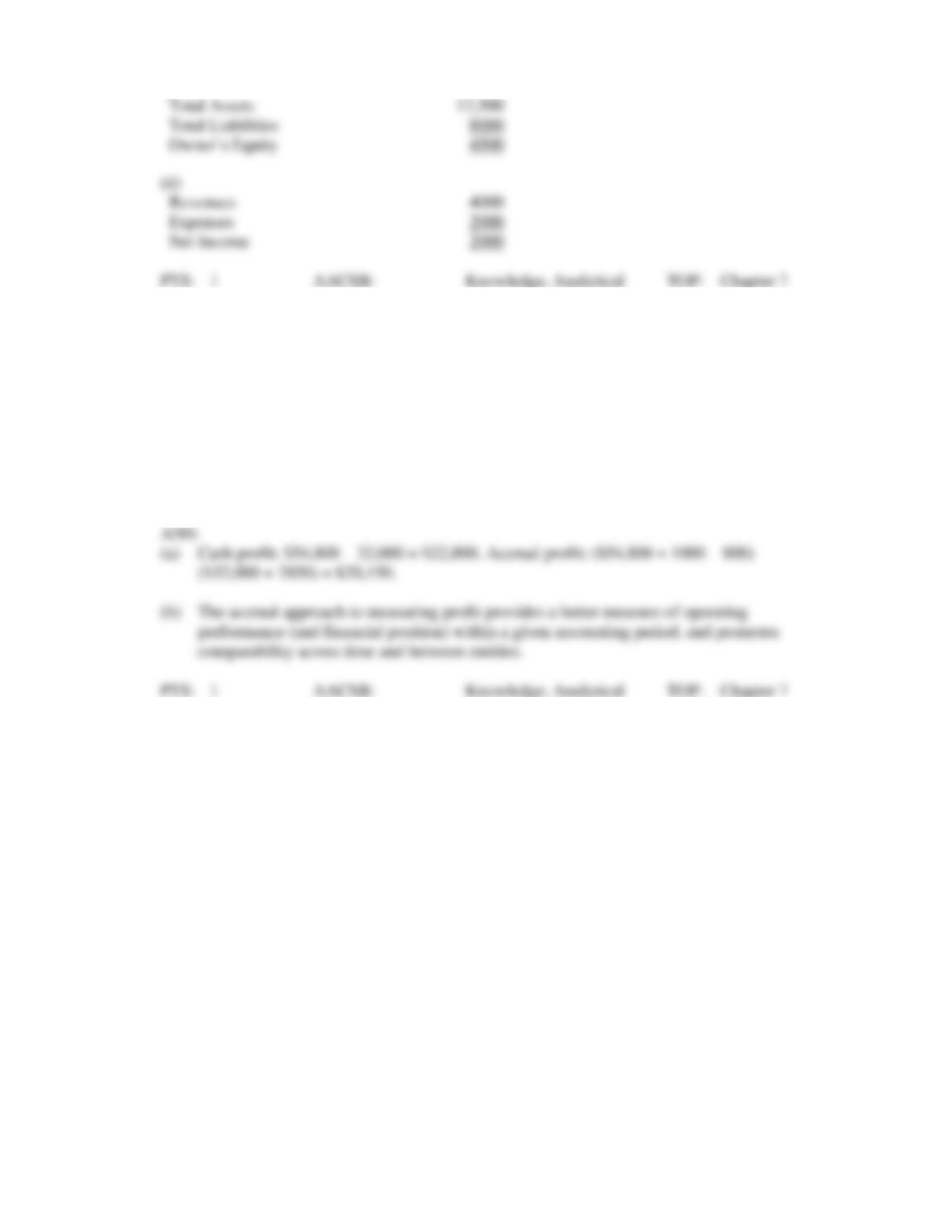
1. The accountant for Tiny Tots has compiled the following information about the company and its
accounts:
Cash
$1500
Prepaid Rent
$1000
Revenues
4000
Expenses
2000
Accounts Payable
4500
Equipment
10,000
Wages Payable
2500
Notes Payable
1000
(a)
What is the total amount of assets belonging to Tiny Tots?
(b)
What is the total amount that Tiny Tots owes to creditors?
(c)
Using the accounting equation, what is the amount of Owner’s Equity reported on Tiny
Tots balance sheet?
(d)
How much net profit did Tiny Tots have for the year?
Cash
Prepaid Rent
Equipment
Total Assets
Accounts Payable
Wages Payable
Notes Payable
Total Liabilities
(c)
2. Pele runs a soccer coaching school. During the year ended 30 June 20X7, coaching fees of $54,800
were received in cash. Fees due but not received or recorded at 30 June 20X7 totalled $1000. Fees
received in advance at 30 June 20X7 totalled $800. Cash expenses paid during the year ended 30
June 20X7 totalled $32,000. Accrued expenses due but not paid at 30 June 20X7 totalled $2850.
(a)
Calculate the profit for the year ended 30 June 20X7 using both the cash and accrual
approaches.
(b)
Explain why the accrual approach to measuring profit is considered to be better than the
cash approach.
(a)
Cash profit: $54,800 – 32,000 = $22,800. Accrual profit: ($54,800 + 1000 – 800) –
comparability across time and between entities.
3. Clarinet Trading is involved in the purchase and sale of musical instruments. It sells goods at cost
plus 45%. The transactions entered into by the entity during the last three months of the financial
year ended 30 June 20X7 included the following.
April Purchased musical instruments for resale on credit for $85,000.
Sold musical instruments for cash $23,000 and credit $14,000.
Paid wages $4000. Owner withdrew $1000 cash for personal use.
May Purchased equipment for $18,000 for use in the business. Paid a cash instalment of
$10,000 at acquisition; the balance is payable in September 20X7.
Received $10,000 in cash from accounts receivable.
Sold musical instruments for cash $7450 and credit $9700.
Paid $14,000 in cash off accounts payable and received discount of $205.
Owner withdrew musical instruments for personal use $3500.
June Sold musical instrument for cash $5800 and credit $9300.
Received advice that $800 of accounts receivable was not collectable and the figure was
written off. Received $2000 cash for musical instruments which will be provided to the
customers concerned in July 20X7.
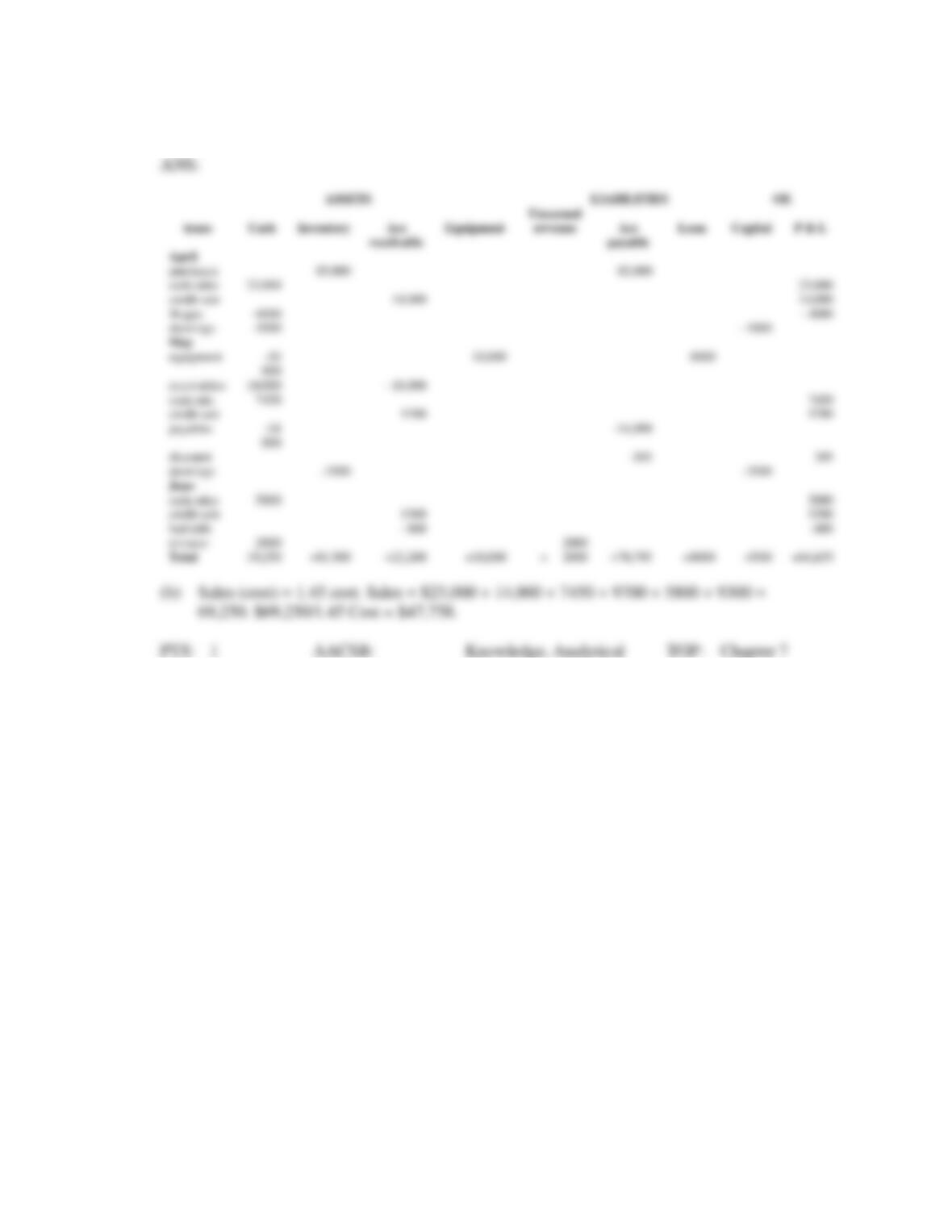
(a)
Record the foregoing transactions on the worksheet provided. Total the columns.
(b)
Calculate the cost of the musical instruments sold by the business for the three months
ended 30 June 20X7.
4. Nankeen commenced business providing cleaning services on 1 June 20X7, by contributing
equipment at $4000, a commercial van at $23,000 and cash of $2300. Transactions during June
were as follows:
June 4
4
6
8
11
14
17
19
21
21
23
25
26
26
28
30
Leased premises and paid two months rent $700 in advance.
Purchased office supplies for $300, paying $100 in part payment.
Billed customer for cleaning services $280.
Cash received for cleaning services $410.
Purchased additional equipment for $800 cash.
Hired a cleaning assistant at an agreed wage of $300 per week.
Paid vehicle maintenance $300.
Revenue of $485 earned from provision of service to customer on credit.
Paid balance on office supplies purchased on credit on 4 June.
Nankeen withdrew $500 cash for personal use.
Paid wages to assistant $300.
Revenue earned for cleaning services on account $230.
Received cash of $250 from accounts receivable.
Petrol expenses paid $85.
Received cash of $180 from accounts receivable after allowing for a $10 discount.
Office supplies used $85.
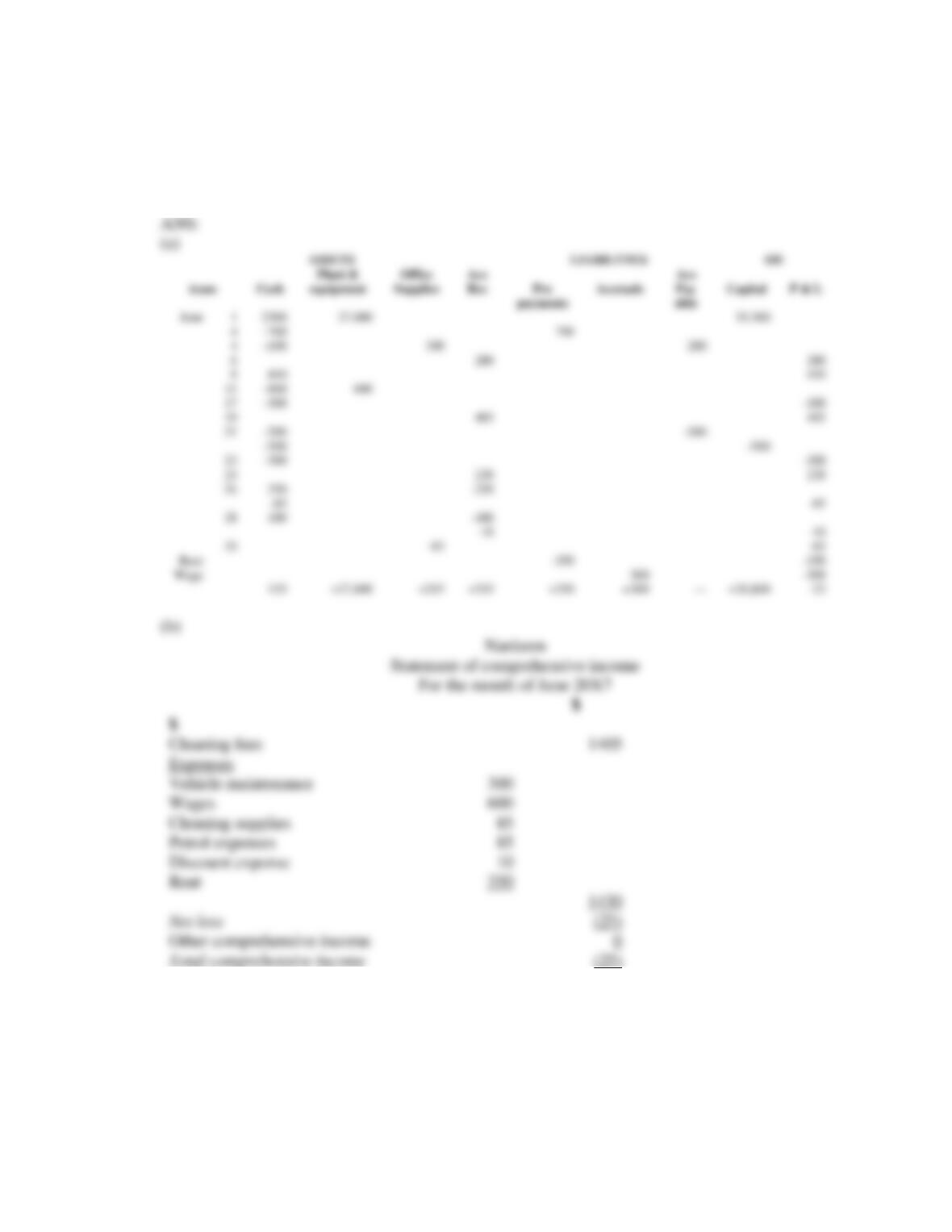
(a)
Complete a worksheet for the month of June including any final adjustments. Record all
physical non-current assets in a single column titled, plant & equipment. Total the
columns on completion of the worksheet.
(b)
Prepare the statement of comprehensive income for the month of June, and a classified
balance sheet as at 30 June 20X7.
.
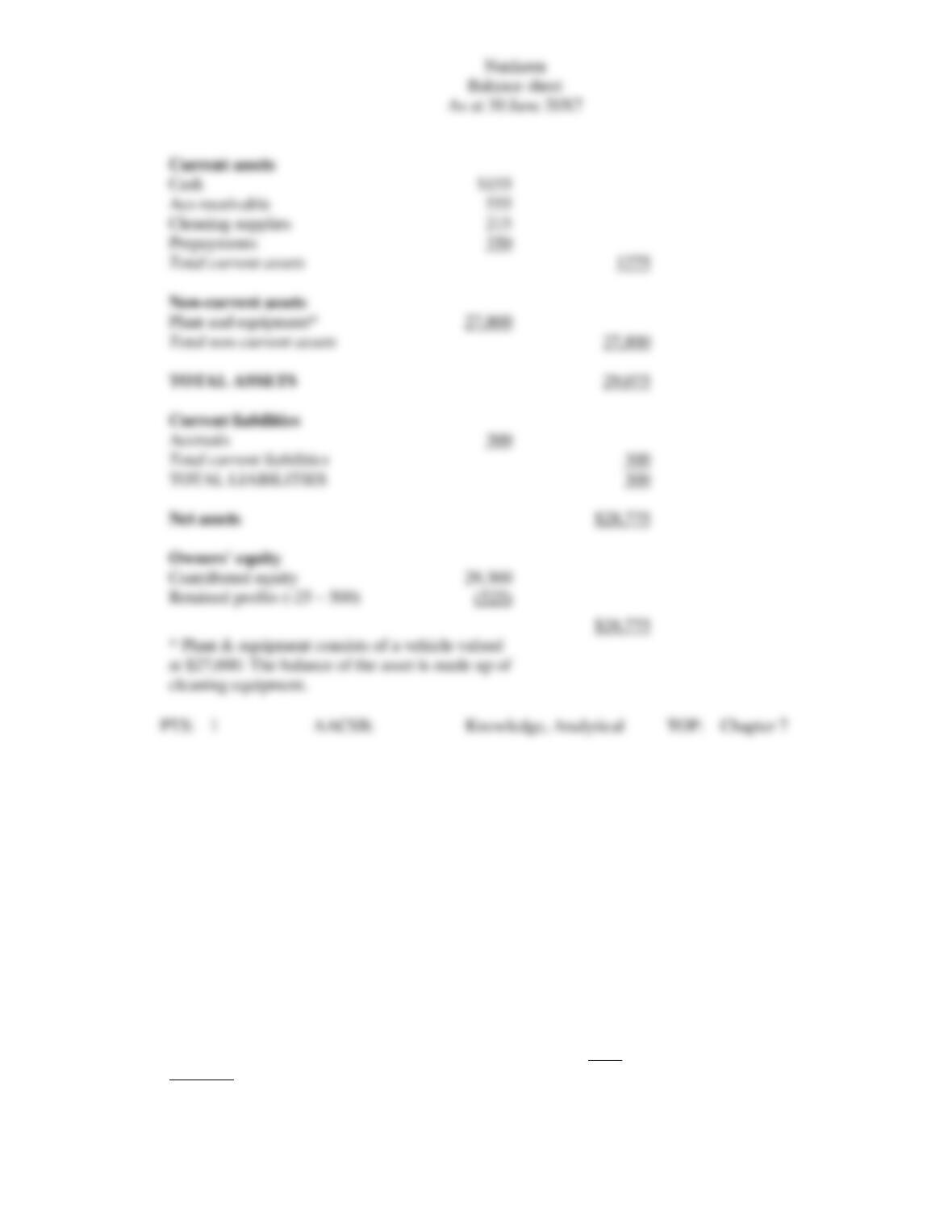
Cash
Acs receivable
Cleaning supplies
Prepayments
Plant and equipment*
Current liabilities
Accruals
TOTAL LIABILITIES
Net assets
Contributed equity
cleaning equipment.
CASE
1. The following financial statements have been prepared for Clearview for the month of June 20X7.
The financial statements have been prepared using accrual accounting, except to the extent evident
in the information provided. The business is a sole proprietorship. Trading commenced on 1 June
20X7. The business offers a window cleaning service on both cash and credit terms. Forty per cent
of the work completed in June was on credit. Customers are given 30 days to pay. The proprietor
invested cash of $2500 and a vehicle valued at $27,000 at 1 June 20X7.
Clearview
Statement of comprehensive income
For the month of June 20X7
Cleaning fees
$1405
Expenses
Vehicle expenses
-180

Wages for casual employee
-500
Advertising fees
-50
Various insurances
-100
Cleaning supplies
-85
Discount expense
-10
Lease on premises
-450
-$1375
Net profit
30
Other comprehensive income
0
Total comprehensive income
30
Clearview
Balance sheet
As at 30 June 20X7
Current assets
Cash
$385
Acs receivable
325
Supplies
470
Prepayments
350
Total current assets
1530
Non-current assets
Plant and equipment at cost
27,800
Total non-current assets
27,800
TOTAL ASSETS
29,330
Current liabilities
Accrued wages
300
Total current liabilities
300
TOTAL LIABILITIES
300
Net assets
29,030
Owners’ equity
Contributed equity
$29,500
=
Retained profits (30 – 500 drawings)
-470
29,030
Discuss the performance of the business for the period as revealed by the foregoing financial
statements, paying particular attention to the entity’s profitability and cash position.