CHAPTER 6
CASH AND ACCOUNTS RECEIVABLE
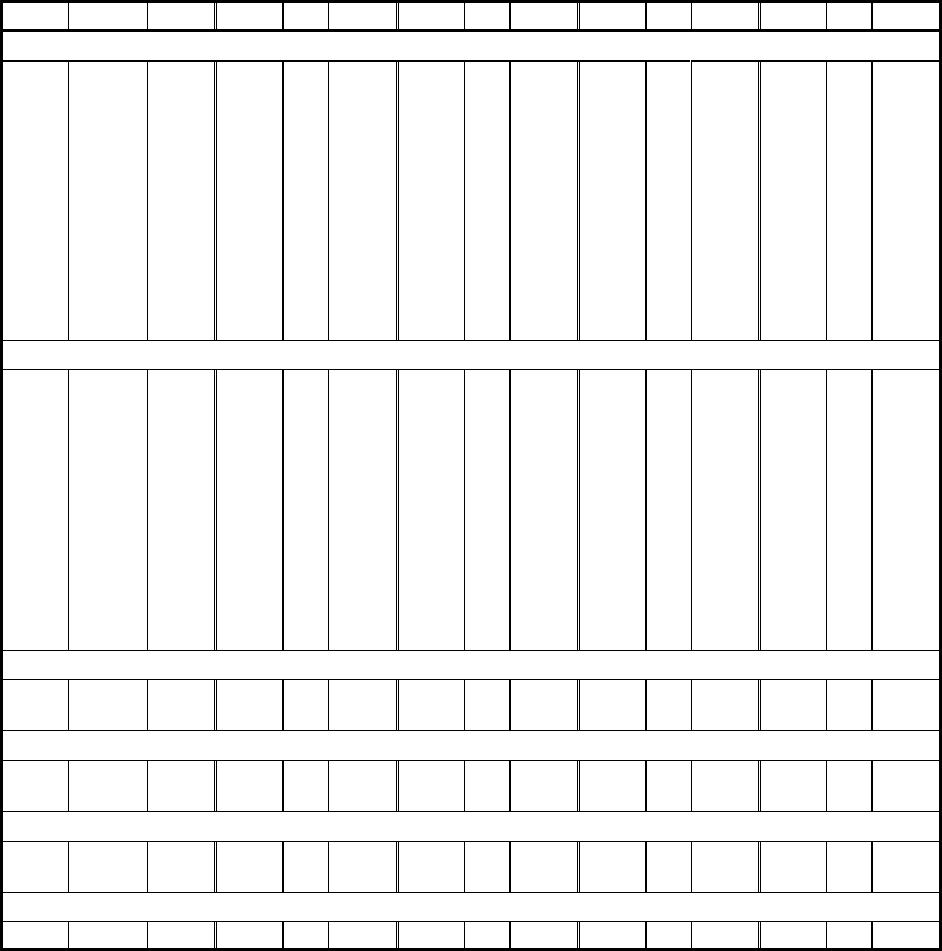
SUMMARY OF QUESTION TYPES BY LEARNING
OBJECTIVE AND LEVEL OF DIFFICULTY
Item
LO
LOD
Item
LO
LOD
Item
LO
LOD
Item
LO
LOD
Item
LO
LOD
True-False Statements
1.
1
E
12.
4
M
23.
6
E
34.
7
E
45.
9
M
2.
1
E
13.
4
E
24.
6
M
35.
7
M
46.
9
M
3.
2
H
14.
4
E
25.
6
E
36.
8
H
47.
10
M
4.
2
E
15.
4
M
26.
6
E
37.
8
M
48.
10
E
5.
2
M
16.
4
M
27.
6
M
38.
8
M
49.
11
M
6.
2
E
17.
4
M
28.
6
E
39.
8
M
50.
11
M
7.
2
H
18.
5
E
29.
6
M
40.
8
M
51.
11
M
8.
3
E
19.
5
E
30.
7
M
41.
8
E
52.
11
E
9.
3
E
20.
5
E
31.
7
M
42.
8
M
53.
11
E
10.
3
E
21.
5
E
32.
7
M
43.
8
M
54.
11
M
11.
3
E
22.
5
M
33.
7
E
44.
9
E
Multiple Choice Questions
55.
1
E
66.
4
M
77.
7
H
88.
8
H
99.
10
E
56.
1
E
67.
4
H
78.
7
M
89.
8
E
100.
11
E
57.
2
H
68.
4
M
79.
7
M
90.
8
H
101.
11
E
58.
3
E
69.
4
E
80.
7
H
91.
8
H
102.
11
H
59.
3
M
70.
5
E
81.
7
H
92.
9
E
103.
11
M
60.
3
E
71.
5
M
82.
8
E
93.
9
M
104.
11
E
61.
3
E
72.
6
M
83.
8
E
94.
9
M
105.
11
E
62.
3
M
73.
6
M
84.
8
H
95.
9
E
106.
11
E
63.
4
M
74.
7
M
85.
8
M
96.
10
M
107.
11
M
64.
4
M
75.
7
E
86.
8
M
97.
10
E
108.
11
M
65.
4
M
76.
7
H
87.
8
H
98.
10
M
Exercises
109.
4
M
111.
4
H
113.
7,8
M
115.
11
H
110.
4
H
112.
7
M
114.
7,8
M
Matching
116.
3,6–
9,11
M
Short-Answer Essay
117.
3
E
119.
5
M
121.
7,9
M
123.
11
M
118.
4
M
120.
6
M
122.
8
M
Essay
124.
4
H
Note: E = Easy M = Medium H = Hard
6 – 2 Test Bank for Understanding Financial Accounting, Canadian Edition
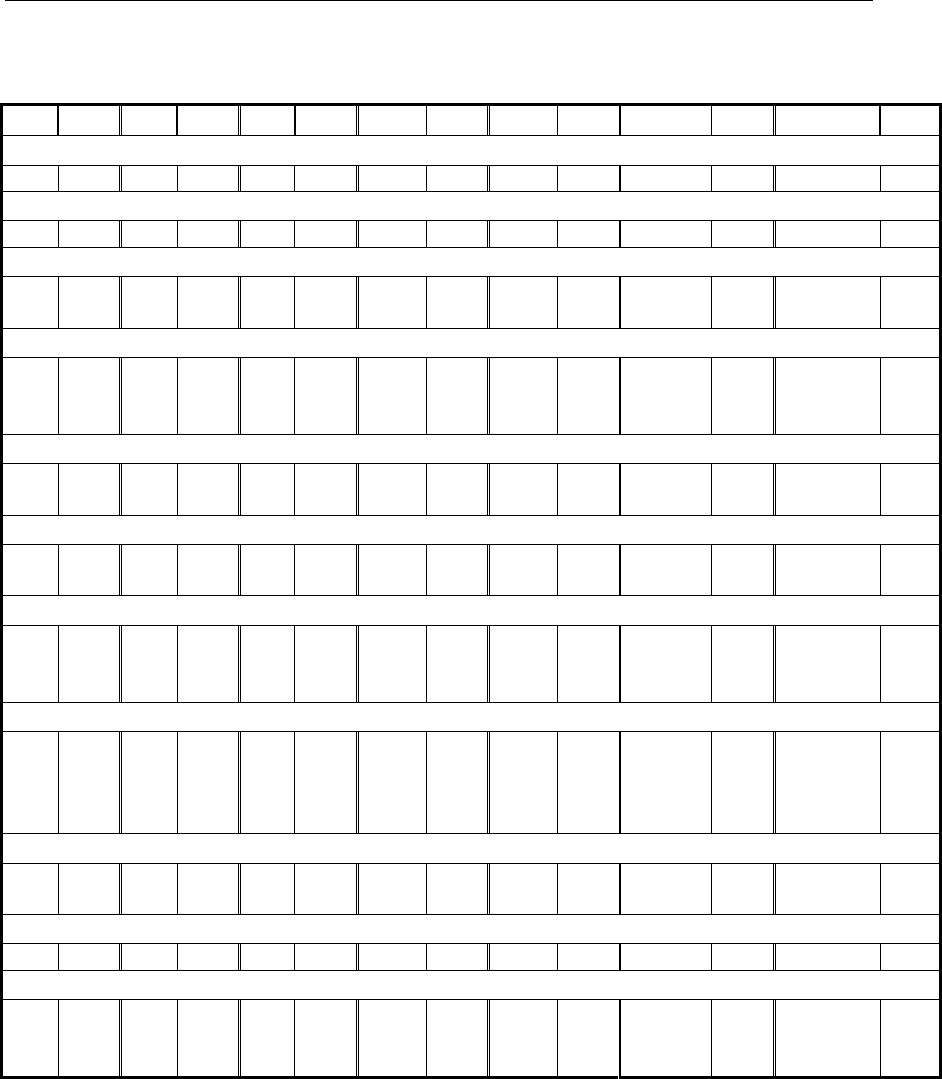
SUMMARY OF LEARNING OBJECTIVES BY QUESTION TYPE
Item
Type
Item
Type
Item
Type
Item
Type
Item
Type
Item
Type
Item
Type
Learning Objective 1
1.
TF
2.
TF
55.
MC
56.
MC
Learning Objective 2
3.
TF
4.
TF
5.
TF
6.
TF
7.
TF
57.
MC
Learning Objective 3
8.
TF
10.
TF
58.
MC
60.
MC
62.
MC
117.
SAE
9.
TF
11.
TF
59.
MC
61.
MC
116.
Ma
Learning Objective 4
12.
TF
15.
TF
63.
MC
66.
MC
69.
MC
111.
Ex
13.
TF
16.
TF
64.
MC
67.
MC
109.
Ex
118.
SAE
14.
TF
17.
TF
65.
MC
68.
MC
110.
Ex
124.
Es
Learning Objective 5
18.
TF
20.
TF
22.
TF
71.
MC
19.
TF
21.
TF
70.
MC
119.
SAE
Learning Objective 6
23.
TF
25.
TF
27.
TF
29.
TF
73.
MC
120.
SAE
24.
TF
26.
TF
28.
TF
72.
MC
116.
Ma
Learning Objective 7
30.
TF
33.
TF
74.
MC
77.
MC
80.
MC
113.
Ex
121.
SAE
31.
TF
34.
TF
75.
MC
78.
MC
81.
MC
114.
Ex
32.
TF
35.
TF
76.
MC
79.
MC
112.
Ex
116.
Ma
Learning Objective 8
36.
TF
40.
TF
82.
MC
86.
MC
90.
MC
116.
Ma
37.
TF
41.
TF
83.
MC
87.
MC
91.
MC
122.
SAE
38.
TF
42.
TF
84.
MC
88.
MC
113.
Ex
39.
TF
43.
TF
85.
MC
89.
MC
114.
Ex
Learning Objective 9
44.
TF
46.
TF
93.
MC
95.
MC
121.
SAE
45.
TF
92.
MC
94.
MC
116.
Ma
Learning Objective 10
47.
TF
48.
TF
96.
MC
97.
MC
98.
MC
99.
MC
Learning Objective 11
49.
TF
52.
TF
100.
MC
103.
MC
106.
MC
115.
Ex
50.
TF
53.
TF
101.
MC
104.
MC
107.
MC
116.
Ma
51.
TF
54.
TF
102.
MC
105.
MC
108.
MC
123.
SAE
Note: TF = True-False Ex = Exercise SAE = Short-Answer Essay
MC = Multiple Choice Ma = Matching Es = Essay
Cash and Accounts Receivable 6 – 3
CHAPTER LEARNING OBJECTIVES
1. Explain why cash and accounts receivable are of significance to users.
2. Describe the valuation methods for cash.
3. Explain the main principles of internal control.
4. Explain the purpose of bank reconciliations, including their preparation and the
treatment of related adjustments.
5. Explain why companies sell on account and identify the additional costs that result
from this decision.
6. Describe the valuation methods for accounts receivable.
6 – 4 Test Bank for Understanding Financial Accounting, Canadian Edition
7. Explain the allowance method of accounting for bad debts.
8. Identify the two methods of estimating bad debts under the allowance method and
describe the circumstances for using each method.
9. Explain the direct writeoff method of accounting for bad debts and when it is
acceptable to use it.
10. Explain alternative ways in which companies shorten their cash-to-cash cycle.
Cash and Accounts Receivable 6 – 5
11. Explain the concept of liquidity. Calculate the current ratio, quick ratio, accounts
receivable turnover ratio, and average collection period ratio and assess the results.

6 – 6 Test Bank for Understanding Financial Accounting, Canadian Edition
TRUE-FALSE STATEMENTS
1. The definition of cash includes: currency, cheques, money orders, and bank accounts.
2. Cash and accounts receivable are a company’s least liquid assets.
3. Foreign currency is valued and reported on the statement of financial position using the
exchange rate that existed on the transaction date.
4. Cash equivalents have a maturity date within three months of the date of acquisition.
5. A treasury bill is an example of a long-term investment.
6. Companies will never have a negative cash balance as cash is an asset and must always be
in a debit position.
7. Cash held in foreign currencies must be translated into Canadian dollars using the rate of
exchange at the statement of financial position date.
8. Writing cheques instead of using cash would be a proper internal control procedure.
9. For internal control purposes, if duties are effectively separated, there is no way fraud can
occur.
10. Collusion is where two or more employees work together to commit the theft and conceal it.
11. Independent verification can be done internally or externally.
12. When preparing a bank reconciliation, the balance as reported by the bank is adjusted until
it agrees with the balance reported in the company’s books.
13. Bank reconciliations should only be prepared for a company’s main operating account.
14. A bank reconciliation has two sides, one is the” bank side” and the other is the “balancing
side”.

Cash and Accounts Receivable 6 – 7
15. The reconciling items on the bank side will be items the company knows about but the bank
does not.
16. To adjust the cash account to the correct amount the accountant needs to make journal
entries for all the adjustments on the G/L side of the bank reconciliation.
17. All adjustments that are additions to the G/L side of a bank reconciliation are credits to cash.
18. An account receivable is usually evidenced by a formal promissory note.
19. Selling on account reduces overall sales.
20. The likelihood a customer will default on payments depends on the customer’s
creditworthiness.
21. A company with strict credit policies may lose potential sales.
22. A company with too lose credit policies will benefit from a substantial increase in sales with
no impact to expenses.
23. The gross amount of accounts receivable should be reflected on the statement of financial
position; this is what the company expects to collect in cash.
24. Accounts receivable are reflected on the statement of financial position at their gross
amounts.
25. Allowance for doubtful accounts is a contra-liability account.
26. When companies are using the allowance for doubtful accounts, they are using the
allowance method.
27. The A/R subledger is used to manage the individual account details of each of the
company’s suppliers.
28. The total of all the A/R sudledgers must equal the total of the Accounts Receivable account.

6 – 8 Test Bank for Understanding Financial Accounting, Canadian Edition
29. Companies following IFRS must disclose changes in the allowance for doubtful accounts
balance in the notes to the financial statements.
30. The allowance method of recognizing bad debt expense does not properly match revenues
and expenses.
31. Under the allowance method a company must record the bad debt expense in the same
period in which the credit sales were recorded.
32. A writeoff is the process of reinstating a customer’s account when it is deemed collectible.
33. When a customer makes full or partial payment of an account that has previously been
written off this is considered a recovery.
34. A recovery of an account will decrease the cash account and increase the accounts
receivable account.
35. Bad Debt Expense is a permanent account.
36. If bad debt expense is over or underestimated in a prior period, an adjustment will be made
to the allowance for doubtful accounts this period.
37. The percentage of credit sales method for estimating bad debt expense is based on the
assumption that the amount of bad debts is a function of the total sales made on credit.
38. Percentage of sales method is also known as the statement of financial position method.
39. When estimating bad debts under the allowance method, companies can only use one
method.
40. New business CANNOT account for bad debts because they do not have any historical data
in relation to collectible accounts.
41. The longer a receivable goes without being collected the less likely it will become
uncollectible.
42. As a contra-asset account, Allowance for Doubtful Accounts will always have a credit
balance.

Cash and Accounts Receivable 6 – 9
43. Aging of accounts receivable method will normally result in a better approximation of the net
realizable value of the receivables than the percentage of credit sales method.
44. The direct writeoff method recognizes bad debts only when they know the customer is NOT
going to pay.
45. The direct writeoff method requires two journal entries when an account is written off.
46. The appropriate method to use when bad debts are significant is the allowance method.
47. Selling to customers on account reduces the cash-to-cash cycle.
48. To shorten the cash-to-cash cycle companies will offer a sales discount.
49. The current ratio is most commonly used to measure the stability of an entity.
50. Analyzing the accounts receivable turnover is important in assessing the short-term liquidity
of an organization.
51. The quick ratio is a less stringent measure of liquidity than the current ratio.
52. Two common ratios for long-term liquidity are the current ratio and the quick ratio.
53. One problem with the current ratio is that some assets may be less liquid than others.
54. A higher asset turnover ratio number is better than a lower turnover number.
6 – 10 Test Bank for Understanding Financial Accounting, Canadian Edition
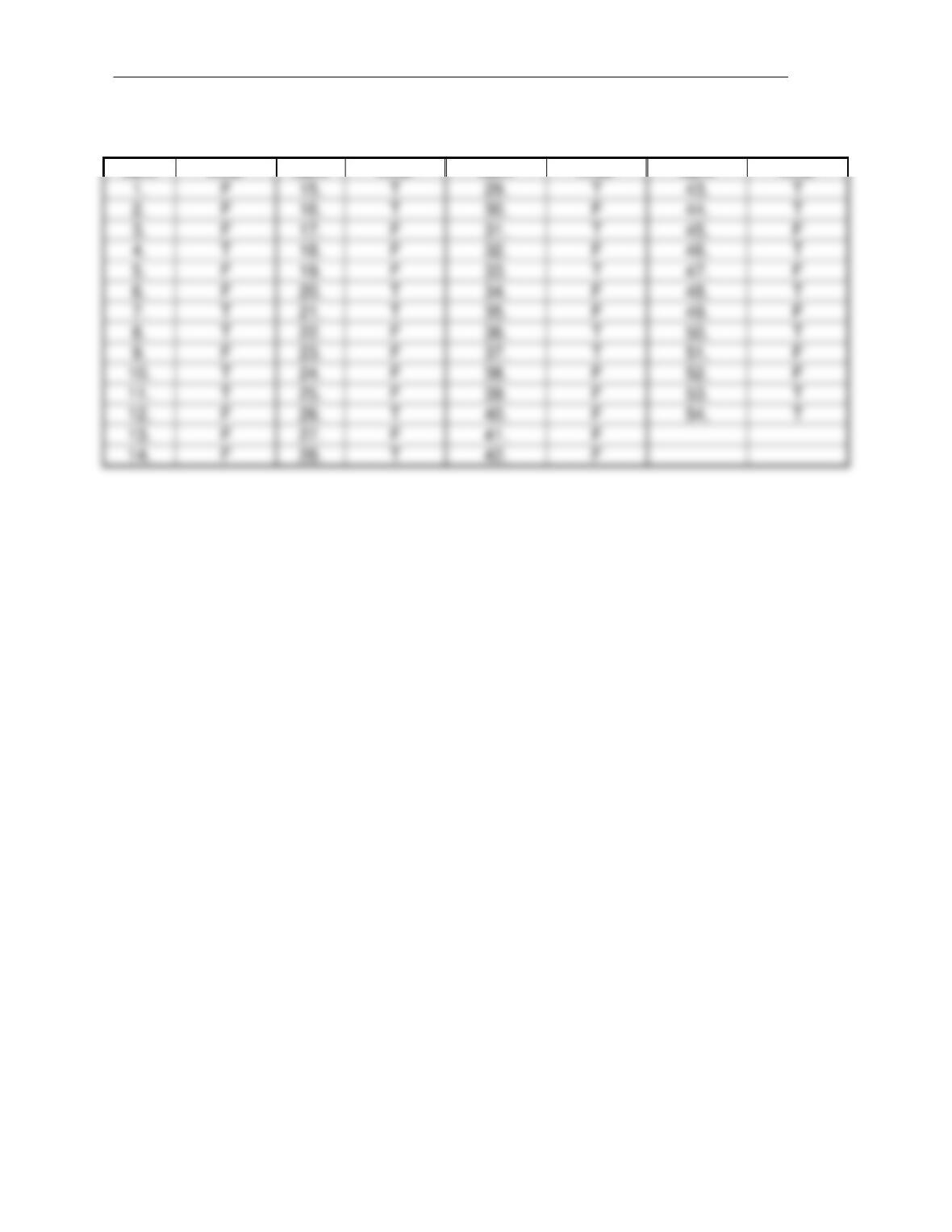
ANSWERS TO TRUE-FALSE STATEMENTS
Item
Ans.
Item
Ans.
Item
Ans.
Item
Ans.

Cash and Accounts Receivable 6 – 11
MULTIPLE CHOICE QUESTIONS
55. All of the following are normally considered liquid assets of a company EXCEPT
a) accounts receivable.
b) inventory.
c) notes receivable.
d) short-term investments.
56. Which of the following would be classified as part of the cash account on the statement of
financial position?
a) short term investments
b) prepaid expenses
c) currency
d) restricted cash
57. Foreign currency held by a Canadian corporation is disclosed on the financial statements
using the exchange rate that existed on the date of the
a) financial statements.
b) purchase of the currency.
c) change in the exchange rate.
d) intended use of the currency.
58. All of the following are examples of internal controls over cash EXCEPT
a) depositing cash in the bank regularly.
b) ensuring different people are responsible for receiving and depositing cash.
c) ensuring that all cash transactions are recorded on a regular basis.
d) maintaining a separate facility for the storage of perishable inventory.
59. Opportunities for employee fraud arises when
a) an employee is in charge of purchasing, inspecting, and recording assets.
b) employees verify each other’s work.
c) an employee has clear documentation procedures.
d) an employee is responsible for making the daily cash bank deposit.
60. Policies and procedures that are established to protect and manage a company’s assets are
known as
a) a record-keeping system.
b) an accounting system.
c) internal controls.
d) management controls.
61. All of the following are examples of physical controls EXCEPT
a) locks.

6 – 12 Test Bank for Understanding Financial Accounting, Canadian Edition
b) fences.
c) bank reconciliations.
d) alarms.
62. Separation of duties means
a) one person receives cash and one person signs cheques.
b) one person signs cheques and orders goods.
c) one person enters transactions and signs cheques.
d) one person receives cash and reconciles the bank.
63. Which of the following is NOT a reconciling item when preparing a bank reconciliation?
a) bank service charges not recorded by the corporation
b) outstanding cheques
c) interest collected on a note receivable by the bank and recorded by the corporation
d) outstanding deposits
64. The ending balance on the bank statement for December is $1,425.33. The company has
outstanding cheques of $263.35, outstanding deposits of $729.61, and incurred bank service
fees of $12.00 during the month. The adjusted cash balance for the company as at December
31 is
a) $947.07.
b) $1,891.59.
c) $1,879.59.
d) $1903.59.
65. Who should be responsible for preparing the bank reconciliation?
a) the person who makes the deposits
b) the person who writes the cheques
c) the person who maintains the accounting records
d) a person not involved in the day-to-day banking activities
66. As part of the bank reconciliation process the following must occur:
a) bank adjusting entries.
b) company adjusting entries.
c) verification of bank charges.
d) inventory of company cheques.
67. Bank reconciliations are NOT
a) an important cash control.
b) to be completed by all companies.
c) sufficient to determine fraud.
d) useful.
68. All of the following are reasons why a transaction may have been reflected in the company’s

Cash and Accounts Receivable 6 – 13
accounting records but NOT by the bank EXCEPT
a) a cheque has been written but the receiving company did not deposit it yet.
b) bank has charged service fees.
c) the company make a deposit on the last day of the month.
d) the company recorded a payment received however forgot to deposit the cheque.
69. The starting point for the bank portion of the bank reconciliation is labelled
a) Account Balance.
b) Bank Balance.
c) Transaction Balance.
d) Cash Balance.
70. Which of the following statements is INCORRECT?
a) Companies sell on account to increase total sales.
b) Companies sell on account to remain competitive.
c) Companies sell on account to generate additional forms of revenue.
d) Companies sell on account to increase bad debt expense.
71. When selling on account, companies incur costs such as
a) wages for credit granting function.
b) rent expense.
c) bad debt revenue.
d) sales discounts.
72. Which of the following do NOT affect the amounts collected on accounts receivables?
a) credit policy
b) returns policy
c) discounts policy
d) the allowance for doubtful accounts
73. Accounts receivable are reflected on the statement of financial position at the carrying
amount which is
a) accounts receivable plus allowance for doubtful accounts.
b) accounts receivable less allowance for doubtful accounts.
c) accounts receivable plus bad debt expense.
d) accounts receivable less bad debt expense.
74. Which of the following entries would be the appropriate entry for writing off an uncollectible
account receivable under the allowance method?
a) Dr. Bad Debt Expense
Cr. Accounts Receivable
b) Dr. Sales
Cr. Accounts Receivable
c) Dr. Accounts Receivable
Cr. Bad Debt Expense

6 – 14 Test Bank for Understanding Financial Accounting, Canadian Edition
d) Dr. Allowance for Doubtful Accounts
Cr. Accounts Receivable
75. Which of the following is a contra account?
a) Bad Debts
b) Accounts Receivable Recoveries
c) Allowance for Doubtful Accounts
d) Credit Sales
76. When an account receivable that has previously been written off is later paid, under the
allowance method the correct accounting is to
a) Dr. A/R
Cr. Allowance for Doubtful Accounts
Dr. Cash
Cr. A/R
b) Dr. Cash
Cr. A/R
Dr. A/R
Cr. Allowance for Doubtful Accounts
c) Dr. Cash
Cr. A/R
d) Dr. A/R
Cr. Allowance for Doubtful Accounts
77. Ventura Co. had accounts receivable totalling $450,000 and an allowance for doubtful
accounts with a balance of $5,000 on June 1, 2015. On June 2 Ventura wrote off $7,500 of
uncollectible accounts. The net carrying value of accounts receivable before and after the
writeoff was
Before After
a) $450,000 $442,500.
b) $445,000 $442,500.
c) $445,000 $452,500.
d) $445,000 $457,500.
78. The process of removing a specific customer’s account receivable from a company’s books
when the account is deemed uncollectible is
a) an allowance.
b) a write off.
c) a recovery.
d) none of the above.
79. The contra-asset account used to provide for an estimate of uncollectible accounts is
a) Bad Debt Expense.
b) Allowable Accounts Receivable.
c) Allowance for Doubtful Accounts.
d) A/R subledger.

Cash and Accounts Receivable 6 – 15
80. The entry to provide for uncollectible accounts under the allowance method affects both the
statement of income and the statement of financial position by
a) increasing expenses and increasing the carrying amount of the accounts receivable.
b) decreasing expenses and increasing the carrying amount of the accounts receivable.
c) increasing expenses and decreasing the carrying amount of the accounts receivable.
d) decreasing expenses and decreasing the carrying amount of the accounts receivable.
81. Which of the following statements is correct in regards to the recovery entry?
a) It does not effect the statement of income.
b) It effects both the statement of income and the statement of financial position.
c) It only effects the statement of income.
d) It only effects the statement of financial position.
Use the following information for questions 82–83.
Loveto Inc.’s books revealed the following data for 2015 after all adjustments were made:
Cash sales $825,000
Sales returns (on credit sales) 35,000
Allowance for doubtful accounts (credit balance) 3,800
Credit sales 575,000
Accounts receivable 168,000
Loveto estimates bad debt expense based on 2% of net credit sales.
82. The bad debt expense for 2015 was
a) $10,800.
b) $11,500.
c) $14,600.
d) $3,360.
83. The net carrying value of accounts receivable before the bad debt expense is recognized is
a) $156,500.
b) $164,200.
c) $168,000.
d) $171,800.
Use the following information for questions 84–85.
Kewatin Company recorded $3,500,000 in credit sales in 2015 and prepared the following aging
schedule of their $730,000 in accounts receivable as at December 31, 2015:
Days outstanding Balance Estimated percentage uncollectible
0–30 days $350,000 1%
31–60 days 275,000 2%
61–90 days 67,500 5%
0ver 90 days 37,500 25%

6 – 16 Test Bank for Understanding Financial Accounting, Canadian Edition
The balance in their allowance for doubtful accounts before year-end adjustments is a $2,000
credit.
84. The bad debt expense for 2015 is
a) $21,750.
b) $23,750.
c) $19,750.
d) $35,000.
85. The balance in the allowance for doubtful accounts after year-end adjustments will be
a) $2,000.
b) $23,750.
c) $21,750.
d) $19,750.
86. The statement of financial position method is also known as
a) the percentage of credit sales method.
b) the easy collection method.
c) the aging of accounts receivable method.
d) none of the above.
87. Which one of the following calculations is correct for the percentage of credit sales method?
a) Bad debt expense = Sales x historic %
b) Bad debt expense = Credit sales x historic %
c) Bad debt expense x historic % = Allowance for doubtful accounts
d) Bad debt expense = Accounts receivable x historic %
88. If a company is experiencing more write offs than were estimated,
a) the bad debt should be reduced next period.
b) the direct method should be implemented.
c) the percentage should be increased next accounting period.
d) an adjustment should be made retrospectively.
89. The most common threshold for account receivable groupings is
a) 0–5 days.
b) n/120 days.
c) 30–60 days.
d) 160–180 days.
90. All of the following are features of the percentage of credit sales method EXCEPT
a) emphasizes earnings statement relationships.
b) focuses on asset valuation.
c) determines bad debts expense directly.
d) focuses on income measurement.

Cash and Accounts Receivable 6 – 17
91. All of the following are features of the aging of accounts receivable method EXCEPT
a) focuses on asset valuation.
b) analysis of allowance for doubtful accounts required in order to determine bad debts
expense.
c) emphasizes statement of financial position relationship.
d) determines bad debt expense directly.
92. Which of the following methods does NOT accurately match revenues and expenses?
a) direct writeoff method
b) allowance method
c) percentage of credit sales method
d) aging of accounts receivable method
93. When is it acceptable to use the direct writeoff method to account for uncollectible
accounts?
a) when the expected bad debts are significant
b) when the company has historical data in regards to uncollectible accounts
c) when the company uses the percentage of sales method
d) when the expected bad debts are not significant
94. No allowance for doubtful accounts is used for the
a) direct write off method.
b) percentage of credit sales method.
c) allowance method.
d) aging of accounts receivable method.
95. If bad debts are NOT significant which method is best to use?
a) direct write off method
b) percentage of credit sales method
c) allowance method
d) aging of accounts receivable method
96. If a company is experiencing cash flow difficulties it may opt to sell its receivables to a third
party to generate cash. This is known as
a) internal cash controls.
b) pledging.
c) factoring.
d) cash management.
97. Many companies have to pay a fee for credit card transactions; this fees is normally
a) 0–1%.
b) 5–10%.
c 10–30%.

6 – 18 Test Bank for Understanding Financial Accounting, Canadian Edition
d) 1–5%.
98. If a company made a $5,500 credit card transaction and the credit card discount was 4%,
what is the correct entry to accounts receivable?
a) Dr. Accounts Receivable $5,720
b) Dr. Accounts Receivable $5,280
c) Cr. Accounts Receivable $5,720
d) Cr. Accounts Receivable $5,280
99. If a company is looking to shorten their cash-to-cash cycle, they can sell their accounts
receivable and this is called
a) recourse.
b) factoring.
c) writeoff.
d recovery.
Use the following information for questions 100–103.
Orville Enterprise Ltd. revealed the following information for the years ended December 31,
2014 and 2015:
2015 2014
Current Assets
Cash $ 25,000 $ 26,250
Accounts Receivable 247,500 299,000
Inventory 1,950,000 1,725,000
Prepaid expenses 4,000 4,000
Total Current Assets $2,226,500 $2,054,250
Current Liabilities $1,400,000 $1,225,000
Net Credit Sales $2,400,000 $2,255,000
Orville Enterprise’s credit terms are net 30 days.
100. Orville Enterprise Ltd’s 2015 current ratio is
a) 1.59:1.
b) 1.39:1.
c) 1.00:1.
d) 0.19:1.
101. Orville Enterprise’s quick ratio for 2015 is
a) 1.59:1.
b) 1.39:1.
c) 0.88:1.
d) 0.19:1.
102. Orville Enterprise’s A/R turnover ratio is
a) 9.70.

Cash and Accounts Receivable 6 – 19
b) 8.78.
c) 8.03.
d) 8.52.
103. On the average Orville Enterprise has been collecting its accounts receivable
a) within the 30 days required by its credit terms.
b) after the 30 days has passed.
c) within the discount period of 10 days.
d) More information is needed to answer this question.
104. The current ratio is also known as
a) working capital ratio.
b) debt to equity ratio.
c) current turnover.
d) quick ratio.
105. A current ratio of 3:1 means
a) the company has 3 dollars of debt to every dollar of assets.
b) the company has 3 dollars of assets to every 1 dollar of debt.
c) the company has 3 dollars of assets for every 3 dollars of debt.
d) the company has 3 dollars of debt to every 3 dollar of assets.
106. The quick ratio is also known as
a) working capital ratio.
b) debt to equity ratio.
c) current turnover.
d) acid test ratio.
107. Which of the following statements is INCORRECT?
a) If the current ratio is too high the company may not be managing its assets effectively.
b) If the current ratio is too high the company overly high levels of inventory.
c) If the current ratio is too high the company may have too much cash on hand.
d) If the current ratio is too high the company may have an insignificant amount of receivables.
108. Quick assets are
a) inventory plus cash and prepaid expenses.
b) current assets plus current liabilities.
c) current assets less prepaid expenses.
d) current assets less inventory and prepaid expenses.
6 – 20 Test Bank for Understanding Financial Accounting, Canadian Edition
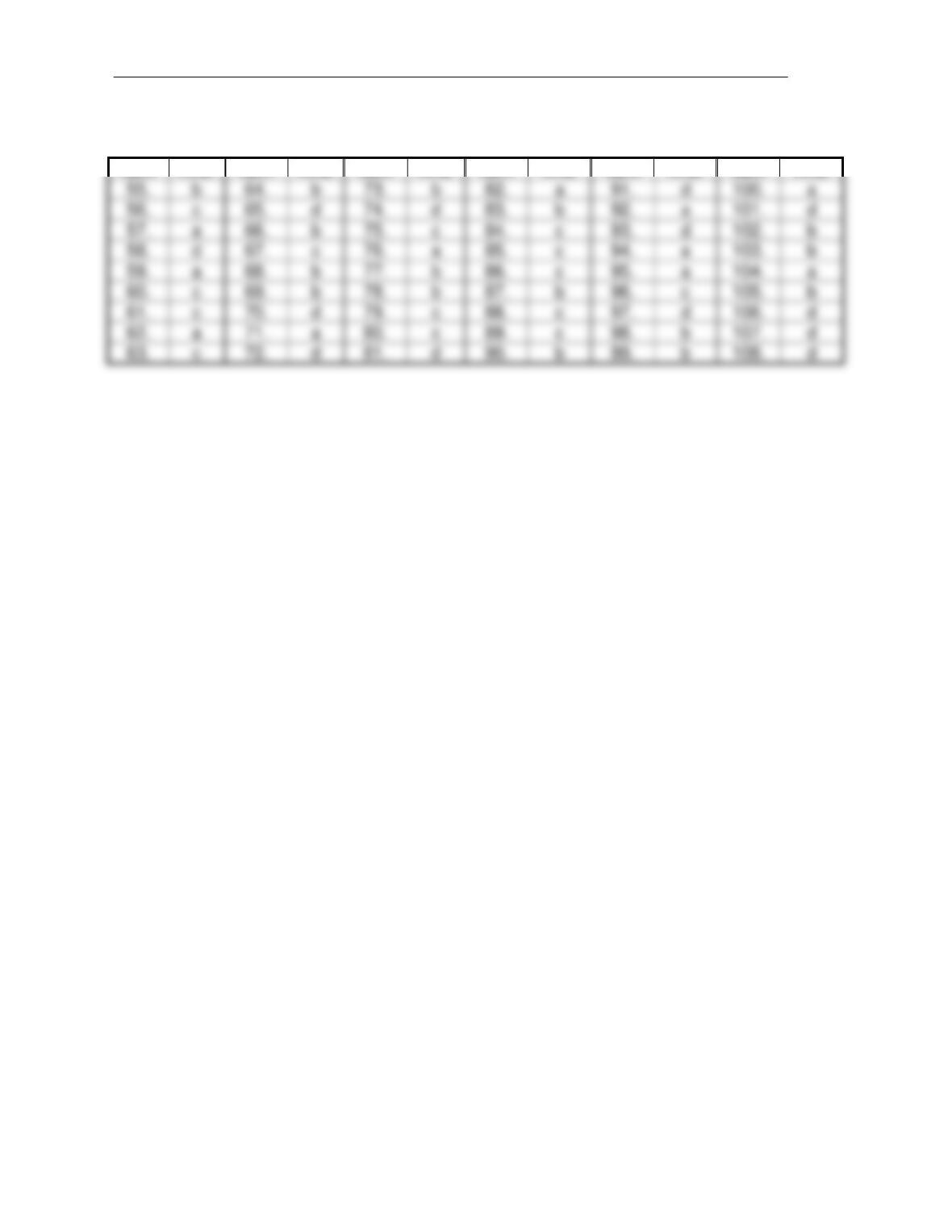
ANSWERS TO MULTIPLE CHOICE QUESTIONS
Item
Ans.
Item
Ans.
Item
Ans.
Item
Ans.
Item
Ans.
Item
Ans.
Cash and Accounts Receivable 6 – 21
EXERCISES
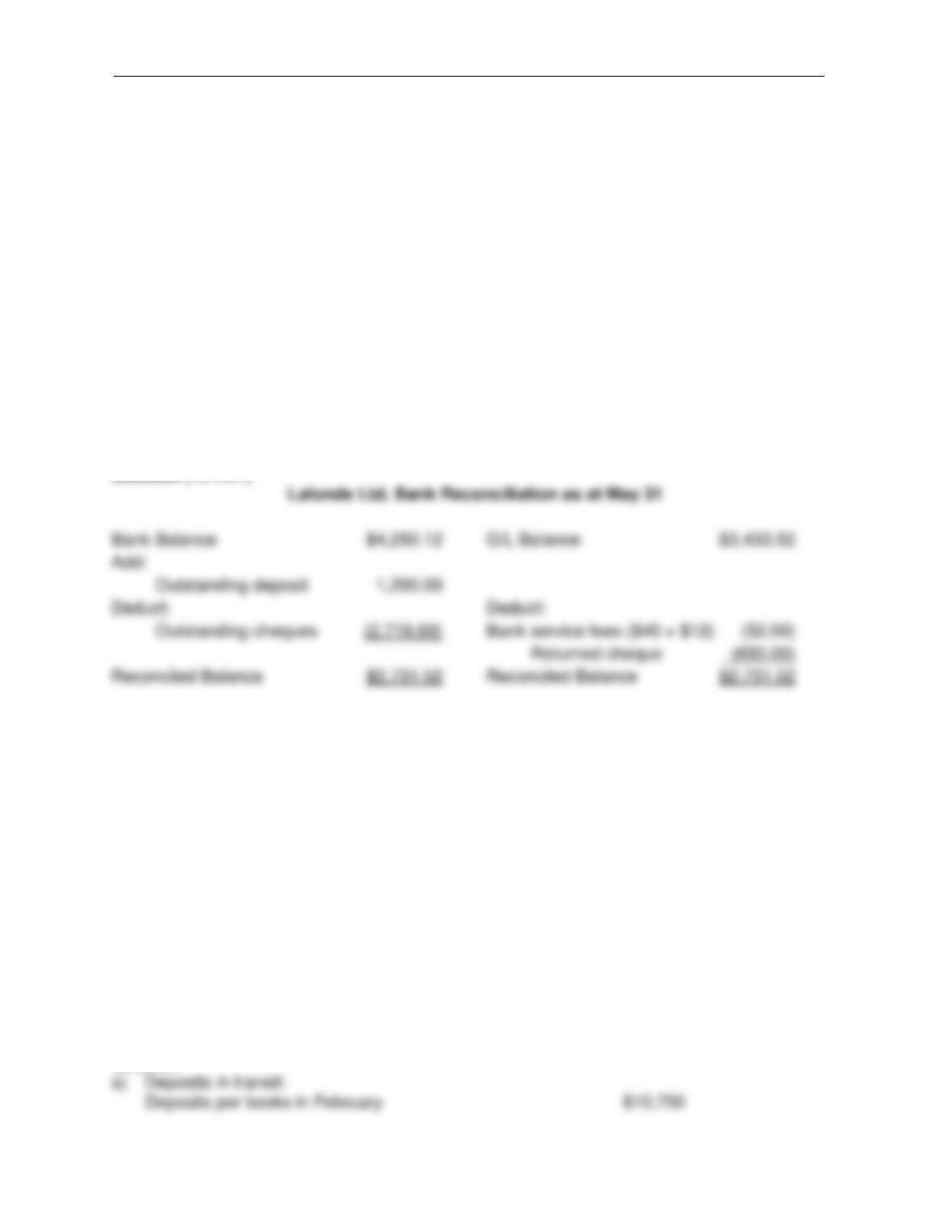
109. The May 31 bank statement for Lalonde Ltd had an ending balance of $4,250.12. The cash
account according to the company’s records was $3,433.52 as at the same date. The following
additional data was available
1. The company had made a deposit in the night box of $1,200.00 on May 31 after the branch
was closed.
2. There were outstanding cheques totalling $2,718.60 as at May 31.
3. The bank service fee was $40.00 for the month.
4. A cheque in the amount of $650.00 deposited by Lalonde on May 21 had been returned
NSF and the bank charged a $12.00 fee on the item. Lalonde had not known about the
returned item until it received the bank statement.
Instructions
Prepare the bank reconciliation for Lalonde Ltd. for the month of May.
110. The cash records of Montrose Mini Ltd. show the following:
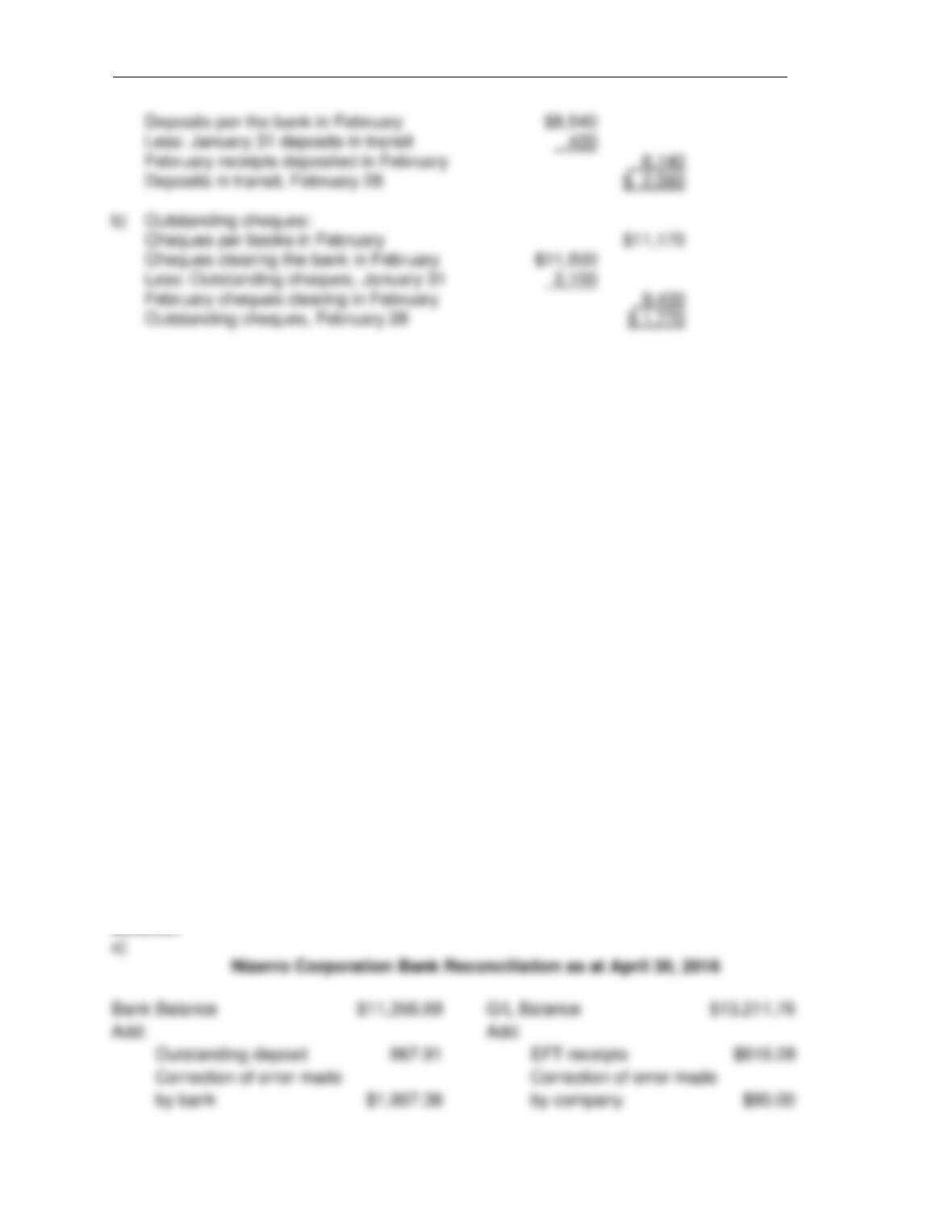
1. The January 31 bank reconciliation indicated that deposits in transit totalled $400. During
February, the general ledger account, Cash, shows deposits of $10,700, but the bank
statement indicates that only $8,540 in deposits were received during the month.
2. The January 31 bank reconciliation also reported outstanding cheques of $2,100. During
the month of February, Montrose Mini Ltd.’s books show that $11,170 of cheques were
issued, yet the bank statement showed that $11,500 of cheques cleared the bank in
February.
There were no bank debit or credit memoranda and no errors were made by either the bank or
Montrose Mini Ltd.
Instructions
a) What were the deposits in transit at February 28?
b) What were the outstanding cheques at February 28?
Solution
6 – 22 Test Bank for Understanding Financial Accounting, Canadian Edition
111. Nizzero Corporation is a newly created company and noted the following cash related
transaction for the first month ended April 2016:
1. According to the bank statement received for the month of April 2016, the balance in
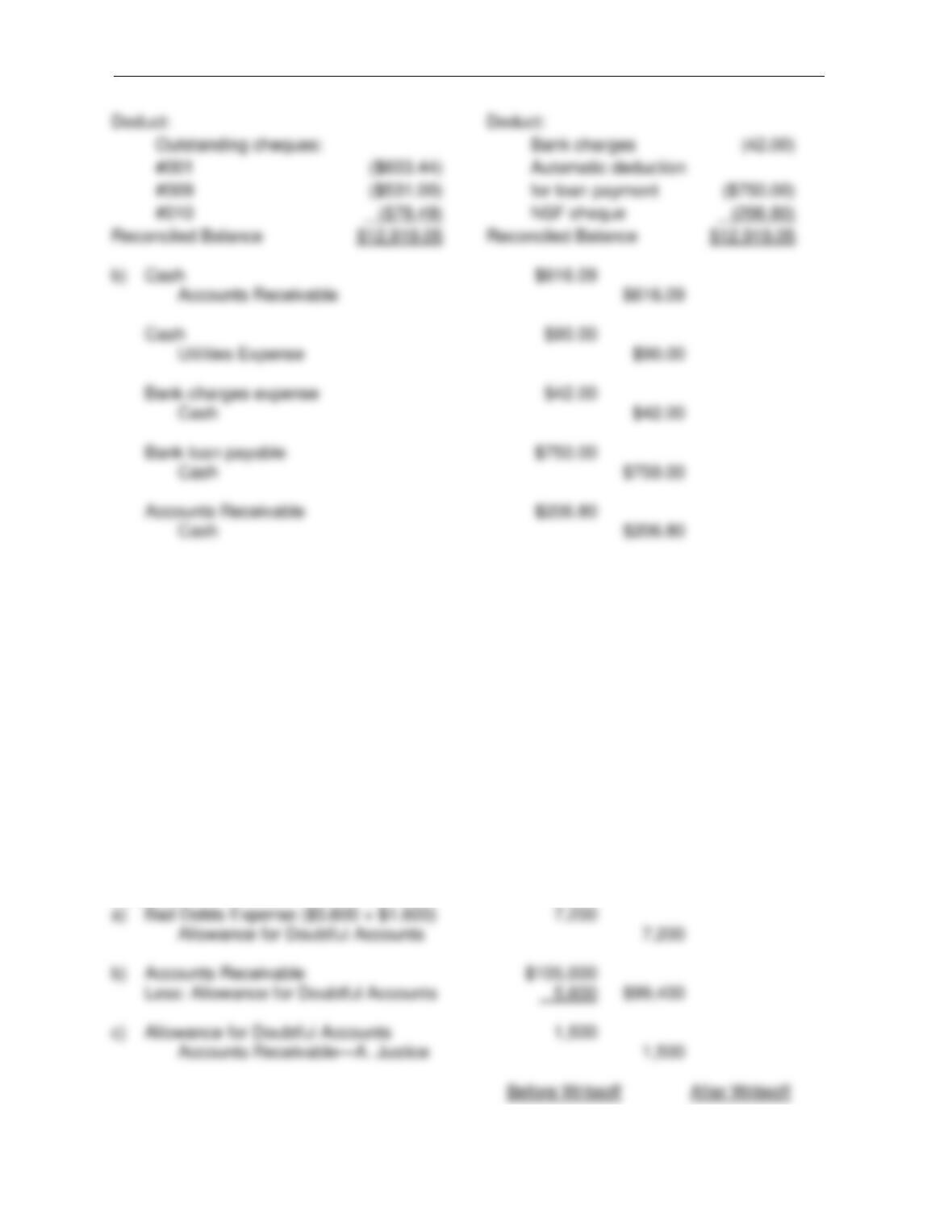
Nizzero’s bank account on April 30 was $11,356.69.
2. The balance in the company’s Cash account in the general ledger on April 30, 2016 was
$13,211.76.
3. The last deposit of the month, for $867.91, was made as a night deposit on April 30.
4. One of Nizzero’s customers paid its account by making an EFT from its bank into Nizzero’s
bank account in the amount of $616.09.
5. The bank subtracted a service charge of $42.00 from the company’s bank account for April.
6. Cheque number 001 for $603.44, cheque number 009 for $531.00, and cheque number
010 for $78.49 were still outstanding at the end of April.
7. The bank statement showed that $750.00 was deducted from Nizzero’s account by the
bank as payment of loan principal.
8. The bank returned a cheque from one of Nizzero’s customers marked NSF for $206.80 that
a customer used to pay off their account.
9. The bank statement showed that cheque number 004 (which Nizzero had issued to pay for
utilities expense) was recorded by the bank as $784.65, while the company incorrectly
recorded this cheque as $874.65.
10. The bank deducted a cheque written by Nizarri Company (a different company) from
Nizzero Company’s account. The amount of the cheque was $1,907.38.
Instructions
a) Prepare the bank reconciliation for April 30, 2016.
b) Prepare all necessary journal entries to balance the cash ledger.
Solution
Cash and Accounts Receivable 6 – 23
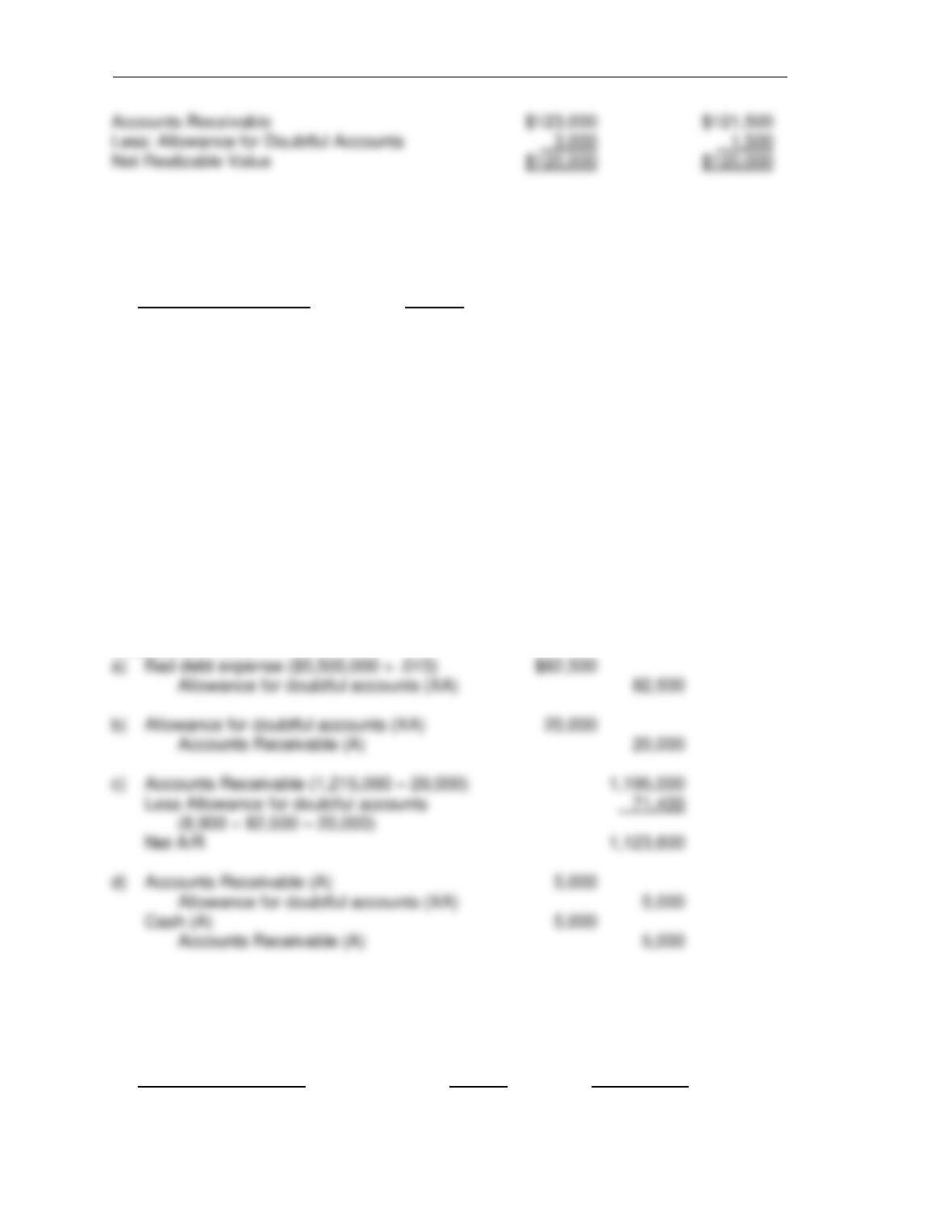
112. Atlantic Computers has credit sales of $600,000 in 2015 and a debit balance of $1,600 in
the Allowance for Doubtful Accounts at year end. As of December 31, 2015, $105,000 of
accounts receivable remain uncollected. The credit manager of Atlantic prepared an aging
schedule of accounts receivable and estimates that $5,600 will prove to be uncollectible.
On April 15, 2016 Atlantic Computers writes off the $1,500 balance owed by A. Justice.
Instructions
a) Prepare the adjusting entry to record the estimated uncollectible accounts expense in 2015.
b) Show the statement of financial position presentation of accounts receivable on December
31, 2015.
c) On April 15, before the writeoff, assume the balance of Accounts Receivable account is
$123,000 and the balance of Allowance for Doubtful Accounts is a credit of $3,000. Make
the appropriate entry to record the writeoff of the Justice account. Also show the statement
of financial position presentation of accounts receivable before and after the writeoff.
Solution
6 – 24 Test Bank for Understanding Financial Accounting, Canadian Edition
113. Dipetro Co Inc. generated $5.5 million in credit sales during the current year. Based on
past experience, it is estimated that 1.5% of all credit sales will prove to be uncollectible. The
balance of the allowance for doubtful accounts at December 31 is $8,900 credit. Accounts
receivable at December 31 consists of the following:
Account Classification Amount
1–30 days $850,000
31–60 days 175,000
61–90 days 120,000
91–120 days 50,000
Over 120 days 20,000
Instructions
a) Calculate and record the journal entry for bad debt expense for the current year using the
percentage of credit sales method.
b) Dipetro Co. has decided to write off all the accounts that were over 120 days old. Record
the journal entry.
c) What is the balance for Accounts Receivable as shown on the December 31 statement of
financial position?
d) One of the customers whose $5,000 account was written off, paid Dipetro Co. in full.
Record the journal entry.
Solution (10 min.)
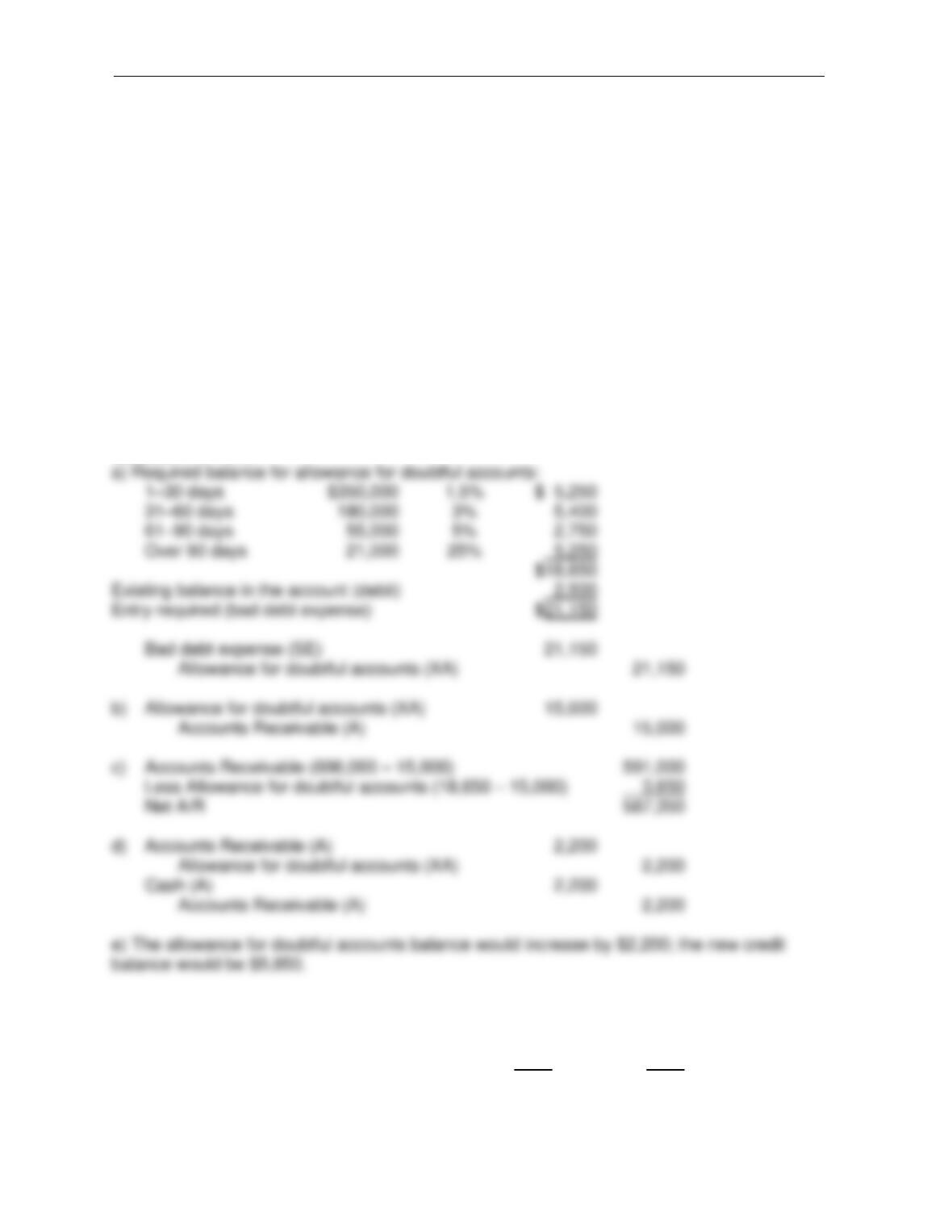
114. Wong Inc. generated $2.75 million in credit sales during the current year. The balance of
the allowance for doubtful accounts at December 31 is $2,500 debit. Accounts receivable at
December 31 consists of the following:
Estimated Percentage
Account Classification Amount Uncollectible
1–30 days $350,000 1.5%
Cash and Accounts Receivable 6 – 25
31–60 days 180,000 3%
61–90 days 55,000 5%
Over 90 days 21,000 25%
Instructions
a) Calculate and record the journal entry for bad debt expense for the current year using the
aging of accounts receivable approach.
b) Wong has decided to write off $15,000 of the accounts that were over 90 days old. Record
the journal entry.
c) What is the balance for Accounts Receivable as shown on the December 31 statement of
financial position?
d) One of the customers whose $2,200 account was written off paid in full. Record the journal
entry.
e) Is the balance in the allowance for doubtful accounts affected by the transaction in part d)?
If so, by how much? What is the new balance?
Solution (12 min.)
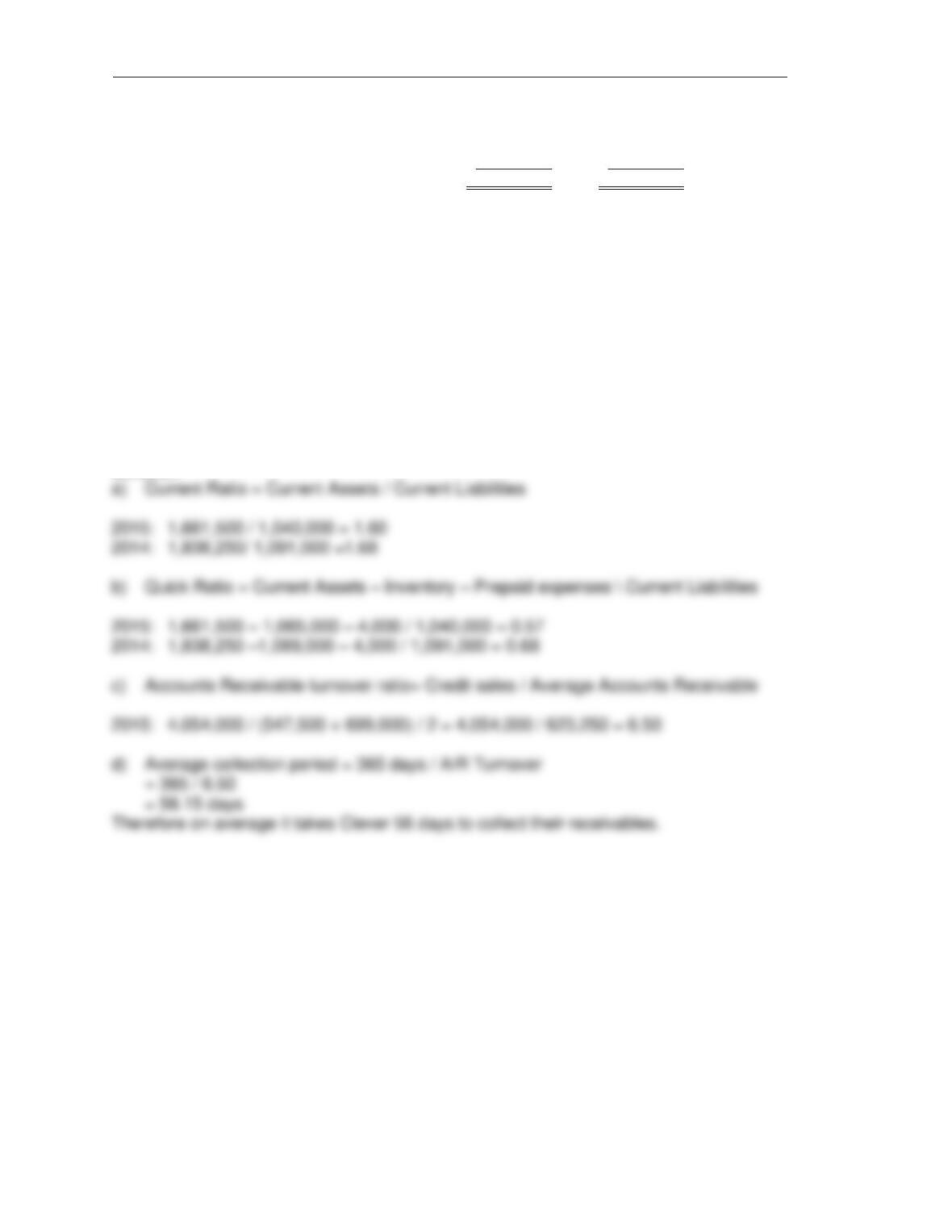
115. Clever Enterprise Ltd. revealed the following information for the years ended December 31,
2014 and 2015:
2015 2014
Current Assets
Cash $ 45,000 $ 46,250
6 – 26 Test Bank for Understanding Financial Accounting, Canadian Edition
Accounts Receivable 547,500 699,000
Inventory 1,065,000 1,089,000
Prepaid expenses 4,000 4,000
Total Current Assets $1,661,500 $1,838,250
Current Liabilities $1,040,000 $1,091,000
Net Credit Sales $4,054,000 $4,169,000
Clever Enterprise’s credit terms are net 30 days.
Instructions
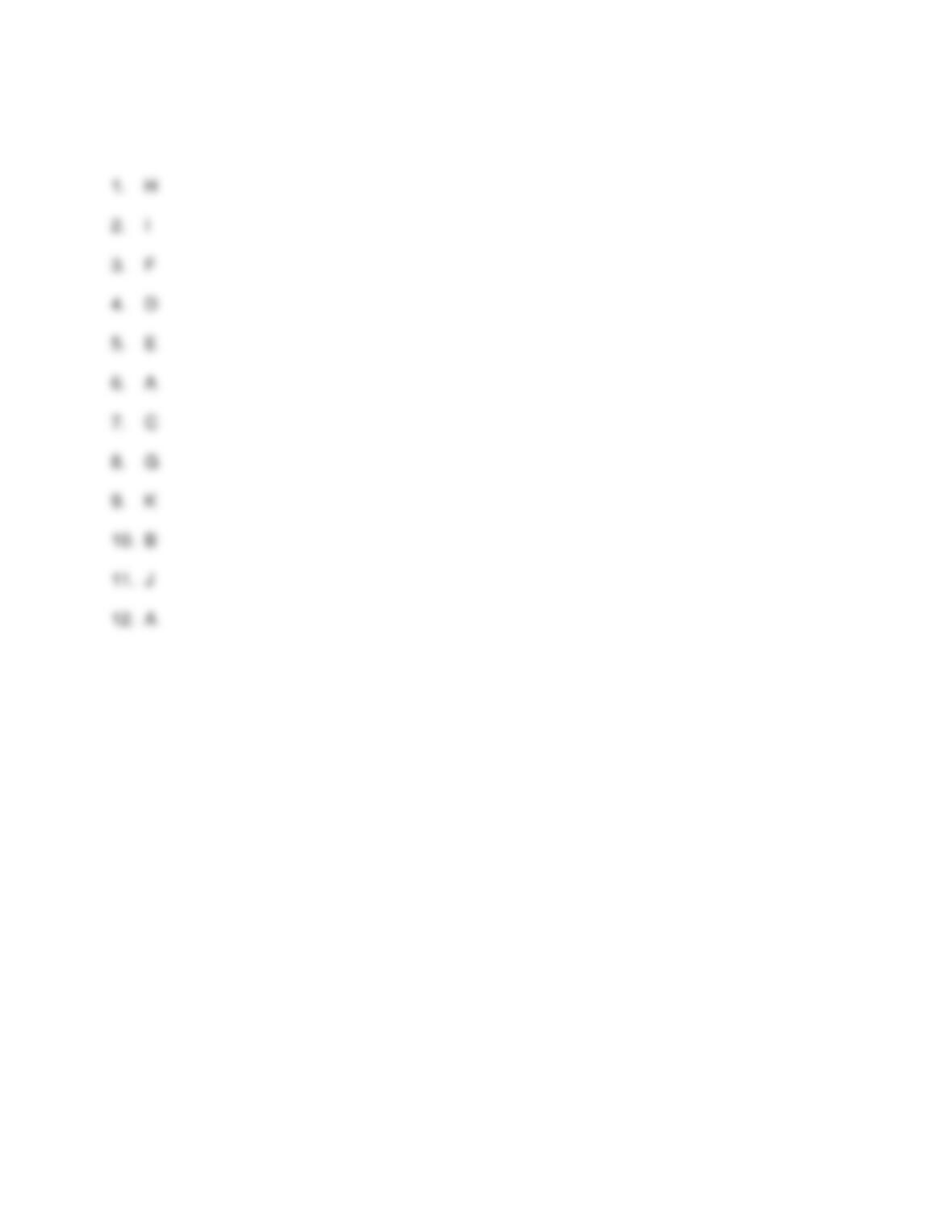
a) Calculate Clever Enterprise’s 2015 and 2014 current ratio.
b) Calculate Clever Enterprise’s quick ratio for 2015 and 2014.
c) Calculate Clever Enterprise’s Accounts Receivable turnover ratio for 2015.
d) On the average how long does it take Clever Enterprise to collect its accounts receivable?
Solution

Cash and Accounts Receivable 6 – 27
MATCHING
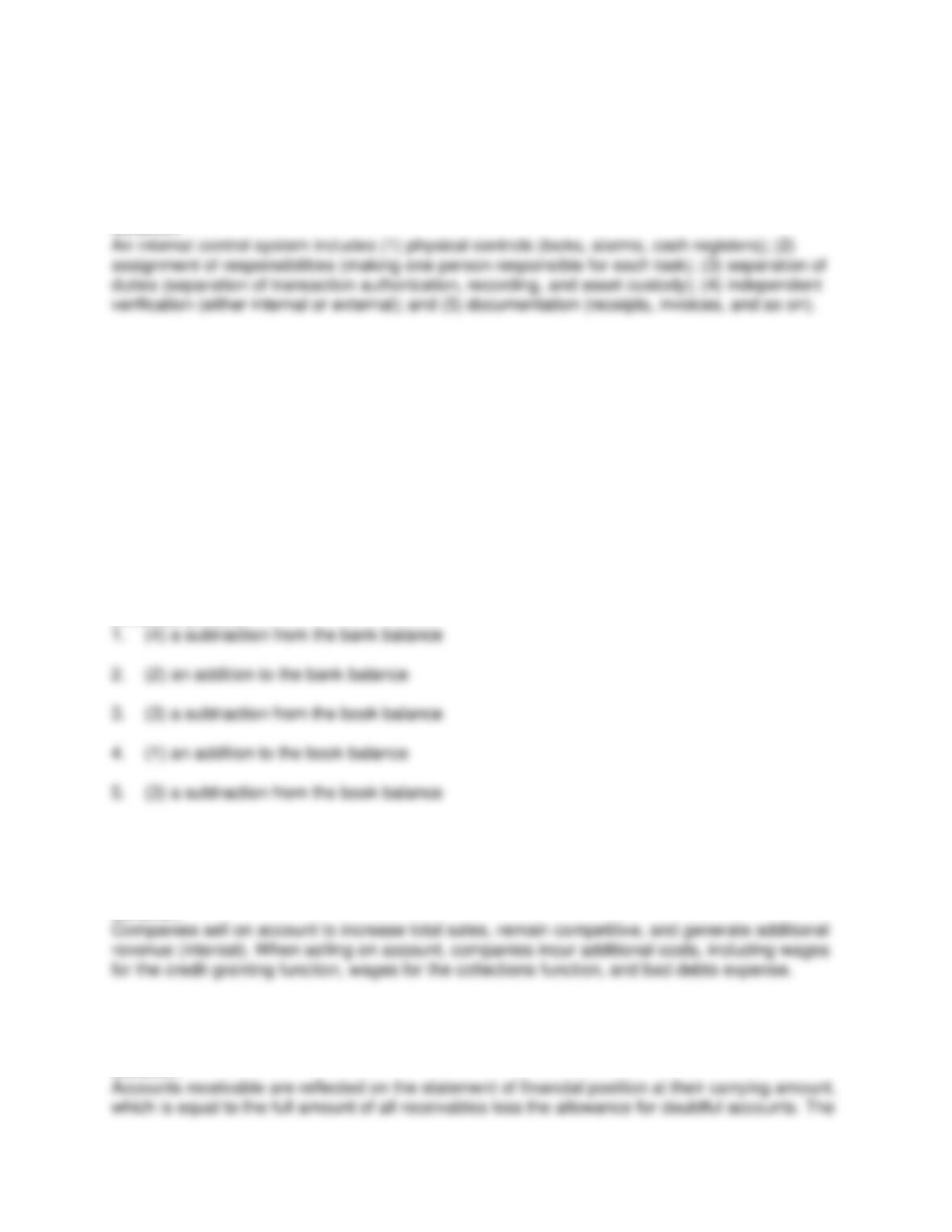
116. Listed below are a set of terms and a set of definitions. Match each term to the appropriate
definition by placing its letter in the space provided.
TERMS
A. Current ratio G. Aging of accounts receivable method
B. Internal control H. Recovery
C. Factoring I. Physical controls
D. Allowance method J. Quick Ratio
E. Writeoff K. Direct write off method
F. Carrying amount
DEFINITIONS
____ 1. Collection of a specific accounts receivable that has been previously written off
____ 2. Designed to protect assets from theft, diversion, damage or destruction
____ 3. Full value of accounts receivable less the allowance for doubtful accounts
____ 4. Estimates are made in regards to the uncollectible amount and a bad debt
expense is recorded in the same period as the credit sales
____ 5. The process of removing a customer’s account receivable from the books when
the account is deemed uncollectible
____ 6. Ratio that measures the entity’s short-term liquidity
____ 7. Selling of accounts receivable
____ 8. Method of estimating bad debt based on collectibility of the accounts receivable
____ 9. Recognize bad debt only when the company knows the customer will not pay
____ 10. System established to promote safeguarding of assets
____ 11. Used to assess short term liquidity but only includes quick assets
____ 12. Measure of short-term liquidity
6 – 28 Test Bank for Understanding Financial Accounting, Canadian Edition
ANSWERS TO MATCHING (5 min.)
Cash and Accounts Receivable 6 – 29
SHORT-ANSWER ESSAY QUESTIONS
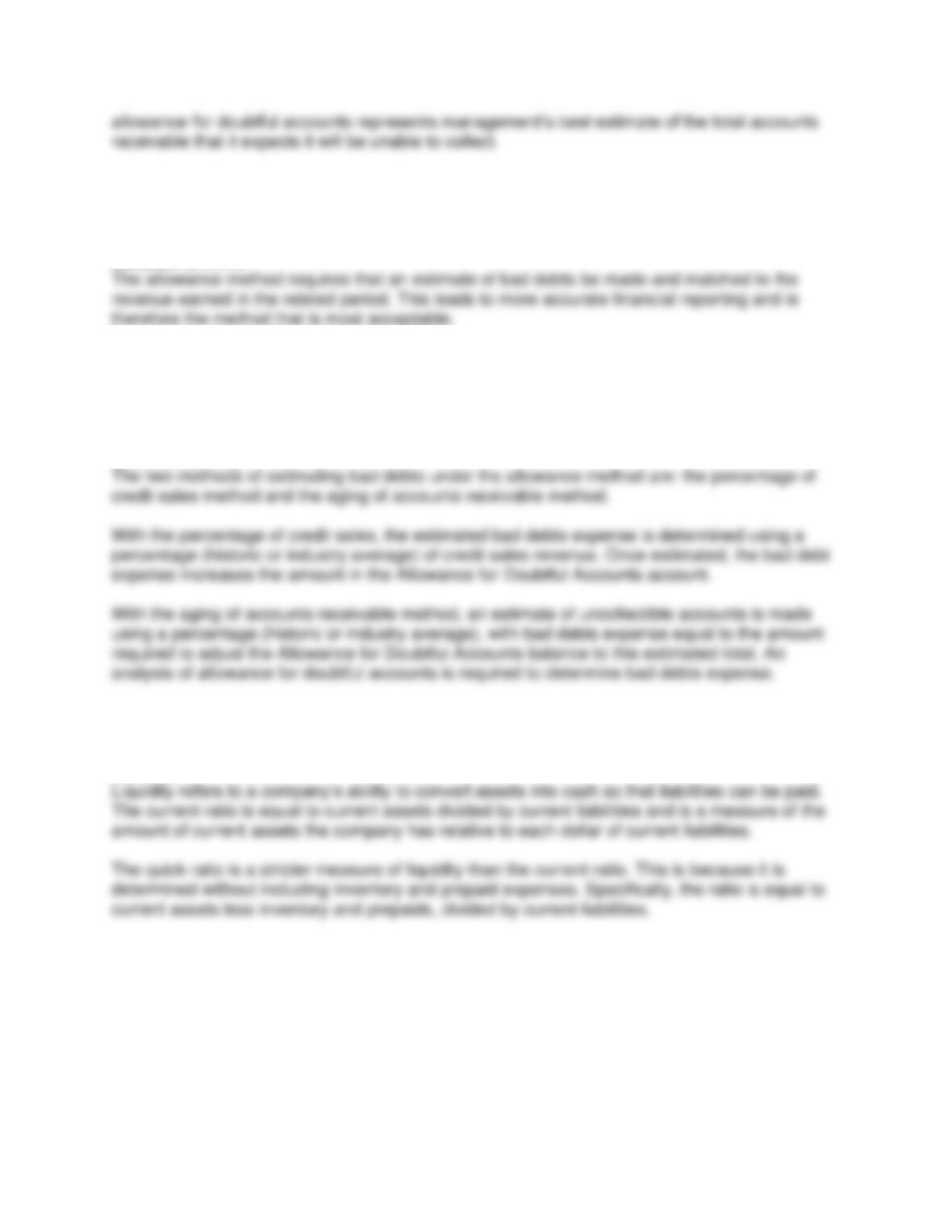
117. Explain the main principles of internal control.
Solution
118. The following five items are usually considered to be part of the bank reconciliation
process:
1. Outstanding cheques
2. Deposits in transit
3. NSF Cheques
4. Bank collection of notes receivable on company’s behalf
5. Service charge
Instructions
Classify each item as (1) an addition to the book balance; (2) an addition to the bank balance;
(3) a subtraction from the book balance; or (4) a subtraction from the bank balance.
Solution (5 min.)
119. Explain why companies sell on account and identify the additional costs that result from
this decision.
Solution
120. Describe the valuation methods for accounts receivable.
Solution
6 – 30 Test Bank for Understanding Financial Accounting, Canadian Edition
121. Which of the two methods of accounting for uncollectible accounts, the allowance method
or the direct writeoff method, is most acceptable? Why?
Solution (8 min.)
122. Briefly explain the two generally acceptable ways to estimate the expected uncollectible
accounts receivable at the end of a period. Explain how the allowance for doubtful accounts is
affected under each method.
Solution (8 min.)
123. Explain the concept of liquidity and how it is measured.
Solution
Cash and Accounts Receivable 6 – 31
ESSAY QUESTIONS
124. A client who is an owner/operator of a small convenience store has come to you for advice
on how to prepare a bank reconciliation. She has read somewhere that there are definite
benefits to preparing a bank reconciliation every month, but she is not sure how doing so will
help her.
Instructions
Provide your client with a summary of how to prepare a bank reconciliation. Explain how
preparing monthly bank reconciliations can provide important control procedures for her
business.
Solution (10 min.)
6 – 32 Test Bank for Understanding Financial Accounting, Canadian Edition
LEGAL NOTICE