Exam
Name___________________________________
TRUE/FALSE. Write ‘T’ if the statement is true and ‘F‘ if the statement is false.
1) The coupon value of a bond is the face value of that bond.
2) A bond is said to mature on the date when the issuer repays its notional value.
MULTIPLE CHOICE. Choose the one alternative that best completes the statement or answers the question.
3) Which of the following best illustrates why a bond is a type of loan?
A) The issuers of bonds regularly pay interest on the face value of the bond to the buyers of those bonds.
B) When a company issues a bond, the buyer of that bond becomes a part owner of the issuing company.
C) Federal and local governments issue bonds to finance long–term projects.
D) When an investor buys a bond from an issuer, the investor is giving money to the issuer, with the
assurance it will be repaid at a date in the future.
4) How much will the coupon payments be of a 20–year $500 bond with a 8% coupon rate and quarterly
payments?
A) $3.33
B) $10.00
C) $20.00
D) $40.00
5) How much will the coupon payments be of a 30–year $10,000 bond with a 4.5% coupon rate and semiannual
payments?
A) $30
B) $225
C) $350
D) $450
6) A corporate bond makes payments of $9.67 every month for ten years with a final payment of $2009.67.
Which of the following best describes this bond?
A) a 10–year bond with a face value of $2000 and a coupon rate of 4.8% with monthly payments
B) a 10–year bond with a face value of $2000 and a coupon rate of 5.8% with monthly payments
C) a 10–year bond with a face value of $2009.67 and a coupon rate of 4.8% with monthly payments
D) a 10–year bond with a face value of $2009.67 and a coupon rate of 5.8% with monthly payments
7) An investor holds a Ford bond with a face value of $5000, a coupon rate of 4%, and semiannual payments
that matures on 01/15/2009. How much will the investor receive on 01/15/2009?
A) $200
B) $5000
C) $5100
D) $5200
8) Which of the following best shows the timeline for cash flows from a five–year bond with a face value of
$2,000, a coupon rate of 4.2%, and semiannual payments?
A) 0 1 2 3 4 5
+—–+—–+—–+—–+—–+
$84 $84 $84 $84 $2,084
B) 0 1 2 3 9 10
+—–+—–+—–+— . . . —–+—–+
$17.50 $17.50 $17.50 $17.50 $2,017.50
C) 0 1 2 3 9 10
+—–+—–+—–+— . . . —–+—–+
$48 $48 $48 $48 $48
D) 0 1 2 3 9 10
+—–+—–+—–+— . . . —–+—–+
$42 $42 $42 $42 $2,042
9) 0 1 2 3 59 60
+—–+—–+—–+— . . . —–+—–+
$62.50 $62.50 $62.50 $62.50 $62.50 +$5,000
A corporation issues a bond that generates the above cash flows. If the periods shown are 3 months, which of
the following best describes that bond?
A) a 15–year bond with a notional value of $5000 and a coupon rate of 5% paid quarterly
B) a 15–year bond with a notional value of $5000 and a coupon rate of 1.25% paid annually
C) a 30–year bond with a notional value of $5000 and a coupon rate of 3.75% paid semiannually
D) a 60– year bond with a notional value of $5000 and a coupon rate of 5% paid quarterly
10)
A university issues a bond with a face value of $10,000 and a coupon rate of 5.65% that matures on
07/15/2015. The holder of such a bond receives coupon payments of $282.50. How frequently are coupon
payments made in this case?
A) monthly
B) quarterly
C) semiannually
D) annually
11) Which of the following statements is FALSE?
A) Bonds are a securities sold by governments and corporations to raise money from investors today in
exchange for promised future payments.
B) By convention the coupon rate is expressed as an effective annual rate.
C) Bonds typically make two types of payments to their holders.
D) The time remaining until the repayment date is known as the term of the bond.
12) A bond certificate indicates:
A) the amounts and dates of all payments to be made.
B) the individual to whom payments will be made.
C) the yield to maturity of the bond.
D) the price of the bond
13) Which of the following is true about the face value of a bond?
A) It is the notional amount we use to compute coupon payments.
B) It is the amount that is repaid at maturity.
C) It is usually denominated in standard increments, such as $1,000.
D) All of the above are true.
SHORT ANSWER. Write the word or phrase that best completes each statement or answers the question.
14) How are the cash flows of a coupon bond different from an amortizing loan?
15) The only cash payment an investor in a zero–coupon bond receives is the face value of the bond on its
maturity date.
16) Prior to its maturity date, the price of a zero–coupon bond is its face value.
MULTIPLE CHOICE. Choose the one alternative that best completes the statement or answers the question.
17) How are investors in zero–coupon bonds compensated for making such an investment?
A) Such bonds are purchased at their face value and sold at a premium at a later date.
B) The bond makes regular interest payments.
C) Such bonds are purchased at a discount to their face value.
D) The face value of these bonds is less than the value of the bond when the bond matures.
18) What is the yield to maturity of a one–year, risk–free, zero–coupon bond with a $10,000 face value and a price
of $9600 when released?
A) 3.212%
B) 4.000%
C) 4.167%
D) 9.600%
19) Maturity (years) 1 2 3 4 5
Price $97.25 $94.53 $91.83 $89.23 $87.53
The
above table shows the price per $100 face value of several risk–free, zero–coupon bonds. What is the yield to
maturity of the three–year, zero–coupon, risk–free bond shown?
A) 2.83%
B) 2.85%
C) 2.86%
D) 2.88%
20) Why is the yield to maturity of a zero–coupon, risk–free bond that matures at the end of a given period the
risk–free interest rate for that period?
A) Since such a bond provides a risk–free return over that period, the Law of One Price guarantees the
risk–free interest rate be equal to this yield.
B) Since a bond’s price will converge on its face value as the bond approaches the maturity date, the Law
of One Price dictates that the risk–free interest rate will reflect this convergence.
C) Since interest rates will rise and fall in response to the movement in bond prices.
D) Since there is, by definition, no risk in investing in such bonds, the return from such bonds is the best
that can be expected from any investment over the period.
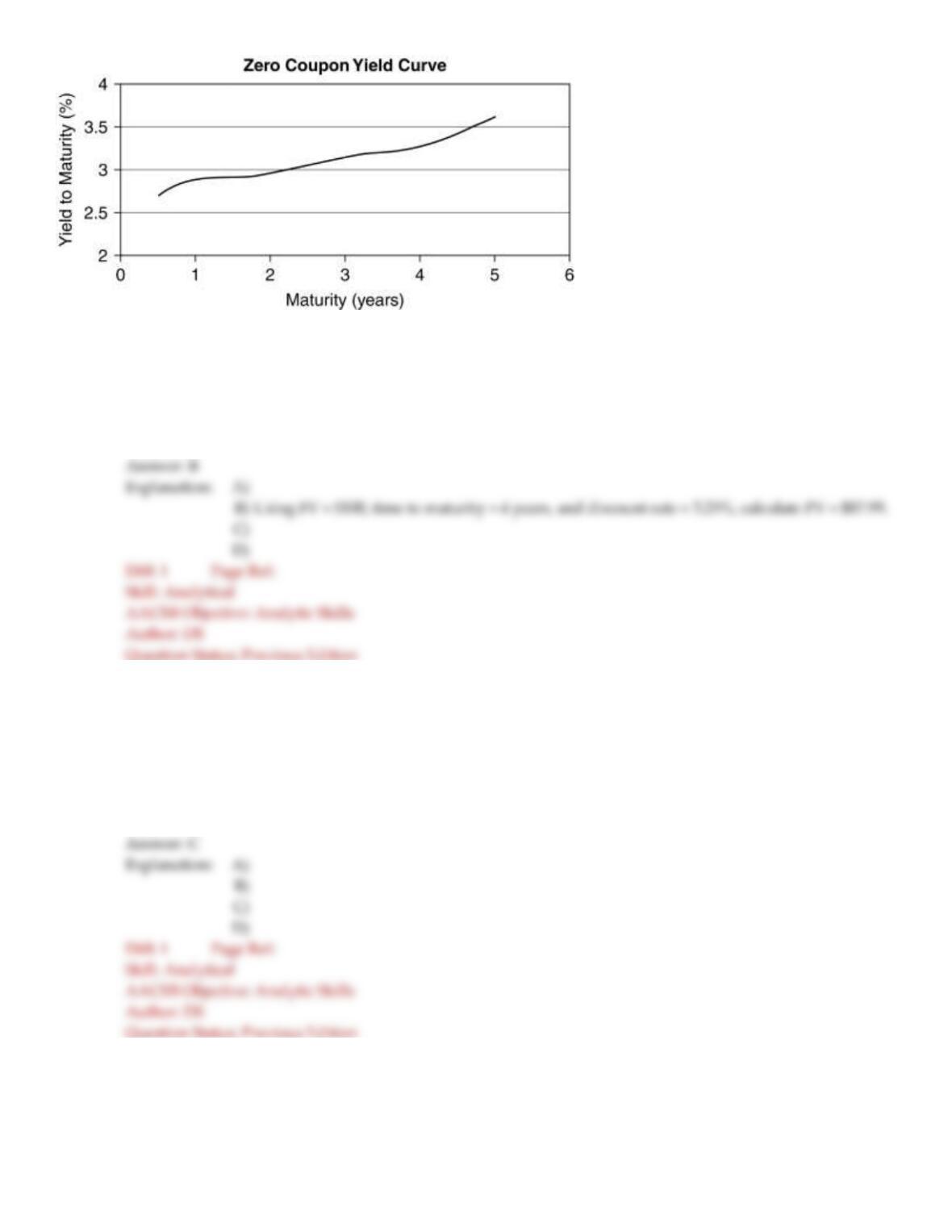
21) The current zero–coupon yield curve for risk–free bonds is shown above. What is the price per $100 face value
of a four–year, zero–coupon, risk–free bond?
A) $85.64
B) $87.99
C) $92.15
D) $96.67
22) The current zero–coupon yield curve for risk–free bonds is shown above. What is the risk–free interest rate on
a 3–year maturity?
A) 3.00%
B) 3.15%
C) 3.25%
D) 6.34%
23) A risk–free, zero–coupon bond with a face value of $1,000 has 15 years to maturity. If the YTM is 5.8%, which
of the following would be closest to the price this bond will trade at?
A) $721
B) $686
C) $525
D) $429
24) A risk–free, zero–coupon bond has 15 years to maturity. Which of the following is closest to the price per $100
of face value that the bond will trade at if the YTM is 7%?
A) $29.55
B) $32.68
C) $36.24
D) $38.78
25) A risk–free, zero–coupon bond with a $5000 face value has ten years to maturity. The bond currently trades
at $3650. What is the yield to maturity of this bond?
A) 3.197%
B) 3.284%
C) 3.465%
D) 3.699%
26) Which of the following risk–free, zero–coupon bonds could be bought for the lowest price?
A) one with a face value of $1000, a YTM of 4.8%, and 5 years to maturity
B) one with a face value of $1000, a YTM of 3.2%, and 8 years to maturity
C) one with a face value of $1000, a YTM of 6.8%, and 10 years to maturity
D) one with a face value of $1000, a YTM of 5.9%, and 20 years to maturity
27) Which of the following statements is FALSE?
A) The bond certificate typically specifies that the coupons will be paid periodically until the maturity date
of the bond.
B) The bond certificate indicates the amounts and dates of all payments to be made.
C) The only cash payments the investor will receive from a zero–coupon bond are the interest payments
that are paid up until the maturity date.
D) Usually the face value of a bond is repaid at maturity.
28) Which of the following statements is FALSE?
A) The amount of each coupon payment is determined by the coupon rate of the bond.
B) Prior to its maturity date, the price of a zero–coupon bond is always greater than its face value.
C) The simplest type of bond is a zero–coupon bond.
D) Treasury bills are U.S. government bonds with a maturity of up to one year.
29) Which of the following statements is FALSE?
A) One advantage of quoting the yield to maturity rather than the price is that the yield is independent of
the face value of the bond.
B) Unlike the case of bonds that pay coupons, for zero–coupon bonds, there is no simple formula to solve
for the yield to maturity directly.
C) Because we can convert any bond price into a yield, and vice versa, bond prices and yields are often
used interchangeably.
D) The internal rate of return (IRR) of an investment in a bond is given a special name, the yield to
maturity (YTM).
30) Which of the following statements is FALSE?
A) The internal rate of return (IRR) of an investment in a zero–coupon bond is the rate of return that
investors will earn on their money if they buy a default free bond at its current price and hold it to
maturity.
B) The yield to maturity of a bond is the discount rate that sets the future value (FV) of the promised bond
payments equal to the current market price of the bond.
C) Financial professionals also use the term spot interest rates to refer to the default–free zero–coupon
yields.
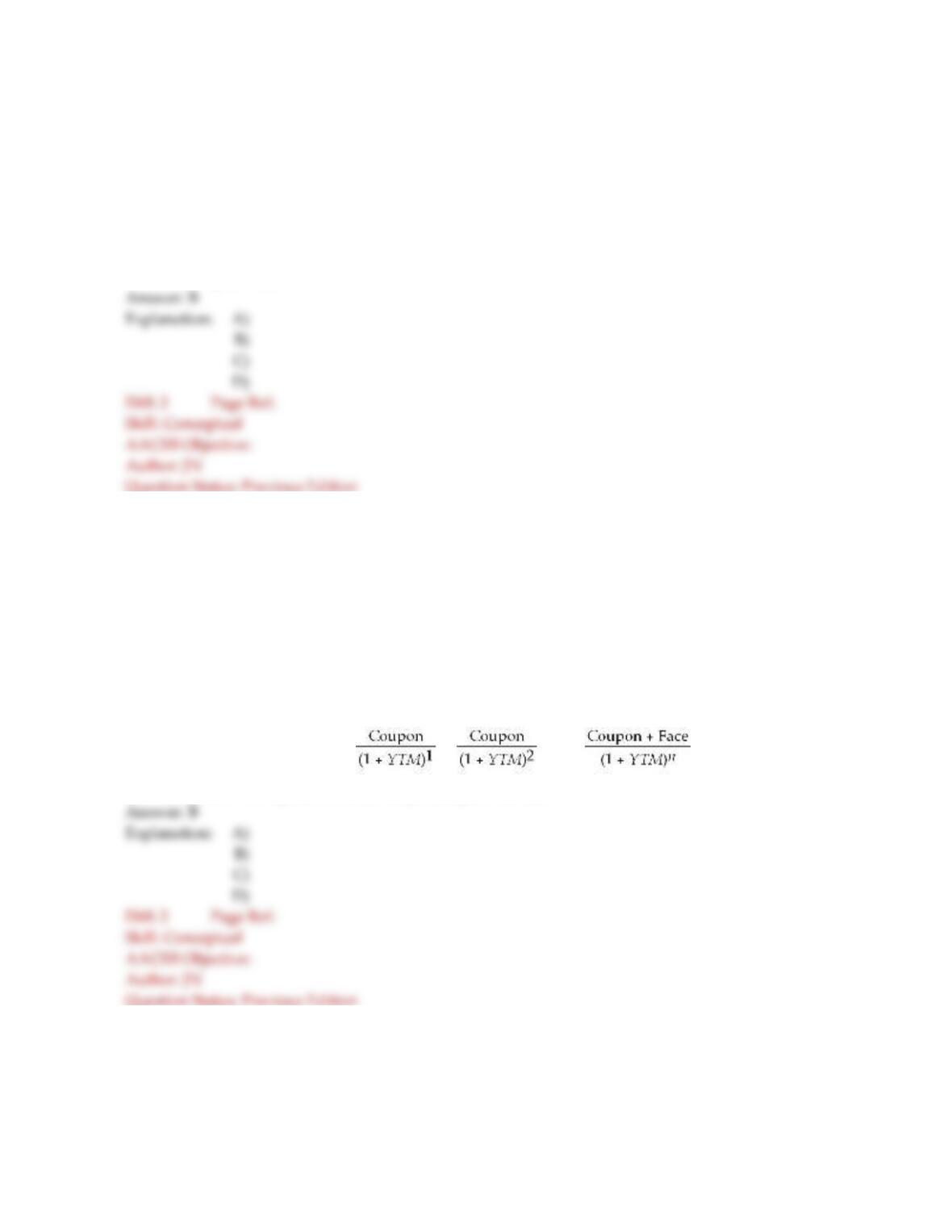
D) When we calculate a bond’s yield to maturity by solving the formula,
Price of an n–period bond = + + … + ,
the yield we compute will be a rate per coupon interval.
31) Which of the following statements is FALSE?
A) Zero–coupon bonds are also called pure discount bonds.
B) The internal rate of return (IRR) of an investment opportunity is the discount rate at which the net
present value (NPV) of the investment opportunity is equal to zero.
C) The yield to maturity for a zero–coupon bond is the return you will earn as an investor from holding the
bond to maturity and receiving the promised face value payment.
D) When prices are quoted in the bond market, they are conventionally quoted in increments of $1000.
32) Consider a zero–coupon bond with $1,000 face value and 20 years to maturity. The price will this bond
trade if the YTM is 6% is closest to:
A) $215
B) $312
C) $335
D) $306
33) Consider a zero–coupon bond with a $1000 face value and ten years left until maturity. If the YTM of this
bond is 10.4%, then the price of this bond is closest to:
A) $1000
B) $602
C) $1040
D) $372
34) Consider a zero–coupon bond with a $1000 face value and ten years left until maturity. If the bond is
currently trading for $459, then the yield to maturity on this bond is closest to:
A) 7.5%
B) 10.4%
C) 9.7%
D) 8.1%
SHORT ANSWER. Write the word or phrase that best completes each statement or answers the question.
35) Under what situation can a zero–coupon bond be selling at a premium?
36) Under what situation can a zero–coupon bond be selling at par to its face value?
37) How are the cash flows of a zero–coupon bond different from those of a coupon bond?
TRUE/FALSE. Write ‘T’ if the statement is true and ‘F‘ if the statement is false.
38) Treasury bonds have original maturities from one to ten years, while Treasury notes have original maturities
of more than ten years.
39) Bond traders generally quote bond yields rather than bond prices, since yield to maturity depends on the
MULTIPLE CHOICE. Choose the one alternative that best completes the statement or answers the question.
40) What is the yield to maturity of a five–year, $5000 bond with a 4.5% coupon rate and semiannual coupons if
this bond is currently trading for a price of $4876?
A) 4.30%
B) 5.07%
C) 6.30%
D) 8.60%
41) What is the yield to maturity of a ten–year, $1000 bond with a 5.2% coupon rate and semiannual coupons if
this bond is currently trading for a price of $884?
A) 5.02%
B) 6.23%
C) 6.82%
D) 12.46%
42) A bond has three years to maturity, a $2000 face value, and a 6.3% coupon rate with annual coupons. What is
its yield to maturity if it is currently trading at $1801?
A) 6.30%
B) 8.48%
C) 9.22%
D) 10.32%
43) What must be the price of a $10,000 bond with a 6.5% coupon rate, semiannual coupons, and two years to
maturity if it has a yield to maturity of 8% APR?
A) $9727.76
B) $9819.74
C) $10,619.63
D) $10,754.44
44) What must be the price of a $1000 bond with a 5.8% coupon rate, annual coupons, and 30 years to maturity if
YTM is 7.5% APR?
A) $114.22
B) $685.00
C) $799.22
D) $1005.26
45) A $1000 bond with a coupon rate of 5.4% paid semiannually has five years to maturity and a yield to
maturity of 7.5%. If interest rates rise and the yield to maturity increases to 7.8%, what will happen to the
price of the bond?
A) fall by $9.82
B) fall by $11.59
C) rise by $12.16
D) The price of the bond will not change.
46) A $5000 bond with a coupon rate of 6.4% paid semiannually has four years to maturity and a yield to
maturity of 6.2%. If interest rates fall and the yield to maturity decreases by 0.8%, what will happen to the
price of the bond?
A) fall by $98.64
B) fall by $40.49
C) rise by $84.46
D) rise by $142.78
47) What is the coupon rate of a two–year, $10,000 bond with semiannual coupons and a price of $9543.45, if it
has a yield to maturity of 6.8%?
A) 4.32%
B) 5.60%
C) 6.25%
D) 8.44%
Use the information to answer the question(s) below.
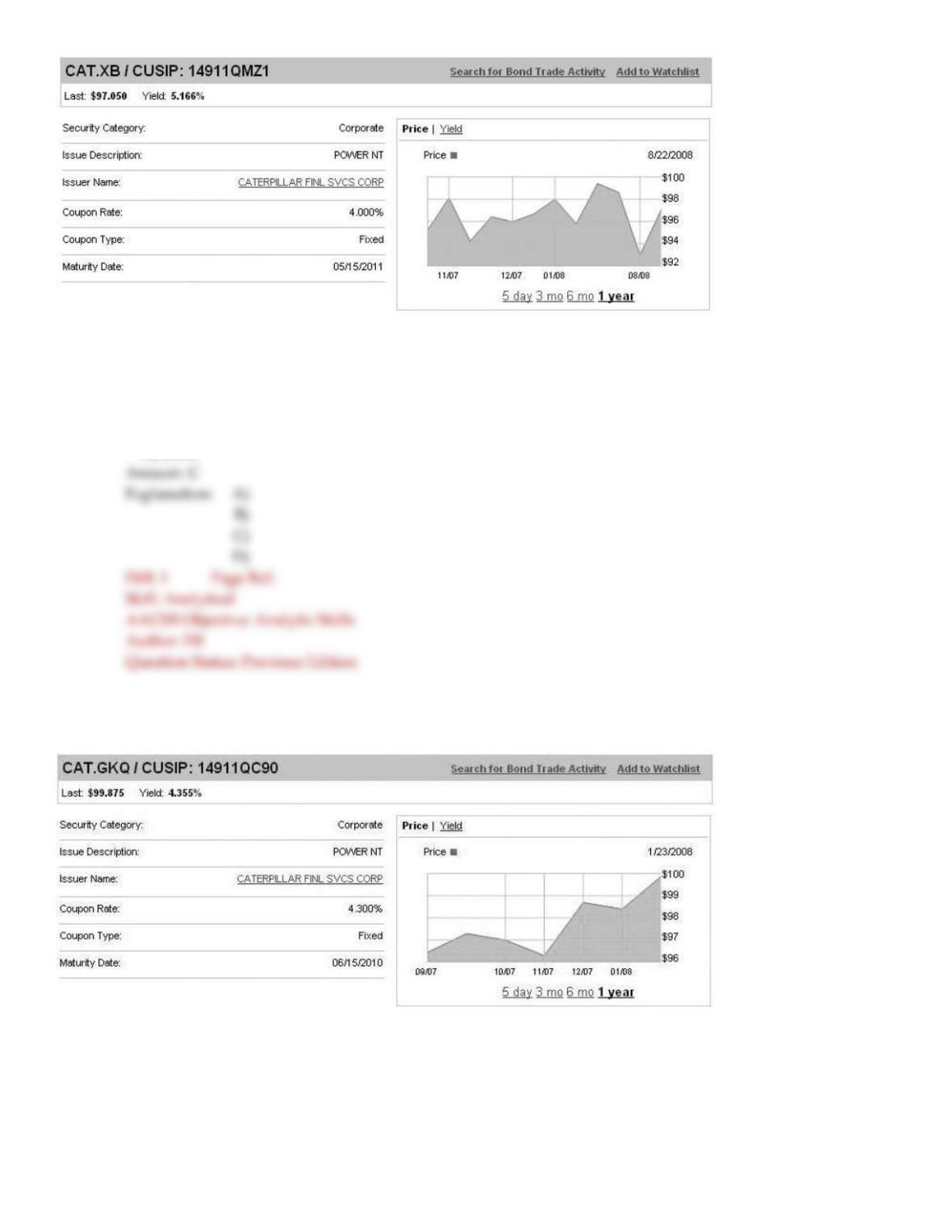
48) Shown above is information from FINRA regarding one of Caterpillar Financial Services’ bonds. How much
would the holder of such a bond earn each coupon payment for each $100 in face value if coupons are paid
annually?
A) $1.38
B) $3.95
C) $4.30
D) $4.36
Use the information for the question(s) below.
49) Shown above is information from FINRA regarding one of Bank of America’s bonds. How much would the
holder of such a bond earn each coupon payment for each $100 in face value if coupons are paid
semiannually?
A) $1.49
B) $2.15
C) $2.32
D) $4.30
Use the information for the question(s) below.
The Sisyphean Company has a bond outstanding with a face value of $1000 that reaches maturity in 15 years. The bond
certificate indicates that the stated coupon rate for this bond is 8% and that the coupon payments are to be made
semiannually.
50) How much will each semiannual coupon payment be?
A) $60
B) $40
C) $120
D) $80
51) Assuming the appropriate YTM on the Sisyphean bond is 7.5%, then the price that this bond trades for will
be closest to:
A) $1045
B) $691
C) $1000
D) $957
52) Assuming the appropriate YTM on the Sisyphean bond is 7.5%, then this bond will trade at
A) par.
B) a discount.
C) a premium.
D) none of the above
53) Assuming the appropriate YTM on the Sisyphean bond is 9.0%, then the price that this bond trades for will
be closest to:
A) $946
B) $919
C) $1086
D) $1000
54) Assuming the appropriate YTM on the Sisyphean bond is 9%, then this bond will trade at
A) a premium.
B) a discount.
C) par.
D) none of the above