55) Assuming that this bond trades for $1112, then the YTM for this bond is closest to:
A) 8.0%
B) 3.4%
C) 6.8%
D) 9.2%
56) Assuming that this bond trades for $903, then the YTM for this bond is closest to:
A) 8.0%
B) 6.8%
C) 9.9%
D) 9.2%
Use the table for the question(s) below.
The following table summarizes prices of various default–free zero–coupon bonds (expressed as a percentage of face
value):
Maturity (years)
1
2
3
4
5
Price (per $100 face value)
94.52
89.68
85.40
81.65
78.35
57) The yield to maturity for the two year zero–coupon bond is closest to:
A) 6.0%
B) 5.8%
C) 5.6%
D) 5.5%
58) The yield to maturity for the three year zero–coupon bond is closest to:
A) 5.4%
B) 5.8%
C) 5.6%
D) 6.0%
59) Based upon the information provided in the table above, you can conclude
A) that the yield curve is flat.
B) nothing about the shape of the yield curve.
C) that the yield curve is downward sloping.
D) that the yield curve is upward sloping.
ESSAY. Write your answer in the space provided or on a separate sheet of paper.
Use the information for the question(s) below.
The Sisyphean Company has a bond outstanding with a face value of $1000 that reaches maturity in 15 years. The bond
certificate indicates that the stated coupon rate for this bond is 8% and that the coupon payments are to be made
semiannually.
60) How much are each of the semiannual coupon payments? Assuming the appropriate YTM on the
Sisyphean bond is 8.8%, then at what price should this bond trade for?
61) Assuming that this bond trades for $1035.44, then the YTM for this bond is equal to:
SHORT ANSWER. Write the word or phrase that best completes each statement or answers the question.
62) What care, if any, should be taken regarding the sign of the cash flows while drawing the timeline and
associated cash flows of a coupon bond?
63) What care, if any, should be taken regarding the timing of the cash flows while drawing the timeline and
associated cash flows of a coupon bond?
64) How can the financial calculator be used to calculate the price of a coupon bond from its yield to maturity?
65) What issues should one be careful of when calculating the bond price from its yield to maturity using the
“time value of money” (TVM) keys of a financial calculator?
66) What issues should one be careful of when calculating the bond price from its yield to maturity using the
“cash flow” (CF) keys of a financial calculator?
TRUE/FALSE. Write ‘T’ if the statement is true and ‘F’ if the statement is false.
67) Before it matures, the price of any bond is always less than its face value.
68) A bond will trade at a discount if its coupon rate is less than its yield to maturity.
MULTIPLE CHOICE. Choose the one alternative that best completes the statement or answers the question.
69) Which of the following bonds is trading at par?
A) a bond with a $2000 face value trading at $1987
B) a bond with a $1000 face value trading at $999
C) a bond with a $1000 face value trading at $1000
D) a bond with a $2000 face value trading at $2012
70) A company releases a five–year bond with a face value of $1000 and coupons paid semiannually. If market
interest rates imply a YTM of 6%, what should be the coupon rate offered if the bond is to trade at par?
A) 3%
B) 4%
C) 6%
D) 8%
71) A company releases a five–year bond with a face value of $1000 and coupons paid semiannually. If market
interest rates imply a YTM of 6%, which of the following coupon rates will cause the bond to be issued at a
premium?
A) 3%
B) 4%
C) 6%
D) 8%
72) Which of the following bonds is trading at a premium?
A) a five–year bond with a $2000 face value whose yield to maturity is 7.0% and coupon rate is 7.2% APR
paid semiannually
B) a ten–year bond with a $4000 face value whose yield to maturity is 6.0% and coupon rate is 5.9% APR
paid semiannually
C) a 15–year bond with a $10,000 face value whose yield to maturity is 8.0% and coupon rate is 7.8% APR
paid semiannually
D) a two–year bond with a $50,000 face value whose yield to maturity is 5.2% and coupon rate is 5.2% APR
paid monthly
73) Which of the following statements are true?
A) A fall in bond prices causes interest rates to fall.
B) A fall in interest rates causes a fall in bond prices.
C) A rise in interest rates causes bond prices to fall.
D) Bond prices and interest rates are not connected.
74) A bond is currently trading below par. Which of the following must be true about that bond?
A) The bond’s yield to maturity is less than its coupon rate.
B) The bond is a zero–coupon bond.
C) The bond’s yield to maturity is greater than its coupon rate.
D) B and C above
75) If the yield to maturity of all of the following bonds is 6%, which trades at the greatest premium per $100
face value?
A) a bond with a $10,000 face value, four years to maturity and 6.2% semiannual coupon payments
B) a bond with a $500 face value, ten years to maturity and 5.2% annual coupon payments
C) a bond with a $5000 face value, several years to maturity and 5.5% annual coupon payments
D) a bond with a $1000 face value, five years to maturity and 6.3% annual coupon payments
76) A bond has a $1000 face value, ten years to maturity, and 7% semiannual coupon payments. What would be
the expected difference in this bond’s price immediately before and immediately after the next coupon
payment?
A) $18
B) $35
C) $70
D) $84
77) A ten–year, zero–coupon bond with a yield to maturity of 6% has a face value of $1000. An investor purchases
the bond when it is initially traded, and then sells it four years later. What is the rate of return of this
investment, assuming the yield to maturity does not change?
A) 0.26%
B) 3.07%
C) 6.00%
D) 7.65%
78) Which of the following bonds will be most sensitive to a change in interest rates?
A) a ten–year bond with a $2000 face value whose yield to maturity is 5.8% and coupon rate is 5.8% APR
paid semiannually
B) a 15–year bond with a $5000 face value whose yield to maturity is 7.4% and coupon rate is 6.2% APR
paid annually
C) a 20–year bond with a $3000 face value whose yield to maturity is 6.0% and coupon rate is 5.4% APR
paid semiannually
D) a 30–year bond with a $1000 face value whose yield to maturity is 5.5% and coupon rate is 6.4% APR
paid annually
79) An investor purchases a 30–year, zero–coupon bond with a face value of $1000 and a yield to maturity of
6.5%. He sells this bond ten years later. What is the rate of return on his investment, assuming yield to
maturity does not change?
A) 6.04%
B) 6.24%
C) 6.50%
D) 6.62%
80) Which of the following bonds will be least sensitive to a change in interest rates?
A) a ten–year bond with a $2000 face value whose yield to maturity is 5.8% and coupon rate is 5.8% APR
paid semiannually
B) a 15–year bond with a $5000 face value whose yield to maturity is 7.4% and coupon rate is 6.2% APR
paid annually
C) a 20–year bond with a $3000 face value whose yield to maturity is 6.0% and coupon rate is 5.4% APR
paid semiannually
D) a 30–year bond with a $1000 face value whose yield to maturity is 5.5% and coupon rate is 6.4% APR
paid annually
81) Which of the following bonds will be most sensitive to a change in interest rates if all bonds have the same
initial yield to maturity?
A) a ten–year bond with a $1000 face value whose coupon rate is 5.8% APR paid semiannually
B) a ten–year bond with a $1000 face value whose coupon rate is 7.4% APR paid semiannually
C) a 20–year bond with a $1000 face value whose coupon rate is 5.8% APR paid semiannually
D) a 20–year bond with a $1000 face value whose coupon rate is 7.4% APR paid semiannually
82) A company issues a ten–year bond at par with a coupon rate of 6% paid semi–annually. The YTM at the
beginning of the third year of the bond (8 years left to maturity) is 7.8%. What is the new price of the bond?
A) $894.35
B) $569.65
C) $722.06
D) $1,000.00
83) A company issues a ten–year bond at par with a coupon rate of 6% paid semi–annually. The YTM at the
beginning of the third year of the bond (8 years left to maturity) is 7.8%. What was the percentage change in
the price of the bond over the past two years?
A) 11.81%
B) –43.04%
C) –10.56%
D) 75.55%
84) What is the dirty price of a bond?
A) the bond’s price based only on the bond’s yield
B) the bond’s actual cash price
C) the bond’s price based only on coupon payments
D) the bond’s price less an adjustment for changes in interest rates
85) A five–year bond with a $1000 face value has a yield to maturity is 5.5% and its coupon rate is 6.0% paid
annually. The dirty price of this bond exactly 6 months after its second coupon payment is closest to:
A) $684.67
B) $983.93
C) $1005.87
D) $1043.49
86) A twenty year bond with a $1000 face value was issued with a yield to maturity of 4.5% and pays coupons
semi–annually. After ten years, the yield to maturity is still 4.5% and the clean price of the bond is $960.09.
After three more months go by, what would you expect the dirty price to be?
A) $960.09
B) $970.09
C) $980.09
D) Cannot be determined from information given.
SHORT ANSWER. Write the word or phrase that best completes each statement or answers the question.
87) Under what situation should the clean price, dirty price, and the price calculated by the basic annuity and
present value (PV) equations for a bond be equal?
TRUE/FALSE. Write ‘T’ if the statement is true and ‘F’ if the statement is false.
88) Bonds with a high risk of default generally offer high yields.
89) The credit spread of a bond shrinks if it is perceived that the probability of the issuer defaulting increases.
MULTIPLE CHOICE. Choose the one alternative that best completes the statement or answers the question.
Use the information for the question(s) below.
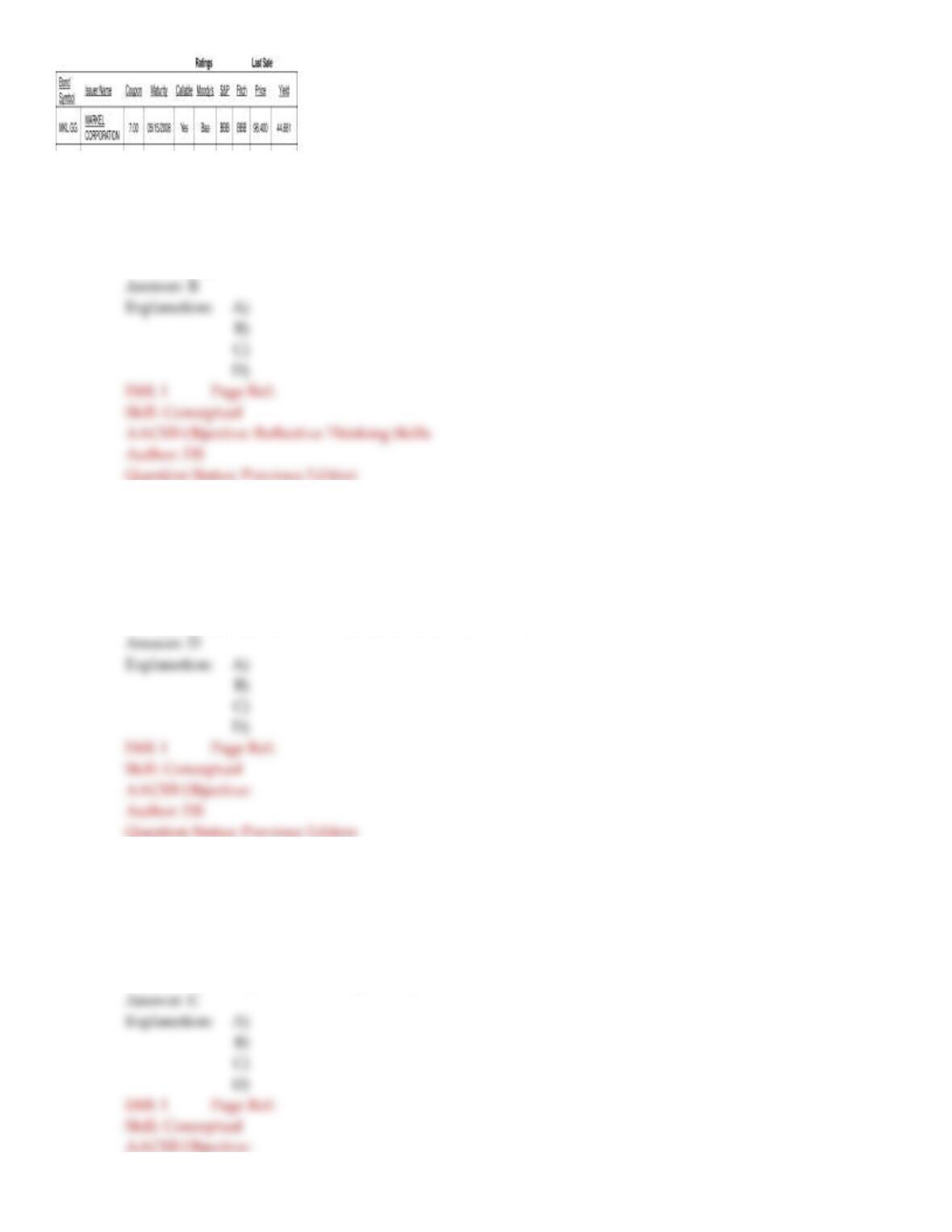
90) The above information is for a corporate bond issued by the Markel Corporation.What sort of bond is this?
A) a high–risk bond
B) an investment grade bond
C) a speculative bond
D) a high–yield bond
91) Which of the following best describes a bond rated by Standard and Poor’s and Moody as B?
A) judged to be high quality by all standards
B) possessing many favorable characteristics
C) neither highly protected nor poorly secured
D) generally lacks the characteristics of a desirable investment
92) Why are the interest rates of U.S. Treasury notes less than the interest rates of equivalent corporate bonds?
A) The U.S. government has a high credit spread.
B) There is significant risk that the U.S. government will default.
C) U.S. Treasury securities are widely regarded to be risk–free.
D) U.S. Treasury securities are generally used to determine interest rates.