
Elements of Ecology, 9e (Smith)
Chapter 6 Plant Adaptations to the Environment
6.1 Short Answer Questions
1) All life is made up of complex molecules built on a framework of ________ atoms.
2) The stage of photosynthesis during which chlorophyll absorbs light energy is called the
________ reaction.
3) The enzyme that catalyzes carboxylation during photosynthesis is called ________.
4) The light level at which the rate of carbon uptake in photosynthesis equals the rate of carbon
loss in respiration is the light ________ point.
5) In some shade plants, the negative effect of high light levels on the rate of photosynthesis is
referred to as ________.
6) The process of photosynthesis in plants occurs in specialized cells within the leaf called
________ cells.
7) ________ are openings in the leaves of terrestrial plants that allow for the uptake of CO2.

8) ________ is the movement of a substance from areas of higher to lower concentration.
9) The force exerted outward on a plant cell wall by the water contained in the cell is called
________ pressure.
10) The measure used to describe the free energy of water at any point along the soil-plant-
atmosphere continuum is called its ________ potential.
11) The ratio of carbon fixed (photosynthesis) per unit of water lost (transpiration) is called the
________ efficiency.
12) Once dissolved in water, the CO2 molecule reacts with water to form ________.
13) Plants convert bicarbonate to carbon dioxide using the enzyme carbonic ________.
14) ________ is the transfer of heat energy between a solid and a moving fluid.
15) The transfer of heat from the plant to the surrounding environment is influenced by the
existence of the ________ layer.

16) To survive, grow, and reproduce, plants must maintain a ________ carbon balance.
17) A plant growing in the shade is expected to have a ________ maximum photosynthetic rate
than a plant growing in sunlight.
18) The ratio of surface area to weight for a leaf is called the ________.
19) In tropical regions with distinct wet and dry seasons, plants that drop their leaves at the onset
of the dry season are termed drought ________.
20) C4 plants divide photosynthesis between two types of cells: the mesophyll and the ________
cells.
21) Many plants adapted to arid environments use the ________ photosynthetic pathway to fix
CO2 during the night.
22) The ability of some plants to tolerate extreme cold is known as ________.
23) Nutrients that are needed by plants in large amounts are called ________.

24) Much of the nitrogen taken in by a plant is used to synthesize the molecules rubisco and
________.
25) The higher rates of diffusion and photosynthesis under elevated atmospheric concentrations
of CO2 have been termed the ________.
6.2 Multiple-Choice Questions
1) The ultimate source of carbon from which life is constructed is derived from
A) atmospheric carbon dioxide.
B) respiration.
C) decomposition.
D) the consumption of other organisms.
2) Organisms that derive their energy from sunlight are referred to as
A) homotrophs.
B) heterotrophs.
C) chemoautotrophs.
D) photoautotrophs.
3) The process of using energy from the Sun to convert CO2 into organic molecules is called
A) respiration.
B) assimilation.
C) photosynthesis.
D) chemosynthesis.

4) The pigment that absorbs light energy (photons) in photosynthesis is
A) rubisco.
B) chlorophyll.
C) PEP.
D) CAM.
5) In the Calvin-Benson or C3 photosynthetic pathway, the enzyme rubisco catalyzes the
reaction called
A) chemosynthesis.
B) carboxylation.
C) photoreduction.
D) respiration.
6) Net photosynthesis is equal to
A) photosynthesis + respiration.
B) photosynthesis – respiration.
C) photosynthesis x respiration.
D) photosynthesis / respiration.
7) The value of photosynthetically active radiation above which no further increase in
photosynthesis occurs is referred to as
A) photoinhibition.
B) chlorophyll compensation.
C) the light compensation point.
D) the light saturation point.
8) In photosynthesis, the net uptake of CO2 by a plant is greatest
A) when PAR equals zero.
B) at the light compensation point.
C) during photoinhibition.
D) at the light saturation point.
9) In photosynthesis, the uptake of CO2 by plants occurs through openings on the surface of
A) roots.
B) stems.
C) leaves.
D) flowers.
10) A CO2 gradient between the inside and outside of a leaf is maintained during photosynthesis
because
A) energy is expended by the plant to maintain the CO2 gradient.
B) the CO2 concentration outside of the leaf is always increasing.
C) the CO2 concentration in the mesophyll is constantly decreasing.
D) the stomata close whenever more CO2 is needed.
11) Overall, water movement from the soil, through plant tissues, and finally to the atmosphere
through transpiration, is driven by a gradient of
A) water potential.
B) osmotic pressure.
C) water temperature.
D) specific leaf area.
12) The osmotic potential of a plant refers to the
A) force exerted outward on a cell wall by the water contained in the cell.
B) surfaces of larger molecules, such as those in the cell walls, exerting an attractive force on
water.
C) association between concentrations of solutes in cells and the rate of water loss.
D) ratio of carbon fixed (photosynthesis) per unit of water lost (transpiration).

13) Which of the following conditions is required for the continued movement of water from the
soil into and through a plant via transpiration?
A) ψatm < ψroot < ψleaf < ψsoil
B) ψatm < ψleaf < ψroot < ψsoil
C) ψsoil < ψroot < ψleaf < ψatm
D) ψsoil < ψatm < ψroot < ψleaf
14) Unlike terrestrial plants, submerged aquatic plants lack
A) leaves.
B) chlorophyll.
C) stomata.
D) stems.
15) Submerged aquatic plants can take up CO2 from the water in all of the following ways,
except
A) diffusion through stomata.
B) direct diffusion of ambient CO2 from water across cell membranes.
C) active transport of bicarbonate into the leaf followed by conversion to CO2.
D) excretion of carbonic anhydrase into the water, followed by uptake of the resulting CO2.
16) The rates of photosynthesis and respiration in a plant are controlled by the temperature in the
A) soil.
B) air.
C) leaf.
D) root.
17) As temperatures continue to rise, the photosynthetic rate reaches a maximum related to
A) the temperature response of rubisco.
B) the thickness of the boundary layer.
C) soil temperature.
D) oxygen availability.

18) The transfer of heat from the plant to the surrounding environment is influenced by the
existence of the boundary layer, which refers to the layer of
A) waxy cutin on the surface of a leaf.
B) epidermal cells surrounding the stomata.
C) mesodermal cells beneath the epidermis.
D) still air or water adjacent to the surface of a leaf.
19) Net carbon uptake per unit time by a plant is directly related to
A) the difference between photosynthetic rate and respiration rate.
B) photosynthetic rate.
C) respiration rate.
D) the difference between photosynthetic rate and decomposition rate.
20) Carbon balance focuses on the balance between
A) uptake of CO2 in photosynthesis and loss of heat via evapotranspiration.
B) loss of CO2 through respiration and gain of nutrients.
C) loss of H2O balanced with the gain of CO2 via transpiration.
D) uptake of CO2 in photosynthesis balanced with the loss of CO2 during respiration.
21) The rate of carbon uptake increases only when plants allocate carbon to the production of
A) roots.
B) fruits.
C) leaves and stems.
D) flowers.
22) Compared with plants growing in shade, plants growing in sunlight tend to have smaller
A) stems.
B) roots.
C) leaves.
D) flowers.

23) Compared with plants growing in sunlight, plants growing in shade tend to have a greater
A) rate of photosynthesis.
B) specific leaf area.
C) light compensation point.
D) light saturation point.
24) Compared with a shade-intolerant plant, a shade-tolerant plant
A) has a greater SLA.
B) grows faster.
C) requires a higher intake of CO2 to balance losses of CO2 from respiration.
D) allocates very little carbon to leaf tissue.
25) Which of the following is an incorrect statement?
A) A large leaf maximizes light interception.
B) A deeply lobed leaf minimizes heat exchange with the atmosphere.
C) A thick leaf reduces loss of water via transpiration.
D) A leaf with a high SLA is generally thin and flexible.
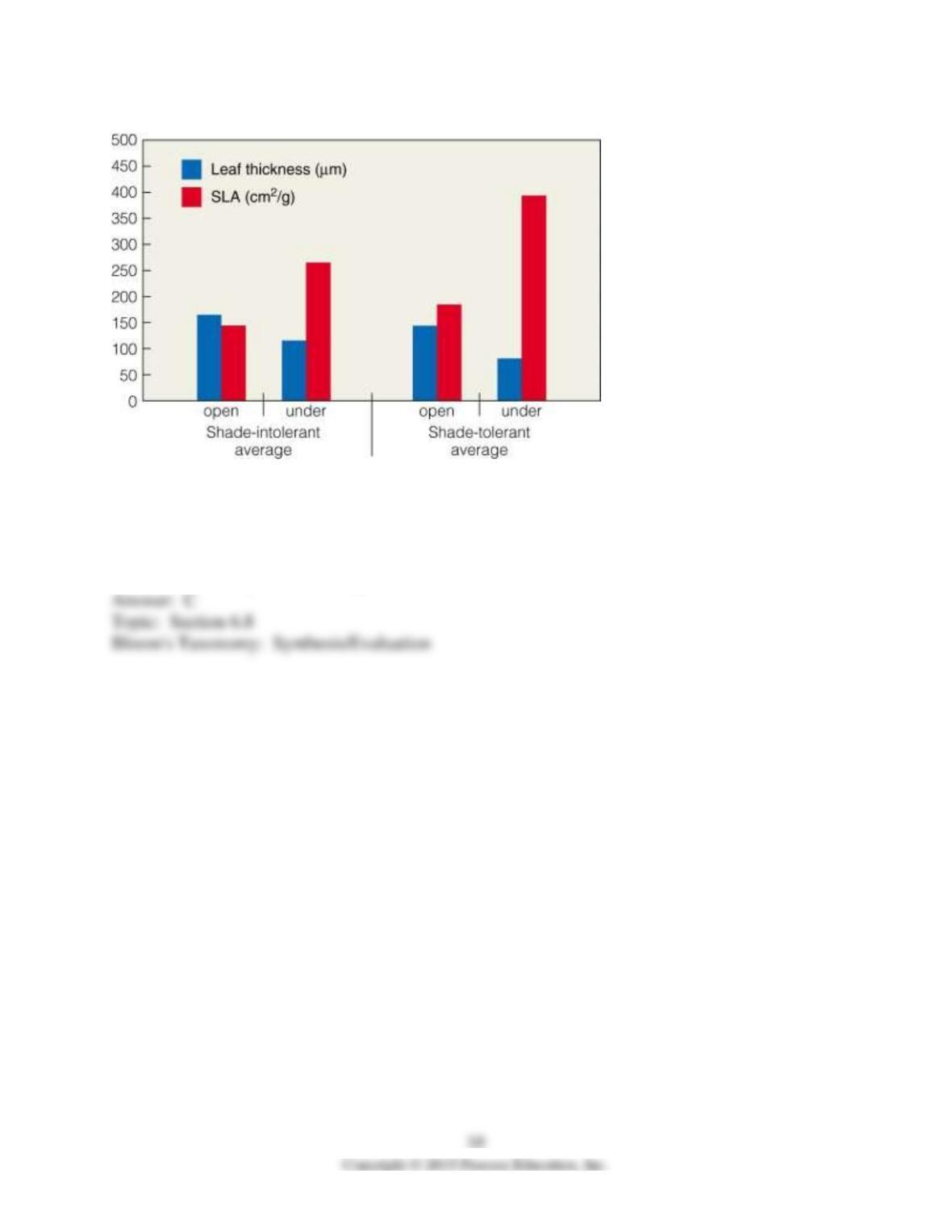
26)
Why is the SLA higher under shade for both shade-tolerant and shade-intolerant plants?
A) Shade intolerant plants have larger surface areas.
B) Leaves tend to be thicker in the shade.
C) Leaves tend to have larger surface areas to absorb more sunlight.
D) Shade tolerant plants have larger surface areas.
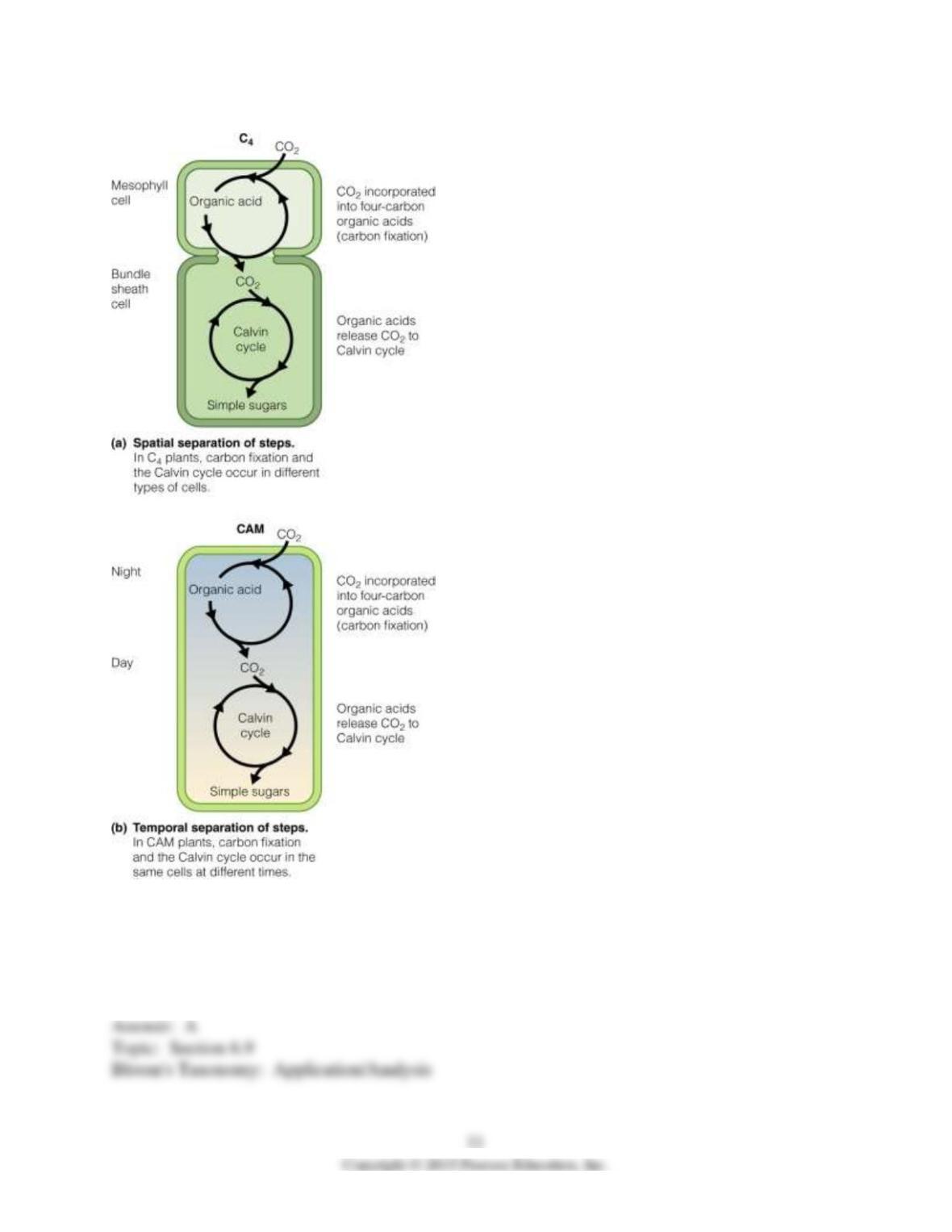
27)
Which of the following photosynthetic pathways is ideal for desert plants?
A) CAM
B) C4
C) C3
D) respiration

28) Plants can reduce water loss by
A) closing their stomata.
B) growing larger leaves.
C) growing more slowly.
D) increasing photosynthesis.
29) Plants using the C4 photosynthetic pathway
A) use rubisco to catalyze the reaction between O2 and RuBP.
B) have a lower rate of photosynthesis than plants using the C3 photosynthetic pathway.
C) divide photosynthesis between mesophyll and bundle sheath cells.
D) are mostly trees.
30) The C4 photosynthetic pathway is most common in
A) gymnosperm trees.
B) angiosperm trees.
C) algae, bryophytes, and ferns.
D) grasses and shrubs in warm and dry climates.
31) CAM plants
A) occur mostly in rainforests.
B) fix carbon dioxide during the night.
C) fix carbon dioxide in bundle sheath cells.
D) lack stomata.
32) All the following are plant adaptations to low temperatures, except
A) shedding leaves at the onset of cold weather.
B) production of antifreeze molecules.
C) a shifting of Topt.
D) increased photosynthetic rate to heat leaves.

33) Which of the following elements is considered a plant micronutrient?
A) iron
B) nitrogen
C) phosphorus
D) oxygen
34) Plants adapted to low-nutrient environments are characterized by
A) a high growth rate.
B) decreased root production.
C) increased leaf longevity.
D) faster growth when more nitrogen is available.
35) An Acacia seedling grown in shade (50% full sun) is expected to have a ________ net
assimilation rate (NAR) and a ________ leaf area ratio (LAR) than an Acacia seedling grown in
full sun.
A) higher; higher
B) lower; lower
C) lower; higher
D) higher; lower
36) Leaf area ratio (LAR) is the product of specific leaf area (SLA) and
A) net assimilation rate (NAR).
B) relative growth rate (RGR).
C) maximum net photosynthesis.
D) leaf weight ratio (LWR).
37) Which group of plants responds to increased CO2 with the highest biomass enhancement
ratio?
A) C3
B) C4
C) CAM
D) all respond equally

6.3 True/False Questions
1) Chemoautotrophs are the dominant primary producers in oxygen-deficient environments, such
as the hydrothermal vents of the deep ocean floor.
2) Photosynthesis produces more water than it uses.
3) The light and dark reactions of photosynthesis occur in different areas of the chloroplast.
4) In photosynthesis, the light-independent reactions do not directly require the presence of
sunlight.
5) At light levels below the light compensation point, the rate of carbon loss due to respiration
exceeds the rate of uptake in the process of photosynthesis.
6) Photoinhibition is the negative effect of high light levels on respiration.
7) In photosynthesis, carbon dioxide enters the leaf of a plant through its open stomata.
8) The drier the air outside a leaf, the faster is water lost from the leaf through the stomata.

9) The growth rate of plant cells and the efficiency of their physiological processes are highest
when the cells are at minimum turgor.
10) Water moves from regions of high water potential to regions of low water potential.
11) Water in plants is lost to the atmosphere through the stomata.
12) Submerged aquatic plants typically have stomata.
13) Some terrestrial plants use bicarbonate (HCO3–) as a carbon source for photosynthesis.
14) Plants lose heat to the environment through direct contact of leaves with the air or water.
15) Wind or water flow functions to reduce the size of the boundary layer of leaves.
16) Under ideal conditions, when resources are unlimited, plant growth is maximized when
carbon is allocated to the stem.
17) Allocation of carbon to roots directly increases both respiration and photosynthesis rates.

18) Allocating carbon to the production of roots increases access to water and soil nutrients but
limits carbon allocation to the production of leaves.
19) Plants growing in shade have a higher rate of leaf respiration than plants growing in sunlight.
20) Plants growing in shade tend to produce less rubisco and more chlorophyll than plants
growing in full sun.
21) Plants growing in sunlight tend to allocate more resources to leaf production than to root
production compared with plants growing in full sun.
22) Deciduousness is an adaptation of plants to dry environments.
23) CAM plants typically live in hot, dry deserts.
24) Members of the same plant species always exhibit the same response to changes in
temperature.
25) Dehydration can be a problem for plants in cold habitats.

26) Nitrogen is a plant macronutrient.
27) Plants adapted to high-nutrient environments have higher growth rates than plants adapted to
low-nutrient environments.
28) Plants growing in low-nutrient environments have greater root production than plants living
in high-nutrient environments.
6.4 Essay Questions
1) Discuss the differences between light-dependent and light-independent reactions of
photosynthesis.
2) Explain why the opening of stomata has both benefits and costs for plants in dry
environments.
3) Describe how water moves from the soil, through plant tissues, into the atmosphere through
transpiration. Define and use the concept of water potential in your answer.
4) Describe the differences in carbon acquisition between terrestrial and aquatic plants.
5) Draw a graph to illustrate how gross photosynthesis and respiration respond to temperature
change. Label Topt on the graph.
6) Explain how the allocation of carbon to plant roots influences net carbon gain by plants.

7) Give an example of how different aspects of the physical environment interact to influence
plants.
8) Describe two plant adaptations to low light and explain why these adaptations would not serve
plants in high light environments.
9) Discuss the differences between the C4 and CAM pathways of photosynthesis. Under what
environmental conditions is the CAM pathway advantageous and why?
10) Compare how CO2 uptake and net photosynthetic rates change with temperature between
cold-weather and warm-weather plants. Use one or more graphs in your answer.
11) Explain the link between nutrient availability and plant performance. Use the specific
example of nitrogen to illustrate the interdependence of plant processes.