Chapter 6 – Presentation of financial performance and the worksheet
TRUE/FALSE
1. The statement of comprehensive income shows the results of operations over a period of time, and
the balance sheet shows the financial condition of a business at a specific date.
2. The statement of comprehensive income reports revenues and expenses for the period but does not
report income.
3. The statement of comprehensive income reflects the financial position of the business for the
accounting period.
4. Income has the effect of increasing assets and increasing owners’ equity.
5. An expense is a decrease in assets or an increase in liabilities, and will result in a decrease in owners’
equity.
6. An essential characteristic of an expense is a decrease in economic benefits.
7. Unexpired costs are found on the statement of comprehensive income.
8. Capitalising a cost for the period instead of recording it as an expense of the period will understate
profit for the period.
9. Profitability means having enough funds on hand to pay debts as they fall due.
10. The net profit figure is often referred to as the ‘bottom line’ and is the residual of income after
deducting expenses for the period.
11. Where the expenses of an entity exceed income for a period, a loss results.
12. Drawings by owners are an expense.
13. Gross profit is the sales revenue received, less the cost of the goods sold from ordinary operating
activities.
14. The statement of changes in equity includes transactions with owners.
15. Earnings management enhances the decision usefulness of financial reporting.
16. Revenue is recognised under the historical cost accounting model when it has substantially been
earned and the entity has the cash or a substantial claim to cash.
17. The essential difference between an asset and an expense revolves around whether the economic
benefits involved lie in the future or the past.
MULTIPLE CHOICE
1. The statement of comprehensive income shows financial information:
A.
at a point in time.
B.
over a period of time.
C.
at the time of the originating transaction.
D.
at the time of sale of an item.
2. The balance sheet shows the position of the entity:
A.
at a point in time.
B.
when it is insolvent only.
C.
when it is making profits.
D.
for a specified period of time.
3. What information does a statement of comprehensive income not show?
A.
Net Profit
B.
Revenues
C.
Liabilities
D.
Tax Expense
4. Which one of the following statements is true?
A.
The statement of comprehensive income shows the financial position of an entity as of a
specific date.
B.
The statement of comprehensive income shows the financial position of an entity for a
specific period of time.
C.
The balance sheet shows the financial position of an entity at a specific date.
D.
The balance sheet shows the financial position of an entity for a specific period of time.
5. A single statement of comprehensive income reports which of the following?
A.
Assets and liabilities.
B.
Cash inflows and cash outflows.
C.
Income and expenses.
D.
Retained earnings and dividends.
6. A single statement of comprehensive income:
A.
measures comprehensive income.
B.
reports net profit or loss for the period.
C.
is used by external decision makers.
D.
does all of the above.
7. Income and expenses are reported on a(n):
A.
statement of comprehensive income.
B.
balance sheet.
C.
liability statement.
D.
asset statement.
8. Which of the following accounts would not be affected by a credit sale?
A.
Inventory
B.
Cost of Goods Sold
C.
Cash
D.
Sales Revenue
9. Revenue has the effect of:
A.
increasing assets and decreasing liabilities.
B.
increasing assets and owner’s equity.
C.
increasing assets and decreasing owner’s equity.
D.
leaving the entire balance sheet unchanged.
10. Revenues indicate:
A.
the sales price of goods and services sold during a period.
B.
how much cash was received from sales during a period.
C.
the cost of resources consumed in producing and selling goods and services sold during a
period.
D.
the net profit earned during a period.
11. Jeremy received $50 as a gift and $120 from his a job as a waiter. He then spent $15 on a silver
ring. What is Jeremy’s revenue?
A.
$50
B.
$120
C.
$170
D.
$155
12. Jeremy received $50 as a gift and $120 from his a job as a waiter. He then spent $15 on a silver
ring. What is Jeremy’s income?
A.
$50
B.
$120
C.
$170
D.
$155
13. During the first month of operations, Kelly’s Tax Service provided services and billed customers
in the amount of $6000. By the end of the first month, $3600 had been collected and it was
expected that the other $2400 would be collected during the following month. On Kelly’s
statement of comprehensive income for the first month, what amount of revenue should be
reported?
A.
$0
B.
$2400
C.
$3600
D.
$6000
14. Which of the following transactions for July represents revenue for the month?
A.
Collected $1000 in advance for architectural services to be provided in August.
B.
Completed architectural services for $30,000, payable in seven days.
C.
Borrowed $60,000 from the bank, repayable over two years.
D.
Collected cash of $5000 from an account receivable outstanding since February.
15. Which of the following is an essential characteristic of an expense?
A.
Decreases in future economic benefits.
B.
Contribution to owners.
C.
Increases in assets or reduction in liabilities.
D.
Increase in future economic benefits.
16. Which of the following can Tim not recognise as an expense assuming all relate to his business?
A.
Payment of interest on a loan of $100.
B.
A suspicion that John will not return the $26 that he borrowed from Tim.
C.
Payment of electricity for the month of $50.
D.
Use of water to which Tim will be invoiced in two months.
17. Which of the following would not result in the recording of an expense?
A.
Receipt of a bill from the telephone company.
B.
Recording of wages paid to managers.
C.
Drawings by the owner for personal expenses.
D.
Receipt of a bill for electricity used.
18. Leslie started a computer software firm by investing $16,000 of her own money. She spent three-
quarters of it on furniture, fixtures and operating supplies for the business. After borrowing
$12,000 from First National Bank, she spent one-third of the funds on computer hardware. At that
point in time what balances should be recorded in her accounting system for total assets and total
expenses?
Total Assets Total Expenses
A.
$28,000 $16,000
B.
$12,000 $16,000
C.
$16,000 $0
D.
$28,000 $0
19. Which of the following transactions is not an expense?
A.
Replacing an asbestos roof with a new tiled roof.
B.
Replacing tyres of a motor vehicle.
C.
Regular maintenance of equipment.
D.
The installation of new light globes.
20. Which of the following pairs of items would normally be classified as expenses?
A.
Ordinary dividends and salaries paid.
B.
Salaries paid and interest paid on loans.
C.
Discount received and interest paid on loans.
D.
Amortisation of goodwill and loan payable.
21. Which of the following transactions for July represents an expense for the month?
A.
Paid $15,000 in advance as first payment for a new computing system.
B.
Purchased inventory on account for resale in August.
C.
Paid cash of $2000 to the bank for July interest on loan.
D.
Borrowed $80,000 from the bank, repayable over four years.
22. Charging an interest cost as an expense when it should be capitalised as an asset will result in:
A.
an overstatement of total assets.
B.
the understatement of net profit for the next period.
C.
an overstatement of interest expense for the next period.
D.
the understatement of net profit for the current period.
23. Which of the following statements relating to expenses is not true?
A.
Expenses result in an increase in owner’s equity.
B.
Expenses may arise through immediate cash payments or through promises to pay cash in
the future for services received.
C.
Expenses result from costs incurred normally to earn revenue.
D.
Cash may be paid out before expenses are incurred.
24. If the accounting period were the year ending 31 December 20X6, which of the following costs
would not be reported as an expense for that period?
A.
Wages paid on 1 January 20X7 for the previous fortnight.
B.
Goods for resale bought and not sold on 31 December 20X6.
C.
Electricity bill paid on 2 January 20X7 for the previous quarter.
D.
Creditor paid on 3 January 20X7 for advertising in December 20X6.
25. Ian bought some goods in May 20X6 for $600 and sold them in August 20X6 for $950. For the
financial year ending on 30 June 20X6, which of the following statements is correct?
A.
Ian has expenses amounting to $600.
B.
Ian has revenues amounting to $950.
C.
Ian has a profit of $350.
D.
Ian has assets of $600.
26. Using the equation Income – Expenses = Profit, what could cause an increase in profit?
A.
An increase in income.
B.
An increase in income and decreases in expenses.
C.
A decrease in expenses.
D.
Any of the above.
27. During May, the Friendly Resort had income of $10,000 and expenses of $4000. The owner
withdrew $800 cash from the business during the month. If Owners’ Equity on 31 May was
$18,000, Owners’ Equity on 1 May must have been:
A.
$23,200
B.
$12,000
C.
$12,800
D.
$24,000
28. Cisco Company has the following account balances in its accounting system at year end:
Advertising Revenue
$120
Salaries & Wages Expense
68
Rent Expense
24
Machinery
40
Insurance Expense
14
Interest Income
8
Interest Expense
10
The net profit (or loss) for the period is:
A.
$52
B.
$(28)
C.
$12
D.
$4
29. The Stealth Company reports the following information for 20X6:
1 January 20X6
31 December 20X6
Assets
$60,000
$70,000
Liabilities
$12,000
$14,000
Assume that owners invested $3000 during 20X6 and that withdrawals were $12,000. Net profit
for 20X6 must have been:
A.
$12,000
B.
$14,000
C.
$16,000
D.
$17,000
30. You are inspecting the statement of comprehensive income of a company. It reports a profit of
$75,800. From this information, you can conclude that:
A.
the owners have a rather small investment in the firm.
B.
the company is a merchandising firm.
C.
there have been financing and investing activities during the period but no operating
activities.
D.
the value of resources received from sales exceeds the value of resources consumed.
31. Determine the profit earned by a business owner who recorded the following transactions during
May:
1.
Sold $5000 of merchandise that had cost the company $3500.
2.
Paid $200 cash for rent for the months of May and June.
3.
Used $100 of supplies during May.
A.
$1500
B.
$1300
C.
$1200
D.
$5000
32. What effect do revenues and expenses eventually have on Owners’ Investment?
Revenues Expenses
A.
Decrease Decrease
B.
Decrease Increase
C.
Increase Increase
D.
Increase Decrease
33. The Flying High Company recorded a net profit for the 20X6 year but paid no dividends.
Comparing the balance sheet at the end of 20X6 with the one at the beginning of 20X6, which of
the following must be true?
A.
Current assets would be higher.
B.
Non-current assets would be higher.
C.
Liabilities would be higher.
D.
Shareholders’ equity would be higher.
34. Net profit is:
A.
the excess of income over expenses that a business records during a period.
B.
the excess of expenses over revenues that a business records during a period.
C.
the amount of revenue that a business reports during a period.
D.
the amount of resources created by a business during a period.
35. At the end of an accounting period, the amount of net profit earned by a company is transferred to
the balance sheet and reported under which one of the following categories?
A.
Assets
B.
Liabilities
C.
Shareholders’ equity
D.
The amount of net profit is not transferred to the balance sheet.
36. In relation to income, revenue and expenses, which of the following statements is incorrect?
A.
Revenue is the inflows from ordinary activities while income is revenue plus all gains.
B.
The difference between revenue and cost of goods sold is referred to as gross profit (loss).
C.
Income and expenses do not impact the equation Assets = Liabilities + Owners’ Equity.
D.
Income increases equity while expenses decrease it.
37. Merchandise inventory costing $10,000 was sold to customers on credit for $15,000. What amount
of revenue and cash flow resulted from the sale of the inventory?
Revenue Cash Flow
A.
$5000 $15,000
B.
$10,000 $10,000
C.
$15,000 $0
D.
$5000 $0
38. At year end, Elliott counted the office supplies on hand, which amounted to $1500. The firm had
$900 of supplies on hand at the start of the year, and had purchased $6000 of supplies during the
year. What was the total office supplies expense for the year?
A.
$6900
B.
$3600
C.
$5400
D.
$4500
39. The Boaters News magazine sold five-year subscriptions during 20X6 totalling $75,000. Assume
that all subscriptions were effective from 1 January 20X6 and that the calendar year is the
accounting period. At 31 December 20X6, in addition to the cash which of the following should be
reported on Boaters News’ financial statements?
A.
Revenue of $75,000 and an asset of $75,000.
B.
Revenue of $15,000 and equity of $60,000.
C.
Revenue of $15,000 and liabilities of $60,000.
D.
Revenue of $15,000 and an asset of $60,000.
40. Physicians, Inc. subscribes to three magazines and pays $140, $90 and $76 respectively, on 1 July
20X6. The subscriptions are for one year and are recorded in Prepaid Subscriptions when paid. At
31 December 20X6, what amount is recorded for ‘magazine expense’ and what is the balance of
the Prepaid Subscription account?
Magazine Expense Prepaid Subscriptions
A.
$153 $153
B.
$306 $306
C.
$25.50 $153
D.
$25.50 $306
41. Chamber’s Tube & Rim Company reported Retained Profits of $20,000 at year end 20X6. The
accompanying statement of comprehensive income reported $10,000 in income for 20X6 and
$20,000 in expenses. The beginning 20X6 balance of Retained Profits must have been:
A.
$50,000.
B.
$40,000.
C.
$30,000.
D.
$20,000.
42. A cost ought to be recognised as an asset when:
A.
it is probable that it will provide future economic benefits.
B.
it may provide future economic benefits.
C.
it involves drawings by the owner.
D.
the cash has been paid.
43. On 1 January, Erin, a manufacturer of fine furniture, entered into an agreement with a customer to
make a chair that was to be made to meet the unique specifications of the customer. The customer
paid a $20 deposit on the chair at that date. Erin finished making the chair on 31 January. The
customer took delivery on that day, and agreed to pay Erin the outstanding balance of $3860 in two
instalments on 28 February and 31 March. When would Erin normally recognise the revenue as
having been earned, from a historical cost accounting perspective?
A.
1 January
B.
31 January
C.
28 February
D.
31 March
44. A statement of changes in equity reports on:
A.
all owner changes in equity that took place during a financial reporting period.
B.
only contributions from owners.
C.
only distributions to owners.
D.
net profit and only contributions from owners.
45. Which of the following items do not appear in the statement of changes in equity?
A.
Dividends paid to shareholders.
B.
Total comprehensive income.
C.
Fair value changes of cash flow hedges.
D.
Shares issued during the period.
46. Company XYZ recorded net profit of $150m for the period. In addition it recognised the following
changes in fair values for the period:
Available-for-sale securities +$10m
Cash flow hedges – $5m
Land +$85m
What would be the amount of total comprehensive income for the period?
A.
$90m
B.
$95m
C.
$150m
D.
$240m
47. A company sells inventory on credit for $10,000 which originally cost $4000. Which of the
following would not be a result of recording this transaction in the worksheet?
A.
An increase in total assets and revenue.
B.
An increase in total assets, revenue and expenses.
C.
An increase in revenue and expenses, but no effect on total assets.
D.
An increase in profit.
48. The ‘Get Out There’ Tour Company had equity of $60,000 at the beginning of the year. After a
successful tourist season, dividends of $50,000 were paid and equity at the end of the year was
$185,000. The profit for the year was:
A.
$125,000
B.
$175,000
C.
$185,000
D.
$235,000
49. A drawing by an owner has the effect of:
A.
increasing assets and decreasing owner’s equity.
B.
decreasing assets and owner’s equity.
C.
decreasing assets and increasing owner’s equity.
D.
leaving the entire balance sheet unchanged.
SHORT ANSWER
1. Distinguish between the concepts income and revenue. Support your answer by using an example
to demonstrate the difference.
2. Distinguish between the concepts expense and asset. Support your answer by using an example to
demonstrate the difference.
3. Describe the nature and impact of factors that may play a role in influencing the format and content
of the income statement/statement of comprehensive income?
PROBLEM
1. The core business of Greenmango Ltd involves the sale of anti-virus software. The following took
place during the financial year ended 30 June 20X0. The company earned $25,000,000 from the
sale of software; $3,000,000 from update downloads; and $50,000 in interest from investing on the
short-term money market. The company also received a $2000 discount arising out of the early
settlement of a liability; and issued shares in exchange for $500,000 cash during the year.
(a)
Discuss whether the foregoing five financial items would meet the definition of income to
the company during the year? Give reasons for your answer.
(b)
Which, if any, of the items would meet the definition of revenue to the company for the
year? Give reasons for your answer.
definition of income.
2. Greenmango Ltd incurred expenditure on the following items during the year ended 30 June 20X0:
(i)
dividends to shareholders.
(ii)
salaries and wages earned by employees.
(iii)
the acquisition of plant and equipment for use in the business.
(iv)
the maintenance of plant and equipment.
(v)
advertising.
(vi)
registration and insurance of the company’s fleet of motor vehicles.
Would the expenditure on the foregoing items meet the definition of (i) expenses, (ii) assets, or (iii)
none of the above? Give reasons for your answers.
3. The following balances were taken from the accounting records of Singapore Enterprises Ltd as at
30 June 20X1.
Cash
Accounts receivable
Supplies inventory
Plant & equipment
Accounts payable
Capital 1 July 20X0
Drawings
Fees revenue
Supplies expense
Selling expenses
Borrowing expenses
General & administrative expenses
Income tax expense
$6000
11,000
4500
71,000
2000
49,250
6000
189,000
98,000
8000
1750
12,000
22,000
(a)
Prepare a statement of comprehensive income for the business for the year ended 30 June
20X1.
(b)
Prepare a classified balance sheet for the business as at 30 June 20X1.
Fees revenue
4. Colombo commenced business as a sole proprietor providing computer repair services on 1 June
200X. Colombo contributed land and buildings at $120,000, equipment at $19,000 and cash of
$13,000. Transactions during June were as follows:
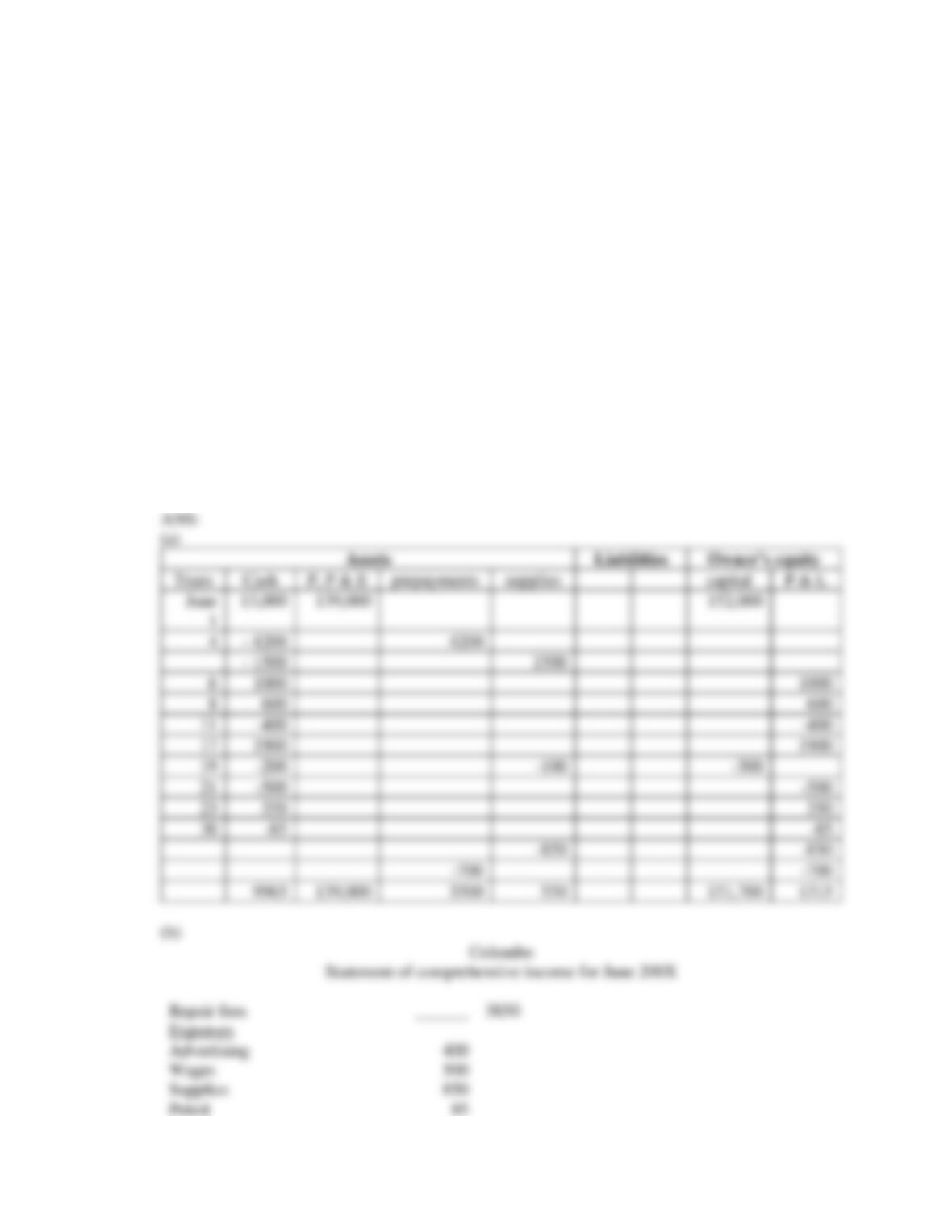
June 4
4
6
8
11
17
19
21
23
30
Leased vehicle for use in the business and paid 6 months lease $4200.
Purchased supplies of parts for use in the repair of computers for $1500
cash.
Completed computer repairs $1000 cash.
Completed computer repairs for customer for $600 cash.
Paid advertising expenses $400.
Revenue of $1900 cash earned
Colombo withdrew $200 cash and $100 of the computer parts supplies
for personal use.
Paid wages to assistant $500.
Cash revenue earned $350.
Petrol expenses paid $85.
Computer supplies used during the month $850.
(a)
Complete a worksheet for the month of June, including any final adjustments. Record all property,
plant and equipment in a single column of that name.
(b)
Prepare the statement of comprehensive income for June and the balance sheet at 30 June 200X.