A) 13.0%
B) 13.4%
C) 4.9%
D) 3.0%
89) If the current inflation rate is 4% and you have an investment opportunity that pays 10%, then the real rate of
interest on your investment is closest to:
A) 10.0%
B) 14.0%
C) 6.0%
D) 5.8%
Use the table for the question(s) below.
Suppose the term structure of interest rates is shown below:
Term
1 year
2 years
3 years
5 years
10 years
20 years
Rate
(EAR%)
5.00%
4.80%
4.60%
4.50%
4.25%
4.15%
90) What is the shape of the yield curve and what expectations are investors likely to have about future interest
rates?
A) inverted; higher
B) normal; higher
C) inverted; lower
D) normal; lower
91) The present value (PV) of receiving $1000 per year with certainty at the end of the next three years is closest
to:
A) $2737
B) $2723
C) $2733
D) $2744
92) Consider an investment that pays $1000 certain at the end of each of the next four years. If the investment
costs $3,500 and has a net present value (NPV) of $74.26, then the four year risk–free interest rate is closest to:
A) 4.5%
B) 4.58%
C) 4.55%
D) 4.53%
93) The net present value (NPV) of an investment that costs $2700 and pays $1000 certain at the end of one,
three, and five years is closest to:
A) $21.47
B) $1665.62
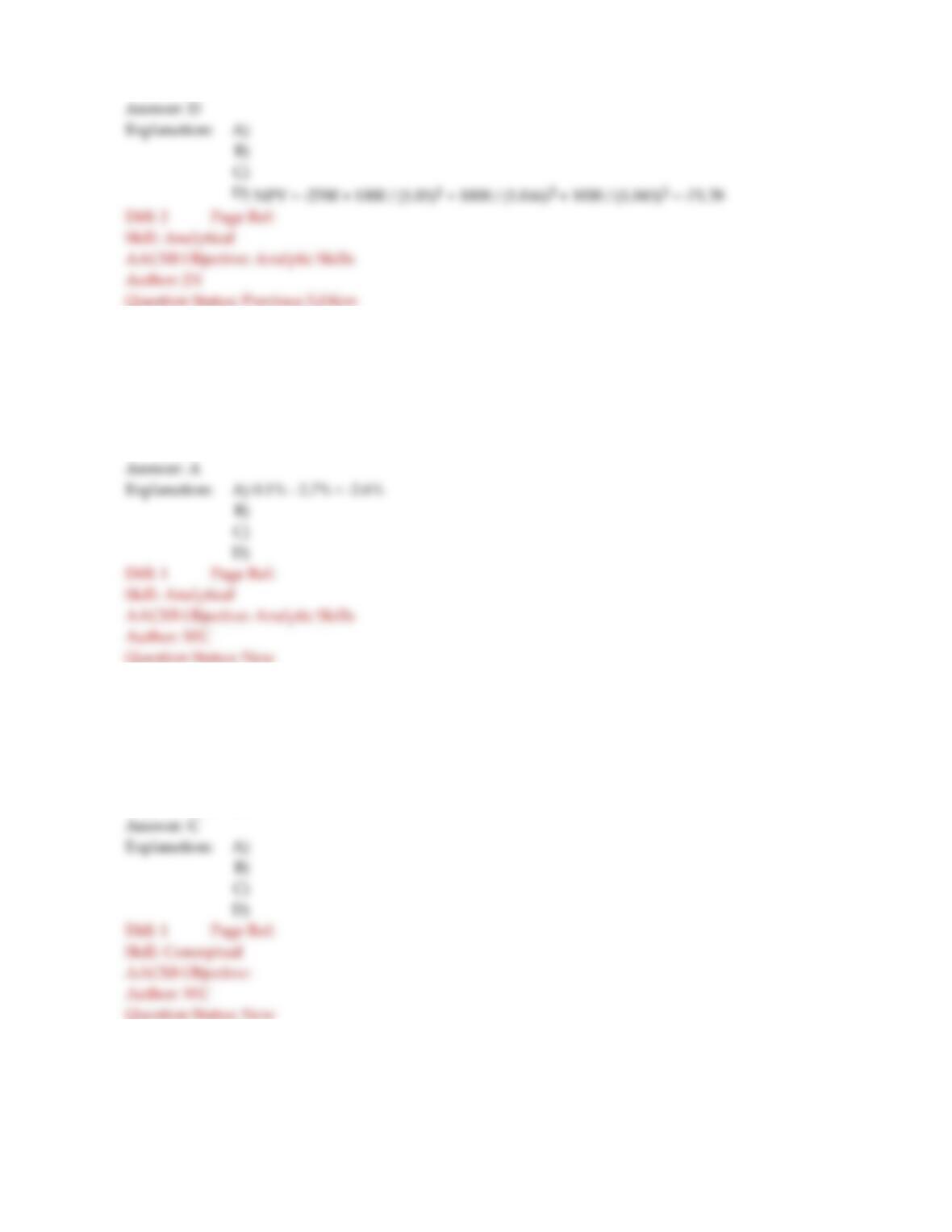
C) –$100.26
D) –$71.38
94) In 2009, U.S. Treasury yielded 0.1%, while inflation was 2.7%. What was the real rate in 2009?
A) –2.6%
B) 2.6%
C) –2.8%
D) 2.8%
95) Inflation is calculated as the rate of change in the:
A) Unemployment rate.
B) Gross Domestic Product.
C) Consumer Price Index.
D) Risk–free rate.
96) The yield curve is typically:
A) downward sloping.
B) upward sloping.
C) flat.
D) inverted.
ESSAY. Write your answer in the space provided or on a separate sheet of paper.
97) Can the nominal interest rate ever be negative? Can the real interest rate ever be negative? Explain.
Use the table for the question(s) below.
Suppose the term structure of interest rates is shown below:
Term
1 year
2 years
3 years
5 years
10 years
20 years
Rate
(EAR%)
5.00%
4.80%
4.60%
4.50%
4.25%
4.15%
98) After examining the yield curve, what predictions do you have about interest rates in the future? About
future economic growth and the overall state of the economy?
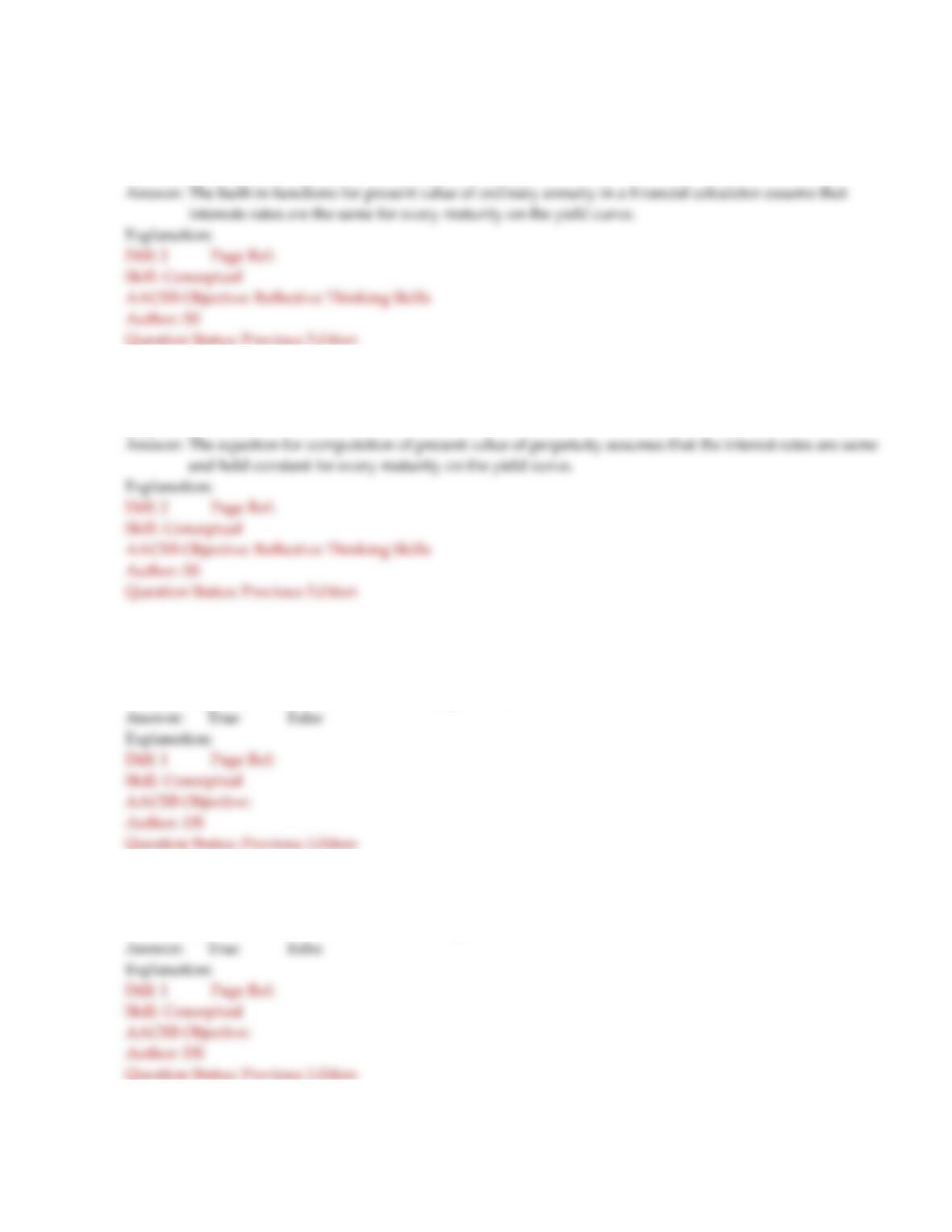
99) What is the net present value (NPV) of an investment that costs $2500 and pays $1000 certain at the end of
one, three, and five years?
Question Status: Previous Edition
SHORT ANSWER. Write the word or phrase that best completes each statement or answers the question.
100) What is the implied assumption about interest rates when using a the built–in functions of a financial
calculator to calculate the present value (PV) of an annuity?
101) What is the implied assumption about interest rates when the equation to calculate the present value (PV) of
perpetuity is used?
TRUE/FALSE. Write ‘T’ if the statement is true and ‘F’ if the statement is false.
102) The opportunity cost of capital is the best available expected return offered in the market on an investment of
comparable risk and term to the cash flow being discounted.
103) The term “opportunity” in opportunity cost of capital comes from the fact that any worthwhile opportunity
for investment will have a cost: the risk to the capital invested.
104) The opportunity cost of capital will generally be more than the interest rate offered by U.S. Treasury
securitie s with the same term, for a risk–free investment.
MULTIPLE CHOICE. Choose the one alternative that best completes the statement or answers the question.
105) What, typically, is used to calculate the opportunity cost of capital on a risk–free investment?
A) the best available expected return offered in any investment available in the market
B) the interest rate on U.S. Treasury securities with the same term
C) the interest rate of any investments alternatives that are available
D) the best rate of return offered by U.S. Treasury securities
106) Elinore is asked to invest $5000 in a friend’s business with the promise that the friend will repay $5500 in one
year’s time. Elinore finds her best alternative to this investment, with similar risk, is one that will pay her
$5400 in one year’s time. U.S. securities of similar term offer a rate of return of 6%. What is the opportunity
cost of capital in this case?
A) 6%
B) 8%
C) 9%
D) 10%
107) Why, in general, do investment opportunities offer a rate greater than that offered by U.S. Treasury securities
for the same horizon?
A) Most investment opportunities offer far greater risk than those offered by U.S. Treasury securities.
B) The return from U.S. Treasury securities generally attracts less tax than the returns from other
investments.
C) The opportunity cost of capital for a given horizon is generally based on U.S. Treasury securities with
that same horizon.
D) U.S. Treasury securities are generally considered to be the best alternative to most investments.
108) Which of the following statements is FALSE?
A) The investor’s opportunity cost of capital is the best available expected return offered in the market on
an investment of comparable risk and term of the cash flows being discounted.
B) Interest rates we observe in the market will vary based on quoting conventions, the term of investment,
and risk.
C) The opportunity cost of capital is the return the investor forgoes when the investor takes on a new
investment.
D) For a risk–free project, the opportunity cost of capital will typically be greater than the interest rate of
U.S. Treasury securities with a similar term.
109) Which of the following statements is FALSE?
A) The actual return kept by an investor will depend on how the interest is taxed.
B) The equivalent after–tax interest rate is r(1 – τ).
C) The highest interest rate, for a given horizon, is the rate paid on U.S. Treasury securities.
D) It is important to use a discount rate that matches both the horizon and the risk of the cash flows.
SHORT ANSWER. Write the word or phrase that best completes each statement or answers the question.
110) How do we decide on opportunity cost when we have several opportunities that need to be foregone?