54) A construction company takes a loan of $280,000 to cover the cost of a new grader. If the interest rate is
8.75%APR, and payments are made monthly for five years, what percentage of the outstanding principal
does the company pay in interest each month?
A) 0.73%
B) 7.29%
C) 8.75%
D) 9.25%
E) 10.5%
55) A homeowner has five years of monthly payments of $1400 before she has paid off her house. If the interest
rate is 7% APR, what is the remaining balance on her loan?
A) $59,890
B) $64,918
C) $70,703
D) $84,000
56) A Xerox DocuColor photocopier costing $42,000 is paid off in 60 monthly installments at 6.5% APR. After
three years the company wishes to sell the photocopier. What is the minimum price for which they can sell
the copier so that they can cover the cost of the balance remaining on the loan?
A) $18,448
B) $19,645
C) $19,842
D) $26,813
57) A truck costing $112,000 is paid off in monthly installments over four years with 8% APR. After three years
the owner wishes to sell the truck. What is the closest amount from the following list that he needs to pay
on his loan before he can sell the truck?
A) $24,867
B) $28,678
C) $31,432
D) $87,255
58) A small business refits its store. The builders charge them $125,000, which will be paid back in monthly
installments over three years at 6% APR. The builders will reduce this rate to 5.5% APR if they pay $2500 up
front. By approximately how much will this reduce the monthly loan repayments ?
A) $104
B) $28
C) $214
D) $77
59) An investor buys a property for $640,000 with a 25–year mortgage and monthly payments at 8% APR. After
18 months the investor resells the property for $712,000. How much cash will the investor have made from
the sale, once the mortgage is paid off?
A) $63,218
B) $72,412
C) $84,825
D) $92,644
60) Michael has credit card debt of $60,000 that has an 18% APR, compounded monthly. The minimum monthly
payment only requires him to pay the interest on his debt. He receives an offer for a credit card with an APR
of 10% compounded monthly. If he rolls over his debt onto this card and makes the same monthly payment
as before, how long will it take him to pay off his credit card debt?
A) 72 months
B) 78 months
C) 84 months
D) 98 months
61) A homeowner has $200,000 home with a 20–year mortgage, paid monthly at 7.25% APR. After five years he
receives $50,000 as an inheritance. If he pays this $50,000 toward his mortgage along with his regular
payment, by approximately how many years will it reduce the amount of time it takes him to pay off his
mortgage?
A) 6 years
B) 5 years
C) 4 years
D) 3 years
62) Joseph buys a Hummer for $60,000, financing it with a five–year 6.5% APR loan paid monthly. He decides to
pay an extra $50 per month in addition to his monthly payments. Approximately how long will he take to
pay off the loan under these conditions?
A) 4 years 10 months
B) 4 years 9 months
C) 4 years 6 months
D) 4 years 4 months
63) Liam had an extension built onto his home. He financed it for 48 months with a loan at 4.9% APR. His
monthly payments were $750. How much was the loan amount for this extension?
A) $32,631
B) $34,842
C) $36,000
D) $38,420
64) Corey buys 10 Tufflift 4–post, 4.5–ton car hoists for his parking garage at a total cost of $410,000. He finances
this with a five–year loan at 6.2% APR with monthly payments. After he has made the first 20 payments, how
much is the outstanding principal balance on his loan?
A) $150,969
B) $250,698
C) $287,153
D) $302,284
65) Assume your current mortgage payment is $900 per month. If you begin to pay $1,000 per month (with the
extra $100 per month going to principal), which of the following will be TRUE?
A) The mortgage balance will decrease faster with $1,000 monthly payment compared to $900 monthly
payments.
B) The total paid (principal and interest) will increase with $1,000 monthly payment compared to $900
monthly payments.
C) The total interest expense will increase with $1,000 monthly payment compared to $900 monthly
payments.
D) The total principal paid will decrease with $1,000 monthly payment compared to $900 monthly
payments.
66) Five years ago you took out a 30–year mortgage with an APR of 6.5% for $200,000. If you were to refinance
the mortgage today for 20 years at an APR of 4.25%, , how much would your monthly payment change by?
A) The monthly payment will increase by $104.79.
B) The monthly payment will decrease by $104.79
C) The monthly payment will increase by $343.12.
D) The monthly payment will decrease by $343.12.
67) Five years ago you took out a 30–year mortgage with an APR of 6.5% for $200,000. If you were to refinance
the mortgage today for 20 years at an APR of 4.25% , how much would you save in total interest expense?
A) $176,846
B) $75,848
C) $151,696
D) $100,998
SHORT ANSWER. Write the word or phrase that best completes each statement or answers the question.
68) How are interest and return of principal handled in an amortizing loan payment?
TRUE/FALSE. Write ‘T’ if the statement is true and ‘F’ if the statement is false.
69) Market forces determine interest rates based ultimately on the willingness of individuals, banks, and firms to
borrow, save, and lend.
70) The real interest rate is the rate of growth of one’s purchasing power due to money invested.
71) Quality adjustments to changes in the CPI most often result in reductions to the inflation rate calculated from
it.
72) What is the real interest rate given a nominal rate of 8% and an inflation rate of 4.5%?
A) 3.3%
B) 4.5%
C) 4.9%
D) 8.0%
73) Which of the following formulas gives you the growth in purchasing power?
A) growth of money + growth of prices
B) (1 + real rate) / (1 + nominal rate)
C) (1 + inflation rate) / (1 + nominal rate)
D) growth of money / growth of prices
74) In 2007, interest rates were about 4.5% and inflation was about 2.8%. What was the real interest rate in
2007?
A) 1.58%
B) 1.61%
C) 1.62%
D) 1.65%
75) Given that the inflation rate in 2006 was about 3.24%, while a short term municipal bond offered a rate of
2.9%, which of the following statement is correct?
A) The purchasing power of investors in these bonds grew over the course of the year.
B) The real interest rate for investors in these bonds was greater than the rate of inflation.
C) Investors in these bonds were able to buy less at the end of the year than they could have purchased at
the start of the year.
D) The nominal interest rate offered by these bonds gave the true increase in purchasing power that
resulted from investing in these bonds.
76) Historically, why have high inflation rates tended to be associated with high nominal interest rates?
A) Individuals will spend more when they expect their investments to increase in value.
B) Growth in investment and savings is encouraged when consumers are judged to be overspending.
C) High inflation leads to a decrease in purchasing power and thus increases the attractiveness of
investment over consumption in the short term.
D) The real interest rate needs to be high enough so that individuals can expect their savings to have
greater purchasing power in the future than in the present.
77) When the costs of an investment come before that investment’s benefits, what will be theeffect of a rise in
interest rates on the attractiveness of that investment to potential investors?
A) It will make it more attractive, since it will increase the investment’s net present value (NPV).
B) It will make it more attractive, since it will decrease the investment’s net present value (NPV).
C) It will make it less attractive, since it will increase the investment’s net present value (NPV).
D) It will make it less attractive, since it will decrease the investment’s net present value (NPV).
78) In which of the following situations would the reserve bank in a certain country be most likely to lower
interest rates?
A) The economy is growing slowly or not at all.
B) Inflation is rising rapidly.
C) The level of investment is very low.
D) The rate of savings is extremely high.
79)
Term in years: 2 5 10 30
Rate: 2.25% 3.125% 3.5% 4.375%
The table above shows the interest rates available from investing in risk–free U.S. Treasury securities with
different investment terms. If an investment offers a risk–free cash flow of $100,000 in ten years’ time, what is
the present value (PV) of that cash flow?
A) $80,051
B) $78,320
C) $73,512
D) $70,892
80)
Term in years: 1 2 3 4 5
Rate: 1.8% 2.25% 2.30% 2.66% 3.13%
The table above shows the interest rates available from investing in risk–free U.S. Treasury securities with
different investment terms. What is the present value (PV) of cash flows from an investment that yields
$4000 at the end of each year for the next four years?
A) $14,898
B) $14,956
C) $14,990
D) $15,093
81) In which of the following situations would it not be appropriate to use the following formula:
PV = C0 + C1/(1 + r) + C2/(1 + r)2 + . . . . + Cn/(1 + r)n
when determining the present value (PV) of a cash flow stream?
A) when yield curves are flat
B) when short–term and long–term interest rates vary widely
C) when the inflation rate is high
D) when the discount rate is high
82)
In an effort to maintain price stability, it is expected that the European Central Bank will raise interest rates
in the future. Which of the following is the most likely effect of such an action on short– and long–term
interest rates in Europe?
A) Long–term interest rates will tend to be higher than short–term interest rates.
B) Long–term interest rates will be about the same as short–term interest rates.
C) Both long– and short–term interest rates would be expected to fall sharply.
D) No relative change in short and long term interest rates could be predicted.
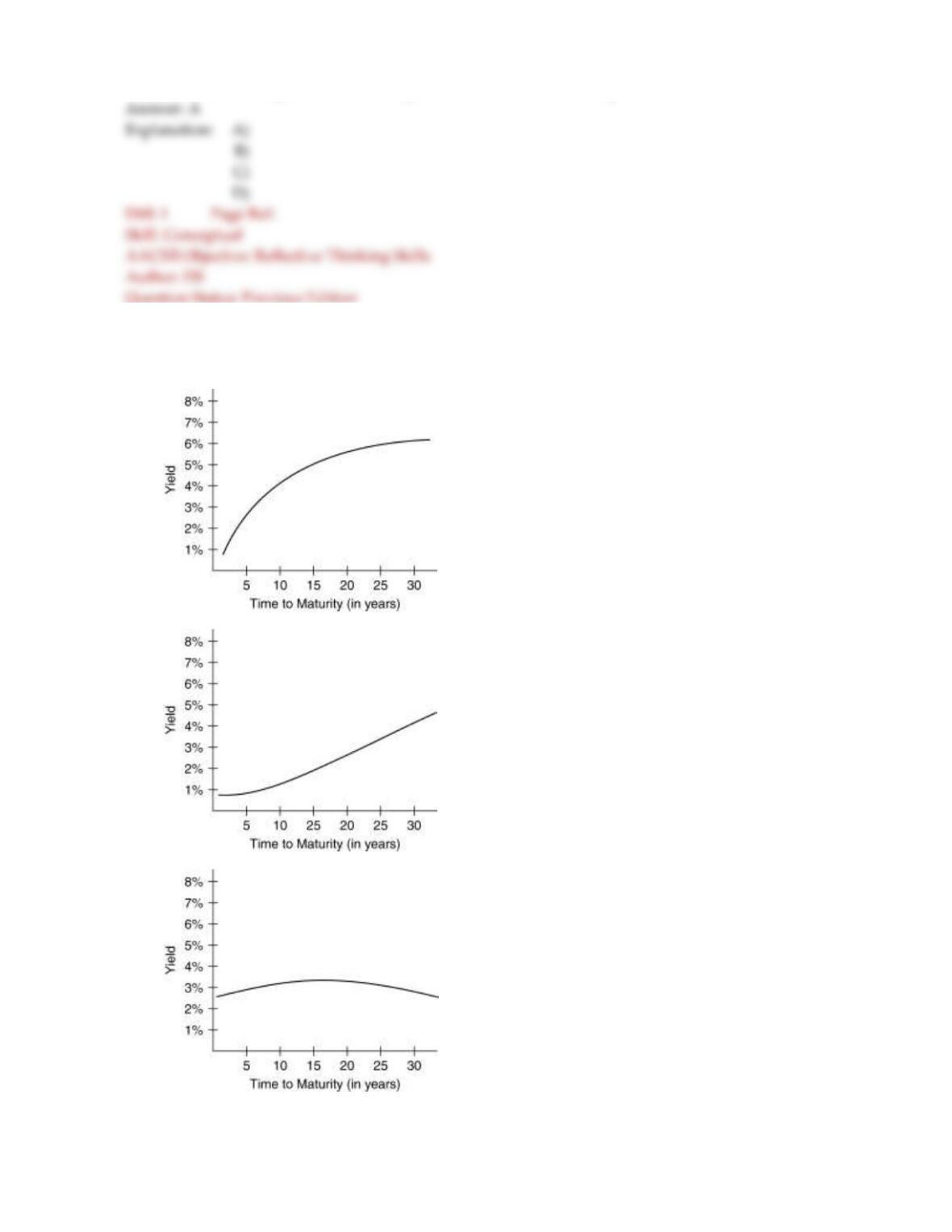
83) Which of the following yield curves would most likely predict a downturn in the economy?
A)
B)
C)
D)
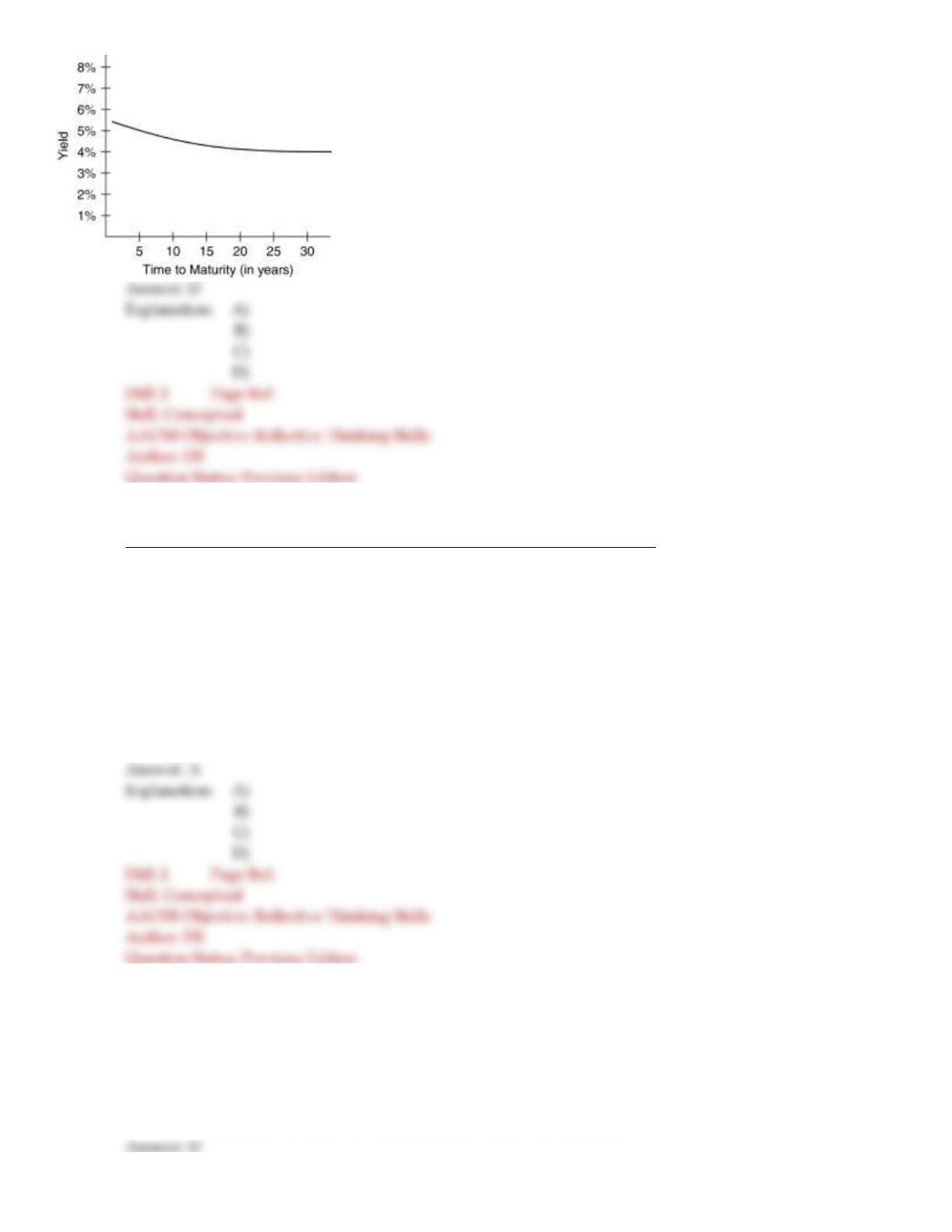
84) Term: 1 year 2 years 3 years 5 years 10 years 20 years
Rate: 5.00% 5.20% 5.40% 5.50% 5.76% 5.9%
Given the above term structure of interest rates, which of the following is most likely in the future?
Option I. Interest rates will fall.
Option II. Economic growth will slow.
Option III. Long–term rates will fall relative to short term rates.
A) Option I only
B) Option II only
C) Option III only
D) Options I and II
85) Which of the following reasons for considering long–term loans inherently more risky than short–term loans
is most accurate?
A) There is a greater chance that a borrower will default in a longer time–frame.
B) The penalties for closing out a long term loan early make them unattractive to many investors.
C) Long term loans typically have ongoing costs that accumulate over the life of the loan.
D) The loan values are very sensitive to changes in market interest rates.
86) A bank lends some money to a business. The business will pay the bank a single payment of $180,000 in ten
years time. How much greater is the present value (PV) of this payment if the interest rate is 9% rather than
8%?
A) $7341
B) $35,892
C) $76,033
D) $83,374
87) Which of the following statements is FALSE?
A) The interest rates that banks offer on investments or charge on loans depends on the horizon of the
investment or loan.
B) The Federal Reserve determines very short–term interest rates through its influence on the federal funds
rate.
C) The interest rates that are quoted by banks and other financial institutions are nominal interest rates.
D) Fundamentally, interest rates are determined by the Federal Reserve.
88) If the current inflation rate is 5%, then the nominal rate necessary for you to earn an 8% real interest rate on
your investment is closest to: