Exam
Name___________________________________
TRUE/FALSE. Write ‘T’ if the statement is true and ‘F‘ if the statement is false.
1) When you borrow money, the interest rate on the borrowed money is the price you pay to be able to convert
your future loan payments into money today.
2) When there are large numbers of people looking to save their money and there is little demand for loans, one
would expect interest rates to be high.
3) The annual percentage rate indicates the amount of interest, including the effect of any compounding.
MULTIPLE CHOICE. Choose the one alternative that best completes the statement or answers the question.
4) Which of the following would be LEAST likely to lower the interest rate that a bank offers a borrower?
A) The number of borrowers seeking funds is low.
B) The expected inflation rate is expected to be low.
C) The borrower is judged to have a low degree of risk.
D) The investment will be for a long period of time.
5) What is the effective annual rate (EAR)?
A) the interest rate that would earn the same interest with annual compounding
B) the ratio of the number of the annual percentage rate to the number of compounding periods per year
C) the discount rate for an n–year time interval, where n may be more than one year or less than or equal to
one year (a fraction)
D) the cash flows from an investment over a one–year period divided by the number of times that interest
is compounded during the year
6) A bank offers a loan that will requires you to pay 6% interest compounded monthly. Which of the
following is closest to the EAR charged by the bank?
A) 5.84%
B) 6.00%
C) 6.17%
D) 72.00%
7) A bank pays interest quarterly with an EAR of 8%. What is the periodic interest rate applicable per quarter?
A) 1.46%
B) 1.80%
C) 1.94%
D) 2.00%
8) Howard is saving for a long holiday. He deposits a fixed amount every month in a bank account with an
EAR of 7.5%. If this account pays interest every month then how much should he save from each monthly
paycheck in order to have $10,000 in the account in two years’ time?
A) $161
B) $166
C) $388
D) $4818
9) An 8% APR with monthly compounding is closest to which of the following?
A) an EAR of 6.7%
B) an EAR of 7.72%
C) an EAR of 8.3%
D) an EAR of 8.5%
10) Which of the following best describes the annual percentage rate?
A) the quoted interest rate which considered with the compounding period gives the effective interest rate
B) the effective annual rate after compounding is taken into account
C) the discount rate when compounded more than once a year or less than once a year
D) the discount rate when it is divided by the number of of times it is compounded in a year
11) A graphic designer needs a laptop for audio/video editing, and notices that they can elect to pay $2900 for a
Dell XPS laptop, or lease from the manufacturer for monthly payments of $79 each for four years. The
designer can borrow at an interest rate of 7% APR compounded monthly. What is the cost of leasing the
laptop over buying it outright?
A) Leasing costs $311 more than buying.
B) Leasing costs $384 more than buying.
C) Leasing costs $399 more than buying.
D) Leasing costs $892 more than buying.
12) Which of the following accounts has the highest EAR?
A) one that pays 6.1% every six months
B) one that pays 1.0% per month
C) one that pays 12.6% per year
D) one that pays 3% every three months
13) Drew receives an inheritance that pays him $50,000 every three months for the next two years. Which of the
following is closest to the present value (PV) of this inheritance if the interest rate is 8.5% (EAR)?
A) $354,223
B) $364,309
C) $365,322
D) $400,000
14)
Investment:
A
B
C
D
Rate of Return:
5.7%
5.6%
5.5%
5.5%
Compounding
Yearly
Semiannually
Monthly
Weekly
The table above shows the rate of return (APR) for four investment alternatives. Which offers the highest
EAR?
A) Investment A
B) Investment B
C) Investment C
D) Investment D
15) A bank offers an account with an APR of 6% and an EAR of 6.09%. How does the bank compound interest
for this account?
A) weekly compounding
B) monthly compounding
C) semiannual compounding
D) annual compounding
16) What is the present value (PV) of an investment that pays $10,000 every year for four years if the interest rate
is 7% APR, compounded quarterly?
A) $33,730
B) $33,872
C) $38,680
D) $40,000
17) A small foundry agrees to pay $250,000 two years from now to a supplier for a given amount of coking coal.
The foundry plans to deposit a fixed amount in a bank account every three months, starting three months
from now, so that at the end of two years the account holds $250,000. If the account pays 5.5% APR
compounded monthly, how much must be deposited every three months?
A) $29,770
B) $29,777
C) $29,740
D) $31,250
18) Emma runs a small factory that needs a vacuum oven for brazing small fittings. She can purchase the model
she needs for $180,000 up front, or she can lease it for five years for $4200 per month. She can borrow at 7%
APR, compounded monthly. Assuming that the oven will be used for five years, should she purchase the
oven or should she lease it?
A) Lease, since the present value (PV) of the lease is $12,224 less than the cost of the oven.
B) Lease, since the present value (PV) of the lease is $8642 less than the cost of the oven.
C) Lease, since the present value (PV) of the lease is $2212 less than the cost of the oven.
D) Buy, since the present value (PV) of the lease is $32,108 more than the cost of the oven.
19) Which of the following statements is FALSE?
A) Because interest rates may be quoted for different time intervals, it is often necessary to adjust the
interest rate to a time period that matches that of our cash flows.
B) The effective annual rate indicates the amount of interest that will be earned at the end of one year.
C) The annual percentage rate indicates the amount of simple interest earned in one year.
D) The annual percentage rate indicates the amount of interest including the effect of compounding.
20) The effective annual rate (EAR) for a loan with a stated APR of 8% compounded monthly is closest to:
A) 8.30%
B) 8.33%
C) 8.00%
D) 8.24%
21) The effective annual rate (EAR) for a loan with a stated APR of 10% compounded quarterly is closest to:
A) 10.52%
B) 10.25%
C) 10.38%
D) 10.00%
22) The effective annual rate (EAR) for a savings account with a stated APR of 4% compounded daily is closest
to:
A) 4.00%
B) 4.10%
C) 4.08%
D) 4.06%
Use the table for the question(s) below.
Consider the following investment alternatives:
Investment
Rate
Compounding
A
6.25%
Annual
B
6.10%
Daily
C
6.125
Quarterly
D
6.120
Monthly
23) Which alternative offers you the highest effective rate of return?
A) Investment A
B) Investment B
C) Investment C
D) Investment D
24) Which alternative offers you the lowest effective rate of return?
A) Investment A
B) Investment B
C) Investment C
D) Investment D
25) The highest effective rate of return you could earn on any of these investments is closest to:
A) 6.250%
B) 6.267%
C) 6.300%
D) 6.310%
26) The lowest effective rate of return you could earn on any of these investments is closest to:
A) 6.250%
B) 6.267%
C) 6.100%
D) 6.300%
Use the information for the question(s) below.
Your firm needs to invest in a new delivery truck. The life expectancy of the delivery truck is five years. You can
purchase a new delivery truck for an upfront cost of $200,000, or you can lease a truck from the manufacturer for five
years for a monthly lease payment of $4000 (paid at the end of each month). Your firm can borrow at 6% APR with
quarterly compounding.
27) The effective annual rate on your firm’s borrowings is closest to:
A) 6.00%
B) 6.24%
C) 6.17%
D) 6.14%
28) The monthly discount rate that you should use to evaluate the truck lease is closest to:
A) 0.487%
B) 0.512%
C) 0.498%
D) 0.500%
29) The present value (PV) of the lease payments for the delivery truck is closest to:
A) $206,900
B) $207,050
C) $207,680
D) $198,420
30) You are considering purchasing a new automobile that will cost you $28,000. The dealer offers you 4.9%
APR financing for 60 months (with payments made at the end of the month). Assuming you finance the
entire $28,000 and finance through the dealer, your monthly payments will be closest to:
A) $1454
B) $527
C) $467
D) $478
31) You are considering purchasing a new truck that will cost you $34,000. The dealer offers you 1.9% APR
financing for 48 months (with payments made at the end of the month). Assuming you finance the entire
$34,000 and finance through the dealer, your monthly payments will be closest to:
A) $708
B) $594
C) $736
D) $1086
Use the information for the question(s) below.
You are purchasing a new home and need to borrow $250,000 from a mortgage lender. The mortgage lender quotes you
a rate of 6.25% APR for a 30–year fixed rate mortgage. The mortgage lender also tells you that if you are willing to pay
two points, they can offer you a lower rate of 6.0% APR for a 30–year fixed rate mortgage. One point is equal to 1% of the
loan value. So if you take the lower rate and pay the points, you will need to borrow an additional $5000 to cover points
you are paying the lender.
32) Assuming you do not pay the points and borrow from the mortgage lender at 6.25%, then your monthly
mortgage payment (with payments made at the end of the month) will be closest to:
A) $1570
B) $1530
C) $1540
D) $1500
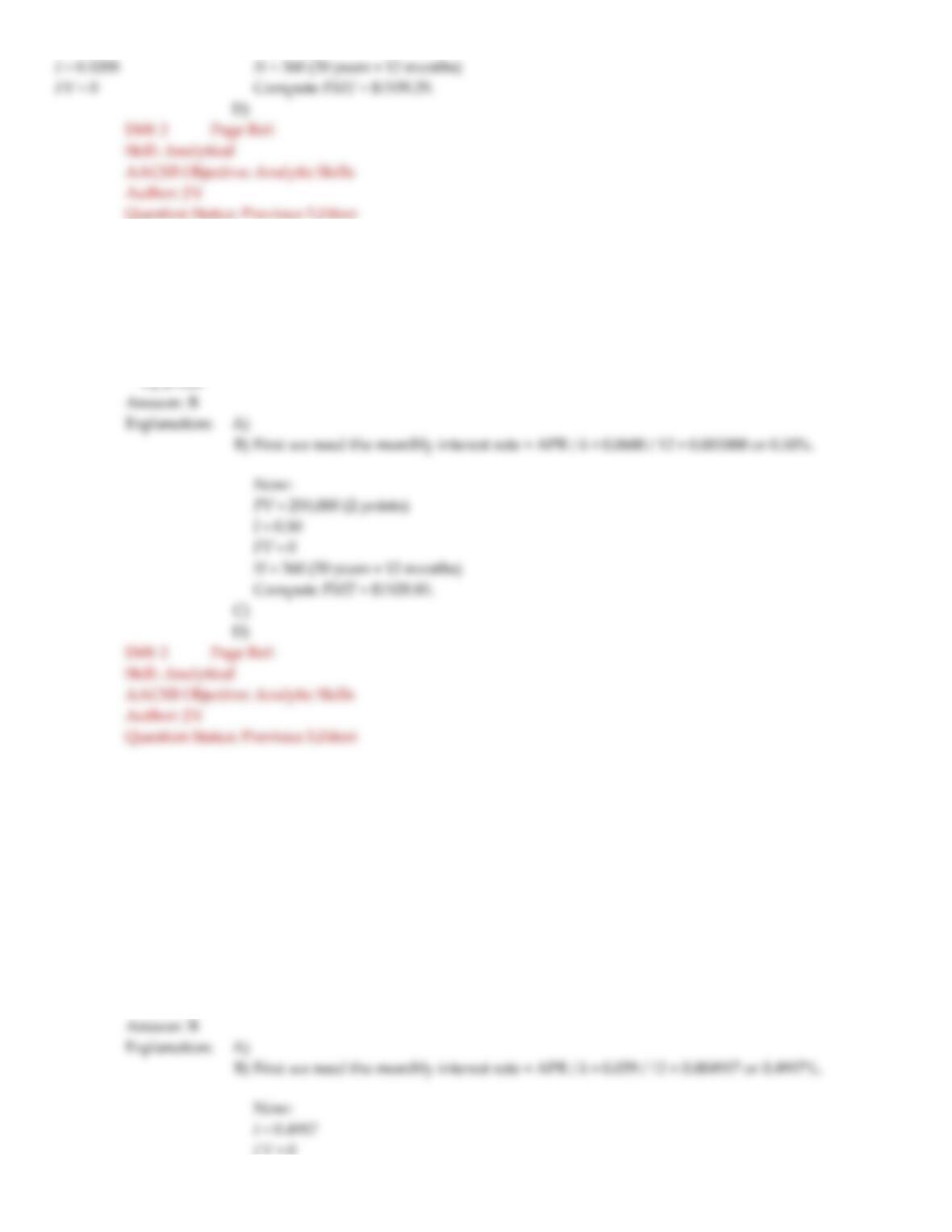
33) Assuming you pay the points and borrow from the mortgage lender at 6.00%, then your monthly mortgage
payment (with payments made at the end of the month) will be closest to:
A) $1540
B) $1530
C) $1570
Use the information for the question(s) below.
Two years ago you purchased a new SUV. You financed your SUV for 60 months (with payments made at the end of the
month) with a loan at 5.9% APR. You monthly payments are $617.16 and you have just made your 24th monthly payment
on your SUV.
34) The amount of your original loan is closest to:
A) $37,000
B) $32,000
C) $20,300
D) $31,250
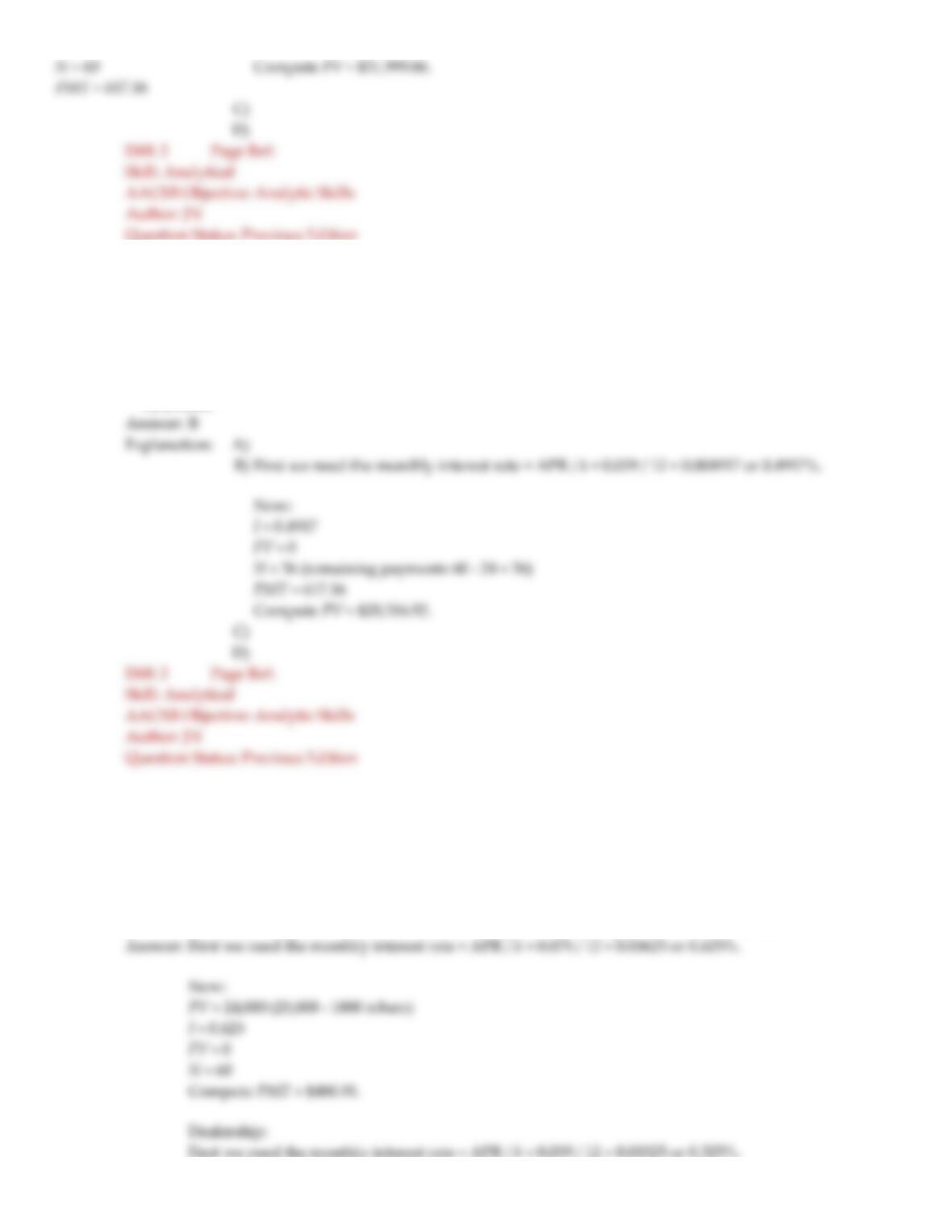
35) Assuming that you have made all of the first 24 payments on time, then the outstanding principal balance on
your SUV loan is closest to:
A) $31,250
B) $20,300
C) $19,200
D) $32,000
ESSAY. Write your answer in the space provided or on a separate sheet of paper.
36) You are in the process of purchasing a new automobile that will cost you $25,000. The dealership is offering
you either a $1000 rebate (applied toward the purchase price) or 3.9% financing for 60 months (with
payments made at the end of the month). You have been pre–approved for an auto loan through your local
credit union at an interest rate of 7.5% for 60 months. Should you take the $1000 rebate and finance through
your credit union or forgo the rebate and finance through the dealership at the lower 3.9% APR?
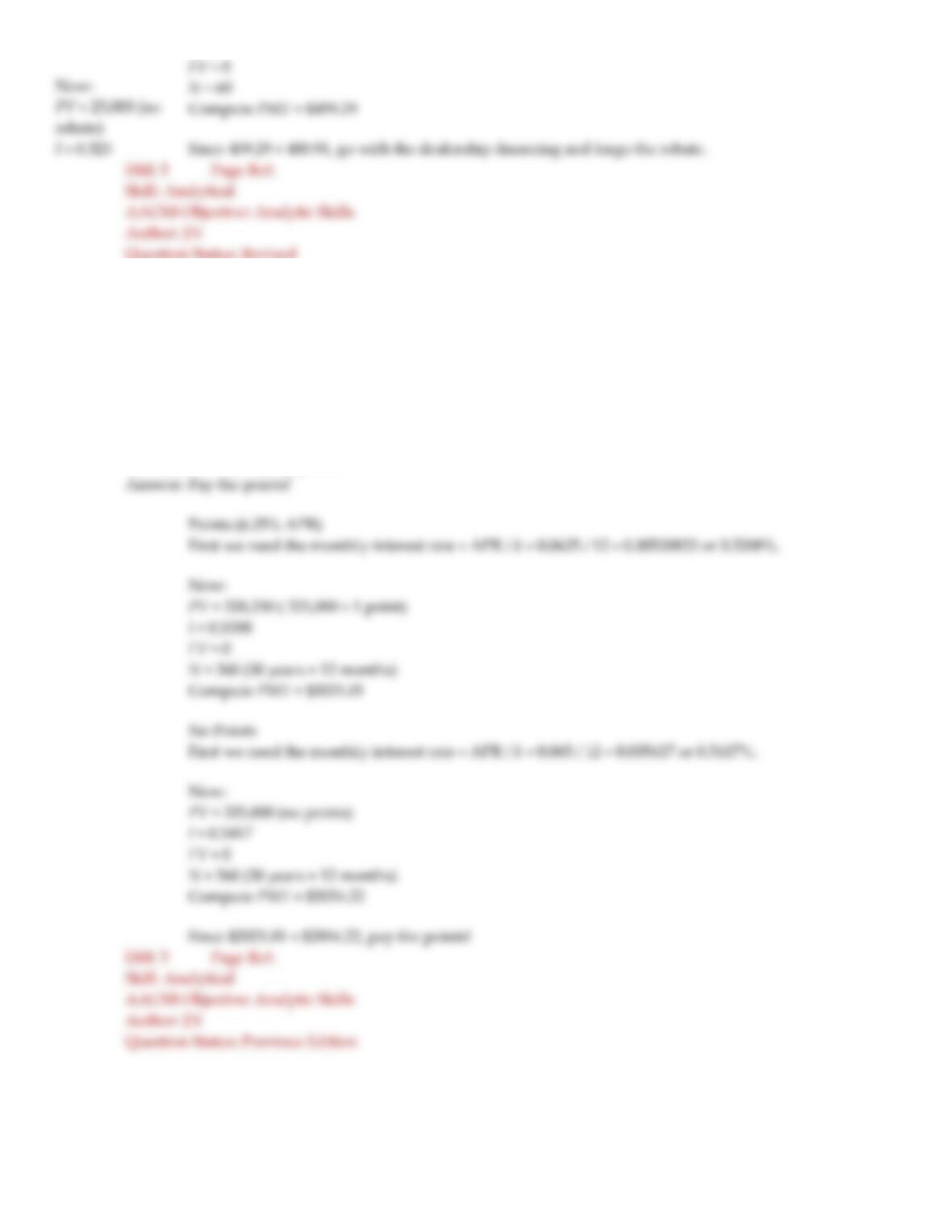
37) You are purchasing a new home and need to borrow $325,000 from a mortgage lender. The mortgage
lender quotes you a rate of 6.5% APR for a 30–year fixed rate mortgage (with payments made at the end of
each month). The mortgage lender also tells you that if you are willing to pay one point, they can offer you
a lower rate of 6.25% APR for a 30–year fixed rate mortgage. One point is equal to 1% of the loan value. So
if you take the lower rate and pay the points, you will need to borrow an additional $3250 to cover points
you are paying the lender. Assuming that you do not intend to prepay your mortgage (pay off your
mortgage early), are you better off paying the one point and borrowing at 6.25% APR or just taking out the
loan at 6.5% without any points?
MULTIPLE CHOICE. Choose the one alternative that best completes the statement or answers the question.
38) A 10% APR with quarterly compounding is equivalent to an EAR of:
A) 10.00%.
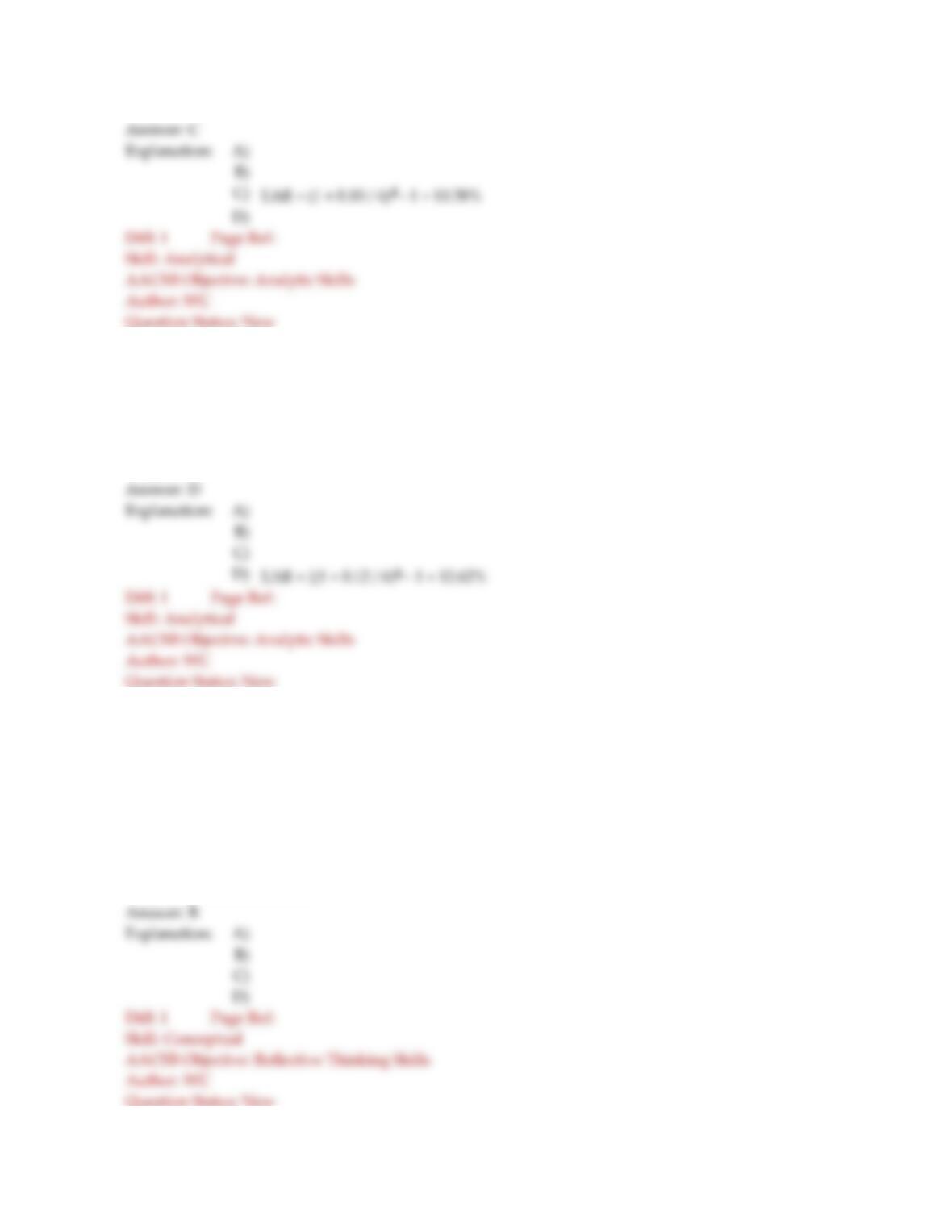
B) 10.47%
C) 10.38%.
D) 9.81%.
39) A 12% APR with bi–monthly compounding is equivalent to an EAR of:
A) 11.98%.
B) 12.50%
C) 12.00%.
D) 12.62%.
40) Which of the following is/are TRUE?
I. The EAR can never exceed the APR.
II. The APR can never exceed the EAR.
III. The APR and EAR can never be equal.
A) Only I. is true.
B) Only II. is true.
C) Only II. & III. are true.
D) Only I. & III. are true.
41) When computing a present value, which of the following is TRUE?
A) You should adjust the discount rate to match the time period of the cash flows.
B) You should adjust the future value to match the present value.
C) You should adjust the time period to match the present value.
D) You should adjust the cash flows to match the time period of the discount rate.
SHORT ANSWER. Write the word or phrase that best completes each statement or answers the question.
42) Everything else remaining same, under what situation will APR and EAR be equal?
43) What is the general relationship between the absolute values of APR and EAR for an investment?
44) Is it possible to analyze cash flows that occur in time intervals that are not exactly equal to a year?
45) What care, if any, should be taken when cash flows occur in periodicities that are shorter than a year e.g.,
quarterly or monthly cash flows?
46) How do we handle a situation when both compounding period and cash flow interval are given to us but
both are less than a year and not equal to each other?
TRUE/FALSE. Write ‘T’ if the statement is true and ‘F‘ if the statement is false.
47) Joe borrows $100,000 and agrees to repay the principal, plus 7% APR interest compounded monthly, at the
end of three years. Joe has taken out an amortizing loan.
48) A $40,000 new car loan is taken out with the terms 9% APR for 48 months. How much are monthly payments
on this loan?
A) $833.33
B) $769.79
C) $995.40
D) $1002.56
49) A $60,000 loan is taken out on a boat with the terms 7% APR for 36 months. How much are the monthly
payments on this loan?
A) $1666.66
B) $1783.33
C) $1796.54
D) $1852.62
50) A pottery factory purchases a continuous belt conveyor kiln for $50,000. A 6.5% APR loan with monthly
payments is taken out to purchase the kiln. If the monthly payments are $501, over what term is this loan
being paid?
A) 10 years
B) 11 years
C) 12 years
D) 13 years
51)
Ursula wants to buy a $18,999 used car. She has savings of $2,000 plus an $800 trade–in. She wants her
monthly payments to be about $272. Which of the following loans offers monthly payments closest to $270?
A) 6.5% APR for 36 months
B) 6.5% APR for 48 months
C) 6.5% APR for 60 months
D) 6.5% APR for 72 months
52) A house costs $138,000. It is to be paid off in exactly ten years, with monthly payments of $1675. What is the
APR of this loan?
A) 7.52%
B) 7.80%
C) 8.00%
D) 8.33%
53) A home buyer buys a house for $225,000. She pays 20% cash, and takes a fixed–rate mortgage for ten years at
6.26% APR. If she makes semi–monthly payments, which of the following is closest to each of her payment?
A) $915.08
B) $932.05
C) $937.50
D) $1165.07