CHAPTER 5
THE STATEMENT OF CASH FLOWS
SUMMARY OF QUESTION TYPES BY LEARNING
OBJECTIVE AND LEVEL OF DIFFICULTY
Item
LO
LOD
Item
LO
LOD
Item
LO
LOD
Item
LO
LOD
Item
LO
LOD
True-False Statements
1.
1
E
7.
2
E
13.
4
E
19.
5
E
25.
5
E
2.
1
E
8.
2
M
14.
4
E
20.
5
M
26.
5
E
3.
1
E
9.
3
M
15.
4
E
21.
5
M
27.
6
E
4.
1
E
10.
3
E
16.
4
M
22.
5
M
28.
6
M
5.
1
E
11.
4
M
17.
4
M
23.
5
H
29.
6
E
6.
1
M
12.
4
M
18.
4
E
24.
5
E
Multiple Choice Questions
30.
1
M
43.
3
M
56.
4
E
69.
4
M
82.
5
M
31.
1
M
44.
3
M
57.
4
M
70.
4
M
83.
5
M
32.
1
E
45.
3
H
58.
4
M
71.
4
M
84.
5
H
33.
2
M
46.
3
M
59.
4
H
72.
4
M
85.
5
H
34.
2
M
47.
4
M
60.
4
H
73.
4
M
86.
5
H
35.
2
E
48.
4
M
61.
4
M
74.
4
H
87.
5
H
36.
3
M
49.
4
E
62.
4
H
75.
4
H
88.
5
H
37.
3
M
50.
4
M
63.
4
H
76.
4
M
89.
5
M
38.
3
E
51.
4
E
64.
4
M
77.
4
M
90.
5
M
39.
3
M
52.
4
E
65.
4
H
78.
4
E
91.
6
H
40.
3
E
53.
4
M
66.
4
H
79.
5
H
92.
6
M
41.
3
M
54.
4
M
67.
4
H
80.
5
M
93.
6
H
42.
3
H
55.
4
E
68.
4
M
81.
5
M
Exercises
94.
4
M
96.
4
H
98.
4
H
100.
5
H
95.
4
H
97.
4
H
99.
4,5
M
101.
6
M
Matching
102.
1,3,4
M
103.
3,4
M
Short-Answer Essay
104.
1
E
106.
3
M
108.
4
M
110.
4
M
105.
1
M
107.
4
E
109.
4
M
Essay
111.
2
M
112.
5
M
Note: E = Easy M = Medium H = Hard
5 – 2 Test Bank for Understanding Financial Accounting, Canadian Edition
SUMMARY OF LEARNING OBJECTIVES BY QUESTION TYPE
Item
Type
Item
Type
Item
Type
Item
Type
Item
Type
Item
Type
Item
Type
Learning Objective 1
1.
TF
3.
TF
5.
TF
30.
MC
32.
MC
104.
SAE
2.
TF
4.
TF
6.
TF
31.
MC
102.
Ma
105.
SAE
Learning Objective 2
7.
TF
8.
TF
33.
MC
34.
MC
35.
MC
111.
Es
Learning Objective 3
9.
TF
37.
MC
40.
MC
43.
MC
46.
MC
106.
SAE
10.
TF
38.
MC
41.
MC
44.
MC
102.
Ma
36.
MC
39.
MC
42.
MC
45.
MC
103.
Ma
Learning Objective 4
11.
TF
47.
MC
55.
MC
63.
MC
71.
MC
94.
Ex
107.
SAE
12.
TF
48.
MC
56.
MC
64.
MC
72.
MC
95.
Ex
108.
SAE
13.
TF
49.
MC
57.
MC
65.
MC
73.
MC
96.
Ex
109.
SAE
14.
TF
50.
MC
58.
MC
66.
MC
74.
MC
97.
Ex
110.
SAE
15.
TF
51.
MC
59.
MC
67.
MC
75.
MC
98.
Ex
16.
TF
52.
MC
60.
MC
68.
MC
76.
MC
99.
Ex
17.
TF
53.
MC
61.
MC
69.
MC
77.
MC
102.
Ma
18.
TF
54.
MC
62.
MC
70.
MC
78.
MC
103.
Ma
Learning Objective 5
19.
TF
23.
TF
79.
MC
83.
MC
87.
MC
99.
Ex
20.
TF
24.
TF
80.
MC
84.
MC
88.
MC
100.
Ex
21.
TF
25.
TF
81.
MC
85.
MC
89.
MC
112.
Es
22.
TF
26.
TF
82.
MC
86.
MC
90.
MC
Learning Objective 6
27.
TF
28.
TF
29.
TF
91.
MC
92.
MC
93.
MC
101.
Ex
Note: TF = True-False Ex = Exercise SAE = Short-Answer Essay
MC = Multiple Choice Ma = Matching Es = Essay
The Statement of Cash Flows 5 – 3
CHAPTER LEARNING OBJECTIVES
1. Understand and explain why the statement of cash flows is of significance to users.
2. Explain how the statement of cash flows and the statement of income differ.
3. Identify the three major types of activities that are presented in a statement of cash
flows and describe some of the typical transactions included in each category.
4. Prepare a statement of cash flows using a comparative statement of financial position,
a statement of income, and some additional information.
5 – 4 Test Bank for Understanding Financial Accounting, Canadian Edition
5. Interpret a statement of cash flows and develop potential solutions to any cash flow
challenges identified.
6. Calculate and interpret a company’s cash flows to total liabilities ratio and determine
the amount of net free cash flow being generated.

The Statement of Cash Flows 5 – 5
TRUE-FALSE STATEMENTS
1. The Statement of Cash Flows and the Statement of Income both measure a company‘s
performance.
2. The components of a Statement of Cash Flows are investing, financing, and operating
activities.
3. A company can only analyze its operations properly provided it has all detailed financial
statements.
4. The Statement of Cash Flows and Statement of Income are both important measurements of
long term profitability.
5. The Statement of Cash Flows provides a perspective of an organization’s performance by
highlighting the results in the net change in its cash position during the year.
6. A positive cash flow from operating activities indicates that a company’s financing activities
are generating more cash than required for operations.
7. The Statement of Income reflects the lead/lag relationships in cash flows.
8. Non-cash expenses will reduce the amount of cash a company is able to generate from its
operations.
9. Cash paid for dividends to shareholders is classified as an investing activity.
10. All companies must present operating activities first on the statement of cash flows.
11. Cash equivalents include investments that can be readily converted into cash; investment
maturity dates are irrelevant.
12. If prepaid expenses are shown as having a positive effect on cash flow, it is because
prepaid expenses increased during the year.
13. Cash from operating activities will be the same using either the direct or indirect method to
prepare the Statement of Cash Flows.

5 – 6 Test Bank for Understanding Financial Accounting, Canadian Edition
14. Cash position takes into consideration cash and cash equivalents.
15. If a company has used a line of credit, then the amount of the borrowing can be considered
“positive cash”.
16. Accounting standard setters have established three acceptable methods for preparing a
Statement of Cash Flows.
17. The direct method is also known as the reconciliation method.
18. The most common type of non-cash item is depreciation expense.
19. In the early part of the cash-to–cash cycle, net cash flows are normally inflows.
20. Companies can raise an unlimited amount of cash from financing activities as long as they
are willing to pay higher interest rates.
21. Capitalization refers to the long term assets on the Statement of Financial Position.
22. Inadequate financing is the major reason new business start-ups experience cash
shortages.
23. The cash-to-cash cycle is the time between when a company pays out cash to purchase
goods until those goods are ultimately paid for by the supplier.
24. One way to solve cash flow challenges is to slow down the sales growth rate.
25. A large increase in accounts receivable may indicate that a company is having difficulties
collecting its receivables.
26. A large increase in accounts payable indicates that a company is paying its suppliers on
time.
27. The cash flows to total liabilities ratio is used to assess company’s ability to meet its liability
through its operating cash flows.

The Statement of Cash Flows 5 – 7
28. Free cash flow is a commonly used measure in the management discussion and analysis
section of annual reports.
29. A negative net free cash flow is considered to be a good thing.
5 – 8 Test Bank for Understanding Financial Accounting, Canadian Edition
ANSWERS TO TRUE-FALSE STATEMENTS
Item
Ans.
Item
Ans.
Item
Ans.
Item
Ans.

The Statement of Cash Flows 5 – 9
MULTIPLE CHOICE QUESTIONS
30. A banker contemplating a loan to a company should focus on which section(s) of the
Statement of Cash Flows in order to determine the company’s ability to repay the loan?
a) Operating activities
b) Operating and financing activities
c) Investing activities
d) Operating and investing activities
31. The information presented on the statement of cash flows enables users to
a) assess the company’s ability to generate cash flows from its core operations.
b) evaluate the cash flows the company has been able to obtain from investors and creditors.
c) Assess the extent to which the company has invested cash to replace or add revenue-
generating capital assets.
d) all of the above
32. Information on a company’s cash flows is used for all of the following, EXCEPT
a) assess the company’s ability to repay debt in the future.
b) evaluate the potential for the company to be able to pay dividends in the future.
c) evaluate the past performance of a company.
d) estimate the company’s future cash requirements.
33. All of the following statements are true, EXCEPT
a) to analyze operations properly you need both the Statement of Income and the Statement of
Cash Flows.
b) in the long run total profits and net cash flows will be very similar.
c) the Statement of Cash Flows considers events that the Statement of Income does not.
d) the Statement of Cash Flows and the Statement of Income both cover the period of a year
because profits and cash flows are very similar over the period of a year.
34. The following items are reported on a company’s Statement of Income. Which of them is
most likely equal to its cash flow impact?
a) Depreciation expense
b) Gain on sale of capital assets
c) Loss on sale of investment
d) Interest expense
35. The Statement of ___ is for shareholders to assess company profitability.
a) Cash Flows
b) Shareholders’ Equity
c) Financial Position
d) Income

5 – 10 Test Bank for Understanding Financial Accounting, Canadian Edition
36. Which of the following would cause an inflow of cash?
a) issuing common shares to retire long-term debt
b) payment of a dividend to the shareholders
c) incurring a loss on the sale of a capital asset
d) recognizing depreciation expense
37. Which of the following would cause an outflow of cash?
a) sale of inventory for cash
b) the sale of an investment for a loss
c) issuing common shares to acquire capital assets
d) purchase of a temporary investment
38. Investing activities typically involve accounts classified as
a) long-term assets.
b) long-term liabilities.
c) shareholders’ equity.
d) short-term assets.
39. Financing activities typically involve accounts classified as
a) current assets and current liabilities.
b) current liabilities and shareholders’ equity.
c) long-term liabilities and shareholders’ equity.
d) current liabilities and long-term liabilities.
40. Operating activities typically involve accounts classified as
a) current assets and current liabilities.
b) current assets and long-term liabilities.
c) long-term assets and current liabilities.
d) long-term assets and long-term liabilities.
41. Cash flows from financing activities include
a) proceeds received from sale of equipment.
b) proceeds received from sale of the company’s shares.
c) purchase of land.
d) proceeds from the sale of shares of another company.
42. Which of the following would be an example of an investing activity on the Statement of
Cash Flows?
a) issuance of bonds payable
b) purchase of bonds payable
c) sale of common shares
d) receipt of dividend income from investments
43. Which of the following would be an example of a financing activity on the Statement of Cash

The Statement of Cash Flows 5 – 11
Flows?
a) payment of interest on debt
b) payment of a dividend
c) receipt of interest on investments
d) sale of equipment
44. Which of the following would be an example of an investing activity on the Statement of
Cash Flows?
a) purchase of capital assets
b) sale of preferred shares
c) repurchase of shares issued
d) dividends paid to shareholders
45. Obtaining resources for the corporation from investors or debt-holders and the return of
resources to shareholders and debt-holders is considered part of which of these activities on the
Statement of Cash Flows?
a) Operating activities
b) Investing activities
c) Financing activities
d) none of these
46. The activities of a corporation that are directed to investing the resources of the corporation
over extended periods of time in long-term assets is considered part of which of these activities
on the Statement of Cash Flows?
a) Operating activities
b) Financing activities
c) Investing activities
d) none of these
47. If a company has made arrangements with a bank to borrow money in the months when
they have a negative cash balance, this arrangement is a
a) bank overdraft.
b) demand loan.
c) long-term loan.
d) term deposit.
48. How should a gain on the sale of equipment be reflected in the operating section of the
Statement of Cash Flows when using the indirect method?
a) as a deduction from net income
b) as a cash inflow
c) as an addition to net income
d) It is not reflected in the operating section.
49. Cash equivalents includes everything, EXCEPT
a) demand deposits.

5 – 12 Test Bank for Understanding Financial Accounting, Canadian Edition
b) money market funds.
c) short term bank loan.
d) lines of credit.
50. On the Statement of Cash Flows, which of the following would equal cash paid for income
taxes?
a) income taxes payable plus change in cash
b) income taxes expense plus ending balance in income taxes payable
c) income taxes expense plus beginning balance in income taxes payable
d) income taxes expense plus change in income taxes payable
51. Under the indirect approach, in preparing the cash from operations section of the Statement
of Cash Flows, depreciation is added to net income because
a) it is not a cash expense.
b) it is a cash outflow.
c) it is a source of cash.
d) it is not an allowable expense in determining net income.
52. Under the indirect approach, adjustments must be made to net income in the operations
section for all of the following items, EXCEPT
a) depreciation.
b) gain on the sale of equipment.
c) loss on the sale of land.
d) proceeds for the sale of temporary investments.
53. Which of the following is NOT normally disclosed as supplementary information on the
Statement of Cash Flows?
a) cash paid for dividends during the year
b) depreciation expense for the year
c) income taxes paid during the year
d) cash paid for interest during the year
54. Which of the following is a deduction from net income when using the indirect approach to
prepare the cash from operating activities of the Statement of Cash Flows?
a) increase in accounts payable
b) decrease in prepaid expenses
c) loss on sale of investments
d) depreciation expense
55. Which of the following would be added to net income when using the indirect approach to
prepare the cash from operating activities of the Statement of Cash Flows?
a) increase in inventory
b) gain on sale of investments
c) increase in dividends payable
d) decrease in accounts receivable

The Statement of Cash Flows 5 – 13
56. The direct method of Statement of Cash Flows preparation is
a) widely used in practice.
b) preferred by standard setters.
c) easier to read and interpret than the indirect method.
d) inconsistent and provided different operating results.
57. The direct approach differs from the indirect approach with regard to preparing which
section of the Statement of Cash Flows?
a) Operating activities
b) Investing activities
c) Financing activities
d) There is no difference between the two approaches.
58. A company has surplus cash available and decides to purchase a 270-day treasury bill. The
correct classification of the purchase on the Statement of Cash Flows would be
a) as an Net change in cash equivalents.
b) as a cash outflow in operating activities.
c) as a cash outflow in investing activities.
d) as a cash outflow in financing activities.
59. Babin Co. reported the following for 2015:
Statement of Income Additional data
Sales $800,000 Dividends paid $18,000
Cost of sales 400,000 Decrease in accounts payable 30,000
Gross profit 400,000 Sale of land 40,000
Cash operating expenses 100,000 Increase in inventory 40,000
Depreciation 40,000 Decrease in accounts receivable 5,000
Loss on sale of land 20,000
Net income $240,000
Using the indirect method, the net cash flow from operating activities was
a) $365,000.
b) $300,000.
c) $235,000.
d) $240,000.
60. Crump Ltd. reported the following for 2015:
Statement of Income Additional data
Sales $750,000 Dividends declared and paid $5,000
Cost of sales 300,000 Increase in accounts payable 25,000
Gross profit 450,000 Purchase of land 100,000
Cash operating expenses 75,000 Decrease in inventory 40,000
Depreciation 25,000 Decrease in accounts receivable 15,000
Gain on sale of land 15,000
Net income $365,000
Using the indirect method, the net cash flow is

5 – 14 Test Bank for Understanding Financial Accounting, Canadian Edition
a) $380,000.
b) $375,000.
c) $350,000.
d) $345,000.
61. Assume a company reported net income of $53,000, loss on the sale of equipment of
$10,000, and gain on sale of investments of $21,000. If there were no other adjustments to
reconcile net income to cash from operating activities, the cash inflow from operating activities
must have been
a) $42,000.
b) $63,000.
c) $84,000.
d) $32,000.
62. Blasik Corp. books revealed the following for the current year:
Increase in inventory $ 7,000
Depreciation expense 24,000
Decrease in accounts payable 3,000
Decrease in accounts receivable 9,000
Dividends paid 2,000
Net loss 25,000
What was the net cash flow from operating activities for the year?
a) cash flow from (inflow) $8,000
b) cash flow from (inflow) $0
c) cash flow used (outflow) $2,000
d) cash flow used (outflow) $4,000
63. If a company reported net income for the year of $160,000, cash from operating activities of
$105,000, cash flows from financing activities of $225,000, and cash used in investing activities
of $450,000, what was their change in cash for the year?
a) $120,000 decrease
b) $170,000 decrease
c) $40,000 increase
d) $65,000 decrease
64. Leduc Co. reported sales of $350,000 and total expenses of $280,000; wages payable
increased by $12,000; inventory decreased by $25,000; accounts payable decreased by
$50,000; and depreciation was $30,000. What was the net cash flow from operating activities?
a) $87,000
b) $40,000
c) $15,000
d) $63,000
65. Patricio Co. reported $10,000 cash used in the operating activities section of the Statement
of Cash Flows and the following data: depreciation expense $10,000; an accounts payable
increase of $12,000; a $3,000 decrease in accounts receivable; an increase in wages payable

The Statement of Cash Flows 5 – 15
of $8,000; and a $15,000 gain on the sale of long-term investments. Patricio Co.’s net
income/loss for the period was
a) $8,000 income.
b) $28,000 loss.
c) $38,000 loss.
d) $2,000 income.
66. Paltrow Co. reported $26,000 of cash from operating activities and the following data:
Depreciation $45,000
Increase in accounts payable 12,000
Increase in wages payable 8,000
Increase in inventory 9,000
Decrease in taxes payable 2,000
Paltrow’s net income/loss for the period was
a) $10,000 income.
b) $54,000 loss.
c) $28,000 loss.
d) $8,000 loss.
67. Staffen Co. reported a cash position of $35,000 and as of December 31, after its first year of
operations. Staffen also reported the following:
Net Income $23,000
Depreciation Expense $17,000
Gain on the sale of equipment $5,000
Cash from operating activities $42,000
Cash used in investing activities $100,000
How much cash was provided through Staffen’s financing activities?
a) $100,000
b) $ 93,000
c) $ 90,000
d) $ 0
68. Folio Co. had the following activity during 2015:
Proceeds from sale of equipment $193,000
Dividends paid on common shares 7,000
Purchase of long-term investments 29,000
Repurchase of shares issued 17,000
What was the cash flow from investing activities?
a) $157,000
b) $140,000
c) $164,000
d) $147,000
Use the following information to answer questions 69–70.
Klaus’ Ltd had the following activity during 2015:
Proceeds from sale of long-term investments $ 156,000

5 – 16 Test Bank for Understanding Financial Accounting, Canadian Edition
Gain on the sale of long-term investments 16,000
Loss on the disposal of equipment
($0 proceeds from disposal) 17,000
Proceeds from sale of preferred shares 182,000
Repayment of long-term debt 30,000
69. What was the cash flow from investing activities?
a) $16,000
b) $156,000
c) $173,000
d) $189,000
70. What was the cash flow from financing activities?
a) $135,000
b) $168,000
c) $169,000
d) $152,000
71. Hawthorne Co. had the following activity during 2015:
Net Income $50,000
Cash Receipts from customers $1,750,000
Cash Payments to suppliers $1,050,000
Depreciation Expense $35,000
Cash Payments for operations $640,000
What was the cash flow from operating activities?
a) $ 25,000
b) $ 50,000
c) $ 60,000
d) $ 95,000
Use the following information to answer questions 72–73.
Kingsway Co. had the following activity during 2015:
Proceeds from sale of bonds payable $200,000
Loss of disposal of equipment
($0 proceeds from disposal) 18,000
Dividends paid to shareholders 25,000
Sale of shares 125,000
Gain on the sale of short term investments 75,000
72. What was the cash flow from investing activities?
a) $ 57,000
b) $ 75,000
c) $ 93,000
d) $ – 0 –

The Statement of Cash Flows 5 – 17
73. What was the cash flow from financing activities?
a) $300,000
b) $292,000
c) $325,000
d) $275,000
74. Alder Corp. had the following activity during 2015:
Payment of long-term note payable $375,000
Interest paid on debt 67,200
Proceeds from sale of common shares 500,000
Dividends received on investments 15,000
What was the cash flow from financing activities?
a) $57,800
b) $72,800
c) $125,000
d) $140,000
75. Determine the cash inflows from investing and financing activities given the following data:
Proceeds from issuance of preferred shares $80,000
Interest received on investments 8,000
Proceeds from sale of equipment 89,000
Proceeds from issuance of bonds 300,000
Dividends received on investments 3,000
Proceeds from sale of investments 43,000
Gain on the sale of a temporary investment 4,000
a) investing $132,000; financing $380,000
b) investing $135,000; financing $391,000
c) investing $143,000; financing $380,000
d) investing $148,000; financing $391,000
76. Given the following activities:
Payment of cash dividends to shareholders $ 75,000
Payment of interest on debt 35,000
Purchase of machinery 175,000
Payment on mortgage payable 200,000
Payment to suppliers 65,000
Purchase of short-term marketable securities 15,000
The cash outflows for investing and financing activities were
a) investing $175,000; financing $310,000.
b) investing $190,000; financing $275,000.
c) investing $190,000; financing $310,000.
d) investing $175,000; financing $275,000.
77. Perth Company had reported the following items:
Cash from operations $60,000
Cash for investing activities 250,000

5 – 18 Test Bank for Understanding Financial Accounting, Canadian Edition
Cash from financing activities 175,000
If cash and cash equivalents at the beginning of the year were $18,500, the ending cash and
cash equivalents are closest to
a) ($15,000).
b) $ 3,500.
c) $153,500.
d) $360,000.
78. Which of the following would be considered a continuing source of cash?
a) cash from issuing common shares
b) cash from refinancing debt
c) cash from reducing cash and cash equivalents
d) cash from operations
79. When analyzing a company’s cash flow situation, the term “capitalization” refers to
a) how much cash the company has to start with.
b) how many capital assets the company has purchased during the period.
c) the amount of common shares sold during the period.
d) the length of time in the lead/lag relationship.
80. If a company is experiencing cash flow problems it can alleviate the problem by
a) increasing sales.
b) increasing the amount of capitalization.
c) increasing the amount of goods sold on credit.
d) extending customer payment terms.
81. Which of the following would raise a red flag about the cash-to-cash cycle when reviewing
the Statement of Cash Flows?
a) increase in both accounts receivable and accounts payable
b) decrease in both accounts receivable and accounts payable
c) increase in accounts receivable and decrease in accounts payable
d) stable levels of accounts receivable and accounts payable.
82. Cash from operations is negatively impacted by all of the following, EXCEPT
a) increasing inventory.
b) increasing accounts receivable.
c) decreasing accounts payable.
d) increasing accounts payable.
83. If a company had growing sales, which of the following would normally be expected on the
Statement of Cash Flows?
a) an increase in both accounts receivable and accounts payable
b) a decrease in both accounts receivable and accounts payable
c) a decrease in accounts receivable and an increase in accounts payable
d) an increase in accounts receivable and a decrease in accounts payable
The Statement of Cash Flows 5 – 19
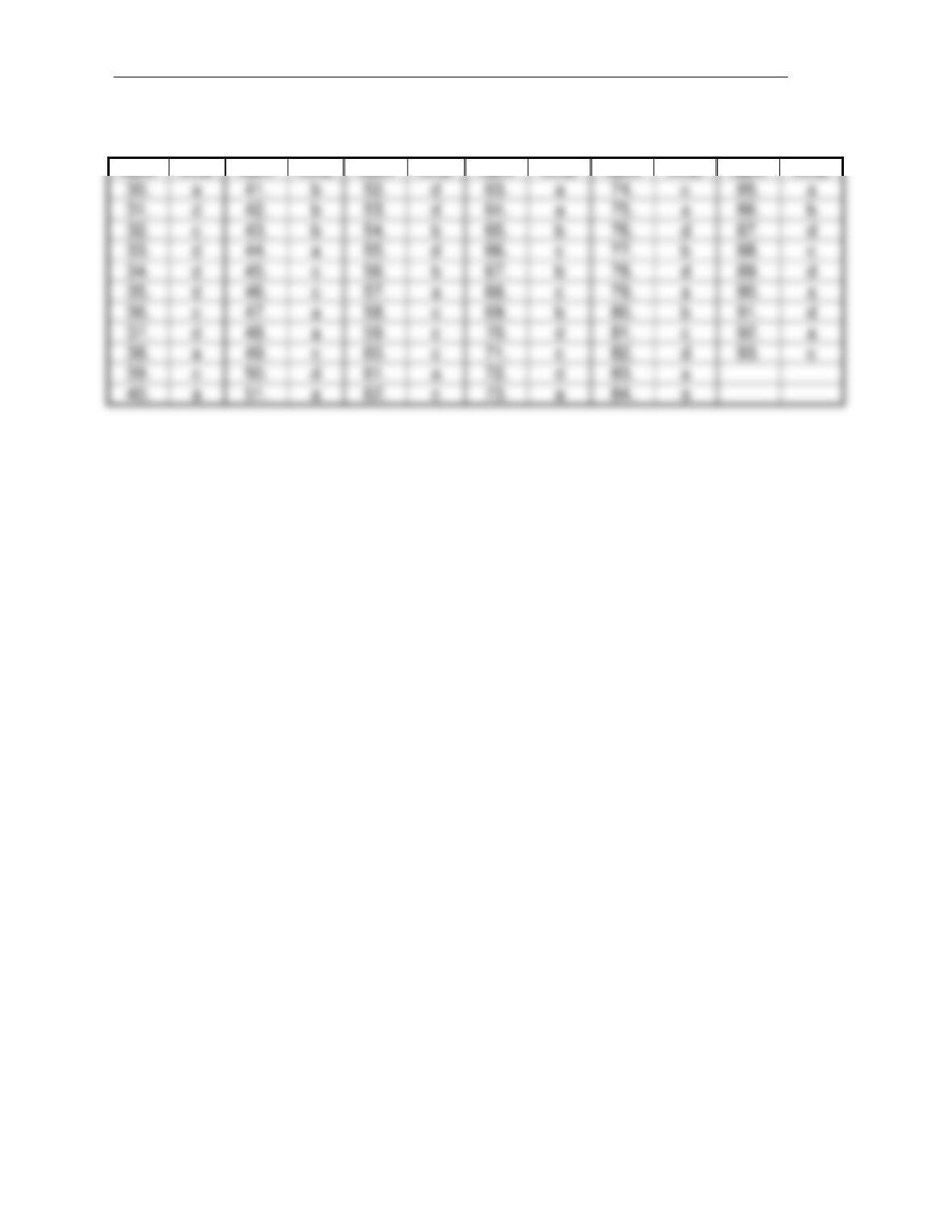
Use the following chart for questions 84–88.
Scenario
Cash flows from
operating activities
Cash flows from
investing activities
Cash flows from
financing activities
1.
+
+
+
2.
+
+
–
3.
+
–
+
4.
+
–
–
5.
–
+
+
6.
–
+
–
7.
–
–
+
8.
–
–
–
84. Based on the chart above which company profile will be fit the cash flow pattern for scenario
1?
a) Successful, but actively relocating using financing from operations with cash from creditors
and shareholders.
b) Struggling, but using cash inflows from the sale of capital assets and new borrowings to
remain in operation.
c) A start-up or struggling company that is able to attract new financing for growth or
reorganization.
d) Struggling, but using existing cash balances to cover losses, purchase capital assets and
repay creditors.
85. Based on the chart above which company profile will be fit the cash flow pattern for scenario
3?
a) Successful and growing, with growth partially financed by creditors and shareholders.
b) Struggling, but using cash inflows from the sale of capital assets and new borrowings to
remain in operation.
c) Successful, with operating activities providing sufficient cash to finance growth and repay
debt or pay dividends.
d) Struggling, but using existing cash balances to cover losses, purchase capital assets and
repay creditors.
86. Based on the chart above which company profile will be fit the cash flow pattern for scenario
5?
a) Successful, but actively relocating using financing from operations with cash from creditors
and shareholders.
b) Struggling, but using cash inflows from the sale of capital assets and new borrowings to
remain in operation.
c) A start-up or struggling company that is able to attract new financing for growth or
reorganization.
d) Struggling, but using existing cash balances to cover losses, purchase capital assets and
repay creditors.

5 – 20 Test Bank for Understanding Financial Accounting, Canadian Edition
87. Based on the chart above which company profile will be fit the cash flow pattern for scenario
8?
a) Struggling and using cash from the sales of capital assets to repay creditors.
b) Struggling, but using cash inflows from the sale of capital assets and new borrowings to
remain in operation.
c) Successful, with operating activities providing sufficient cash to finance growth and repay
debt or pay dividends.
d) Struggling, but using existing cash balances to cover losses, purchase capital assets and
repay creditors.
88. Based on the chart above which company profile will be fit the cash flow pattern for scenario
2?
a) Successful, but actively relocating using financing from operations with cash from creditors
and shareholders.
b) Struggling, but using cash inflows from the sale of capital assets and new borrowings to
remain in operation.
c) Successful, mature company that is downsizing and returning capital to shareholders and
repaying debt.
d) Struggling, but using existing cash balances to cover losses, purchase capital assets and
repay creditors.
89. Companies can resolve the common cash flow challenges by taking all of the following
measures, EXCEPT
a) increasing the amount of capitalization.
b) shortening the cash-to-cash cycle.
c) increasing the rate of growth.
d) decreasing the amount of capitalization.
90. Common cash flow challenges include
a) significant increases in sales volumes.
b) short cash- to-cash cycle.
c) adequate financing.
d) undercapitalization.
91. The term free cash flow is often referred to as
a) IFRS non-financial measure.
b) IFRS financial measure.
c) IFRS performance measure.
d) non-IFRS financial measure.
92. The concept of free cash flow is to measure the amount of cash that a company generates
a) from its operations that is in excess of cash required.
b) from its investing activities that is in excess of cash required.
c) from its financing activities that is in excess of cash required.
d) from its operations that is in below the cash required.

The Statement of Cash Flows 5 – 21
93. The cash flows to total liabilities ratio measures
a) the percentage of a company’s current liabilities that could be met with one year’s investing
cash flows.
b) the percentage of a company’s long term liabilities that could be met with one year’s
operating cash flows.
c) the percentage of a company’s total liabilities that could be met with one year’s operating
cash flows.
d) the percentage of a company’s current liabilities that could be met with one year’s financing
cash flows.
5 – 22 Test Bank for Understanding Financial Accounting, Canadian Edition
ANSWERS TO MULTIPLE CHOICE QUESTIONS
Item
Ans.
Item
Ans.
Item
Ans.
Item
Ans.
Item
Ans.
Item
Ans.
The Statement of Cash Flows 5 – 23
EXERCISES
94. Madison Industries had the following activity during a recent period:
Decrease in inventory $ 15,000
Decrease in accounts receivable 235,000
Decrease in accounts payable 150,000
Net loss (35,000)
Proceeds on sale of capital assets 450,000
Loss on sale of capital assets 50,000
Purchase of patent 125,000
Issued common shares for land 210,000
Depreciation expense 45,000
Instructions
a) Determine the net cash flow from operating activities.
b) Determine the net cash flow from investing activities.
c) Determine the net cash flow from financing activities
Solution (8 min.)
Use the following information for questions 95–96.
The Greendale Corporation prepared the following Statement of Income and comparative
Statement of Financial Positions for 2015:
Greendale CORPORATION
Statement of Income
For the Year Ended December 31, 2015
Sales $1,900,000
Less: Cost of goods sold 980,000
Gross Profit 920,000

5 – 24 Test Bank for Understanding Financial Accounting, Canadian Edition
Less: Depreciation expense—capital assets 200,000
Depreciation expense—patents 27,000
Other operating expenses 197,000
Interest expense 160,000
Loss on sale of land 100,000
Income before taxes 236,000
Income taxes 70,800
Net Income $ 165,200
Greendale CORPORATION
Statement of Financial Position
As at December 31, 2015
Assets 2015 2014
Cash $ 405,200 $ 200,000
Accounts Receivable 180,000 350,000
Temporary Investments 460,000 320,000
Merchandise Inventory 2,336,000 2,090,000
Property, Plant, and Equipment 880,000 800,000
Less: Accumulated Depreciation (760,000) (560,000)
Patents, net a 192,000 a 219,000
Total Assets $3,693,200 $3,419,000
Liabilities and Shareholders’ Equity
Accounts Payable $ 389,000 $ 265,000
Other Accrued Payables 160,000 240,000
Dividends Payable 80,000 80,000
Income Taxes Payable 27,000 42,000
Note Payable (Long-Term) 180,000 560,000
Bonds Payable 900,000 400,000
Common Shares 1,600,000 1,600,000
Retained Earnings a 357,200 a 232,000
Total Liabilities & Shareholders’ Equity $3,693,200 $3,419,000
Additional data
1. Equipment was purchased for $400,000.
2. Cash dividends of $40,000 were paid in 2015.
3. Land was sold for cash proceeds of $220,000.
4. The company sold bonds of $500,000 and made $380,000 of principal payments on notes
payable.
5. Any additional transactions were non-cash transactions and can be ignored for these
exercises.
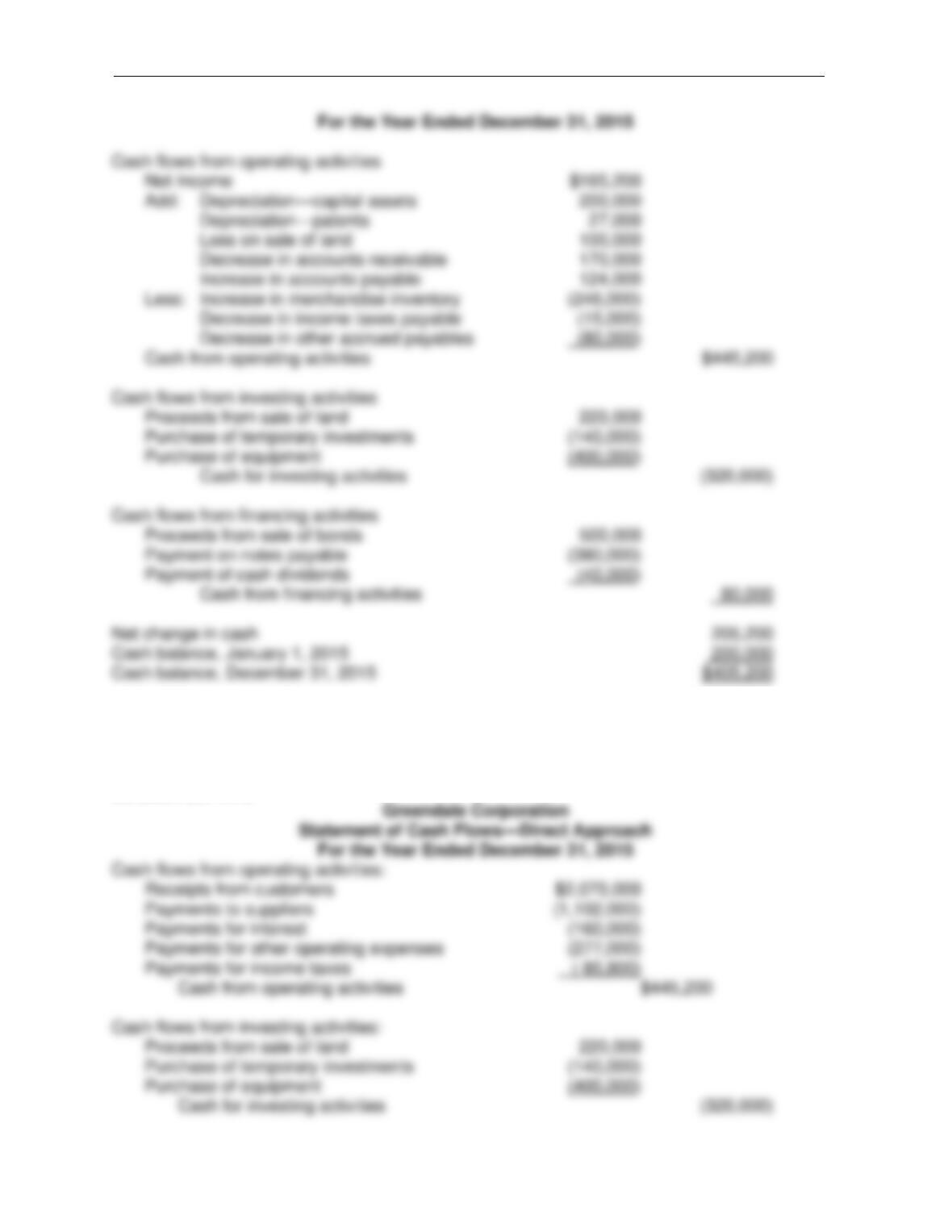
95. Prepare a Statement of Cash Flows for 2015 using the indirect approach.
Solution (25 min.) Greendale Corporation
The Statement of Cash Flows 5 – 25
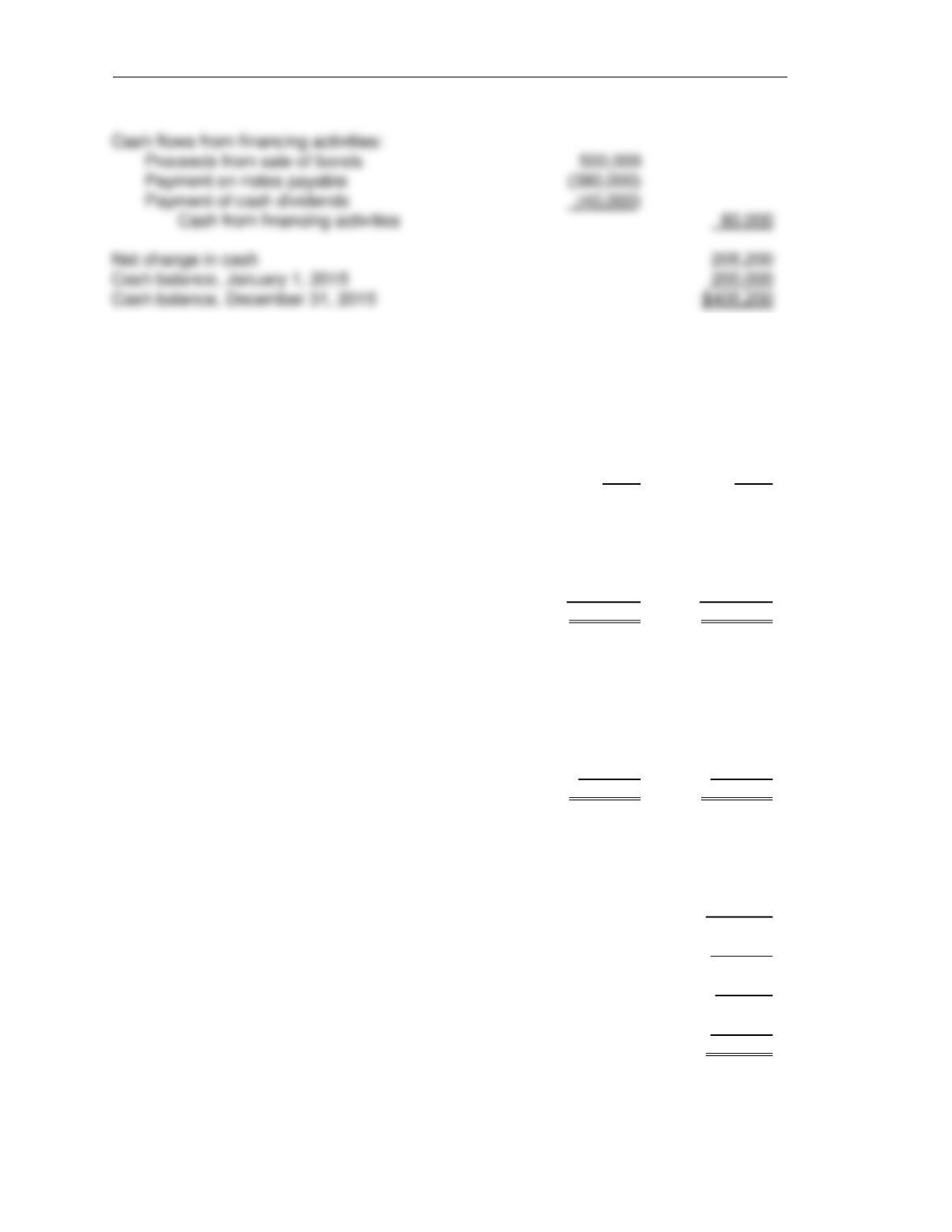
96. Prepare a Statement of Cash Flows for 2015 using the direct approach. Do NOT include the
reconciliation of net income to cash flows from the operating activities schedule.
Solution (25 min.) Greendale Corporation
5 – 26 Test Bank for Understanding Financial Accounting, Canadian Edition
Use the following information for questions 97–98.
The financial statements of McKillop Corp. appear below:
McKillop Corp.
Comparative Statement of Financial Position
December 31
2015 2014
Assets
Cash $ 59,000 $ 23,000
Accounts receivable 31,000 34,000
Merchandise inventory 20,000 15,000
Property, plant, and equipment 50,000 78,000
Accumulated depreciation (20,000) (24,000)
Total $140,000 $126,000
Liabilities and Shareholders’ Equity
Accounts payable $ 15,000 $ 23,000
Income taxes payable 13,000 8,000
Mortgage payable 9,000 33,000
Common shares 39,000 24,000
Retained earnings 64,000 38,000
Total $140,000 $126,000
McKillop Corp.
Statement of Income
Year Ended December 31, 2015
Sales $380,000
Cost of goods sold 290,000
Gross profit 90,000
Operating expenses 36,000
Income from operations 54,000
Interest expense 4,000
Income before income taxes 50,000
Income tax expense 10,000
Net Income $ 40,000
The following additional data were provided:
1. Dividends declared and paid were $14,000.
The Statement of Cash Flows 5 – 27
2. During the year, equipment was sold for $12,000 cash. This equipment cost $28,000
originally and had a carrying amount of $12,000 at the time of sale.
3. Depreciation expense is included in operating expenses.
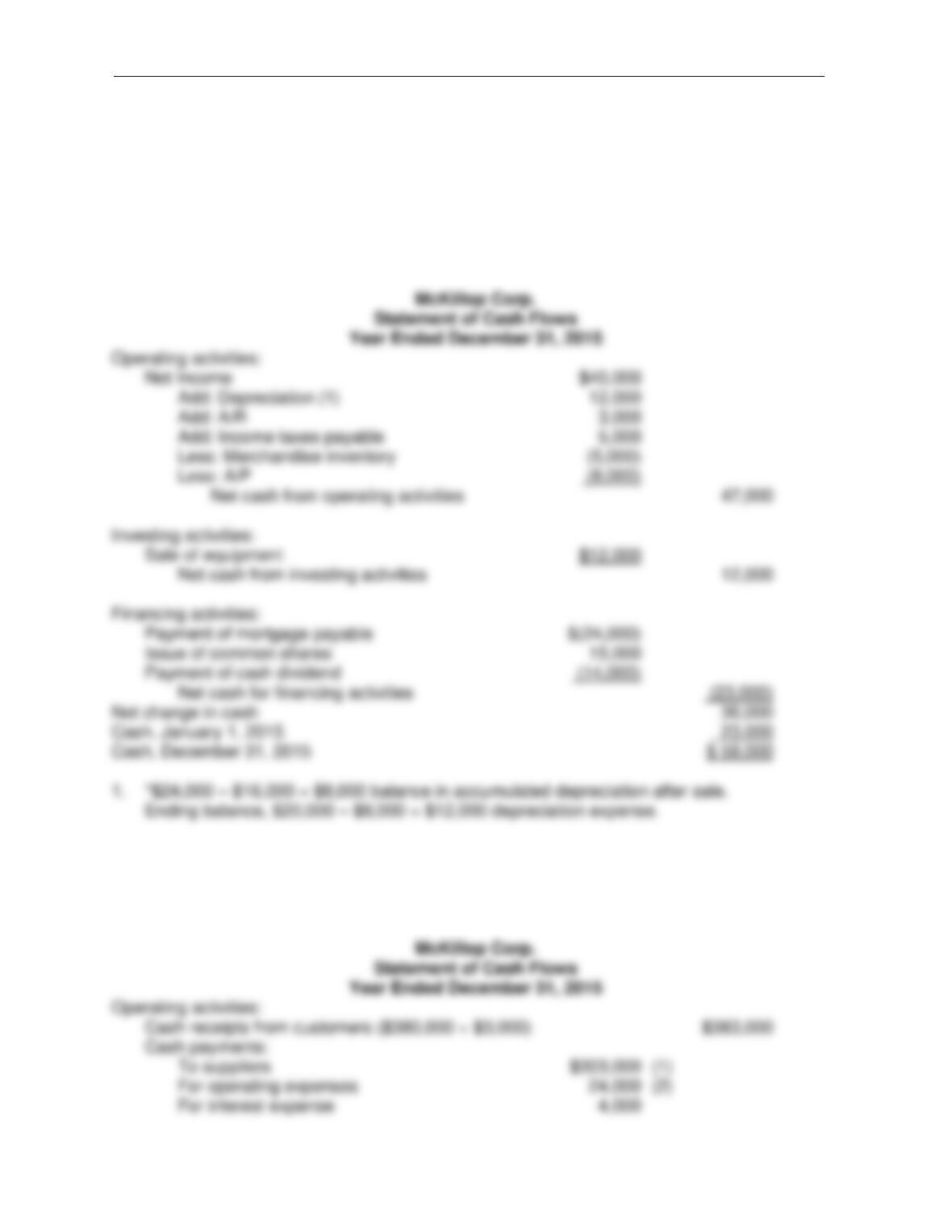
97. Prepare a Statement of Cash Flows using the indirect approach.
Solution (22 min.)
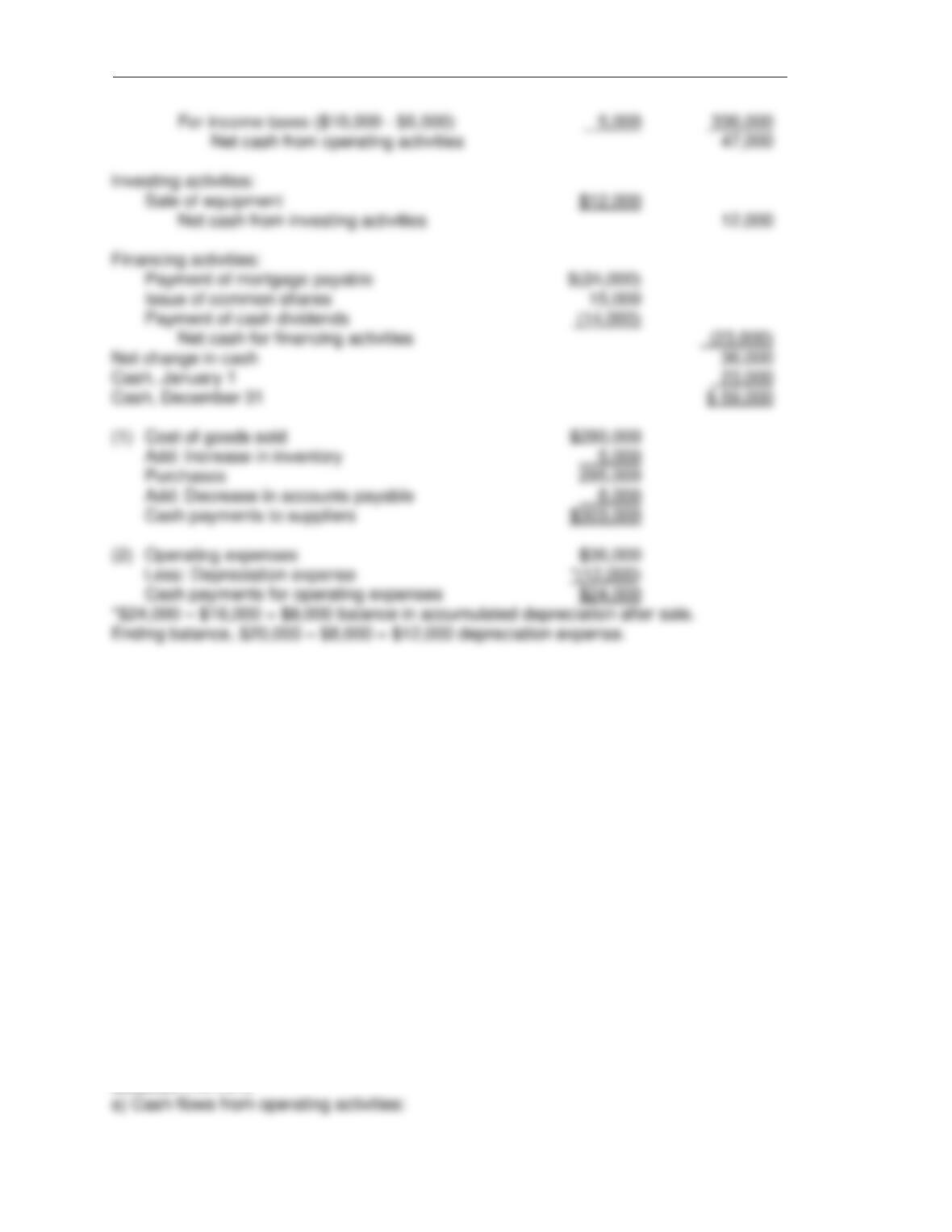
98. Prepare the Statement of Cash Flows using the direct approach.
Solution (22 min.)
5 – 28 Test Bank for Understanding Financial Accounting, Canadian Edition
99. Cambrian Copiers Co. had the following activity during a recent period:
Net income $ 175,000
Depreciation 27,500
Sale of bonds 1,000,000
Decrease in accounts payable 28,000
Decrease in inventory 75,000
Proceeds on sale of capital assets 575,000
Gain on sale of capital assets 37,500
Increase in long-term notes payable 55,000
Decrease in wages payable 71,000
Increase in accounts receivable 22,500
Instructions
a) Prepare the cash flows from operating activities section of the Statement of Cash Flows.
b) Comment on the changes in accounts receivable, accounts payable and inventory for
Cambrian Copiers. Would you normally expect the changes in these three accounts to be
related?
Solution (10 min.)
The Statement of Cash Flows 5 – 29
100. Below is the Statement of Cash Flows for Wilcox Operations Inc. They have just finished
their second year of operation and have approached you, the manager of the local branch of
The Canadian Bank, to ask for a loan.
Wilcox Operations Inc.
Statement of Cash Flows—Indirect Approach
For the Year Ended December 31, 2015
Cash flows from operating activities:
Net income $ 45,000
Add: Depreciation 24,500
Less: Increase in accounts receivable (18,000)
Increase in inventory (71,000)
Increase in prepaid expenses (5,500)
Decrease in accounts payable (4,600)
Cash from operating activities $(29,600)
Cash flows from investing activities:
Proceeds from sale of temporary investments 12,000
Purchase of equipment (95,000)
Cash for investing activities (83,000)
Cash flows from financing activities:
Proceeds from issue of common shares 75,000
Payment of cash dividends (25,500)
Cash from financing activities 49,500
Decrease in cash (63,100)
Cash balance, January 1, 2015 58,000
Cash balance, December 31, 2015 $(5,100)
Instructions
a) Do you think Wilcox Operations Inc. has had a successful year? Support your answer.
5 – 30 Test Bank for Understanding Financial Accounting, Canadian Edition
b) What areas are of concern to you when reviewing their Statement of Cash Flows?
c) What other information would you like? Are there any conditions you would require before
you granted them a loan?
Solution (20 min.)
101. Campbell Corp.
Comparative Statement of Financial Position
December 31
2015 2014
Assets
Cash $ 59,000 $ 23,000
Accounts receivable 31,000 34,000
Merchandise inventory 20,000 15,000
Property, plant, and equipment 50,000 78,000
Accumulated depreciation (20,000) (24,000)
Total $140,000 $126,000
Liabilities and Shareholders’ Equity
The Statement of Cash Flows 5 – 31
Accounts payable $ 15,000 $ 23,000
Income taxes payable 13,000 8,000
Mortgage payable 9,000 33,000
Common shares 39,000 24,000
Retained earnings 64,000 38,000
Total $140,000 $126,000
Campbell Corp.
Statement of Cash Flows
Year Ended December 31, 2015
Operating activities
Net Income $40,000
Add: Depreciation (1) 12,000
Add: A/R 3,000
Add: Income taxes payable 5,000
Less: Merchandise inventory (5,000)
Less: A/P (8,000)
Net cash from operating activities 47,000
Investing activities
Sale of equipment $12,000
Net cash from investing activities 12,000
Financing activities
Payment of mortgage payable $(24,000)
Issue of common shares 15,000
Payment of cash dividend (14,000)
Net cash for financing activities (23,000)
Net change in cash 36,000
Cash, January 1, 2015 23,000
Cash, December 31, 2015 $ 59,000
Instructions
Calculate the cash flows to total liabilities ratio.
Solution

5 – 32 Test Bank for Understanding Financial Accounting, Canadian Edition
MATCHING
102. Listed below is a series of terms and descriptions concerning the Statement of Cash Flows
(SCF). Match each description to the appropriate term by placing its letter in the space provided.
TERMS
A. Non-cash transaction F. Reconciliation approach
B. Direct approach G. Purpose of the SCF
C. Components of the SCF H. Investing activity
D. Cash equivalent I. Indirect approach
E. Financing activity J. Operating activity
DESCRIPTIONS
_____ 1. Operating, investing and financing activities
_____ 2. Highly liquid, risk-free, short-term investments
_____ 3. Payment of dividends
_____ 4. Another name for the indirect approach
_____ 5. Payments to suppliers
_____ 6. Exchange long-term debt for common shares
_____ 7. Sale of plant assets
_____ 8. Assist users in assessing the company’s ability to generate cash flows
_____ 9. Presents a company’s cash flows by cash receipts and cash payments
_____ 10. Adjust net income for non-cash expenses
Solution (5 min.)

The Statement of Cash Flows 5 – 33
103. Listed below are the various types of activities or transactions reported on the Statement of
Cash Flows, followed by a series of transactions. Match each transaction to its related activity
by placing the appropriate letter in the space provided. Assume the indirect method is used.
O = Operating activity F = Financing activity
I = Investing activity N = Non-cash transaction
_____ 1. Payment of cash dividends
_____ 2. Collection from customers
_____ 3. Proceeds from sale of patent
_____ 4. Payment of interest
_____ 5. Purchase of land with common shares
_____ 6. Proceeds from the sale of long-term investments
_____ 7. Depreciation expense
_____ 9. Prepayment of insurance policy
_____ 10. Purchase of equipment
______11. Gain / loss of the disposal of a non-current asset
______12. Proceeds on the sale of equipment
______13. Declaration of a dividend payment
Solution (5 min.)

5 – 34 Test Bank for Understanding Financial Accounting, Canadian Edition
The Statement of Cash Flows 5 – 35
SHORT-ANSWER ESSAY QUESTIONS
104. A friend of yours who is taking a financial accounting course comes to you and wants to
know what the purpose of the Statement of Cash Flows is and how it assists internal and
external users.
Instructions
Write an explanation to your friend.
Solution (8 min.)
105. Explain the relationship between the Statement of Cash Flows and the other financial
statements, the Statement of Income and the Statement of Financial Position.
Solution (10 min.)
106. Identify the three major types of activities that are presented in a Statement of Cash Flows
and describe some of the typical transactions included in each category.
Solution
5 – 36 Test Bank for Understanding Financial Accounting, Canadian Edition
107. The Statement of Cash Flows must be prepared on a cash and cash equivalents basis.
Instructions
a) Define a cash equivalent for purposes of the Statement of Cash Flows and provide two
examples.
b) Explain why cash and cash equivalents are combined for purposes of preparing the
Statement of Cash Flows even though cash equivalents are not really cash.
Solution (8 min.)
108. What is the preferred method of Statement of Cash Flows preparation by standard setters?
Why is this the preferred method?
Solution (5 min.)
109. The operating activities section of the Statement of Cash Flows can be prepared using
either the direct approach or the indirect approach.
Instructions
a) List three cash inflows reported under the direct approach.
b) List three cash outflows reported under the direct approach.
c) List three additions reported under the indirect approach.
d) List three deductions reported under the indirect approach.
Solution (5 min.)
The Statement of Cash Flows 5 – 37
110. Are there investing and financing activities that do NOT appear on the Statement of Cash
Flows? If so, please provide some examples.
Solution
5 – 38 Test Bank for Understanding Financial Accounting, Canadian Edition
ESSAY QUESTIONS
111. When assessing the performance of a company, users of financial statements often look at
the relationship between net income and cash from operations.
Instructions
a) Explain how it would be possible for a company to report a positive net income on the
Statement of Income but a net cash outflow in cash from operations on the Statement of
Cash Flows. Does the cash outflow in operations indicate that the company is in trouble?
b) Would the opposite situation be possible? Could a company that reported a loss on the
Statement of Income report a positive cash flow from operations on the Statement of Cash
Flows? Explain.
Solution (15 min.)
112. A friend who started a business during the last year has come to you with the following
statement: “My accountant is preparing our first financial report and she told me one of the
statements was a Statement of Cash Flows. She also told me that my business is facing cash
flow problems.”
Instructions
Prepare a reply to your friend. Include three causes of cash flow problems and solutions to
solve the cash flow problems. Explain how the Statement of Cash Flows will assist in managing
the business.
Solution (10 min.)
The Statement of Cash Flows 5 – 39
5 – 40 Test Bank for Understanding Financial Accounting, Canadian Edition
LEGAL NOTICE