Elements of Ecology, 9e (Smith)
Chapter 5 Adaptation and Natural Selection
5.1 Short Answer Questions
1) An organism’s structure and ________ reflect adaptations to its particular environment.
2) ________ is the differential success of individuals in a population in response to
environmental conditions.
3) A(n) ________ is any heritable behavioral, morphological, or physiological trait of an
organism that has evolved over a period of time by the process of natural selection.
4) The alternate forms of a gene are called ________.
5) A(n) ________ individual has the same alleles at the same locus on homologous
chromosomes.
6) All of the DNA in a cell is collectively called the ________.
7) The outward appearance of an organism for a given characteristic is called its ________.
8) If the physical expression of a heterozygous individual is intermediate between those of the
homozygotes, the alleles are ________.
9) Phenotypic characteristics that have a continuous distribution are considered to be ________
traits.
10) When genetic variation occurs among subpopulations of the same species, it is known as
genetic ________.
11) The sum of genetic information (alleles) across all individuals in a population at any one
time is called the ________.
12) Reversible phenotypic changes in an individual organism in response to changing
environmental conditions are referred to as ________.
13) The sum of genetic information (alleles) across all individuals in the population is referred to
as the ________.
14) The phenotypic trait that selection acts upon directly is referred to as the ________ of
selection.
15) The type of natural selection in which the mean value of a trait is shifted toward one extreme
is called ________ selection.
16) ________ are heritable changes in a gene or chromosome.
17) ________ mating occurs when individuals choose mates nonrandomly with respect to some
phenotypic trait.
18) ________ is the mating of individuals in the population that are more closely related than
expected by random chance.
19) A(n) ________ is a measurable, gradual change over a geographic region in the average
value of a trait.
20) A(n) ________ is a population that has adapted to its unique local environmental conditions.
21) A population of a species that is distinguishable from other populations by one or more
characteristics is referred to as a(n) ________.
22) The process by which one species gives rise to multiple species that exploit different features
of the environment is called ________.
5.2 Multiple-Choice Questions
1) The mechanism of evolution proposed by Charles Darwin in The Origin of Species is
A) acclimatization.
B) natural selection.
C) acquired inheritance.
D) adaptation.
2) The fitness of an individual is measured by
A) the proportion of heterozygous alleles within its genome.
B) its body size.
C) its efficiency in obtaining energy.
D) the proportionate contribution it makes to future generations.
3) The specific traits of a particular organism enabling it to survive, grow, and reproduce within
a given environment are called
A) mutations.
B) genes.
C) adaptations.
D) phenotypes.
4) A gene is
A) a stretch of DNA coding for a polypeptide chain (sequence of amino acids).
B) a microscopic, threadlike body within a cell.
C) any heritable behavioral, morphological, or physiological trait of an organism.
D) all of the DNA in a cell.
5) The alternate forms of a gene are called
A) chromosomes.
B) loci.
C) alleles.
D) genomes.
6) The color of a flower is controlled by two alternative alleles at a single locus, R (red) and r
(white). If an individual has the Rr alleles, it is considered to be
A) homozygous dominant with a red color.
B) heterozygous with a red color.
C) heterozygous with a white color.
D) homozygous recessive with a white color.
7) An allele that completely masks the effect of another allele is considered
A) codominant.
B) dominant.
C) ineffective.
D) recessive.
8) Which of the following characteristics is an example of a qualitative trait?
A) flower color
B) arm length
C) body weight
D) root length
9) The tongue length of an animal is controlled by two alternative alleles at a single locus, L
(long) and l (short). If an individual has parents that are both homozygous dominant, it will be
A) homozygous dominant with a long tongue.
B) heterozygous with a long tongue.
C) heterozygous with a short tongue.
D) homozygous recessive with a long tongue.
10) Traits that have a continuous distribution are known as
A) quantitative traits.
B) qualitative traits.
C) phenotypic traits.
D) genotypic traits.
11) The gene pool refers to all of the genetic information within a
A) cell.
B) individual.
C) population.
D) species.
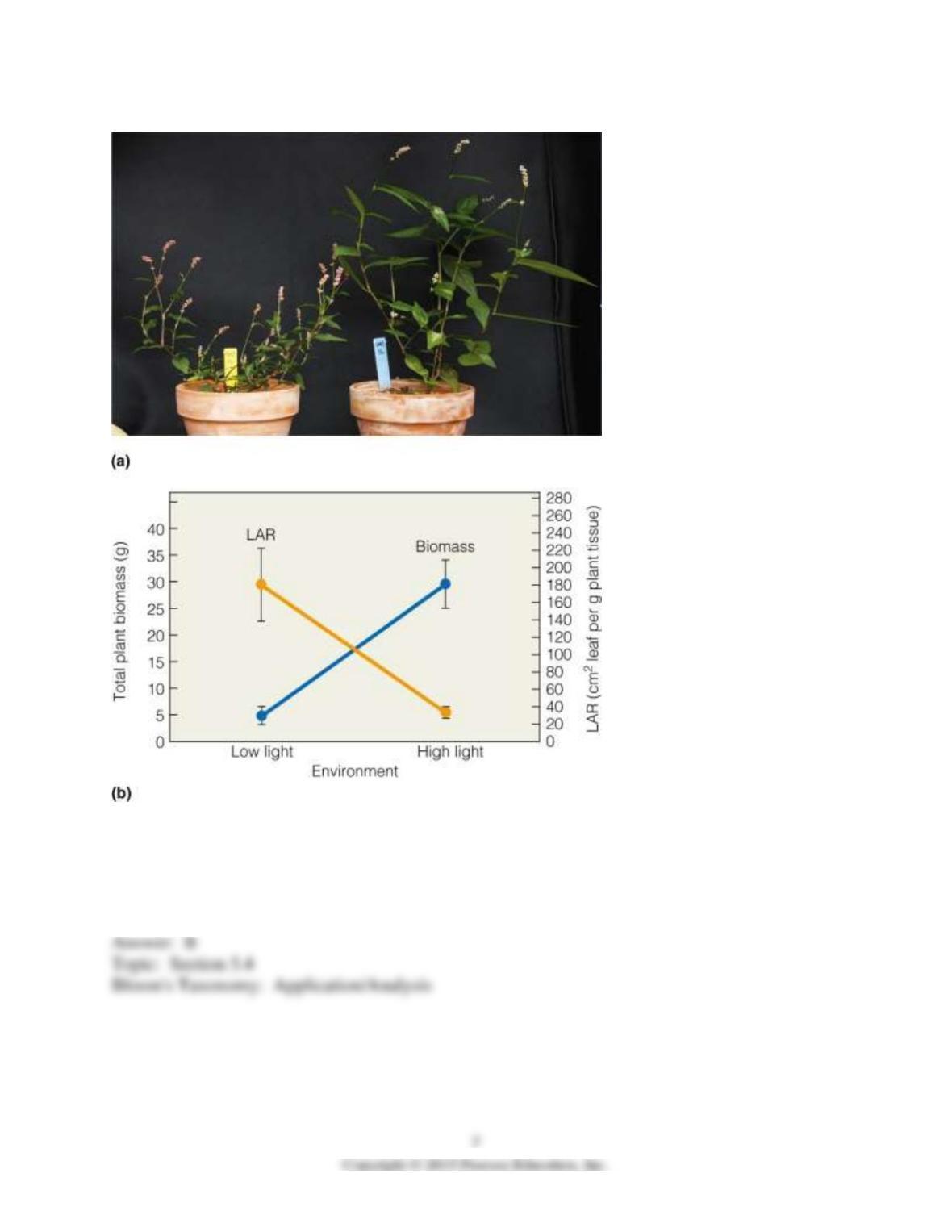
12)
Plants grown under a medium light condition would exhibit how much biomass?
A) 5g
B) 20g
C) 30g
D) 45g
13) The expression of different phenotypic traits for a given genotype under different
environmental conditions is referred to as
A) acclimation.
B) phenotypic plasticity.
C) developmental plasticity.
D) habituation.
14) If a population has an allele frequency of 1.0, you would say that
A) the allele frequency is ideal.
B) genetic variation of that allele is low.
C) genetic variation of that allele is high.
D) that allele is under selection.
15) Identical twin raccoons are raised in different environments and yet behave very differently.
This is an example of
A) heterozygous alleles.
B) the norm of reaction.
C) genetic differentiation.
D) acclimation.
16) Which of the following represents acclimation?
A) Deeper beaks evolve in a population.
B) Marine lionfish are able to tolerate freshwater in estuaries.
C) Tropical trees grow taller than temperate ones to compete for light.
D) Poisonous animals are brightly colored to ward off predators.
17) Researchers Rosemary and Peter Grant have discovered that beak size frequency of
Galápagos Island medium ground finch populations varies with all the following, except
A) rainfall.
B) seed hardness.
C) seed size.
D) seed color.
18) If birds with larger beaks are favored by the environment, it is likely that ________ selection
will occur.
A) directional
B) disruptive
C) stabilizing
D) standardizing
19) Measurements of bill length in a population of seed-eating birds reveals two distinct groups:
small-billed individuals feeding on soft-shelled seeds and large-billed individuals feeding on
hard-shelled seeds. This bimodal distribution most likely resulted from
A) stabilizing selection.
B) natural selection.
C) directional selection.
D) disruptive selection.
20) Several years of heavy precipitation occur on the Galápagos Islands. What do you predict
would happen to the beaks of Darwin’s medium ground finches?
A) Populations would crash.
B) Disruptive selection on seed size would occur.
C) Midparent beak size would decrease.
D) Offspring beak depth would increase.
21) Peter and Rosemary Grant are known for their work on
A) Tenebrionid beetles.
B) marine iguanas.
C) Galápagos tortoises.
D) Darwin’s finches.
22) What is the primary original source of genetic variation in a population?
A) mutation
B) genetic drift
C) blending inheritance
D) cloning
23) Under which of the following conditions would genetic drift exert the greatest influence?
A) a population with a large range
B) a very small population
C) a very large population
D) a population that has access to sufficient resources
24) The movement of genes between populations is referred to as
A) mutation.
B) migration.
C) genetic drift.
D) gene flow.
25) The effect of positive assortative mating is to
A) increase the number of homozygotes in the population.
B) increase the number of heterozygotes in the population.
C) reduce the number of individuals with diseases in the population.
D) increase the fertility of individuals in the population.
26) In tiger salamanders one phenotype is cannibalistic while another is not. Both are stable
strategies. Which form of selection is best represented by this scenario?
A) stabilizing
B) directional
C) disruptive
D) proportional
27) Squirrels tend to have larger body sizes at higher latitudes. This could be an example of
A) acclimation.
B) positive assortative mating.
C) a cline.
D) the Hardy-Weinberg principle.
28) A gradual change in phenotype across an environmental gradient, such as white-tailed deer
changing gradually in size from large in the north to small in the south, is referred to as
A) migration.
B) a subspecies.
C) a cline.
D) an ecotype.
29) Geographic isolates of a particular species that differ from other populations by one or more
characteristics are considered to be
A) clines.
B) subspecies.
C) evolutionary “dead ends.”
D) ecotypes.
30) Individual beak size of individual finches of the Galápagos Islands
A) may change during a bird’s lifetime.
B) will always match the beak size useful for seed foraging.
C) has nothing to do with overall population characteristics.
D) will greatly influence individual survival.
31) The Galápagos Islands are inhabited by 13 species of Darwin’s finches that evolved from a
single species. This is an example of
A) clinal variation.
B) adaptive radiation.
C) directional selection.
D) genetic drift.
32) The simplest response an individual organism can make to a change in environmental
conditions is to
A) remain still.
B) move to a more suitable location.
C) produce offspring that are better suited to the new conditions.
D) reduce foraging activity.
33) According to the Hardy-Weinberg principle, which of the following must be true for gene
frequencies in a population to remain the same?
A) Mating is random.
B) Mutations occur consistently.
C) The population is small.
D) Natural selection occurs.
34) In the Hardy-Weinberg equation P + H + Q = 1, what does “Q” represent?
A) total number of individuals in the population
B) frequency of heterozygotes
C) frequency of dominant homozygotes
D) frequency of recessive homozygotes
35) A transgenic organism is one that
A) changes gene frequency over time.
B) provides gene information to another organism.
C) changes gender over time.
D) has received genetic information from another organism.
36) Bt corn is
A) adapted to resist Bt pesticides.
B) grown only on no till farms.
C) a variety that possesses genes from a bacterium.
D) a drought tolerant form of corn.
37) In a population with a q allele frequency of 0.6, what would the frequency of allele p be?
A) 0.6
B) 0.5
C) 0.36
D) 0.4
38) What is the allele frequency of q in a population with genotypic frequencies of P = 0.3, H =
0.4, and Q = 0.3?
A) 0.3
B) 0.5
C) 0.6
D) 0.9
5.3 True/False Questions
1) Charles Darwin advocated a theory of evolution that involved individuals acquiring useful
characteristics during their lifetimes.
2) A trait cannot be subject to natural selection unless it is heritable.
3) An individual evolves during its lifetime.
4) Genes are arranged in threadlike bodies called chromosomes.
5) The position occupied by a gene on the chromosome is called the locus.
6) Most traits are influenced by only one locus.
7) The expression of most phenotypic traits is affected to varying degrees by the environment.
8) Changes due to developmental plasticity are reversible.
9) The selective agent is the environmental cause of fitness differences among organisms with
different phenotypes.
10) Disruptive selection favors individuals possessing traits near the mean value of a population.
11) Most mutations are beneficial.
12) Inbreeding is usually beneficial to a population because it increases genetic diversity.
13) Gene flow is restricted between subspecies because of some extrinsic barrier, such as rivers
or mountain ridges.
14) Ecotypes are variants within a species that are adapted to local environmental conditions.
15) Variation within and among species would increase dramatically if the environment were
homogeneous.
16) The characteristics maximize the fitness of an individual under one set of environmental
conditions generally limit its fitness under a different set of conditions.
5.4 Essay Questions
1) Define an adaptation and describe how it relates to natural selection.
2) Use an example to explain how and why the genotype and environment influence the
phenotype of an organism.
3) Describe the differences between stabilizing, disruptive, and directional selection.
4) According to the research of Beren Robinson, how would you expect stickleback species to
differ between two lakes, one of which supports two species of stickleback and the other has a
single species?
5) Explain how the effects of mutation, genetic drift, and gene flow influence the genetic
variation of a population.
6) Define a cline and a subspecies, and explain how they are affected by gene flow.
7) Explain the difference between phenotypic plasticity and adaptation, and suggest how you
would collect data that would distinguish between them.