Environment: Science Behind the Stories, 2e Cdn. Ed. (Withgott)
Chapter 5 Species Interactions and Community Ecology
5.1 Graph and Figure Interpretation Questions
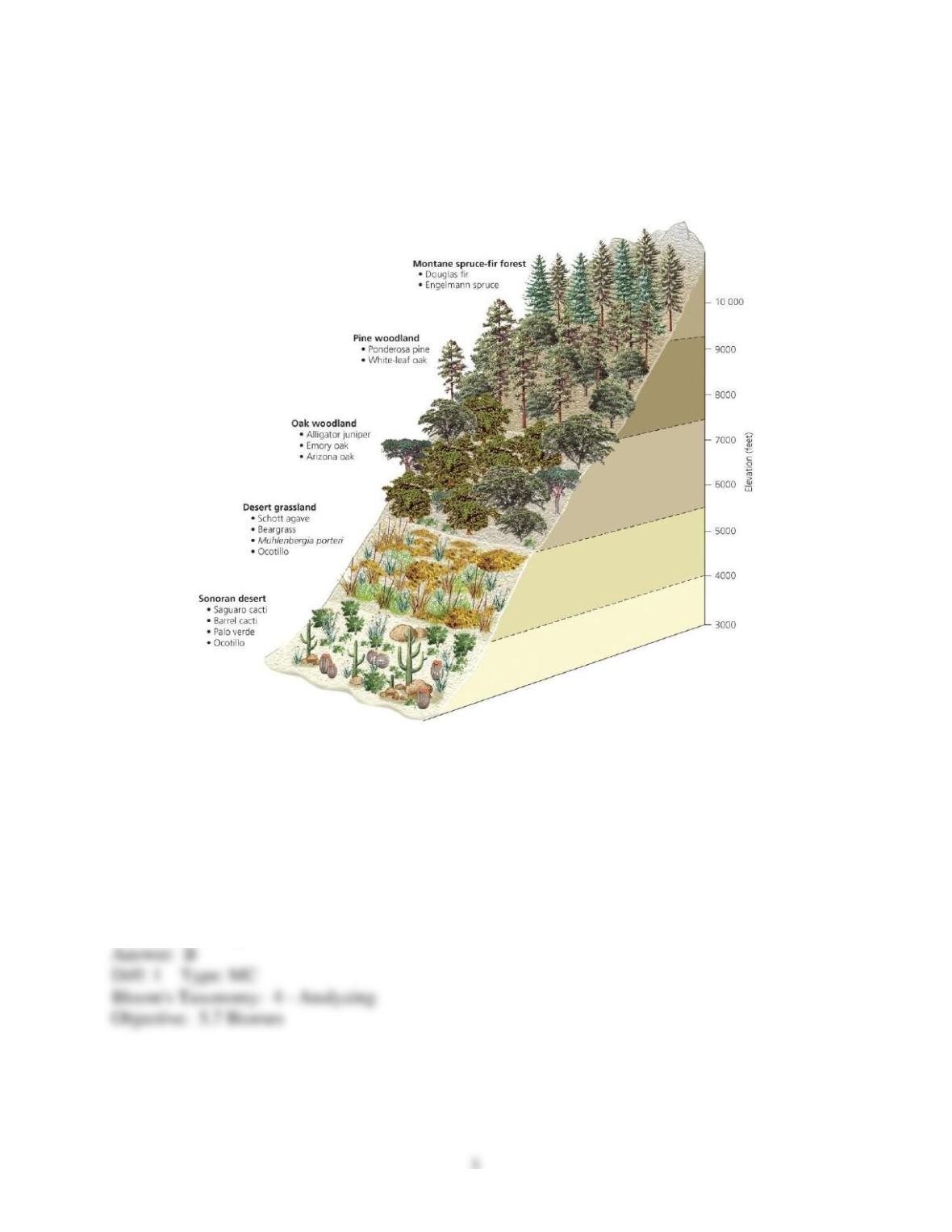
Figure 5.1
Use Figure 5.1 to answer the following questions.
1) Refer to Figure 5.1. What does the diagram illustrate?
A) Biomes at the highest altitudes are similar to biomes near the equator.
B) Biomes at the highest altitudes are similar to biomes near the poles.
C) Rules regarding climate and biomes do not apply to mountainous regions.
D) Increasing altitudes demonstrate the stages of succession.
E) Mountain ranges contain all of Earth’s biomes.

2) Refer to Figure 5.1. The montane spruce-fir forest in this figure most closely resembles a
________.
A) boreal forest
B) prairie
C) temperate rainforest
D) temperate deciduous forest
E) chaparral
3) Refer to Figure 5.1. Organisms most likely to be found at the bottom (left) of this figure would
be ________.
A) loosestrife
B) frogs and fish
C) wolves
D) bisons
E) snakes

5.2 Matching Questions
Match the following.
A) temperate rainforest
B) parasitism
C) temperate deciduous forest
D) savanna
E) amensalism
F) temperate grassland
G) tropical dry forest
H) coevolution
I) commensalism
J) chaparral
K) desert
L) predation
M) boreal forest
N) tropical rainforest
1) Describes the region in southeastern Canada, which is characterized by stable precipitation
and moderate seasonal temperature variation
2) Describes the region west of the Great Lakes, which is characterized by little precipitation,
thick organic soils, and extreme temperature differences between winter and summer
3) Describes the Pacific Northwest of Canada, which is characterized by heavy rainfall and
monthly average temperatures between 8 and 24°C
4) Describes the terrestrial biome bordering the Mediterranean Sea, which is characterized by
mild wet winters, and warm dry summers

5) Describes a tropical biome with a dry and a wet season, and with very warm temperatures
year-round
6) Describes biome in Egypt; characterized by very sparse rainfall and large variations in
temperature between day and night, and between seasons
7) Hosts and parasites repeatedly evolve new responses to one another in this process
8) Describes a sea lamprey’s relationship to fish
9) The type of relationship that occurs when large desert plants create shadow and leaf litter that
benefit other plant species
Diff: 2 Type: MA
Bloom’s Taxonomy: 2 – Understanding
Objective: 5.1 Species interactions
5.3 Short Answer Questions
1) Define the term invasive species and give two examples from your textbook.
2) Explain briefly the mutualistic relationship between plant roots and some fungi.
3) Briefly explain the restoration of Garry oak-associated ecosystems at Chatterton Hill Park in
Victoria, British Columbia.
4) Briefly explain ecological restoration of the Great Plains.
5) Briefly describe the factors that determine characteristics of aquatic biomes.
6) Briefly describe what is meant by a pioneer species.

7) Removal of a ________ from an ecological community has a particularly strong or far-
reaching impact on food webs.
8) When multiple organisms seek the same limited resource, their relationship is said to be one
of ________.
9) The relationship between flowering plants and bees is best described as ________.
10) Explain briefly how killer whales could be linked to the disappearance of underwater kelp
“forests” off Alaska.
11) The relationship between flowering plants and caterpillars is best described as ________.
12) What is the difference between community resistance and resilience?

7
13) What determines which biome covers any particular portion of the planet?
5.4 Multiple-Choice Questions
1) Zebra mussels ________.
A) are native to Canada
B) were introduced into the United States in the early 1900s
C) are presently restricted to the Great Lakes and the Hudson River, but they are expected to
spread rapidly in the near future
D) are clogging water intake pipes at factories, power plants, and wastewater treatment facilities
E) excrete waste that facilitates algal blooms and subsequent eutrophication of lakes
2) Individuals of a single species fighting over access to a limiting resource is one example of
________.
A) resource partitioning
B) competitive exclusion
C) interspecific symbiosis
D) interspecific competition
E) intraspecific competition
3) Zooplankton populations in Lake Erie and Lake Ontario have declined by up to 70% since the
arrival of zebra mussels because ________.
A) zebra mussels prey on zooplankton and its food, phytoplankton
B) zebra mussels carry a parasite that kills zooplankton
C) zebra mussels feed on cyanobacteria, which zooplankton need as a food source
D) zebra mussels block sunlight penetration into lakes and thus prevent zooplankton from
photosynthesizing
E) waste from zebra mussels promotes bacterial growth that kills zooplankton
4) By definition, parasites ________ their host.

A) kill
B) are much smaller than
C) feed on and harm
D) cannot live independently of
E) never kill
5) Orchids require tree limbs for support, but do not harm the trees. This demonstrates ________.
A) facilitation
B) commensalism
C) amensalism
D) mutualism
E) allelopathy
6) ________ capture solar energy and use photosynthesis to produce sugars.
A) Producers
B) Primary consumers
C) Secondary consumers
D) Detritivores
E) Heterotrophs
7) Gazelles grazing on grass in savannah are ________.
A) producers
B) primary consumers
C) secondary consumers
D) detritivores
E) decomposers

8) Zooplankton-eating fish are ________.
A) producers
B) primary consumers
C) secondary consumers
D) detritivores
E) herbivores
9) Which of the following is true about top predators?
A) They are likely to be keystone species.
B) They are likely to be herbivores.
C) They are likely to be producers.
D) They include bacteria and fungi.
E) Their removal increases biodiversity.
10) Secondary succession ________.
A) requires primary succession to precede it
B) occurs after a volcano spreads lava across a landscape
C) occurs after a fire or flood
D) typically begins with lichen colonizing rock
E) is very predictable because it always ends in the formation of a climax community
11) The most important cause for the similarity between altitudinal and latitudinal zonations of
biomes is the the similarity in ________.
A) temperature
B) UV radiation
C) precipitation
D) atmospheric pressure
E) oxygen levels

12) Which terrestrial biome has the most biodiversity?
A) temperate deciduous forest
B) prairie
C) tropical rainforest
D) temperate rainforest
E) boreal forest
13) Desert and tundra both ________.
A) have lithosols
B) have wide temperature between day and night
C) lack insects
D) have relatively low precipitation
E) lack shrubs
14) Taiga and tundra both ________.
A) lack trees
B) have low temperatures in winter
C) lack birds
D) have many burrowing rodents
E) have a similar amount of precipitation in summer
15) The statement “hiking up a mountain in the southwestern United States is like walking from
Mexico to Canada” is meant to demonstrate that ________ change(s) as you change altitude and
latitude.
A) biomes
B) oxygen levels
C) carbon dioxide levels
D) levels of industrial air pollutants
E) human population density

16) ________ are typical primary consumers in a temperature deciduous forest.
A) Snakes
B) Deer
C) Shelf fungi
D) Bison
E) Wolves
17) A climax community always ________.
A) is achieved once the succession gets under way
B) remains in place until a disturbance restarts succession
C) applies to terrestrial biomes
D) applies to aquatic biomes
E) returns to its original state
18) Herbivory is a type of ________.
A) competition
B) mutualism
C) neutralism
D) amensalism
E) predation
19) Benthic organisms in the Great Lakes ________.
A) live near the water’s surface
B) occupy a different depth zone than lanthic organisms
C) benefit from the presence of zebra mussels
D) include phytoplankton
E) include zooplankton