Chapter 5 – Presentation of financial position and the worksheet
TRUE/FALSE
1. Liquidity refers to the ease with which assets can be converted to cash in the normal course of
business.
2. The historical cost assumption requires that an asset that is used for personal use and not for
business use should be recorded at cost in the business balance sheet.
3. The business entity assumption requires that an asset that is used for personal use and not for
business use should not be recorded in the business balance sheet.
4. A balance sheet provides information on the liquidity of the entity.
5. An operating cycle may exceed 12 months and be longer than an accounting cycle.
6. A mortgage payable that had only 12 months left before due for repayment would be reclassified
from a non-current liability to a current liability.
7. A piece of equipment purchased for resale within the entity’s operating cycle would be classified
as a current asset.
8. Current assets are always classified according to their nature and not their function.
9. To be classified as a current liability, a debt must be expected to be paid within the current
accounting period or within the entity’s operating cycle, whichever is the longer.
10. In the situation where an entity is insolvent, equity holders will be paid only whatever remains
after all liabilities are paid.
11. The balance sheet equation can be represented as: Assets – Liabilities = Equity
12. The ‘net assets’ of a business is equal to current assets plus current liabilities.
13. In relation to the format of a balance sheet, large and complex organisations will summarise assets
under broad headings.
14. If assets increase, then, applying the principle of duality, we must increase liabilities, decrease
another asset or increase owners’ equity.
15. The worksheet illustrates the basics underlying double-entry bookkeeping.
16. A double-entry error will cause an imbalance in the worksheet which is twice the amount recorded.
17. If a worksheet does not balance and the imbalance is not caused by a transposition, single-entry or
double-entry error, then it must be an addition or subtraction error.
18. An addition or subtraction error will cause the worksheet to be out of balance by half the amount of
the transaction.
MULTIPLE CHOICE
1. Which of the following statements is incorrect?
A.
A balance sheet reports assets, liabilities and equity at a point in time.
B.
The exclusion of an asset from the business balance sheet because it is for private use is
due to the going concern assumption.
C.
The average period between the purchase of merchandise and the conversion of this
merchandise back into cash is the operating cycle.
D.
In order for a resource to be classified as an asset of the entity, the benefits must accrue to
the entity.
2. A balance sheet is a statement that shows the resources controlled and the obligations owed by an
entity:
A.
in the previous financial year.
B.
for the financial year.
C.
for the accounting period.
D.
at a point in time.
3. Which of the following best describes the purpose of the balance sheet?
A.
To summarise assets and liabilities for the accounting period.
B.
To report the inflows and outflows of cash.
C.
To balance current period revenues with those of the previous period.
D.
To report assets, liabilities and owner’s equity as of a specific date.
4. The most liquid type of asset is:
A.
bills receivable.
B.
cash.
C.
investment in listed shares.
D.
inventory.
5. Which of the following best represents examples of liquid assets?
A.
Cash and office equipment.
B.
Cash and accounts receivable.
C.
Cash and inventory.
D.
Cash and prepaid assets.
6. Which statement below is true about a company’s operating cycle?
A.
It may not exceed one year.
B.
It must be one year.
C.
It may be longer than a year.
D.
It is always longer than a year.
7. Non-current assets are best described as:
A.
assets that extend benefits beyond the coming financial year or operating cycle.
B.
tangible assets that extend benefits beyond the coming year or operating cycle, whichever
is longer.
C.
assets that are depreciated for a maximum of 40 years.
D.
assets that provide economic benefits over the coming year.
8. Gibson, Inc. a retailer, reports the following information:
Accounts Payable
$600
Accounts Receivable
$5200
Cash
7000
Loan Payable
4400
Retained Profits
7800
Inventory
10,200
Buildings
17,600
Office Supplies
1600
What is the most likely amount for the firm’s current assets?
A.
$41,600
B.
$24,000
C.
$22,400
D.
$13,800
9. Which of the following is classified as a liability?
A.
Wages expense.
B.
Accounts payable.
C.
Owners’ drawings.
D.
Retained profits.
10. Amounts owed by a business enterprise to external parties are described as:
A.
assets.
B.
liabilities.
C.
equities.
D.
revenue.
11. Owners’ equity is:
A.
the owners interest in the assets of the firm.
B.
only profits retained in the business.
C.
the contributions by the proprietor plus all profits retained by the business.
D.
only contributions by the proprietor.
12. How many of the following headings would be found on the balance sheet: Unearned revenue,
Non-current assets, Current liabilities, Equity, Accounts receivable, Owner’s equity, Inventory,
Wages expense, and Interest income.
A.
Five
B.
Six
C.
Seven
D.
Eight
13. Which of the following equations is correct?
A.
Assets = Liabilities + Owners’ Equity – (Income – Expenses)
B.
Assets + (Income + Expenses) = Liabilities + Owners’ Equity
C.
Assets + Liabilities + Owners’ Equity = Income – Expenses
D.
Assets – Liabilities = Owners’ Equity + (Income – Expenses)
14. Which of the following is not a valid expression of the balance sheet equation?
A.
Assets = Liabilities + Owners’ Equity
B.
Assets – Liabilities = Owners’ Equity
C.
Assets – Owners’ Equity = Liabilities
D.
Liabilities + Assets = Owners’ Equity
15. An entity’s owners’ equity is one-third of its total assets. Its liabilities total $100,000. What is the
amount of its total assets?
A.
$100,000
B.
$150,000
C.
$200,000
D.
$300,000
16. An entity’s owners’ equity is one-third of its total liabilities. Its assets total $200,000. What is the
amount of its owners’ equity?
A.
$50,000
B.
$66,667
C.
$150,000
D.
$300,000
17. The purchase of an asset for cash will:
A.
not affect total assets, liabilities, and owners’ equity.
B.
increase total assets and increase total liabilities.
C.
increase total assets and increase total owners’ equity.
D.
increase total assets.
18. When an organisation purchases a machine for cash, which of the following is true?
A.
Total assets increase.
B.
Total liabilities decrease.
C.
Total expenses increase.
D.
Total equity stays the same.
19. The Davis Company purchases a new delivery truck by making a 10% cash down payment and
signing a note payable for the balance. How will assets, liabilities and owner’s equity be affected
by this transaction?
Assets Liabilities Owners’ Equity
A.
decrease increase no change
B.
increase increase no change
C.
increase decrease increase
D.
no change increase decrease
20. On 31 May 20X7, after many months of planning, Macy opened a bike shop by investing $10,000
of his own money. On May 31 he spent 20% of it to pay the rent for three months from 1 June
20X7 on a store location, and the balance on furnishings and fixtures that had been delivered and
set up the night before. A friend had loaned Macy $6000, all of which he used to purchase
inventory on 31 May, prior to opening. If Macy prepared a balance sheet as at 31 May 20X7, what
would be the balances for total assets and total liabilities?
Total Assets Total Liabilities
A.
$10,000 $6000
B.
$14,000 $6000
C.
$16,000 $6000
D.
$16,000 $10,000
21. Blanche started a business by contributing $24 000 cash and a truck valued at $40,000. The
company then purchased equipment by paying the $24 000 cash as a down payment (which
accounted for half its purchase price), and financed the other half by signing a note payable at the
bank. After the above transactions, Blanche’s company balance sheet is:
Assets Liabilities Owner’s Equity
A.
$64,000 $0 $64,000
B.
$88,000 $0 $88,000
C.
$88,000 $24,000 $64,000
D.
$112,000 $24,000 $88,000
22. George Corporation had the following transactions during the month of August:
1.
Owners started the company by investing $400,000 in cash.
2.
Purchased $200,000 of equipment by making a $100,000 cash down payment and
signed a 90-day note payable for the balance.
3.
Purchased land for $500,000, signing a note payable for the full amount.
4.
Earned $60,000 of services revenue (of which $40,000 was received in cash with the
balance on accounts receivable).
What are total assets for George Corporation at the end of August?
A.
$1,060,000
B.
$1,100,000
C.
$1,140,000
D.
$1,160,000
23. Chocolate Heaven, Inc. had a balance of $200,000 in shareholders’ equity at 31 December 20X6.
During 20X7, the company recorded a net profit of $50,000, distributed dividends of $30,000, and
borrowed $10,000. What was the company’s shareholders’ equity at 31 December 20X7?
A.
$200,000
B.
$210,000
C.
$220,000
D.
$230,000
24. The accounting records of Margo Catering show the following balances at 31 December 20X7:
Cash
$600
Notes Payable
$200
Office Equipment
2400
Owners’ Equity
1000
Accounts Receivable
400
Retained Profits
900
Accounts Payable
800
Expenses
3400
Total assets as of 31 December 20X7 are:
A.
$3000
B.
$3400
C.
$4400
D.
$5300
25. Which one of the following statements is generally true regarding the relationship between the
items mentioned?
A.
An increase in assets will always cause an increase in owners’ equity.
B.
A decrease in assets will always cause a decrease in liabilities.
C.
An increase in revenues normally increases owners’ equity.
D.
Expenses decrease revenues.
26. When a liability is paid, which of the following is true?
A.
Total assets and total liabilities remain the same.
B.
Total assets and total owner’s equity decrease.
C.
Total assets decrease by the same amount that total liabilities increase.
D.
Total assets and total liabilities decrease.
27. The Club of Winston Churchill has the following items disclosed on its balance sheet. The only
item missing is owner’s equity:
Accounts receivable
$25,000
Motor vehicles
$30 000
Cash
40,000
Notes Payable
15 000
Bank overdraft
15,000
Goodwill
25 000
Loan payable
150,000
Prepaid Rent
3500
Office Building
90,000
Plant & Equipment
80 000
What are the values of the club’s total assets and net assets?
A.
Total assets $293,500 and net assets $113,500
B.
Total assets $293,500 and net assets $110,000
C.
Total assets $308,500 and net assets $98,500
D.
Total assets $238,500 and net assets $110,000
28. The Club of Winston Churchill has the following items disclosed on its balance sheet as at
30/6/20X2:
Accounts receivable
$25,000
Motor vehicles
$30,000
Cash at bank
40,000
Notes Payable
15,000
Bank overdraft
15,000
Goodwill
25,000
Loan payable
150,000
Prepaid rent to 31/12/20X2
3500
Office Building
90,000
Plant & equipment
80,000
What is the value of the club’s current assets?
A.
$25,000
B.
$65,000
C.
$68,500
D.
$93,500
29. On a balance sheet, assets are usually classified as:
A.
Current Assets, Fixed Assets, Plant and Equipment, and Intangible Assets.
B.
Current Assets, Long Term Assets, Plant and Equipment, and Intangible Assets.
C.
Current Assets, Fixed Assets and Long-term Investments.
D.
Current Assets and Non-current Assets.
30. What is the value of total assets if current assets equal $2200, current liabilities equal $1500, non-
current liabilities equal $800 and shareholders’ equity equals $2500?
A.
$2200
B.
$3700
C.
$4800
D.
$7000
31. During an accounting period, total assets decreased by $5m while owner’s equity increased by
$8m. The change in total liabilities during this period must have been a:
A.
$3m increase.
B.
$3m decrease.
C.
$13m increase.
D.
$13m decrease.
32. Bart Corporation reports these balances in its accounting system. Determine the balance of the
Retained Profits account.
Accounts Payable
$40
Loan Payable
$100
Land and buildings
320
Supplies Inventory
8
Notes Payable
16
Owners’ Equity
220
Equipment
140
Interest Payable
4
Cash
80
Retained Profits
?
Accounts Receivable
120
Inventory
72
A.
$360
B.
$580
C.
$620
D.
$780
33. Double-entry bookkeeping is based on a rule known as:
A.
accrual accounting.
B.
going concern principle.
C.
the principle of duality.
D.
the business entity principle.
34. When applying the principle of duality to the balance sheet equation, an increase in assets will not
normally result in:
A.
an increase in liabilities.
B.
an increase in another asset.
C.
an increase in owners’ equity.
D.
a decrease in another asset.
35. Which of the following is not a characteristic of a worksheet?
A.
It is set out in the form of the balance sheet equation.
B.
It provides a vehicle for recording accounting transactions.
C.
It requires the use of a computerised system to ensure accuracy.
D.
It applies the principles of double-entry bookkeeping.
36. Two transactions are recorded incorrectly in a worksheet. The first error is a transaction of $1000
which is recorded twice on the assets side of the worksheet. The second error is a transaction of
$500 recorded only on the assets side of the worksheet. What will be the difference between the
assets side of the worksheet and the liabilities + owners’ equity side of the worksheet?
A.
$500
B.
$1500
C.
$2000
D.
$2500
37. Which of the following errors will not cause an imbalance in the worksheet?
A.
A single-entry or double-entry error.
B.
Not recording a transaction or recording a transaction twice.
C.
A subtraction or transposition error.
D.
An addition or subtraction error.
38. A common error encountered when examining a worksheet that does not balance is the discovery
that the error is mathematically divisible by nine. This type of error is commonly referred to as:
A.
an addition or subtraction error.
B.
a single-entry error.
C.
a transposition error.
D.
a double-entry error.
39. During an accounting period, a transaction occurred involving the purchase of equipment for
$9000. On reviewing the worksheet, it was discovered that the transaction had not been recorded.
The most likely reason that the omission was picked up is:
A.
the worksheet did not balance by $9000.
B.
the imbalance was divisible by 9.
C.
the omission was picked up by a diligent bookkeeper.
D.
the worksheet did not balance by $4500.
40. A Ltd sold a car for $75,000 which it had recorded in its accounts at $60,000. The effect on A
Ltd’s accounts is:
Assets Liabilities Equity
A.
increase no change increase
B.
decrease decrease increase
C.
increase no change no change
D.
no change decrease no change
41. The worksheet is a form of:
A.
journal.
B.
financial statement.
C.
working paper.
D.
ledger.
42. Aria was trying to determine the amount of total equity in her music business. An exclusive list of
accounts is listed below:
Piano
$12,000
Cash
$2000
Office equipment
$4000
Bank overdraft
$2000
Profit for the period
$2000
Based on this information, the total owner’s equity in Aria’s business was:
A.
$2000
B.
$10,000
C.
$14,000
D.
$16,000
SHORT ANSWER
1. What is meant by the concept of duality? Illustrate your answer with respect to the following three
transactions (events):
• Entity paid wages for services provided in the preceding fortnight.
• Entity issued shares for land.
• Entity paid $30,000 cash for equipment to be used in the business
2. Briefly describe four sources of the common types of errors that may be made in recording
transactions (events) in the worksheet.
3. What is the operating cycle of a business? How does this impact the classification of assets into
current and non-current categories?
4. What role does the business entity principle play in accounting for the transactions, assets and
liabilities of an entity?
5. At 30 June 2011, the non-current asset section of the balance sheet of Qantas included leasehold
aircraft and engines valued at cost, $4947 million, written-down value $3159 million.
(a)
Explain how the definition and recognition criteria of assets would be met in order for
Qantas to report the aircraft as assets in the balance sheet?
(b)
How is written-down value calculated?
6. What are the three components of the balance sheet? Briefly discuss each.
PROBLEM
1. Identify the impact of the following events on the balance sheet equation.
a The owner pays $3000 into the business bank account.
b The business acquires equipment for $8000, paying a $3000 deposit, with the balance payable in
90 days.
c The business provides services for $850 cash.
d Paid salaries and wages $2300.
e The business provides a potential customer with a quote of $900 for the provision of services.
f The business purchases supplies for $385 cash.
2. X Ltd sold 2000 computers in June 20X0. The terms of sale included a 12-month warranty. The
warranty provides that X Ltd will meet the cost of repairs that are associated with faulty parts
attributable to manufacture. Past experience indicates that 10% of computer sales lead to warranty
claims at an average cost of $70 for parts and $100 for labour, per computer.
Discuss whether the warranty commitment would meet the definition and recognition criteria of a
liability to the firm at 30 June 20X0.
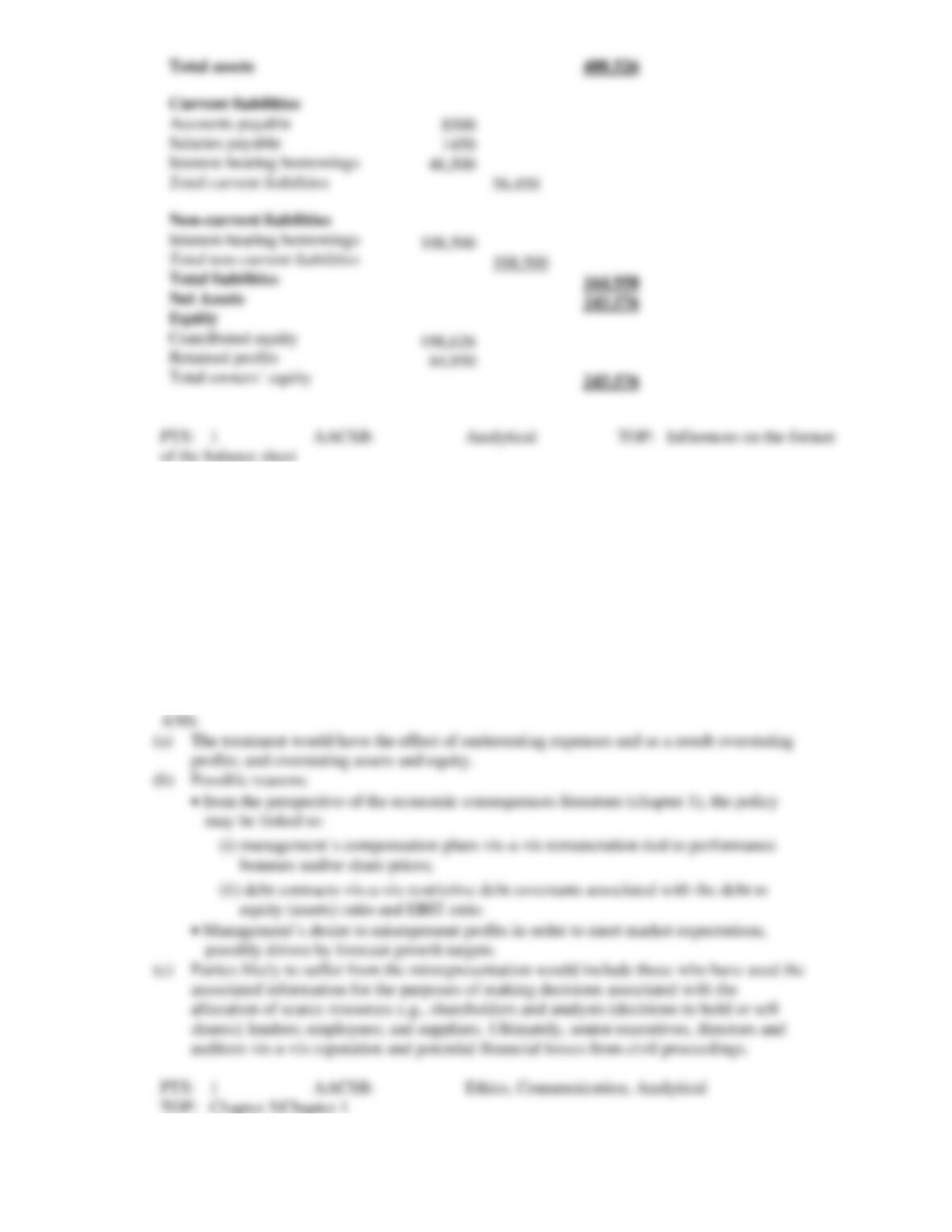
3. Xavier Plata operates a small manufacturing business, trading under the name of Plata Products.
The following list of financial data relates to the business as at 30 June 20X0.
Cash
Receivables
Inventories
Prepaid insurance
Intangibles
131,950
70,300
13,026
1500
8750
Plant & equipment (net)
Accounts payable
Salaries payable
Interest-bearing, long-term
Borrowings
Contributed capital
Retained profits
183,000
8500
1450
155,000
198,626
44,950
Additional information
•
Receivables will be collected within 12 months of 30 June 20X0.
•
30% of the figure for interest-bearing borrowings is payable within 12 months of 30
June 20X0.
Required
Prepare a fully classified balance sheet for Plata Products as at 30 June 20X0.
of the balance sheet
CASE
1. In June 2002 WorldCom, a US telecommunications firm, announced that it had misreported
financial information in previous accounting periods – to the sum of USD $3.9 billion – by
recording routine operating expenses as capital expenditure.
Discuss
(a)
The impact of the treatment on the financial statements.
(b)
The possible reasons for management’s accounting policy choice.
(c)
Whether any party is likely to suffer from the misrepresentation.
profits; and overstating assets and equity.
(b)
Possible reasons:
auditors vis-a-vis reputation and potential financial losses from civil proceedings.
ESSAY
1. The balance sheet includes information on the resources, financial structure, solvency and
adaptability of a reporting entity. Discuss.