Exam
Name___________________________________
TRUE/FALSE. Write ‘T’ if the statement is true and ‘F‘ if the statement is false.
1) The present value (PV) of a stream of cash flows is just the sum of the present values of each individual cash
flow.
MULTIPLE CHOICE. Choose the one alternative that best completes the statement or answers the question.
2) You are given two choices of investments, Investment A and Investment B. Both investments have the same
future cash flows. Investment A has a discount rate of 4%, and Investment B has a discount rate of 5%.
Which of the following is true?
A) The present value of cash flows in Investment A is higher than the present value of cash flows in
Investment B.
B) The present value of cash flows in Investment A is lower than the present value of cash flows in
Investment B.
C) The present value of cash flows in Investment A is equal to the present value of cash flows in
Investment B.
D) No comparison can be made – we need to know the cash flows to calculate the present value.
3) Which of the following investments has a higher present value, assuming the same (strictly positive) interest
rate applies to both investments?
Year
Investment X
Investment Y
1
$5,000
$11,000
2
$7,000
$9,000
3
$9,000
$7,000
4
$11,000
$5,000
A) Investment X has a higher present value.
B) Investment Y has a higher present value.
C) Investment X and Investment Y have the same present value, since the total of the cash flows is the
same for both.
D) No comparison can be made – we need to know the interest rate to calculate the present value.
4) An investment pays you $20,000 at the end of this year, and $10,000 at the end of each of the four following
years. What is the present value (PV) of this investment, given that the interest rate is 4% per year?
A) $42,150
B) $45,913
C) $54,134
D) $58,614
5) A lottery winner will receive $1 million at the end of each of the next ten years. What is the future value (FV)
of her winnings at the time of her final payment, given that the interest rate is 8.5% per year?
A) $13.84 million
B) $14.84 million
C) $18.95 million
D) $19.95 million
6) Suppose you invest $1000 into a mutual fund that is expected to earn a rate of return of 10%. The amount of
money will you have in ten years is closest to which of the following? The amount you will have in 50 years
is closest to which of the following?
A) $386; $9
B) $2594; $45,259
C) $2594; $117,391
D) $3138; $ 1,311,892
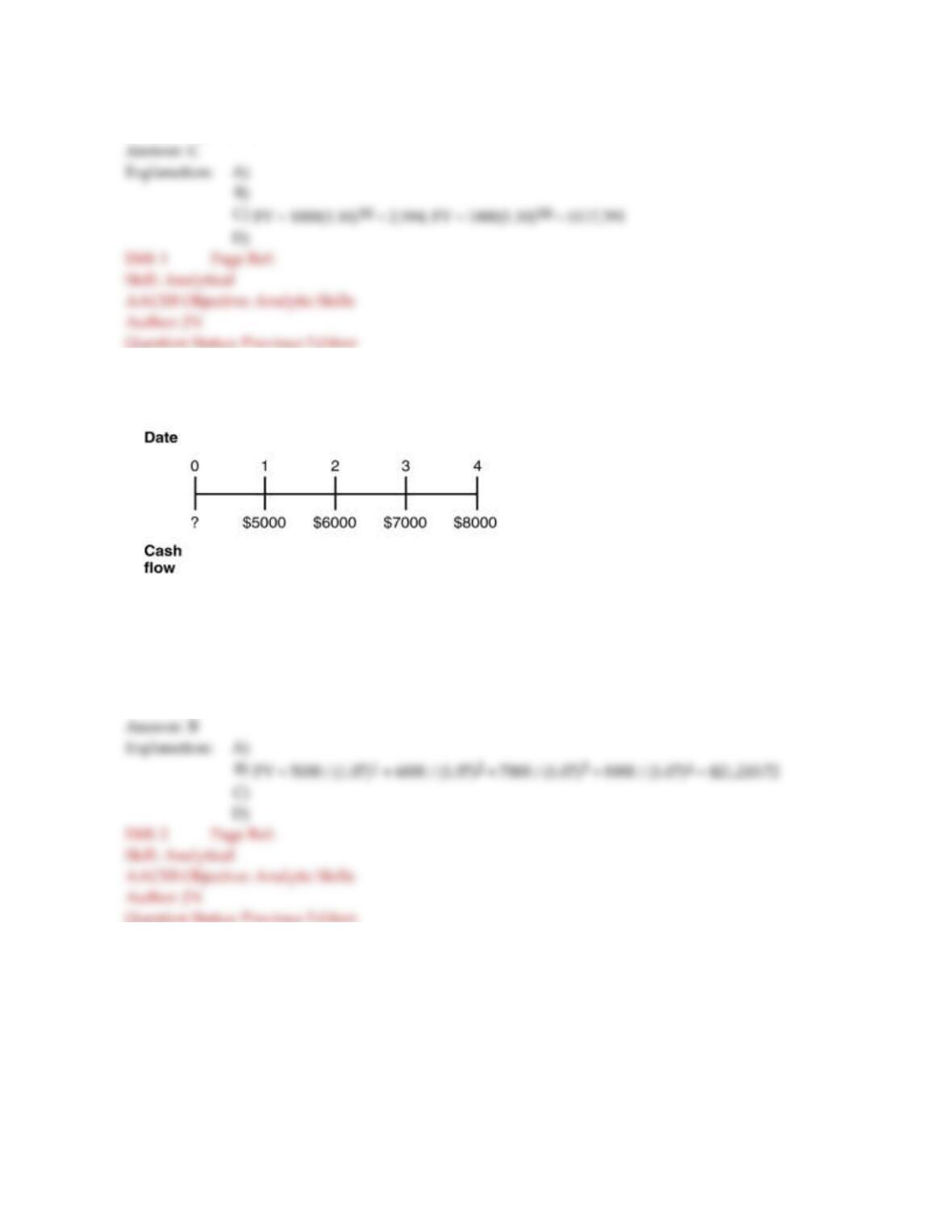
7) Consider the following timeline detailing a stream of cash flows:
If the current market rate of interest is 8%, then the present value (PV) of this stream of cash flows is closest
to:
A) $22,871
B) $21,211
C) $24,074
D) $26,000
8) Consider the following timeline detailing a stream of cash flows:
If the current market rate of interest is 8%, then the future value (FV) of this stream of cash flows is closest to:
A) $11,699
B) $10,832
C) $12,635
D) $10,339
9) Consider the following timeline detailing a stream of cash
flows:
If the current market rate of interest is 10%, then the present value (PV) of this stream of cash flows is closest
to:
A) $674
B) $600
C) $460
D) $287
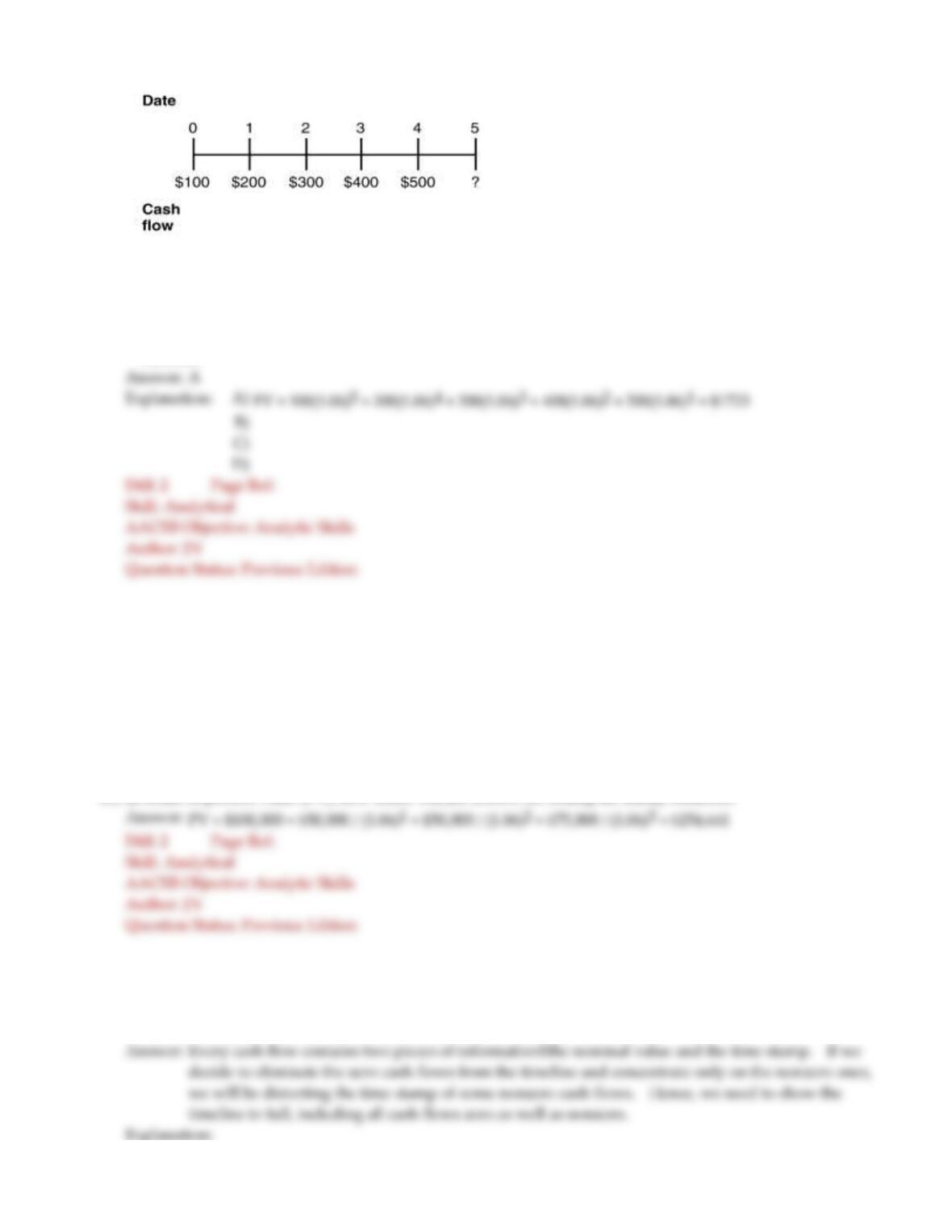
10) Consider the following timeline detailing a stream of cash flows:
If the current market rate of interest is 6%, then the future value (FV) of this stream of cash flows is closest to:
A) $1723
B) $1500
C) $1626
D) $1288
ESSAY. Write your answer in the space provided or on a separate sheet of paper.
Use the information for the question(s) below.
Joe just inherited the family business, and having no desire to run the family business, he has decided to sell it to an
entrepreneur. In exchange for the family business, Joe has been offered an immediate payment of $100,000. Joe will
also receive payments of $50,000 in one year, $50,000 in two years, and $75,000 in three years. The current market rate of
interest for Joe is 6%.
11) In terms of present value (PV), how much will Joe receive for selling the family business?
SHORT ANSWER. Write the word or phrase that best completes each statement or answers the question.
12) If a few intermediate cash flows in valuing a stream of cash flows are zero can we delete those points on the
timeline and squeeze the timeline to show only nonzero cash flows?
MULTIPLE CHOICE. Choose the one alternative that best completes the statement or answers the question.
13) If $10,000 is invested in a certain business at the start of the year, the investor will receive $3000 at the end of
each of the next four years. What is the present value of this business opportunity if the interest rate is 7%
per year?
A) $148.53
B) $161.63
C) $172.45
D) $178.88
14) A business promises to pay the investor of $2000 today for a payment of $500 in one year’s time, $1000 in two
years’ time and $1000 in three years’ time. What is the present value of this business opportunity if the
interest rate is 5% per year?
A) $247.06
B) $253.78
C) $256.88
D) $261.07
15) Salvatore has the opportunity to invest in a scheme which will pay $5000 at the end of each of the next 5
years. He must invest $10,000 at the start of the first year and an additional $10,000 at the end of the first
year. What is the present value of this investment if the interest rate is 4%?
A) –$1410.67
B) –$112.23
C) $1248.56
D) $2643.73
16) A homeowner in a sunny climate has the opportunity to install a solar water heater in his home for a cost of
$2400. After installation the solar water heater will produce a small amount of hot water every day, forever,
and will require no maintenance. How much must the homeowner save on water heating costs every year if
this is to be a sound investment? (The interest rate is 9% per year.)
A) $216
B) $240
C) $248
D) $262
17) What is the present value (PV) of an investment that will pay $400 in one year’s time, and $400 every year
after that, when the interest rate is 5%?
A) $2400
B) $3600
C) $7200
D) $8000
18) A perpetuity has a PV of $32,000. If the interest rate is 10%, how much will the perpetuity pay every year?
A) $2909
B) $3100
C) $3200
D) $3520
19) Ally wishes to leave a provision in her will that $2000 will be paid annually in perpetuity to a local charity.
How much must she provide in her will for this perpetuity if the interest rate is 6%?
A) $3201.21
B) $21,200.00
C) $33,333.33
D) $42,000.00
20) A perpetuity will pay $1000 per year, starting five years after the perpetuity is purchased. What is the
present value (PV) of this perpetuity on the date that it is purchased, given that the interest rate is 4%?
A) $1410
B) $20,582
C) $21,370
D) $34,604
21) A perpetuity will pay $1000 per year, starting five years after the perpetuity is purchased. What is the future
value (FV) of this perpetuity, given that the interest rate is 4%?
A) $1410
B) $20,582
C) $21,370
D) There is no solution to this problem.
22) Which of the following statements regarding perpetuities is FALSE?
A) To find the value of a perpetuity one cash flow at a time would take forever.
B) A perpetuity is a stream of equal cash flows that occurs at regular intervals and lasts forever.
C)
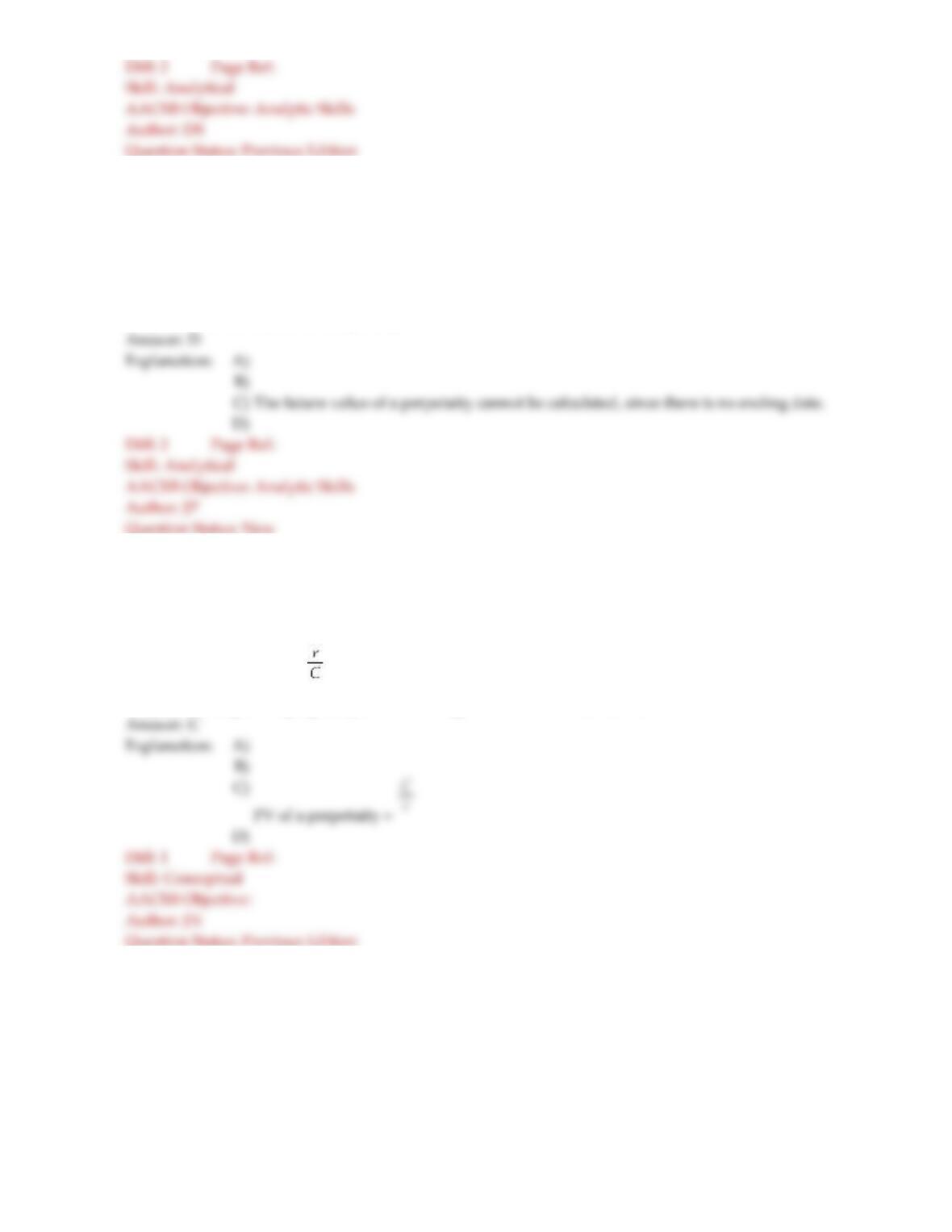
PV of a perpetuity =
D) One example of a perpetuity is the British government bond called a consol.
23) Which of the following is true about perpetuities?
A) Since a perpetuity generates cash flows every period infinitely, the cash flow generated equals the PV
times the interest rate.
B) Since a perpetuity generates cash flows every period infinitely, each cash flow must be discounted to
calculate the present value.
C) Since a perpetuity generates cash flows every period infinitely, there is no way to solve for the cash
flow given the present value and the interest rate.
D) A perpetuity does not generate cash flows every period infinitely.
24) Which of the following is true about perpetuities?
A) All else equal, the value of a perpetuity is higher when the periodic cash flow is higher.
B) All else equal, the value of a perpetuity is higher when the interest rate is lower.
C) If two perpetuities have the same present value and the same interest rate, they must have the same
cash flows.
D) All of the above are true statements.
TRUE/FALSE. Write ‘T’ if the statement is true and ‘F‘ if the statement is false.
MULTIPLE CHOICE. Choose the one alternative that best completes the statement or answers the question.
26) An annuity is set up that will pay $1500 per year for ten years. What is the present value (PV) of this annuity
given that the discount rate is 6%?
A) $8441
B) $11,040
C) $14,721
D) $19,771
27) An annuity pays $12 per year for 100 years. What is the present value (PV) of this annuity given that the
discount rate is 8%?
A) $144.62
B) $146.63
C) $149.93
D) $151.45
28) An annuity pays $10 per year for 50 years. What is the future value (FV) of this annuity at the end of that 50
years given that the discount rate is 5%?
A) $182.56
B) $525.00
C) $845.25
D) $2093.48
29) An annuity pays $50 per year for 20 years. What is the future value (FV) of this annuity at the end of those 20
years, given that the discount rate is 7%?
A) $326.44
B) $684.76
C) $1524.24
D) $2049.77
30) If the current rate of interest is 8%, then the present value (PV) of an investment that pays $1000 per year and
lasts 20 years is closest to:
A) $18,519
B) $45,761
C) $9,818
D) $20,000
31) If the current rate of interest is 8%, then the future value (FV) of an investment that pays $1000 per year and
lasts 20 years is closest to:
A) $18,519
B) $45,762
C) $9,818
D) $20,000
32) You are saving money to buy a car. If you save $300 per month starting one month from now at an interest
rate of 4%, how much will you be able to spend on the car after saving for 4 years?
A) $41,778.96
B) $15,287.27
C) $15,587.88
D) $13,286.65
33) You are borrowing money to buy a car. If you can make payments of $300 per month starting one month
from now at an interest rate of 4%, how much will you be able to borrow for the car today if you finance the
amount over four years?
A) $6,358.54
B) $13,067.62
C) $15,587.88
D) $13,286.65
34) Since your first birthday, your grandparents have been depositing $1000 into a savings account on every one
of your
birthday
s. The account pays 4% interest annually. Immediately after your grandparents make the deposit on your
18th birthday, the amount of money in your savings account will be closest to:
A) $25,645
B) $36,465
C) $12,659
D) $18,000
35) Since your first birthday, your grandparents have been depositing $100 into a savings account every month.
The account pays 4% interest annually. Immediately after your grandparents make the deposit on your
18th birthday, the amount of money in your savings account will be closest to:
A) $11,941,266
B) $31,559
C) $30,774
D) $21,600
36) Which of the following statements regarding annuities is FALSE?
A)
PV of an annuity = C ×
B) The difference between an annuity and a perpetuity is that a perpetuity ends after some fixed number
of payments.
C) An annuity is a stream of N equal cash flows paid at regular intervals.
D) Most car loans, mortgages, and some bonds are annuities.
TRUE/FALSE. Write ‘T’ if the statement is true and ‘F‘ if the statement is false.
37) A growing perpetuity where the rate of growth is greater than the discount rate will have an infinitely large
present value (PV).
MULTIPLE CHOICE. Choose the one alternative that best completes the statement or answers the question.
38) Investment X and Investment Y are both growing perpetuities with initial cash flow of $100. Both
investments have the same interest rate (r). The present value of Investment X is $5,000, while the present
value of Investment Y is $4,000. Which of the following is true?
A) Investment X has a higher growth rate than Investment Y.
B) Investment X has a lower growth rate than Investment Y.
C) The answer cannot be determined without knowing the interest rate for both investments.
D) This makes no sense – with the same initial cash flow and the same interest rate Investment X and
Investment Y should have the same present value.
39) Clarissa wants to fund a growing perpetuity that will pay $5000 per year to a local museum, starting next
year. She wants the annual amount paid to the museum to grow by 5% per year. Given that the interest rate
is 8%, how much does she need to fund this perpetuity?
A) $62,500.00
B) $102,112.33
C) $143,445.65
D) $166,666.67
40) Martin wants to provide money in his will for an annual bequest to whichever of his living relatives is oldest.
That bequest will provide $1000 in the first year, and will grow by 7% per year, forever. If the interest rate is
11%, how much must Martin provide to fund this bequest?
A) $9090.90
B) $14,285.71
C) $25,000.00
D) $36,687.45
41) A rich donor gives a hospital $100,000 one year from today. Each year after that, the hospital will receive a
payment 5% larger than the previous payment, with the last payment occurring in ten years’ time. What is
the present value (PV) of this donation, given that the interest rate is 9%?
A) $467,922.22
B) $585,987.27
C) $772,173.49
D) $779,843.27