Elements of Ecology, 9e (Smith)
Chapter 4 The Terrestrial Environment
4.1 Short Answer Questions
1) Animal life depends on the ________ within a region to provide the essential resources of
food and cover.
2) About 75%-95% of living cells, both plant and animal, is composed of ________.
3) The two physical factors that vary most in terrestrial environments are ________ and
________.
4) The amount of light at any depth in the canopy is affected by the number of ________ above.
5) The wavelengths that make up the visible light spectrum are referred to as ________ radiation.
6) In the temperate regions of the world, many forest tree species are ________, shedding their
leaves during the winter months.
7) A collection of natural bodies of earth, composed of mineral and organic matter and capable
of supporting plant growth, is referred to as ________.
8) Soil formation begins with the ________ of rocks and their minerals.
9) A rock that is broken into smaller fragments as a result of freezing and thawing has
experienced ________ weathering.
10) The parent material of soils originating from sand and silt carried by the wind is referred to
as ________.
11) The movement of solutes through the soil is known as ________.
12) ________ matter (particularly humus) makes soil dark or black.
13) Particles of ________ control the water-holding capacity of soil and ion exchange.
14) ________ is a property of soils that is determined by the different sizes and types of particles
in soils.
15) The largest particles of soil are referred to as ________.
16) A sequence of horizontal layers of soil is referred to as a soil ________.
17) Distinct layers in the soil that are created by localized chemical and physical processes are
called ________.
18) The process of mineral particles such as clay and salts accumulating in the B layer of soils is
referred to as ________.
19) When the amount of water in a soil exceeds what the pore space can hold, the soil is
________.
20) The ________ point is the stage at which the moisture level in soil decreases to a level at
which plants can no longer extract water.
21) The amount of water retained by the soil between field capacity and wilting point is the
available water ________.
22) ________ are positively charged particles in the soil that attract anions.
23) The ________ exchange capacity is a basic measure of soil quality and increases with higher
clay and organic matter content.
24) Soils with a pH greater than 7 are considered to be ________.
25) Regions that are subjected to heavy volcanic activity have dark soils called ________.
26) ________ is a process common to soils found in humid environments in the tropical and
subtropical regions.
27) In low-lying areas with poor drainage, ________ results in a black or bluish-gray soil with a
high organic content.
4.2 Multiple-Choice Questions
1) A waxy layer coating the aerial parts of most plants, such as stems and leaves, which reduces
water loss is referred to as the
A) meristem.
B) vascular cambium.
C) cuticle.
D) xylem.
2) Organisms that live in aquatic systems experience limited temperature fluctuations due to
water’s
A) high specific heat.
B) high viscosity.
C) high surface tension.
D) covalent nature.
3) Each of the following is a challenge faced by a terrestrial plant except
A) buoyancy.
B) desiccation.
C) cells and tissues to maintain structure.
D) variability in air temperature.
4) If a tree 50 meters (m) high has 30,000 leaves, the surface area of the leaves is 300 m2, and
the amount of ground covered by the tree’s canopy is 75 m2. The leaf area index (LAI) is
A) 4.
B) 6.
C) 100.
D) 400.
5) Which wavelength of light penetrates through plant cover the farthest?
A) violet (400 nm)
B) green (500 nm)
C) red (660 nm)
D) far-red (730 nm)
6) The leaf area index (LAI) of a temperate deciduous forest is highest during
A) fall.
B) spring.
C) summer.
D) winter.
7) Light availability within a forest is lowest in the
A) canopy layer.
B) midstory layer.
C) understory layer.
D) ground layer.
8) All the following factors affect the attenuation of light in water, except
A) phytoplankton.
B) water itself.
C) intensity of light.
D) dissolved substances.
9) Soil is formed from the layer of unconsolidated debris overlaying hard, unweathered rock
referred to as
A) regolith.
B) topsoil.
C) till.
D) loam.
10) The mechanical destruction and/or chemical modification of rock into smaller particles is
called
A) leaching.
B) mineralization.
C) percolation.
D) weathering.
11) Soils developing from sand and silt carried by the wind are referred to as
A) till.
B) eolian.
C) colluvium.
D) fluvial.
12) Under which conditions are the processes of weathering, leaching, and input of organic
material from plants into soil maximized?
A) warm temperatures and abundant water
B) cool temperatures and abundant water
C) cool temperatures and scarce water
D) warm temperatures and scarce water
13) Which of the following statements is incorrect?
A) Topography affects the erosion of parent material.
B) Soil develops very rapidly, within several years.
C) Plants move nutrients from deep in the soil to the surface.
D) Plant roots stabilize the soil surface.
14) Leaching is
A) the movement of solutes through soil.
B) the breakdown of parent material.
C) the gain of cations.
D) the loss of leaves from a plant.
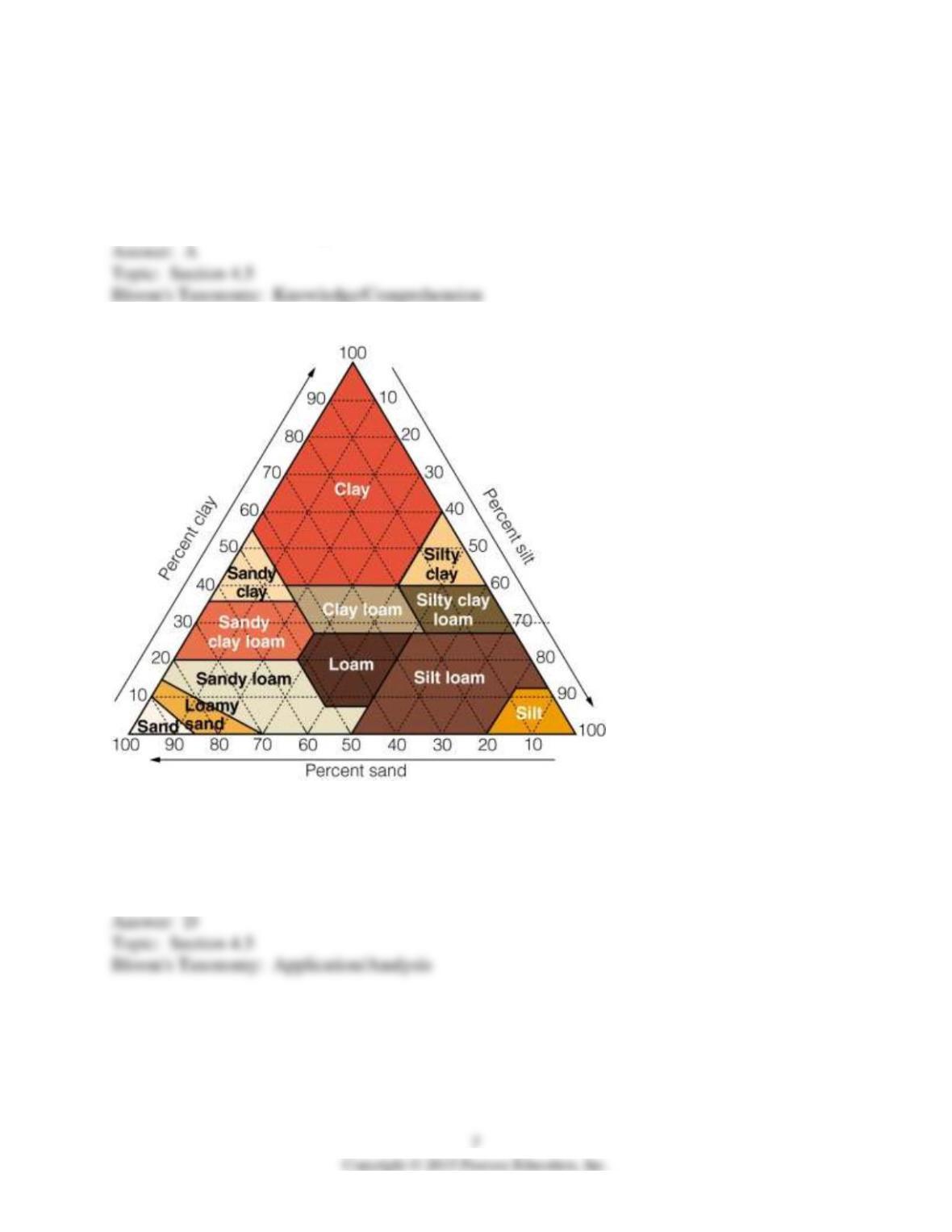
15)
A soil that is 10% silt, 80% sand, and 10% clay would be considered
A) clay loam.
B) sandy clay.
C) slit loam.
D) loamy sand.
16) Soil particles are classified on the basis of
A) age.
B) color.
C) water content.
D) size.
17) Soils rich in iron oxide are
A) blackish.
B) yellowish-brown or reddish.
C) whitish or grayish.
D) greenish.
18) The smallest particles occurring in soil are referred to as
A) clay.
B) gravel.
C) sand.
D) silt.
19) The most shallow soils occur in or on
A) steep slopes.
B) native grasslands.
C) valleys.
D) floodplains.
20) The surface layer of soils is referred to as the
A) A horizon.
B) B horizon.
C) C horizon.
D) O horizon.
21) The E horizon of soils is characterized by the maximum amount of
A) biological activity.
B) decomposition.
C) leaching of mineral particles.
D) accumulation of leached mineral particles.
22) The soil horizon in which leached mineral particles such as clay and salts tend to accumulate
is the
A) A horizon.
B) B horizon.
C) C horizon.
D) O horizon.
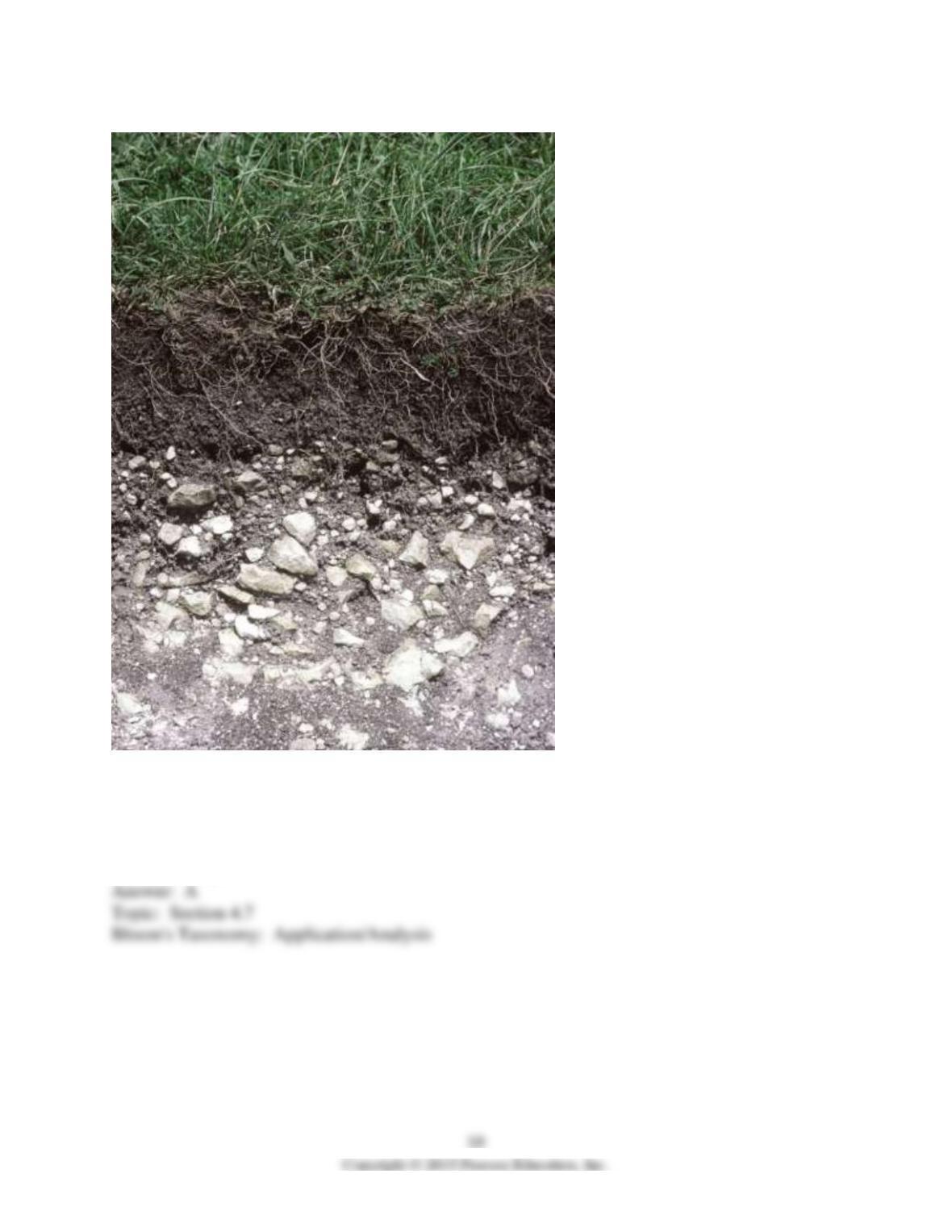
23)
The rocky area at the bottom of the photo would be considered which section of a soil profile?
A) unconsolidated material
B) subsoil
C) topsoil
D) organic layer
24) The amount of water a soil holds at field capacity is greatest for
A) clay.
B) sand.
C) silt.
D) loam.
25) When the amount of water in soil exceeds what the pore space can hold, the soil is
A) at field capacity.
B) at the wilting point.
C) saturated.
D) desiccated.
26) Which of the following soils holds the most water?
A) clay loam on a ridgetop
B) sandy loam in a valley
C) clay loam in a valley
D) sandy loam on a ridgetop
27) The available water capacity is highest for
A) clay soils.
B) silty soils.
C) sandy soils.
D) intermediate clay loam soils.
28) Which of the following is a common soil anion?
A) NH4+
B) Ca2+
C) NO3–
D) Mg2+
29) Generally, an ion with a ________ positive charge and ________ size will bind most
strongly to a soil particle.
A) greater; smaller
B) smaller; larger
C) smaller; smaller
D) greater; larger
30) As soil acidity increases, the concentration of ________ increases.
A) Ca2+
B) Al3+
C) Na+
D) NH4+
31) Aluminum is toxic to plants because it
A) destroys chlorophyll in the leaves, reducing the rate of photosynthesis.
B) inhibits production of pollen, reducing the rate of reproduction.
C) damages the roots, reducing nutrient uptake.
D) inhibits mitosis within the meristem tissues, reducing growth of the stems.
32) Negatively charged particles in the soil are referred to as
A) mollisol.
B) entisol.
C) cations.
D) colloids.
33) Dark clay soils that show significant expansion and contraction due to wetting and drying are
referred to as
A) mollisols.
B) vertisols.
C) spodosols.
D) andisols.
34) The soil-forming process occurring in cool, moist climates of midlatitude regions where
coniferous vegetation dominates is referred to as
A) laterization.
B) podzolization.
C) gleization.
D) calcification.
35) The soil-forming process that occurs naturally in desert basins and along the coast and is a
problem in agricultural areas where irrigation is practiced is
A) calcification.
B) gleization.
C) laterization.
D) salinization.
36) Soil in regions with high rainfall or in low-lying areas associated with poor drainage form
through the process of
A) laterization.
B) calcification.
C) gleization.
D) podzolization.
37) The general relationship between available light and leaf area index (LAI) is described by
A) Bohr’s law.
B) Beer’s law.
C) Leibig’s law.
D) the Central Limit Theorem.
38) No till farming is advantageous because it
A) reduces soil erosion.
B) increases yield.
C) decreases need for pesticide use.
D) decreases plant cover.
39) The Dust Bowl occurred
A) in the Central Valley of California.
B) in the Great Plains.
C) on the Eastern Seaboard.
D) in Southern Texas.
4.3 True/False Questions
1) The greatest limitation faced by terrestrial organisms is desiccation.
2) Trees allocate most of their tissue mass to supportive and conductive tissues in the trunk.
3) Temperature fluctuation is greater in aquatic environments than in terrestrial environments.
4) The greater the leaf area index (LAI) above the forest floor, the lower the quantity of light
reaching the forest floor.
5) In high-latitude habitats, forest canopies that have leaves positioned at an angle will absorb
light more effectively.
6) In temperate deciduous forest, light penetration to the ground is greater during summer than
during winter.
7) Soil is an abiotic environment.
8) Soil formed by water seeping into rock crevices, freezing, and expanding is an example of
chemical weathering.
9) Microorganisms contribute to the formation of soils.
10) The greater the depth of water percolation, the greater the depth of weathering and soil
development.
11) More rainfall enters the soil on steep slopes than on level land.
12) Poorly drained soils or soils saturated by water tend to be yellowish-brown or reddish.
13) In forests, most of the organic matter that enters the soil comes from plant roots.
14) The soil in a particular area is arranged in layers called horizons that vary in texture,
structure, and consistency from one another.
15) Eluviation refers to the leaching of minerals and finer soil particles from the upper layers to
the lower layers of soil.
16) An E horizon is more likely to develop in grassland soils than in forest soils.
17) Clay soils have smaller pores and hold considerably less water than sandy soils.
18) Coarse-textured soils have a low field capacity and a low wilting point.
19) Soils on ridgetops are generally drier than valley soils.
20) Ions carrying a positive charge are cations.
21) Most soils contain far more cations than anions.
22) An increase in soil acidity is responsible for releasing soluble aluminum, which can be toxic
to plant roots.
23) Oxisols are formed in areas with frozen soil.
24) Entisols are immature soils associated with recently deposited sediments.
25) Calcification results in the buildup of dissolved alkaline salts in the B horizon of soils.
26) Laterization is a soil-forming process that is typical of cool, moist climates at high latitudes.
27) Beer’s law can be used to describe the attenuation of light in both aquatic and terrestrial
environments.
4.4 Essay Questions
1) Describe three structural adaptations of terrestrial plants that allow them to survive on land.
2) Identify and discuss the biotic and abiotic factors affecting the amount of light penetrating
through a forest to the forest floor.
3) Give several possible definitions of “soil.” Why is it difficult to develop a good definition of
soil, even for a pedologist?
4) Explain and give examples of how mechanical and chemical weathering lead to the formation
of soils.
5) Describe and give specific examples of how biological activities contribute to soil formation.
6) Define soil texture and describe two ways that texture may influence the soil function.
7) Draw a typical soil profile. Label and describe each of the four horizons.
8) Define the available water capacity of soil and discuss how it is affected by the physical and
topographical characteristics of soil.
9) Define soil fertility and explain why cation exchange capacity (CEC) is integral to the
maintenance of soil fertility.
10) Explain one example of the influence of climate and vegetation on the type of soil that
develops in an area.