42) Which of the following statements regarding growing perpetuities is FALSE?
A) We assume that r < g for a growing perpetuity.
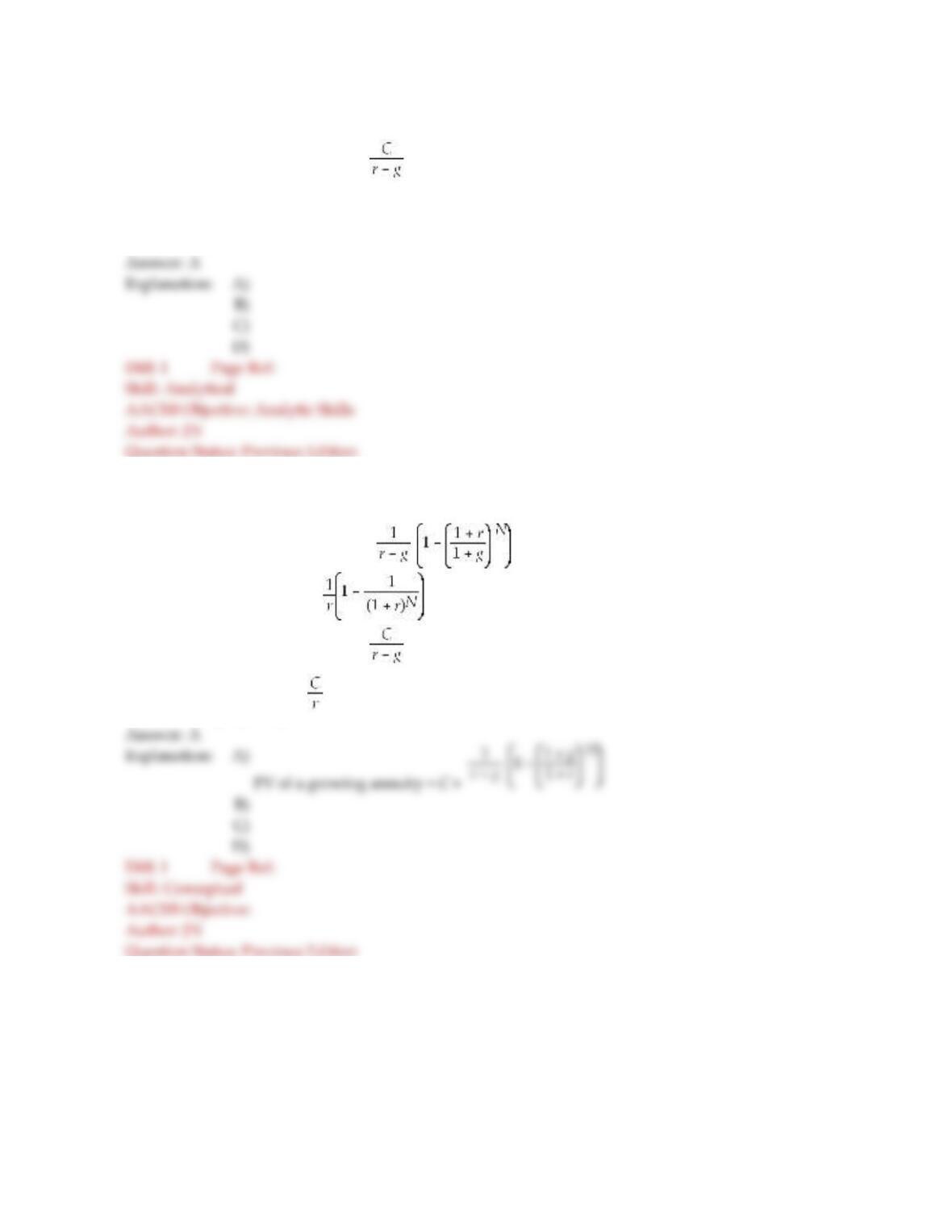
B)
PV of a growing perpetuity =
C) To find the value of a growing perpetuity one cash flow at a time would take forever.
D) A growing perpetuity is a cash flow stream that occurs at regular intervals and grows at a constant rate
forever.
43) Which of the following formulas is INCORRECT?
A)
PV of a growing annuity = C ×
B)
PV of an annuity = C ×
C)
PV of a growing perpetuity =
D)
PV of a perpetuity =
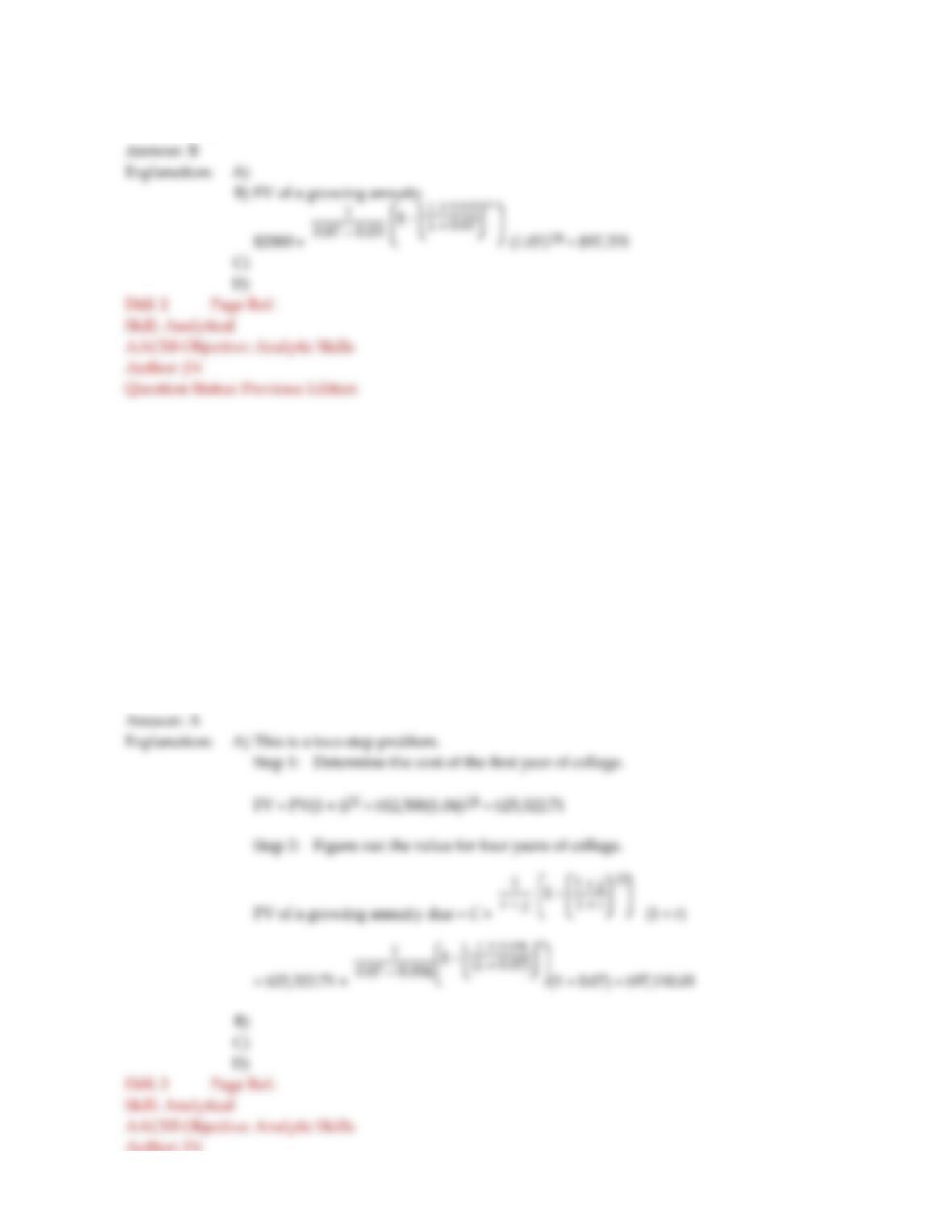
44) Suppose that a young couple has just had their first baby and they wish to insure that enough money will be
available to pay for their child‘s college education. They decide to make deposits into an educational
savings account on each of their daughter’s birthdays, starting with her first birthday. Assume that the
educational savings account will return a constant 7%. The parents deposit $2000 on their daughter’s first
birthday and plan to increase the size of their deposits by 5% each year. Assuming that the parents have
already made the deposit for their daughter’s 18th birthday, then the amount available for the daughter’s
college expenses on her 18th birthday is closest to:
A) $42,825
B) $97,331
C) $67,998
D) $103,063
Use the information for the question(s) below.
Suppose that a young couple has just had their first baby and they wish to ensure that enough money will be available to
pay for their child’s college education. Currently, college tuition, books, fees, and other costs average $12,500 per year.
On average, tuition and other costs have historically increased at a rate of 4% per year.
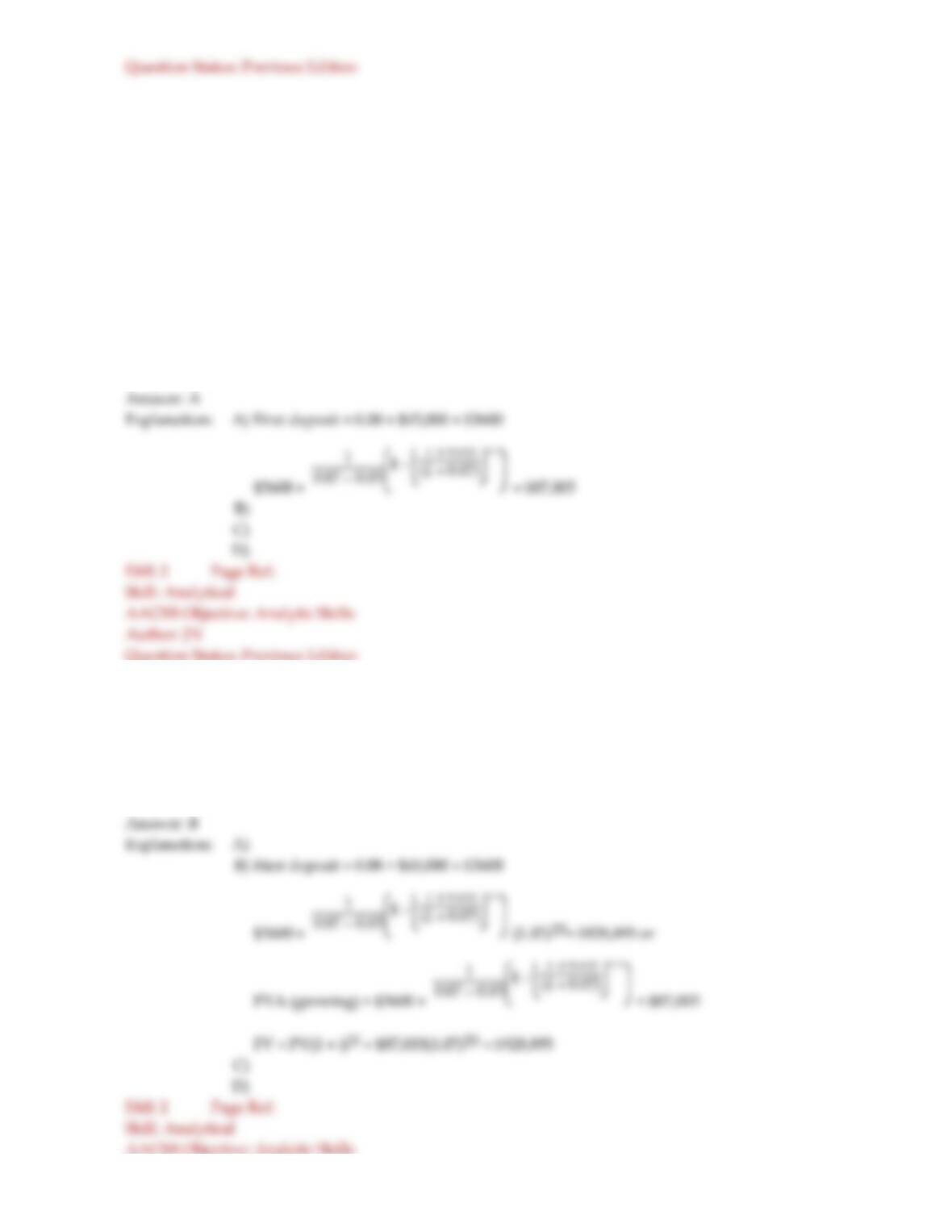
45) Assuming that college costs continue to increase an average of 4% per year and that all her college savings
are invested in an account paying 7% interest, then the amount of money she will need to have available at
age 18 to pay for all four years of her undergraduate education is closest to:
A) $97,110
B) $107,532
C) $101,291
D) $50,000
Use the information for the question(s) below.
Assume that you are 30 years old today, and that you are planning on retirement at age 65. Your current salary is
$45,000 and you expect your salary to increase at a rate of 5% per year as long as you work. To save for your retirement,
you plan on making annual contributions to a retirement account. Your first contribution will be made on your 31st
birthday and will be 8% of this year’s salary. Likewise, you expect to deposit 8% of your salary each year until you reach
age 65. Assume that the rate of interest is 7%.
46) The present value (PV) (at age 30) of your retirement savings is closest to:
A) $87,000
B) $108,000
C) $46,600
D) $75,230
47) The future value (FV) at retirement (age 65) of your savings is closest to:
A) $497,530
B) $928,895
C) $1,263,236
D) $108,000
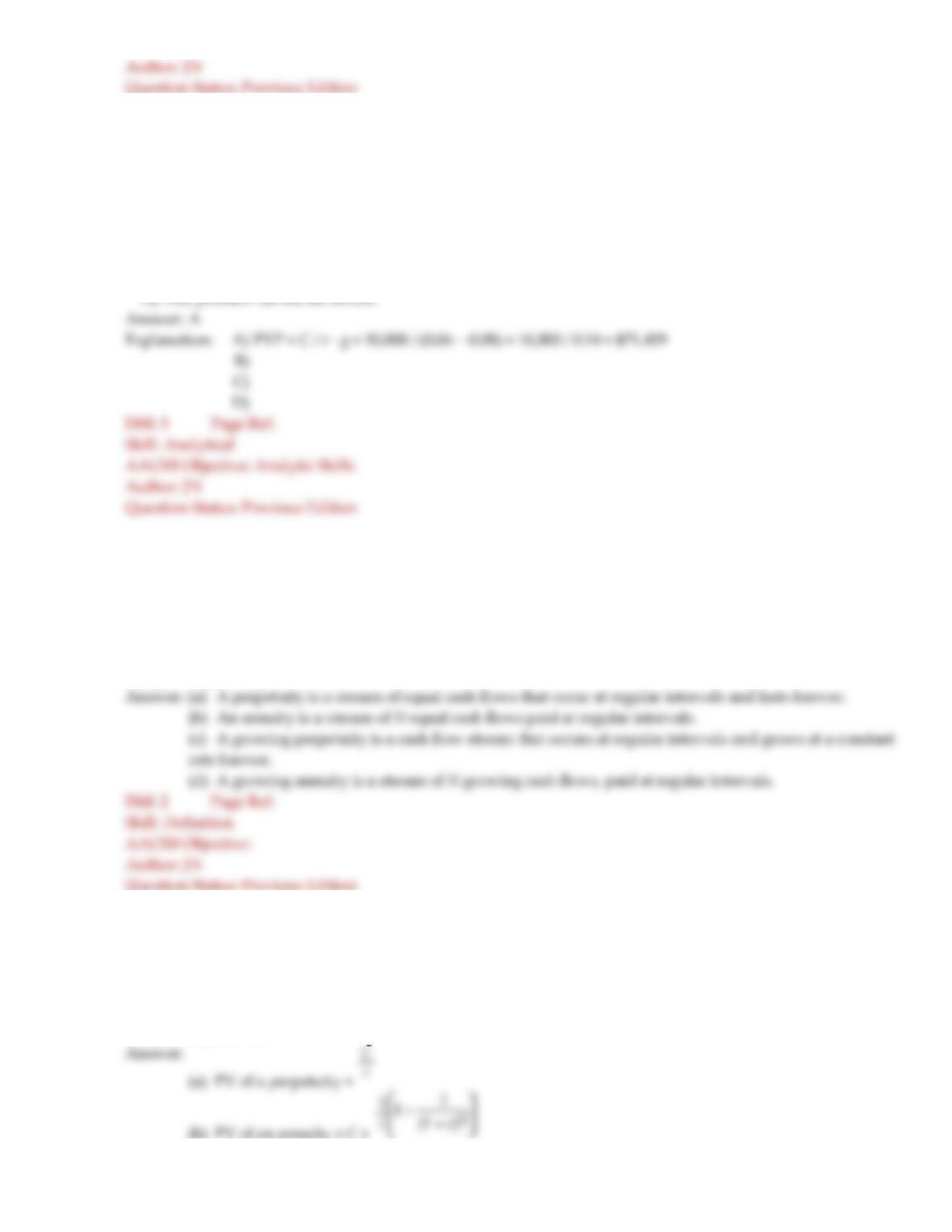
48) You are thinking about investing in a mine that will produce $10,000 worth of ore in the first year. As the
ore closest to the surface is removed it will become more difficult to extract the ore. Therefore, the value of
the ore that you mine will decline at a rate of 8% per year forever. If the appropriate interest rate is 6%, then
the value of this mining operation is closest to:
A) $71,429
B) $500,000
C) $166,667
ESSAY. Write your answer in the space provided or on a separate sheet of paper.
49) Define the following terms:
(a) perpetuity
(b) annuity
(c) growing perpetuity
(d) growing annuity
50) How do you calculate (mathematically) the present value (PV) of a(n):
(a) perpetuity
(b) annuity
(c) growing perpetuity
(d) growing annuity
SHORT ANSWER. Write the word or phrase that best completes each statement or answers the question.
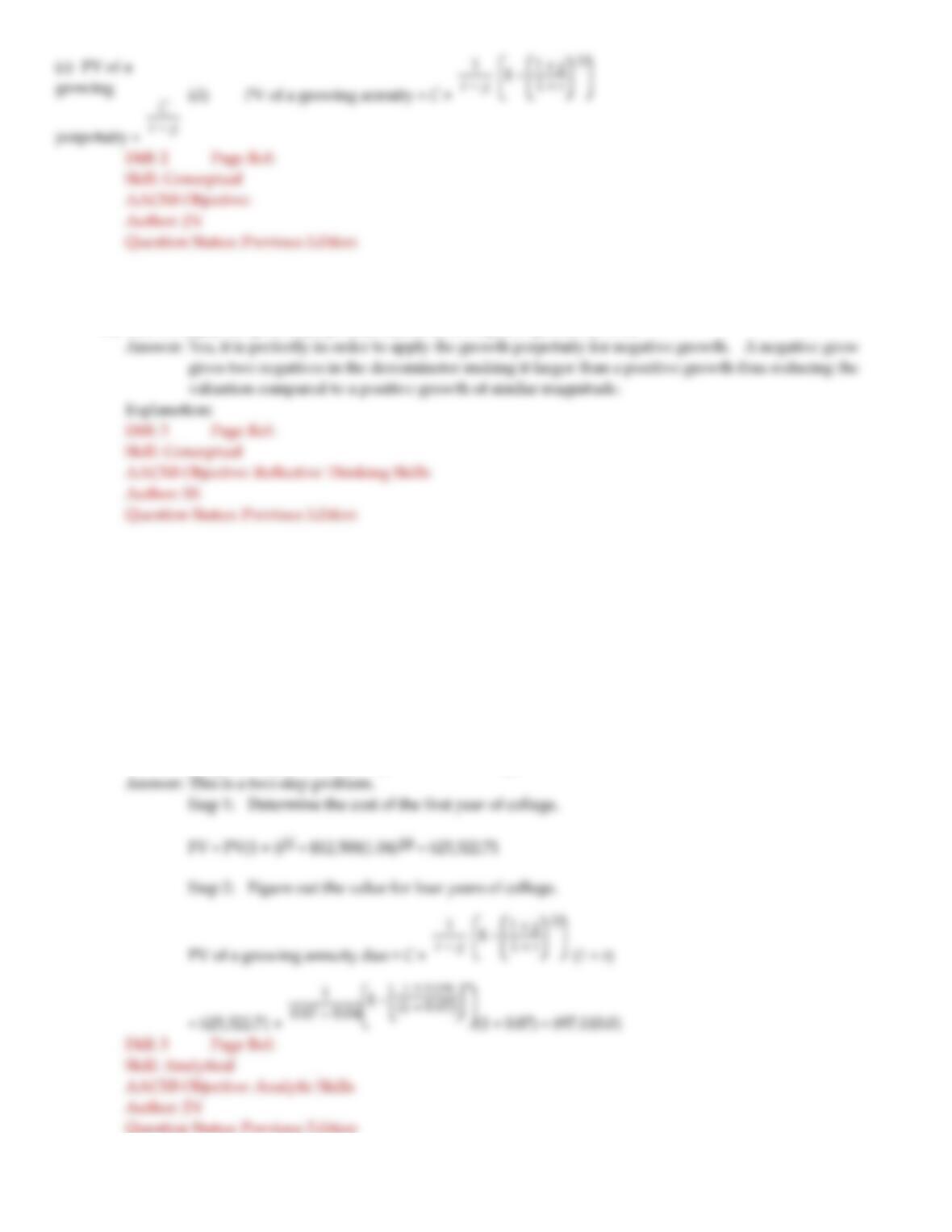
51) Can we apply the growth perpetuity equation for negative growth as well?
ESSAY. Write your answer in the space provided or on a separate sheet of paper.
Use the information for the question(s) below.
Suppose that a young couple has just had their first baby and they wish to ensure that enough money will be available to
pay for their child’s college education. Currently, college tuition, books, fees, and other costs average $12,500 per year.
On average, tuition and other costs have historically increased at a rate of 4% per year.
52) Assuming that college costs continue to increase an average of 4% per year and that all her college savings
are invested in an account paying 7% interest, then what is the amount of money she will need to have
available at age 18 to pay for all four years of her undergraduate education?
SHORT ANSWER. Write the word or phrase that best completes each statement or answers the question.
53) How do the growth perpetuity results differ with negative and positive growths of similar magnitude
assuming everything else remains unchanged?
TRUE/FALSE. Write ‘T’ if the statement is true and ‘F’ if the statement is false.
54) The internal rate of return (IRR) is the interest rate that sets the net present value (NPV) of the cash flows
equal to zero
55) Trial and error is the only way to compute the internal rate of return (IRR) when interest is calculated over
five or more periods.
MULTIPLE CHOICE. Choose the one alternative that best completes the statement or answers the question.
56) Dan buys a property for $250,000. He is offered a 20–year loan by the bank, at an interest rate of 6% per year.
What is the annual loan payment Dan must make?
A) $21,796.14
B) $24,864.98
C) $32,684.66
D) $64,486.34
57) A bank is negotiating a loan. The loan can either be paid off as a lump sum of $100,000 at the end of five
years, or as equal annual payments at the end of each of the next five years. If the interest rate on the loan is
10%, what annual payments should be made so that both forms of payment are equivalent?
A) $12,000
B) $16,380
C) $19,588
D) $20,000
58) A bank offers a home buyer a 25–year loan at 8% per year. If the home buyer borrows $120,000 from the
bank, how much must be repaid every year?
A) $7896.45
B) $9845.89
C) $10,786.66
D) $11,241.45
59) Matthew wants to take out a loan to buy a car. He calculates that he can make repayments of $4000 per year.
If he can get a five–year loan with an interest rate of 7.5%, what is the maximum price he can pay for the car?
A) $16,184
B) $18,243
C) $20,324
D) $21,674
60) A businessman wants to buy a truck. The dealer offers to sell the truck for either $120,000 now, or six yearly
payments of $25,000. Which of the following is closest to the interest rate being offered by the dealer?
A) 5%
B) 7%
C) 9%
D) 11%
61) How long will it take $50,000 placed in a savings account at 10% interest to grow into $75,000?
A) 4.25 years
B) 5.00 years
C) 5.25 years
D) 5.50 years
62) Faisal has $15,000 in his savings account and can save an additional $5000 per year. If interest rates are 12%,
how long will it take his savings to grow to $50,000?
A)
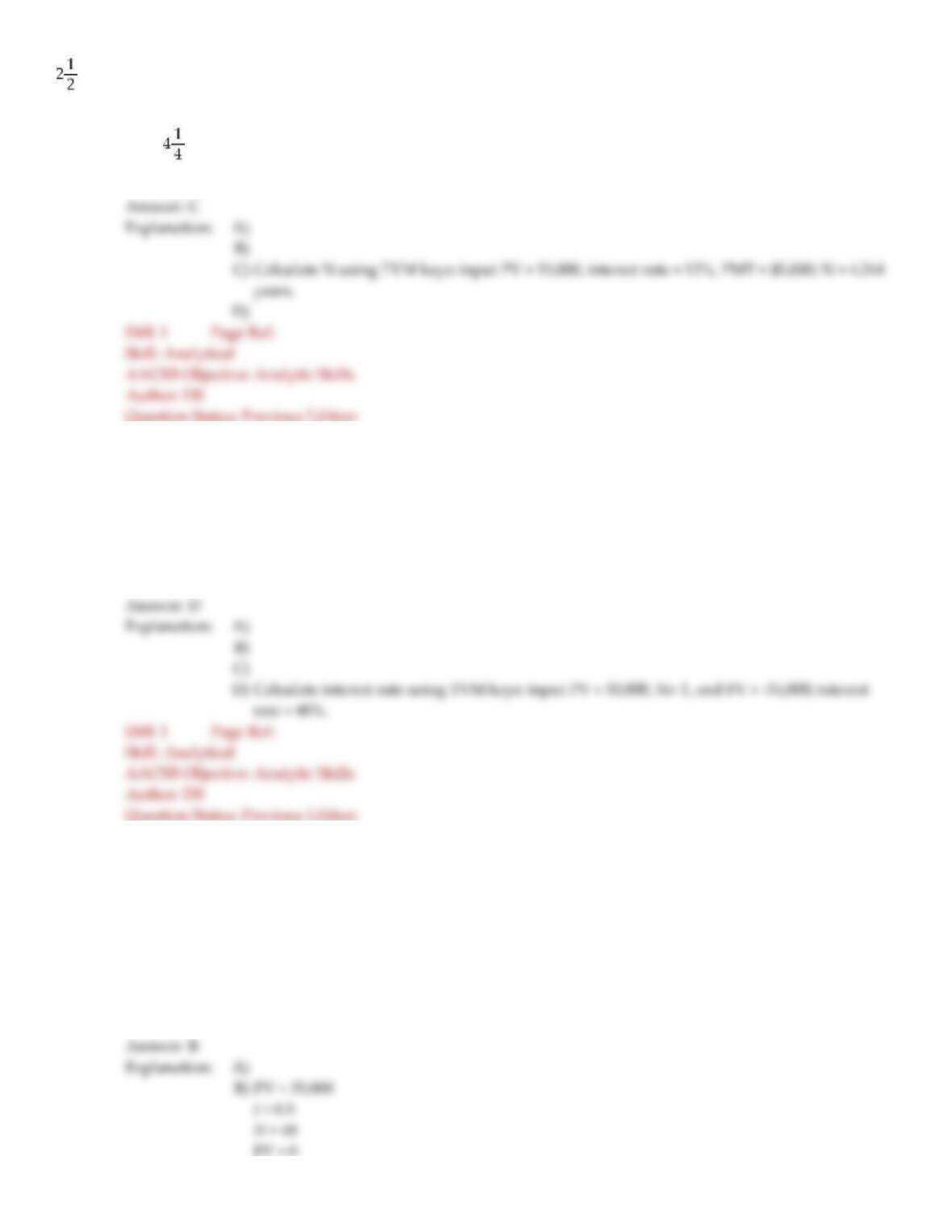
years
B) 3 years
C)
years
D) 5 years
63) What is the internal rate of return (IRR) of an investment that requires an initial investment of $10,000 today
and pays $14,000 in one year’s time?
A) 4%
B) 14%
C) 24%
D) 40%
64) You are interested in purchasing a new automobile that costs $35,000. The dealership offers you a special
financing rate of 6% APR (0.5%) per month for 48 months. Assuming that you do not make a down
payment on the auto and you take the dealer’s financing deal, then your monthly car payments would be
closest to:
A) $729
B) $822
C) $842
D) $647
65) You are considering purchasing a new home. You will need to borrow $250,000 to purchase the home. A
mortgage company offers you a 15–year fixed rate mortgage (180 months) at 9% APR (0.75% month). If you
borrow the money from this mortgage company, your monthly mortgage payment will be closest to:
A) $2585
B) $660
C) $2535
D) $1390
66) You are considering investing in a zero–coupon bond that will pay you its face value of $1000 in ten years. If
the bond is currently selling for $485.20, then the internal rate of return (IRR) for investing in this bond is
closest to:
A) 12%
B) 8.0%
C) 7.5%
D) 10%
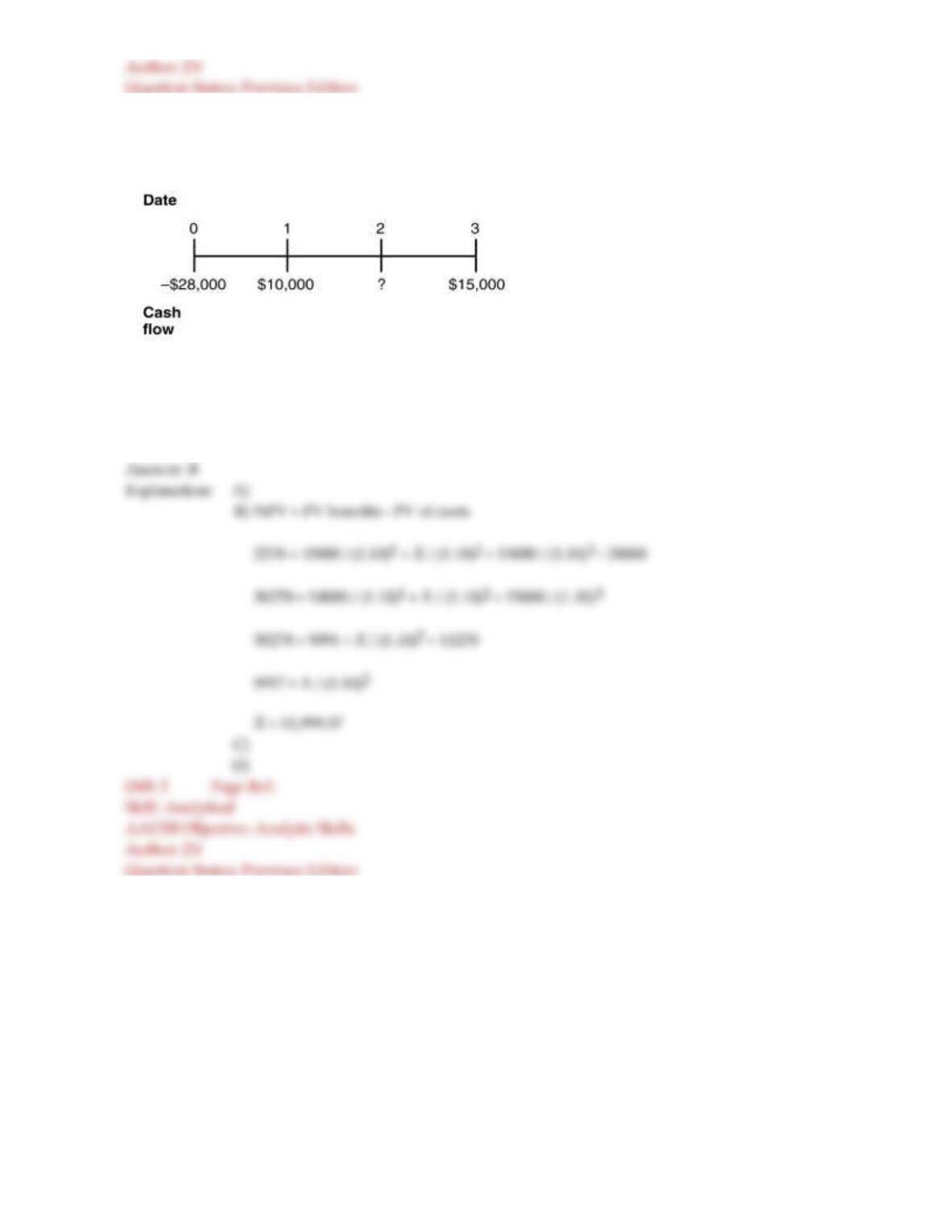
67) You are offered an investment opportunity that costs you $28,000, has a net present value (NPV) of $2278,
lasts for three years, has interest rate of 10%, and produces the following cash flows:
The missing cash flow from year 2 is closest to:
A) $12,500
B) $12,000
C) $13,000
D) $10,000