1) What is the basis of the audit for FCAA? Where did you find the information?
2) What types of investments does FCAA classify as cash equivalents? Where did you find the
information?
3) What method of depreciation does FCAA use? Where did you find the information?
4) The audit is unqualified. Source: Auditor’s letter. Subtract 1/2 point for missing source.
5) Did total expenses grow faster or slower than total revenues between fiscal years 2009 and
2010. Support your answer with the appropriate numbers from the statements. Where did you
find the information?
6) What were the two largest contributors to the growth in operating expenses (in dollars) by
natural account between fiscal years 2009 and 2010? Support your answer with the appropriate
numbers from the statements. Where did you find the information?
7) What was the impact of “contributions and in–kind support” on FCAA’s profitability in fiscal year
2010? Support your answer with the appropriate numbers from the statements. Where did you
find the information?
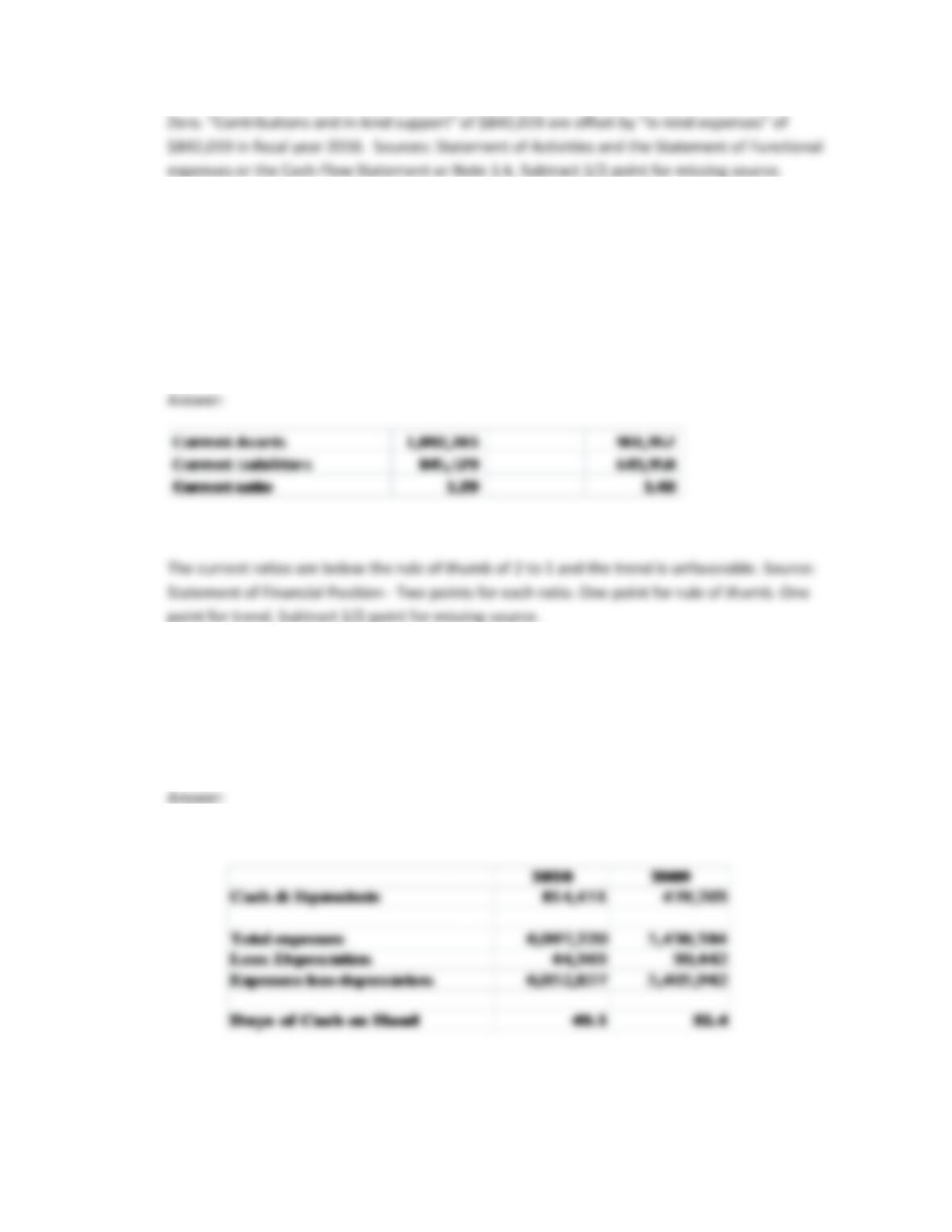
8) What were FCAA’s current ratios in fiscal years 2009 and 2010? Are the current ratios above or
below the rule of thumb? Is the trend favorable or unfavorable? Support your answer with the
appropriate numbers from the statements. Where did you find the information?
Current ratio = current assets / current liabilities
9) How many days of cash did FCAA have on hand at the end of fiscal years 2009 and 20010? Is the
trend favorable or unfavorable? Support your answer with the appropriate numbers from the
statements. Where did you find the information?
Days of cash on Hand = (cash + marketable securities) / (operating expenses – depreciation)/365
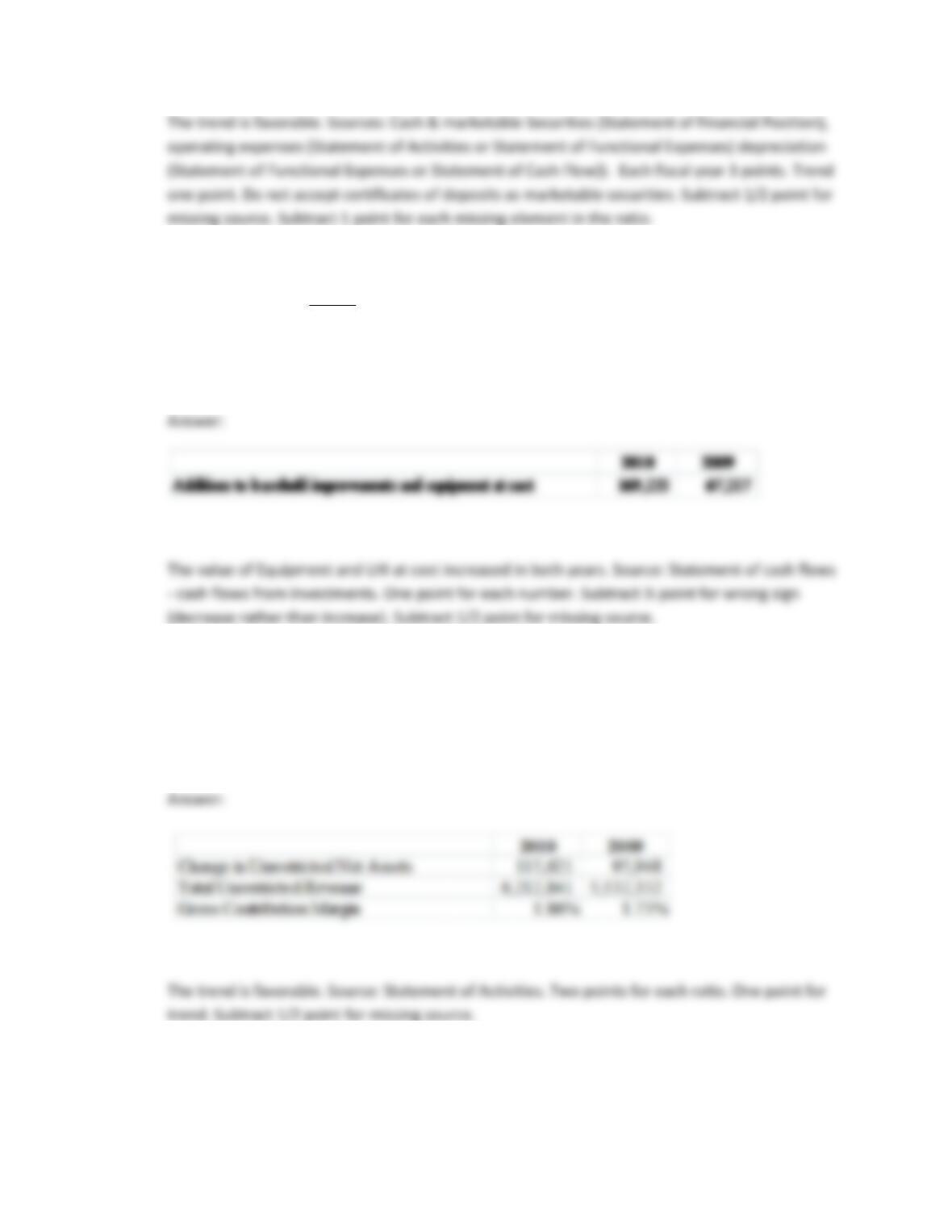
10) What was the value at cost of FCAA’s additions or deletions to leasehold improvements and
equipment in fiscal years 2009 and 2010? Did the value of equipment at cost increase or
decrease? Support your answer with the appropriate numbers from the statements. Where did
you find the information?
11) What were FCAA’s gross profit margins in fiscal years 2009 and 2010? Is the trend favorable or
unfavorable? Support your answer with the appropriate numbers from the statements. Where
did you find the information?
Gross profit margin = change in unrestricted net assets / total unrestricted revenue
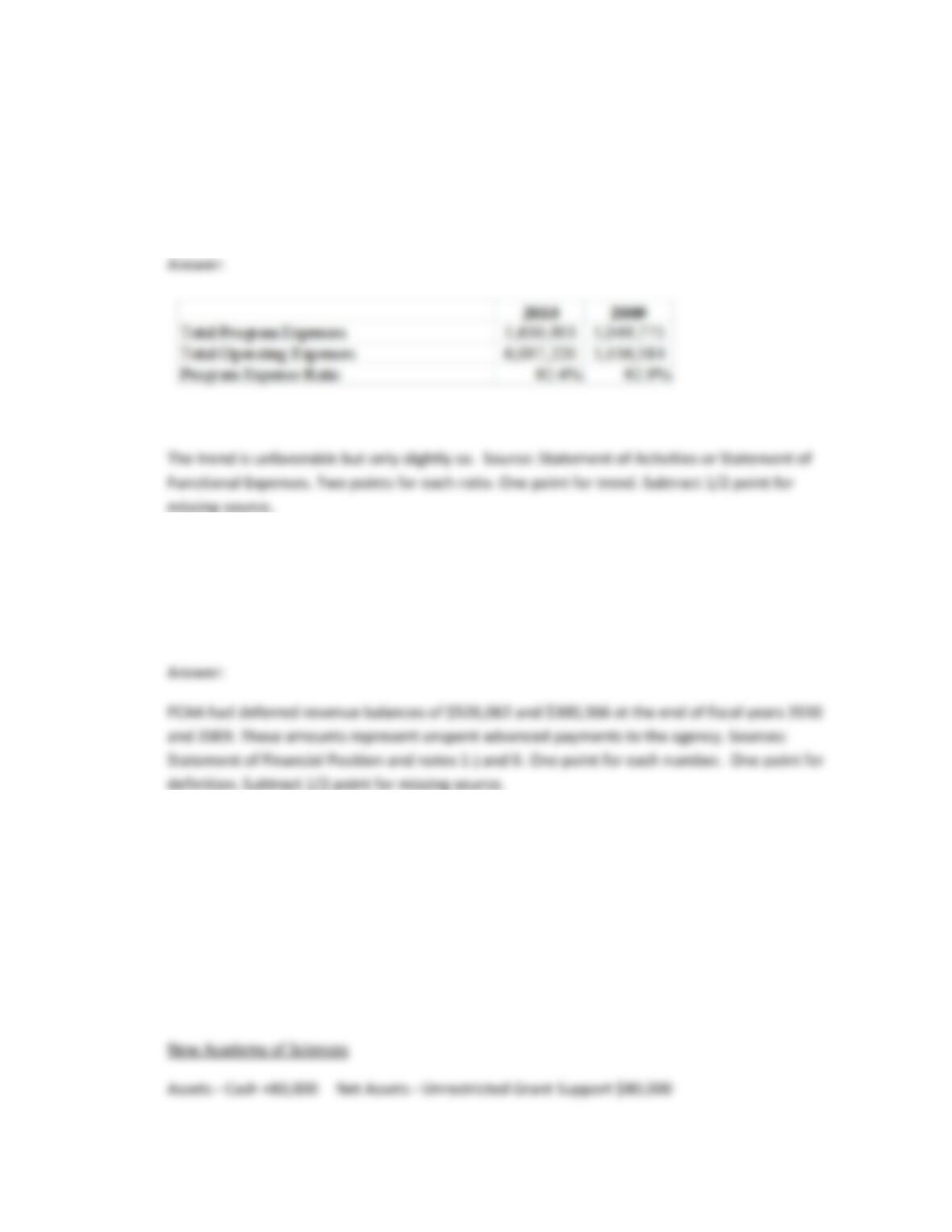
12) What were FCAA’s program expense ratios in fiscal years 2009 and 2010? Is the trend favorable
or unfavorable? Support your answer with the appropriate numbers from the statements.
Where did you find the information?
Program expense ratio = total program expenses / total expenses
13) What were FCAA’s deferred revenue balances as of the end of fiscal years 2009 and 2010? What
do these amounts represent? Support your answer with the appropriate numbers from the
statements. Where did you find the information?
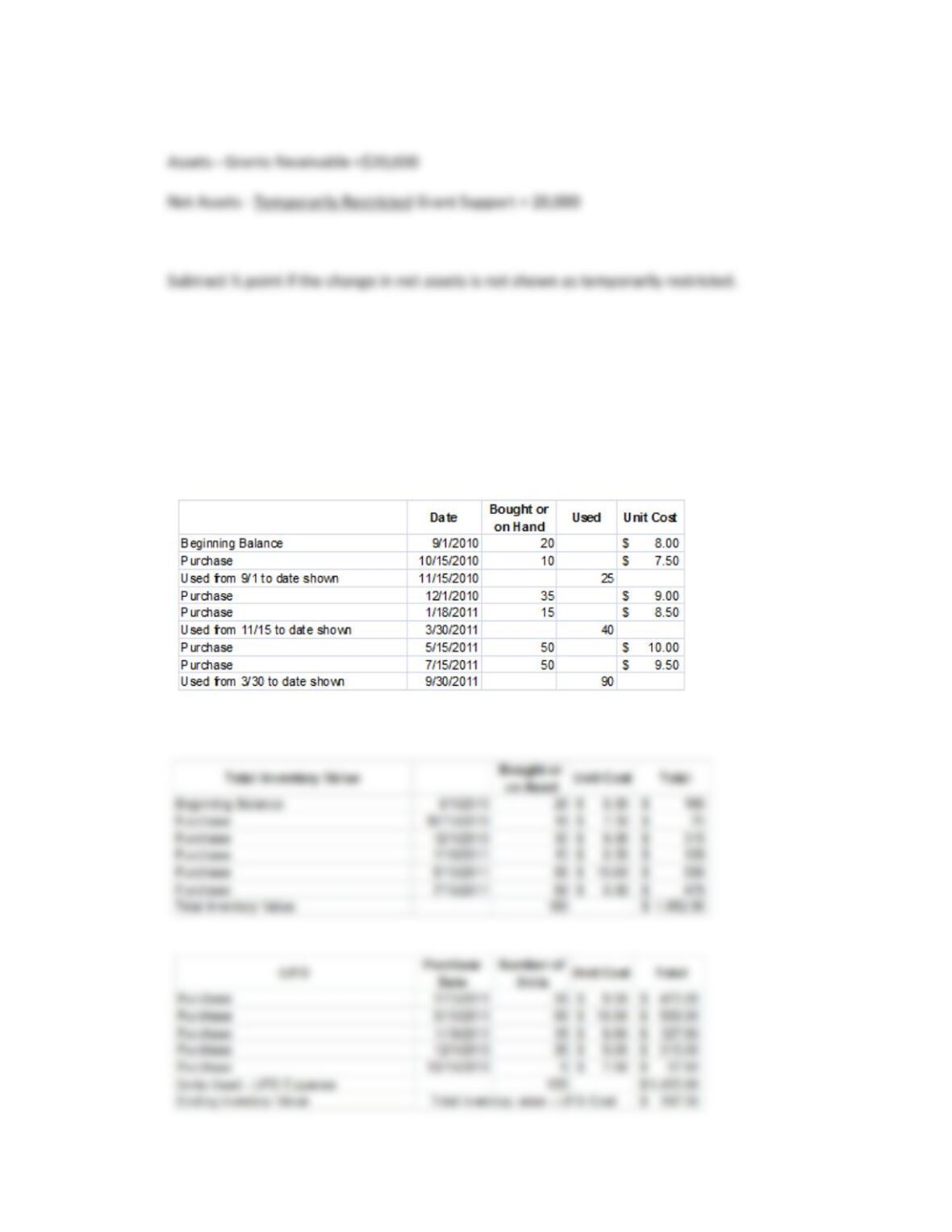
1. The State Department of Education offers demonstration grants that Charter Schools can use to
develop curriculum. Each grant is for $100,000. Grants are paid to school districts as follows:
80% at the start of the academic year and 20% upon completion of a performance report. The
New Academy of Sciences (NAS) which, an independent, non-profit organization received one of
the grants. NAS expects to complete the performance report by the middle of its next fiscal
year. How would NAS record the State grant revenue on September 30, the last day of their
current fiscal year?
Answer:
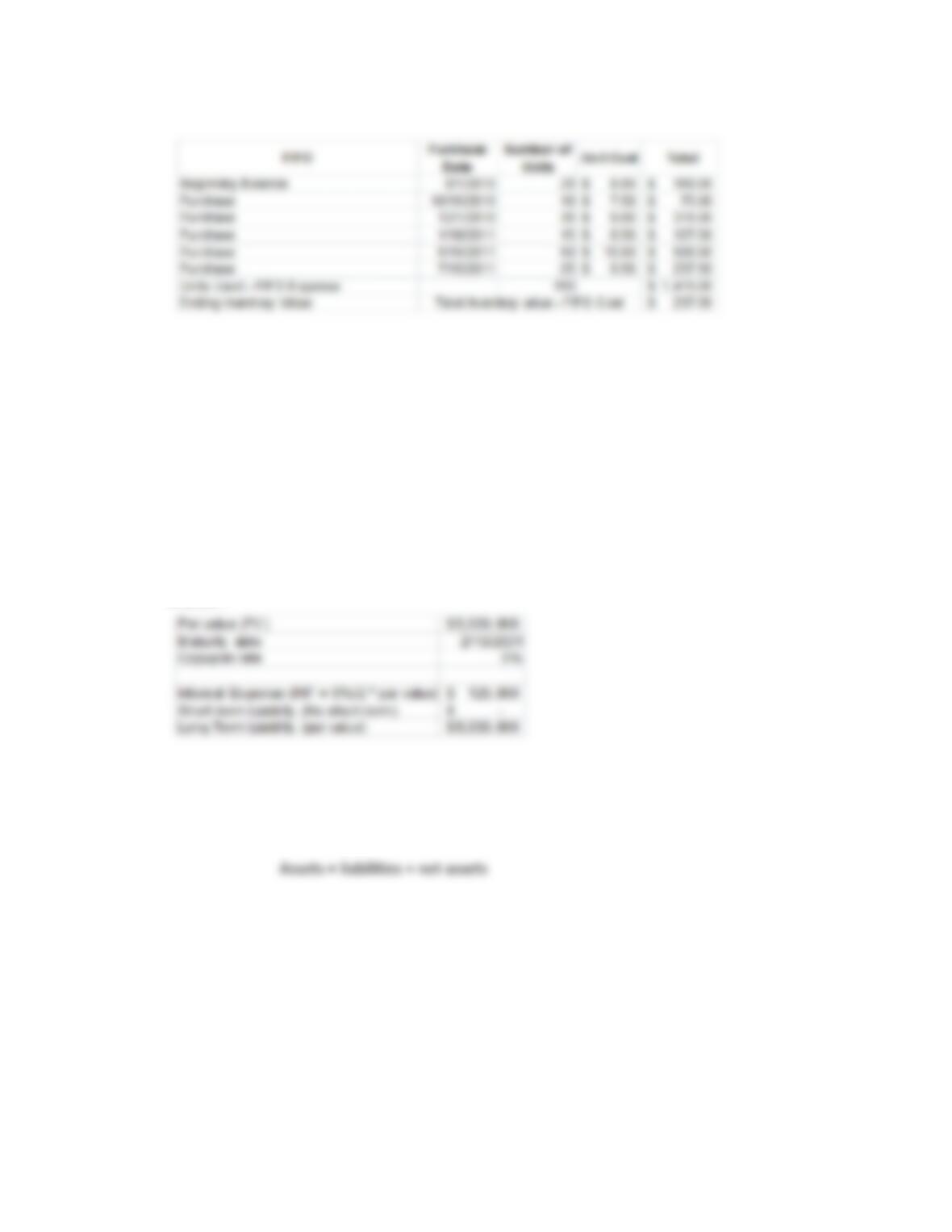
2. During the fiscal year the New Academy of Sciences (NAS) bought and used cases of cleaning
fluids as shown in the table below. What would NAS’s inventory expense and inventory value be
on September 30, the last day of its fiscal year?
a. Using LIFO
b. Using FIFO
Answer:
3. Food for Folks (FFF), a nonprofit organization, issued a $5,000,000 bond on February 15, 2011.
The bond matures on February 15, 2031 and has a coupon rate of 5%. Interest payments are
due on February 15th and August 15th of each year. FFF’s current 2011-12 fiscal year ends on
July, 31, 2012. Answer the questions below about NAS’s bond. Be sure to show all calculations.
a. How much would FFF recognize as an interest expense at the end of its fiscal year?
b. On February 15, the day they took out the loan, how much of the $5,000,000 bond
would FFF recognize as a current liability?
c. On February 15, the day they took out the loan, how much of the $5,000,000 bond
would FFF recognize as a long-term liability?
Answer:
4. What is the fundamental accounting equation for a balance sheet?
Answer:
5. If a nonprofit organization buys a $1,000,000 building, its net assets would _______
_____________ while the same transaction for a government fund would result in
a(n)________________ in fund balances:
a) increase
b) decrease
c) stay the same
d) can not tell from the information given
Answer:
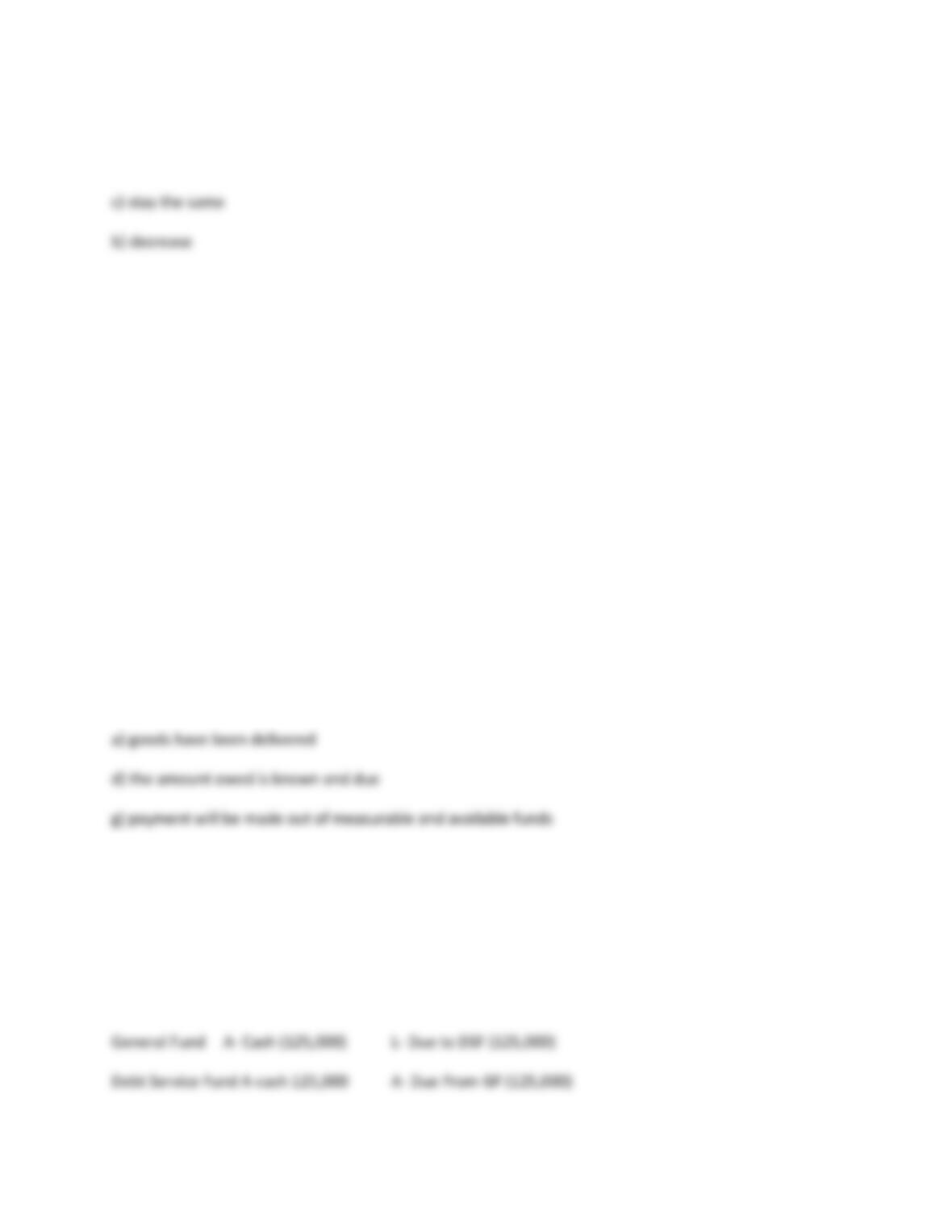
6. County Government would recognize expenditures when __________
________________________________________________________________
_____________________________________. (choose from the selections below)
a) goods have been delivered
b) cash is available to make the payment
c) revenues have been encumbered
d) the amount owed is known and due
e) the expenditure has been budgeted
f) the expenditure has been encumbered
g) payment will be made out of measurable and available funds
Answer:
7. On April 1 of the fiscal year, New County Government’s (NCG) General Fund transferred $1,250,000
out of a required $1,500,000 to its Debt Service Fund. That transaction was recorded on the date it
occurred. (You do not have to record this transaction.) On May 1, NCG transferred an additional
$125,000 (also part of the required $1,500,000) to the debt service fund. How would the $125,000
transfer be recorded in each of the two affected funds?
Answer:
1. #