Environment: Science Behind the Stories, 2e Cdn. Ed. (Withgott)
Chapter 4 Evolution, Biodiversity, and Population Ecology
4.1 Graph and Figure Interpretation Questions
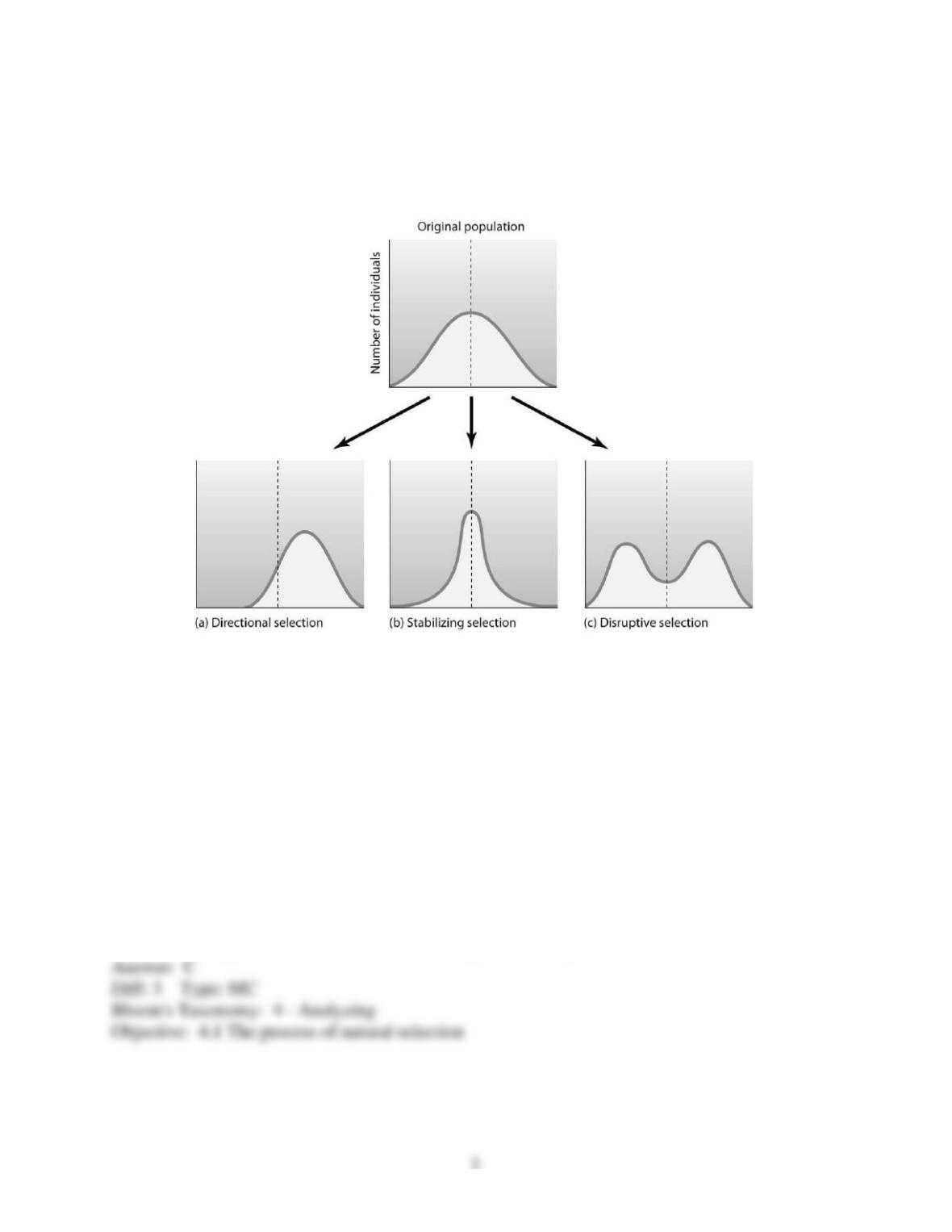
Figure 4.1
Use Figure 4.1 to answer the following questions.
A flock of 100 small, bright yellow and brown finches is blown off course and ends up on a large
island where there is a lot of open, grassy ground, and low hills. There are mammals, many
plants, some insects, lizards, and a few hawks, but there are no other small birds. There are two
types of plants with edible seeds, a very small-seeded grass, and a large-seeded bush.
1) Refer to Figure 4.1. Over many years, the population of finches on the island ________.
A) begins to look like graph (a), directional selection, with regard to beak size
B) begins to look like graph (b), stabilizing selection, with regard to beak size
C) begins to look like graph (c), disruptive selection, with regard to beak size
D) goes extinct because there is nothing that the finches can manage to eat
E) doesn’t change; the finches maintain their original diversity

2) Refer to Figure 4.1. The hawks on the island have always eaten insects, lizards, and mammals,
but they find the brightest yellow finches to be easy prey as well. Over many years, the
population of finches on the island ________.
A) begins to look like graph (a), directional selection, with regard to colouration
B) begins to look like graph (b), stabilizing selection, with regard to colouration
C) begins to look like graph (c), disruptive selection, with regard to colouration
D) goes extinct because the hawks eat them all
E) doesn’t change; the finches maintain their original diversity
3) Refer to Figure 4.1. Over many years, the population of finches on the island ________.
A) begins to look like graph (a), directional selection, with regard to wing length
B) begins to look like graph (b), stabilizing selection, with regard to wing length
C) begins to look like graph (c), disruptive selection, with regard to wing length
D) goes extinct because the wings do not change
E) doesn’t change; the finches maintain their original diversity
4.2 Matching Questions
Match the following.
A) habitat
B) type I
C) population potential
D) environmental cooperation
E) ecosystems
F) community
G) population density
H) population
I) type III
J) niche
K) environmental resistance
L) ecotones
1) Multiple interacting species that live in the same area
2) Communities and the abiotic material with which their members interact
3) Specific biotic and abiotic environment in which an organism lives
4) Number of individuals within a population per unit area
5) Stabilizes a population at its carrying capacity
6) A cod female can produce millions of eggs. Most likely cod has this survivorship curve
Diff: 1 Type: MA
Bloom’s Taxonomy: 4 – Analyzing
Objective: 4.5 Characteristics that predict population dynamics
4.3 Short Answer Questions
1) What are the two main lessons from the Monteverde rain forest?
2) What is biological diversity, and what specific categories of diversity are included in the
definition?
3) What is habitat selection, and how does it differ for different organisms?
4) Write the equation used to determine growth rate.
5) Differentiate between habitat and niche.

6) The similarity in the shape of fish and dolphins is an example of ________.
7) The departure of individuals from a population is called ________.
8) The innate reproductive capacity of a species is its ________.
9) How may a clumped population distribution possibly reduce the vulnerability of an individual
to predation?
10) In the hierarchy of matter, what a macromolecule is to an organelle is what a(n) ________ is
to an organ.
11) An organelle is to a cell what a(n) ________ is to an organism.
12) ________ use other plants as their habitat.

4.4 Multiple-Choice Questions
1) Extinction is ________.
A) a natural process
B) not caused by human disturbance
C) the loss of communities from the planet
D) proceeding more slowly now than at any other time
E) something that occurs only rarely
2) Most extinction is ________.
A) the result of catastrophe
B) gradual
C) the result of slow climate change
D) problematic for generalists
E) not often a problem for specialists
3) The two processes that determine the world’s current biodiversity are ________.
A) allopatric and sympatric speciation
B) mutation and cleavage
C) endemism and climate change
D) extinction and speciation
E) breeding and ecotourism
4) A population is a group of ________.
A) individuals of interacting species that live in one area
B) individuals of interacting species that interact in multiple ecosystems
C) individuals of a single species that live in one area
D) individuals of a single species that interact in multiple ecosystems
E) cells that have similar function
5) A community is a group of ________.
A) individuals of interacting species that live in one area
B) individuals of interacting species that interact in multiple ecosystems
C) individuals of a single species that live in one area
D) individuals of a single species that interact in multiple ecosystems
E) cells that have similar function
6) The functional role of a species in its community is its ________.
A) habitat
B) place in the food chain
C) selection
D) niche
E) evolution
7) 500 000 puffins live on four small islands in Witless Bay in Newfoudland and Labrador.
Living in this bird colony ________.
A) decreases probability of an individual puffin encountering a potential mate
B) decreases biodiversity within the species
C) decreases competition
D) decreases the use of resources
E) increases the incidence of disease transmission
8) Population distribution describes ________.
A) placement of a species around the globe
B) placement of a species within a country’s boundaries
C) spatial arrangement of individuals of a single species within a particular area or ecosystem
D) spatial arrangement of multiple species within a particular area
E) how near or far away individuals in a population are from a resource, such as water

9) Penguins during their breeding season concentrate in relatively few dense colonies. Within a
colony they often aggressively defend their own space against their neighbours. The spatial
distribution of these penguins is ________.
A) at local level: clumped; at larger scale: uniform
B) at local level: uniform; at larger scale: clumped
C) at local level: random; at larger scale: clumped
D) at local level: clumped; at larger scale: random
E) random, both at local level and at larger scale
10) Unregulated populations tend to increase by ________.
A) linear growth
B) exponential growth
C) pyramidal growth
D) logistic growth
E) immigration
11) The carrying capacity is the ________.
A) maximum population size that a given environment can sustain
B) greatest number of different niches possible in a given area
C) potential growth in the number of species in a given area
D) limitation on numbers of species in a community
E) average number of offspring carried to term by a species
12) Density-dependent factors ________.
A) include the effects of a hard freeze on an entire community
B) include the effects of a hard freeze on a single species within a community
C) cause decreases in the number of species in an ecosystem
D) include the effects of rainfall on an entire community
E) include the effects of disease and predators on a single species within a community
13) Grey whales produce at most one offspring every other year. They are ________.
A) r-selected
B) K-selected
C) density-independent organisms
D) not likely to exhibit parental care
E) not likely to have been subject to variable and unpredictable mortality before humans arrived
14) Heavy rains and mudslides cause a river to change course, isolating two groups of lizards
from one another. Over a long period of time, ________.
A) one group will probably become a local species
B) both groups will probably become native species
C) the groups will probably become genetically different, and speciation may occur
D) one or both groups will probably emigrate
E) one or both groups will probably become invasive species
15) The Great Lakes have native species of freshwater mussels. In 1988, the first individuals of
invasive Zebra mussels arrived in the balast water from Europe, multiplied rapidly, spread
throughout the Lakes and beyond, and began competing for food and space with native mussels.
The zebra mussels ________.
A) in the beginning had lower carrying capacity than native mussel species
B) lowered the carrying capacity of native mussel species
C) encountered similar environmental resistance as native mussel species
D) succeeded because they exhibit parental care
E) did not affect significantly the bottom-dwelling community

16) The destruction of ecosystems is NOT always a problem ________.
A) because restoration ecology can restore ecosystems
B) because humans can find and make their own resources
C) because zoos and gardens contain most important species and breeding technologies are
improving
D) because our understanding of genetics allows us to restore populations
E) This is incorrect; the destruction of ecosystems is always a problem.
17) A small moth pollinates native trees when they bloom in April. Some of the moths emerge in
early March and discover a different blooming shrub to use as a resource. This is an example of
what, over time, could be ________.
A) sympatric speciation
B) allopatric speciation
C) an invasive species
D) an extinction for the original population
E) a change in age structure of the original population
18) One example of artificial selection is ________.
A) crossing a lion and a tiger to get a sterile animal called a liger
B) gypsy moths as an invasive species
C) pet dogs that, having gone wild, are mating with coyotes and living in packs
D) humans placing a gene for human insulin into a flower
E) broccoli
19) If you were part of a population of field mice, an example of an adaptive trait that could help
with reproduction and/or survival would be ________.
A) being brightly coloured so other mice could see you
B) needing to eat more food than other mice your size
C) spending more time running around on the ground looking for better seeds
D) having a bit more fur to withstand cold weather
E) having shorter legs to be lower to the ground

11
20) A number of coyotes move into an area and begin to eat a population of small harvest mice.
After several years, the harvest mice are much speedier runners than before the coyotes came.
This is an example of ________.
A) stabilizing selection
B) directional selection
C) disruptive selection
D) allopatric speciation
E) sympatric speciation
21) Which of the following would represent a clumped population dispersion pattern?
A) a forest of pine trees
B) oaks planted on city streets
C) a pod of 40 migrating grey whales
D) eagles nesting in the Fraser River Canyon
E) earthworms in the soil of a garden
22) A type I survivorship curve, with higher death rates at older ages, is typical of ________.
A) redwood trees
B) large open-water ocean fish, such as tuna
C) dandelions
D) large mammals such as gorillas
E) large reptiles such as alligators
23) An example of a density-independent factor would be ________.
A) blight (a mould disease) in a wheat field
B) an ice storrm causing damage to trees and shrubs
C) nest sites for a flock of warblers
D) a plant parasite, such as mistletoe
E) a grass that is wind pollinated
24) Which of the following pairs contains, first, an r-selected organism and, second, a K-selected
organism?
A) elephant; whale
B) elephant; pine tree
C) pine tree; dandelion
D) dandelion; pine tree
E) grasshopper; whale
25) A coyote, which can alter its food intake to match seasonal abundance of plants, fruits, or
small animals, is considered to be ________.
A) a generalist, able to be flexible
B) a specialist, able to specialize on whatever is available at the time
C) a local species, able to be flexible
D) density independent and resource neutral
E) an organism with a type II survivorship curve
26) A species has evolved an asexual mode of reproduction by having offspring develop from
unfertilized eggs. Which of the following will be true of this species’ response to natural
selection?
A) There will be more deaths from natural selection because there is no mutation.
B) There will be less genetic variation from recombination and a risk of not adapting quickly to
environmental change.
C) The species will increase in numbers because genetic variation is increased.
D) The species will compensate for loss of genetic variation by hybridizing with other species.
E) There will be fewer deaths from natural selection because sexual recombination is always
harmful.
27) Which of the following is true?
A) Species on Earth today are but a fraction of all species that ever lived.
B) The number of species existing at any given time has decreased throughout history.
C) Extinctions of past species has happened gradually and on a small scale.
D) Most organisms present early in Earth’s prehistory were more complex than modern
organisms.
E) Bacteria represent a newer form of life, not present during the early prehistory of Earth.
28) The fossil record clearly shows that ________.
A) several different species can hybridize to produce a single new species
B) large complex organisms evolved long before simple organisms
C) nearly all species that have existed in the past still exist today
D) all species evolve from pre-existing species
E) new species appear suddenly and fully differentiated, without an ancestral species
1) Paleontologists calculate that the average time a species spends on Earth is between 1 and 10
million years.
2) A population that is limited by a resource is expected to continuously have an exponential
growth curve.
3) Ants are K-strategists.
4) Salmon are K-strategists.
5) One line of evidence for natural selection is the obvious results from the artificial selection
that humans have performed on plants and on animals.
6) Birds have a survivorship curve type II.
4.6 Essay Questions
1) Briefly describe speciation. Differentiate between allopatric and sympatric speciation.
2) Describe the sixth mass extinction event, when it occurred, and its specific causes.
3) Differentiate between exponential and logistic growth curves. Give examples of the conditions
under which each would occur.
4) Is a carrying capacity a fixed entity? Discuss the role of humans in regulating carrying
capacity for the human species and in altering the carrying capacity for other species.
5) A population of quail live in an area of prairie grasslands. In good years, a pair of quail can
have four clutches of young, with as many as 12 to 14 eggs in each clutch. Despite this, the
population size remains stable over the long term. Discuss the population structure, its potential
for growth, and its possible limiting factors, using at least four of the terms you learned in this
chapter.
6) A species of bird had an original range covering the entire eastern half of the United States
from New England west to the Mississippi and then south to Florida. During a period of
glaciation, the eastern part of the population was cut off from the western part for 2000 years.
Then the glacier melted and the birds’ range was re-established. During the separation, the
western birds evolved a slightly different song and a darker wing colour. Ornithologists are now
studying this species to determine whether speciation has taken place. What evidence will they
look for in their study?
7) Demonstrate how the characteristics of the K-selected species all “make sense”–that is, how
they fit together into a “logical” reproductive strategy. You may do this by showing how each K-
characteristics supports, or is explained by, one or more of the other K-characteristic(s).
8) Differentiate between generalist and specialist species. Give an example of each. Which are
more vulnerable to extinction and why?
9) Provide the advantages and disadvantages of high population density.
10) Differentiate between the divergent and convergent evolution. What are they? What drives
them? Provide examples of each.
4.7 Scenario-Based Questions
Read the following scenario and answer the questions below.
The Kaibab Plateau in southern Utah and northern Arizona is a high, isolated, forested, and high
chaparral peninsula-like area, with elevations up to 3000 m. By the early 1900s, ranchers had
been grazing many cattle there for generations, and the land showed some grazing damage.
Heavy hunting pressure, in combination with the cattle grazing, had reduced the population of
Kaibab deer to only about 4000.
In 1906, President Theodore Roosevelt established the Grand Canyon National Game Preserve
on the Kaibab Plateau in an effort to protect the mule deer from over hunting by humans and
from predation. Deer hunting ceased, and open season was declared on cougars, wolves, and
coyotes. This was one of the first efforts to protect endangered wildlife. It would be followed by
others in Canada and in the United States.
1) What made the Kaibab Plateau so ideal for attempting to improve the mule deer population?
A) It was open land where animals could freely move to and from other areas.
B) It was completely fenced from the rangeland.
C) The ranchers and hunters were all willing to help protect the deer.
D) It was isolated, and the deer had essentially no emigration or immigration.
E) Researchers were able to study every aspect of the issue.
2) President Roosevelt’s actual goal was to ________.
A) improve the range for livestock
B) improve the range for deer
C) preserve and increase the deer population
D) preserve the natural environment
E) remove predators
Read the following scenario and answer the questions below.
Between 1907 and 1923, cattle grazing was greatly reduced, deer hunting was eliminated, and
predators were killed. Over 600 cougars, 11 wolves (most had already been killed in the 1800s),
and 3000 coyotes were trapped or shot. In response, the deer herd began to increase. By 1915,
the deer were estimated at 25 000; by 1920 at
50 000; and by 1923 at approximately 100 000.
3) Which of the graph lines described below suggests the Kaibab deer population between 1900
and 1923?
A) a straight line slanting upward, showing a steady increase over time
B) a J-shaped upward curve with a very rapid increase
C) a “sine wave” curving up, down, up, down
D) a rapidly decreasing slope from left to right
E) an S-shaped curve that shows a smooth, rapid increase and then levels off
4) The removal of the livestock and predators, and the cessation of hunting in 1907 ________.
A) changed the environmental resistance, increasing K for the Kaibab deer
B) changed the environmental resistance, decreasing K for the Kaibab deer
C) removed the limits on immigration, allowing more deer into the area
D) decreased r, allowing more births among Kaibab deer
E) increased r, allowing more births among Kaibab deer
5) The initial population of Kaibab deer in 1906 was about 4000, which worked out to an
average density of one deer per 0.75 km2. What is the approximate density in 1923?
A) one deer per 3 km2
B) one deer per 0.2 km2
C) one deer per 20 km2
D) one deer per 0.03 km2
E) one deer per 2 km2
6) If there was no environmental resistance, based on the population growth between 1915, 1920,
and 1923,
when would you expect the population to reach 200 000?
A) 1939
B) 1931
C) 1928
D) 1926
E) 1925
7) If in the pre-European period (i.e., before cattle grazing and the hunting for deer and
predators) Kaibab supported a stable population of 50 000 deer, then what would be today’s
carrying capacity of the mule deer population in Kaibab? Assume that the Game Preserve
rangers continued to ban the cattle grazing and continued to kill predators, and that the
population spike in the 1920s didn’t cause a permanent damage to soils and vegetation.
A) 50 000 or less
B) 50 000
C) 50 000 or higher
D) higher than 50 000
E) 100 000 or higher
a