
Exam #1
Please follow the directions provided. Tests are due by 6:05 pm on Thursday, October 20, 2011. Late
tests will receive no credit. Remember to put your name on the exam as well. This exam is worth 20
points in total, 10 for each problem.
1) Tutoring Is Critical (TIC) is a new not-for-profit startup organization dedicated to providing
individualized educational support for children in New York City. The following events occurred in 2011:
1) Borrowed $100,000 for its start-up costs. The loan carries a 5% annual interest rate, and all
2) Used $12,000 to pay for the first year’s rent for its office space. It uses the space all year.
3) Purchased 3 computers for $1,500 each, with expected useful lives of 3 years but no salvage
4) Hired 5 tutors on contract. Paid each of them $10,000 up front to retain their services for the
5) Placed an advertisement in the local newspaper for their services. The ad cost $1,000.
6) A local foundation donated $25,000 to provide tutoring services for children whose families
7) 20 students sign up for and pay for one year of tutoring services, at a price of $2,000 each.
8) 5 students sign up for tutoring and qualify for a full subsidy (that is, they pay $0) from the
9) A local private school also hires TIC to come to the school to tutor their students. The school
10) The tutors each earn $25,000 in compensation, and TIC pays them what it owes above the
retainer (that is, you need to consider the retainer paid out in number 4 above as well). $10,000
11) TIC earns the $50,000 received from the school for services provided.
Because it is a startup, there are no opening balances. Complete a transaction worksheet for ALL
transactions recognized during the year (2011). Remember to include any year-end transactions. Then
generate a balance sheet, an operating statement, and a cash flow statement. Note when creating the
cash flow statement, you should use the change in total net assets as the first line, and you can ignore
any changes to restricted net assets (that is, when creating the cash flow statement, you can treat all net
assets the same as we did through most of the semester so far).
2) Training Opportunities for Prison Populations (TOPP) runs a job-training program where persons
exiting the prison system learn skills to transition to employment and self-sufficiency. Here, they learn
carpentry skills and the organization sells their work in a retail store. Those involved earn money from
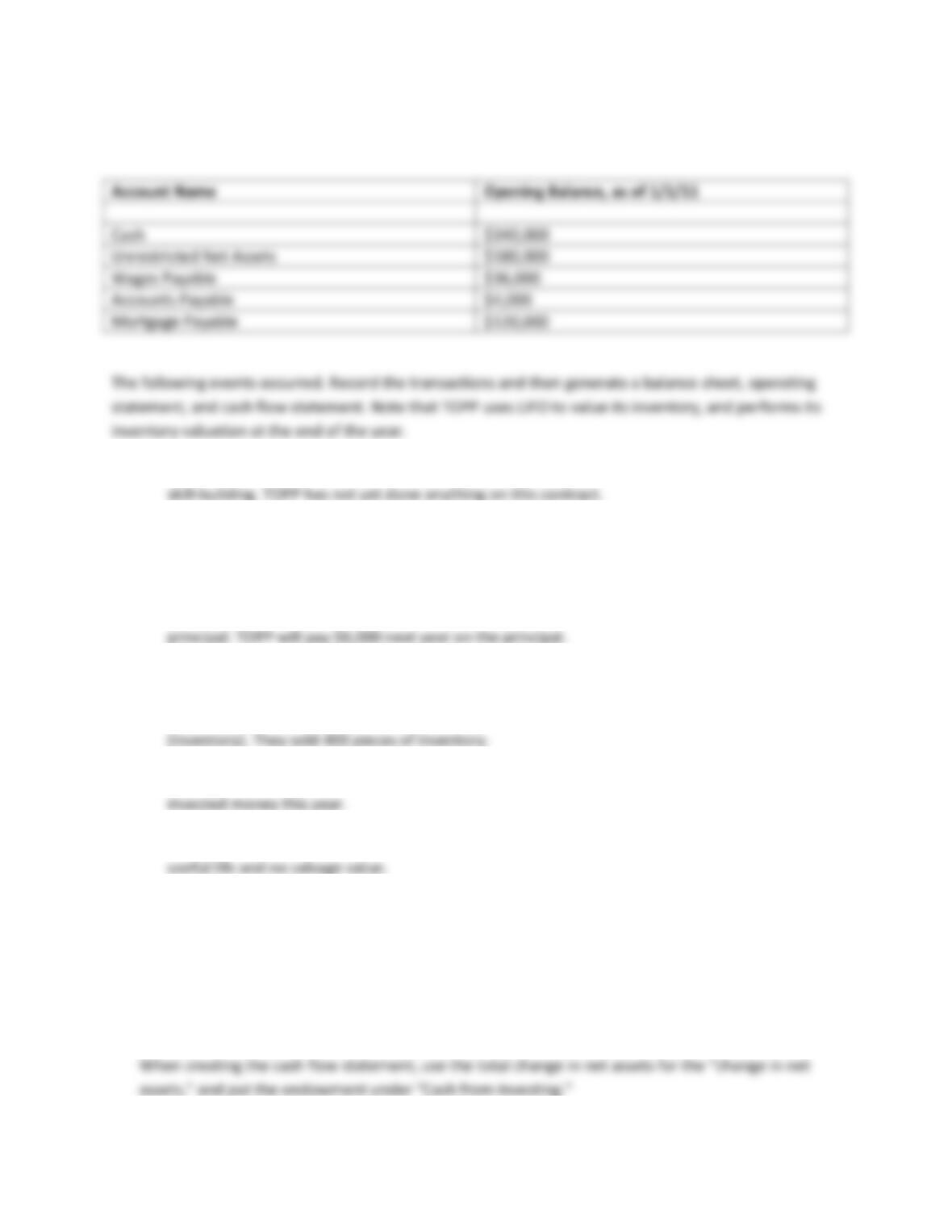
the sales, and the organization supports its mission as well. Starting balances for TOPP’s general ledger
accounts at the beginning of 2011 were:
1) Received $150,000 as an advance on a New York State Department of Corrections contract for
2) Bought 300 wood blocks from suppliers for $30 each. TOPP paid cash for the inventory.
3) Paid workers $30,000 for wages earned last year.
4) Paid $10,000 to a bank on an outstanding mortgage. $5,000 was for interest and $5,000 was for
5) Bought 150 wood blocks from suppliers for $40 each. Again, TOPP paid cash for the inventory.
6) $80,000 of sales revenue was earned in the retail store, and all of it was from selling carpentry
7) Received $50,000 for an endowment that can never be spent. TOPP expects to earn 8% on the
8) Purchased and paid for tools for the workshop at a cost of $10,000. The tools have a 2-year
9) Workers earned $25,000. They were paid by TOPP.
10) Bought 400 wood blocks from suppliers for $45 each. TOPP has not yet paid this bill.
11) Earned 6% on the endowment investments in interest. The cash may be used for any purposes.