Chapter 4 – Wealth and the measurement of profit
TRUE/FALSE
1. The wealth of an entity is determined by what it controls and what it owes.
2. Choosing a measurement system affects profit but does not affect wealth.
3. Profit represents an increase in wealth.
4. Profit measures the flow of resources into and out of the business over time.
5. Historic cost is the cost incurred by an individual or enterprise in acquiring an item, measured at
the time of the originating transaction.
6. The written down cost of an asset represents the cost of an asset after accumulated depreciation.
7. Historical cost is often referred to as the most relevant method of measurement.
8. Net realisable value is based on an expected selling price in a forced sale.
9. The net realisable value is the estimated proceeds of sales less, where applicable, all further costs
to the stage of completion, and less all costs to be incurred in marketing, selling and distribution to
customers.
10. The value of the expected earnings from using an item, discounted at an appropriate rate to give a
present-day value, is the economic value.
11. The common measurement method adopted in most countries is that of historic cost.
12. The fair value of an asset is more reliable where there exists a liquid market for the asset, than
when no liquid market exists.
13. Where an asset is exchanged between a willing seller and a willing buyer and the exchange price is
below the market price due to fact that the parties involved are related, the resulting exchange price
is referred to as fair value.
14. Fair value arises in circumstances where the price is based on an orderly transaction between a
willing seller and a willing buyer.
15. Economic value is considered to be an ideal approach to measuring value, but may lack reliability
due to the fact that the measure relies on estimates.
MULTIPLE CHOICE
1. Which of the following statements is true of profit and wealth?
A.
Profit is money and wealth is savings.
B.
Profit is a non-static measure and wealth is a static measure.
C.
Profit and wealth are non-circular.
D.
Profit and wealth are not related.
2. Which of the following statements is incorrect?
A.
Profit is a non-static measure and wealth is a static one.
B.
Profit is the difference between wealth at the start and at the end of the period.
C.
Profit represents the sum of all gains .
D.
Profit represents an increase in wealth.
3. Jane buys a 1957 FJ Holden at time T0 for $100,000. At time T1, the car is valued at $180,000.
Jane’s profit and wealth at T1 are:
A.
$100,000 and $80,000 respectively.
B.
$80,000 and $180,000 respectively.
C.
$80,000 and $100,000 respectively.
D.
$80,000 and $80,000 respectively.
4. James had $80,000 in the bank. He used some of this cash to buy a new car for $67,000 on 1
January 20X7. He subsequently modified the car, at no cost, and sold it for $78,000 on 1 March
20X7. What profit did James make from the sale of the car?
A.
$3000
B.
$8000
C.
$11,000
D.
$14,000
5. Peter has the following assets at various dates. He has no liabilities and earned no other income
over this two-year period.
Date
1/1/X5
1/1/X6
1/1/X7
Asset 1
$44,000
$41,000
$46,000
Asset 2
$24,000
$29,000
$39,000
Asset 3
$66,000
$61,000
$59,000
Which of these statements is correct?
A.
Peter’s wealth increased by $10,000 over this two-year period.
B.
Peter’s profit was $3000 for the year ended 1 January 20X7.
C.
Peter’s wealth was $134,000 at 1 January 20X7.
D.
Peter’s loss was $8000 for the year ended 1 January 20X6.
6. Historic cost refers to:
A.
the cost of selling an item.
B.
the cost to replace an item
C.
the purchase consideration of an item, plus incidental costs.
D.
economic value.
7. When calculating costs associated with the sale of an item, which of the following are included in
the net realisable value?
A.
Marketing, manufacturing and selling costs.
B.
Manufacturing, selling and distribution costs.
C.
Marketing, selling and distribution costs.
D.
Marketing and distribution costs.
8. Aaron sold his large lounge chair to his friend for $1000. He incurred costs of $100 for advertising,
$120 for hiring a van to transport the chair to the buyer, and $200 for a speeding fine. What is the
net realisable value?
A.
$1100
B.
$1120
C.
$1220
D.
$1420
9. Tom purchased an item for $5050 in 20X6. He sold the item to a complete stranger for $7000 in
20X7 and incurred a sum of $250 for advertising it. Which of the following statements is true?
A.
Historical cost is $5050.
B.
Fair value is $7000.
C.
Net realisable value is $6750.
D.
All of the above.
10. James had $80,000 in the bank. He used some of this cash to buy a new car for $67,000 on 1
January 20X7. James subsequently modified the car and sold it for $78,000 on 1 March 20X7. The
modifications cost James $10,000. The historical cost of the car is:
A.
$67,000.
B.
$68,000.
C.
$78,000.
D.
$88,000.
11. For which of the following accounts would the use of historical cost normally be a greater
limitation than for the other three?
A.
Cash
B.
Accounts Receivable
C.
Plant and Machinery
D.
Prepaid Rent
12. For which of the following accounts would the limitation ‘use of estimates and allocations’ not be
a concern?
A.
Inventory
B.
Cash
C.
Equipment
D.
Accounts Receivable
13. Which of the following statements about the limitations of financial statements is false?
A.
Many of the numbers reported in financial statements result from estimates.
B.
Financial statements report primarily the current value of assets.
C.
Some important factors may not be reported in a firm’s financial statements.
D.
Certain types of resources are not reported in the financial statements.
14. Current accounting practice in Australia is to initially record property, plant and equipment at:
A.
economic value.
B.
cost.
C.
net realisable value.
D.
replacement cost.
15. Where an asset is measured on the basis of the discounted net cash flows that are expected to be
generated by the future use of the item, the resulting measure is referred to as:
A.
fair value.
B.
net realisable value.
C.
historic cost.
D.
economic value.
16. Where an asset is measured at fair value, the figure involved:
A.
is more likely to be reliable if a liquid market for the asset exists than if no liquid market
exists.
B.
reflects an historical value.
C.
is the same as replacement cost.
D.
is fair and reasonable.
17. The replacement cost of an asset:
A.
is the same as historical cost.
B.
is sometimes called ‘current cost’.
C.
is the same as economic value.
D.
should always be used where the asset is to be replaced.
18. James had $80,000 in the bank. He used some of this cash to buy a new car for $67,000 on 1
January 20X7. James subsequently modified the car and sold it for $78,000 on 1 March 20X7. The
modifications cost James $9000, and he paid a total of $250 to advertise the car for sale. James
made a profit on the sale of the car of:
A.
nil.
B.
$1750.
C.
$2000
D.
$11,000
19. James had $80,000 in the bank. He used some of this cash to buy a new car for $67,000 on 1
January 20X7. James subsequently modified the car and sold it for $78,000 on 1 March 20X7. The
modifications cost James $10,000, and he paid a total of $250 to advertise the car for sale. James’
wealth after the sale of the car was:
A.
$80,000.
B.
$80,750.
C.
$148,000.
D.
$158,000.
20. Where an asset is measured using economic value, the figure involved:
A.
may lack reliability.
B.
represents the discounted value of expected future earnings from the use of the asset.
C.
represents a measure of current value.
D.
all of the above.
SHORT ANSWER
1. Distinguish between the terms ‘wealth’ and ‘profit’.
2. Explain what is meant by the term written-down value, and how the measure differs from the
historic cost of an asset.
PROBLEM
1. Assume that you bought a new computer from Computers Plus for $3200 in August 20X0. In
January 20X1 your computer is in need of repair. You have been advised that it will cost $275 to
repair the computer. You could sell the computer for $500 if you have it repaired and $100 if you
do not have it repaired. The new price for a similar computer in January 20X1 is $3050.
(a)
What is the historic cost of the computer to you?
(b)
What is the net realisable value of the asset to you in January 20X1 if you:
(i) have the computer repaired?
(ii) do not have the computer repaired?
(c)
What is the replacement cost of the computer in January 20X1?
(d)
Assuming the computer is repaired, do you consider the figure for the replacement cost an
appropriate measure of the future economic benefits that will be derived from the
continued use of the computer? Why/Why not?
2. Assume that the following information relates to you at today’s date. You have $120 cash in hand;
$3350 deposited in a bank account; a motor vehicle valued at $13,000; jewellery and other
miscellaneous items valued at $3200; and a friend owes you $100. You owe $1500 to a relative
who lent you the money to purchase the vehicle. What is the amount ($) of your wealth, given the
foregoing information?
3. In the season 2001–02 Manchester United (England) paid a transfer fee of USD $58.1 million to
Leeds United (England) for the services of soccer star Rio Ferdinand.
(a)
What factors may Manchester United have taken into consideration in arriving at the
value of Ferdinand’s services to the club?
(b)
What would be the advantages and disadvantage of using economic value to arrive at the
transfer fee?
earnings would include the following: membership fees, gate takings, sponsorships and
sales of club merchandise.
4. In August 2005, Western Australia’s biggest meat processor, E G Green & Sons, suspended
trading with debts estimated at $20 million. The company was at that time facing either (i)
liquidation, or (ii) trading out of difficulty and continuing as a going concern.
(a)
Identify five of the major groups of stakeholders who would be directly impacted by the
suspension in the entity’s operations.
(b)
What method(s) of valuing the firm’s non-monetary assets may have been appropriate
under both scenarios? Support your discussion by identifying the reasons for your choice
of methods.
(b)
Liquidation involves realising all assets and paying out the various claimholders.
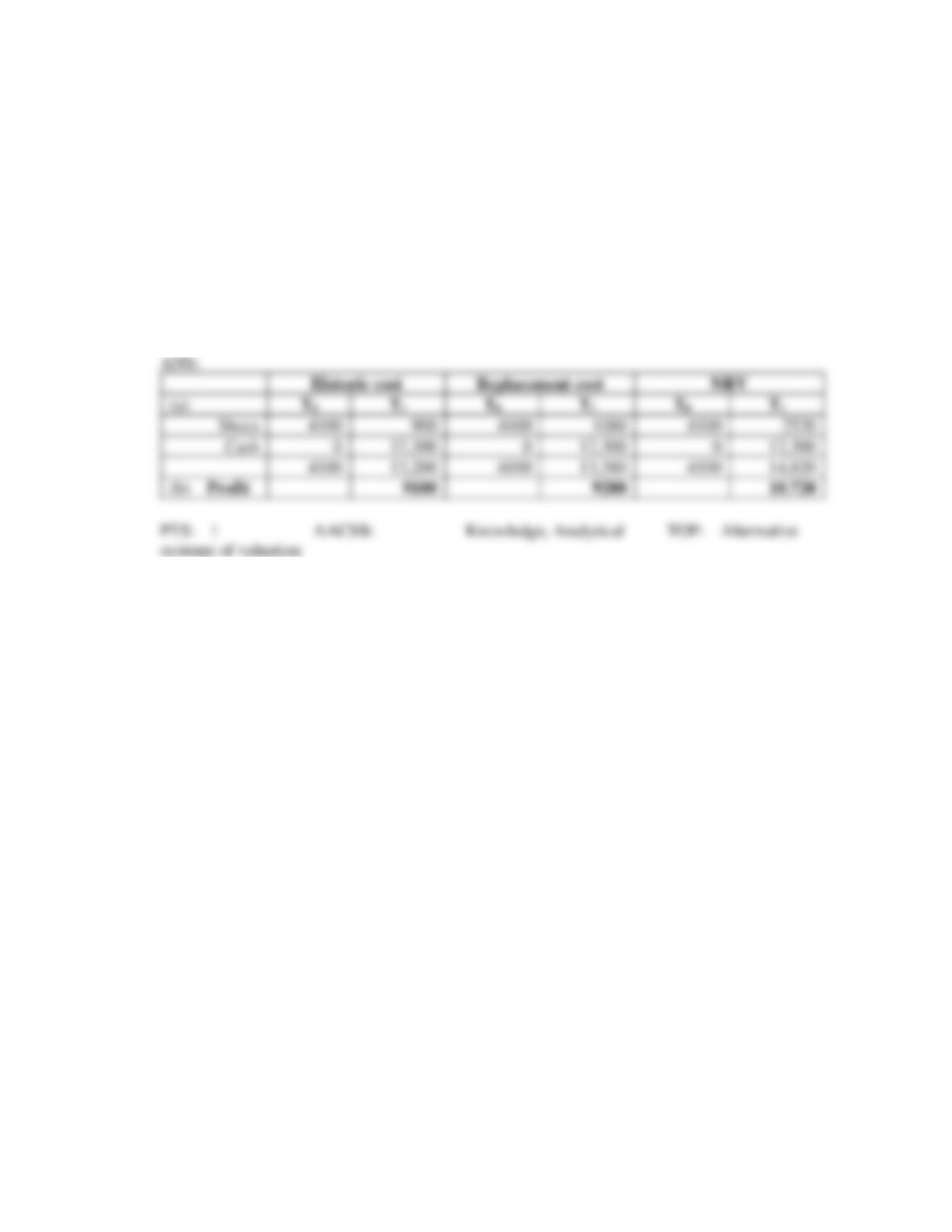
5. Pod Fashion buys and sells shoes. At 1 January 20X0 the business held 500 pairs of shoes, valued
at $10 a pair.
During January the business sold 410 pairs of the shoes at $40 cash per pair. The average cost of
selling the shoes was $10 cash per pair. The replacement cost of the shoes at 31 January 20X0 was
$12 a pair. Further, due to market competition, the expected selling price of the shoes in the
foreseeable future will be $38 a pair at an average cost of $10 per pair.
(a)
Calculate the wealth of Pod Fashion at 1 January 20X0 and 31 January 20X0, assuming
that the $10 value for shoes at 1 January represents both the historic cost, replacement
cost and net realisable value at that date.
(b)
Calculate the profit Pod Fashion made for the month of January 20X0, using the historic
cost, replacement cost and net realisable value methods.