Elements of Ecology, 9e (Smith)
Chapter 3 The Aquatic Environment
3.1 Short Answer Questions
1) The process by which water travels in a sequence from the air to Earth and returns to the
atmosphere is referred to as the ________ cycle.
2) The total amount of evaporating water from the surfaces of the ground and vegetation is called
________.
3) The ________ of water is the amount of heat that is required to raise the temperature of water
one degree Celsius.
4) Small animals, such as water striders and water spiders, can run across a pond’s surface due to
________.
5) ________ is the source of frictional resistance to objects moving through water.
6) As sunlight passes through water, only ________ wavelengths are able to penetrate into
deeper water.
7) The region of the vertical depth profile where the temperature declines most rapidly is called
the ________.
8) The upper layer of warm, low-density water of an open body of water is called the ________.
9) A liquid that is a homogeneous mixture of two or more substances is called a ________.
10) The movement of molecules from an area of high concentration to an area of low
concentration is called ________.
11) The solubility of oxygen ________ as water warms.
12) In the open ocean, concentrations of oxygen reach a minimum value of 500-1000 m, a region
referred to as the oxygen ________.
13) The abundance of hydrogen ions in solution is a measure of ________.
14) ________ solutions are those that have a higher concentration of OH– (hydroxyl ions) than
H+ ions.
15) Aquatic organisms are unable to tolerate low pH conditions largely because acidic waters
contain high concentrations of ________.
16) A region of ________ occurs where deep waters of the ocean move upward to the surface.
17) The physical movements of water caused by the gravitational pull of the Sun and the Moon
are called ________.
18) The area lying between the water lines of high and low tide is referred to as the ________.
19) The place where freshwater streams and rivers meet the sea and mix with saltwater is called
a(n) ________.
3.2 Multiple-Choice Questions
1) About 75% of the Earth’s surface is covered by
A) water.
B) bare ground.
C) forest.
D) grassland.
2) The energy driving the global water cycle is provided by
A) wind.
B) tides.
C) rotation of the Earth on its axis.
D) solar energy.

3) The evaporation of water from internal surfaces of leaves, stems, and other living parts of a
plant is called
A) osmosis.
B) transpiration.
C) diffusion.
D) infiltration.
4) Most of Earth’s water resides in
A) the oceans.
B) the polar ice caps and glaciers.
C) freshwater lakes, ponds, rivers, and streams.
D) groundwater.
5) The individual atoms of a water molecule are held together by
A) ionic bonds.
B) hydrogen bonds.
C) covalent bonds.
D) weak bonds.
6) You notice mayfly larvae trying to emerge from a stream being slowed down when they reach
the surface. Why might this be?
A) Because of the surface tension of the water.
B) Because of the colder temperature at surface.
C) Because of less oxygen at the surface.
D) Because of higher flows at surface.
7) Water takes longer than air to warm up or cool off because of water’s high
A) specific heat.
B) viscosity.
C) surface tension.
D) density.

8) The density of water is greatest at
A) -4°C.
B) 0°C.
C) 4°C.
D) 100°C.
9) The streamlined body shape of many aquatic organisms that swim helps reduce frictional
resistance caused by water’s high
A) buoyancy.
B) viscosity.
C) surface tension.
D) density.
10) Aquatic organisms generally require less structural support (e.g., skeletons) due to water’s
high
A) specific heat.
B) buoyancy.
C) surface tension.
D) viscosity.
11) As light enters water, the last wavelengths absorbed are
A) red wavelengths.
B) yellow wavelengths.
C) green wavelengths.
D) blue wavelengths.
12) An organism that lives in a deep marine environment may exhibit all the following physical
characteristics, except
A) large eyes.
B) bioluminescence.
C) colorful skin pigmentation.
D) streamlined body.

13) You are SCUBA diving in deep water and accidentally cut yourself. Your blood appears
blue. Why?
A) Blue light is filtered out at this depth.
B) Your blood changes color due to the pressure at this depth.
C) Red light is filtered out at this depth.
D) Oxygen has been pressurized out of your blood at this depth.
14) The upper layer of warm, less dense water is referred to as the
A) thermocline.
B) hypolimnion.
C) epilimnion.
D) benthic zone.
15) A scientist measures the temperature of a lake at various depths and finds very little variation
between temperatures at the surface and at the bottom of the lake. The temperature
measurements were most likely taken in a
A) temperate lake during summer.
B) temperate lake during winter.
C) tropical lake during summer.
D) tropical lake during winter.
16) The depth of a thermocline is directly influenced by all the following factors, except
A) wind speed.
B) wave action.
C) input of solar radiation.
D) influx of water.

17) You are monitoring a section of a creek that has recently been logged. What would you
predict about the change in the average water temperature in that section?
A) It would evaporate completely.
B) It would stay the same.
C) It would decrease.
D) It would increase.
18) Why are fall and spring temperatures colder in deeper areas of lakes than they are in the
winter?
A) Air temperatures are colder in the fall and spring.
B) There is a lag in time for the cold water to reach these depths.
C) Aquatic animals are more active in the winter.
D) Lake stratification causes colder water to sink in spring and fall.
19) In comparison with the epilimnion of a lake, the water of the hypolimnion is
A) warmer.
B) less dense.
C) cooler.
D) more oxygenated.
20) The purest form of water containing the fewest solutes occurs in
A) clouds.
B) surface water.
C) groundwater.
D) precipitation.
21) In a stream that flows over limestone you would predict there would be higher
A) solute concentrations.
B) temperatures.
C) flows.
D) biodiversity.
22) Concentrations of solutes are greatest in
A) springs.
B) rivers.
C) lakes.
D) oceans.
23) The primary ions that contribute to the salinity of ocean waters are
A) calcium and sodium.
B) sodium and chloride.
C) sodium and carbonate.
D) calcium and chloride.
24) Molecules spontaneously move from an area of higher concentration to an area of lower
concentration in a process known as
A) conduction.
B) solution.
C) evaporation.
D) diffusion.
25) The primary sources of oxygen in a water body are the atmosphere and
A) decomposition.
B) evaporation.
C) photosynthesis.
D) respiration.
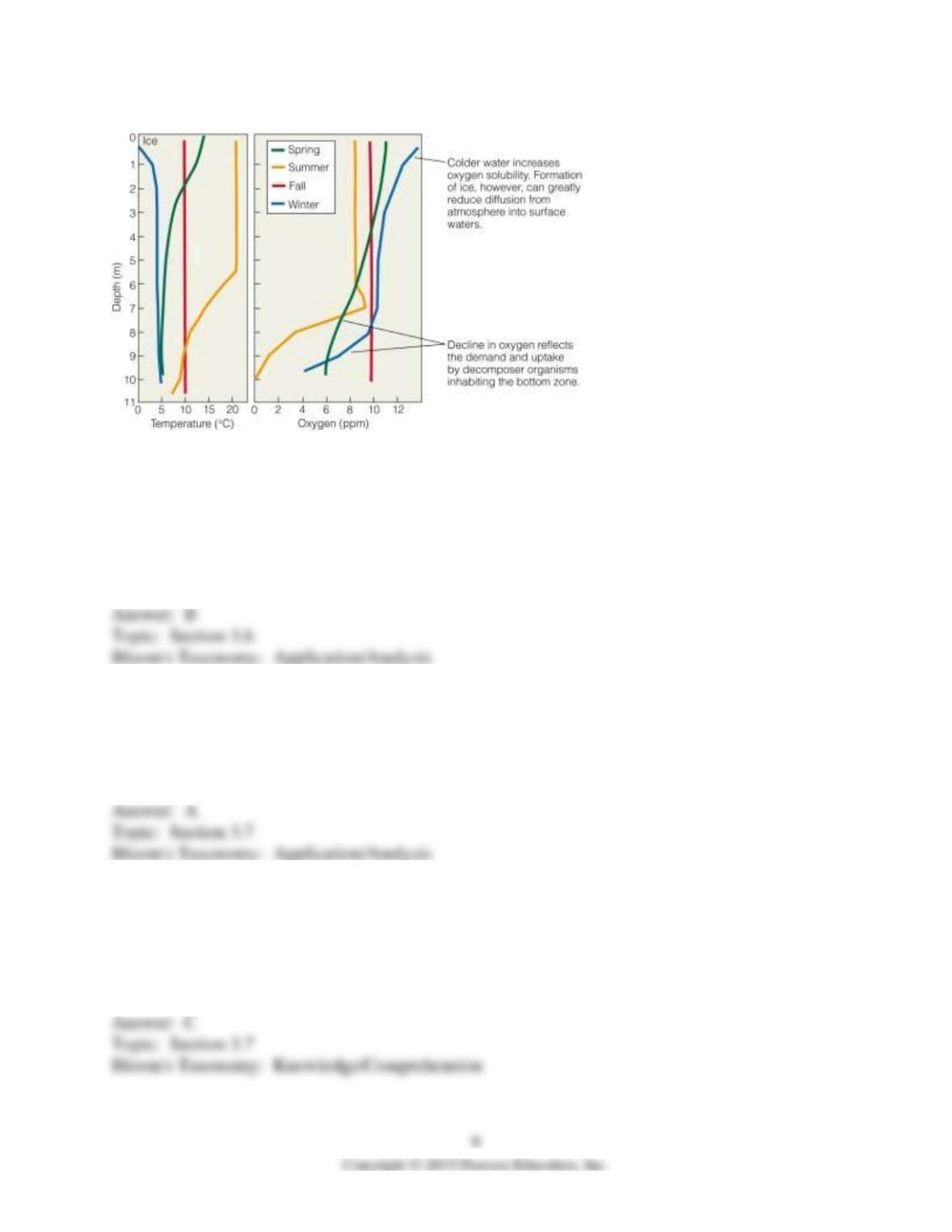
26)
What might make the winter profile for oxygen concentration in winter appear more like the fall
profile?
A) a lack of ice formation on the surface and few decomposers at the lake bottom
B) ice formation on the surface and few decomposers at the lake bottom
C) a lack of ice formation on the surface and increased numbers of decomposers at the lake
bottom
D) ice formation on the surface and increased numbers of decomposers at the lake bottom
27) A solution with a pH of 3
A) is more alkaline than a solution with a pH of 2.
B) has a higher concentration of OH– than a solution with a pH of 4.
C) is neutral.
D) is more acidic than a solution with a pH of 3.5.
28) Aquatic organisms are unable to tolerate low pH conditions mainly because acidic waters
contain high concentrations of toxic
A) sodium.
B) chlorine.
C) aluminum.
D) carbon dioxide.

29) Why do mountain streams have rocky bottoms?
A) Large amounts of snow reduce sediment erosion.
B) Cold temperatures reduce sediment accumulation
C) This is the result of a lack of sediment at high altitudes.
D) Steep gradients cause high velocity flows.
30) Tides are strongest when the
A) body of water is very large.
B) Sun is setting.
C) Earth, Moon, and Sun are in line.
D) Moon and Sun are at right angles to the Earth.
31) A ________ tide occurs when the Moon and Sun are at right angles to the Earth.
A) low
B) high
C) spring
D) neap
32) Daily and seasonal fluctuations in temperature, salinity, and dissolved gases are most
extreme in
A) the intertidal zone.
B) sandy beaches.
C) the estuary.
D) the open ocean.
33) Salinity within an estuary is greatest in
A) surface water at high tide.
B) surface water at low tide.
C) deep water at high tide.
D) deep water at low tide.
34) How does an increased atmospheric CO2 concentration result in increased ocean acidity?
A) CO2 causes less oxygen to occur in oceans.
B) CO2 transforms into H+ ions.
C) CO2 reacts with water to form H2CO3.
D) Increased CO2 causes increases in animal waste which result in more acidic conditions.
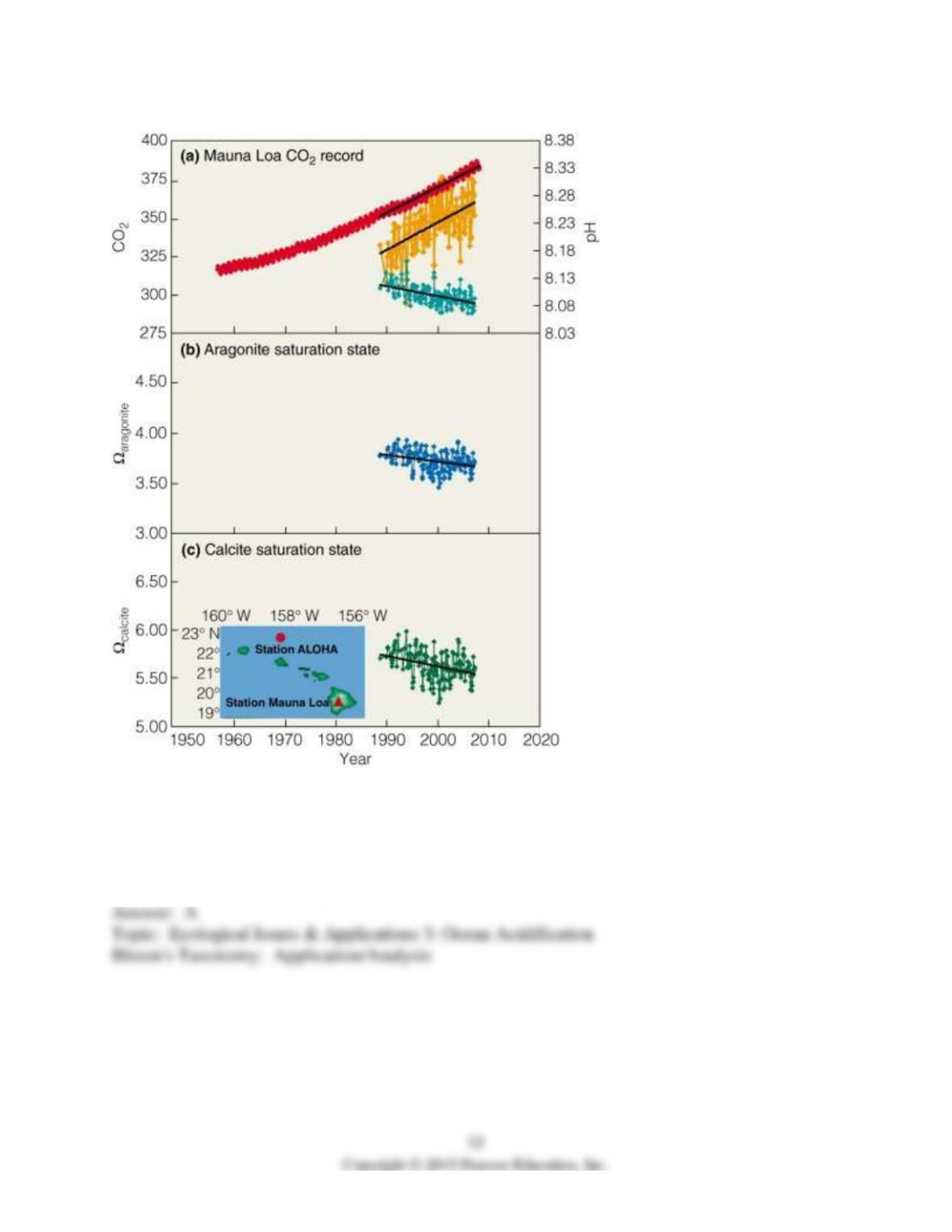
35)
In panel B of the figure, what might cause the Aragonite saturation state to begin increasing?
A) reduction in ocean acidification
B) increased ocean acidification
C) increase in CO2 emissions
D) increased fish biodiversity

3.3 True/False Questions
1) The rotation of Earth on its axis is the driving force behind the water cycle.
2) The turnover rate of water is longer in the ocean than in the atmosphere.
3) Individual atoms within water molecules are held together by covalent bonds.
4) Temperature fluctuates more in aquatic habitats than in terrestrial habitats.
5) The viscosity of water is lower than the viscosity of air.
6) Of the visible light spectrum, blue wavelengths penetrate the deepest into water.
7) The thermocline is permanent in tropical bodies of water and seasonal in temperate bodies of
water.
8) In lakes and ponds of temperate latitudes, the upper and bottom layers of water usually turn
over as water warms up during spring.
9) Saltwater has a higher concentration of solutes than freshwater.
10) Cold water contains more oxygen than warm water.
11) During summer, the amount of oxygen in the water is greatest at the bottom of ponds and
lakes.
12) A high pH indicates a very acidic solution.
13) Aluminum is toxic to many aquatic species.
14) Upwelling occurs in the equatorial waters of the ocean.
15) The Sun has a stronger effect than the Moon on tides.
16) Tides are highest and lowest during a spring tide, when the Sun and Moon are aligned with
the Earth.
17) Salinity is higher in an estuary than in the ocean.

3.4 Essay Questions
1) Describe the water or hydrologic cycle and explain how water arrives at various reservoirs
where it is stored.
2) Explain how differences in the viscosity of water and air affect the biology of plants and
animals living in aquatic and terrestrial environments.
3) Describe several adaptations that have evolved in organisms in response to the minimal light
environments in deep water.
4) Explain how temperature, density, and oxygen concentrations vary with depth in large bodies
of water.
5) Explain why water can dissolve more substances than any other liquid. Furthermore, explain
the importance of this property to life on Earth.
6) Explain how the pH of an aquatic environment can influence the organisms that live in or
around the water body.
7) Describe the causes of oceanic upwelling.
8) Explain how tides form and why tidal heights vary over time.
9) Define an estuary, and describe how gradients in salinity are maintained.