CHAPTER 3
DOUBLE- ENTRY ACCOUNTING AND THE
ACCOUNTING CYCLE
SUMMARY OF QUESTION TYPES BY LEARNING OBJECTIVE
AND LEVEL OF DIFFICULTY
Item
LO
LOD
Item
LO
LOD
Item
LO
LOD
Item
LO
LOD
Item
LO
LOD
True-False Statements
1.
2
E
4.
2
E
7.
5
M
10.
8
M
13.
8
E
2.
2
E
5.
4
E
8.
5
M
11.
8
E
14.
8
E
3.
2
E
6.
5
M
9.
7
E
12.
8
E
Multiple Choice Questions
15.
2
E
24.
2
E
33.
6
E
42.
6
M
51.
8
E
16.
2
E
25.
2
E
34.
6
E
43.
6
E
52.
8
M
17.
2
E
26.
3
E
35.
6
M
44.
6
E
53.
8
E
18.
2
M
27.
3
H
36.
6
E
45.
7
M
54.
8
E
19.
2
E
28.
3
E
37.
6
M
46.
7
M
55.
8
E
20.
2
M
29.
4
M
38.
6
M
47.
7
M
56.
8
M
21.
2
M
30.
4
E
39.
6
M
48.
7
M
22.
2
E
31.
5
E
40.
6
M
49.
7
M
23.
2
E
32.
5
M
41.
6
H
50.
8
E
Exercises
57.
6
E
59.
7
M
61.
8
E
63.
8
M
58.
6
E
60.
7
M
62.
8
M
64.
8
H
Matching
65.
2
E
66.
2,3,6
M
67.
3
M
Short-Answer Essay
68.
5
E
69.
6
E
70.
7
M
71.
7
H
Essay
72.
4–8
E
Note: E = Easy M = Medium H = Hard
3 – 2 Test Bank for Understanding Financial Accounting, Canadian Edition
SUMMARY OF LEARNING OBJECTIVES BY QUESTION TYPE
Item
Type
Item
Type
Item
Type
Item
Type
Item
Type
Item
Type
Item
Type
Learning Objective 2
1.
TF
4.
TF
17.
MC
20.
MC
23.
MC
65.
Ma
2.
TF
15.
MC
18.
MC
21.
MC
24.
MC
66.
Ma
3.
TF
16.
MC
19.
MC
22.
MC
25.
MC
Learning Objective 3
26.
MC
27.
MC
28.
MC
66.
Ma
67.
Ma
Learning Objective 4
5.
TF
29.
MC
30.
MC
72.
Es
Learning Objective 5
6.
TF
7.
TF
8.
TF
31.
MC
32.
MC
68.
SAE
72.
Es
Learning Objective 6
33.
MC
36.
MC
39.
MC
42.
MC
57.
Ex
69.
SAE
34.
MC
37.
MC
40.
MC
43.
MC
58.
Ex
72.
Es
35.
MC
38.
MC
41.
MC
44.
MC
66.
Ma
Learning Objective 7
9.
TF
46.
MC
48.
MC
59.
Ex
70.
SAE
72.
Es
45.
MC
47.
MC
49.
MC
60.
Ex
71.
SAE
Learning Objective 8
10.
TF
13.
TF
51.
MC
54.
MC
61.
Ex
64.
Ex
11.
TF
14.
TF
52.
MC
55.
MC
62.
Ex
72.
Es
12.
TF
50.
MC
53.
MC
56.
MC
63.
Ex
Note: TF = True-False Ex = Exercise SAE = Short-Answer Essay
MC = Multiple Choice Ma = Matching Es = Essay
Double-Entry Accounting And The Accounting Cycle 3 – 3
CHAPTER LEARNING OBJECTIVES
1. Explain how the double-entry accounting system works, including how it
overcomes the limitations of the template approach.
2. Explain the normal balance concept and how it is used within the double-entry
accounting system.
3. Identify and explain the steps in the accounting cycle.
4. Explain the signifi cance of a company ’ s decisions regarding its chart of
accounts and the implications of subsequent changes.
3 – 4 Test Bank for Understanding Financial Accounting, Canadian Edition
5. Explain the difference between permanent and temporary accounts.
6. Identify and record transactions in the general journal and general ledger.
ledger is equal to the total credits posted.
7. Explain why adjusting entries are necessary and prepare them.
8. Explain why closing entries are necessary and prepare them.

Double-Entry Accounting And The Accounting Cycle 3 – 5
TRUE-FALSE STATEMENTS
1. All accounts are increased by credits and decreased by debits.
2. All Statement of Financial Position accounts increase with debits, while all Statement
of Income accounts increase with credits.
3. Cash is normally a credit balance.
4. Increases to assets are recorded on the credit side of a T account.
5. A Chart of Accounts lists the accounts and balances at a specific time.
6. Prepaid expenses, inventory and accounts payable are examples of permanent
accounts.
7. Salary expense, sales revenue, and depreciation expense are examples of permanent
accounts.
8. At the beginning of the fiscal year an entity’s permanent and temporary accounts
should all have a zero balance.
9. An adjusting entry can be used to record transactions that have been missed.
10. Net income is calculated as net sales revenues minus the cost of goods sold.
11. Closing entries are done monthly for all companies.
12. All Statement of Financial Position items are temporary and must be closed out
annually.
13. Balances in the revenue and expense accounts will affect retained earnings at the
end of the period.
14. An income summary account can be used when closing the books.

3 – 6 Test Bank for Understanding Financial Accounting, Canadian Edition
ANSWERS TO TRUE-FALSE STATEMENTS
Item
Ans.
Item
Ans.
Item
Ans.
Item
Ans.
Item
Ans.

Double-Entry Accounting And The Accounting Cycle 3 – 7
MULTIPLE CHOICE QUESTIONS
15. The right side of a T account is also known as the
a) debit side.
b) credit side.
c) asset side.
d) liability side.
16. Which of the following relationships best expresses the double-entry nature of an
accounting system?
a) assets = liabilities
b) assets = debits
c) liabilities = credits
d) debits = credits
17. Which of the following statements is true?
a) The normal balance is always on the side of the T account that is increasing.
b) The normal balance is always on the side of the T account that is decreasing.
c) The normal balance is always on the debit side of the T account.
d) The normal balance is always on the credit side of the T account.
18. Which of the following statements regarding the retained earnings account is NOT
true?
a) It normally has a credit balance.
b) Its balance is increased by revenues.
c) Its balance is decreased by expenses.
d) Its balance is increased by the declaration of dividends.
19. Which of the following transactions would involve a debit to an asset account?
a) recording depreciation expense on capital assets
b) payment of an accounts payable
c) payment of a dividend
d) collection of an accounts receivable
20. Which of the following results in a debit entry to the account identified?
a) increase in shareholders’ equity
b) recording interest revenue
c) payment on accounts receivable
d) decrease in shareholders’ equity
21. Which of the following statements about accumulated depreciation is NOT true?
a) It is calculated in accordance with the matching principle.
b) It records the portion or how much of the asset has been used up.

3 – 8 Test Bank for Understanding Financial Accounting, Canadian Edition
c) It is reflected on the Statement of Financial Position.
d) It helps determine how much an asset can be sold for.
22. Which of the following accounts normally has a debit balance?
a) Accumulated depreciation
b) Prepaid insurance
c) Accounts payable
d) Common shares
23. Which of the following accounts normally has a credit balance?
a) Accumulated depreciation
b) Accounts receivable
c) Dividends declared
d) Rent expense
24. Which of the following accounts normally has a credit balance?
a) Cash
b) Dividends declared
c) Insurance expense
d) Retained earnings
25. Which of the following accounts normally has a debit balance?
a) Accounts payable
b) Retained earnings
c) Land
d) Sales revenue
26. Which of the following is the first step in the accounting cycle?
a) Recognize that a transaction has occurred.
b) Prepare a source document.
c) Prepare a chart of accounts.
d) Journalize a transaction.
27. Which of the following sequences concerning the accounting cycle is correct?
a) journalize, post, adjusting entries, financial statements
b) transaction analysis, trial balance, post, adjusted trial balance
c) post, adjusting entries, closing entries, financial statements
d) adjusting entries, closing entries, adjusted trial balance, financial statements
28. Which of the following is NOT part of the accounting cycle?
a) posting
b) financial statement analysis
c) adjusted trial balance
d) transaction analysis

Double-Entry Accounting And The Accounting Cycle 3 – 9
29. The chart of accounts is ___.
a) static
b) dynamic
c) not generally useful
d) contains only permanent accounts
30. A list of all the accounts used by the company in its accounting records is referred to
as a
a) Chart of accounts
b) adjusted trial balance
c) general journal
d) general ledger
31. Which of the following types of accounts appear on the Statement of Financial
Position and Statement of Income respectively?
Statement of Financial Position Statement of Income
a) Permanent accounts Permanent accounts
b) Permanent accounts Temporary accounts
c) Temporary accounts Permanent accounts
d) Temporary accounts Temporary accounts
32. Which of the following accounts would have a balance that carries over from one
period to the next?
a) Revenue
b) Insurance expense
c) Prepaid insurance
d) Dividends declared
33. Which of the following accounting records is in chronological order?
a) the chart of accounts
b) the general journal
c) the general ledger
d) the statement of income
34. The process of transferring data from the general journal to the general ledger is
called
a) journalizing.
b) ledgerizing.
c) posting.
d) balancing.
35. Which of the following is a listing of all the account balances at a specific point in
time?

3 – 10 Test Bank for Understanding Financial Accounting, Canadian Edition
a) the Statement of Financial Position
b) the chart of accounts
c) the general ledger
d) the trial balance
36. The process of identifying and recording transactions is called
a) transaction analysis.
b) posting.
c) recognizing.
d) journalizing.
37. The purchase of land for a combination of cash and issuance of shares would
require which of the following entries?
a) Dr. Land, Cr. Common shares, Cr. Cash
b) Dr. Cash, Dr. Common shares, Cr. Land
c) Dr. Land, Cr. Cash, Dr. Common Shares
d) Dr. Cash, Cr. Land, Cr. Common shares
38. The sale of merchandise to a customer partly for cash and partly on account would
require which of the following entries?
a) Dr. Accounts receivable, Dr. Cash, Cr. Sales revenue
b) Dr. Cash, Dr. Accounts payable, Cr. Sales revenue
c) Dr. Cash, Cr. Sales revenue
d) Dr. Accounts payable, Dr. Accounts receivable, Cr. Sales revenue
39. The purchase of land for a combination of cash and a 15-year note would require
which of the following entries?
a) Dr. Land, Dr. Cash, Cr. Long-term note payable
b) Dr. Land, Cr. Cash, Cr. Long-term note payable
c) Dr. Cash, Cr. Long-term note payable, Cr. Land
d) Dr. Land, Dr. Long-term note payable, Cr. Cash
40. When the board of directors declares and pays a $500 dividend, which of the
following would be included in the resulting journal entry?
a) Dr. Retained earnings, Cr. Cash
b) Dr. Cash, Cr. Retained Earnings
c) Dr. Retained Earnings, Cr. Dividends declared
d) Dr. Cash, Cr. Dividends payable
41. When an inventory item that cost $75 is sold on account for $100, which of the
following would be included in the journal entry recording the cost of goods sold?
a) Dr. Cash $100
b) Cr. Cost of goods sold $75
c) Cr. Accounts Receivable $100
d) Cr. Inventory $75

Double-Entry Accounting And The Accounting Cycle 3 – 11
42. Which of the following statements about the trail balance is NOT true?
a) Debit balances must equal credit balances.
b) It includes only assets, liability and equity accounts.
c) It is useful for detecting errors.
d) It is an important step in the accounting cycle.
43. An example of a contra asset account is
a) Accumulated depreciation.
b) Depreciation expense.
c) Discount on Bonds Payable.
d) Prepaid expenses.
44. Which of the following would cause the trial balance to be out of balance?
a) an entry recorded with only debits
b) an unrecorded entry
c) an entry recorded twice
d) an entry recorded to the wrong accounts
45. Which of the following would normally be recorded with an adjusting entry?
a) sales on account
b) payment for supplies bought on account
c) Wage expense
d) Depreciation expense
46. Which of the following would be the adjusting entry to record accrued interest at the
end of an accounting period?
a) Dr. Interest expense, Cr. Cash
b) Dr. Interest expense, Cr. Interest payable
c) Dr. Interest payable, Cr. Interest income
d) Dr. Interest payable, Cr. Cash
47. Which of the following would be the adjusting journal entry to expense prepaid rent
for the period?
a) Dr. Prepaid rent, Cr. Rent expense
b) Dr. Rent expense, Cr. Cash
c) Dr. Prepaid rent, Cr. Cash
d) Dr. Rent expense, Cr. Prepaid rent
48. Which of the following would be the adjusting journal entry to recognize earned but
unpaid wages for the period?
a) Dr. Wages Expense, Cr. Cash
b) Dr. Wages Payable, Cr. Cash
c) Dr. Wages Payable, Cr. Wages Expense

3 – 12 Test Bank for Understanding Financial Accounting, Canadian Edition
d) Dr. Wages Expense, Cr. Wages Payable
49. Which of the following is NOT an example of an adjusting entry?
a) recording unpaid interest at year end relating to an outstanding loan balance at year
end
b) recording depreciation on office equipment purchased during the year
c) recording the gain on the sale of equipment made during the year
d) reducing the prepaid rent account for the portion of rent actually used
50. A net loss occurs when
a) assets exceed liabilities.
b) expenses exceed revenues for the year.
c) dividends exceed income for the year.
d) cumulative expenses and dividends have exceeded income.
51. Which of the following types of entries is used to reset the temporary accounts to
zero and update the balance in the retained earnings?
a) journal entries
b) adjusting entries
c) closing entries
d) balancing entries
52. Which of the following would be the closing entry for dividends declared?
a) Dr. Expense summary, Cr. Dividends declared
b) Dr. Retained earnings, Cr. Dividends declared
c) Dr. Dividends declared, Cr. Expense summary
d) Dr. Dividends declared, Cr. Retained earnings
53. Which of the following is a current asset item on the Statement of Financial Position?
a) Equipment
b) Prepaid expenses
c) Accounts payable
d) Accrued wages payable
Use the following information for questions 54–56.
Consider the following data:
Cash ……………………………………………… $ 15,200
Accounts receivable …………………………. 29,500
Accounts payable …………………………….. 34,500
Note payable …………………………………… 50,000
Inventory ………………………………………… 17,000
Dividends payable ……………………………. 5,200
Equipment ………………………………………. 220,000
Temporary investments …………………….. 6,400

Double-Entry Accounting And The Accounting Cycle 3 – 13
Net Income ……………………………………… 35,000
Accumulated Amortization …………………. 100,000
Common shares ………………………………. 40,000
Beginning Retained earnings …………….. 23,400
Prepaid rent expense ……………………….. 1,600
Salaries payable ………………………………. 12,000
54. Total assets amounts to
a) $189,700.
b) $288,100.
c) $289,700.
d) $389,700.
55. Total liabilities amounts to
a) $101,700.
b) $98,100.
c) $196,500.
d) $198,100.
56. Total Shareholder’s Equity amounts to
$53,200.
$58,400.
$93,200.
$98,400.
3 – 14 Test Bank for Understanding Financial Accounting, Canadian Edition
ANSWERS TO MULTIPLE CHOICE QUESTIONS
Item
Ans.
Item
Ans.
Item
Ans.
Item
Ans.
Item
Ans.
Double-Entry Accounting And The Accounting Cycle 3 – 15
EXERCISES
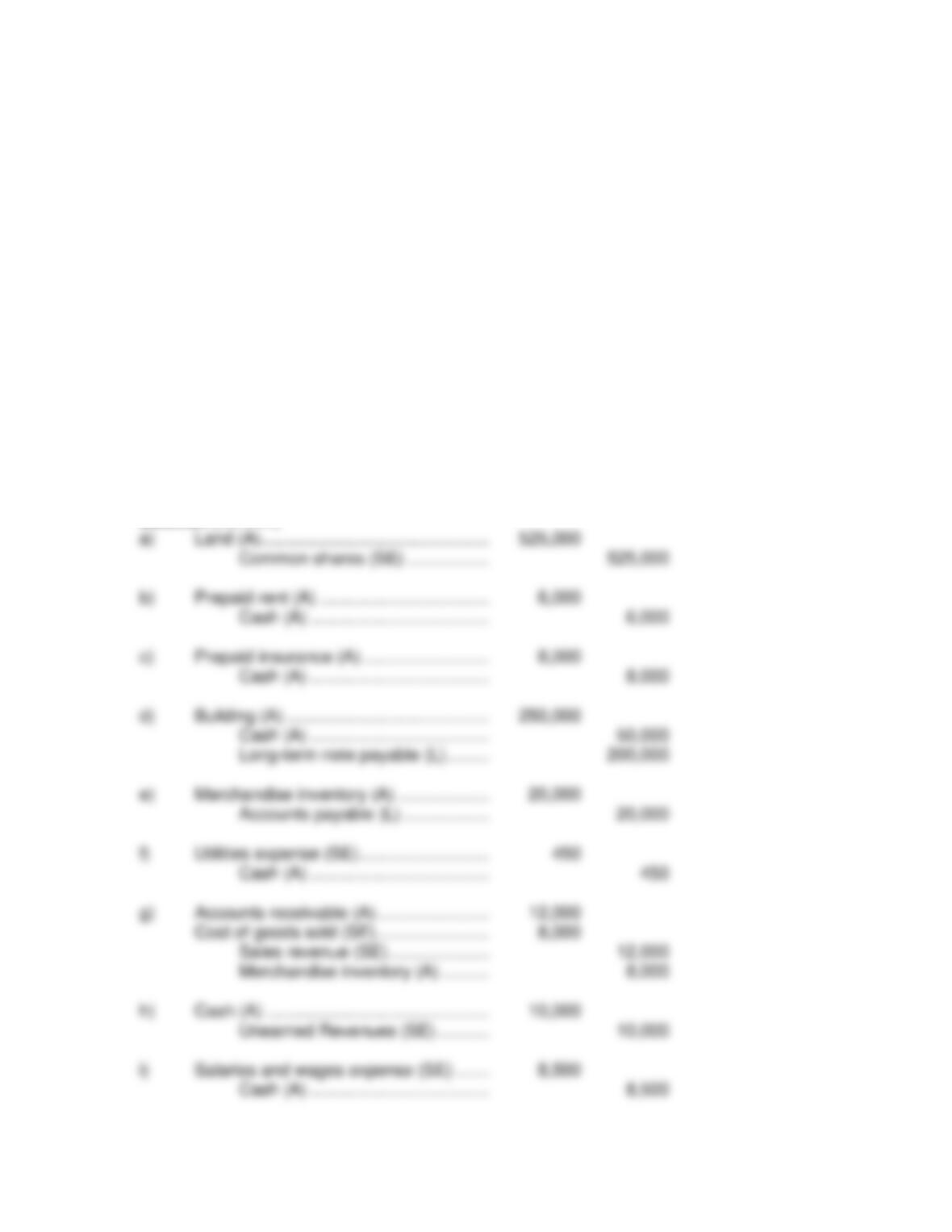
57. Prepare the journal entries for the following transactions:
a) Bought land for 15,000 shares with a $35 per share market value.
b) Paid six months rent in advance for a total of $6,000.
c) Paid insurance premiums for the year in the amount of $8,000.
d) Bought a building for $250,000. Paid one-fifth in cash and the balance with a 10-
year, 10% interest note payable.
e) Purchased $20,000 of merchandise inventory on credit.
f) Paid utilities bill for $450.
g) Sold $8,000 of merchandise inventory for $12,000 on credit.
h) Collected a $10,000 cash deposit from customers for custom orders.
i) Paid salaries and wages of $8,500.
j) Paid $8,000 on merchandise inventory previously purchased in part e).
k) Received $7,000 from customers on account.
l) Declared and paid a $5,000 dividend.
Solution (12 min.)
3 – 16 Test Bank for Understanding Financial Accounting, Canadian Edition
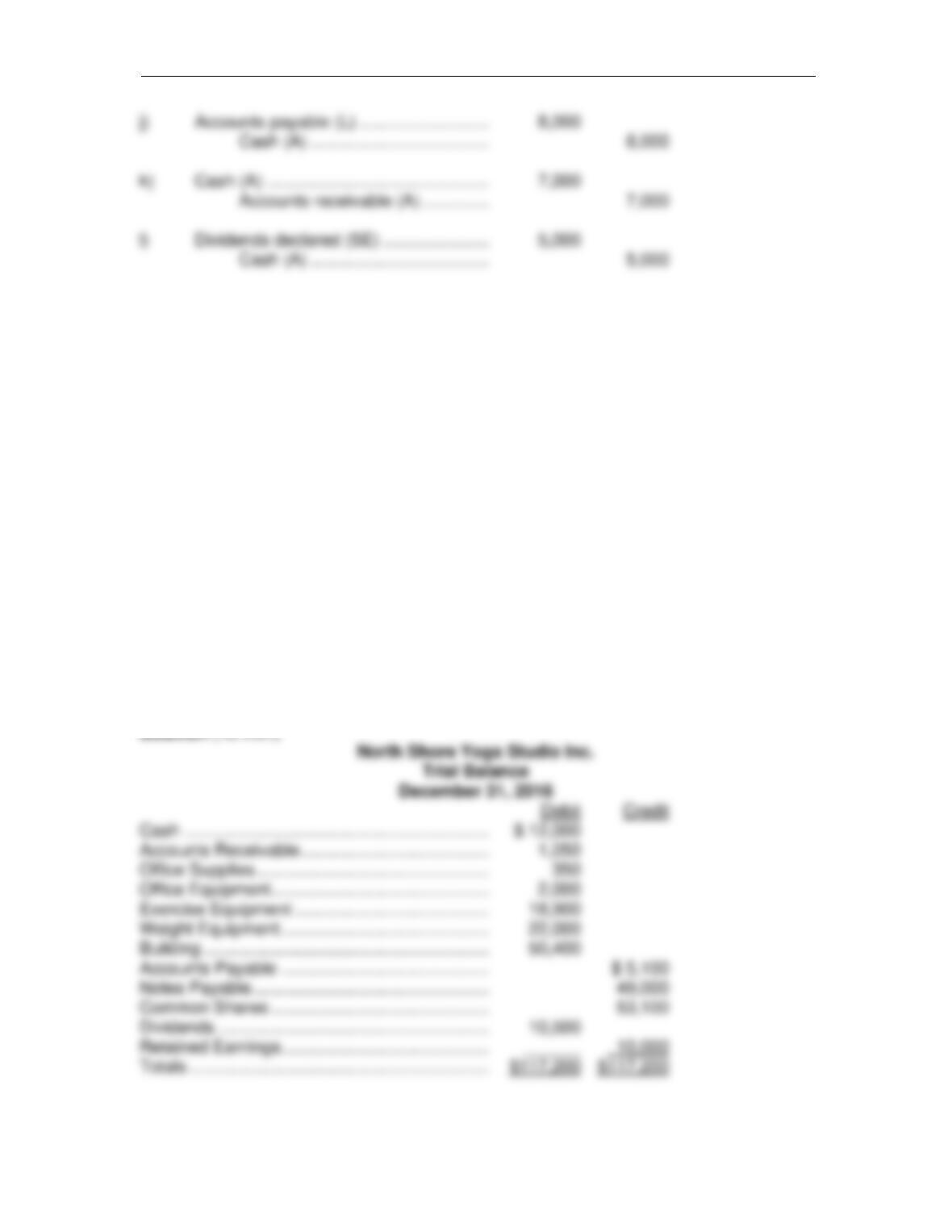
58. The ledger accounts of North Shore Yoga Studio Inc. at December 31, 2016 are
shown below:
Accounts Payable ……………………………. $ 5,100
Accounts Receivable ………………………… 1,050
Building ………………………………………….. 50,400
Common Shares ……………………………… 53,100
Cash ……………………………………………… 12,000
Exercise Equipment …………………………. 18,900
Weight Equipment ……………………………. 22,000
Notes Payable …………………………………. 49,000
Office Supplies ………………………………… 350
Office Equipment ……………………………… 2,000
Dividends …………………………..…………… 10,500
Retained Earnings ……………………………. 10,000
Instructions
Prepare a trial balance with the ledger accounts arranged in the proper financial
statement order. Include the appropriate heading. Assume all accounts have a normal
balance.
Double-Entry Accounting And The Accounting Cycle 3 – 17
59. Shown below is the trial balance for Miller Moving Co. as at December 31, 2016, the
company’s year-end. The company owner provides you with the following additional
information:
a) No interest has been paid yet on the note payable. The note has been outstanding
since April 1 and the interest rate is 6%.
b) The equipment originally cost $200,000 and has an estimated residual value of
$20,000 and a useful life of 6 years.
c) On June 1 the company renewed its insurance policy and paid a $1,200 premium
for the year. It was correctly recorded at that time as prepaid insurance.
d) On October 1 the company sold a 12-month service contract to a client for $18,000
and recorded it as Unearned Revenue because at that point they had not yet
provided any service to the client. They have been providing the service since the
contract was sold.
Miller Moving Co.
Trial Balance
as at December 31, 2016
Debit Credit
Cash ……………………………………………………… $ 8,900
Accounts Receivable ………………………………… 28,000
Prepaid insurance ……………………………………. 1,200
Equipment ………………………………………………. 200,000
Accumulated depreciation …………………………. $6,000
Accounts Payable ……………………………………. 12,000
Notes Payable …………………………..…………….. 20,000
Unearned revenue …………………………………… 18,000
Common Shares ……………………………………… 60,000
Retained Earnings …………………………..……….. 56,700
Sales & service revenue ……………………………. 240,000
Salaries ………………………………………………….. 120,000
Rent ………………………………………………………. 24,000
Supplies expense …………………………………….. 29,500
Depreciation expense ……………………………….. 0
Insurance expense …………………………………… 1,100
Interest expense ………………………………………. 0 _______
Totals …………………………………………………….. $412,700 $412,700
Instructions
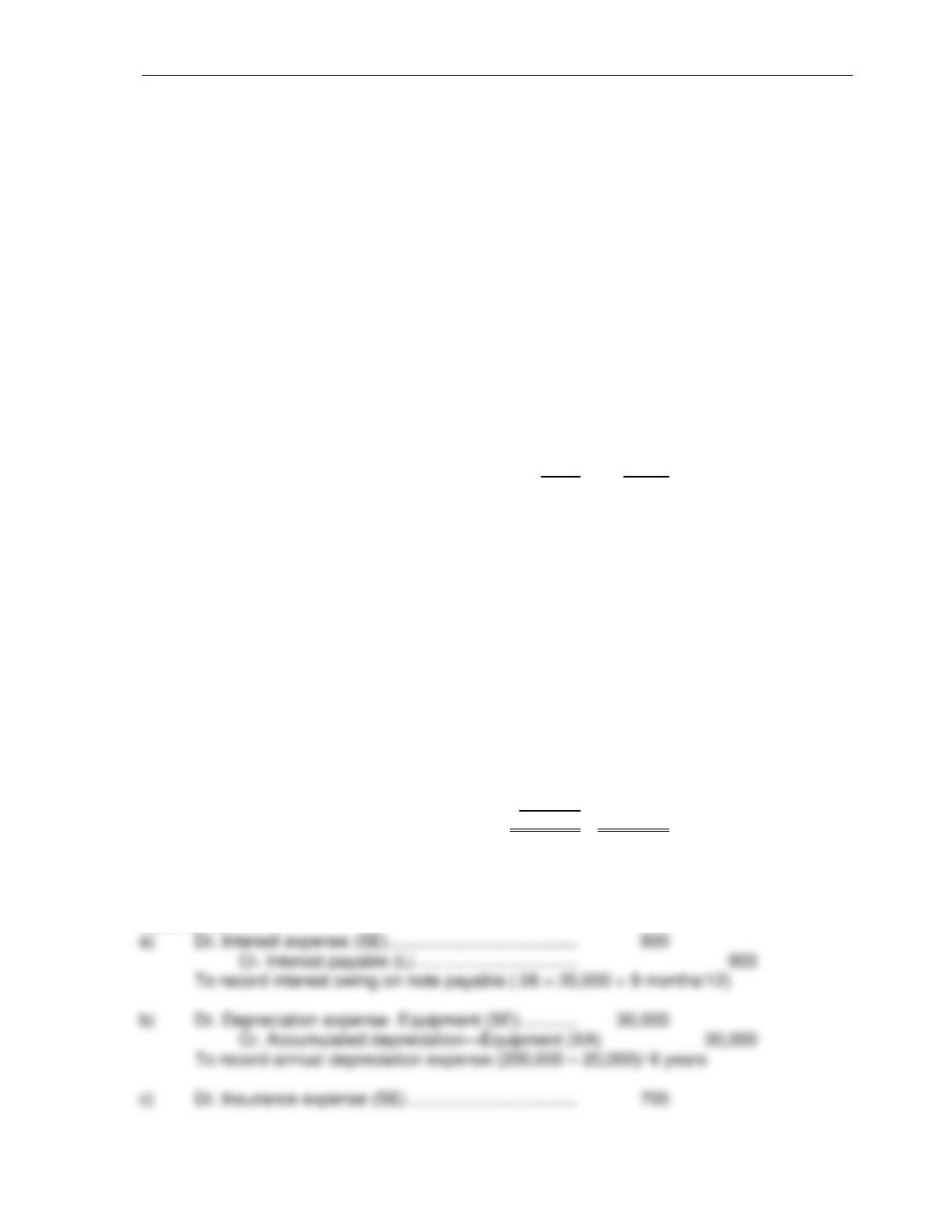
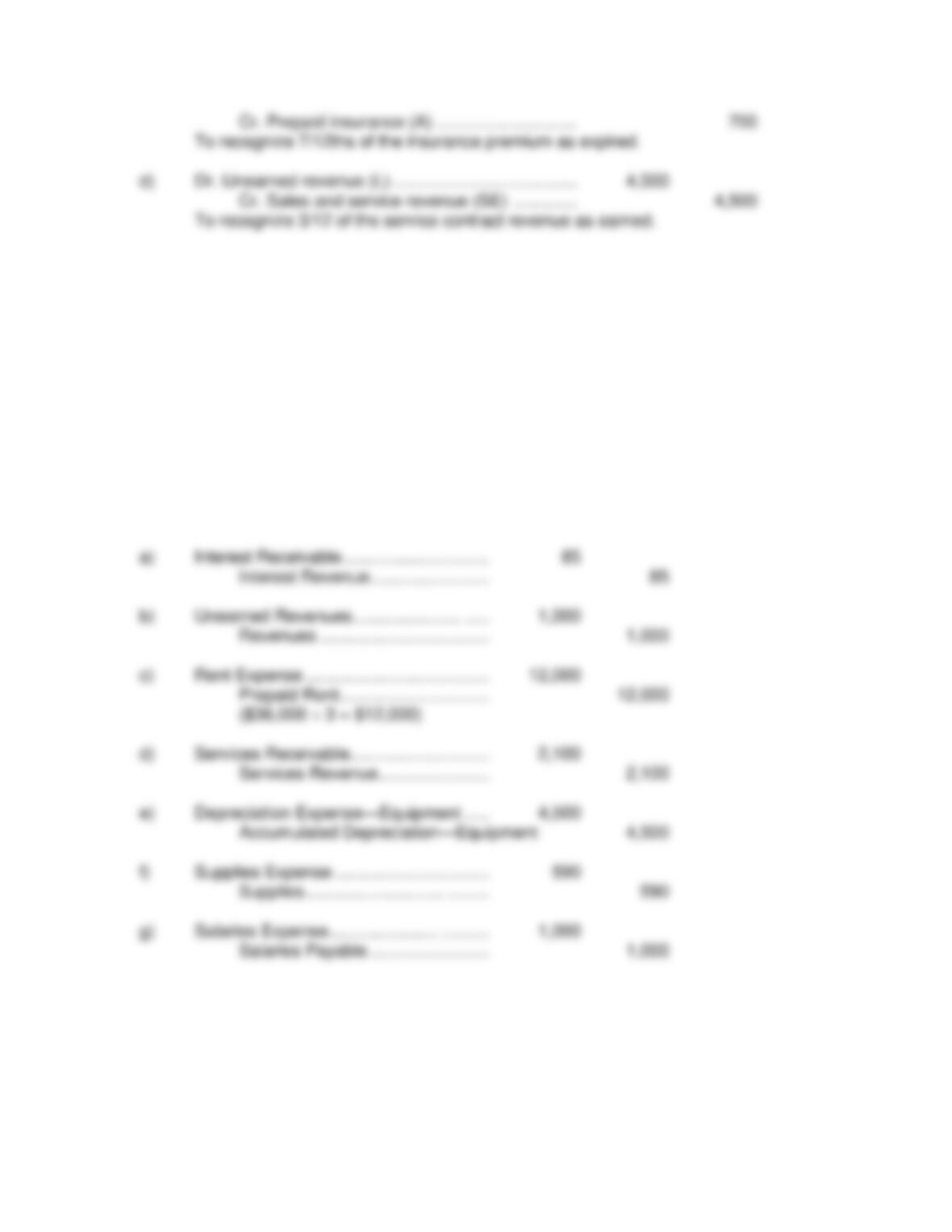
Prepare any adjusting entries required.
Solution (12 min.)
3 – 18 Test Bank for Understanding Financial Accounting, Canadian Edition
60. Prepare year-end adjustments for the following transactions:
a) Accrued interest on notes receivable is $85.
b) Unearned revenues earned totals $1,000.
c) Three years’ rent, totalling $36,000, was paid in advance at the beginning of the
year.
d) Services totalling $2,100 had been performed but not yet billed at the end of the
year.
e) Depreciation on equipment totalled $4,500 for the year.
f) Supplies for use totalled $690. By year end, only $100 in supplies remained.
g) Salaries owed to employees at the end of the year total $1,000.
Solution (10 min.)
61. Jennifer Lee owns and operates Coffee and Connextions, Inc., a small internet café.
Coffee and Connextions, Inc.
Statement of Income
Month Ending April 30
Revenues ……………………………………………….. $12,850
Double-Entry Accounting And The Accounting Cycle 3 – 19
Cost of Goods Sold ………………………………….. 4,600
Gross Profit …………………………………………….. $8,250
Operating expenses
Wages ……………………………………………. $795
Utilities …………………………………………… 360
Depreciation ……………………………………. 145
Total operating expenses ………………………….. 1,300
Net income before interest and income taxes .. $6,950
Interest expense ………………………………………. 25
Net income before income taxes ………………… $6,925
Income tax expense …………………………………. 1,731
Net income ……………………………………………… $5,194
Instructions
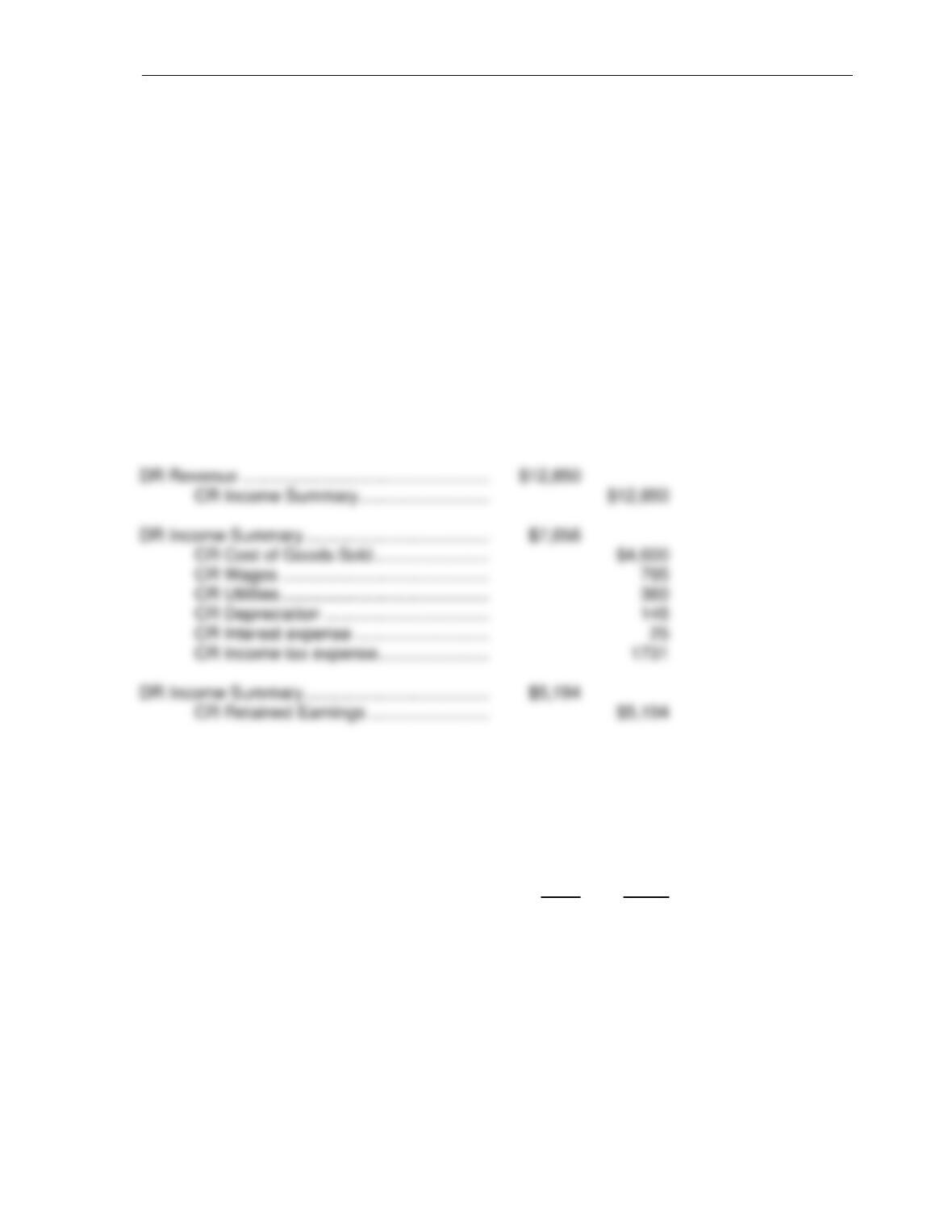
Prepared any closing entries required.
Solution (10 min.)
62. Shown below is an adjusted trial balance for Booker Enterprises Ltd. at the end of its
accounting period, December 31, 2016.
Booker Enterprises Ltd.,
Adjusted Trial Balance
December 31, 2016
Debit Credit
Cash ……………………………………………………… $4,600
Accounts receivable …………………………………. 6,200
Inventory ………………………………………………… 12,500
Prepaid expenses ……………………………………. 5,000
Building ………………………………………………….. 140,000
Accumulated depreciation-building ……………… $20,000
Accounts payable …………………………………….. 20,500
Common shares ………………………………………. 5,000
Retained earnings, Jan 1, 2016 ………………….. 78,000
Dividends declared …………………………………… 5,000
3 – 20 Test Bank for Understanding Financial Accounting, Canadian Edition
Sales revenue …………………………………………. 280,000
Cost of goods sold …………………………………… 168,000
Wages expense ………………………………………. 53,000
Supplies expense …………………………………….. 2,000
Depreciation expense ……………………………….. 6,200
Insurance expense …………………………………… 1,000 _______
Totals …………………………………………………….. $403,500 $403,500
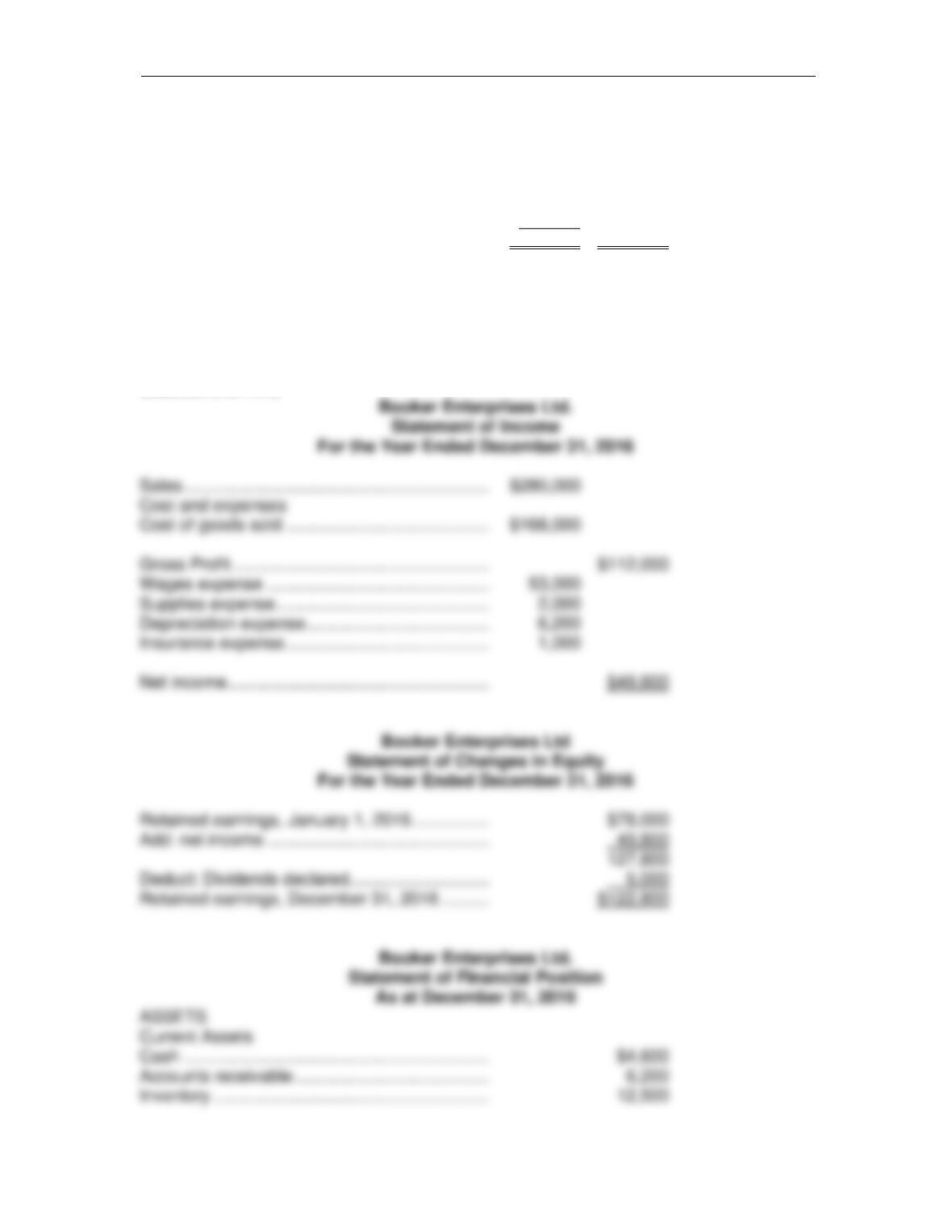
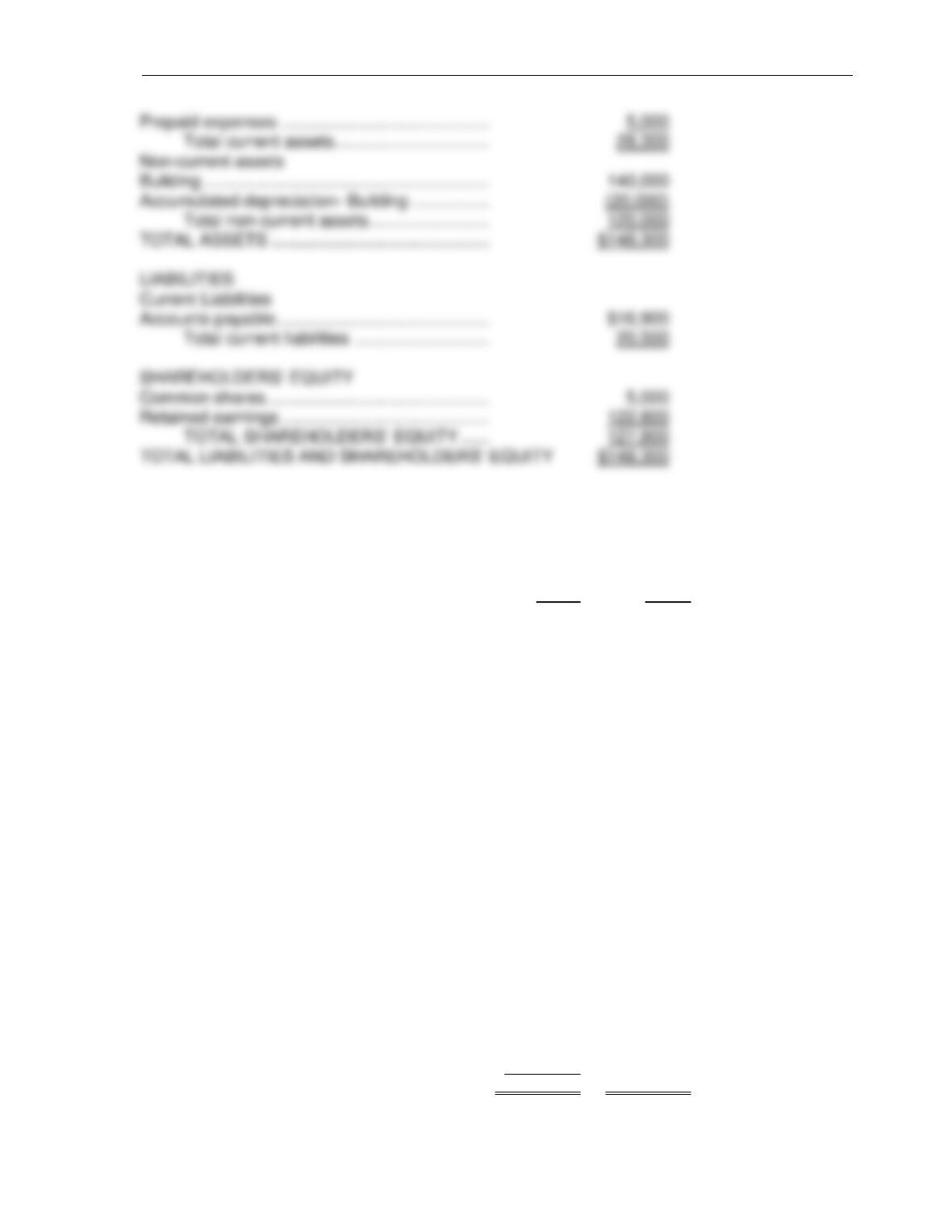
Instructions
a) Prepare a Statement of Income.
b) Prepare a Statement of Changes in Equity.
c) Prepare a classified Statement of Financial Position.
Solution (12 min.) Booker Enterprises Ltd.
Double-Entry Accounting And The Accounting Cycle 3 – 21
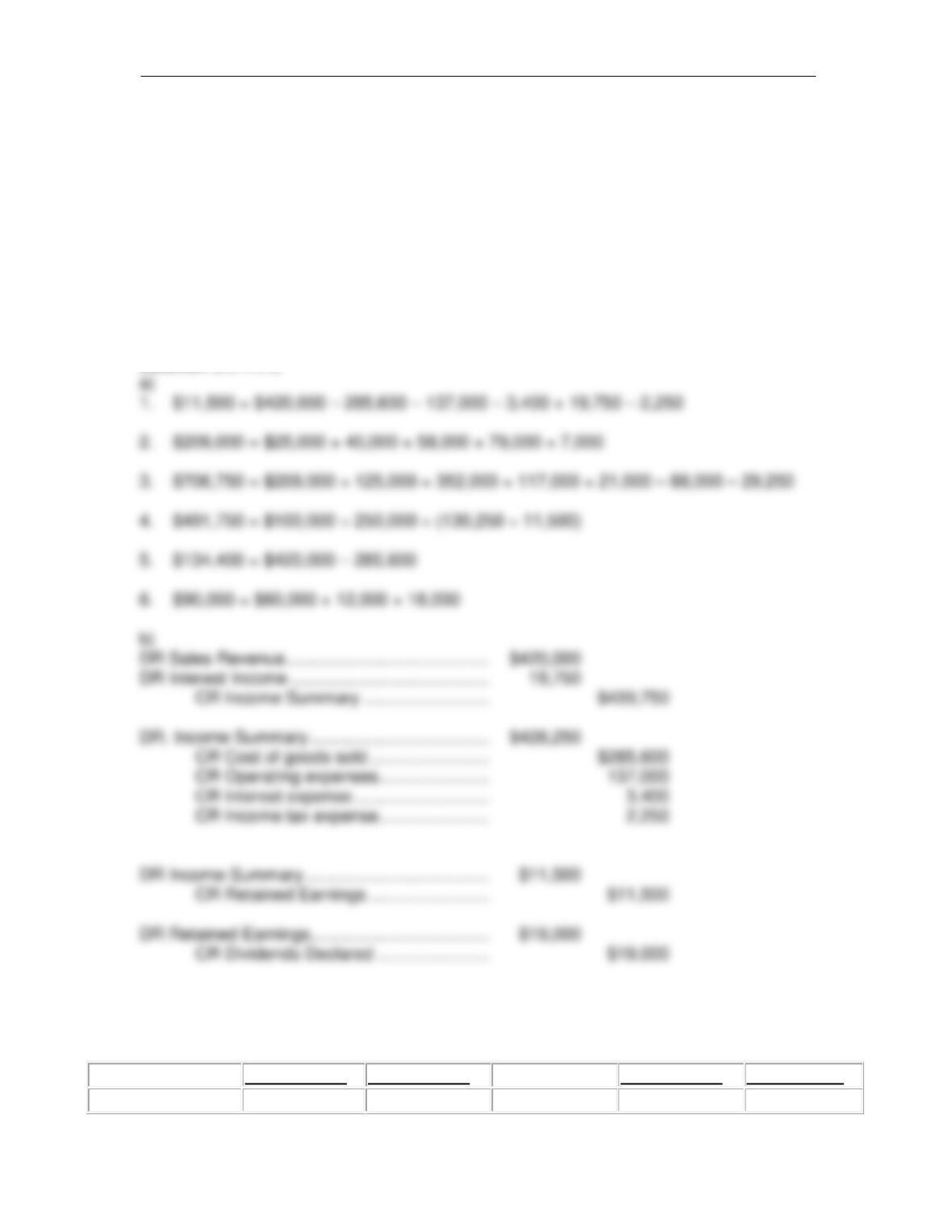
63. Given the following adjusted trial balance:
Deuce Corporation
Adjusted Trial Balance
November 30, 2016
Debit Credit
Cash ……………………………………………………… $25,000
Temporary investments …………………………….. 40,000
Accounts receivable …………………………………. 58,000
Inventory ………………………………………………… 79,000
Prepaid expenses ……………………………………. 7,000
Land ………………………………………………………. 125,000
Buildings ………………………………………………… 352,000
Equipment ………………………………………………. 117,000
Patents …………………………………………………… 21,000
Accumulated depreciation—buildings ………….. 88,000
Accumulated depreciation—equipment ……….. 29,250
Accounts payable …………………………………….. 60,000
Accrued expenses …………………………..……….. 12,000
Unearned revenue …………………………………… 18,000
Note payable—due in 4 years ……………………. 125,000
Preferred shares ……………………………………… 100,000
Common shares ………………………………………. 250,000
Retained earnings ……………………………………. 130,250
Sales Revenue ………………………………………… 420,000
Interest income ………………………………………… 19,750
Cost of goods sold …………………………………… 285,600
Operating expenses …………………………………. 137,000
Interest expense ………………………………………. 3,400
Income tax expense …………………………………. 2,250 ________
$1,252,250 $1,252,250
3 – 22 Test Bank for Understanding Financial Accounting, Canadian Edition
Instructions
a) Determine the
1. net income (loss).
2. current assets.
3. total assets.
4. shareholders’ equity.
5. gross profit.
6.current liabilities.
b) Prepare any closing entries required. Assume dividends declared and paid in 2016
are $19,000.
Solution (25 min.)
64. The following is a summary of ledger balances at the end of the 2015 and 2016 for
Maleficent’s Marvellous Magic Store:
Dec 31, 2015
Dec 31, 2016
Dec 31, 2015
Dec 31,2016
Accounts Payable
$30,000
$20,000
Temporary
$5,000
$5,000
Double-Entry Accounting And The Accounting Cycle 3 – 23
Investment
Accounts
Receivable
$2,000
$2,500
Interest
expense
$8,000
$9,000
Accumulated
depreciation on
Fixed Assets
($20,000)
($22,500)
Inventory
$90,000
$120,000
Advertising
$7,500
$13,000
Line of Credit
$5,000
$1,200
Buildings (at cost)
$150,000
$150,000
Depreciation
expense
$2,500
$2,500
Cash
$2,500
$3,500
Mortgage on
Building
$90,000
$85,000
Common Shares
$50,000
$50,000
Purchases
$600,000
$750,000
Cost of Goods Sold
$611,500
???????
Rent Expense
$12,000
$12,000
Equipment (at cost)
$45,000
$45,000
Retained
Earnings
$100,000
????
Revenue
$800,000
$950,000
Income Tax
Expense
$20,000
$25,000
Salaries
expense
$75,000
$85,000
Insurance for
coming year
$2,000
$2,200
Salaries
Payable
$1,500
$2,000
Insurance for
past year
$8,500
$10,000
Utilities
expense
$5,000
$6,000
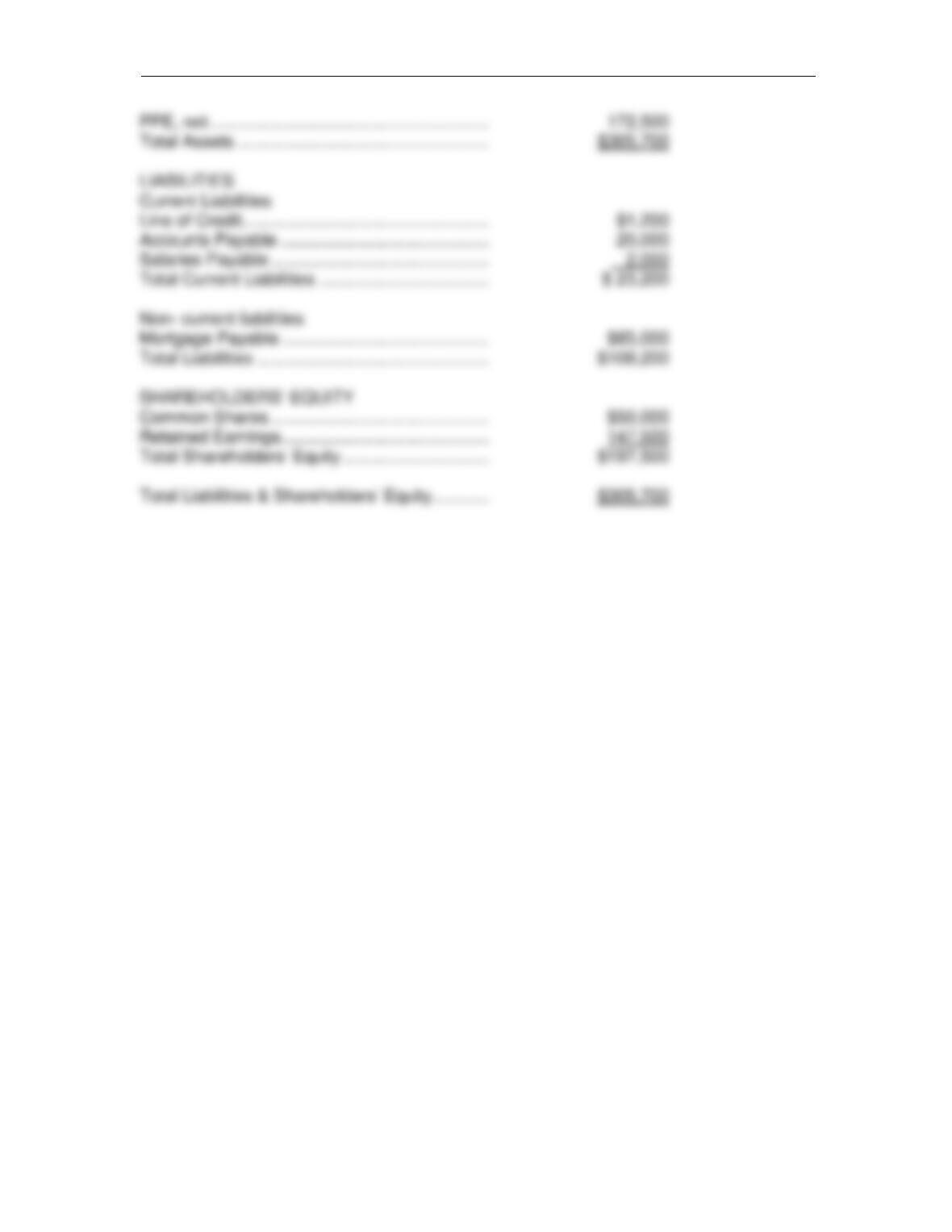
Instructions
Prepare a Statement of Financial Position for 2016 based on the above information,
assuming the company declared and paid a dividend of $20,000 in 2016.
3 – 24 Test Bank for Understanding Financial Accounting, Canadian Edition
Double-Entry Accounting And The Accounting Cycle 3 – 25
MATCHING
65. Indicate with a Dr. or a Cr. whether each of the following accounts normally has a
debit or a credit balance.
____ a) Shareholder’s Equity
____ b) Accumulated depreciation
____ c) Temporary investments
____ d) Dividends declared
____ e) Accounts payable
____ f) Inventory
____ g) Sales revenues
____ h) Bonds payable
____ i) Prepaid rent expense
____ j) Deposits from customers
Solution (5 min.)
66. Fill in the blanks using the words provided below:
Analysing, accounts receivable, Statement of Financial Position, crediting, debiting,
journal, ledger, prepaid expenses, posting, sales returns and allowances, unearned
revenue.
a) The act of entering an amount on the left side of an account is called ___ the account,
and making an entry on the right side is called ___ the account.
b) When a customer returns merchandise previously purchased on credit,
the entry to record the return requires a debit to the ___ account and a credit to the ___
account.
3 – 26 Test Bank for Understanding Financial Accounting, Canadian Edition
c) The basic steps in the recording process are ___ each transaction, entering the
transaction in a ___, and ___ the information to appropriate accounts in the ___.
d) Expenses paid and recorded in an asset account before they are used or consumed
are called ___. Revenue received and recorded as a liability before it is earned is
referred to as ___.
e) The ___ reports the assets, liabilities, and shareholders’ equity of a business on a
specific date.
Solution (5 min.)
67. Arrange the following accounting cycle steps in the proper order by placing numbers
1 through 10 in the blanks provided:
____ a) Journalize an entry
____ b) Prepare financial statements
____ c) Prepare trial balance
____ d) Journalize adjusting entries
____ e) Analyze a transaction
____ f) Post to the general ledger
____ g) Journalize closing entries
____ h) Prepare adjusted trial balance
____ i) Initialize the accounts
____ j) Recognize an event or a transaction has occurred
Solution (5 min.)

Double-Entry Accounting And The Accounting Cycle 3 – 27
3 – 28 Test Bank for Understanding Financial Accounting, Canadian Edition
SHORT-ANSWER ESSAY QUESTIONS
68. What are temporary accounts and why are they used?
Solution (5 min.)
69. Why is a trial balance prepared and what is its function?
Solution (8 min.)
70. What are adjusting entries and in what two types of situations are they necessary?
Provide an example.
Solution (5 min.)
71. At the end of December 2016 when preparing the financial statements, the
accountant forgot to make the adjusting entry related to the depreciation of the capital
assets.
Instructions
Explain the effect of the error on the Statement of Income and Statement of Financial
Position for 2016 and 2017. Assume the error was not discovered and was not corrected
in 2017.
Solution (8 min.)
Double-Entry Accounting And The Accounting Cycle 3 – 29
3 – 30 Test Bank for Understanding Financial Accounting, Canadian Edition
ESSAY QUESTIONS
72. List and provide a brief explanation of each step in the accounting cycle.
Solution (10 min.)
Double-Entry Accounting And The Accounting Cycle 3 – 31
LEGAL NOTICE