
Essentials of Entrepreneurship & Small Business Mgmt., 7e (Scarborough)
Chapter 3 Designing a Competitive Business Model and Building a Solid Strategic Plan
1) Which of the following is not one of the three components of intellectual capital?
A) Human
B) Structural
C) Competitor
D) Customer
2) ________ involves developing a game plan to guide a company as it strives to accomplish its
mission, goals, and objectives to keep it on its desired course.
A) Competitive advantage
B) Mission
C) Strategic management
D) Market segmentation
3) The aggregation of factors that sets a company apart from its competitors and gives it a unique
position in the market, superior to its competition, is its:
A) mission statement.
B) competitive advantage.
C) competitive profile.
D) strategic plan.
4) Which of the following was not identified as a way for the typical small business to establish a
competitive advantage?
A) Lowering prices
B) Providing higher quality goods or services
C) Improving customer service
D) Doing whatever the company does for its customers better than its competitors

5) ________ are a unique set of capabilities that a company develops in key operational areas-
such as service, innovation, and others-that allow it to potentially vault past its competitors.
A) Core competencies
B) Opportunities
C) Key success factors
D) Mission statements
6) The relationship between core competencies and competitive advantage is best described by
which statement?
A) Strengthening a company’s competitive advantage strengthens its core competencies.
B) A company’s core competencies become the nucleus of its competitive advantage.
C) As a company’s core competencies become stronger, its competitive advantage becomes
weaker.
D) There is no relationship between core competencies and competitive advantage.
7) The key to entrepreneurial success over time is to build a ________ competitive advantage.
A) defensible
B) sustainable
C) coherent
D) random
8) A strategic plan serves as a blueprint to help a company to:
A) match their company’s strengths and weaknesses to the environment’s opportunities and
threats.
B) accomplish its mission, goals, and objectives.
C) identify a company’s competitive advantage and set it apart from its competition with a
unique position in the market.
D) All of the above
9) Which of the following is NOT a characteristic of the strategic management procedure for a
small company?
A) It should use a relatively short planning horizon-two years or less, typically.
B) It should begin with an extensive objective-setting session.
C) It should encourage the participation of employees and even outsiders to improve the
reliability and creativity of the resulting plan.
D) It should allow for flexibility and not be overly structured.
10) A clearly defined vision helps a company in which of the following ways?
A) Provides direction
B) Determines decisions
C) Motivates people
D) All of the above
11) A small company’s mission statement:
A) establishes its purpose in writing.
B) gives the business and everyone in it a sense of direction.
C) defines what the company is, why it exists, and its reason for being.
D) All of the above
12) When developing a company’s mission statement, an entrepreneur should remember to:
A) write the statement alone without anyone else’s interference.
B) omit statements about her values because they may turn some stakeholders off.
C) keep it short and simple.
D) All of the above

13) Strengths and weaknesses are ________ to the organization.
A) internal factors
B) external factors
C) internal and/or external factors
D) factors not belonging
14) ________ are positive internal factors that contribute toward accomplishing the company’s
mission, goals, and objectives, while ________ are negative internal factors that inhibit the
accomplishment of a firm’s mission, goals, and objectives.
A) Strengths; weaknesses
B) Weaknesses; strengths
C) Opportunities; threats
D) Threats; opportunities
15) Kevin Abt noticed that people were cooking meals in their homes less often but wanted to
avoid the hassle of going out to eat. They wanted to “eat in” without cooking. Abt launched a
company, Takeout Taxi, that delivers restaurant-prepared food to his customers’ homes and
businesses. Takeout Taxi is the result of a(n):
A) strength.
B) weakness.
C) opportunity.
D) threat.
16) Maria Sanchez is the owner of the Main Street Café and a new restaurant opens a few blocks
away. From Maria’s perspective, this new restaurant constitutes a(n):
A) strength.
B) weakness.
C) threat.
D) opportunity.
17) Every business is characterized by a set of controllable variables that determines the relative
success (or lack of it) of market participants called:
A) distinctive competencies.
B) key success factors.
C) opportunities and threats.
D) competitive edge.
18) Gathering competitive intelligence, such as “dumpster diving” in a competitors trash, may
raise questions regarding:
A) the integrity of the data.
B) the competitive profile matrix.
C) a cost benefit analysis.
D) ethical standards.
19) Your ________ competitors offer the same products and services, and customers often
compare prices, features, and deals from these competitors as they shop.
A) significant
B) direct
C) indirect
D) All of the above
20) An ________ competitor offers the same or similar products of services only in a small
number of areas, and their target customers seldom overlap yours.
A) indirect competitor
B) direct
C) parallel
D) divergent
21) Which of the following is true about the information-gathering process in competitive
analysis?
A) It is an expensive process which only large companies can afford.
B) It can be relatively inexpensive and easy for the small business owner to conduct.
C) It is a process closely regulated by various federal laws which prohibit doing things like
purchasing competitive products and analyzing them.
D) It is a process that requires expert help and is relatively expensive.
22) Which of the following is an effective method of collecting information about competitors?
A) Ask customers and suppliers what competitors are doing.
B) Talk to employees, especially sales representatives and purchasing agents, about competitors.
C) Attend trade shows and collect competitors’ sales literature.
D) All of the above
23) Which of the following is not a recommended method of collecting competitive intelligence?
A) Attend trade shows and collect competitors’ sales literature.
B) Buy competitors’ products or services and assess their quality and features, benchmarking
their products and services against yours.
C) Pay competitors’ employees to become informants about their companies’ strategies, markets,
and trade secrets.
D) Watch for employment ads from competitors to determine the types of workers they are
hiring.
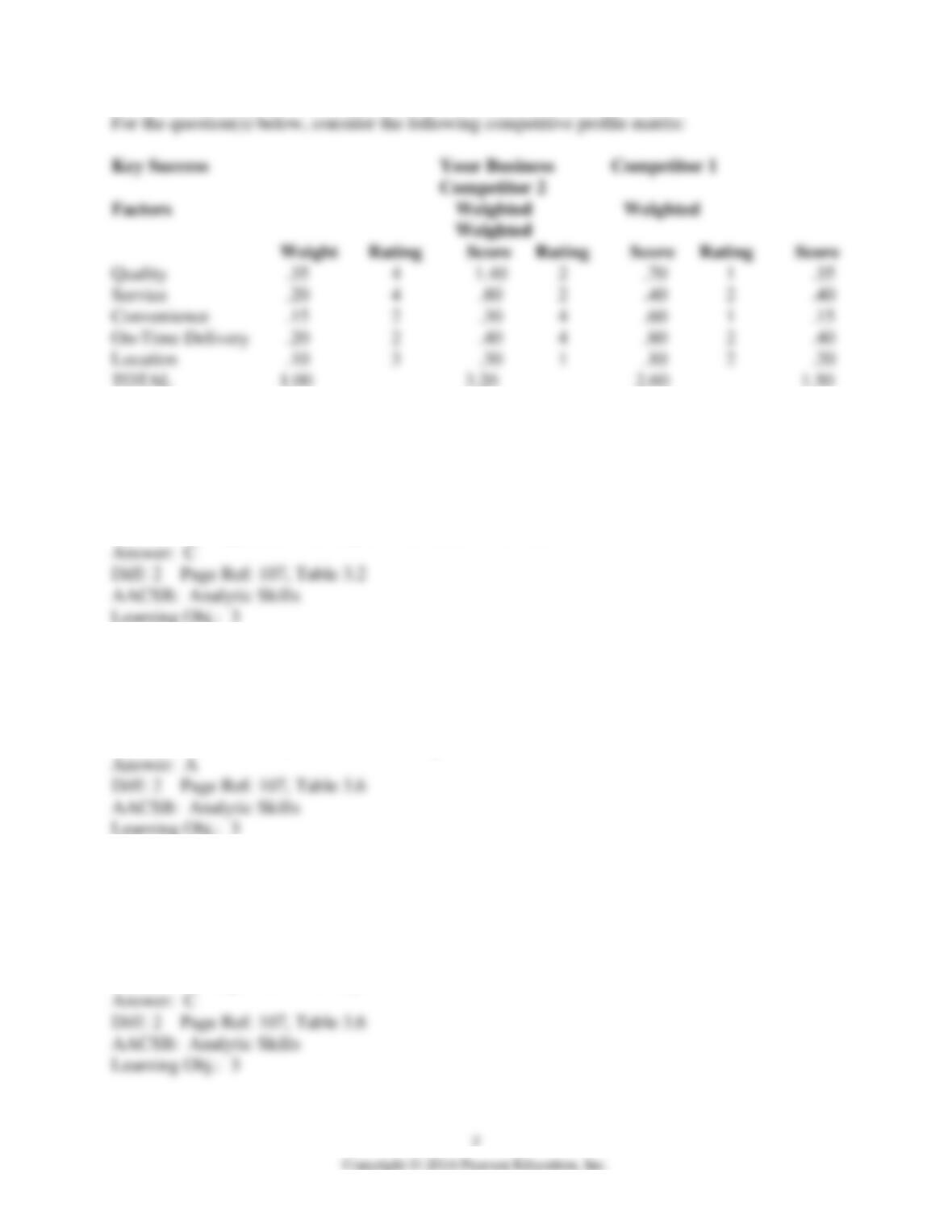
24) Which of the following statements is true?
A) Overall, Competitor 2 is the strongest of these three companies.
B) Your company’s most serious weakness is its poor quality.
C) Your company’s most vulnerable point against these two competitors is in the area of on-time
delivery.
D) The most important of the key success factors is location.
25) Which company has the strongest competitive position?
A) Your company
B) Competitor 1
C) Competitor 2
D) Impossible to tell from the information given
26) Which of the following statements is true?
A) Overall, Competitor 2 is the strongest of these three companies.
B) Your company’s most serious weakness is its poor quality.
C) Your company’s most vulnerable point against these two competitors is in the area of on-time
delivery.
D) The most important of the key success factors is location.
27) Which company has the worst location?
A) Your company
B) Competitor 1
C) Competitor 2
D) Impossible to tell from the information given
28) In terms of quality, which company has the weakest competitive position?
A) Your company
B) Competitor 1
C) Competitor 2
D) Impossible to tell from the information given
29) Which key success factor does the entrepreneur who built this table believe is most
important?
A) Quality
B) Service and on-time delivery
C) Convenience
D) Location
30) A competitive profile matrix:
A) identifies a firm’s core competencies.
B) permits the small business owner to divide a mass market into smaller, more manageable
segments.
C) allows the small business owner to evaluate her firm against competitors on the key success
factors for the industry.
D) creates a road map of action for the entrepreneur in order to fulfill her company’s mission,
goals, and objectives.
31) ________ are the broad, long-range attributes the small business seeks to accomplish;
________ are the more specific targets for performance.
A) Goals; objectives
B) Goals; strategies
C) Objectives; goals
D) Strategies; goals
32) Which of the following is not a characteristic of a well-written objective?
A) Realistic, yet challenging
B) Measurable
C) General
D) Timely
33) The focal point of any company’s strategy, whatever it may be, should be:
A) its product or service.
B) its competition.
C) its customers.
D) its strengths and weaknesses.
34) A ________ is a road map of the tactics and actions an entrepreneur draws up to fulfill the
company’s mission, goals, and objectives.
A) mission
B) strategy
C) competitive edge
D) core competency

35) ________ spell(s) out the “ends” an organization is to achieve; ________ define(s) the
“means” for achieving the ends.
A) Mission, goals, and objectives; strategy
B) Key success factors; strategy
C) Strategy; mission, goals, and objectives
D) Strategy; vision
36) The relationship between a company’s mission, goals, and objectives and its strategy is best
described by which of the following statements?
A) Developing a company’s strategy lays the groundwork for creating its mission, goals, and
objectives.
B) The mission, goals, and objectives spell out the ends the company wants to achieve, and the
strategy defines the means for reaching them.
C) Although managers must change a company’s mission, goals, and objectives as competitive
conditions change, they should avoid adjusting the company’s strategy to prevent the company
from losing its focus and momentum.
D) There is no real link between a company’s mission, goals, and objectives and its strategy.
37) A strategy should:
A) be comprehensive and well integrated.
B) focus on establishing for the firm the key success factors in the industry.
C) identify how the firm will accomplish its mission, goals, and objectives.
D) All of the above
38) A cost-leadership strategy:
A) enables companies to concentrate on a niche within the overall market.
B) is built on differences among market segments.
C) works best when buyers’ primary purchase criterion is price.
D) All of the above
39) A cost-leadership strategy works well when:
A) buyers are sensitive to price changes.
B) competing firms sell the same commodity products.
C) a company can reap savings from economies of scale.
D) All of the above
40) Small firms pursuing a cost-leadership strategy have an advantage in reaching customers
whose primary purchase criterion is:
A) quality.
B) constant innovation.
C) price.
D) customer service.
41) Skatell’s, a small jewelry store with three locations, designs and manufactures much of its
own jewelry while its competitors (many of them large department stores) sell standard, “off-the-
shelf” jewelry. As a result, Skatell’s has developed a loyal customer base of people who seek
unique pieces of jewelry. Skatell’s reputation for selling unique and custom-designed jewelry
allows them to benefit from a:
A) cost-leadership strategy.
B) differentiation strategy.
C) focus strategy.
D) competitive strategy.
42) Cost-leadership may have which of the following inherent dangers?
A) What is chosen to distinguish the product does not boost its performance.
B) An over-focus on the physical characteristics of the product
C) The identified niche is not large enough to be profitable.
D) An overemphasis on costs to the elimination of other strategies
43) A differentiation strategy:
A) seeks to build customer loyalty by positioning goods or services in a unique fashion.
B) is built on a company’s core competence.
C) must create the perception of value in the customer’s eyes.
D) All of the above
44) A small company following a ________ strategy seeks to build customer loyalty by
positioning its goods and services in a unique fashion.
A) differentiation
B) cost-leadership
C) focus
D) niche
45) A company that offers superior product quality, extra customer service, and fast delivery
times is pursuing a:
A) cost-leadership strategy.
B) differentiation strategy.
C) concentration strategy.
D) strategic alliance.
46) Which of the following is a danger in choosing a differentiation strategy?
A) Focusing only on physical characteristics of a product or service and ignoring important
psychological factors, such as status, prestige, image, and customer service
B) Choosing a market that is not large enough to be profitable
C) Misunderstanding the firm’s true cost drivers
D) All of the above

47) The principle behind a ________ strategy is to select one or more market segments, identify
customers’ special needs, and approach them with a good or service designed to excel in meeting
these needs.
A) cost-leadership
B) differentiation
C) focus
D) concentration
48) Rather than attempting to serve the total market, the small firm pursuing a ________ strategy
specializes in serving a specific target segment.
A) cost-leadership
B) differentiation
C) focus
D) head-to-head
49) Shere Vincente operates a travel service that specializes in arranging trips for women, giving
special attention to their needs and preferences, from security and comfort to activities and
events designed to appeal to her target customers. Vincente is pursuing a ________ strategy.
A) cost-leadership
B) differentiation
C) focus
D) positioning
50) Small companies must develop strategies that exploit all of the competitive advantages of
their size by:
A) responding quickly to customers’ needs.
B) remaining flexible and willing to change.
C) constantly innovating.
D) All of the above

51) In order for the control process to work, the business owner must:
A) make as few changes and modifications in the operational plans as possible.
B) concentrate on competitive information.
C) identify and track key performance indicators.
D) maintain control and delegate as little authority and responsibility as possible.
52) Which of the following is NOT one of the four important perspectives a balanced scorecard
should look at a business from?
A) Competitor perspective
B) Internal business perspective
C) Innovation and learning perspective
D) Financial perspective
53) The balanced scorecard ideally looks at a business from four important perspectives relating
to:
A) low-cost, differentiation, focus, and initiative.
B) customers, buyers, suppliers, and substitute products.
C) customers, internal factors, capital, and human resources.
D) customers, internal factors, innovation, and finances.
54) With the growth of the Internet, cloud computing, globalization, and increased competition,
the business environment has become more turbulent and challenging.
55) One of the biggest changes entrepreneurs face is the shift in the economy from a base of
financial to intellectual capital.
56) The three components of intellectual capital are human, structural, and customer.
57) Narrower product lines, smaller customer bases, and more limited geographic areas give
small companies a natural advantage over large businesses when preparing a strategic plan.
58) The most effective way for a small business to establish a competitive advantage is by
offering lower prices.
59) Small companies’ core competencies are often the result of benefits such as agility, speed,
closeness to customers, superior service, and innovative ability-all of which are size advantages
that allow them to do things that their larger competitors cannot.
60) Large companies have a natural advantage over small firms when it comes to preparing a
strategic plan.
61) Although developing a strategic plan is important for large companies, it is not essential to
managing a small company successfully because of its limited resources.
62) The ideal strategic planning process for a small company should start with setting objectives.