
NEW YORK UNIVERSITY
ROBERT F. WAGNER GRADUATE SCHOOL OF PUBLIC SERVICE
CORE-GP.1021: Financial Management
Final Examination
Professors Smith and West
Fall 2011
SOLUTIONS
Name: _____________________________________________________________________
Student ID: _________________________________________________________________
Wagner Student Mailbox No.: __________________________________________________
(If you are not a Wagner student, please write “Non–Wagner”)
Please circle the lecture you normally attend:
Tuesday
12:30 pm
Smith
Tuesday
6:45 pm
West
Wednesday
12:30 pm
Smith
Instructions:
1) Please turn off your cell phone.
2) Print your initials at the top of each page.
3) You may use one double-sided page of notes. Put away all other written materials.
4) You may use, but not share, a calculator. Graphing calculators are not allowed. Be sure to
clear your calculator before each calculation.
5) Write clearly, show your work, and circle your final answer. Only one answer will be
accepted for each problem.
6) When you are done, hand in your exam, transactions worksheet, financial statements, and your
one page of notes.
Good luck!
Initials: ____________
Section 1: Multiple Choice and Short Answers (36 points)
1. (2 points) A not-for-profit opera company purchased a new lighting rig for $275,000 exactly
two years ago. The lighting rig is expected to have a useful life of 10 years and a salvage of
$25,000. The net book value for the lighting rig that would be reported on the balance sheet
today is (circle one):
2. (2 points) In order to retain their tax-exempt status, not-for-profit organizations are required
to have two authorized signatures on all checks they issue above a specific dollar threshold.
3. (2 points) Which generally accepted accounting principle (GAAP) would require a not-for-
profit organization to assign a dollar value to all the donated goods it received throughout the
year?
4. (2 points) Assuming an organization operates at a profit during the fiscal year and has
liabilities, its return on net assets ratio (change in net assets / total net assets) will always be
greater than its return on assets ratio (change in net assets / total assets).
5. (2 points) The following organizations must prepare a statement of functional expenses as
part of their audited financial statements (circle all that apply):
6. (2 points) Investment income earned from an endowment should always be classified as
temporarily restricted.
Initials: ____________
2
7. (2 points) In a state government’s comprehensive annual financial report, which of the
following might appear on the government-wide statement of net assets (circle all that
apply):
8. (4 points) A not-for-profit hospital’s fiscal year ends on December 31st. On January 1st,
2007, the hospital took out a bank loan for $750,000. The loan has an annual interest rate of
6% and requires that the hospital repay the loan principal in 15 equal payments made
annually on the last day of the fiscal year. Interest is paid separately. Loan repayments
began on the last day of FY 2007. Assuming the bank loan is the hospital’s only debt, what
are the current and long-term portions of notes payable that would be shown on the balance
sheet as of the last day of FY 2011? Write your answers in the spaces below.
9. (6 points total) The National Arts Society (TNAS), a not-for-profit organization that provides
grants to arts programs, distributes coffee mugs to individuals who donate over $50 to the
organization annually. TNAS began FY 2011 on July 1st with 20 mugs valued at $47 in total.
On September 1st, the organization purchased an additional 100 mugs at a cost of $2.60 per
mug. On December 15th, TNAS took advantage of a promotional offer from a vendor and
purchased an additional 50 mugs for $105 in total. At the end of FY 2011, TNAS had 45
mugs remaining in its inventory. The organization uses LIFO.
a) (3 points) What is The National Arts Society’s supplies expense for FY 2011?
b) (3 points) What is The National Art Society’s inventory balance at the end of FY
2011?
Initials: ____________
3
10. (12 points total) Show the impact of each transaction using the modified accrual basis of
accounting. Be sure to label each fund:
b) (1 point) Using accrual accounting, the transaction in part (a) would have been recorded
the same.
c) (5 points) Each year, Capital City is legally required to transfer $900,000 from its general
fund to its debt service fund. It transferred the full $900,000 due this year, plus an
additional $200,000 that was required to be transferred the previous year.
d) (1 point) Using accrual accounting, the transaction in part (c) would have been recorded
the same.
Initials: ____________
4
Section 2: Financial Statement Preparation (35 points)
The Science Learning Institute (SLI), a not-for-profit educational center that provides science
tutoring to middle school students, uses accrual accounting to prepare its annual financial
statements. The SLI ended FY 2010 with the following balances in its accounts:
Accounts Payable
0
Cash
103,100
Grants Receivable, net
35,100
Inventory
2,300
Net Assets
273,500
Notes Payable
595,000
Pledges Receivable, net
10,000
PP&E, net
735,000
Wages Payable
17,000
The SLI recorded the following transactions during FY 2011, which ended on August 31, 2011.
1. SLI took out an $850,000 bank loan on September 1, 2007. The loan has an annual interest
rate of 6.5% and is the only borrowing the organization has done since its inception.
2. SLI used the proceeds from the bank loan to purchase its office space on March 1, 2008. The
office space cost $775,000. It is expected to have a useful life of 25 years and no salvage
3. On the first day of FY 2011, SLI purchased new classroom equipment worth $20,000. The
equipment is expected to have a useful life of 8 years and a salvage value of $2,000.
4. SLI earned $325,000 in state grants during FY 2011, spread evenly throughout the year. This
was an increase from the $304,200 in state grants that SLI earned evenly throughout FY 2010.
5. During FY 2011, SLI received $75,000 in donor pledges, 80% of which was collected in cash.
The organization also collected $7,500 in outstanding pledges from the previous fiscal year.
6. SLI’s employees earned $17,500 per month in FY 2011, a monthly increase of $500 from FY
2010. In both FY 2010 and FY 2011, SLI paid its employees with a one-month lag.
7. During FY 2011, SLI ordered $40,000 worth of classroom supplies on credit and used
$35,000 of those supplies throughout the year. At the end of FY 2011, SLI still owed its
8. SLI pays $900 a month in utilities. Utilities are paid timely.
Initials: ____________
5
Record these events on the transactions worksheet template that was provided separately and
then create a balance sheet, activity statement, and cash flow statement for FY 2011 on the pages
that follow.
Initials: ____________
6
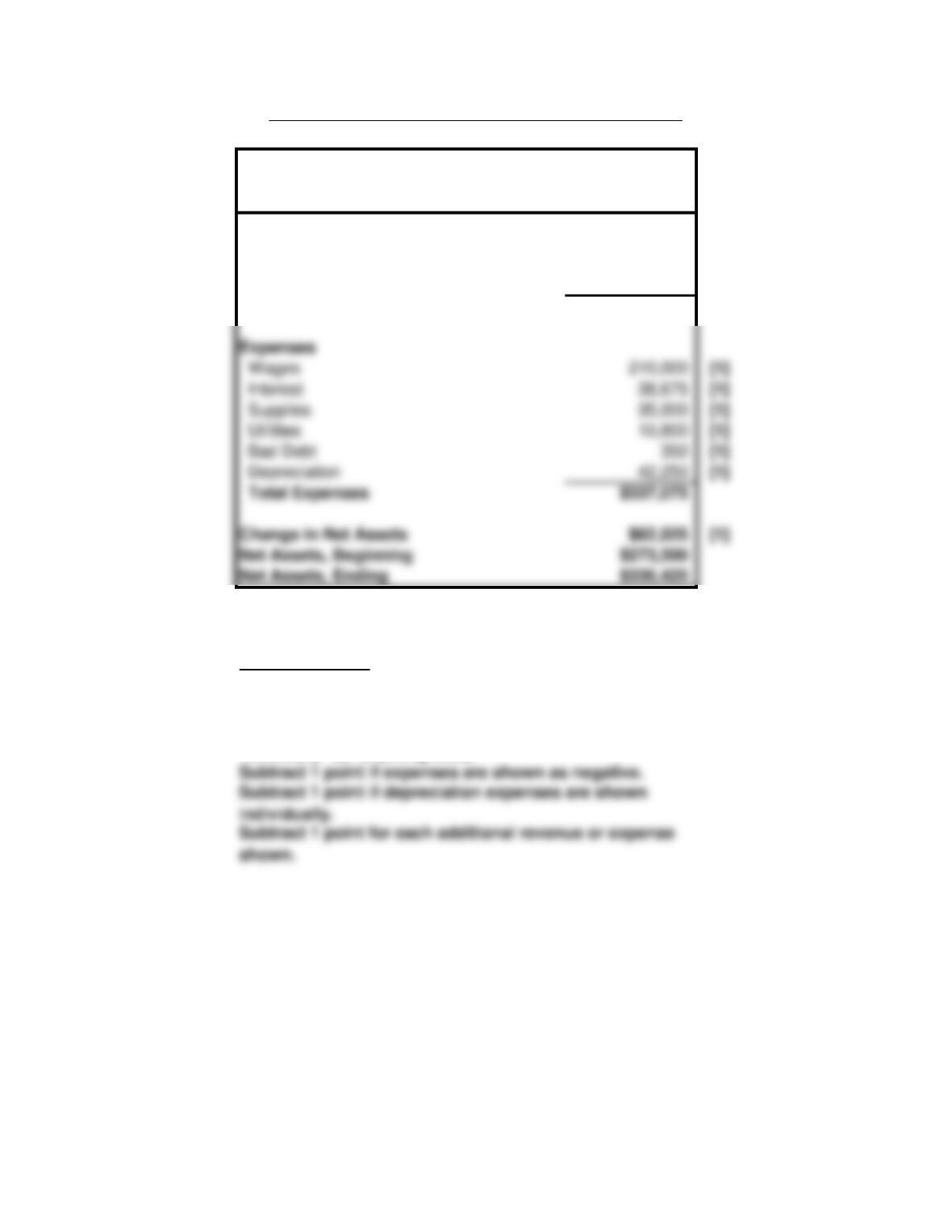
Prepare your balance sheet on this page (12 points)
(Hint: To receive full credit, you do not need to report the previous year’s (FY 2010) balances on the balance sheet,
but we recommend that you do so anyway because it will help you prepare the cash flow statement.)
Assets 2011 2010
Cash $96,225 $103,100
[1]
Grants Receivable, net 37,500 35,100
[1]
Pledges Receivable, net 17,150 10,000
[1]
Inventory 7,300 2,300
[1]
PP&E, net 712,750 735,000
[1]
TOTAL ASSETS $870,925 $885,500
Science Learning Institue
Balance Sheet
As of August 31, 2011
Liabilities and Net Assets
[1]
[1]
[1]
TOTAL LIABILITIES $534,500 $612,000
TOTAL NET ASSETS $336,425 $273,500 [1]
Initials: ____________
7
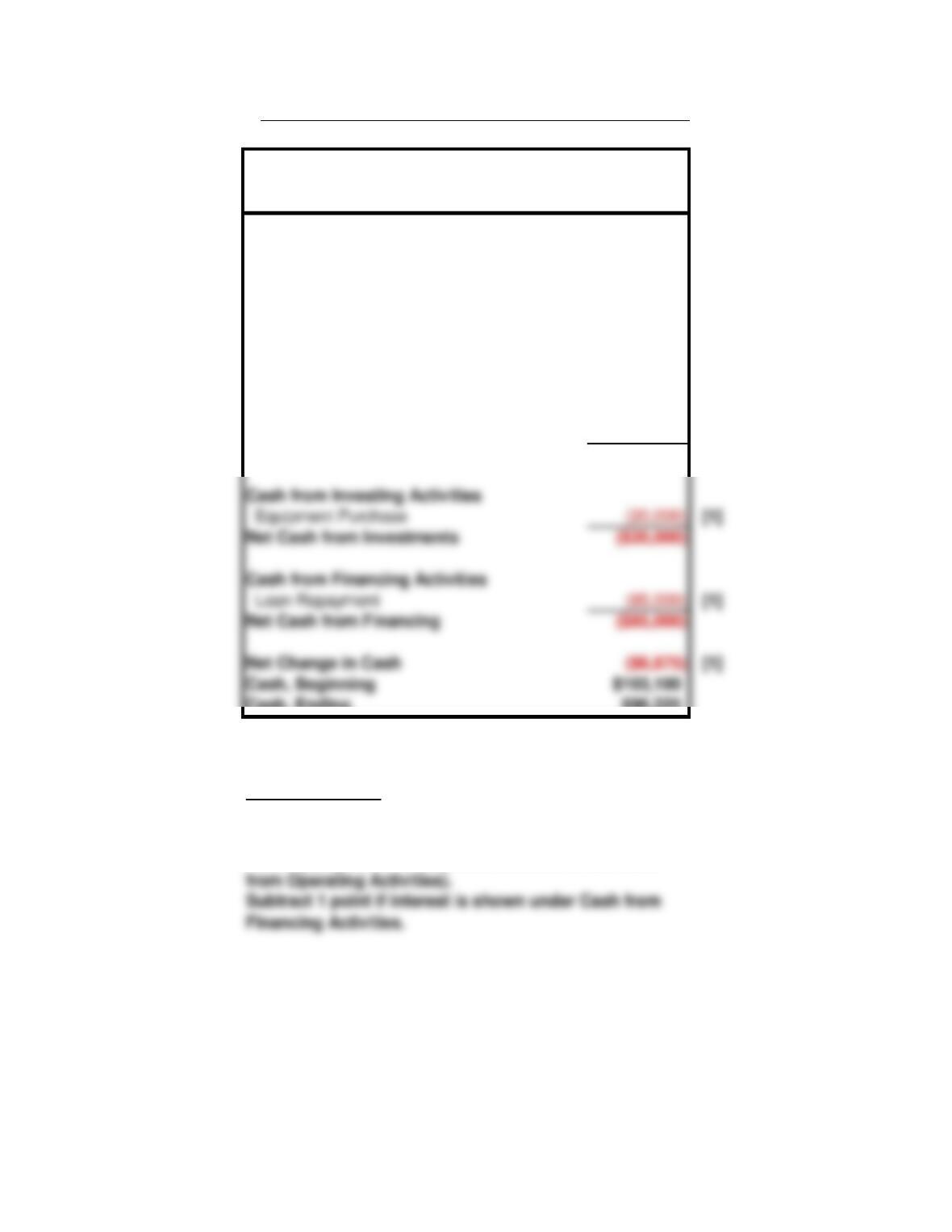
Prepare your activity statement on this page (11 points)
Revenues and Support
State Grants 325,000
[1]
Donations $75,000
[1]
Total Revenue $400,000
Subtract 1 point if expenses are shown as negative.
Award 1 point for format.
Science Learning Institute
Activity Statement
For the Year Ending August 31, 2011
Award 1 point for heading.
Total = 11 points
Subtract 1 point if any revenue labels are followed by the
term “receivables.”
Subtract 1 point if supplies expenses is labeled as
“inventory” (or anything else).
[1]
[1]
[1]
[1]
[1]
[1]
Total Expenses $337,075
Change in Net Assets $62,925 [1]
Net Assets, Beginning $273,500
Initials: ____________
8
Prepare your cash flow statement on this page (12 points)
Cash from Operating Activities
Change in Net Assets $62,925
[1]
Depreciation 42,250
[1]
Changes in Non-Cash Current Assets
Grants Receivable, net (2,400)
[1]
Pledges Receivable, net (7,150)
[1]
Inventory (5,000)
[1]
Changes in Current Liabilities
Accounts Payable 7,000
[1]
Wages Payable 500
[1]
Net Cash from Operations $98,125
Cash, Ending $96,225
Subtract 1/2 point for each incorrect sign.
from Operating Activities).
Subtract 1 point if an item is shown under the wrong
heading (e.g., Loan Repayment is shown under Cash
Total = 12 points.
Science Learning Institute
Cash Flow Statement
For the Year Ending August 31, 2011
Award 1 point for heading.
Award 1 point for format.
Cash from Investing Activities
[1]
Cash from Financing Activities
[1]
Net Cash from Financing ($85,000)
Net Change in Cash ($6,875) [1]
Cash, Beginning $103,100
Initials: ____________
9
Section 3: Financial Statement Analysis (29 points)
All questions in this section reference the FY 2010 financial statements of the American
Diabetes Association (ADA).
For questions 1 through 5, please select the appropriate ratio from the following list, and make
sure to include units of analysis in your answers when appropriate (days, $, %, etc.).
Cash-Flow Coverage
=
Cash from Operations + Interest Expense
Interest Expense + Debt Payments
Current Ratio
=
Current Assets
Current Liabilities
Debt to Equity
=
Total Liabilities
Total Net Assets
Program Services Ratio
=
Program Service Expenses
Total Expenses
Receivables Turnover
=
Unrestricted Revenues and Support
Total Receivables
Return on Net Assets
=
Change in Net Assets
Total Net Assets
1. (3 points) As Finance Director for the American Diabetes Association (ADA), you want
to calculate the organization’s profitability.
b. What is the value of this ratio for FY 2010? Show your work, and circle the
answer.
c. Has ADA’s profitability improved or deteriorated since FY 2009?
Initials: ____________
10
2. (4 points) Now, you want to determine whether ADA’s liquidity is sufficient.
b. What is the value of this ratio for FY 2010? Show your work, and circle the
answer.
c. Does the ratio you calculated in part (b) compare favorably or unfavorably to the
rule of thumb for this ratio? Write “none” if there is no rule of thumb.
3. (3 points) A creditor will evaluate the extent to which ADA is leveraged.
b. What is the value of this ratio for FY 2010? Show your work, and circle the
answer.
c. Does the ratio you calculated in part (b) compare favorably or unfavorably to the
rule of thumb for this ratio? Write “none” if there is no rule of thumb.
Initials: ____________
4. (3 points) The Operations Manager would like to evaluate how efficiently ADA collects
on amounts that are owed to the organization.
b. What is the value of this ratio for FY 2010? Show your work, and circle the
answer.
c. Does the ratio you calculated in part (b) compare favorably or unfavorably to the
rule of thumb for this ratio? Write “none” if there is no rule of thumb.
5. (3 points) Finally, you want to calculate ADA’s ability to make debt service payments.
b. What is the value of this ratio for FY 2010? Show your work, and circle the
answer.
c. Does the ratio you calculated in part (b) compare favorably or unfavorably to the
rule of thumb for this ratio? Write “none” if there is no rule of thumb.
Initials: ____________
6. (2 points) What percentage of ADA’s program expenses was for Research in FY 2010?
Show your work.
7. (3 points) What was the percent change in the size of ADA’s endowment from FY 2009
to FY 2010? Show your work.
8. (2 points) As of FY 2010, ADA offers most of its employees a defined benefit pension
plan.
9. (2 points) ADA did not have a research program in FY 2010.
10. (2 points) ADA did not purchase any property, plant, and equipment during FY 2010.
11. (2 points) In FY 2010, the time or purpose restrictions on $50,336,000 in net assets
expired.
Initials: ____________
13
TRANSACTIONS WORKSHEET FOR PART 2
Cash
Grants
Receivable, net
Pledges
Receivable, net
Inventory PP&E,net
Accounts
Payable
Wages
Payable
Notes
Payable
Beginning
Balance
$103,100 $35,100 $10,000 $2,300 $735,000 $0 $17,000 $595,000 $273,500
1(38,675) (38,675) Interest Expense
(85,000) (85,000)
2(31,000) (31,000) Depreciation Expense
3(20,000) 20,000
(2,250) (2,250) Depreciation Expense
(9,000) (9,000) Depreciation Expense
435,100 (35,100)
325,000 325,000 State Grants
Net Assets
Science Learning Institute, Transactions Worksheet, FY 2011
Net Assets
Assets
Liabilities
NOTES FOR PART 3
(1) Cash and cash equivalents + Accounts receivable + Inventory and supplies + Prepaid
expenses and other assets + Contributions receivable within one year. ADA includes all
current/short-term investments in “cash and cash equivalents” (see Note 3, bottom page 7).
Doubtful accounts are not accounted for because ADA does not provide the allocation basis
(percentage) and therefore we cannot determine the amount that applies to FY 2010 receivables.
(2) All liabilities are included. Though the line of credit has no “clean up” policy, it may expire
in 2011, and it has a high position on the balance sheet. Deferred revenues are generally
recognized over the term of a year (see Note 3, page 9, paragraph 3).
Balance