Environment: Science Behind the Stories, 2e Cdn. Ed. (Withgott)
Chapter 3 Environmental Systems and Ecosystem Ecology
3.1 Graph and Figure Interpretation Questions
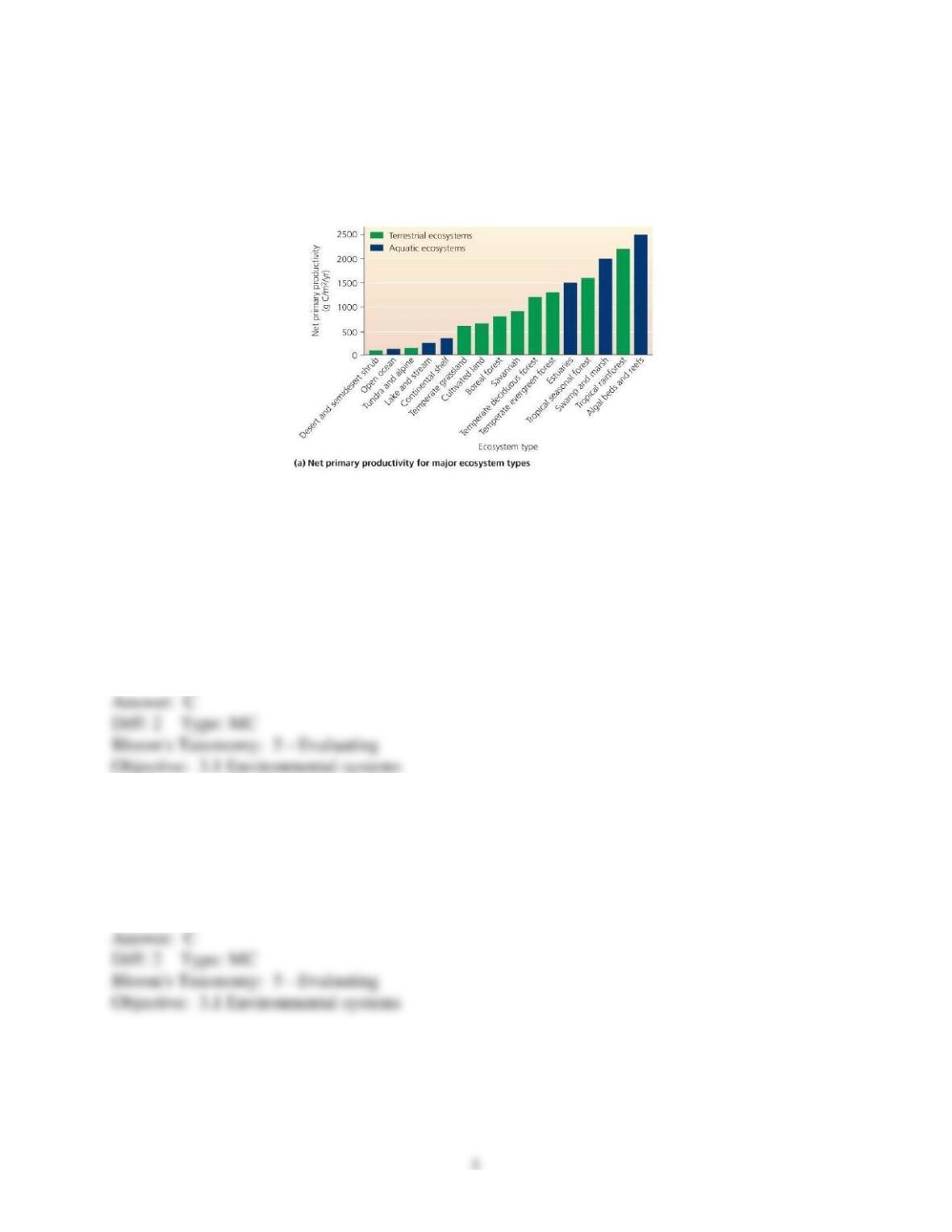
Figure 3.1
Use Figure 3.1 to answer the following questions.
1) Refer to Figure 3.1. This graph helps to explain ________.
A) why the open ocean is so productive
B) why cultivated lands are a logical choice to replace rainforests
C) why we need to be concerned with damage to rainforests and coral reefs
D) why tundra has such high net primary productivity of biomass
E) the importance of deserts
2) Refer to Figure 3.1. Overall, it appears that ________.
A) some ecosystems are 250 times more productive than others
B) cultivated land is more productive than natural ecosystems
C) shallow waters are more productive than deep waters
D) terrestrial ecosystems have higher productivity than aquatic ones
E) no valid conclusions can be drawn

3) Refer to Figure 3.1. Overall, it appears that terrestrial biomes with more available freshwater
________.
A) tend to have less productivity than those without much freshwater
B) tend to have about the same productivity as those without much freshwater
C) tend to have more productivity than those without much freshwater
D) don’t differentiate between freshwater as rainfall and freshwater as ice in glaciers
E) No valid conclusions can be drawn.
3.2 Matching Questions
Match the following.
A) groundwaters
B) cryosphere
C) biomass
D) ecosystem
E) lithosphere
F) biosphere
G) evaporation/precipitation
H) mantle
I) biome
J) evaporation
K) decomposers
L) detritivores
M) river runoff
N) transpiration
1) The largest flux of water in the hydrological cycle
2) Consists of all the planet’s living (and recently
deceased and decaying) organisms
3) Matter contained in living organisms

4) The solid earth beneath our feet
5) The process by which water moves from lakes or rivers to the atmosphere
6) The second largest reservoir of water on Earth
7) Describes a category that fungi and bacteria fit into
Diff: 2 Type: MA
Bloom’s Taxonomy: 2 – Understanding
Objective: 3.2 Energy and matter flows in an ecosystem
3.3 Short Answer Questions
1) What three factors contribute to the “dead zone” in the waters off the Gulf of Mexico?
2) The main reservoir of phosphorus is in ________.
3) “The missing carbon sink” is likely in ________.

4) The reservoir in which sources are equal to sinks is said to be in ________.
5) What are the anthropogenic sources of phosphorus, and why are they a problem?
6) What is the net effect of human activity on Earth’s carbon reservoirs?
7) Define homeostasis.
8) The extremely low dissolved oxygen concentrations in the “dead zone” represent a condition
called ________.
9) The process of nutrient enrichment, subsequent increased production of organic matter, and
eventual ecosystem degradation is known as ________.

10) The term ________ describes all of the interacting organisms and the abiotic factors that
occur in a particular place at the same time.
11) Briefly explain what the main difference is between the flow of matter and the flow of
energy in an ecosystem.
12) Substances move through the environment in cycles called nutrient cycles or ________
cycles.
13) In the process of ________, autotrophs such as green algae and plants use the Sun’s energy,
water, and carbon dioxide from the air to produce new biomass.
14) The total biomass that heterotrophs generate by consuming autotrophs is termed ________.
15) ________, such as soil insects and millipedes, are consumers of nonliving organic matter.

3.4 Multiple-Choice Questions
1) Any network of relationships among a group of components, which interact with and
influence one another through exchange of matter and/or information, is referred to as ________.
A) an interchange
B) a system
C) an ecosystem
D) an environmental collaboration
E) a hierarchy
2) A system receiving inputs and producing outputs without undergoing any changes in size or
function is said to be in ________.
A) static control
B) environmental balance
C) harmonic resonance
D) normal balance
E) dynamic equilibrium
3) Cattle on an open range, in some areas, may compact fragile soils while grazing. This can
damage plant roots, leading to fewer, smaller plants, which may in turn cause cattle to graze
more and work harder to obtain food. This is an example of a ________.
A) positive feedback loop
B) negative feedback loop
C) homeostatic system
D) dynamic equilibrium
E) food web

7
4) The eutrophication that has taken place in the Gulf of St. Lawrence and other locations
appears to be due to ________.
A) global warming from human use of fossil fuels
B) pesticide use along the waterways
C) heavy metals dumped in the sewage
D) weather alone, because it is only obvious in the summer
E) excess nutrients from fertilizers
5) The abiotic components of our planet can be divided into the ________.
A) geosphere and atmosphere
B) lithosphere, hydrosphere, and atmosphere
C) lithosphere, biosphere, and atmosphere
D) lithosphere, hydrosphere, biosphere, and atmosphere
E) centrosphere, geosphere, biosphere, and anthroposphere
6) A natural ecosystem, undamaged by human activity, is a(n) ________.
A) mostly closed system of organic materials and energy; everything is recycled
B) open system of organic materials and an open system of energy, everything is recycled
C) mostly closed system of organic and inorganic materials, and an open system of energy
D) mostly closed system of organic and inorganic materials, and a closed system of energy;
everything is recycled
E) open system of inorganic materials, and an open system of energy
7) The rainforest of western Vancouver Island where it meets the Pacific Ocean could be called
a(n) ________.
A) coastal superbiome
B) ecotone
C) dead zone
D) closed ecosystem
E) abiotic system
8) A small section of prairie grasses, over a year, produces enough biomass to feed insects, mice,

rabbits, birds, deer, antelope, and a host of decomposers. The amount of food potentially
available to the herbivores is the ________.
A) net primary production
B) gross primary production
C) secondary production
D) productivity
E) food chain
9) The rate at which biomass becomes available to consumers is termed ________.
A) gross primary productivity
B) ecosystem productivity
C) fertility
D) secondary production
E) net primary productivity
10) The biosphere consists of the ________.
A) saltwater and freshwater in surface bodies and the atmosphere
B) solid earth beneath our feet (above the mantle)
C) all the planet’s living organisms
D) air surrounding our planet allowing life to exist
E) abiotic portions of the environment
11) Ecotones are the ________.
A) sounds that animal communities make in ecosystems
B) interactive behaviours leading to communication
C) areas between territories of organisms
D) studies of specific biomes by ecologists
E) transitional zones between ecosystems

9
12) Examining areas from the landscape scale, termed landscape ecology, is useful because
________.
A) humans have not yet caused alterations to landscapes
B) the dynamics of animals result in localized problems
C) the role of ecosystems is often overstated
D) multiple ecosystems may exist in a single area with many transitional zones
E) it helps to define the entire closed system
13) Macronutrients ________.
A) are large molecules necessary for making macromolecules
B) are required in large amounts for organisms to survive
C) are the only nutrients that can be tracked in nutrient cycles
D) can be taken up only by plants from rock cycles
E) are what large predators eat
14) Experiments have demonstrated that the growth in the oceans is usually limited by
availability of ________.
A) iron or nitrogen
B) nitrogen
C) phosphorus
D) iron or phosphorus
E) carbon
15) Plants conduct photosynthesis, making glucose and other carbohydrates. To do this, they
need ________.
A) water from the soil
B) water from the humid atmosphere and carbon dioxide from the soil
C) water from the soil and carbon dioxide from the soil
D) carbon dioxide from the atmosphere
E) water from the soil and carbon dioxide from the atmosphere
16) Which of the major water and nutrients cycles has its largest reservoir in the atmosphere?

A) sulphur
B) carbon
C) nitrogen
D) phosporus
E) water
17) The origin of all phosphorus in biological tissues is ________.
A) volcanic activity
B) atmospheric phosphorus gas
C) phosphorus weathered from rock
D) phosphorus fixed from air by symbiotic bacteria
E) phosphorus from ocean waters
18) The origin of all nitrogen in biological tissues is ________.
A) volcanic activities
B) atmospheric nitrogen gas
C) nitrogen weathered from rock
D) lightning
E) the Haber-Bosch process
19) Nitrogen fixation is a process that makes nitrogen available to plants by ________.
A) photosynthesis
B) volcanic eruptions
C) heterotrophic bacteria converting ammonium to nitrate
D) dissolving in freshwater and in the ocean
E) mutualistic and free–living bacteria

20) Humans have dramatically altered the rate of nitrogen fixation into forms usable by
autotrophs ________.
A) by burning fossil fuels to meet our energy needs
B) because of the erosion of farmlands through poor agricultural practices
C) as we produce synthetic fertilizers and apply them to crops, lawns, and parks
D) by using antibiotics to reduce the numbers of denitrifying bacteria
E) by selectively removing leguminous plants
21) The freshwater we depend on for our survival accounts for ________.
A) two-thirds of all water on Earth
B) one-third of all water on Earth
C) 10% of all water on Earth
D) 3% of all water on Earth
E) less than 1% of all water on Earth
22) Aquifers are ________.
A) natural ponds and lakes
B) recharge lakes at water quality facilities
C) underground water reservoirs
D) the result of transpiration
E) oceans
23) By damming rivers and using methods such as flood irrigation, we are ________.
A) increasing evaporation
B) increasing the water table
C) decreasing the water table
D) decreasing transpiration
E) increasing transportation

24) A pond contains 1000 m3 of water. The water flows into the pond at 5 m3 per day, flows out
of the pond in form of a stream at 4 m3 per day, and evaporation from the pond’s surface is 1 m3
per day. What is the water turnover time in this lake?
A) 200 days
B) 1000 days
C) 250 days
D) 100 days
E) There is not enough data to answer this question.
25) Which of the major water and nutrients cycles has its largest reservoir in the ocean?
A) sulphur
B) carbon
C) nitrogen
D) phosporus
E) water
26) Human beings have dramatically altered the flux rate of nitrogen from ________.
A) the atmosphere to various pools on the Earth’s surface
B) soils to the atmosphere
C) proteins to inorganic ions in soils
D) oceans to soils
E) producers to consumers through increased wildfires

13
27) During a year, the gross photosynthesis of grass growing on a 2000 m2 parcel of land was 10
000 kg of carbon (kg C) per year. A farmer harvested this grass to feed it to her animals. The
grass contained 1000 kg of carbon. The animals that ate the grass gained 100 kg of carbon in
their meat. What was the secondary productivity of this piece of land?
A) 5 kgC/m2/yr
B) 0.5 kgC/m2/yr
C) 0.05 kgC/m2/yr
D) 5 kgC/yr
E) 0.5 kgC/yr
28) The secondary consumers obtain their nutrients from ________.
A) primary producers and/or detritivores and decomposers
B) primary producers only
C) detritivores and decomposers only
D) primary and/or tertiary consumers
E) tertiary producers and/or detritivores and decomposers
3.5 True/False Questions
1) Ecosystems that convert solar energy to biomass rapidly are said to have low primary
productivity.
2) Biogeochemical cycles are one example of a positive feedback loop.
3) Excess carbon dioxide in the atmosphere is most easily taken up by producers in
photosynthesis and by the ocean.
4) Most ecosystems are limited by nitrogen as phosphorus is weathered from rock at relatively

high rates.
5) Producers and primary consumers can take up phosphorus dissolved in water; higher-level
consumers must obtain phosphorus from organisms below them in the food web.
6) Humans have tremendously accelerated the flux rate of carbon from the earth to the
atmosphere by burning fossil fuels.
7) Denitrifying bacteria convert atmospheric nitrogen gas directly to nitrate ions.
3.6 Essay Questions
1) Compare and contrast positive and negative feedback loops. Give an example of each. Which
are more common in natural systems and why?

2) Differentiate between an open and a closed system. If possible, give a specific and somewhat
detailed example of each. Do both exist in nature? Why or why not?
3) Give a brief overview of the carbon cycle. Include the source of carbon that enters
ecosystems, how it moves through ecosystems, what it is used for, and where it is ultimately
deposited. What part of this cycle is believed to contribute to global warming?

4) Human activity has affected every aspect of the nitrogen cycle. List the ways that humans
have altered nitrogen content starting with how nitrogen becomes available to producers, where
it goes, and what impacts it has. What are the concerns for the future?
5) Human activity has affected every aspect of the water cycle. List four ways that humans have
altered the water cycle. What are the major concerns for the future?

6) Explain eutrophication in coastal waters. Name one geographic location where this problem
occurs.
7) Describe the Toxic Nation project (an initiative of the Environmental Defence organization).
8) Define the term emergent properties and give an example from a natural system.
9) How and for what is GIS software used by landscape ecologists?

3.7 Scenario-Based Questions
Read the following scenario and answer the questions below.
In the early years of the twentieth century there were lush stands of tall grasses in the valley on
the east side of the Chiricahua Mountains in Arizona, stretching to Mexico on the south and New
Mexico on the east. Dramatic summer rainstorms dumped huge amounts of water, very quickly,
on the rocky upper slopes. The water ran down the slopes and into the grasslands, where it
quickly soaked into the soft, porous soil. Cattle ranching was in full swing, utilizing the rich
grasses, but the ranchers did not appreciate the multitudes of prairie dogs that lived in the
grasslands. Cattle would stumble in the holes, break legs, and die of starvation. In addition, many
ranchers were convinced that the prairie dogs would destroy the grasses because they directly
competed with the cattle for food. The ranchers had already done away with most predators that
might possibly affect cattle, and now they turned their attention to the prairie dogs. The ranchers
become a part of a new federally sponsored movement to poison the grassland prairie dogs. This
movement took root and spread through the 1920s and 1930s. In Canada, the Richardson Ground
Squirrel is a close relative of the prairie dogs with a similar lifestyle. Grain farmers and cattle
ranchers as well as golf club owners currently tend to adopt a zero-tolerance toward these
rodents for the same reasons that the Arizona ranchers were determined to exterminate the prairie
dog in the 1920s and 1930s.
1) Prairie dogs constantly dig through the soil, making new burrows. They eat the grasses, roots
and all. This probably contributes to ________.
A) the grassroots being subject to diseases
B) the soil being loose and to little nutrient cycling, causing grasses to fall over
C) the soil hardening during rains and to little nutrient cycling, causing grasses to die
D) the soils eroding and losing nutrients over time, causing the grasses to die
E) the soil being loose and to nutrient cycling, allowing new grass roots to grow and prosper
2) When the rains came down on the rocky mountainsides, the water ran down into the
grasslands where the prairie dogs were active and ________.
A) quickly ran off the loose soil, eroding the soil
B) quickly evaporated, drying the loose soil
C) quickly soaked into the loose soil, watering the grasses
D) gathered atop the loose soil, forming large muddy spots
E) formed ponds

3) In the late 1800s and early 1900s farmers and ranchers slaughtered coyotes, bobcats, wolves,
mountain lions, eagles, and rattlesnakes, trying to protect their cattle. One direct result may have
been a(n) ________.
A) decrease in soil quality
B) increase in predation
C) increase in soil quality
D) increase in the prairie dog population
E) decrease in the prairie dog population
4) Once the prairie dogs were poisoned and no longer a part of the ecosystem, which of the
following probably occurred?
A) Soils slowly became looser because of the cattle, so soil moisture increased.
B) Soils slowly compacted because of the cattle, so soil moisture decreased.
C) Soils slowly became looser because of the cattle, so fewer nutrients were recycled.
D) Soils slowly compacted because of the cattle, so soil moisture increased.
E) Soils slowly became looser because of the cattle, so soil moisture decreased.
5) The ranchers now wanted to bring back the prairie dogs because they realized that ________.
A) the prairie dogs kept the soil loose, so rain sank in and grasses grew
B) the prairie dogs didn’t eat grass
C) the predators depended on the prairie dogs
D) the cattle also ate the prairie dogs when grass was scarce
E) the prairie dogs were part of the net secondary productivity

6) Some of the conclusions that can be drawn from this scenario include that ________.
A) cattle improved the soils, contributing to this ecosystem
B) predators were unimportant components of this ecosystem; their removal caused no
subsequent problems
C) prairie dogs were unimportant components of this ecosystem; their removal caused no
subsequent problems
D) once humans change one thing in an ecosystem, they may find unexpected results occurring
elsewhere in the ecosystem
E) prairie dogs were part of a negative feedback loop once they were removed