Elements of Ecology, 9e (Smith)
Chapter 2 Climate
2.1 Short Answer Questions
1) The temperature, humidity, precipitation, wind, cloudiness, and other atmospheric conditions
that occur at a specific place and time are referred to as ________.
2) The long-term average pattern of weather at local, regional, or global scales is referred to as
________.
3) Carbon dioxide and ________ are the major gases in the atmosphere that absorb energy from
the sun.
4) The absorption and re-radiation of longwave radiation by gases in the atmosphere is called the
________.
5) Seasonality occurs on planet Earth because of its ________ with respect to the plane it travels
around the Sun.
6) In the Northern Hemisphere, the summer ________ occurs when solar rays fall directly on the
Tropic of Cancer.
7) The amount of force exerted over a given area of surface is called atmospheric ________.
8) With increasing altitude, air density ________.
9) Air masses are deflected to the ________ in the Northern Hemisphere and to the ________ in
the Southern Hemisphere.
10) The winds formed between the equator and about 30 degrees of latitude, blowing from the
northeast in the Northern Hemisphere and southeast in the Southern Hemisphere, are referred to
as ________.
11) In the Southern Hemisphere, oceanic gyres circulate in a(n) ________ direction.
12) The transformation of water from a liquid to a gaseous state is referred to as ________.
13) ________ is the amount of water vapor in the air expressed as a percentage of the saturation
vapor pressure.
14) The ________ is the temperature at which atmospheric water condenses.
15) The narrow region near the equator where trade winds meet is referred to as the ________.
16) Rainfall is greater and the vegetation more dense on the windward side of a mountain range
than on the leeward side, where a(n) ________ is formed.
17) A period of cooling that lasted from approximately the mid-14th to the mid-19th century is
referred to as the ________.
18) During an El Niño event, the waters of the eastern Pacific Ocean are unusually ________.
19) Most organisms live in habitats that provide specific conditions or a(n) ________ that may
be very different from regional weather patterns.
20) There is a strong positive correlation between rising atmospheric CO2 concentrations and
________.
2.2 Multiple-Choice Questions
1) The difference between climate and weather is that
A) weather is limited to precipitation and wind.
B) climate is the long term pattern of weather.
C) climate is limited to temperature.
D) weather is a measure of climate.
2) The two major atmospheric gases that absorb energy from the Sun are
A) oxygen and nitrogen.
B) nitrogen and hydrogen.
C) hydrogen and carbon dioxide.
D) carbon dioxide and water vapor.
3) Without the greenhouse effect, the Earth would
A) be much warmer than it currently is.
B) be much colder than it currently is.
C) have uniform temperatures and would lack seasons.
D) have constant sunlight.
4) Only 51 percent of incoming solar radiation actually reaches Earth’s surface. Most of the
remaining 49 percent of incoming radiation is reflected back to space by
A) clouds and the atmosphere.
B) the ocean’s surface.
C) snow and ice.
D) land.
5) What might be an accurate albedo measure of the surface of a glacier?
A) 0.1
B) 9.0
C) 0
D) 0.9
6) Which of the following is a greenhouse gas?
A) nitrogen
B) carbon dioxide
C) oxygen
D) ozone
7) Solar radiation in December is greatest at
A) the equator.
B) the Tropic of Cancer.
C) 90° in the Southern Hemisphere.
D) 90° in the Northern Hemisphere.
8) Seasonal variation in solar radiation, temperature, and day length is due to the
A) tilt of the Earth’s axis.
B) greenhouse effect.
C) Coriolis effect caused by the spinning of Earth on its axis.
D) sunspot activities at the surface of the Sun.
9) Where is temperature variation the greatest?
A) at the poles
B) in the temperate regions
C) in the tropical regions
D) at the equator
10) Which of the following occurs near the equator?
A) the Hadley cell
B) the Ferrel cell
C) the Polar cell
D) the Westerlies
11) If the Earth spun in the opposite direction what would change?
A) The equator would become as cold as the poles.
B) Air masses in the Northern Hemisphere would rotate counterclockwise.
C) Equatorial air would fall rather than rise.
D) Winter would occur in July in the Northern Hemisphere.
12) Incoming radiation exceeds outgoing radiation at or near
A) the poles.
B) the Northern Hemisphere.
C) the Southern Hemisphere.
D) the equator.
13) The Northeast trade winds occur
A) between the equator and the north pole.
B) between the equator and 30° N.
C) between 10° N and 45° N.
D) all along the Atlantic Ocean.
14) In the Northern Hemisphere, the shortwave radiation is highest during the
A) March equinox.
B) September equinox.
C) June solstice.
D) December solstice.
15) Of the following areas on Earth’s surface, which area moves fastest and has the greatest
linear velocity?
A) North Pole (90° north)
B) Tropic of Cancer (23.5° north)
C) Tropic of Capricorn (23.5° south)
D) Equator (0°)
16) A scientist traveling on a boat from Alaska to Antarctica took daily measurements of
atmospheric pressure. At which latitudes were the lowest pressures found?
A) polar (~90°) and subpolar (~60°) latitudes
B) subpolar (~60°) and subtropical (~30°) latitudes
C) subpolar (~60°) and tropical (~0°) latitudes
D) subtropical (~30°) and tropical (~0°) latitudes
17) Between 30°-60° north latitude, wind currents typically blow from
A) west to east and are deflected toward the left.
B) east to west and are deflected toward the left.
C) west to east and are deflected toward the right.
D) east to west and are deflected toward the right.
18) The systematic patterns of water movement are known as
A) circulations.
B) currents.
C) gyres.
D) trade winds.
19) Surface currents in the ocean typically
A) flow most strongly from west to east in equatorial regions.
B) are colder on the western side of continents.
C) flow counterclockwise in gyres in the Northern Hemisphere.
D) flow unimpeded from east to west just north of Antarctica.
20) Why is the ocean off the coast of Florida warmer than it is off the coast of Western Mexico?
A) Florida is closer to the equator.
B) Mean precipitation is higher in Mexico.
C) Wind patterns are clockwise in the Atlantic.
D) Ocean currents are coming from the tropics rather than the poles.
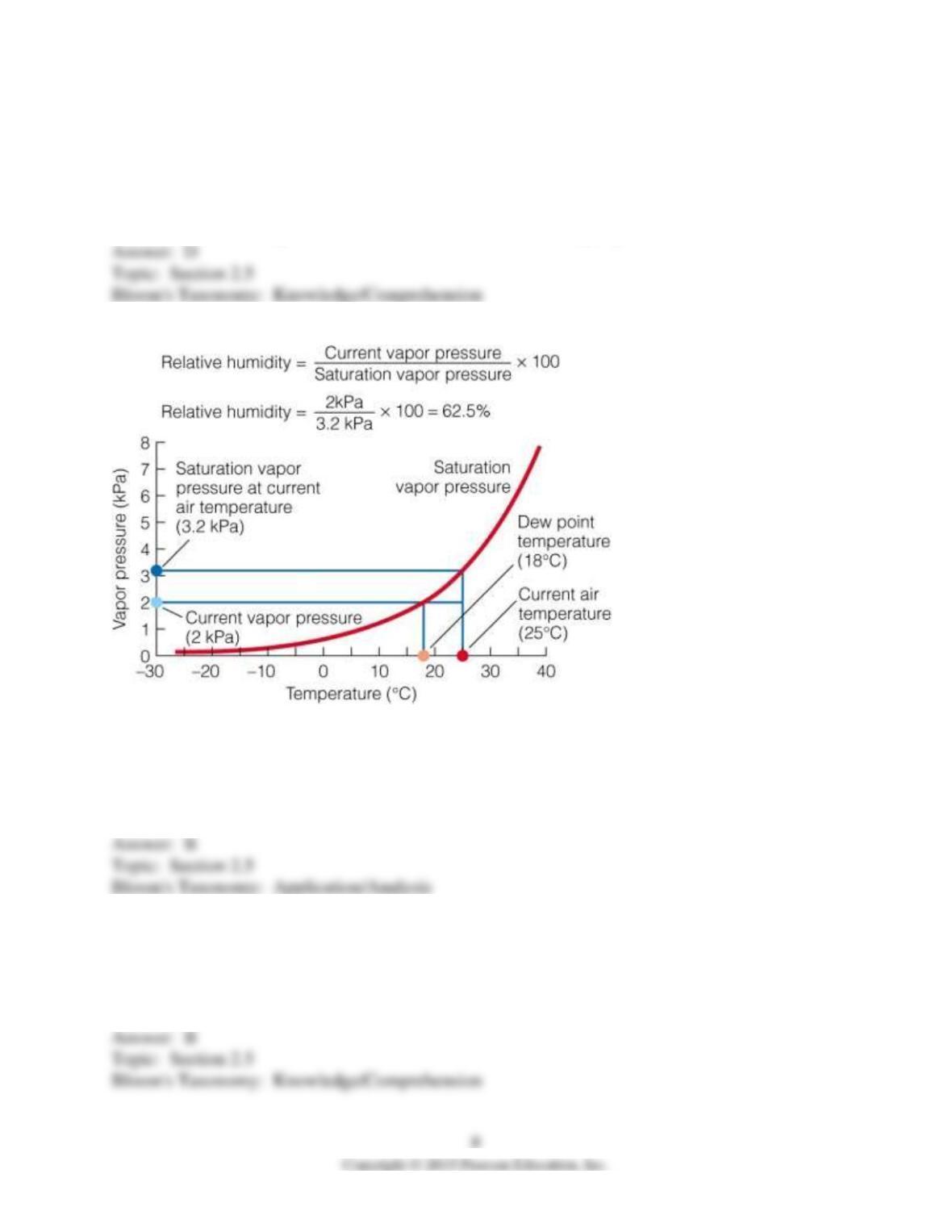
21) Relative humidity is the
A) amount of pressure at a given temperature at which water transforms from a liquid to a
gaseous state.
B) amount of pressure that water vapor exerts independent of the pressure of dry air.
C) temperature at which saturation vapor pressure is achieved.
D) amount of water vapor in the air relative to the saturation vapor pressure.
22)
If the vapor pressure is 1 kPa, what would be the approximate dew point?
A) 25°C
B) 10°C
C) 18°C
D) 1°C
23) The transformation of water from a liquid state to a gaseous state is known as
A) condensation.
B) evaporation.
C) saturation.
D) solidification.
24) In the vicinity of 30° north and 30° south, air typically
A) rises, cools, and precipitates.
B) descends, warms, and precipitates.
C) rises, cools, and is dry.
D) descends, warms, and is dry.
25) During winter in the Northern Hemisphere, the Intertropical Convergence Zone
A) sits directly over the equator.
B) is shifted into the northern latitudes.
C) is shifted into the southern latitudes.
D) does not exist.
26) What causes shifts in the dry and wet seasons of the tropics?
A) Hadley cells
B) saturation VP
C) ITCZ
D) the equatorial low
27) Why do beaches often have less extreme temperature variation than inland areas?
A) The ocean moderates the temperatures.
B) The sand absorbs and loses heat less efficiently.
C) The ocean waves reduce wind.
D) Air temperatures vary with latitudes.
28) Precipitation is generally greater
A) in the Southern Hemisphere than in the Northern Hemisphere.
B) in coastal areas than in interior areas.
C) at the equator than at 30° of latitude.
D) on the leeward side of mountains than on the windward side.
29) As air rises over a mountain, it
A) cools and tends to lose moisture in the form of precipitation.
B) cools and tends to gain moisture without precipitating.
C) warms and tends to lose moisture in the form of precipitation.
D) warms and tends to gain moisture without precipitating.
30) Which side of the mountain receives the most precipitation?
A) leeward side
B) Eastern side
C) Western side
D) windward side
31) Some variation in the solar radiation striking the Earth’s surface is linked to ________
activity.
A) sunspot
B) El Niño
C) La Niña
D) glacial
32) ________ is considered a primary influence on microclimate.
A) Aspect
B) Soil temperature
C) Rainfall
D) Vegetation
33) In contrast with north-facing slopes, south-facing slopes in the Northern Hemisphere are
characterized by
A) a lower rate of evaporation.
B) greater soil moisture.
C) lower air temperatures.
D) more vigorous growth of mosses.
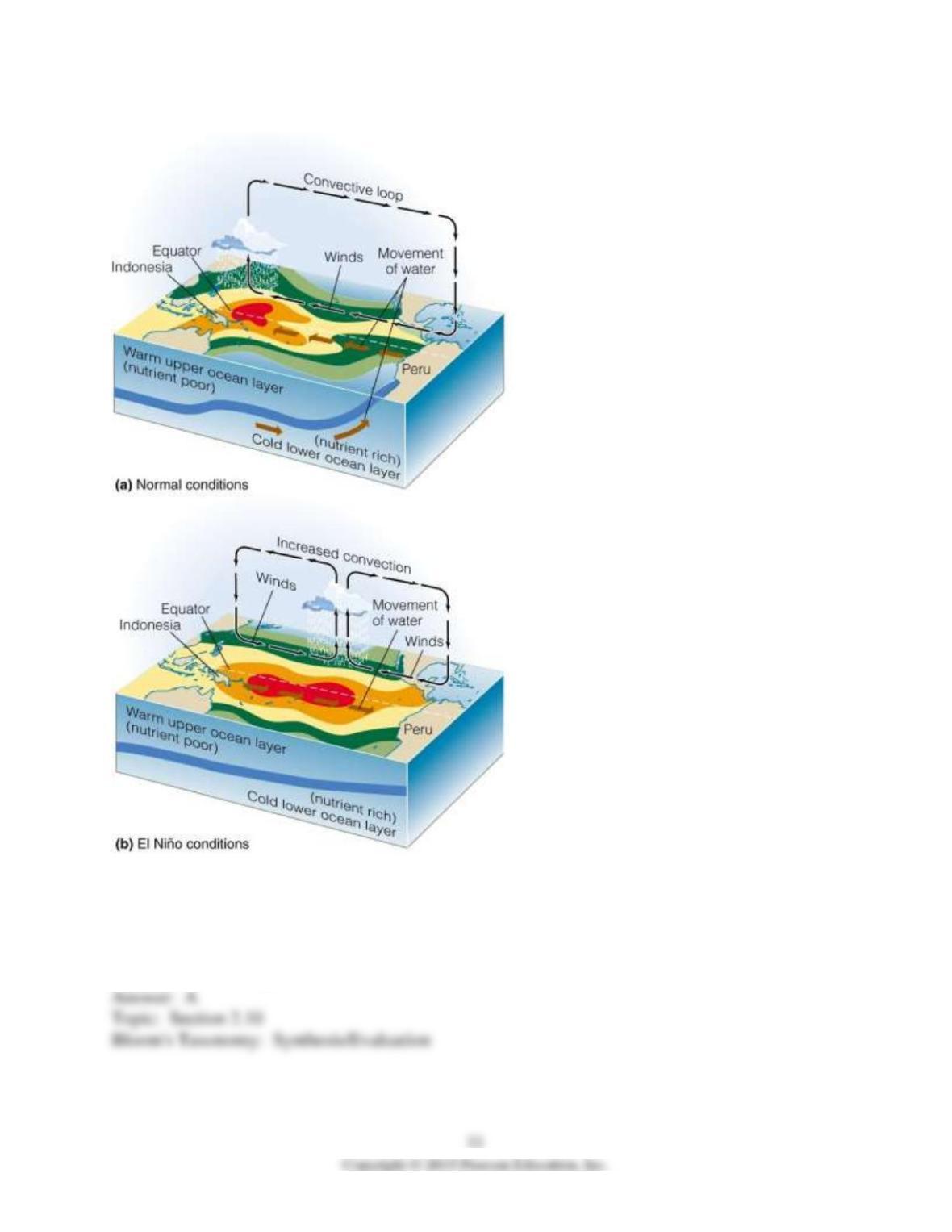
34)
Weakening of trade winds results in
A) flooding in Peru.
B) flooding in Indonesia.
C) reduced convection.
D) cooler ocean temperatures in Peru.
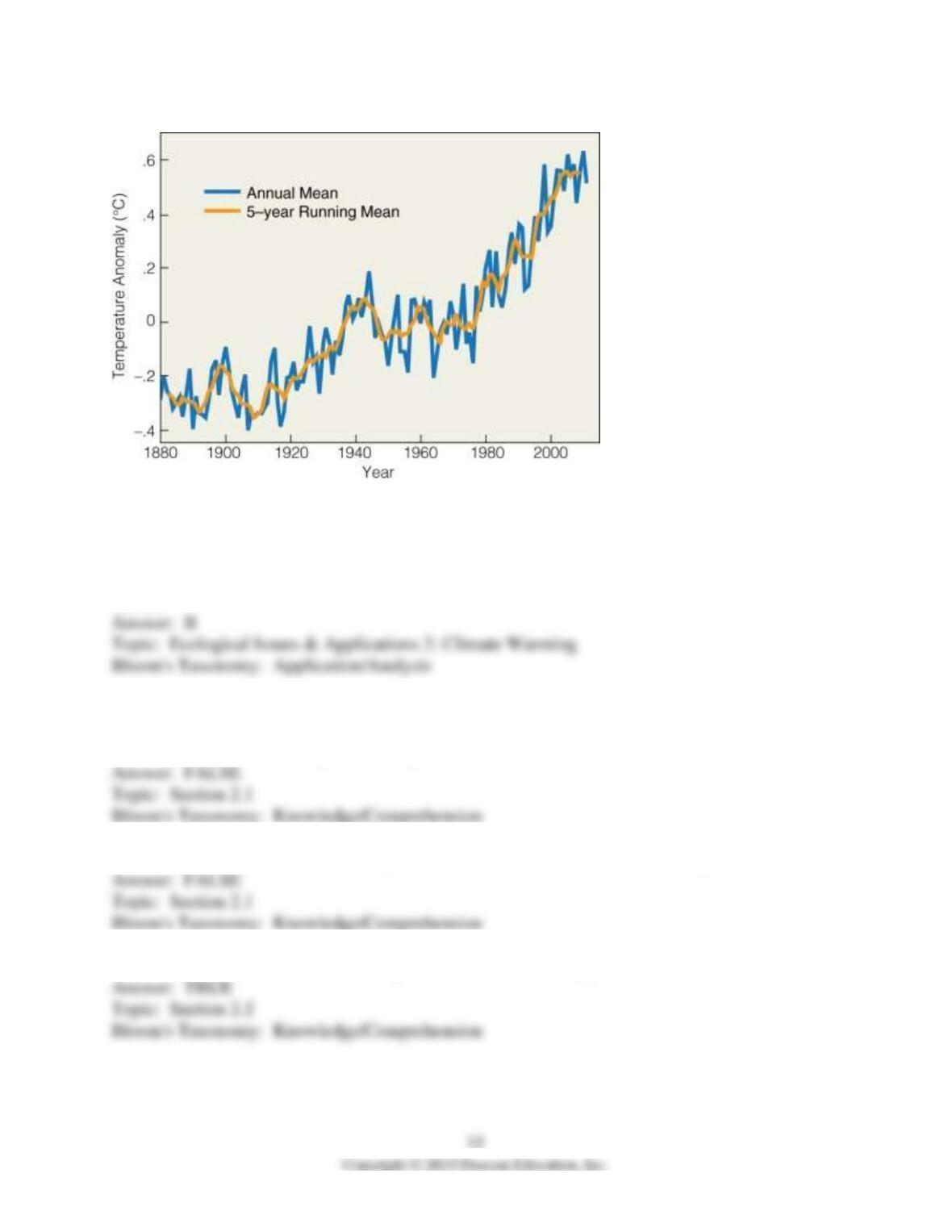
35)
If the current trend continues, what do you predict the temperature anomaly will be in 2025?
A) 0
B) 0.6
C) -0.5
D) -0.2
2.3 True/False Questions
1) A hotter object emits longer wavelengths than a cooler object.
2) Most of the solar radiation arriving at the Earth’s surface is reflected out to space.
3) Solar radiation is more direct in tropical latitudes than in temperate latitudes.
4) Daylight in the Southern Hemisphere is longest during the winter solstice in December.
5) Atmospheric pressure increases with altitude.
6) Dry air cools more rapidly than moist air.
7) Masses of air and water are deflected to the right in the Northern Hemisphere and to the left in
the Southern Hemisphere.
8) In the vicinity of the equator, air warmed by solar radiation rises.
9) Oceanic gyres circulate in a counterclockwise direction in the Northern Hemisphere and in a
clockwise direction in the Southern Hemisphere.
10) The saturation vapor pressure of air increases with temperature.
11) Cold air can hold more water than warm air.
12) Rainfall in the Northern Hemisphere is greater than rainfall in the Southern Hemisphere.
13) Precipitation is higher in tropical regions than in temperate and polar regions.
14) Precipitation on a tropical island is greatest during June to August and lowest during January
to April. This island must be located south of the equator.
15) Vegetation is usually more dense and vigorous on the windward side of mountains than on
the leeward side.
16) Surface temperatures in the eastern Pacific Ocean are warmer during El Niño conditions than
during La Niña conditions.
17) In temperate regions of the Northern Hemisphere, north-facing slopes are less humid than
south-facing slopes.
2.4 Essay Questions
1) Explain the differences between weather, climate, and microclimate. Which is most important
for individual organisms? Give an example.
2) Explain how or why the Earth’s surface emits more energy than it receives from the Sun.
3) Explain why seasonal changes in temperature and daylight occur and why they are more
pronounced at temperate and polar latitudes than at tropical latitudes.
4) Discuss the relationships between atmospheric pressure, temperature, and altitude.
5) Explain how the trade winds develop and why these were so important to 17th-century
merchant sailors.
6) Explain why the saturation vapor pressure increases with air temperature. How does relative
humidity change in response to air warming or cooling?
7) Explain why more rain falls in tropical latitudes (~0°) than in subtropical latitudes (~30°).
8) Why do the amount of rainfall and the composition of vegetation differ greatly on the opposite
sides of a mountain range?
9) Compare the causes and effects of the El Niño and La Niña events.
10) You study two neighboring plant populations growing at 200 meters above sea level (asl).
One population is situated on a north-facing slope, whereas the other population grows on a
south-facing slope. Compare the environmental conditions and microclimates that each
population experiences.