CHAPTER 2
ANALYZING TRANSACTIONS AND THEIR EFFECTS ON
FINANCIAL STATEMENTS
SUMMARY OF QUESTION TYPES BY LEARNING OBJECTIVE
AND LEVEL OF DIFFICULTY
Item
LO
LOD
Item
LO
LOD
Item
LO
LOD
Item
LO
LOD
Item
LO
LOD
True-False Statements
1.
1
E
6.
2
E
11.
4
E
16.
5
E
21.
7
E
2.
1
E
7.
3
E
12.
4
E
17.
6
E
3.
1
M
8.
4
E
13.
4
E
18.
6
E
4.
2
H
9.
4
M
14.
4
M
19.
6
M
5.
2
E
10.
4
M
15.
5
E
20.
7
E
Multiple Choice Questions
22.
2
M
29.
4
E
36.
4
H
43.
4
M
50.
6
E
23.
2
M
30.
4
M
37.
4
M
44.
4
H
51.
6
H
24.
2
M
31.
4
M
38.
4
E
45.
4
M
52.
6
M
25.
3
E
32.
4
E
39.
4
E
46.
4
M
53.
7
E
26.
3,4
E
33.
4
E
40.
4
H
47.
6
M
54.
7
M
27.
4
E
34.
4
M
41.
4
M
48.
6
M
55.
7
M
28.
4
E
35.
4
H
42.
4
M
49.
6
E
56.
7
H
Exercises
57.
4
M
59.
4
M
61.
6
M
63.
6
H
58.
4
H
60.
6
E
62.
6
M
Matching
64.
4
M
65.
4
M
Short-Answer Essay
66.
6
H
67.
7
M
Essay
68.
3
E
Note: E = Easy M = Medium H = Hard
2 – 2 Test Bank for Understanding Financial Accounting, Canadian Edition
SUMMARY OF LEARNING OBJECTIVES BY QUESTION TYPE
Item
Type
Item
Type
Item
Type
Item
Type
Item
Type
Item
Type
Item
Type
Learning Objective 1
1.
TF
2.
TF
3.
TF
Learning Objective 2
4.
TF
5.
TF
6.
TF
22.
MC
23.
MC
24.
MC
Learning Objective 3
7.
TF
25.
MC
26.
MC
68.
Es
Learning Objective 4
8.
TF
13.
TF
29.
MC
34.
MC
39.
MC
44.
MC
59.
Ex
9.
TF
14.
TF
30.
MC
35.
MC
40.
MC
45.
MC
64.
Ma
10.
TF
26.
MC
31.
MC
36.
MC
41.
MC
46.
MC
65.
Ma
11.
TF
27.
MC
32.
MC
37.
MC
42.
MC
57.
Ex
12.
TF
28.
MC
33.
MC
38.
MC
43.
MC
58.
Ex
Learning Objective 5
15.
TF
16.
TF
Learning Objective 6
17.
TF
19.
TF
48.
MC
50.
MC
52.
MC
61.
Ex
63.
Ex
18.
TF
47.
MC
49.
MC
51.
MC
60.
Ex
62.
Ex
66.
SAE
Learning Objective 7
20.
TF
21.
TF
53.
MC
54.
MC
55.
MC
56.
MC
67.
SAE
Note: TF = True-False Ex = Exercise SAE = Short-Answer Essay
MC = Multiple Choice Ma = Matching Es = Essay
Analyzing Transactions and Their Effects on Financial Statements 2 – 3
CHAPTER LEARNING OBJECTIVES
1. Identify the accounting standards used by Canadian companies.
2. Identify and explain the qualitative characteristics of useful financial
information and how the cost constraint affects these.
3. Explain the difference between the cash basis of accounting and the accrual
basis of accounting.
4. Analyze basic transactions and record their effects on the accounting equation.
2 – 4 Test Bank for Understanding Financial Accounting, Canadian Edition
5. Explain the limitations of using the accounting equation template approach to
record transactions.
6. Summarize the effects of transactions on the accounting equation and prepare
and interpret a simple set of financial statements.
7. Calculate and interpret three ratios used to assess the profitability of a
company.

Analyzing Transactions and Their Effects on Financial Statements 2 – 5
TRUE-FALSE STATEMENTS
1. All public companies must follow IFRS.
2. The objective of both IFRS and ASPE is to allow financial reporting that is useful to
the financial statement users.
3. Public companies are prohibited from being cross listed.
4. Relevance, faithful representation and cost constraint are examples of the
fundamental qualitative characteristics.
5. Information is considered to be material if it would impact the decisions of a financial
statement user.
6. Information has predictive value if it provides feedback to users on their previous
assessments of the company.
7. Revenue recognition criteria are necessary to determine when to recognize revenue
when using both accrual and cash accounting methods.
8. The sales of merchandise on credit will cause the retained earnings and long term
liabilities accounts to increase.
9. The purchase of equipment costing $19,500 for $1,500 down and the balance on
account will increase both sides of the Statement of Financial Position Statement of
Financial Position equation by $18,000.
10. The issuance of common shares with a value of $9,000 to purchase land will
increase the common share account.
11. Straight-line depreciation = (cost + residual value) ÷ estimated useful life.
12. Dividends are an expense of doing business.
13. The Classified Statement of Financial Position distinguishes between current and
non current assets and liabilities.

2 – 6 Test Bank for Understanding Financial Accounting, Canadian Edition
14. NBV of an asset is the cost of the asset that has already been expensed.
15. A significant limitation of the template method is the lack of specific retained earnings
and dividends declared accounts.
16. The template method can only be used by large companies.
17. Accumulated depreciation is deducted when calculating net income.
18. The purchase of a three-year insurance policy should be reflected on the Statement
of Financial Position under current assets.
19. A declaration of dividends results in an increase in liabilities and a decrease in
shareholders’ equity.
20. The return on assets = net income ÷ average total assets.
21. The profit margin ratio = sales ÷ net income.
Analyzing Transactions and Their Effects on Financial Statements 2 – 7
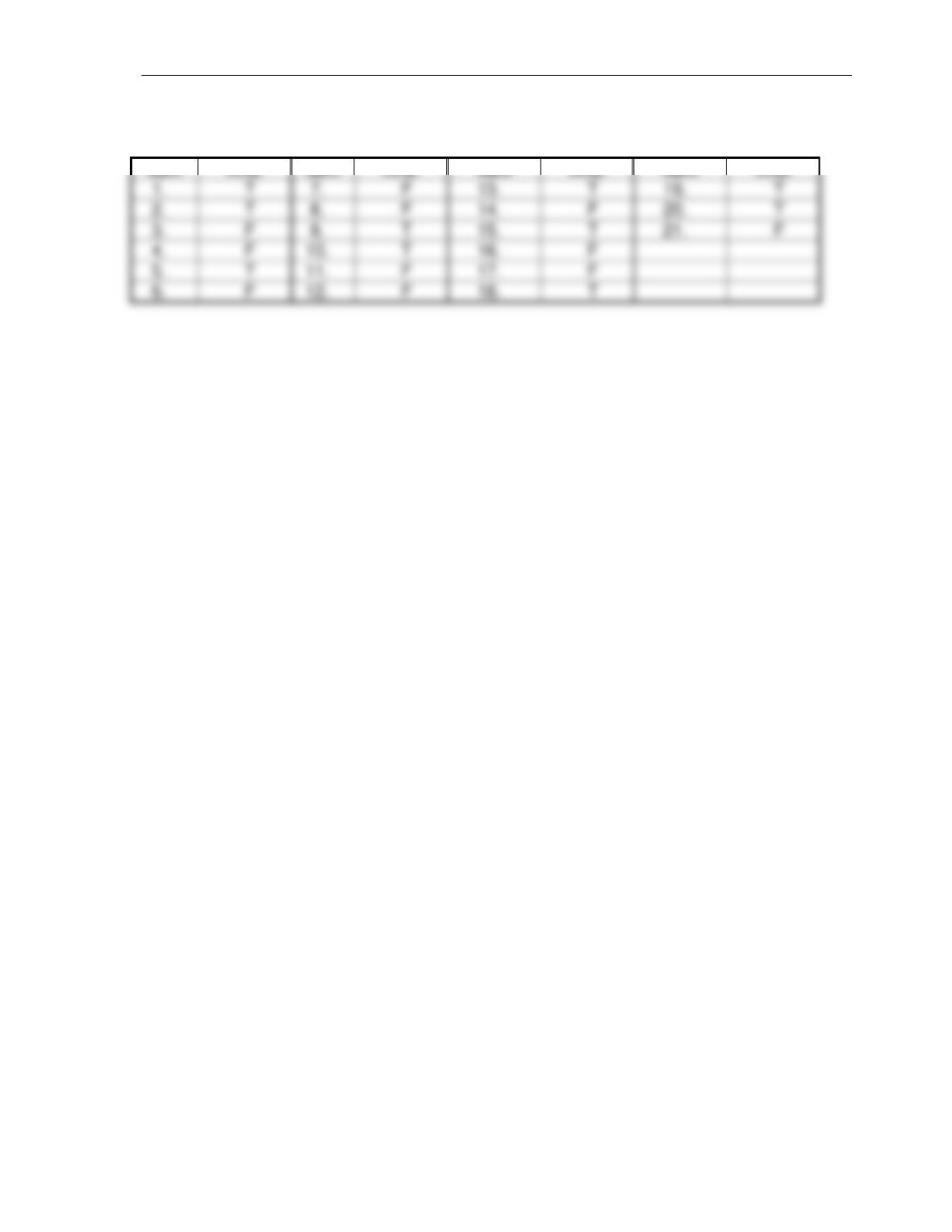
ANSWERS TO TRUE-FALSE STATEMENTS

2 – 8 Test Bank for Understanding Financial Accounting, Canadian Edition
MULTIPLE CHOICE QUESTIONS
22. All of the following are examples of enhancing qualitative characteristics EXCEPT
a) verifiability.
b) understandability.
c) neutrality.
d) timeliness.
23. Information that has been determined based on the best information available using
the correct process and with an adequate explanation provided is an example of which
fundamental characteristic?
a) neutral
b) free from bias
c) timeliness
d) verifiability
24. Which of the following enhancing characteristics is achieved if a third party, with
sufficient understanding, would arrive at a similar result to that used by the company?
a) comparability
b) understandability
c) timeliness
d) verifiability
25. Cost of goods sold should be matched up with the revenue generated on each year’s
Statement of Income because of the
a) revenue recognition criteria.
b) cash basis of accounting.
c) actual basis of accounting.
d) accrual basis of accounting.
26. A company received a $6,500 deposit from a customer for goods to be delivered the
following month. Under the accrual and cash basis of accounting respectively, the
deposit would be recorded as
Accrual basis Cash basis
a) a liability a liability
b) a liability income
c) income a liability
d) income income
Use the following information for questions 27–28.
During a recent week, Emmy’s Consulting received $25,000 cash from clients for
services performed with a total value of $75,000. The balance is to be received within 30
days.

Analyzing Transactions and Their Effects on Financial Statements 2 – 9
27. The effect of this transaction in the accounting records would be
a) + $75,000 revenue = + $25,000 cash + $50,000 accounts receivable.
b) + $50,000 net income = + $50,000 assets.
c) + $25,000 revenue = + $25,000 cash.
d) + $75,000 revenue = + $75,000 accounts receivable.
28. The effect on the Statement of Financial Position equation for this transaction would
be
a) + $25,000 cash = – $50,000 accounts payable + $75,000 retained earnings.
b) + $25,000 cash – $50,000 accounts receivable = $75,000 retained earnings.
c) + $25,000 cash + $50,000 accounts receivable = + $75,000 retained earnings.
d) + $25,000 cash = + $25,000 retained earnings.
29. On July 1, 2017 Albacore Company paid $5,200 for a 1-year insurance policy. To
record this transaction Albacore Company should
a) decrease cash and increase insurance expense.
b) decrease cash and increase prepaid insurance.
c) increase accounts payable and increase insurance expense.
d) increase cash and increase prepaid insurance.
30. How is cash invested by shareholders in exchange for shares initially recorded in the
accounting records?
a) as an increase in retained earnings, and an increase in cash
b) as an increase in long-term investments, and a decrease in cash
c) as an increase in common shares, and a decrease in cash
d) as an increase in common shares, and an increase in cash
31. The following costs are initially expressed as assets but are then reclassified as
expenses when they are used up, EXCEPT for the following:
a) inventory.
b) prepaid insurance.
c) prepaid rent.
d) short term investments.
32. A new company signed a lease for office space during their first month of business.
At that time they paid a total of $12,000 for first and last months’ rent. At the end of the
first month, the effect on the financial statements would be
a) $12,000 rent expense.
b) $6,000 rent expense and $6,000 prepaid rent on the Statement of Financial Position.
c) $12,000 prepaid rent on the Statement of Financial Position.
d) Nothing recorded because the company has not made any sales yet.
33. A company paid $22,000 for goods it had purchased last month for resale. What is

2 – 10 Test Bank for Understanding Financial Accounting, Canadian Edition
the effect of the payment?
a) a decrease in inventory
b) a decrease in accounts payable
c) an increase in cost of goods sold
d) an increase in inventory
34. A company sold available for resale inventory for cash. What is the effect of this
sale?
a) increase in revenue, increase in COGS, decrease in inventory
b) increase in revenue, decrease in COGS, increase in inventory
c) increase in revenue, increase in COGS, increase in inventory
d) increase in revenue, decrease in COGS, decrease in inventory
35. A piece of equipment was recently purchased for $10,600 on June 30. It is estimated
that it will last for 10 years and have a residual value of $400. The depreciation expense
to be recognized in the year of acquisition, assuming a December year-end, would be
a) $1,020.00.
b) $510.00.
c) $318.75.
d) $637.50.
36. If a vehicle was purchased for $6,500 and has a residual value of $500, the annual
depreciation expense will be $1,000 if the estimated useful life is
a) 6 years.
b) 6.5 years.
c) 7 years.
d) 13 years.
37. When $10,000 of inventory is purchased with a six-month note payable bearing 4%
interest, the inventory has a total cost of
a) $10,400.
b) $10,000.
c) $10,200.
d) $9,800.
38. The asset that results when a customer buys goods or services on credit is
a) Accounts receivable.
b) Accounts payable.
c) Notes receivable.
d) Cash.
39. The asset that results from the payment of expenses in advance is
a) Accounts receivable.
b) Short term investments.
c) Inventory.

Analyzing Transactions and Their Effects on Financial Statements 2 – 11
d) Prepaids.
40. On Oct. 1, 2017 Bonita, Inc. signed a 1-year $75,000 note payable from First
National Bank. The loan plus 6% interest is to be repaid on Sept. 30, 2018. Bonita’s
year-end is December 31. In its 2017 financial statements Bonita will record interest
expense of
a) $375.
b) $1,125.
c) $4,500.
d) $75,000.
41. If dividends are declared and paid in the same accounting period, what is the net
effect on the accounting equation?
a) a decrease in retained earnings and an increase in expenses
b) a decrease in cash and an increase expenses
c) a decrease in cash and an increase in retained earnings
d) a decrease in cash and a decrease in retained earnings
42. The purchase of land for a combination of cash and issuance of shares would
require which of the following?
a) increase in Land, increase in Common shares, increase in Cash
b) increase in Cash, decrease in Common shares, decrease in Land
c) increase in Land, increase in Common shares
d) increase in Land, increase in Common shares, decrease in Cash
43. The sale of merchandise to a customer partly for cash and partly on account would
require which of the following?
a) increase in Accounts receivable, increase in Cash, increase in Sales revenue
b) increase in Cash, decrease in Accounts payable, increase in Sales revenue
c) increase in Cash, increase in Sales revenue
d) decrease in Accounts payable, increase in Accounts receivable, increase in Sales
revenue
44. When the board of directors declares a $500 dividend, which of the following would
be included in recording the transaction?
a) increase in Retained Earnings, increase in Dividends Declared
b) decrease in Cash, decrease in Dividends Payable
c) increase in Dividends Declared, increase in Dividends Payable
d) decrease in Dividends Payable, increase in Cash
45. If the company had a loan outstanding, which of the following would be used to
record accrued interest at the end of the accounting period?
a) increase Interest Expense, decrease Cash
b) increase Interest Expense, increase Interest Payable
c) decrease Interest Payable, increase Interest Income

2 – 12 Test Bank for Understanding Financial Accounting, Canadian Edition
d) decrease Interest Payable, decrease Cash
46. Which of the following would be the effect of a transaction to expense prepaid rent
for the period?
a) increase Prepaid Rent, decrease Rent Expense
b) increase Rent Expense, decrease Cash
c) increase Prepaid Rent, decrease Cash
d) increase Rent Expense, decrease Prepaid Rent
47. How are goods purchased for sale at a later date recorded in the financial
statements?
a) as inventory
b) as prepaid expenses
c) as cost of goods sold
d) as operating expenses
48. Which of the following expenses has NO effect on the cash flow of a firm?
a) salaries expense
b) interest expense
c) depreciation expense
d) cost of goods sold
49. Which of the following assets is NEVER expensed on the Statement of Income?
a) land
b) building
c) inventory
d) equipment
50. Which of the following will NOT appear on the Statement of Income?
a) depreciation
b) interest
c) cost of goods sold
d) dividends
51. Which of the following would be the most useful in determining if a company has
sufficient resources to continue operations in the short-term?
a) the profit margin ratio
b) the return on assets ratio
c) the cash from operating activities
d) the cash from financing activities
52. Which of the following transactions would decrease the cash from operating
activities?
a) the payment of dividends

Analyzing Transactions and Their Effects on Financial Statements 2 – 13
b) the sale of goods on account
c) the purchase of goods on account
d) the payment of wages
53. The accounting basis that attempts to measure performance in the period in which it
occurred is the
a) approval basis.
b) cash basis.
c) matching basis.
d) accrual basis.
Use the following information for questions 54–56.
Revenues …………………. $ 50,000
Cost of goods sold ……… 35,000
Operating expenses …… 5,500
Beginning assets ……….. 350,000
Beginning liabilities …….. 245,000
Ending assets ……………. 450,000
Ending liabilities …………. 255,000
54. The profit margin is closest to
a) 2%.
b) 19%.
c) 30%.
d) 89%.
55. The return on assets is closest to
a) 2.1%.
b) 2.4%.
c) 3.75%.
d) 11.13%.
56. The return on equity is
a) 1.0%.
b) 6.3%.
c) 7.6%.
d) 9.0%.
2 – 14 Test Bank for Understanding Financial Accounting, Canadian Edition
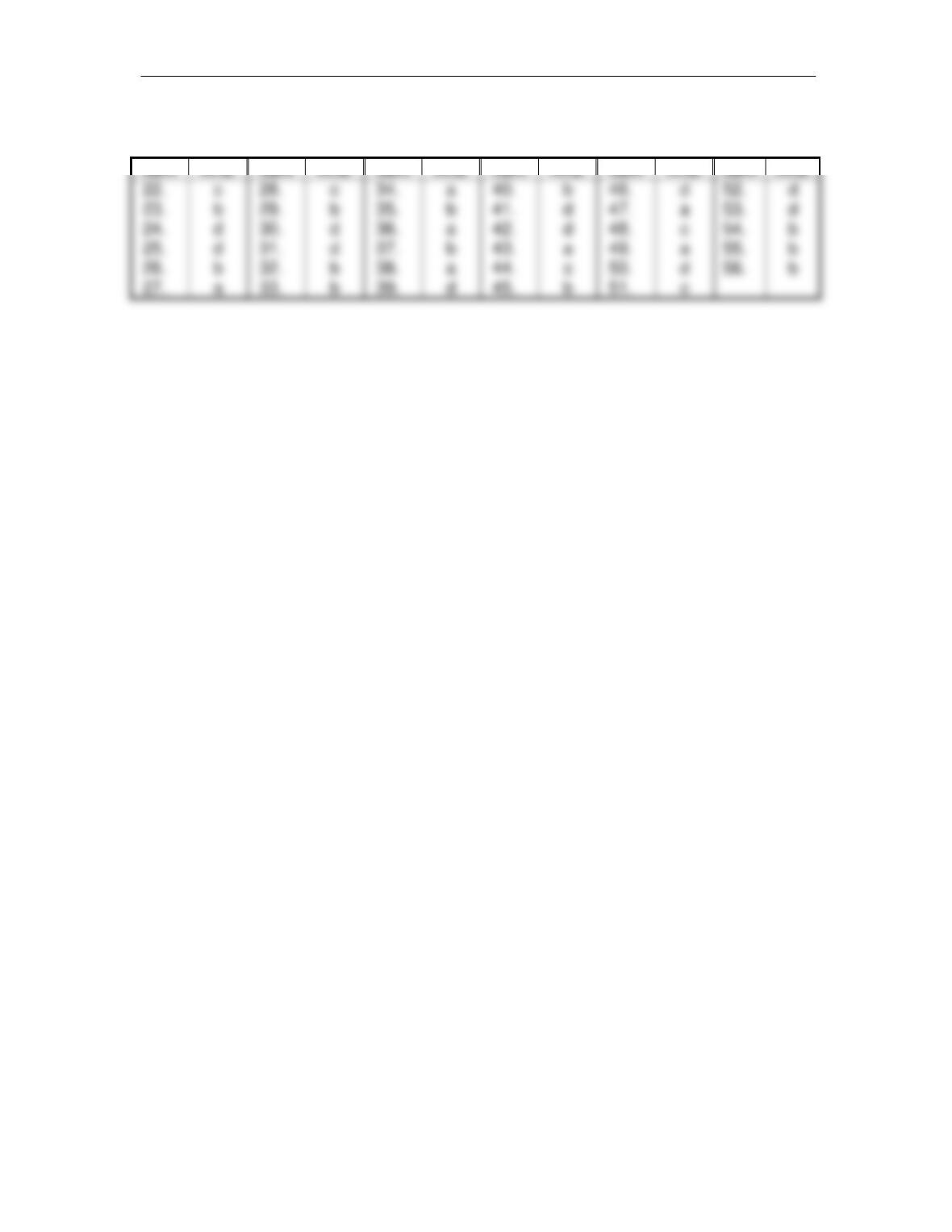
ANSWERS TO MULTIPLE CHOICE QUESTIONS
Analyzing Transactions and Their Effects on Financial Statements 2 – 15
EXERCISES
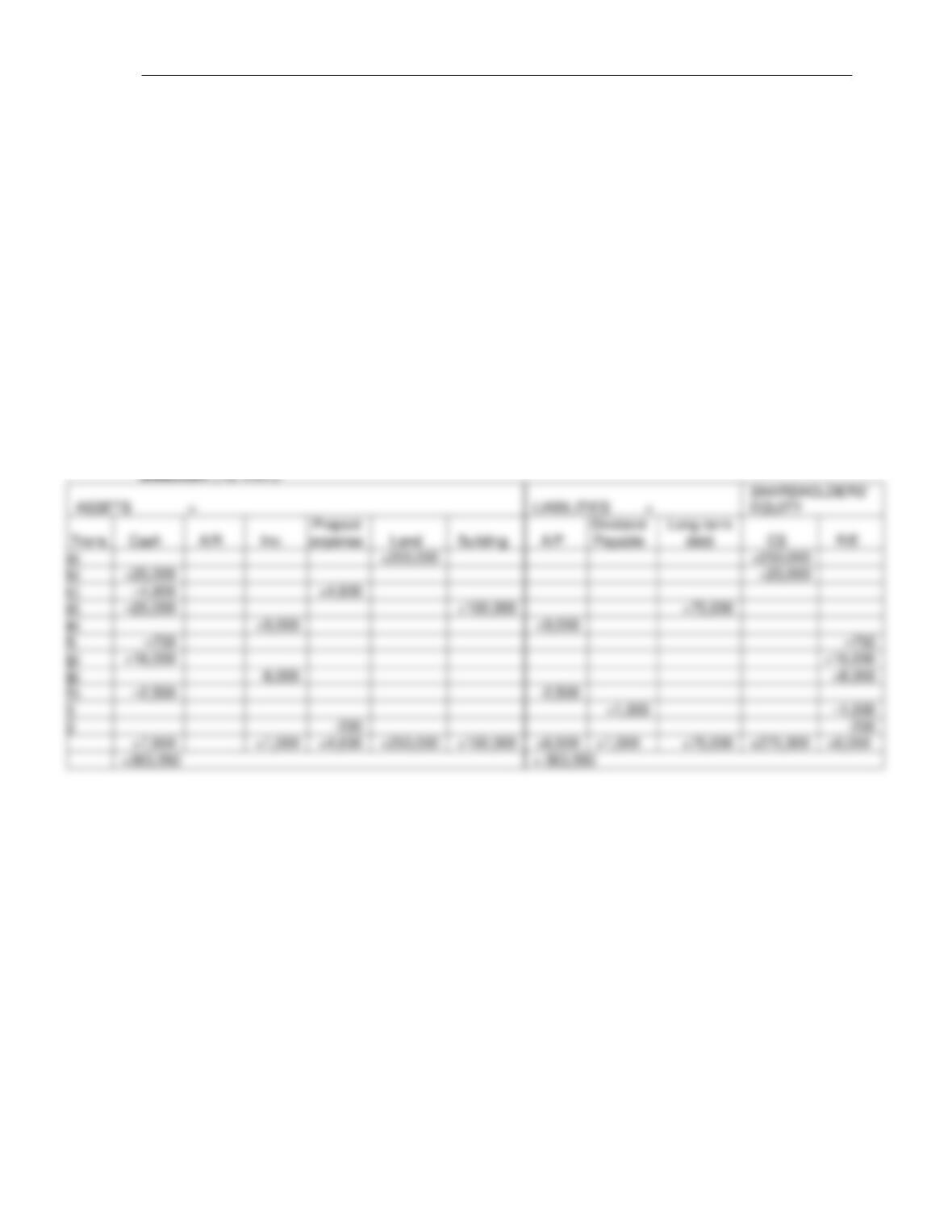
57. Analyze the effect of the following transactions using the basic accounting equation:
a) Bought land with an estimated fair value of $250,000 by issuing 100,000 shares.
b) Issued 10,000 common shares for $25,000 cash
c) Purchased a 2-year insurance policy for $4,800.
d) Bought a building for $100,000. Paid one-fourth in cash and the balance on a 10-
year, 10% interest note payable.
e) Purchased $9,000 of merchandise inventory on credit.
f) Paid utilities bill for $750.
g) Sold $8,000 of merchandise inventory for $16,000 cash.
h) Paid $2,500 on merchandise inventory previously purchased.
i) Declared a $1,000 dividend.
j) Recognized that 1 month of the insurance coverage had expired.
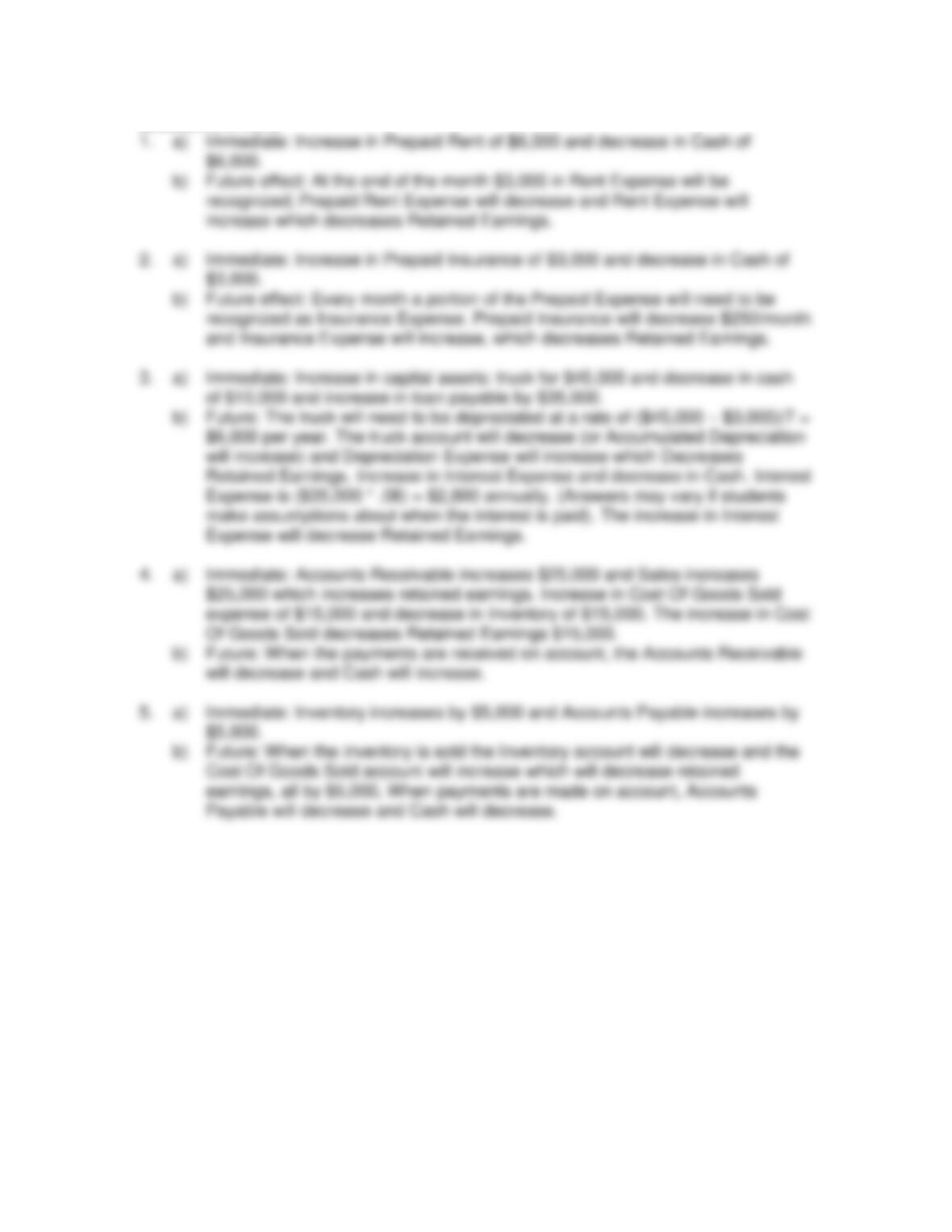
58. Consider the following independent transactions:
1. On January 1, paid, in advance, $6,000 for first and last month’s rent.
2. On Januray 1, paid, in advance, $3,000 for 12 months insurance.
3. Bought a truck to use for delivery purposes for $45,000 and paid for it with $10,000
cash and with a loan from the bank of $35,000 at 8%. The company expects to use
the truck for 7 years after which they estimate the residual value will be $3,000.
4. Sold goods worth $25,000 on credit, that had an inventory cost $15,000.
5. Bought $5,000 of inventory on account.
Instructions
For each transaction indicate:
a) which accounts are immediately affected and how they are affected,
b) which accounts will be affected in the future as a result of the transaction.
2 – 16 Test Bank for Understanding Financial Accounting, Canadian Edition
Solution (15 min.)
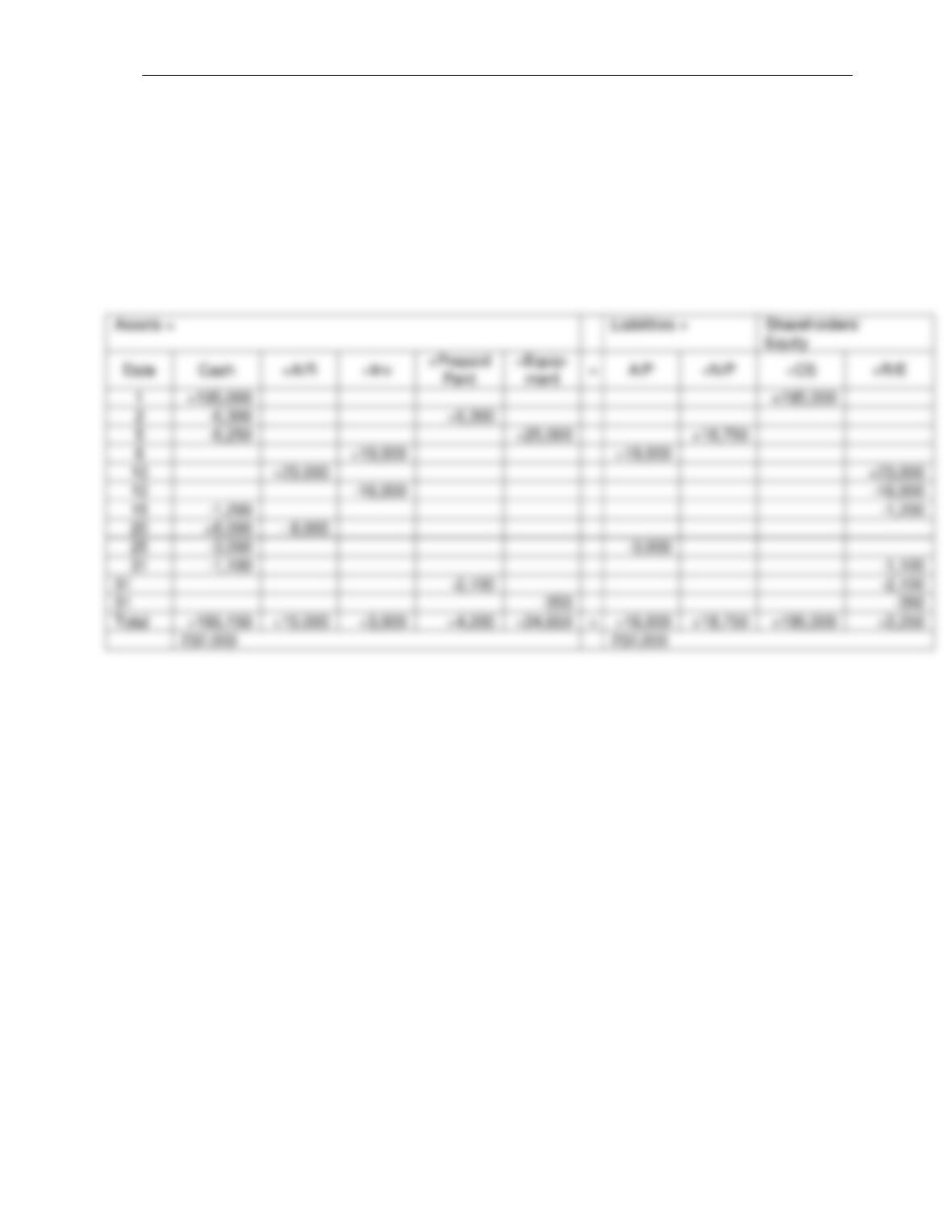
59. Swizzle, Inc. began operations in November of the current year with the following
transactions occurring during the month:
Sep 1 Sold 15,000 common shares for $13 per share.
2 Paid $6,300 for three months’ rent in advance.
5 Purchased $25,000 of equipment paying 25% down and agreeing to pay the
balance in two years.
6 Purchased inventory for $19,000 on credit.
10 Sold on account $16,000 of inventory for $23,000.
15 Paid wages of $1,200.
20 Collected $8,000 from customers on account.
25 Paid suppliers $3,000 on account.
Analyzing Transactions and Their Effects on Financial Statements 2 – 17
31 Paid wages of $1,100.
31 Recognized one month’s rent expense.
31 Recognized one month’s equipment depreciation expense. The estimated
salvage value is $4,000 and the estimated useful life is 5 years.
Instructions
Indicate the effects of these transactions on the balance sheet equation.
Solution (20 min.)
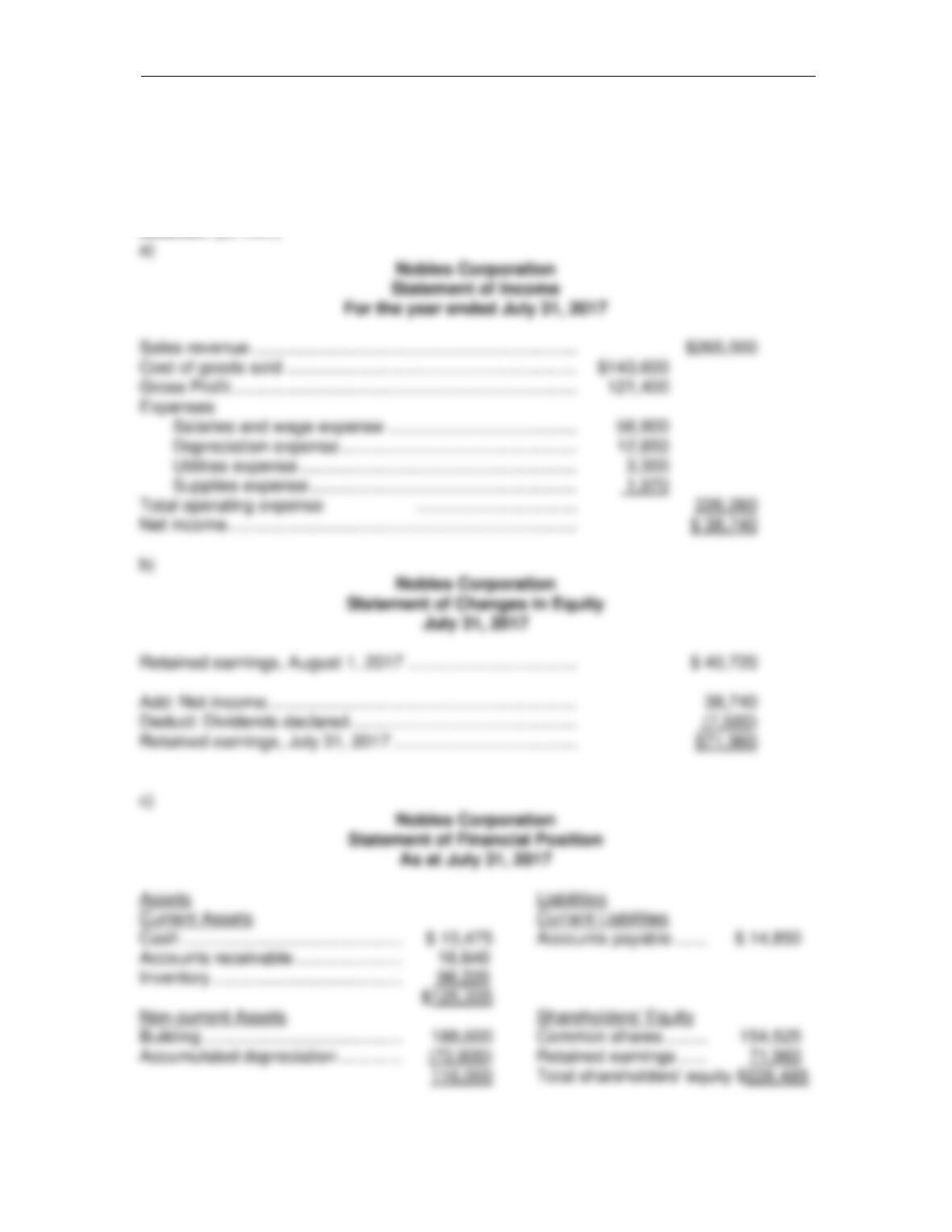
60. Shown below are the account balances for Nobles Corp. for their year-end July 31,
2017:
Cash ………………………………………… $ 10,475
Accounts receivable …………………… 16,640
Inventory ………………………………….. 98,220
Building ……………………………………. 188,600
Accumulated depreciation—building 72,600
Accounts payable ………………………. 14,850
Common shares ………………………… $154,525
Retained earnings, beginning ………. 40,720
Dividends declared …………………….. 7,500
Sales revenue …………………………... 265,000
Cost of goods sold ……………………… 143,600
Salaries and wages expense ……….. 64,540
Depreciation expense …………………. 12,850
Utilities expense ………………………… 3,300
Supplies expense ………………………. 1,970
Instructions
2 – 18 Test Bank for Understanding Financial Accounting, Canadian Edition
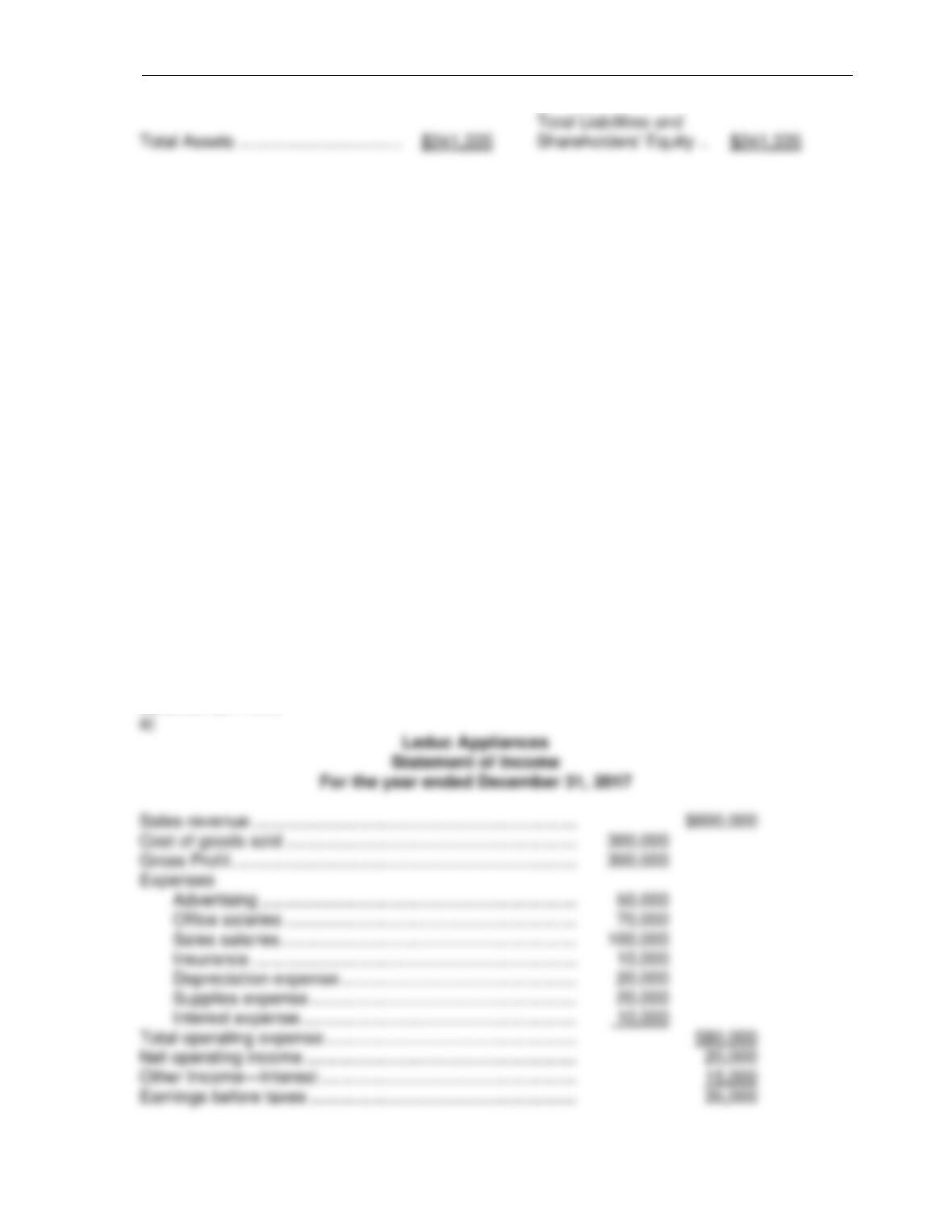
Given the above information, prepare the
a) Statement of Income,
b) Statement of Changes in Equity, and
c) classified Statement of Financial Position.
Solution (20 min.)
Analyzing Transactions and Their Effects on Financial Statements 2 – 19
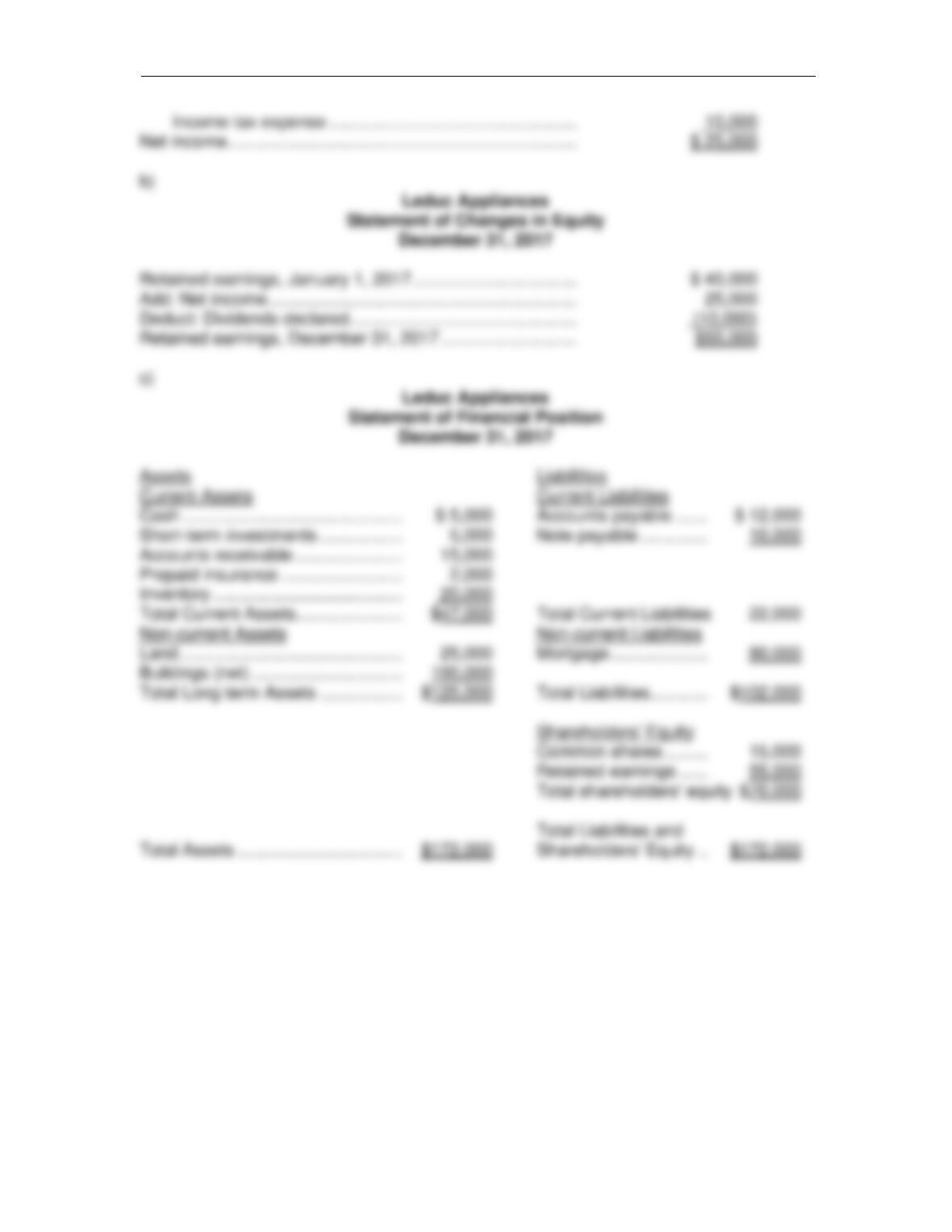
61. Leduc Appliances has the following balances in the company ledgers for the year
ending 2017:
Mortgage ………………………………… $80,000 Interest Expense …….. $10,000
Prepaid Insurance ……………………. $ 2,000 Land ……………………… $25,000
Short-term invest. …………………….. $ 5,000 Office salaries …………. $70,000
Common Shares ……………………… $15,000 Sales Salaries ………… $100,000
Cash ……………………………………… $ 5,000 Supplies ………………… $20,000
Advertising ……………………………… $50,000 Insurance ………………. $10,000
Accounts Receivable ………………… $15,000 Depreciation …………… $20,000
Sales ……………………………………… $600,000 Income tax ……………… $10,000
Accounts Payable ……………………. $12,000 Dividend Payments….. $10,000
Buildings (Net) …………………………. $100,000 Interest Income ……….. $15,000
Cost of Goods Sold ………………….. $300,000 Inventory ……………….. $20,000
Note Payable (due in 9 months) …. $10,000
Retained Earnings (Dec 31, 2016) $40,000
Using the above information prepare the following:
a) An Statement of Income
b) Statement of Changes in Equity
c) Classified Statement of Financial Position
Solution (20 min.)
2 – 20 Test Bank for Understanding Financial Accounting, Canadian Edition
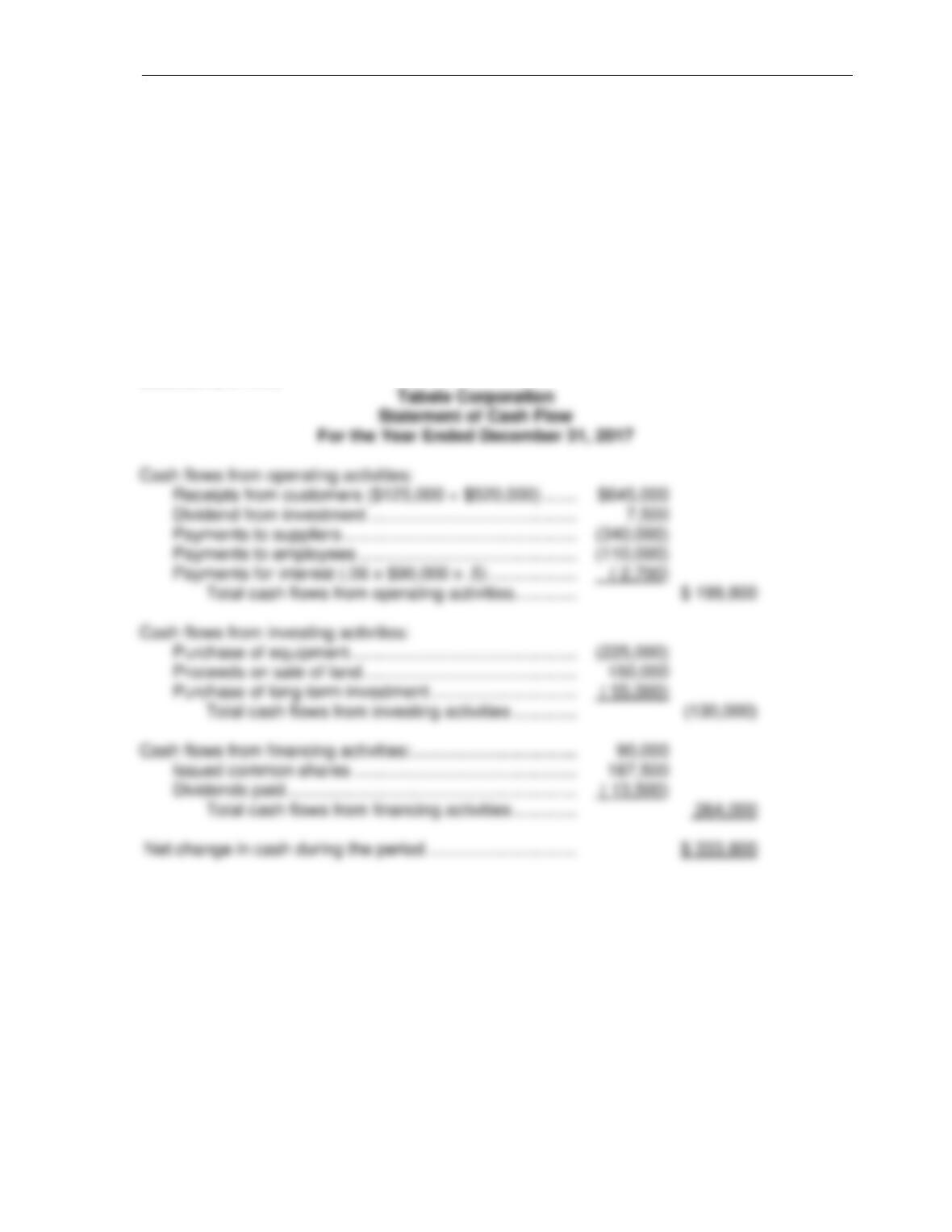
62. Tabele Corporation had the following transactions during the fiscal year ended
August 2017:
a) Purchased inventory costing $325,000 on account.
b) Sold inventory to customers for $725,000; of these sales, $125,000 were cash
sales.
c) Borrowed $90,000 from the bank on March 1 at 6% interest payable annually at
year-end.
d) Paid employees $110,000 in cash.
e) Purchased equipment costing $225,000 in cash.
f) Collected $520,000 from customers on account.
Analyzing Transactions and Their Effects on Financial Statements 2 – 21
g) Purchased $55,000 of another company’s shares as a long term investment.
h) Issued 50,000 common shares for $3.75 per share.
i) Paid suppliers $340,000.
j) Collected a $7,500 cash dividend on the share investment.
k) Declared and paid a $13,500 dividend during the year.
l) Sold a piece of land for proceeds of $150,000
m) Paid the interest due on the loan from the bank in part c.
Instructions
Prepare a statement of cash flow for 2017.
Solution (20 min.) Tabele Corporation
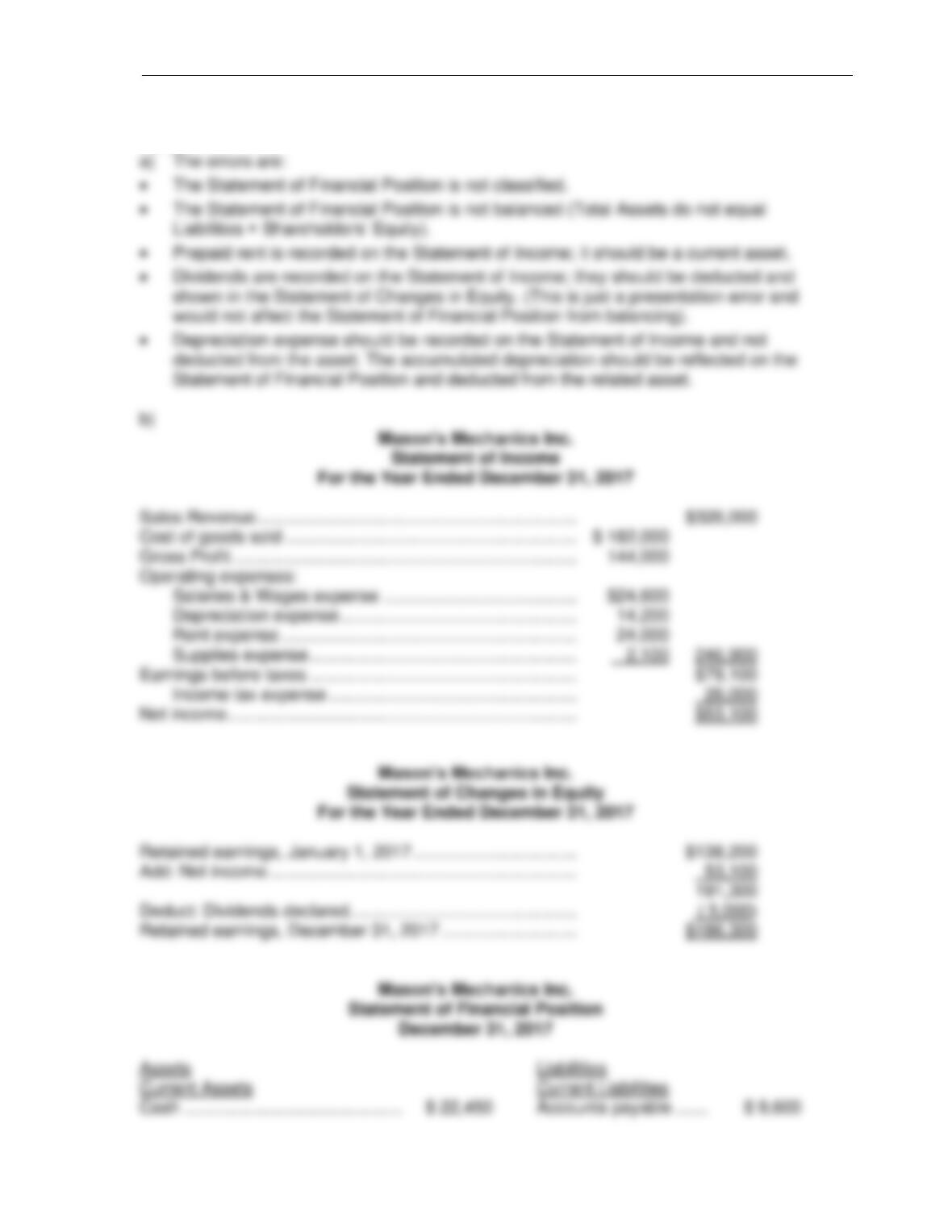
63. Due to the sudden resignation of the accountant at Mason’s Mechanics Inc., the
sales manager had prepared the annual financial statements, shown below:

2 – 22 Test Bank for Understanding Financial Accounting, Canadian Edition
Mason’s Mechanics Inc.
Statement of Income
December 31, 2017
Sales Revenue ………………………………………………………… $326,000
Cost of goods sold …………………………………………………… $ 182,000
Gross Profit …………………………………………………………….. 144,000
Operating expenses:
Salaries & Wages expense …………………………………. $24,600
Rent expense 24,000
Prepaid rent ………………………………………………………. 3,600
Dividends 5,000
Accumulated Depreciation …………………………………… 28,400
Supplies expense ………………………………………………. 2,100 269,700
Earnings before taxes ………………………………………………. $56,300
Income tax expense …………………………………………………. 26,000
Net income …………………………..…………………………………. $30,300
Mason’s Mechanics Inc.
Statement of Changes in Equity
For the Year Ended December 31, 2017
Retained earnings, January 1, 2017 ……………………………. $138,200
Add: Net income ………………………………………………………. 30,300
Retained earnings, December 31, 2017 ………………………. $168,500
Mason’s Mechanics Inc.
Statement of Financial Position
For Year Ended December 31, 2017
Assets Liabilities
Current Assets Current Liabilities
Cash ……………………………………… $ 22,450 Accounts payable ……. $ 9,600
Accounts receivable …………………. 11,250 Non-current Liabilities
Long-term debt ……….. 32,000
Inventory ………………………………… 92,000 Total Liabilities ………… 41,600
……………………………………….. 125,700 Shareholders’ Equity
Non-current Assets
Building ………………………………….. 172,000 Common shares ……… $45,000
Retained earnings …… 168,500
Less depreciation expense ….. (14,200)
……………………………………….. 157,800 Total shareholders’ equity 213,500
Total liabilities and
Total assets ………………………. $283,500 Shareholders’ Equity .. $255,100
Instructions
a) Identify the errors in the financial statements.
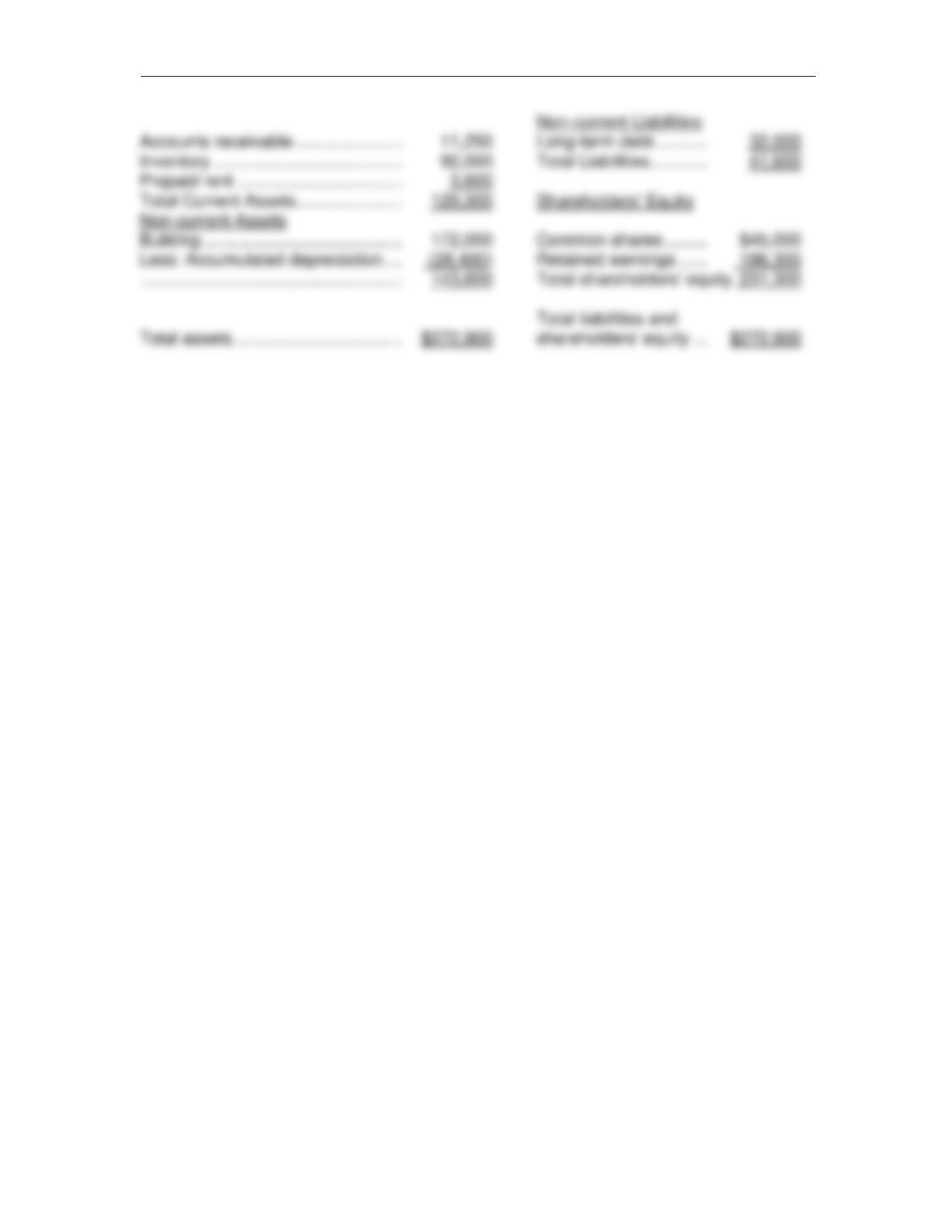
b) Prepare corrected financial statements for Mason’s Mechanics Inc.
Analyzing Transactions and Their Effects on Financial Statements 2 – 23
Solution (25 min.)
2 – 24 Test Bank for Understanding Financial Accounting, Canadian Edition

Analyzing Transactions and Their Effects on Financial Statements 2 – 25
MATCHING
64. For each of the following transactions, indicate if total assets would I increase, D
decrease, or NE for no effect.
____ a) Sale of common shares for cash
____ b) Purchase of inventory for cash
____ c) Collection of accounts receivable
____ d) Payment of dividends
____ e) Sale of merchandise to customers on account
____ f) Recording of depreciation expense
____ g) Payment of accounts payable
____ h) Recording the cost of goods sold
____ i) Receipt of cash and signed long-term note payable
____ j) Purchase of machinery for cash
Solution (7 min.)
65. For each of the following transactions, indicate the effect on shareholders’ equity.
Use I to indicate an increase, D to indicate a decrease, or NE for no effect.

2 – 26 Test Bank for Understanding Financial Accounting, Canadian Edition
____ a) Sale of goods for cash
____ b) Payment of operating expenses
____ c) Sale of goods on credit
____ d) Payment of dividends previously declared
____ e) Payment of accounts payable
____ f) Payment of income taxes.
____ g) Prepayment of expenses.
____ h) Recognizing depreciation expense.
Solution (5 min.)
Analyzing Transactions and Their Effects on Financial Statements 2 – 27
SHORT-ANSWER ESSAY QUESTIONS
66. Identify which statements dividends declared and paid affect and explain why.
Solution (5 min.)
67. Behnke Pharmaceuticals accounting system provided the following data for the last
two years:
2017 2016
Revenues …………………… $ 40,000 $ 25,000
Cost of goods sold ………. 22,500 6,000
Operating expenses …….. 10,000 5,000
Interest expense ………….. 1,500 750
Income tax …………………. 2,500 1,500
Total assets ………………… 150,000 120,000
Total liabilities……………… 80,000 60,000
Total equity ………………… 70,000 60,000
Instructions
Calculate the profit margin, return on assets, and return on equity for 2017. Explain what
each ratio measures in general, and what each specifically indicates for Behnke
Pharmaceuticals.
Solution (15 min.)

2 – 28 Test Bank for Understanding Financial Accounting, Canadian Edition
Analyzing Transactions and Their Effects on Financial Statements 2 – 29
ESSAY QUESTIONS
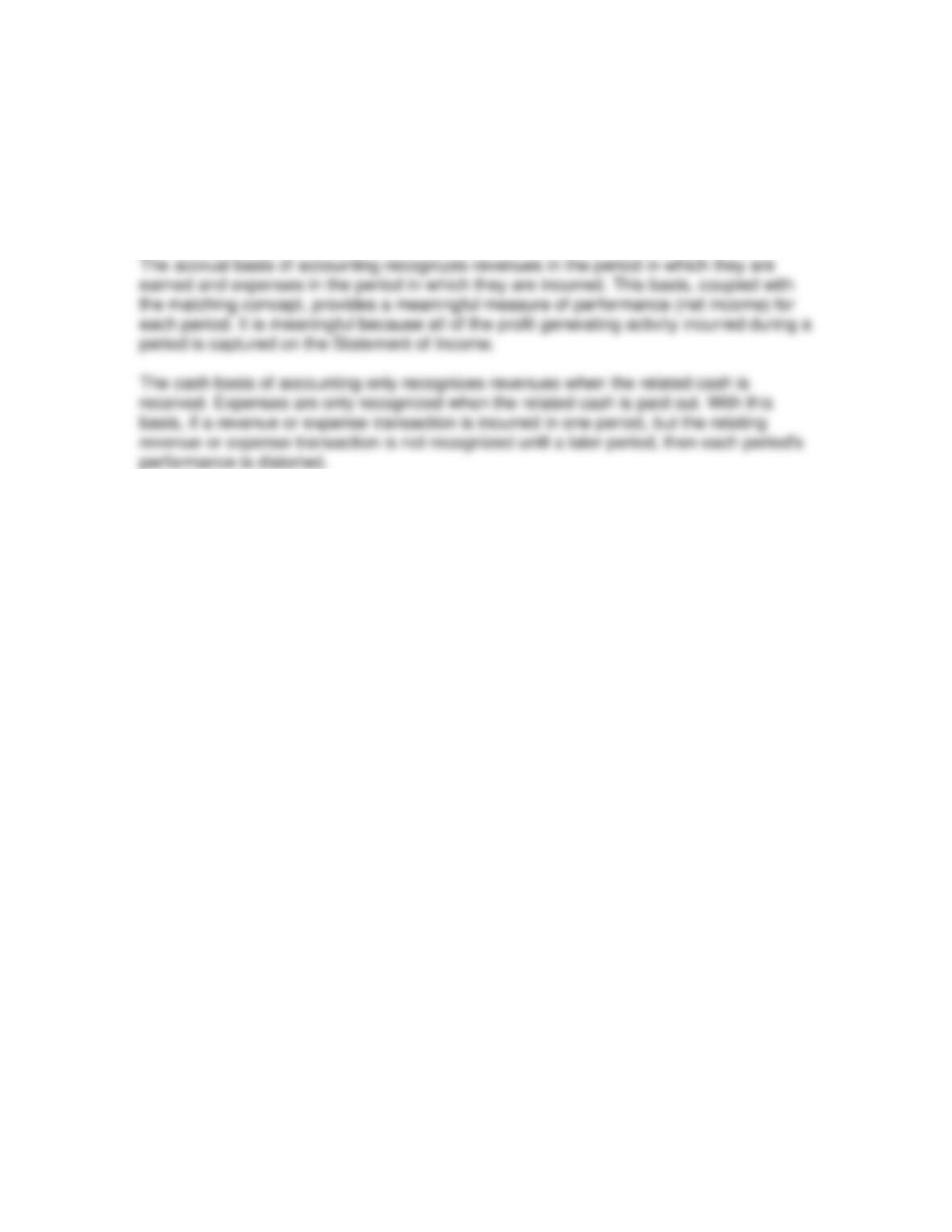
68. Explain both the accrual basis and the cash basis of accounting and indicate why
most companies use the accrual basis.
Solution (8 min.)
2 – 30 Test Bank for Understanding Financial Accounting, Canadian Edition
LEGAL NOTICE