1
Environment: Science Behind the Stories, 2e Cdn. Ed. (Withgott)
Chapter 2 Matter, Energy, and the Physical Environment
2.1 Graph and Figure Interpretation Questions
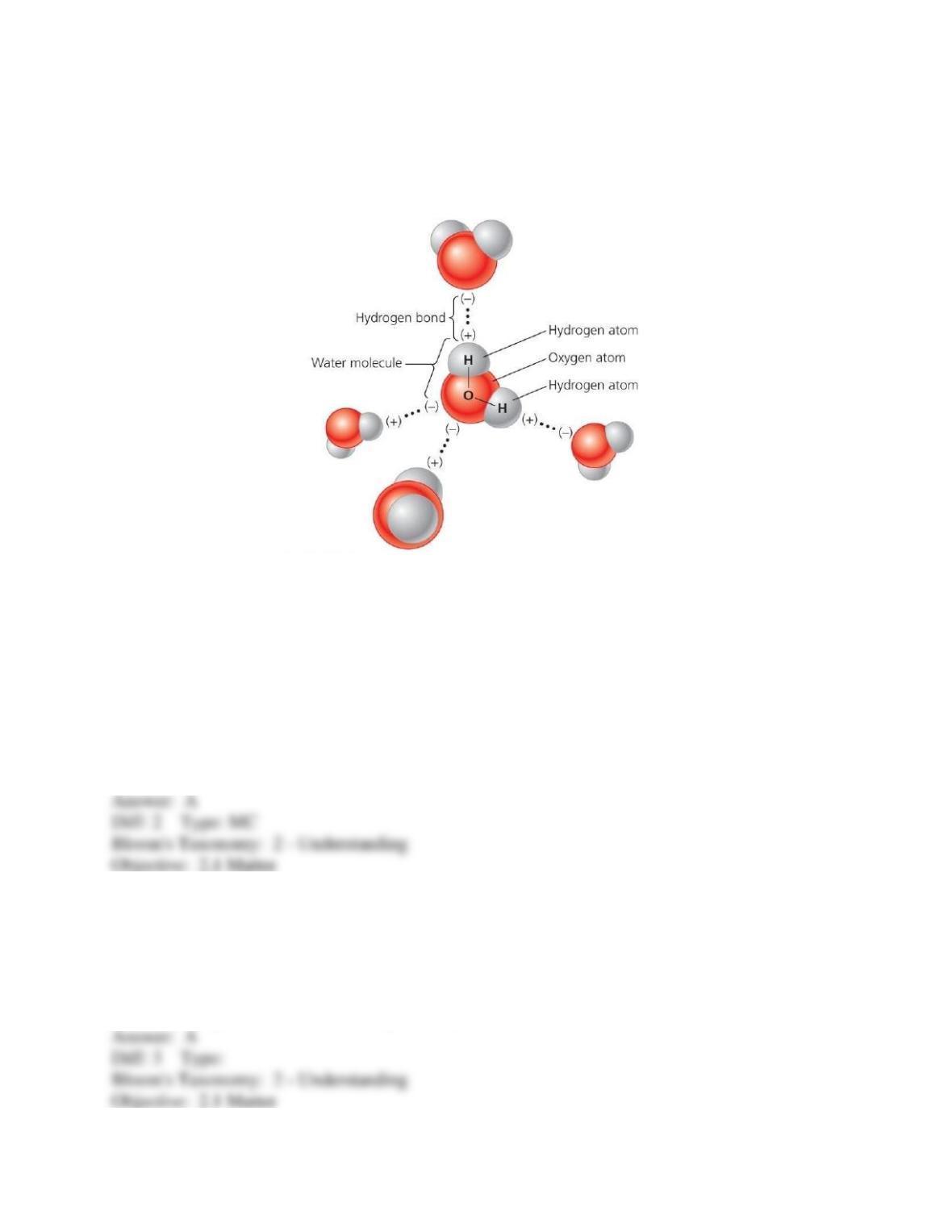
Figure 2.1
Use Figure 2.1 to answer the following questions.
1) Refer to Figure 2.1. Within the water molecule, ________ bonds connect two hydrogens to
every oxygen.
A) polar covalent
B) nonpolar covalent
C) hydrogen
D) ionic
E) dioric
2) Refer to Figure 2.1. Why is one end of each water molecule negative and one end positive?
A) Oxygen has a greater pull on the electrons than hydrogen.
B) Oxygen has a greater pull on the protons than hydrogen.
C) The two hydrogens have a greater pull on the electrons than oxygen.
D) The two hydrogens have a greater pull on the protons than oxygen.
E) The hydrogen bonds create a charge difference.
3) Refer to Figure 2.1. What property of water is due to hydrogen bonds?

A) high pH
B) low pH
C) ability to change temperature quickly
D) ability to dissolve lipids
E) ability to form droplets
4) Refer to Figure 2.1. ________ bonds connect adjacent water molecules (hydrogen from one
molecule with oxygen of another molecule).
A) Polar covalent
B) Nonpolar covalent
C) Hydrogen
D) Ionic
E) Dioric

2.2 Matching Questions
Match the following.
A) electrons
B) isotopes
C) metamorphic
D) ions
E) compounds
F) ionic bond
G) protons
H) molecules
I) atoms
J) hydrogen bond
K) sedimentary
L) covalent bond
M) neutrons
1) The smallest components of matter that still maintain the chemical properties of the element
2) Negatively charged subatomic particles
3) Atoms with the same atomic number, but with different atomic masses
4) Atoms or molecules with a charge
5) Charged subatomic particles located in the nucleus
6) Combinations of atoms held together with bonds

4
7) Combinations of atoms of different elements held together with bonds
8) Bond between atoms sharing electrons equally
9) Bond between two atoms of hydrogen that form a molecule of hydrogen gas (H2)
10) Rocks that form as soils, minerals, and weathered rock particles are deposited, weighted
down, and compressed over time
Diff: 1 Type: MA
Bloom’s Taxonomy: 1 – Remembering
Objective: 2.5 Geological systems
2.3 Short Answer Questions
1) Briefly explain the concept of plate tectonics and why it is important for the study of
geography.
2) Earth’s surface consists of a lightweight thin ________ of rock floating atop a malleable
________.
3) The convergent plate boundaries are created by the processes of ________ or ________.
4) Name Earth’s three major natural power sources.

5
5) Why does ice float?
6) List four categories of geological hazards.
7) What is the first law of thermodynamics, and why is it important?
8) ________ is that which can change the position, physical composition, or temperature of
matter.
9) Write the balanced chemical equation for photosynthesis.
10) Write the balanced chemical equation for aerobic cellular respiration.

11) The degree of disorder in a substance, system, or process is called ________.
12) Chemoautotrophs in the deep ocean use the energy contained in ________ as their energy
source.
2.4 Multiple-Choice Questions
1) 12C and 13C differ in ________.
A) atomic mass
B) ionic number
C) atomic number
D) number of protons
E) number of electrons
2) ________ are composed of amino acids.
A) Proteins
B) Nucleic acids
C) Carbohydrates
D) Lipids
E) Bases

3) ________ are the primary water–insoluble components of cell membranes.
A) Proteins
B) Nucleic acids
C) Carbohydrates
D) Acids
E) Lipids
4) Finger nails, hair, and enzymes are classified as ________.
A) proteins
B) nucleic acids
C) carbohydrates
D) lipids
E) organelles
5) A denser oceanic plate subducts underneath another less dense oceanic plate. This ________.
A) creates strike-slip plate boundaries
B) creates ocean trenches
C) is caused by volcanoes
D) occurs when plates pull apart
E) results in an uplift
6) A sedimentary rock has been subject to extensive compression and increased temperature. The
rock is now best described as ________.
A) heat-resistant
B) igneous
C) decompressive
D) metamorphic
E) deformative

7) Which of the following represents the reaction that provides energy to a human cell?
A) water + carbon dioxide + energy → glucose + oxygen + water
B) glucose + oxygen → water + carbon dioxide + energy
C) water + carbon dioxide → glucose + oxygen + water + energy
D) nitrogen + carbon dioxide + energy → methane + oxygen
E) nitrogen + oxygen + glucose → methane + carbon dioxide
8) Which of the following represents the autotrophic processes occurring in the deep ocean
vents?
A) water + carbon dioxide + energy → glucose + oxygen + water
B) glucose + oxygen → water + carbon dioxide + energy
C) nitrogen + carbon dioxide + energy → methane + oxygen
D) glucose + water → methane + carbon dioxide
E) carbon dioxide + water + hydrogen sulphide → sugar + sulphuric acid
9) The force causing water molecules to adhere to one another in interactions called ________.
A) Van der Waals attractions
B) polar covalent bonds
C) nonpolar covalent bonds
D) acid–base attractions
E) hydrogen bonds
10) Which of the following describes a property of water necessary for life?
A) changes temperature rapidly
B) is noncohesive
C) is more dense as a solid
D) has high pH
E) dissolves many chemicals

11) Precipitation ________.
A) that is acidic has a low concentration of hydrogen ions
B) that is acidic would have a pH higher than 7
C) that is acidic would have a pH lower than pure water
D) that measures pH = 4 is twice as acidic as precipitation that measures pH = 5
E) has become increasingly more basic in the last 100 years, because of industrial air pollution
12) Phytoremediaton ________.
A) remediates phytoplankton
B) uses polycyclic aromatic hydrocarbons found in lemon scented-geranium
C) increases light penetration in water
D) uses plants to detoxify soils
E) increases food supply by making crop photosynthesis more effective
13) Which of the following is not a macromolecule?
A) DNA
B) cellulose
C) glucose
D) starch
E) chitin
14) Which of the following describes lipids?
A) dissolve in water
B) include components of the body’s immune system
C) include DNA
D) are absent from most animal cells
E) store energy and are in cell membranes

15) River water held behind a dam is best described as a form of ________.
A) kinetic energy
B) potential energy
C) chemical energy
D) entropy
E) thermodynamics
16) The sun rises in the morning and shines on your garden. Inside the cells of the vegetables
growing in your garden ________.
A) there is not net consumption or production of water
B) entropy increases
C) entropy stays the same
D) oxygen is consumed
E) water and carbon dioxide are consumed
17) Which of the following is NOT associated with convergent plate boundaries?
A) Hawaiian volcanic islands
B) trenches
C) coastal mountain ranges parallel to the coastline
D) “ring of fire”
E) Japanese volcanic islands
18) Early Earth (4.5 billion years ago) ________.
A) had more abundant and complex life forms compared to today’s Earth
B) was stagnant and lifeless
C) was virtually void of oxygen
D) had a very similar atmosphere to today’s Earth but lacked water
E) had very high levels of oxygen

19) The ________ hypothesis, proposed in the 1930s, says that carbon dioxide, oxygen, and
nitrogen dissolved in Earth’s water formed simple amino acids and eventually complex organic
compounds that self-replicated.
A) heterotrophic
B) extraterrestrial
C) ultraterrestrial
D) homotrophic
E) chemoautotrophic
20) Stanley Miller and Harold Urey did experiments in the early 1950s to prove the ________
hypothesis that life evolved from a “primordial soup” of simple inorganic chemicals.
A) heterotrophic
B) extraterrestrial
C) ultraterrestrial
D) homotrophic
E) chemoautotrophic
21) The ________ hypothesis, proposed by Svante Arrhenius in the early 1900s, suggests that
meteorites delivered life and organic material to Earth.
A) heterotrophic
B) extraterrestrial
C) ultraterrestrial
D) homotrophic
E) chemoautotrophic

22) The ________ hypothesis, proposed in the 1970s and 1980s by Jack Corliss and others,
suggests that life on Earth originated in the deep sea where sulphur was abundant.
A) heterotrophic
B) extraterrestrial
C) ultraterrestrial
D) homotrophic
E) chemoautotrophic
23) During the night, a plant cell burns sugar to obtain energy. This process ________.
A) releases carbon dioxide and water
B) releases oxygen and water
C) represents a decrease in entropy
D) requires the green pigment chlorophyll
E) involves a net consumption of water
24) Coal, oil, and natural gas are ________.
A) renewable
B) fossil fuels
C) part of a sustainable energy future
D) inorganic
E) synthetic
25) Consider the following processes: respiration, chemosynthesis, combustion, and
photosynthesis. How many of these result in the release of oxygen into the atmosphere?
A) none
B) 1
C) 2
D) 3
E) 4

26) When you burn a log in your fireplace you are converting ________.
A) chemical to thermal (heat) energy
B) thermal to electromagnetic energy
C) electromagnetic to chemical energy
D) chemical to nuclear energy
E) proteins to amino acids
27) Which of the following is NOT associated with divergent plate boundaries?
A) Hawaiian volcanic islands
B) rising magma
C) mid-ocean ridges
D) new crust
E) Iceland
28) Which is NOT true about basalt?
A) It is an intrusive rock.
B) It is the principal rock of the Hawaiian volcanic islands.
C) It has small crystals.
D) It cooled rapidly during its formation.
E) It is the main rock of oceanic crust.
29) Which is NOT true about granite?
A) It is extrusive rock.
B) It is plutonic rock.
C) It has a coarse-grained appearance.
D) It cooled slowly during its formation.
E) It solidified below Earth’s surface.

30) 14C has 6 protons and ________.
A) 8 neutrons
B) 8 electrons
C) 6 neutrons
D) 14 neutrons
E) 14 electrons
31) List four samples of freshwater of different temperatures in order of increasing density (with
the least dense first and the densest last). All temperatures are in °C:
A) -5 , 20 , 4 , 1
B) 20, 4, 1, -5
C) 20, 1, 4, -5
D) -5, 1, 4, 20
E) -5, 20, 1, 4
2.5 True/False Questions
1) The heterotrophic hypothesis for the origin of life on Earth argues that the first life forms to
evolve were heterotrophs living in deep-ocean vents.
2) The chemoautotrophic hypothesis is also known as the panspermia hypothesis.
3) All landmasses were once joined together in a supercontinent called Pangaea.

15
4) Japan is a product of a continental collision.
5) Bacteria in deep-sea vents use the chemical bond energy in water molecules to transform
inorganic compounds into organic compounds in a process called chemosynthesis.
6) The Murchison meteorite, which fell in Australia in 1969, was found to contain bacteria.
7) Mariana Trench, Earth’s deepest abyss, was created at a transform plate boundary.
2.6 Essay Questions
1) Describe the rock cycle, explaining how the three major types of rock form and break down.
2) List the four types of macromolecules essential to life. Describe the structures of each, and
describe their major role(s) in organisms.
3) Describe the first and second laws of thermodynamics. Illustrate both laws by using an
example of a burning log of firewood.
4) Explain why chemistry is important in examining environmental issues and solving
environmental problems. Illustrate with examples of such issues/problems.
5) Summarize the heterotrophic hypothesis, the extraterrestrial hypothesis, and the
chemoautotrophic hypothesis for the development of life on Earth.
6) Compare the processes of photosynthesis and cellular respiration. Include a brief explanation
of autotrophs and heterotrophs in your answer.

7) Explain how isotopes are used in environmental science and provide an example from your
text.
8) Describe several properties of water that explain why the lakes in Canada typically do not
freeze all the way to the bottom even during extremely long and cold winters.

2.7 Scenario-Based Questions
Read the following scenario and answer the questions below.
Almost all environmental scientists agree that gases contribute to global climate change. Carbon
dioxide, methane, nitrous oxide, ozone, halocarbons (CFCs and HFCs), and water vapour are the
main culprits. These “greenhouse gases” have increased dramatically in our atmosphere in the
last 300 years, because of rapid industrialization. Human activities significantly increase
greenhouse gases in our atmosphere. Chief among these is the burning of fossil fuels for energy.
When we burn fossil fuels, we combine the carbon in fossil remnants of an organic matter with
oxygen and release the resulting gasses into the atmosphere. With rising standards of living in
developing countries, emissions of carbon dioxide and other greenhouse gases are expected to
continue to rise. If unchecked, it is predicted that carbon dioxide levels will reach twice
preindustrial levels by mid-century and double again by the end of the century. Computer models
have shown that this increase alone could raise Earth’s temperatures by 1 to 3°C by 2100.
1) The burning of fossil fuels is chemically most similar to which of the following biological
processes?
A) phytoremediation
B) autotrophy
C) chemosynthesis
D) cellular respiration
E) photosynthesis
2) Nitrous oxide from burning fossil fuels, in addition to being a greenhouse gas, contributes to
acid precipitation. This can be explained by ________.
A) its ability to form compounds that raise pH
B) its ability to form compounds that lower pH
C) the ability of acids to raise the temperature of the substances which dissolve them
D) the airborne nature of all compounds containing nitrogen
E) the hydrogen bonds connecting the nitrogen and oxygen atoms in the molecule

3) Overpopulation contributes to global warming when ________.
A) most of the population is vegetarian
B) there is also greater consumption of natural resources
C) we compromise our living standards
D) most people use public transportation
E) solar energy is used as the primary source of energy
4) The primary source of increased levels of greenhouse gases on Earth is ________.
A) increased photosynthetic activity
B) loss of heterotrophs
C) modern human lifestyles
D) aerosol spray cans
E) asteroids falling to Earth
5) Why does burning fossil fuels increase global warming?
A) Fossils, if left untouched, cool Earth.
B) New energy is created on Earth when fossil fuels are burned.
C) Burning fossil fuels destroys the ozone layer.
D) Carbon present in coal, oil, and natural gas becomes carbon dioxide when these fuels burn.
E) Burning fossil fuels removes water vapour from the atmosphere.