1
Answer all 5 questions. Make sure your answers are clearly delineated. Show all your
work, and state any assumptions you are making. If you insist on e-mailing the answers,
make sure your name is on the exam. Also, make sure your answers are formatted so that
they are legible and readable. Points will be deducted otherwise.
1) 10 Points Total. The city of Pine Grove operates a public hospital – Hospital For All
(HFA). HFA gets its funding from multiple sources. Because it is the only hospital in the
region, the State gives HFA an annual grant of $1.75 million. In addition, the State gives
HFA $25 per patient it treats. In addition to the State, the 4 adjacent cities to Pine Grove
provide grants to HFA of $600,000 each. Finally, various local foundations provide $1.5
million in total annual donations on average.
In addition to the money from governments and foundations, HFA earns revenue by
treating patients. There are several types of payers for patients (that is, many patients
have insurance that pays for services, but each insurance pays a different amount; some
patients do not have insurance and are responsible for paying for their own services). The
hospital’s expected volume is 50,000 patients. The patient mix for HFA is show below:
Payer % of Total Patients Average Payment to HFA
Medicare 20% $250
Medicaid 25% $175
Private 40% $400
Self Pay (No Insurance) 15% $50
HFA has 15 nurses on staff, at an average salary of $50,000 each. In addition, they
contract with doctors to provide medical services, and HFA expects to pay out $5 million
next year for such services. HFA has additional medical staff such as Technicians and
Physician Assistants, for which it pays $200,000 total. Finally, HFA has administrative
and managerial staff to whom it expects to pay $4 million in salaries next year. In
addition to these salaries, HFA provide its staff with fringe benefits (health insurance,
retirement benefits, etc.) that cost 35% of salary (note: because doctors are not staff, they
do not receive fringe benefits from the hospital; they are considered contractors).
In addition to these expenses, HFA issued a bond several years ago to purchase property
and build buildings. The bonds have a face value of $40 million and an annual coupon
rate of 5%. The buildings cost $30 million, have a useful life of 30 years, and no salvage
value.
Each patient seen by HFA requires the hospital to spend some money on his or her care.
Patients may need medical supplies, pharmaceuticals, food, etc. The hospital estimates
that each patient uses $100 of these resources on average.
2
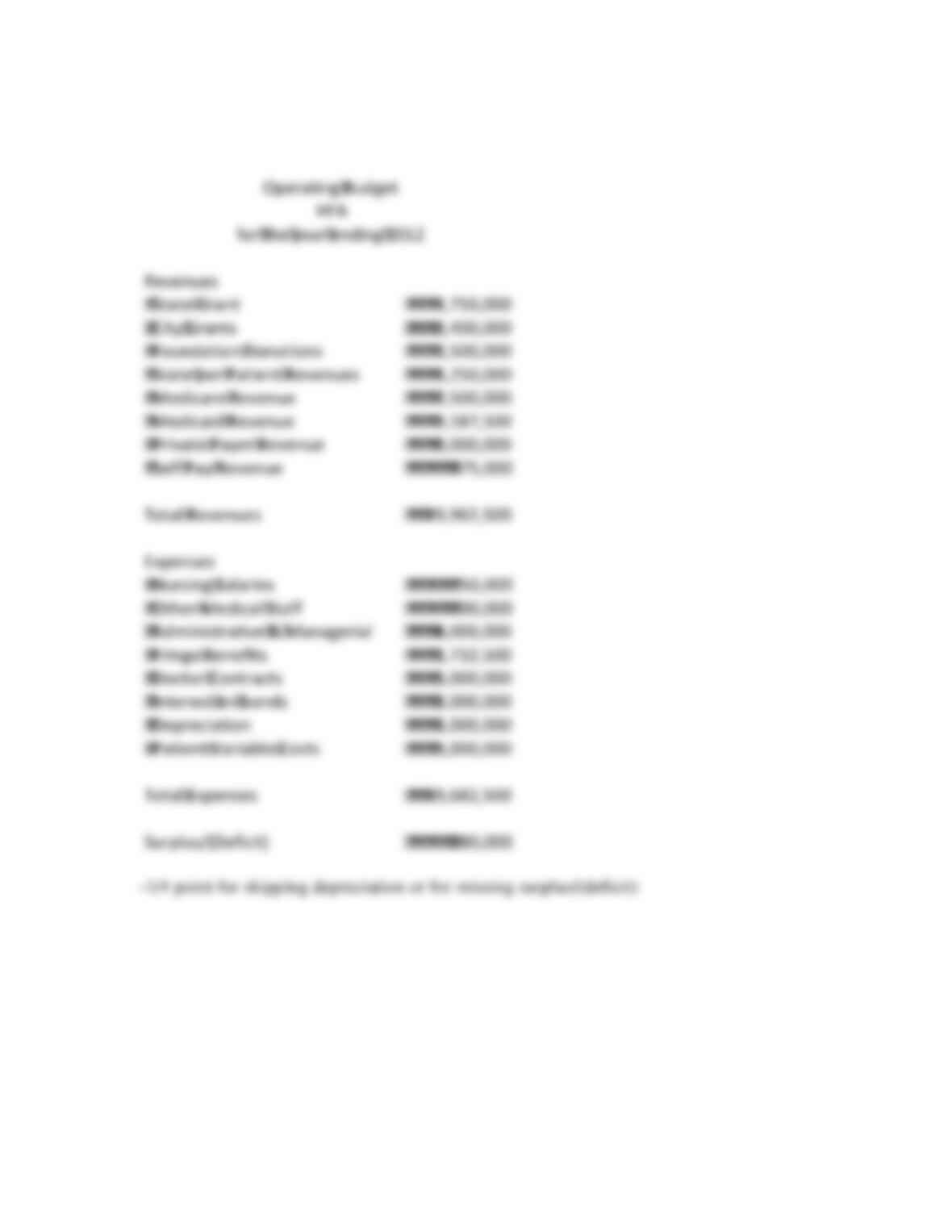
a. 5 points. Prepare an annual operating budget for 2012 using the above information. It is
recommended that you show all your calculations.
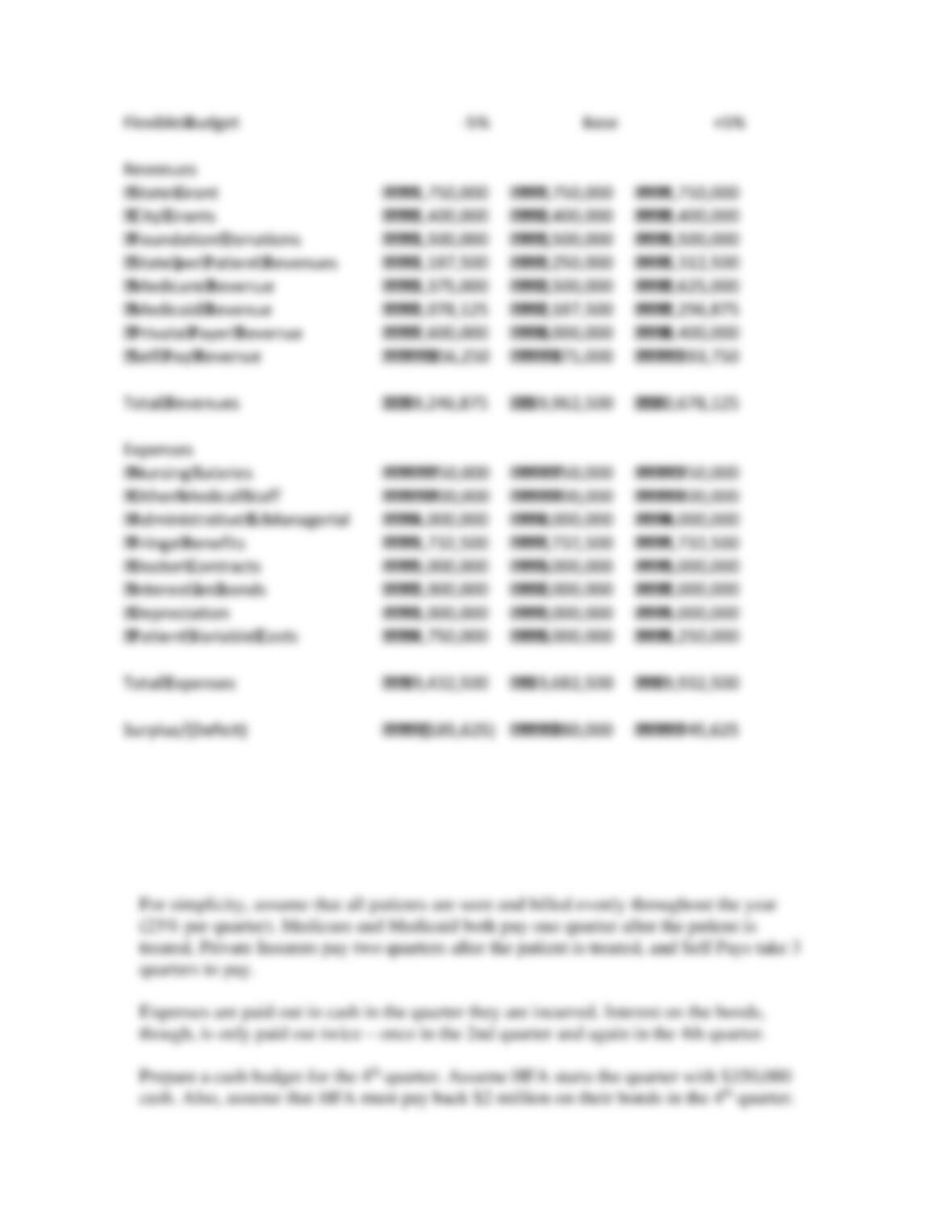
b. 2 points. Construct a flexible budget for HFA, using the operating budget you created
in Part A as your base budget. Assume patient volume might be 5% below or 5% above
budget. For simplicity, assume that patient volume above or below budget is equal across
the different patient types. Also for simplicity, assume that all salaries and contracted
services are fixed and do not change with volume.
3
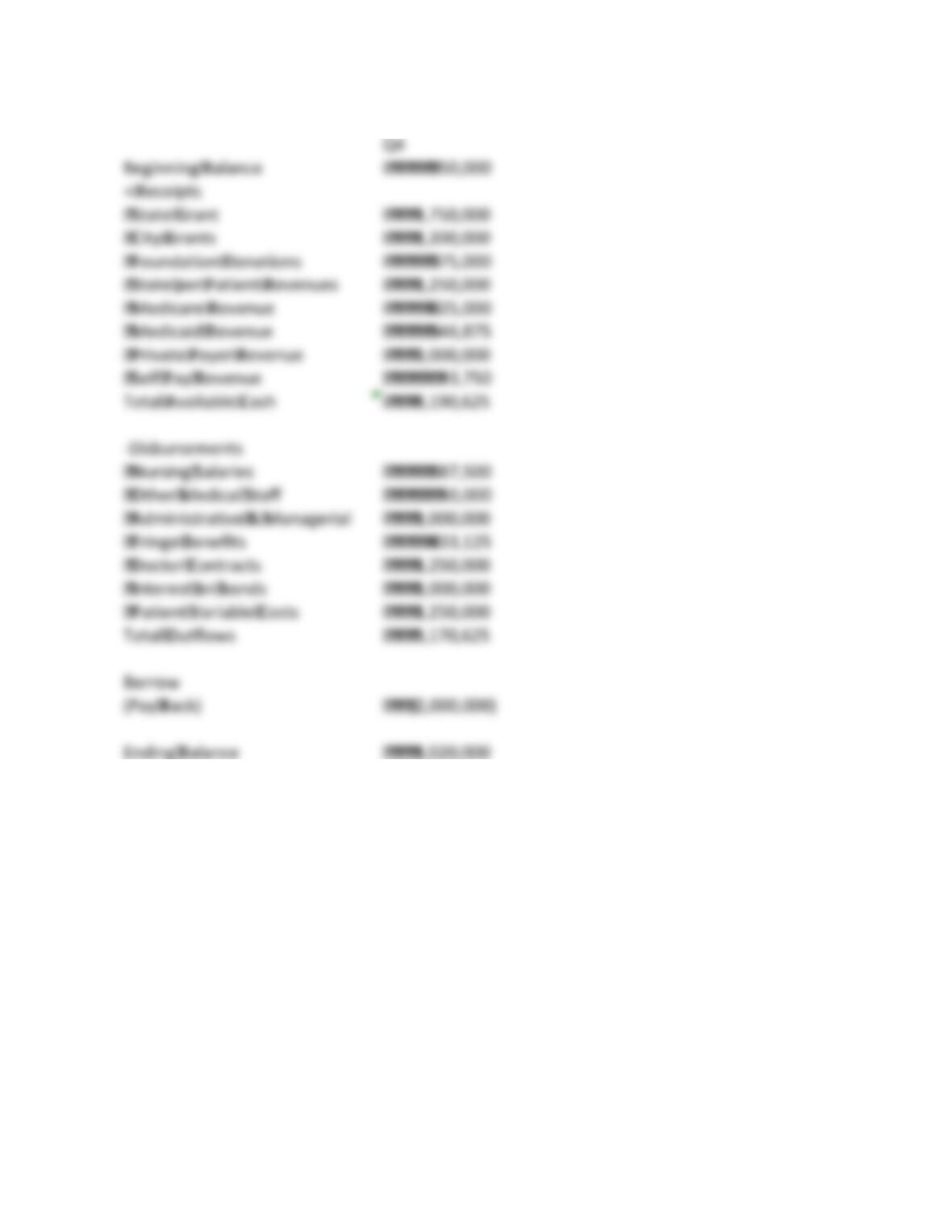
c. 3 points. The State pays the grant to HFA at the beginning of the 4th Quarter of the
fiscal year. 2 cities pay HFA at the beginning of the 2nd Quarter of the fiscal year while 2
pay at the beginning of the 4th Quarter, and the Foundations provide their donations
evenly across the fiscal year (25% of the total per quarter). The State pays HFA the per
patient money on the last day of the fiscal year.
4
2) 3 points. The Brooklyn Country School (BCS) is a nonprofit school trying to determine
how much to charge for tuition. The school expects 500 students next year, and to have
fixed costs of $1 million. The school believes each student will generate $300 in variable
costs. Using the breakeven formula, determine what price BCS should charge to
breakeven? Recalculate what price they should charge if they receive a $200,000 subsidy
from a donor.
5
3) 3 points. The Purtell Animal Welfare Society (PAWS) boards stray animals. They also
provide veterinary checkups to ensure the health of the strays. In 2011, PAWS expected
to board 400 animals, spend 3.25 hours of veterinarian time per animal, and pay the
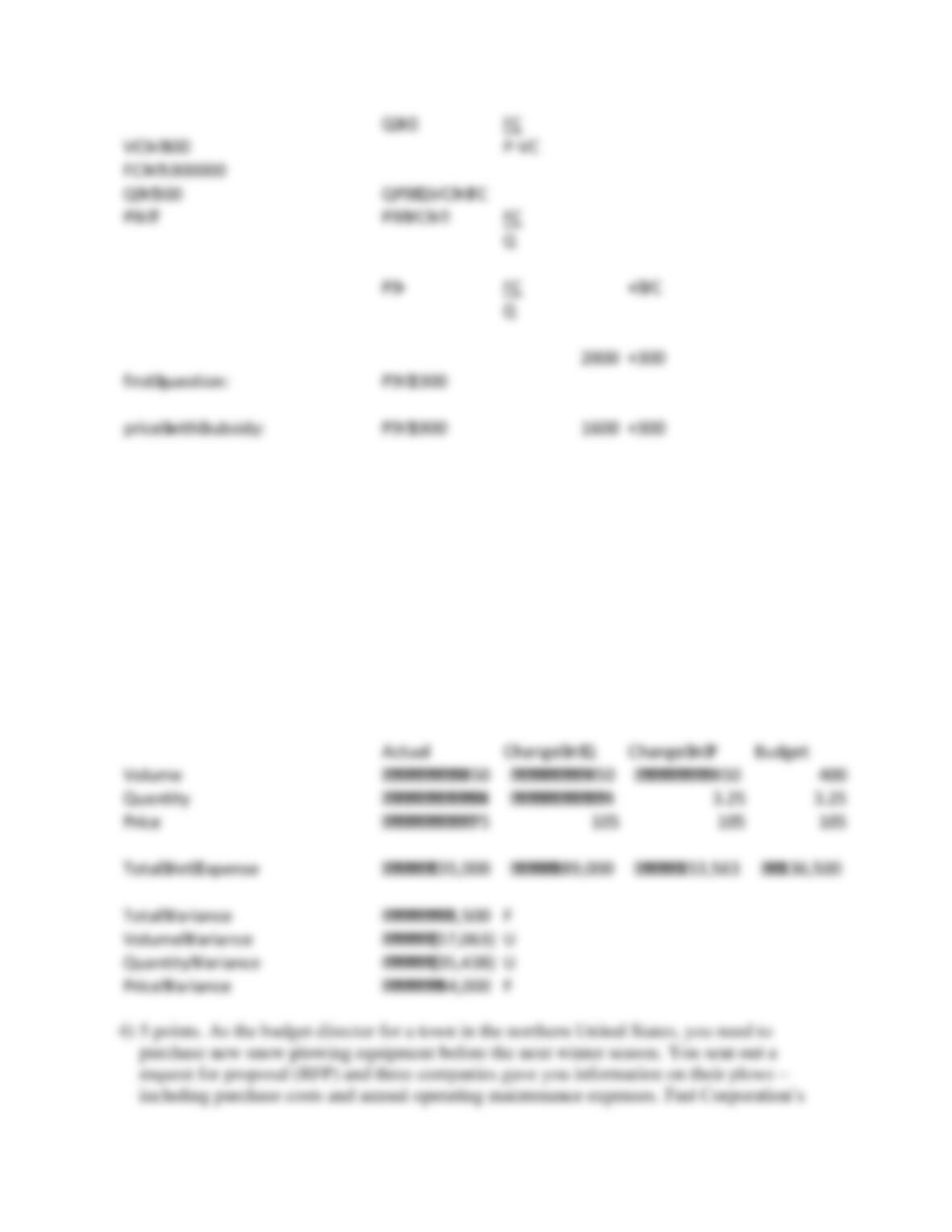
veterinarians $105 per hour, for an annual veterinary expense of $136,500. In actuality,
PAWS boarded 450 animals, vets spent 4 hours per animal and they were paid $75 per
hour.
What was PAWS’s total veterinary expense? What portion of the total veterinary expense
was due to volume? What portion of the total veterinary expense was due to quantity?
What portion of the total veterinary expense was due to price? Indicate whether each
variance is favorable or unfavorable.
6
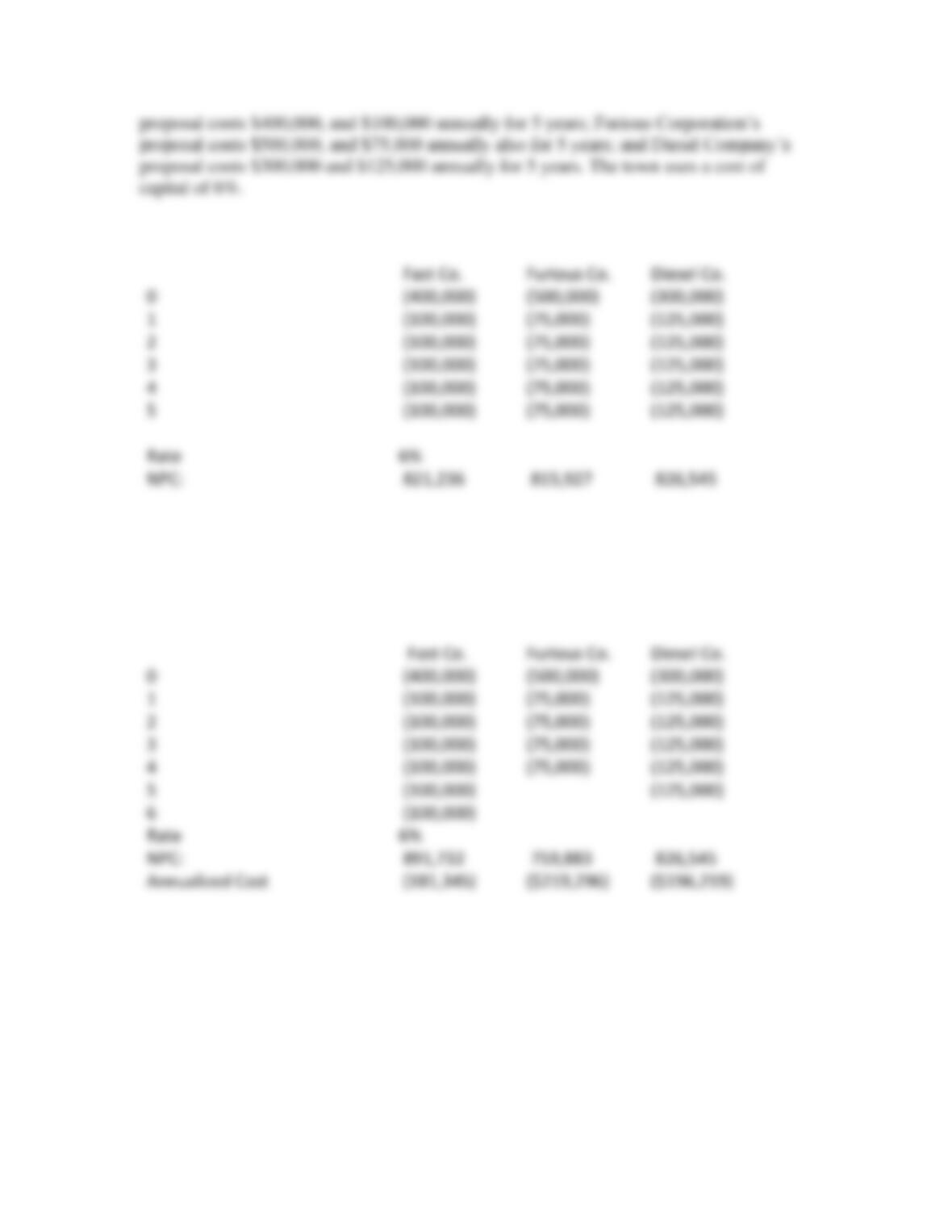
a. Which company’s proposal should you accept? Justify your answer.
b. Just as you were finishing your analysis in Part A above, Fast Corporation tells you
that the proposal will actually cover 6 years. Further, Furious Corporation informs you
their proposal is for 4 years only. With this new information, which of the three
company’s proposal should you accept? Justify your answer.
Fast Co. Furious Co. Diesel Co.
5) 4 points. As a financial analyst for a large metropolitan area’s transportation authority,
you and the information technology department come up with a new system in which
drivers will no longer have to stop to pay tolls, and will instead use tags in cars that are
read by antennae at toll plazas, which charge drivers’ accounts. The initial investment in
the necessary equipment to set up the new system will cost your authority $4.1 million.
This equipment is expected to last 12 years. It is also expected that it will cost $230,000
per year in the first year to maintain the system, and this amount is expected to increase
by 5 percent every year. You expect that the system will generate $560,000 in cash
7
inflows from increased activity at toll plazas and contracts with outside vendors. This
cash inflow is expected to increase by 6 percent each year. Your cost of capital is 5%.
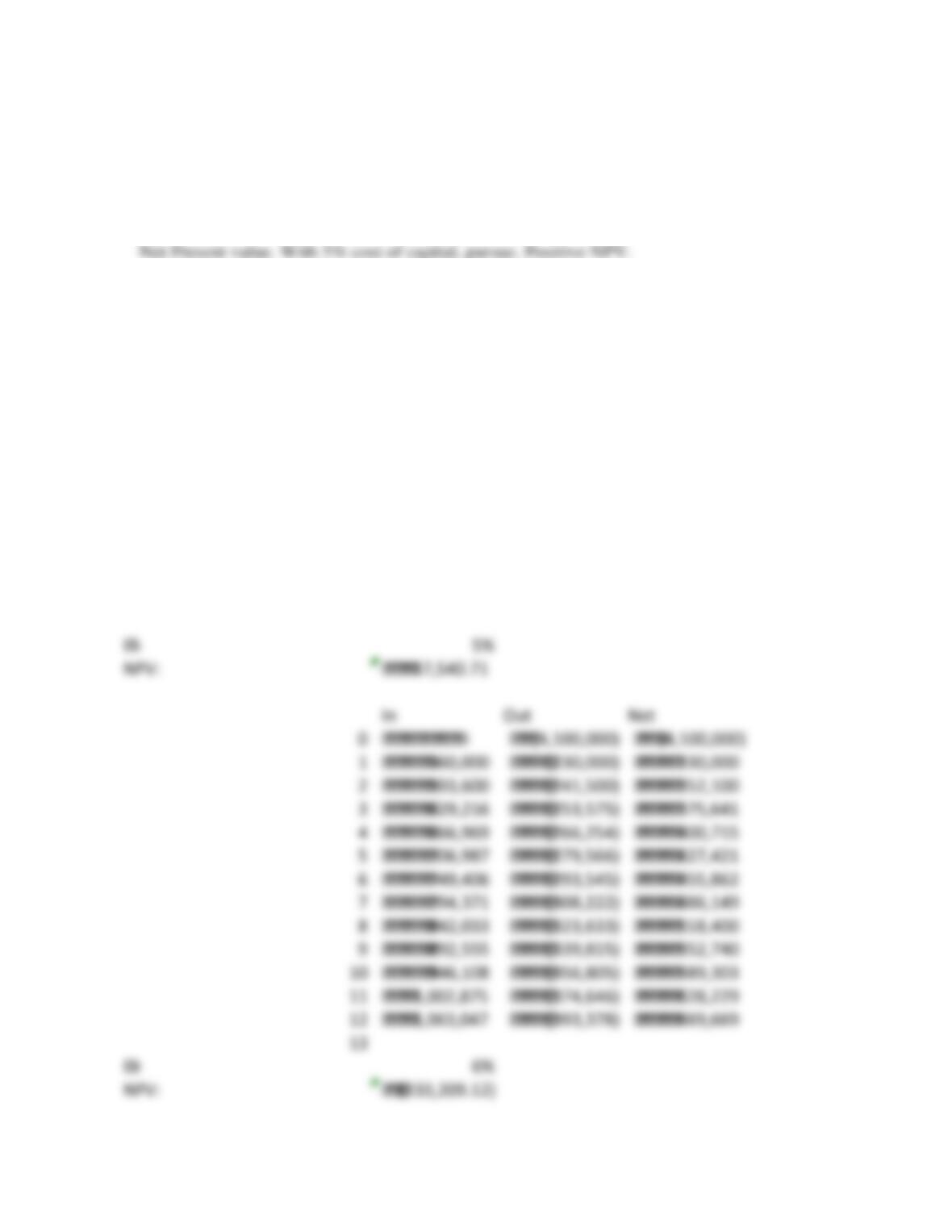
What capital budgeting technique should you use to analyze this project? Should you
undertake the project? Why or why not? What if your cost of capital is 6%? Should you
pursue it then? Again, why or why not? Justify all your answers.
8) In Out Net
0 – (4,100,000) (4,100,000)
1 560,000 (230,000) 330,000
2 593,600 (241,500) 352,100
3 629,216 (253,575) 375,641
4 666,969 (266,254) 400,715
5 706,987 (279,566) 427,421
6 749,406 (293,545) 455,862
7 794,371 (308,222) 486,149
8 842,033 (323,633) 518,400
9 892,555 (339,815) 552,740
10 946,108 (356,805) 589,303
11 1,002,875 (374,646) 628,229
12 1,063,047 (393,378) 669,669