CHAPTER 1
OVERVIEW OF CORPORATE FINANCIAL REPORTING
SUMMARY OF QUESTION TYPES BY LEARNING OBJECTIVE AND
LEVEL OF DIFFICULTY
Item
LO
LOD
Item
LO
LOD
Item
LO
LOD
Item
LO
LOD
Item
LO
LOD
True-False Statements
1.
1
M
7.
4
E
13.
5
E
19.
5
E
25.
5
E
2.
1
E
8.
4
M
14.
5
E
20.
5
E
26.
5
M
3.
1,5
M
9.
4
M
15.
5
M
21.
5
M
27.
5
M
4.
2
E
10.
4
M
16.
5
E
22.
5
E
28.
5
E
5.
2
E
11.
4
E
17.
5
E
23.
5
E
29.
5
E
6.
2
E
12.
5
E
18.
5
E
24.
5
M
30.
5
M
Multiple Choice Questions
31.
1
M
41.
3
M
51.
4
M
61.
5
M
71.
5
M
32.
2
E
42.
4
M
52.
4
M
62.
5
M
72.
5
E
33.
2
E
43.
4
M
53.
5
E
63.
5
M
73.
5
M
34.
2
M
44.
4
M
54.
5
E
64.
5
H
74.
5
M
35.
2
E
45.
4
M
55.
5
M
65.
5
M
75.
5
E
36.
3
E
46.
4
E
56.
5
H
66.
5
M
76.
5
M
37.
3
E
47.
4
E
57.
5
E
67.
5
E
77.
5
E
38.
3
M
48.
4
E
58.
5
H
68.
5
M
39.
3
M
49.
4
M
59.
5
E
69.
5
E
40.
3
M
50.
4
M
60.
5
M
70.
5
M
Exercises
78.
5
E
79.
5
M
80.
5
M
Matching
81.
4
M
82.
5
M
Short-Answer Essay
83.
2
M
84.
3
H
85.
5
M
86.
5
H
Essay
87.
5
H
88.
5
H
Note: E = Easy M = Medium H = Hard
1 – 2 Test Bank for Understanding Financial Accounting, Canadian Edition
SUMMARY OF LEARNING OBJECTIVES BY QUESTION TYPE
Item
Type
Item
Type
Item
Type
Item
Type
Item
Type
Item
Type
Item
Type
Learning Objective 1
1.
TF
2.
TF
3.
TF
31.
MC
Learning Objective 2
4.
TF
6.
TF
33.
MC
35.
MC
5.
TF
32.
MC
34.
MC
83.
SAE
Learning Objective 3
36.
MC
37.
MC
38.
MC
39.
MC
40.
MC
41.
MC
84.
SAE
Learning Objective 4
7.
TF
10.
TF
43.
MC
46.
MC
49.
MC
52.
MC
8.
TF
11.
TF
44.
MC
47.
MC
50.
MC
81.
Ma
9.
TF
42.
MC
45.
MC
48.
MC
51.
MC
Learning Objective 5
12.
TF
20.
TF
28.
TF
58.
MC
66.
MC
74.
MC
85.
SAE
13.
TF
21.
TF
29.
TF
59.
MC
67.
MC
75.
MC
86.
SAE
14.
TF
22.
TF
30.
TF
60.
MC
68.
MC
76.
MC
87.
Es
15.
TF
23.
TF
53.
MC
61.
MC
69.
MC
77.
MC
88.
Es
16.
TF
24.
TF
54.
MC
62.
MC
70.
MC
78.
Ex
17.
TF
25.
TF
55.
MC
63.
MC
71.
MC
79.
Ex
18.
TF
26.
TF
56.
MC
64.
MC
72.
MC
80.
Ex
19.
TF
27.
TF
57.
MC
65.
MC
73.
MC
82.
Ma
Note: TF = True-False Ex = Exercise SAE = Short-Answer Essay
MC = Multiple Choice Ma = Matching Es = Essay
Overview of Corporate Financial Reporting 1 – 3
CHAPTER LEARNING OBJECTIVES
1. Define financial accounting and understand its relationship to economic decision–
making.
2. Identify the main users of financial accounting information and explain how they use
this information.
3. Describe the major forms of business organization and explain the key distinctions
between each form.
4. Explain the three categories of business activities and identify examples of
transactions related to each category.
1 – 4 Test Bank for Understanding Financial Accounting, Canadian Edition
5. Identify and explain the content and reporting objectives of the four basic financial
statements and the notes to the financial statements.

Overview of Corporate Financial Reporting 1 – 5
TRUE-FALSE STATEMENTS
1. Decision makers are often referred to as users of the financial statements and include
investors and creditors.
2. The primary purpose of financial accounting information is to aid users in their economic
decision-making relative to the organization.
3. The section of an annual report that contains management’s discussion of the company’s
operating results is referred to as the Statement of Management’s Responsibility.
4. The shareholders are an example of an internal user of annual report information.
5. Information contained in the financial statements of a company is of use to both internal and
external users.
6. There may be a single shareholder in the case of a public company or many shareholders in
the case of a private company.
7. A firm’s activities can be divided into borrowing, investing, and operating.
8. If an investor owns 10% of the shares of a company, they normally own 10 shares of the
company.
9. Dividends are payments made by the company to distribute future profits.
10. A gain or increase in the value of shares is known as capital appreciation.
11. Creditors are entities that lend money to a company rather than buying shares of a
company.
12. The financial statements of a company are prepared by the shareholders.
13. Assets are listed in the order of their liquidity on the classified Statement of Financial
Position.

1 – 6 Test Bank for Understanding Financial Accounting, Canadian Edition
14. Prepaid expenses can be found on the Statement of Income.
15. The statement of financial position measures cash inflows and outflows of a company over a
period of time.
16. Profit is determined by subtracting the income earned during the period from the expenses
incurred during the same period.
17. Income can also include gains that a company generates from sales that are outside their
normal course of operations.
18. Expenses are defined as increases in economic benefits.
19. Gross profit is equal to the sales received from goods and the operating expenses incurred
during the period.
20. Net earnings is the amount of the company’s revenue that remains after all of its expenses
are accounted for.
21. Retained earnings is the earnings that have been kept and not paid out as dividends.
22. Liquidity refers to how long something will be received, realized, or consumed.
23. Canadian companies use a 12-month period to distinguish between items that are current
from those that are non-current.
24. Working capital measures the company’s ability to meet its short-term obligations using its
non-current assets.
25. Deferred revenue represents customer deposits.
26. Shareholders’ equity is often referred to as the net assets of the company.
27. Share capital records the amount that investors have received in the form of dividends.
28. Companies that are growing normally have negative cash flows from investing activities.

Overview of Corporate Financial Reporting 1 – 7
29. IFRS are the financial reporting standards that must be followed by Canadian public
companies.
30. The MD&A provides a discussion of the risks facing the company and information about
future plans.
1 – 8 Test Bank for Understanding Financial Accounting, Canadian Edition
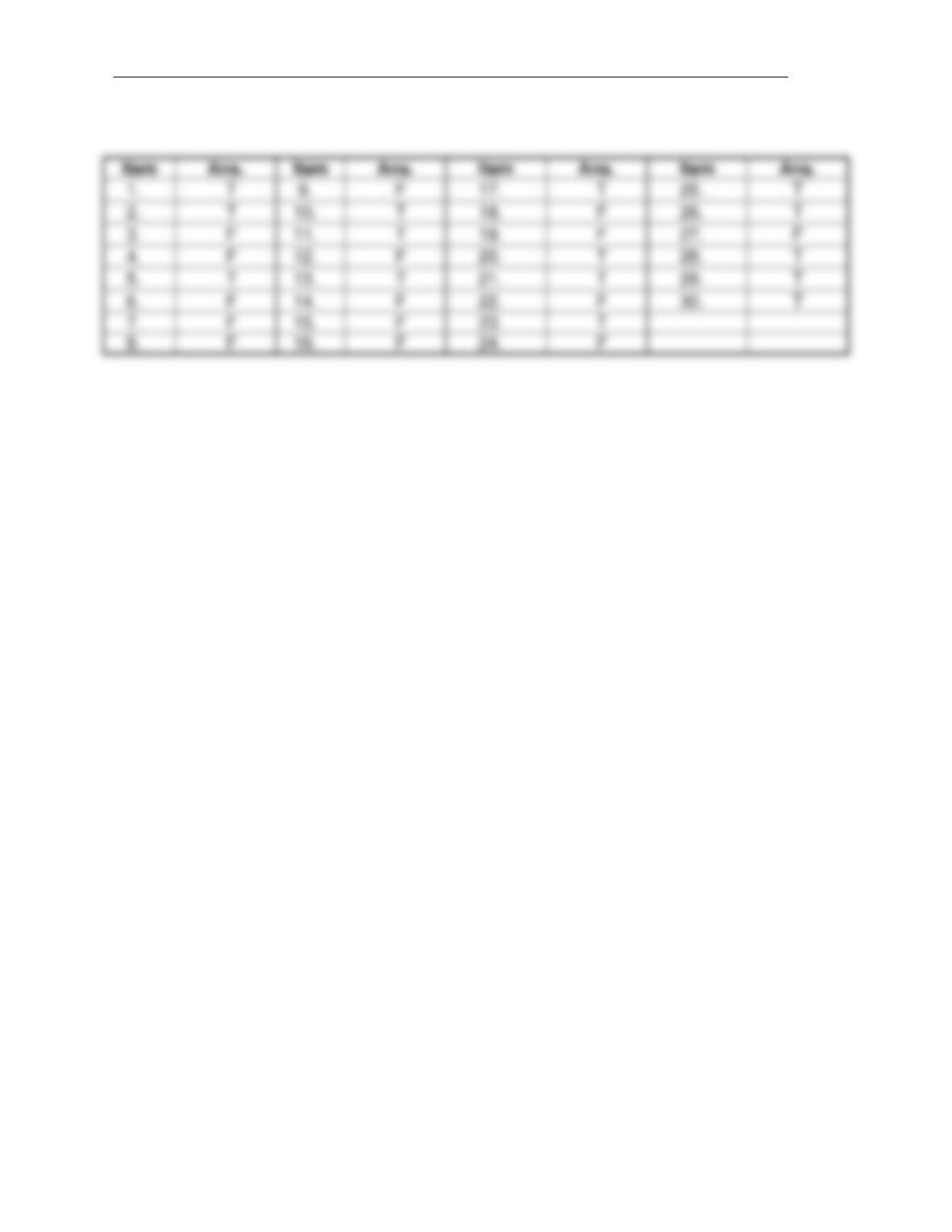
ANSWERS TO TRUE-FALSE STATEMENTS

Overview of Corporate Financial Reporting 1 – 9
MULTIPLE CHOICE QUESTIONS
31. In which section of the annual report does management comment on the company and its
operating results?
a) report to the shareholders
b) management’s discussion and analysis
c) corporate profile
d) selected financial data
32. Which of the following is an internal user of annual report information?
a) creditors
b) board of directors
c) regulators
d) shareholders
33. The shareholders typically elect which of the following to represent their interests?
a) senior management
b) independent auditors
c) board of directors
d) chief operating officer
34. All of the following are external users EXCEPT
a) labour unions.
b) management.
c) regulators.
d) journalists.
35. Those who lend money or otherwise extend credit rather than invest it directly are known as
a) investors.
b) regulators.
c) creditors.
d) unions.
36. A corporation whose shares are held by a small number of individuals is referred to as a
a) proprietorship.
b) publicly traded corporation.
c) small business corporation.
d) privately held corporation.
37. Businesses can be operated in a number of different forms, such as a
a) corporation.
b) partnership.
c) proprietorship.

1 – 10 Test Bank for Understanding Financial Accounting, Canadian Edition
d) all of the above.
38. Which statement is INCORRECT in regards to the characteristics of a corporation?
a) It is a separate legal entity.
b) It can be sued.
c) Shareholders liability is limited to their investment.
d) It cannot be publicly accountable.
39. Which of the following statements best describes a proprietorship?
a) can be single or multiple owners
b) taxed separately
c) most expensive to establish
d) owner is responsible for debt of the company
40. Which of the following statements best describes a partnership?
a) separate legal entity
b) single owner
c) most expensive to establish
d) owners are responsible for debt of the company
41. Which of the following statements best describes a corporation?
a) can be single or multiple owners
b) taxed separately
c) most expensive to establish
d) all of the above
42. What is the initial investment by the shareholders in a company called?
a) owners’ capital
b) shareholders’ capital
c) retained earnings
d) shareholders’ equity
43. The fundamental types of business activities that a firm typically engages in include all of the
following EXCEPT
a) operating.
b) borrowing.
c) investing.
d) financing.
44. Which of the following is an example of an operating activity?
a) paying dividends
b) sale of investment in other companies’ shares
c) purchase of property, plant, and equipment
d) payment of interest expense

Overview of Corporate Financial Reporting 1 – 11
45. Which of the following is a typical financing activity?
a) purchasing property, plant or equipment
b) purchasing another company’s shares
c) paying interest expense
d) paying dividends
46. All of the following are investing activities EXCEPT
a) earning interest income.
b) purchasing property, plant, and equipment.
c) purchasing other companies’ shares.
d) selling property, plant, and equipment.
47. Which of the following is a typical financing activity?
a) payment of dividends
b) payment of interest expense
c) payment of wages
d) purchases of inventory
48. Operating activities include all of the following EXCEPT
a) collections of accounts receivable.
b) payment of tax expense.
c) payment of dividends.
d) payment of interest expense.
49. Which of the following is NOT a typical operating activity?
a) payment of accounts payable
b) payment of long term notes payable
c) payment of wages
d) collection of accounts receivable
50. An example of a financing activity is
a) purchase of property.
b) issuing shares.
c) sales to customers.
d) payment of taxes.
51. An example of an investing activity is
a) purchase of inventory.
b) collections of amounts owed by customers.
c) purchase of shares of other companies.
d) payment of taxes.

1 – 12 Test Bank for Understanding Financial Accounting, Canadian Edition
52. An example of an operating activity is
a) repaying loan principal.
b) paying dividends.
c) purchase of shares of other companies.
d) payments of taxes owed to the government.
53. Which of the following statements best describes financial accounting?
a) An information system in which the underlying transactions of organization are captured,
analyzed, and reported.
b) The reports that management prepares for the owners of the company summarizing how the
company performed during the period.
c) An information system in which all transactions with the company are accurately reported.
d) The reports that management prepares for use in making decisions related to the financing,
investing, and operating activities of a company.
54. Where would the information about company operations be found?
a) on the Statement of Income
b) on the Statement of Financial Position
c) in the notes of the financial statements
d) in the statement of management responsibility
55. In 2014 Farrow Ltd. earned gross revenues of $2,500,000 and had net income of $480,000.
During 2014 the company had 200,000 common shares outstanding and its average
shareholders’ equity was $1,000,000. Farrow’s basic earnings per share for 2014 is
a) $2.50.
b) $2.40.
c) $12.50.
d) $0.48.
56. All of the following can be found on an Statement of Income EXCEPT
a) Interest expense.
b) Depreciation Salaries expense.
c) Prepaid rent expense.
d) Other income.
57. Which of the financial statements provides information about the company’s financial
position?
a) Statement of Income
b) Statement of Financial Position
c) Statement of Cash Flows
d) Statement of Changes in Equity
58. Which of the following is the proper order to list current assets on the Statement of Financial
Position?
a) Cash, Short-Term Investments, Inventory, Prepaid Expenses

Overview of Corporate Financial Reporting 1 – 13
b) Cash, Short-Term Investments, Prepaid Expenses, Accounts Receivable
c) Cash, Inventory, Accounts Receivable, Short-Term Investments
d) Cash, Accounts Receivable, Short-Term Investments, Inventory
59. Which of the following is the basic accounting equation?
a) Assets = liabilities – shareholders’ equity
b) Assets = liabilities × shareholders’ equity
c) Assets = liabilities ÷ shareholders’ equity
d) Assets = liabilities + shareholders’ equity
60. Which of the following are the two components of Shareholders’ equity?
a) Dividends and Retained Earnings
b) Share Capital and Retained Earnings
c) Share Capital and Net Income
d) Net Income and Dividends
61. The change in retained earnings can be calculated as follows:
a) Net Income – Dividends
b) Net Income + Dividends
c) Net Income – Interest
d) Net Income + Interest
62. Dividends are paid when approved by the
a) board of directors.
b) management.
c) shareholders.
d) creditors.
63. The following information is NOT found on the Statement of Income:
a) EPS.
b) Depreciation Expense.
c) Future Income Taxes.
d) Cost of Goods Sold.
64. Which of the following statements is true?
a) The market value and the book value of a company’s shareholders’ equity are usually the
same.
b) The market value is usually less than the book value of a company’s shareholders’ equity.
c) The market value is usually more than the book value of a company’s shareholders’ equity.
d) The value of the shareholders’ equity on the Statement of Financial Position is based on the
value of the company’s shares in the market.
65. Which of the following is a section found in the Statement of Cash Flows?
a) cash from lending activities
b) cash from shareholder activities

1 – 14 Test Bank for Understanding Financial Accounting, Canadian Edition
c) cash from financing activities
d) cash from borrowing activities
66. On the Statement of Cash Flows, the repayment of long-term obligations would be
considered
a) a financing activity.
b) an investing activity.
c) an operating activity.
d) a reduction in a liability.
67. The starting point in the operating activities section of the cash flow statement is
a) Sales Revenue.
b) Retained Earnings.
c) Beginning Cash Balance.
d) Net Income.
68. Where in the financial statements would a user find out which accounting policies
management has selected to use?
a) Statement of Management Responsibility
b) Notes to the Financial Statements
c) Auditors’ Report
d) Management Discussion and Analysis
69. The Statement of Income is also known as
a) Statement of Operations.
b) Statement of Earnings.
c) Statement of Profit or Loss.
d) all of the above.
70. Who determines how much of earnings will be paid as dividends?
a) management
b) board of directors
c) shareholders
d) regulators
71. The working capital equation is
a) Working Capital = Current Assets – Current Liabilities.
b) Working Capital = Current Assets + Current Liabilities.
c) Working Capital = Current Assets – Non-Current Liabilities.
d) Working Capital = Non-current Assets + Current Liabilities.
72. The accounting equation is
a) Assets = Liabilities – Shareholders’ Equity.
b) Assets + Liabilities = Shareholders’ Equity.

Overview of Corporate Financial Reporting 1 – 15
c) Assets = Liabilities + Shareholders’ Equity.
d) Assets – Liabilities = Shareholders’ Equity.
73. A characteristic of an asset is
a) a resource controlled by an entity.
b) a future economic outflow.
c) an event that will happen in the future.
d) none of the above.
74. Licences, patents, trademarks, and copyrights are all examples of
a) current assets.
b) goodwill.
c) intangible assets.
d) short term investments.
75. Goods held for resale to customers are called
a) Inventory.
b) Prepaid Deposits.
c) Property, Plant, and Equipment.
d) Intangible Assets.
76. Amounts owed to customers for advance payments until the related goods or services have
been provided are called
a) Accounts Payable.
b) Deferred Revenue.
c) Accrued Liabilities.
d) Deferred Income Taxes.
77. Measures the resources controlled by a company and the claims on resources at a given
point in time.
a) Statement of Financial Position
b) Statement of Income
c) Statement of Cash Flows
d) Statement of Changes in Equity
1 – 16 Test Bank for Understanding Financial Accounting, Canadian Edition
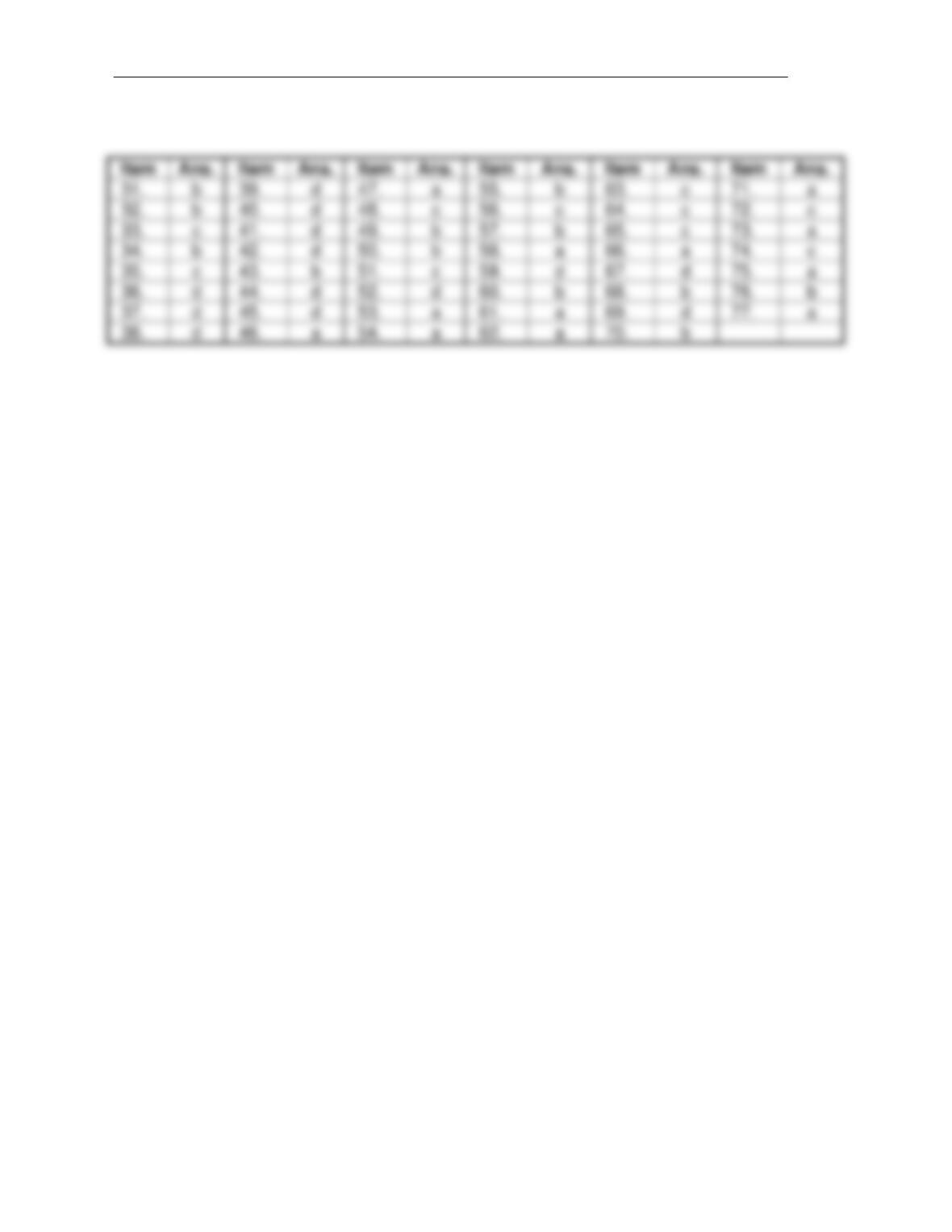
ANSWERS TO MULTIPLE CHOICE QUESTIONS
Overview of Corporate Financial Reporting 1 – 17
EXERCISES
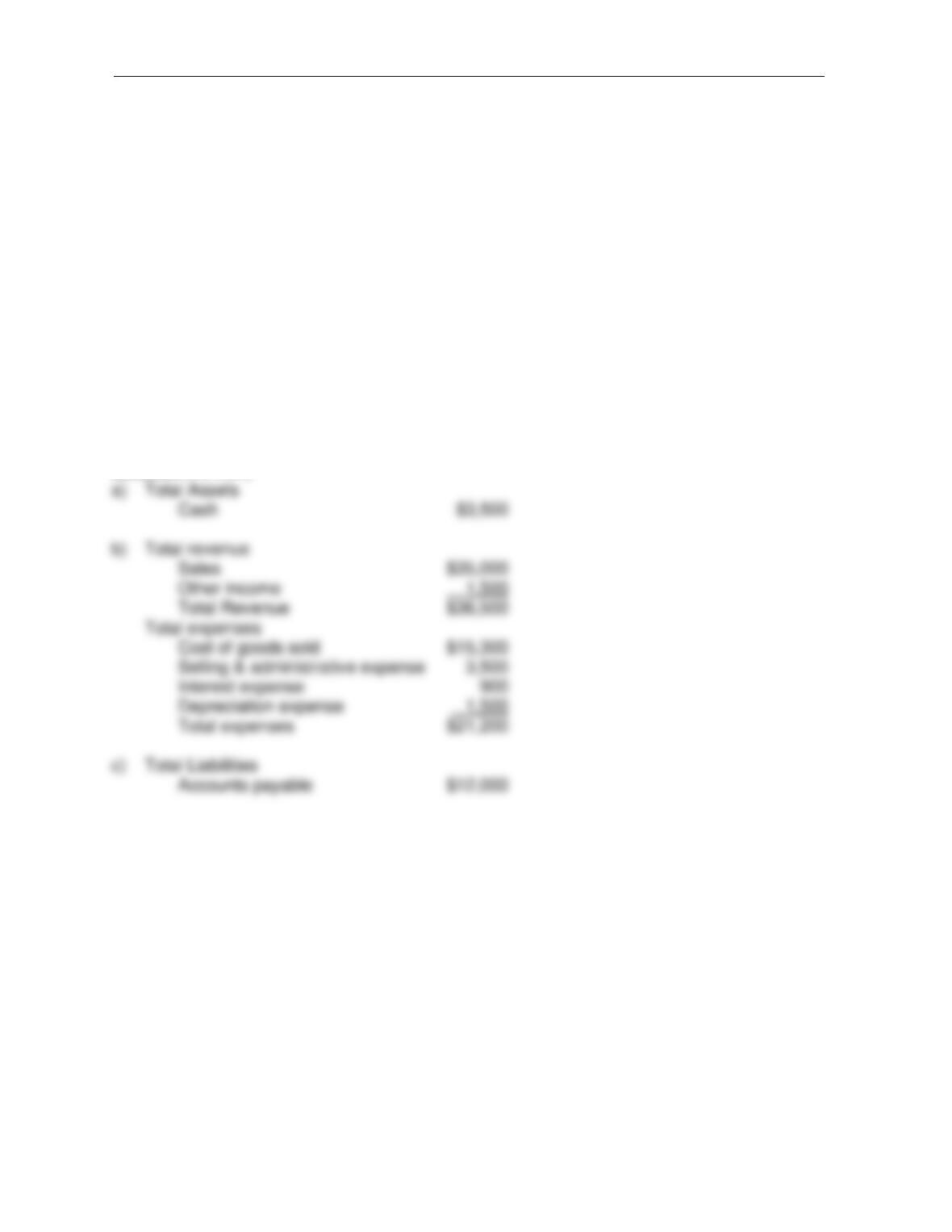
78. The following data was taken from the books of Kahluha, Inc. as of December 31, 2015:
Cost of goods sold $ 15,300 Selling & administrative expense $3,500
Income tax expense 6,120 Accounts payable 12,000
Cash 3,500 Common shares, (6,500 shares) 20,000
Retained earnings 8,000 Dividends 6,000
Other income 1,500 Interest expense 900
Sales revenue 35,000 Depreciation expense 1,500
Instructions
a) Calculate total assets.
b) Calculate total revenue and expenses.
c) Calculate total liabilities.
Solution (10 min.)
79. The following data was taken from the books of Somerset Corporation as of December 31,
2015:
Accounts payable $ 9,000 Income tax payable $ 36,800
Cost of goods sold 214,000 Selling expense 80,000
Cash 12,000 General expense 50,000
Long-term notes payable 19,000 Accounts receivable 10,000
Sales revenue 480,000 Prepaid rent 2,000
Short term investment 5,000 Dividends payable 5,000
Inventory 66,000 Income tax expense 40,800
Common shares 60,000 Equipment 100,000
Retained earnings 65,200 Number of common shares 20,000
Instructions
1 – 18 Test Bank for Understanding Financial Accounting, Canadian Edition
From the list above determine which items should not be reported on the Statement of Financial
Position.
Solution (10 min.)
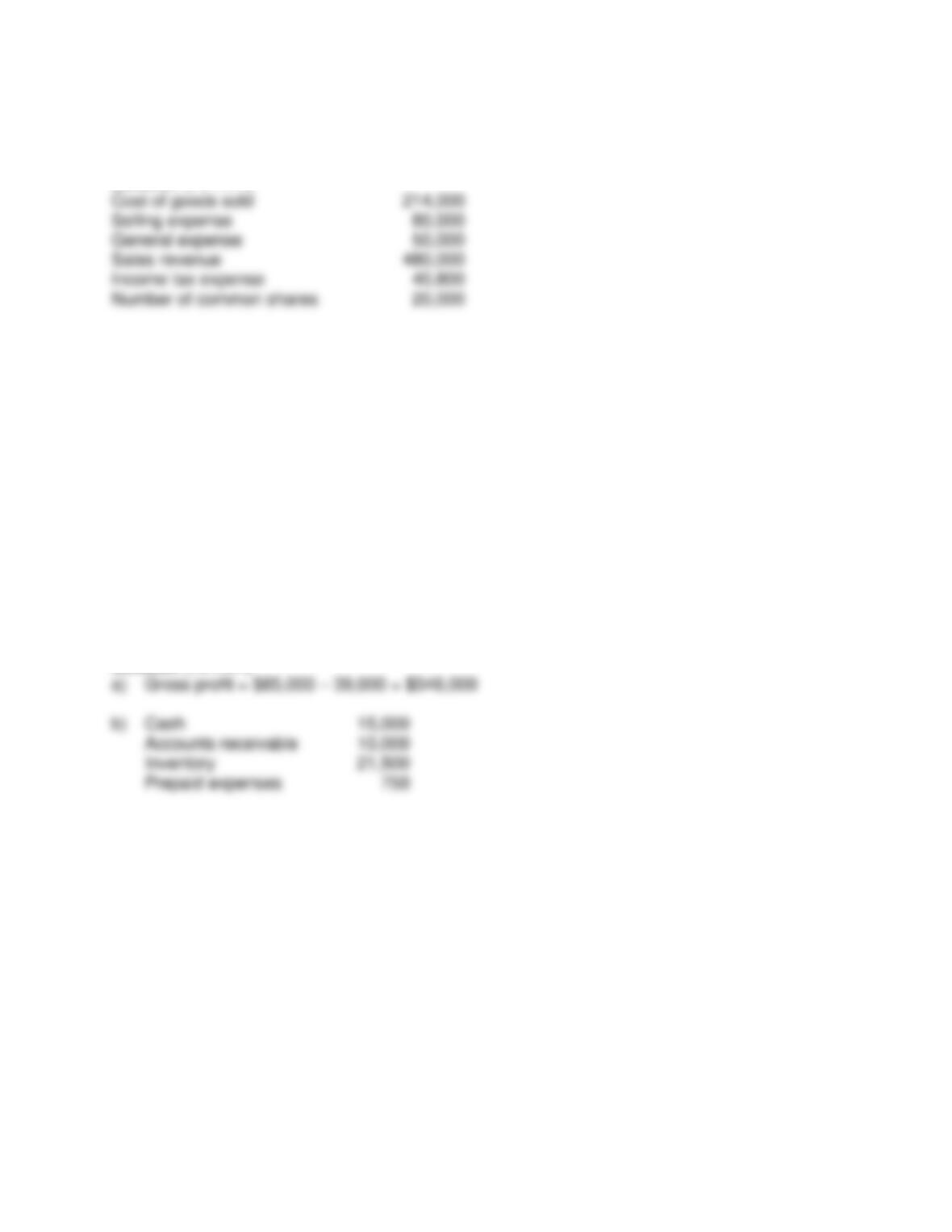
80 The following data was taken from the books as at December 31, 2015 of Marco Inc.:
Cash $15,000 Common shares $15,000
Income tax expense 2,300 Cost of goods sold 39,000
Sales revenue 85,000 Retained earnings (as of January 1) 8,500
Inventory 21,500 Notes payable 50,750
Accounts payable 32,000 Equipment 125,000
Operating expenses 28,900 Dividends paid 4,000
Interest expense 5,600 Accounts Receivable 10,000
Prepaid expenses 750
Instructions
a) Determine the gross profit.
b) List the current assets in order of liquidity.
Solution (10 min.)

Overview of Corporate Financial Reporting 1 – 19
MATCHING
81. Match each of the following activities to the transactions listed below by placing the
appropriate letter in the space provided.
ACTIVITIES
a) Operating
b) Investing
c) Financing
____ 1. Borrowing money
____ 2. Payment of salaries and wages
____ 3. Payment of dividends
____ 4. Sale of long term assets
____ 5. Purchase of another company’s shares
____ 6. Receipt of dividends
____ 7. Collections of amounts owed by customers
____ 8. Issuing shares
___ 9. Purchase of another company’s bonds
___ 10. Purchase of inventory
___ 11. Sales to customers
___ 12. Share repurchase
Solution (5 min.)

1 – 20 Test Bank for Understanding Financial Accounting, Canadian Edition
82. Match each of the following financial statement lines to the correct financial statement by
placing the appropriate letter in the space provided.
Financial Statement
a) Statement of Financial Position
b) Statement of Income
c) Statement of changes in equity
d) Statement of Cash Flows
___ 1. Income Taxes Payable
___ 2. Cost of Goods Sold
___ 3. Property, plant and equipment
___ 4. Cash from Operating activities
___ 5. Dividends Declared
___ 6. Inventory
___ 7. Operating expenses
___ 8. Gain on machinery
___ 9. Prepaid Expenses
___ 10. Accounts Receivable
___ 11. Net Income
___ 12. Goodwill
Solution (5 min.)

Overview of Corporate Financial Reporting 1 – 21
1 – 22 Test Bank for Understanding Financial Accounting, Canadian Edition
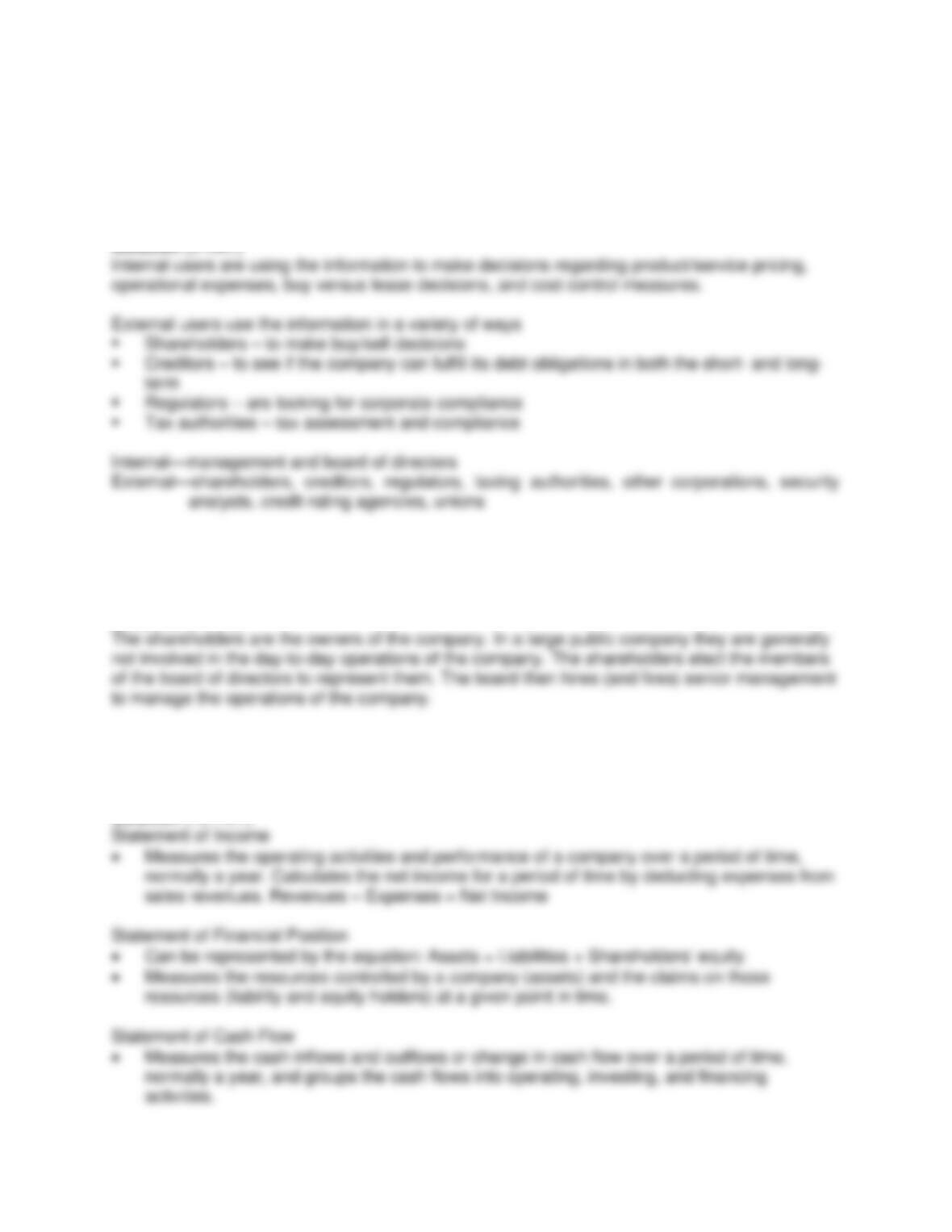
SHORT-ANSWER ESSAY QUESTIONS
83. How do internal users differ from external users of financial statements? Identify two internal
and two external users of annual reports.
84. Briefly explain the relationship between the management, the board of directors, and the
shareholders in a public company.
Solution (5 min.)
85. Identify and describe the three primary financial statements prepared by accountants. How
do these statements differ?
Solution (10 min.)
Overview of Corporate Financial Reporting 1 – 23
86. List the three types of business activities that are measured and reflected on the cash flow
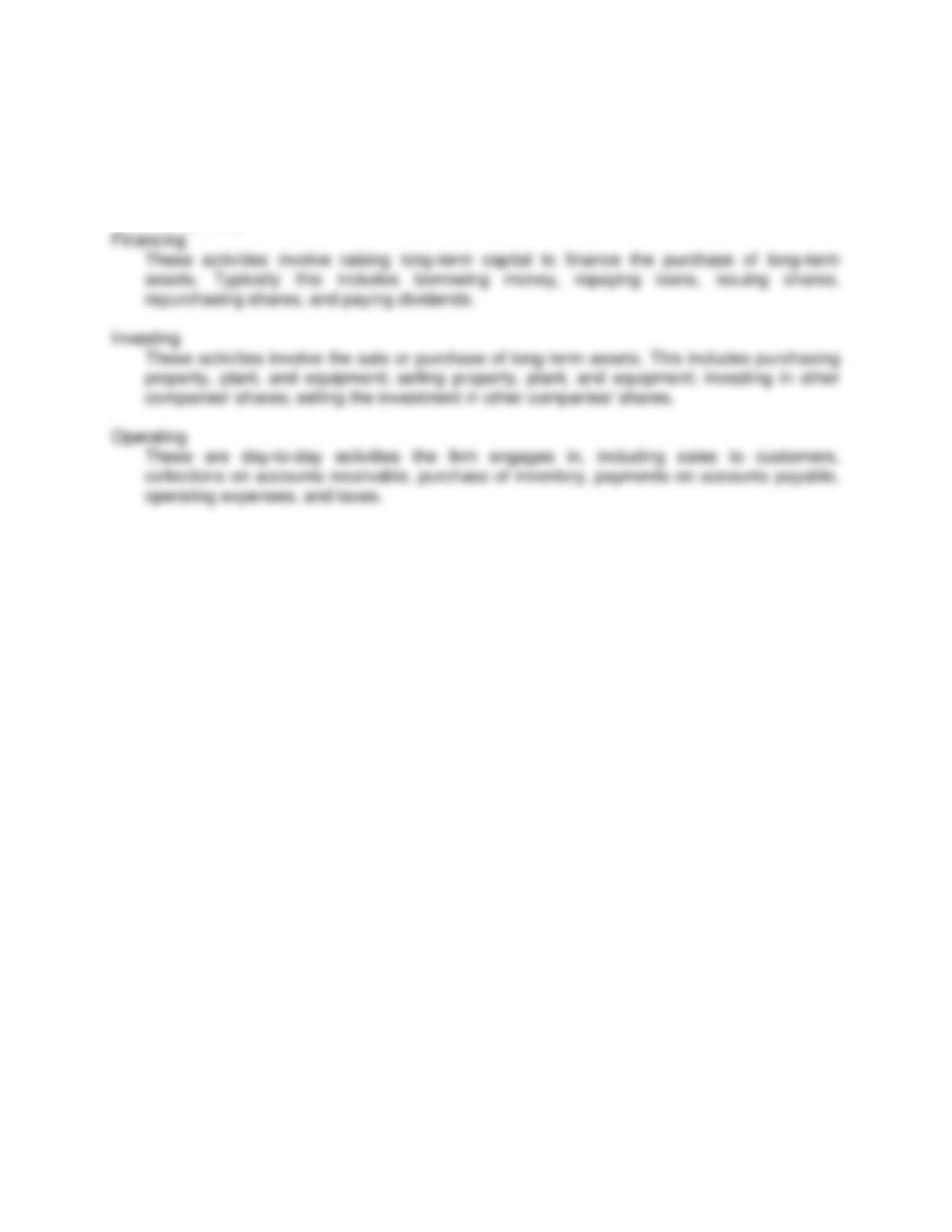
statement and provide three examples of transactions found within each activity.
Solution (5 min.)
1 – 24 Test Bank for Understanding Financial Accounting, Canadian Edition
ESSAY QUESTIONS
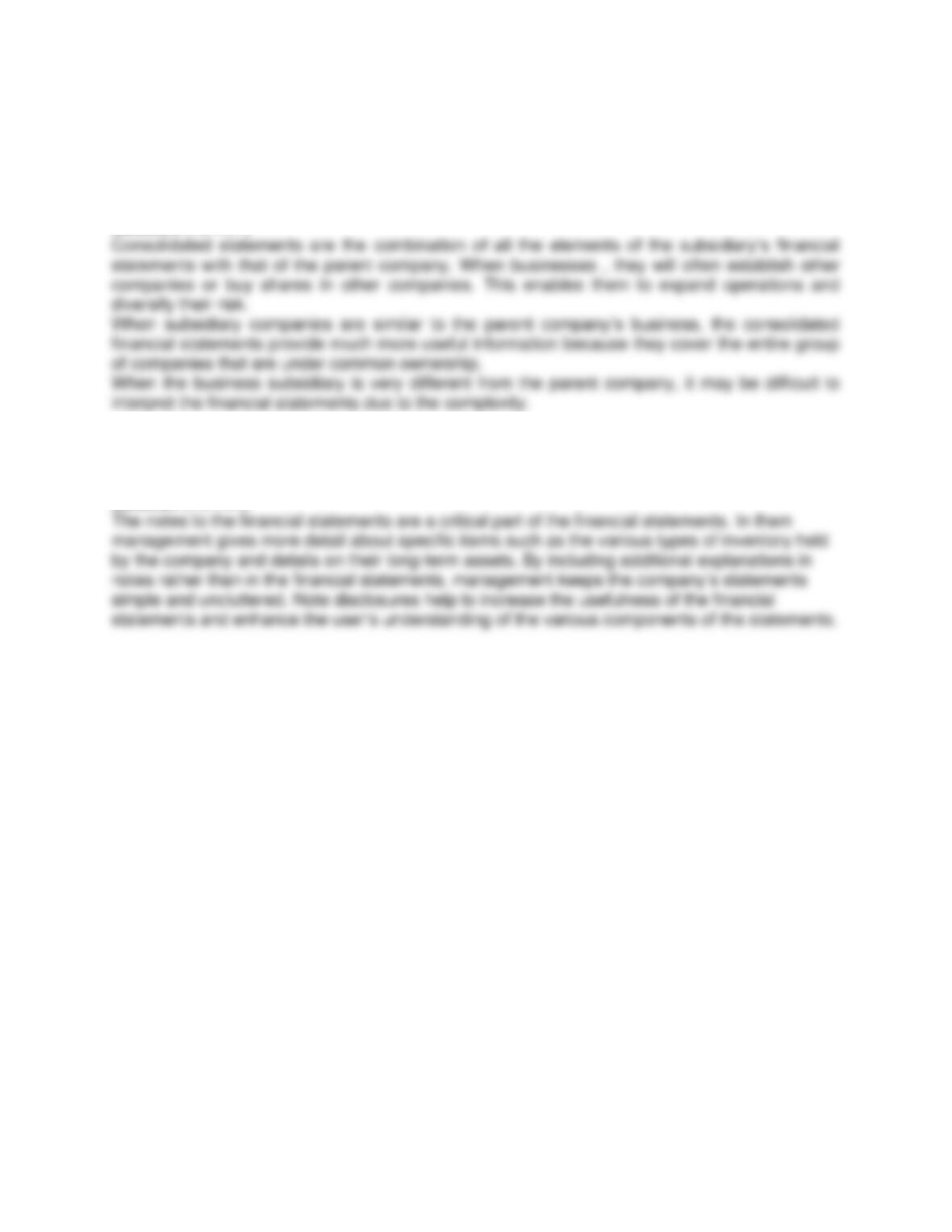
87. What are consolidated statements? Do they provide useful information to their users?
Solution (12 min.)
88. What are the “notes to the financial statements”? Why are they used?
Solution (15 min).
Overview of Corporate Financial Reporting 1 – 25
LEGAL NOTICE