53) In which of the following relationships is an agency conflict problem LEAST likely to arise?
A) the relationship between a hire–car company and the persons who hire that company’s cars regarding
the treatment of those cars
B) the relationship between high–level military officers and the soldiers who serve under them regarding
the willingness of the soldiery to take risks
C) the relationship between a restauranter and the suppliers of produce to that restaurant regarding the
freshness of the produce supplied
D) the relationship between a driver and the passengers in a car regarding the safe driving of that car
54) What is the most common way that agency conflict problems are addressed in most corporations?
A) by minimizing the number of decisions that a manager makes where there is a conflict between the
managers interests and those of the shareholders
B) by terminating the employment of employees who are found to have put their own interests above that
of the company’s
C) by using disinterested outside bodies to adjudicate between managers and shareholders when such
conflicts arise
D) by prosecuting managers who have been found to have illegally used company moneys for their own
benefit
55) A company’s board of directors chooses to provide a comprehensive health care plan for the families of all
employees, despite the large cost. They argue that this will not only increase the number of employees who
stay with the firm, and thus reduce some costs involved in employee turnover, but also increase the
employees’ diligence and industry. What general principle is being argued by the board of directors?
A) In a conflict between stakeholders in a company, the most important stakeholder is not always the
stockholders.
B) Some activities that decrease shareholders’ wealth may have intangible benefits which increase the
strength of the company overall.
C) When a conflict of interest arises between shareholders and other stakeholders, in general, the correct
solution is the one that creates the greatest good for the greatest number of stakeholders.
D) Ethical decisions should be assessed on their moral value, not on their value in dollars and cents.
56) Why is the stock price of a company an indication of the performance of that company’s senior managers?
A) Well–run companies are invariably highly profitable, which leads to a higher share price.
B) In general, people want to invest in a well–managed corporation, which will drive up the price of
shares.
C) Investors who can see that a company is well–run will hold on to their shares, even if the company faces
temporary set–backs, since they know that the stock price will likely rise again.
D) Larger companies tend to be better run and so have higher stock prices.
57) A corporate raider gains a controlling fraction of the shares of a poorly managed company and replaces the
board of directors. How does the corporate raider hope to make a profit in this case?
A) by the sale of the assets held by the company that hold most of its value
B) by the rise in the value of the stock held by the raider when the new board of directors is judged to be
superior to the ousted board of directors
C) by motivating the board of directors and other stakeholders in the company to make difficult
short–term decisions that will increase the long–term viability of the company
D) by removing the employees expectations of the continued poor performance of the company
58) A ________ is when a rich individual or organization purchases a large fraction of the stock of a poorly
performing firm and in doing so gets enough votes to replace the board of directors and the CEO.
A) shareholder proposal
B) leveraged buyout
C) shareholder action
D) hostile takeover
SHORT ANSWER. Write the word or phrase that best completes each statement or answers the question.
59) Briefly discuss the issues in the agency conflict problem.
60) Explain some of the measures taken to reduce the agency conflict problem.
TRUE/FALSE. Write ‘T’ if the statement is true and ‘F’ if the statement is false.
1.5 The Stock Market
61) The shares of private corporations are traded on a stock market.
62) Stock markets provide liquidity for a firm’s shares.
63) If broker will buy a share of stock from you at $3.85 and sell it to you at $3.87, the ask price would be $3.85.
MULTIPLE CHOICE. Choose the one alternative that best completes the statement or answers the question.
64) Which of the following need be true for an asset to be considered liquid?
A) It pays regular dividends.
B) It can be bought and sold at an organized stock market or bourse.
C) It is offered for sale on both primary and secondary markets.
D) It can be easily bought and sold and the selling price is very close to the buying price at a given point in
time.
65) Why is it in general difficult to determine the market price of a private corporation’s shares at any point in
time?
A) It is difficult to obtain enough information to accurately value such a company.
B) The price of its shares is fixed by the owners.
C) It has a limited number of owners.
D) There is no organized market for its shares.
66) Which of the stock markets listed below is the smallest, as judged by trading volume?
A) Deutsche Börse
B) London Stock Exchange
C) NASDAQ
D) NYSE Euronext (US)
67) Why is a stock exchange like NASDAQ considered a secondary market?
A) It trades the second largest volume of shares in the world.
B) Shares sold on it are exchanged between investors without any involvement of the issuing corporation.
C) The exchange has rules that attempt to ensure that bid and ask prices do not get too far apart
D) NASDAQ is called a secondary market because NYSE is considered a primary market.
68)
On August 19, 2004 Google IPO offered 19,605,052 shares at a price of U.S. $85 per share, which were sold in
an online auction in a bid to make the shares more widely available. Which of the following statements best
describes why these are considered a primary market transaction?
A) The transaction was between the corporation and investors.
B) Shares of Google from this time onward could be traded between investors on a stock exchange.
C) The shares were the first to be publicly issued by Google.
D) Google was at the time a recently founded company seeking capital with which to expand.
69) What is the bid–ask spread?
A) the difference in price available for an immediate sale of a stock and the immediate purchase of that
stock
B) all of the costs and fees that a stock exchange charges in order to process a transaction
C) the rise or fall in the value of a stock between the time it is acquired by an investor and sold by that
investor
D) the difference in the selling price of a stock between different exchanges
70)
Stella places a market order with her broker to buy 1000 shares of OneWorld Corp. The broker buys 1000
shares at $15.40 each, and sells them to Stella at $15.55 each. He also charges a commission of $12.00. What is
bid–ask spread in this case?
A) $15,400
B) $15,562
C) $172
D) $150
71) Which of the following is a measure of the aggregate price level of collections of pre–selected stocks?
A) NASDAQ
B) S&P 500
C) NYSE
D) Euronext
Use the figure for the question(s) below.
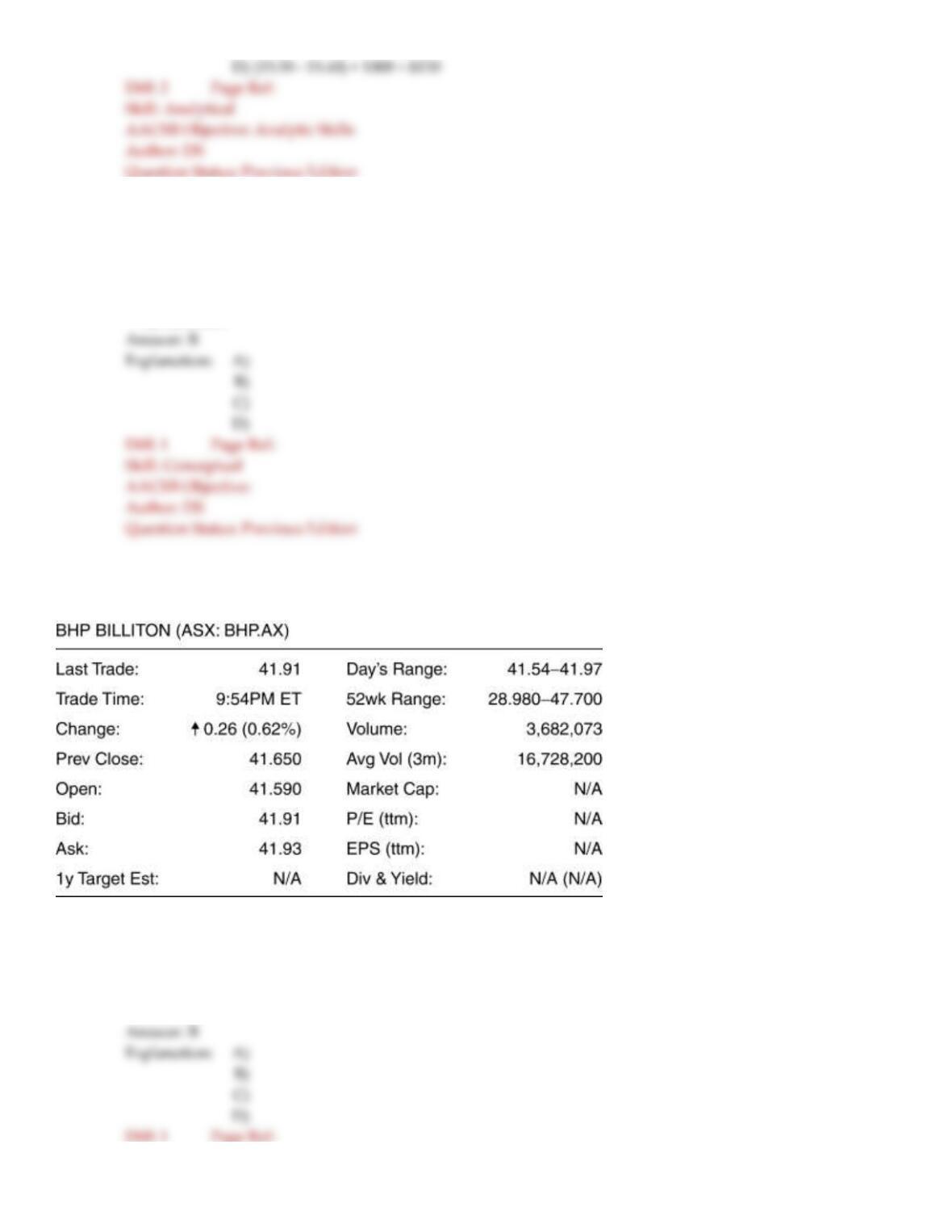
72) Using the above information, how much would you pay for a share of BHP Billiton stock?
A) $41.91
B) $41.93
C) $41.65
D) $41.59
Use the figure for the question(s) below.
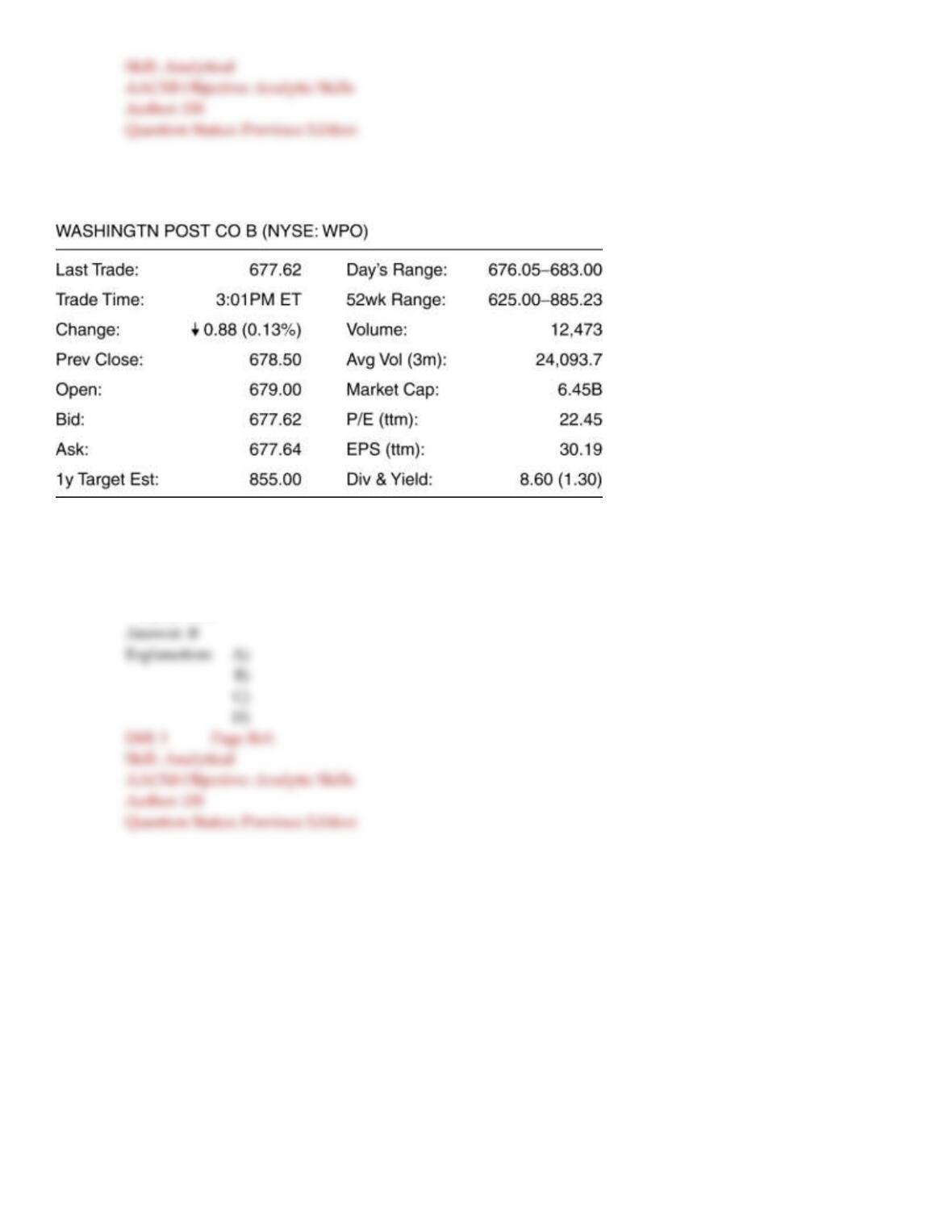
73) Using the above information, how much would you receive if you sold a share of Washington Post stock?
A) $683.00
B) $677.62
C) $678.50
D) $677.64
Use the figure for the question(s) below.
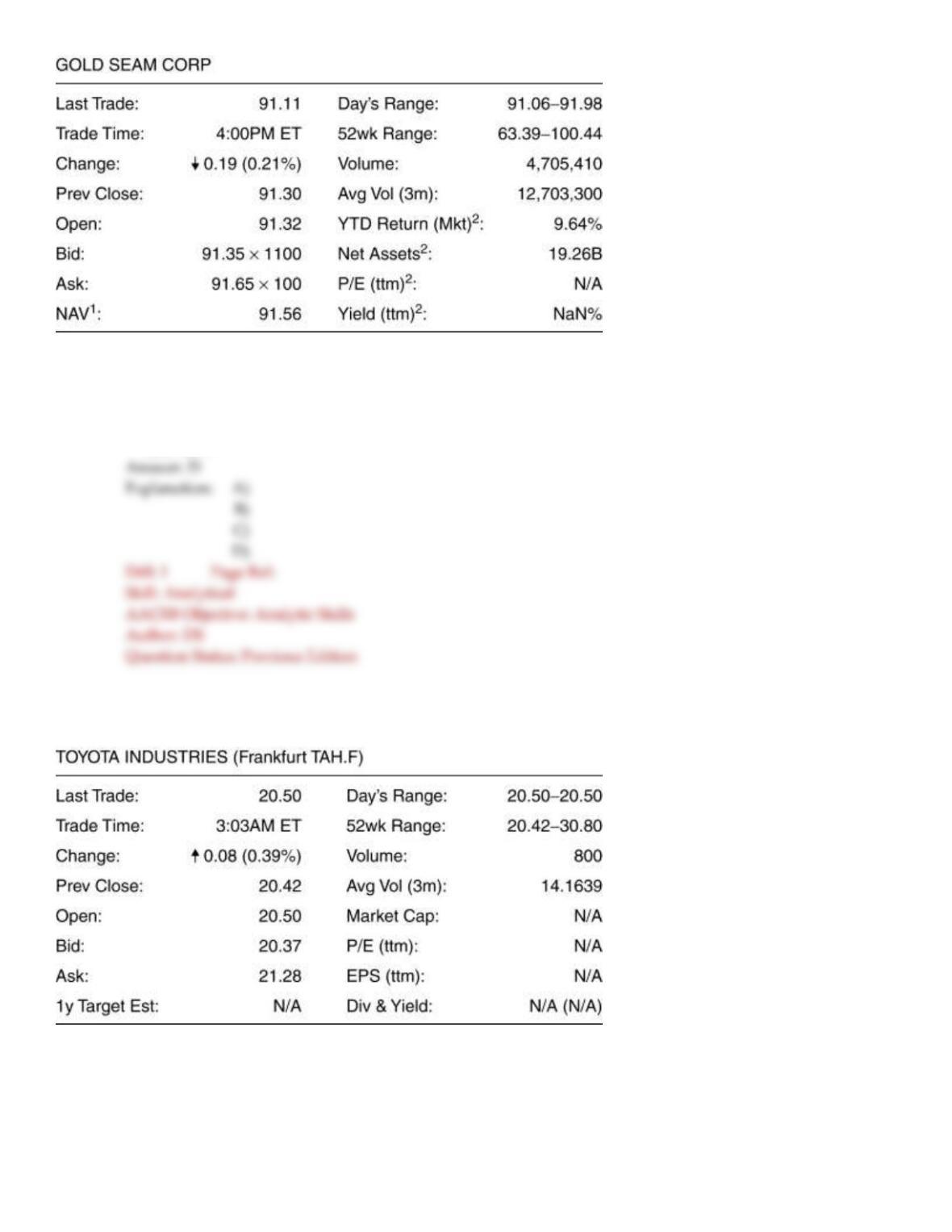
74) Based on the information shown above, what would it cost to buy 1000 shares of the above stock?
A) $91,110
B) $91,300
C) $91,320
D) $91,650
Use the figure for the question(s) below.
75) Based on the information shown above, how much would you receive from selling 2000 shares of the above
stock?
A) €40,840
B) €40,740
C) €41,000
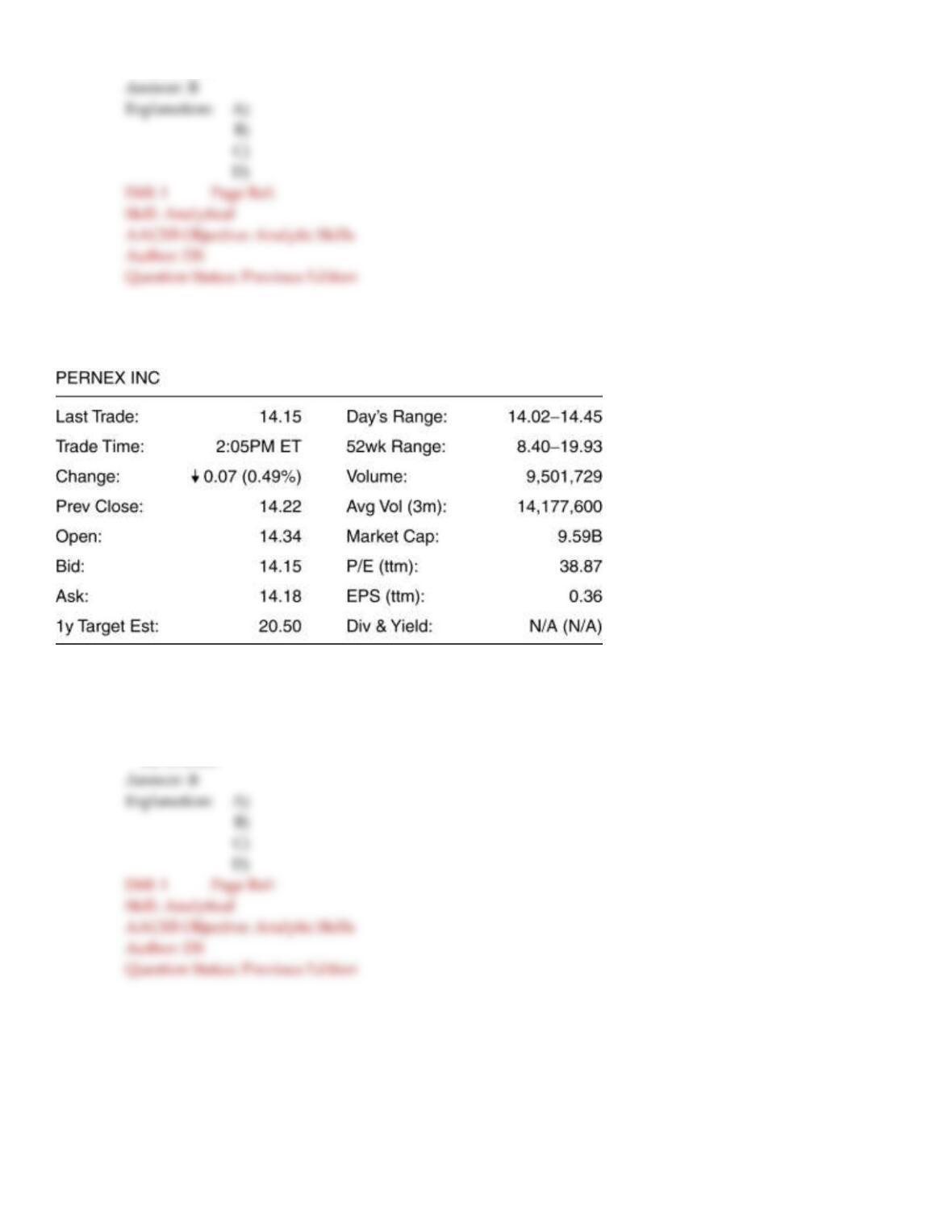
D) €42,560
Use the figure for the question(s) below.
76) What is the bid–ask spread on the stock shown above?
A) 1 cent
B) 3 cents
C) 6 cents
D) 12 cents
Use the figure for the question(s) below.
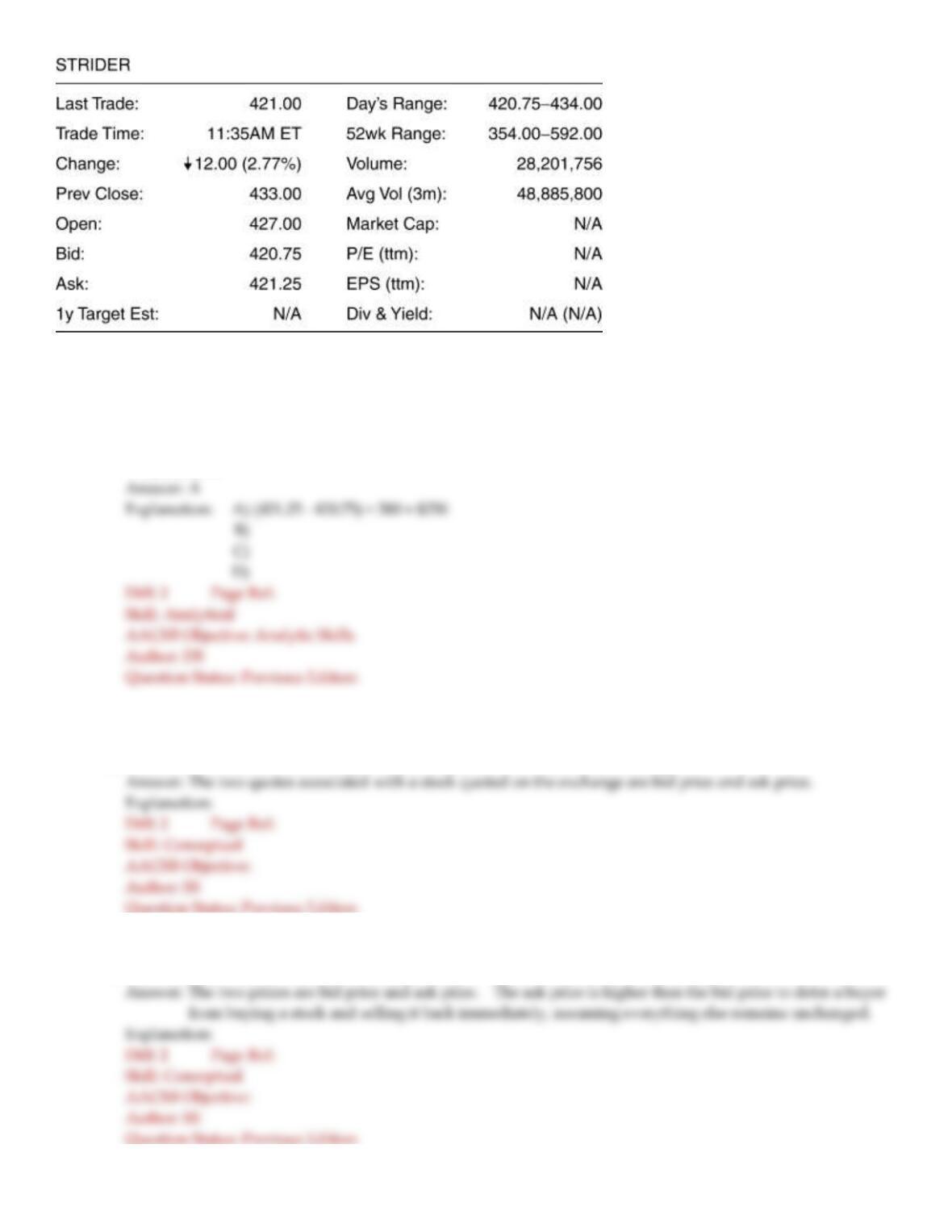
77) How much money would a stock exchange make from buying and selling 500 shares of the stock under the
conditions shown above?
A) $250
B) $3000
C) $5875
D) $210,375
SHORT ANSWER. Write the word or phrase that best completes each statement or answers the question.
78) What are the terms for the two types of prices quoted for a stock on an exchange?
79) What is the general relation of the two types of prices quoted for a stock on a exchange?
80) What is the term for the applicable price that I will pay, if I have to buy a stock?
81) What is the term for the applicable price that the seller gets when he sells a stock on the exchange?
82) What are the main differences between the NYSE and NASDAQ stock markets?
TRUE/FALSE. Write ‘T’ if the statement is true and ‘F’ if the statement is false.
83) Raising new capital by issuing bonds is an example of a commercial banking activity.
MULTIPLE CHOICE. Choose the one alternative that best completes the statement or answers the question.
84) Put the following steps of the financial cycle in the correct order:
I. Money flows to companies who use it to fund growth through new products
II. People invest and save their money
III. Money flows back to savers and investors
A) I, II, III
B) II, I, III
C) III, II, I
D) II, III, I
85) Investments by wealthy individuals and endowments is a major source of money for each of the following
except:
A) private equity funds.
B) hedge funds.
C) venture capital funds.
D) mutual funds.
86) Which of the following is not a role of financial institutions?
A) Moving funds from savers to borrowers.
B) Spreading out risk–bearing.
C) Printing money for borrowers.
D) Moving funds though time.