
Elements of Ecology, 9e (Smith)
Chapter 1 The Nature of Ecology
1.1 Short Answer Questions
1) ________ is activism with a stated aim of protecting the natural environment, particularly
from the negative impacts of human activities.
2) ________ is the scientific study of the relationship between organisms and their environment.
3) The living, or ________, and nonliving, or ________, components of the environment interact
within an ecosystem.
4) A group of individuals of the same species that occupies a given area is referred to as a(n)
________.
5) All populations of different species living and interacting within an ecosystem are referred to
collectively as a(n) ________.
6) At the ________ level, an ecologist might focus on the factors that affect the relative
abundance of various populations in the area.
7) All science begins with ________, which is the first step in the process known as the scientific
method.

8) In a field experiment, an ecologist measures the effects of nitrogen on productivity, plotting
data for nitrogen on the x-axis and productivity on the y-axis. In this experiment, the dependent
variable is ________.
9) A(n) ________ is an abstract, simplified representation of a real system, allowing us to predict
some behavior or response using a set of explicit assumptions.
10) The ________ forms the basic unit in ecology.
1) The term “ecology” is defined as the study of the
A) environment.
B) relationships between organisms.
C) relationships between organisms and their environment.
D) impact of humans on the environment.
2) Which of the following is a cornerstone of the science of ecology?
A) Environmentalism
B) Darwin’s theory of natural selection
C) Economics
D) Populations
3) Moisture and concentration of oxygen
A) are parts of an organism’s environment.
B) have no effect on the physiology of an organism.
C) are biological conditions that impact an organism’s survival.
D) do not vary in the environment.

4) The interaction of a biotic community and its abiotic environment is referred to as a(n)
A) biosphere.
B) ecosystem.
C) population.
D) biome.
5) Which of the following is considered an abiotic component of the ecosystem?
A) temperature
B) microbes
C) plants
D) animals
6) A biome is
A) the thin layer surrounding the Earth that supports all life.
B) all the populations of different species living and interacting within an ecosystem.
C) a broad-scale region dominated by similar types of ecosystems.
D) an area of land or water composed of a patchwork of communities and ecosystems.

7)
Experiments done at Cedar Creek Long Term Ecological Research site are ideal for examining
concepts at what level?
A) ecosystem
B) population
C) community
D) individual
8) All populations of different species living and interacting within an ecosystem are referred to
collectively as a(n)
A) community.
B) biome.
C) population.
D) ecosystem.

9) Which of the following is an example of a biome?
A) community
B) landscape
C) tropical rainforest
D) ecosystem
10) A predator consuming prey would occur at the organizational level of the
A) community.
B) biome.
C) population.
D) ecosystem.
11) Broad scale regions dominated by similar types of ecosystems are called
A) communities.
B) biospheres.
C) biomes.
D) landscapes.
12) Which of the following represents the correct organization of ecological systems from the
lowest to the highest level of organization?
A) individual, biome, biosphere, community, population, ecosystem
B) individual, community, population, ecosystem, biosphere, biome
C) individual, population, community, ecosystem, biome, biosphere
D) individual, population, community, biome, biosphere, ecosystem
13) Which of the following questions is most appropriate to an investigation at the population
level?
A) What is the effect of diminished resources on an individual’s life span?
B) What is the relationship between resource availability and birthrate?
C) What factors influence the distribution of tropical forests?
D) How long does it take for carbon to be cycled from the atmosphere into living tissue?

14) An ecologist who focuses on the individual could study all of the following, except
A) morphology.
B) physiology.
C) behavior.
D) death rate.
15) Which of the following questions is most appropriate to an investigation at the landscape
level?
A) What is the effect of diminished resources on an individual’s life span?
B) What is the relationship between resource availability and birthrate?
C) Which factors give rise to the spatial extent and arrangement of the various ecosystems?
D) How long does it take for carbon to be cycled from the atmosphere into living tissue?
16) Consider the question: “Why do tropical rain forests support a greater diversity of species
than temperate forests?” At which level of organization would this be addressed?
A) individual
B) population
C) landscape
D) global
17) A hypothesis refers to a(n)
A) phenomenon that is observed but is not yet understood.
B) testable explanation for an observed phenomenon.
C) untestable explanation for an observed phenomenon.
D) falsified explanation for an observed phenomenon.
18) Which of the following best represents the flow of the scientific method?
A) question, hypothesis, hypothesis testing, observation, predictions
B) predictions, question, observation, hypothesis, hypothesis testing
C) observation, hypothesis, hypothesis testing, question, predictions
D) observation, question, hypothesis, predictions, hypothesis testing

19) The correct sequence of the scientific method is
A) ask a question, observation, form a hypothesis, test a hypothesis, form a theory.
B) form a hypothesis, ask a question, observation, test a hypothesis, form a theory.
C) form a theory, ask a question, form a hypothesis, observation, test a hypothesis.
D) observation, ask a question, form a hypothesis, test a hypothesis, form a theory.
20) A scientist wants to manipulate glucose levels in amphibians to determine freeze tolerance at
-5 Celsius. Which arena would suit this question best?
A) Laboratory experiment
B) Field experiment
C) Field surveys
D) Observation in the wild
21) An integrated set of hypotheses that together explain a broader set of observations is
considered a(n)
A) experiment.
B) educated guess.
C) fact.
D) theory.
22) An ecologist conducts a greenhouse experiment to study the effect of nitrogen concentration
on the productivity of sunflower seedlings. What is the independent variable in this experiment?
A) productivity of sunflowers
B) concentration of nitrogen
C) the number of sunflower seeds planted
D) the daily amount of water given to each sunflower seed
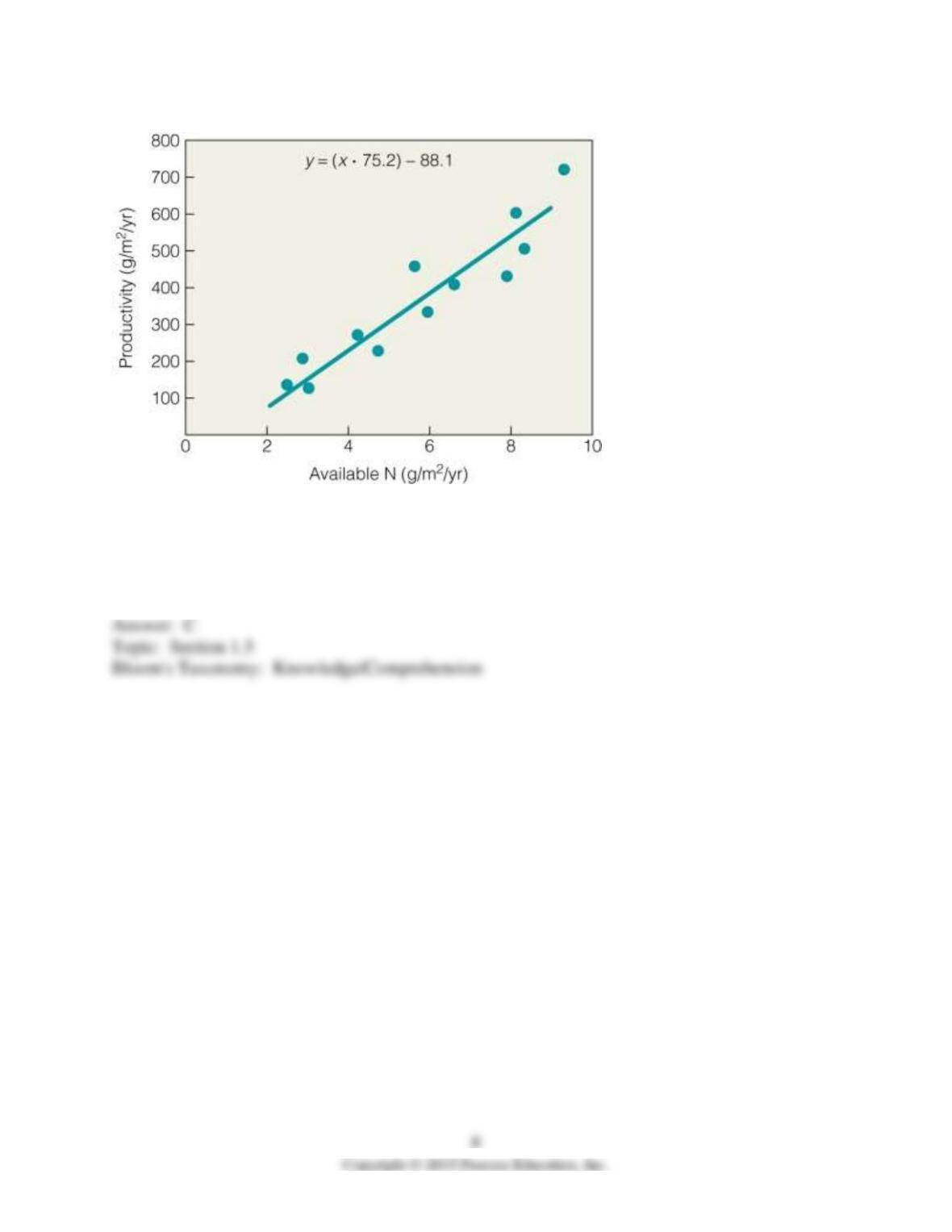
23)
In Figure 1.8, Available N is the
A) dependent variable.
B) model.
C) independent variable.
D) response variable.
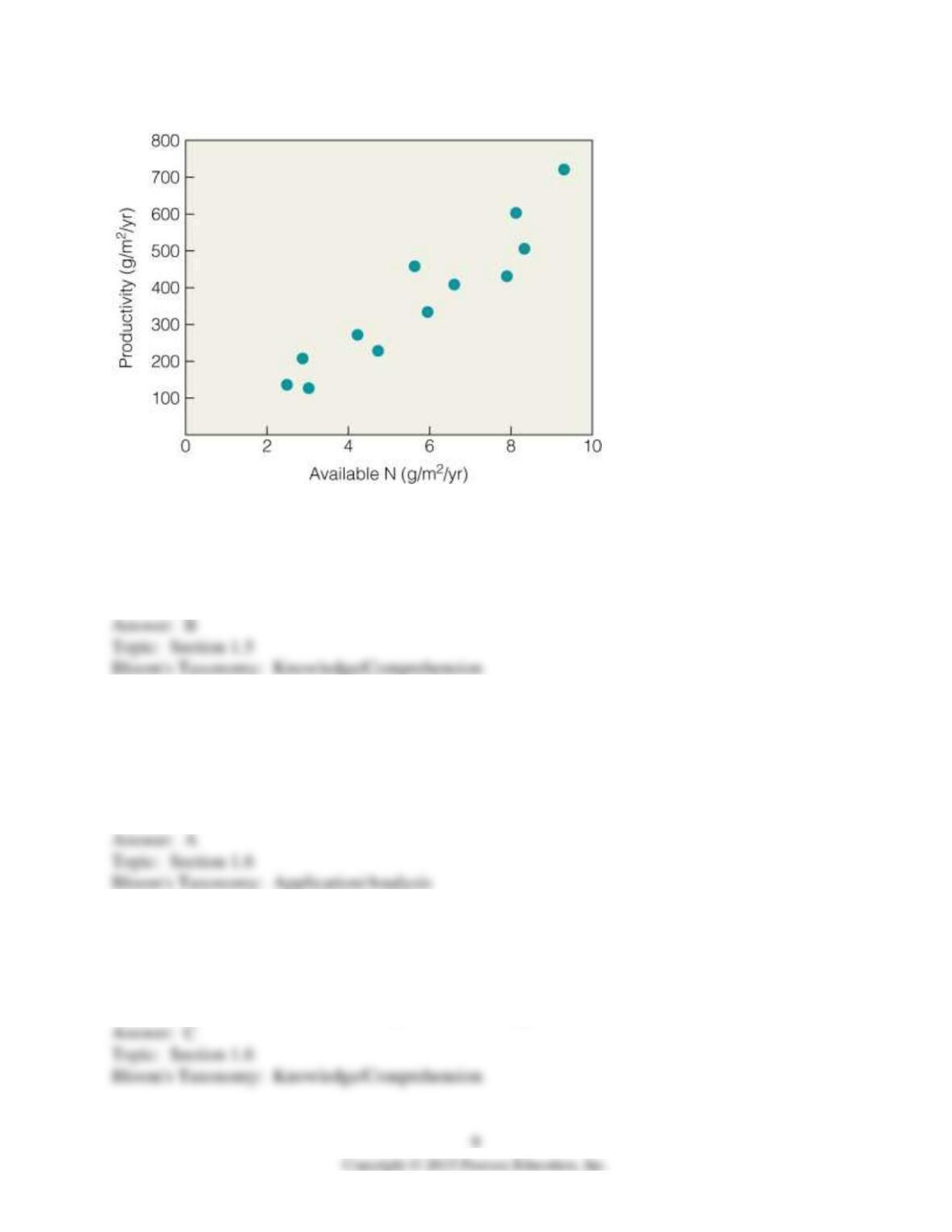
24)
Figure 1.5 represents which type of plot?
A) Random
B) Scatter
C) Linear
D) Factorial
25) Which model would you use to examine the relationship between nitrogen concentration and
plant growth?
A) linear regression
B) species area curve
C) intermediate disturbance
D) Hamilton’s rule
26) A model is used by ecologists to
A) prove how nature works by demonstrating cause-and-effect relationships.
B) analyze data that have been collected during an experiment.
C) make predictions about how nature works using a set of explicit assumptions.
D) observe how nature works in an experimental setting.

27) The real goal of hypothesis testing is to
A) eliminate incorrect ideas.
B) form a theory.
C) fully explain observations.
D) understand why science never changes.
28) Science can best be described as
A) a search for the ultimate truth.
B) a search for evidence that proves our concepts wrong.
C) proving facts.
D) a complete lack of dissent amongst ideas to obtain the truth.
29) Because ecology relies on many different branches of science (e.g., geology), it is considered
A) hypothetical.
B) unscientific.
C) permanent.
D) interdisciplinary.
30) Why is ecology considered an interdisciplinary science?
A) It involves a large expanse of various species.
B) It involves and draws from various fields of science such as geology, hydrology, and
meteorology.
C) It encompasses the field of environmental science.
D) It includes the study of human population growth.
31) The basic unit in ecology is the
A) ecosystem.
B) gene.
C) individual.
D) species.

32) The basic unit of ecology is the individual because it
A) is the basis for ecosystems.
B) is the unit on which natural selection acts.
C) cannot be further reduced to smaller parts.
D) passes genetic information to successive individuals.
33) An ecologist measured the length and weight of different individuals of a species of bird.
The most common method of graphically displaying the data is a
A) frequency distribution.
B) histogram.
C) pie chart.
D) scatter plot.
34) If x and y have a positive relationship as shown by a scatter plot, then the value of y will
A) increase as the value of x decreases.
B) increase as the value of x increases.
C) decrease as the value of x increases.
D) stay the same as the value of x decreases.
35) Which economist influenced Darwin’s conception of natural selection?
A) Charles Elton
B) Gregor Mendel
C) Thomas Malthus
D) Frederic Clements

1.3 True/False Questions
1) Ecology is the same as environmentalism.
2) A community includes both living and nonliving components.
3) Microbes are considered an abiotic factor within an ecosystem.
4) A population refers to all the individuals of the same species that occupy a given area.
5) A freshwater pond ecosystem includes only the living organisms within the pond.
6) The number of seeds produced by a single flower affects the birthrate of that population of
flowers.
7) A valid scientific hypothesis must be testable.
8) A theory is an integrated set of hypotheses that explains a broad set of observations.

13
9) A field experiment gives the investigator much more control over the environmental
conditions than does a laboratory experiment.
10) Ecological models can be mathematical or they can be verbally descriptive.
11) Science is a process of testing and correcting concepts in order to explain the world around
us.
12) There is generally only one valid explanation for an observation.
1.4 Essay Questions
1) Explain the distinction between ecology and environmentalism.
2) Using a real example, illustrate how an organism can both respond to and modify the abiotic
conditions of its ecosystem.
3) Explain the distinction between an ecosystem and a biome.
4) Explain why ecology is inherently an interdisciplinary science. Give two examples of the ties
between ecology and other branches of science.
5) Describe a field experiment that you might use to test the hypothesis that water availability
affects plant growth. Suggest one set of possible results and the implications of those results for
the hypothesis.

14
6) Explain why it is difficult for ecologists to give definitive answers.
7) Explain why human population growth, biological diversity, sustainability, and global climate
change are considered crucial environmental problems facing humans.